PHASE V THE SUMMER CAMPAIGN IN THE YPRES SALIENT April—September 1917
Reading edition
At 1.30 p.m. on the day after our relief in the Cité St. Pierre we marched off to Lozinghem via Hersin, Barlin, Haillicourt, and Marles-les-Mines, a distance of about eleven miles. Lozinghem was quite a pleasant little village and the billets were good, but we only spent one night there, and the march was continued at 9 a.m. next morning to Ligny-les-Aires, which was also a good billeting area, and where we had five days in which to clean up.
At 9 a.m. on April 25 we marched to Delette, which was to be our training area. The billets were not too good for a rest area, but the ground available for training was suitable and extensive, and the country was charmingly fresh and open after the many months we had spent amongst the closely grouped mining villages and the ugly mine buildings of the Lens area.
In the morning the training was almost entirely devoted to open fighting with half an hour’s close-order drill thrown in, while the afternoons were devoted to physical training, bayonet fighting, and training in Lewis gun, bomb, and rifle bomb.
89Maj. C. P. Kingsland, from the 4th Territorial Reserve Battalion, who joined the Battalion when it came out of the Cité St. Pierre, was now commanding D Company, and Capt. H. L. Lewis, after his short stay with D Company, had returned to command C Company. Capt. H. S. Brown and Capt. W. G. Lock were commanding A and B Companies as before.
A good deal of football was played in the evenings. In the first round of the company competition, D Company beat A, and C Company beat B, both fairly easily. The final was played on May 5, and a most exciting game ended in a goalless draw. It was not possible to replay the match until the following September, when the two teams were very much altered by the ravages of the summer campaign, and C Company won by six goals to one.
On May 2 the Corps Commander, Lieut.-Gen. Sir Claude Jacobs, inspected the companies at training in the attack, and in the afternoon all officers of the Division went over to Corps Headquarters, where the Corps Commander shook hands with each one, and made a short speech, which gave us some inkling that we were in for a pretty warm summer.
On the same evening a battalion boxing competition was held. Excellent progress had been made by the competitors under the expert tuition of Pte. Bill Ladbury, of D Company, a former champion of England and holder of the Lonsdale belt. Ladbury himself gave a very clever sparring exhibition.
90On May 7 the first blankets and winter clothing were withdrawn from the men, and officers had orders to reduce their kit to the regulation 35 lbs., and were also issued with privates’ uniforms, so we had very little doubt left that there was going to be a war somewhere, and that we were going to be mixed up in it.
The last few days in this area were spent in practising trench-to-trench attacks, following a creeping barrage.
The weather was brilliantly fine during our rest, and on the whole it was very enjoyable. There can be no doubt that everyone left Delette feeling thoroughly fit and quite ready to face whatever the gods and the higher command, not to mention the Hun, had in store for us.
At 9 a.m. on May 10 we left Delette, and marched via Therouanne and Rebecq to Wittes, arriving there at 4.10 p.m. It was very hot, and a two and a half hours’ halt for dinners was made in the middle of the day. Next day we remained at Wittes, and the Divisional Commander, Maj.-Gen. J. E. Capper, C.B., inspected the Battalion, and made a speech, complimenting us on what we had done in the past, and saying that even greater things would be required of us in the future, finishing up with blood and hatred in his very best style. This was the last time that Gen. Capper inspected the Battalion, as within a few days he left the Division, which he loved so much, to take charge of the Tank Corps, and we lost a fine soldier and a great friend.
The next day we had a long and exhausting 91march in very hot weather via Steenbecque, Hazebrouck, and Steenvoorde to Beauvoorde in the Boeschepe area. We marched off at 5.30 a.m. and arrived in at about 7 p.m., after covering twenty-two miles. There was again a long midday halt for dinners.
At 10 a.m. on the 13th the march was continued via Poperinghe to Brandhoek. It was again very hot, and after arriving at 4.30 p.m., and getting into Dominion Camp, which had been taken over by the advanced party, we had to pack up again and move into Eerie Camp at 9.30 p.m. On that day, which was a Sunday, an advanced party of commanding officer, officers commanding companies, and others went by lorry from Beauvoorde to Ypres to reconnoitre the infantry barracks and ramparts which were to be taken over the next day. The party had a most appropriate welcome to the celebrated city; the barracks were heavily shelled with 5·9’s from very soon after their arrival for nearly two hours. At the end of that time the structure and appearance of the building had undergone considerable modifications, and the advanced party viewed without enthusiasm the prospect of spending a week there.
The next evening at 9.45 the Battalion marched out of camp and entrained at Brandhoek, proceeding by train to the asylum just short of Ypres and then going on, the companies to infantry barracks and Battalion Headquarters to the ramparts. Here we were in brigade reserve, relieving the 8th Battalion of the Yorks and 92Lancs Regiment. Maj. Whitty, with thirteen officers and 230 other ranks, remained behind in the transport lines, and moved on the 15th into Toronto Camp.
The Battalion spent six fairly peaceful days in Ypres. The city was frequently shelled, but little of it fell in the barracks. These were built almost square, with an open courtyard in the middle. The outside wall on the eastern and the inside wall on the western side were very badly damaged, but the northern and southern wings were in fairly good repair, and were the most occupied.
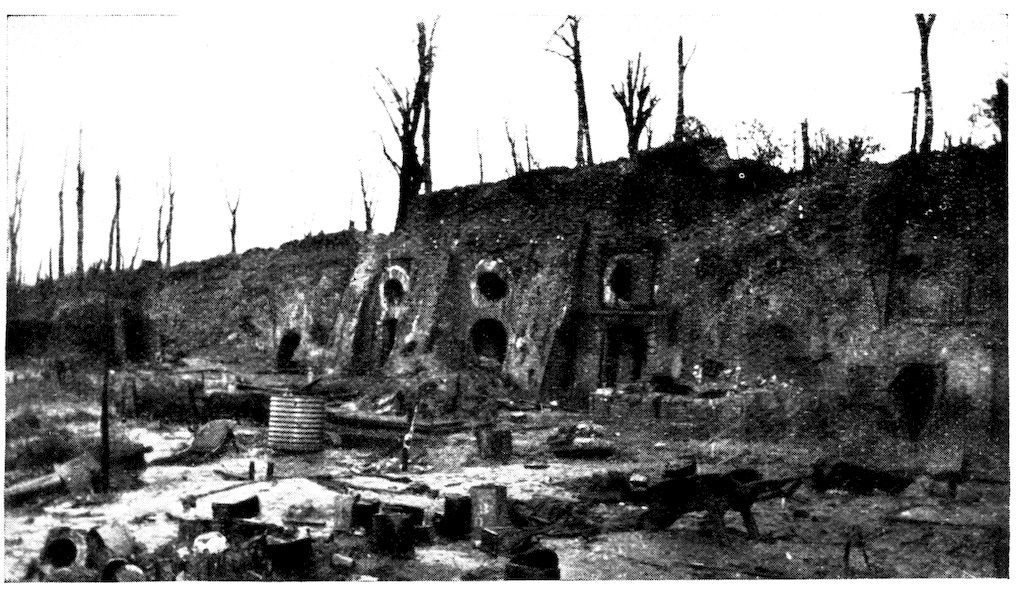
BATTALION HEADQUARTERS IN THE RAMPARTS AT YPRES.
On the evening of the 20th the Battalion marched out of the Lille Gate and proceeded to relieve the 8th Queen’s in the right subsection Hooge 1, the most easterly point in the Salient, three-quarters of a mile south of the village of Hooge. A, B, and C Companies were in the front line in that order from right to left, with D Company in support. The trenches lay in Sanctuary Wood, with right and centre companies on the southern slopes of Observatory Ridge, almost the only piece of high ground held by us in the Salient, and of further importance on account of the sap-heads of the extensive Canadian tunnelling system in Crab Crawl and Winnipeg Trenches. A Company and the right of B Company were holding Cross Trench, but further to the left it was too water-logged for occupation, and the rest of B Company and C Company held Vancouver Trench as the front line. C Company was in very low damp ground, but was a long way from the enemy, and escaped almost all the strafing which occurred on the right. D Company were on the reverse side of the ridge, with Fort Street as their battle position. The relief was a quiet one, and was complete by midnight.
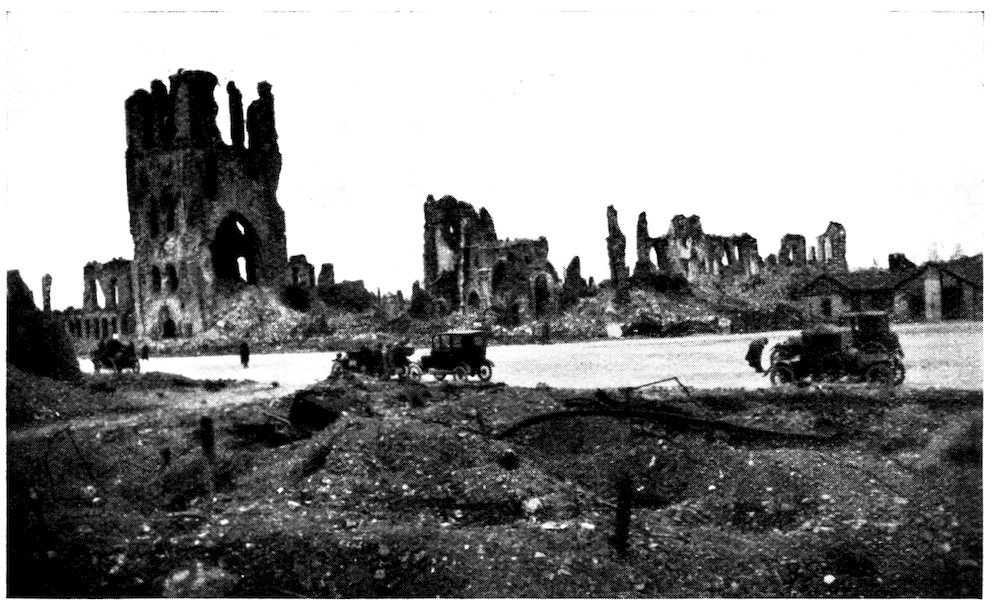
YPRES. The Square showing the Cloth Hall.
93On the 21st 2nd Lieut. Orchardson of D Company was wounded in the shoulder by a shell splinter, and both that day and the next there was a good deal of “minnying” on the two right companies. Throughout the morning of the 23rd the enemy carried out a Minnenwerfer strafe mainly on the right of D Company, and did considerable damage both in casualties and to the trenches. The right half of Vancouver Trench was obliterated, and Cross Trench was blown in badly near the junction with Crab Crawl, cutting off communication between the two. The B Company stretcher-bearers showed great gallantry in getting back the wounded from isolated portions of Cross and Vancouver Trenches across the open under heavy fire.
In the evening the Brigadier came up and ordered the repair of the trenches as quickly as possible; but even before he had left the trenches at 7 p.m. an exceptionally heavy bombardment was opened, affecting the right centre and support companies. The majority of A Company were able to get shelter in the Crab Crawl tunnel and B Company, with D, again came in for the worst of it. Crab Crawl, Winnipeg Trench, Vigo Street and Hill Street were immediately blocked, but Fort Street and the left of 94Winnipeg remained open, and D Company there filled the gap which was left in the front line. The B.G.C., who only escaped the bombardment by a few minutes, is reported to have said that there would not be a man left alive in the trenches. The high-explosive bombardment lasted for an hour, and was then followed by shrapnel, and all the companies stood to in expectation of an attack. Our artillery, however, was putting down a beautiful counter-barrage, which must have seriously disorganised any intended attack, and certainly in the gathering darkness and heavy smoke no assaulting troops were seen by our men. Next day some new stick bombs were found near the evacuated portion of Vancouver Trench, from which it would appear that a small portion of the enemy did succeed in trickling through that far.
The bombardment stopped at 8.55 p.m., but was renewed at 9.30, mostly on the support and communication trenches, until 11 p.m. One company of the support battalion, The Queens, was sent up in close support, and one company to the Zillebeke Dug-outs. Our casualties were seven killed and thirty-one wounded.
Our trenches were in a terrible state, and one hundred men of The Queens were sent up at once to assist us in digging them out.
The next evening D Company relieved B in the centre. Cross Trench was again occupied and communication with Crab Crawl restored. Vancouver was also occupied, except on the extreme right. To dig out this, a party of one 95hundred East Surreys were sent up, but they had considerable difficulty in retracing the line of the old trench. We were also hard at work all night, and a strong patrol from A Company, under 2nd Lieut. Griffith, was sent out to cover our working parties. The enemy, however, made no attempt to molest us, and had evidently suffered considerably himself, as he could be heard working all night.
On the night of the 26th/27th we were relieved by The Queens and returned, excepting A Company, who remained in close support in Wellington Crescent and Ritz Street, to the infantry barracks at Ypres without further casualties.
On the night of the 28th/29th we were relieved by the 2nd Bedfords, and proceeded by train from the siding near the asylum to Hopoutre, and from there we marched to camp near Wippenhoek. The area round the station and asylum was heavily shelled while we were entraining, and we had a most unpleasant finale to the tour. Lieut.-Col. Parker was slightly wounded, but remained at duty.
The Battalion arrived in camp in the early hours of the morning of May 29. The officers were quartered in some old and rather dilapidated huts and the men were under canvas which had been erected by the details at Transport Lines the day before.
That day was spent in cleaning up, kit inspection, and the posting to companies of a new draft of about seventy-five other ranks, which had joined the details a few days previously.
96For the next few days training was carried out as far as was possible. Time was also spent in preparing the equipment for “Fighting Order,” and collecting and practising with the various forms of ammunition, bombs, rifle grenades, flares, Lewis-gun drums, and other appurtenances of war which have to be hung on the person of a soldier about to enter into offensive operations.
All this time the guns were roaring away at their work of demolishing those celebrated defences, thought at one time to be almost impregnable, which protected the famous Messines-Wytschaete Ridge.
At about this time we lost two of our company commanders. Capt. Sir Henry Hawley, Bart., had served with the Battalion before it came overseas, and rejoined early in 1916. He succeeded Capt. T. P. P. Walker in command of C Company, and held this appointment with great success for some months. Capt. W. G. Lock joined D Company as a 2nd lieutenant, after the Battle of Loos, and succeeded Capt. C. F. Penton in command of the Company when the latter was wounded on the Somme. He was subsequently transferred to command B Company, and remained with them for eight months until he went down for a rest as a temporary instructor at a Musketry School; there he seems to have made himself indispensable, and he never came back. We were very sorry to lose them.
On the night 5th/6th the Battalion moved from the Wippenhoek Camp to N Camp, near Scottish lines at Busseboom, arriving in at 2.15 97a.m. on the 6th. There were great numbers of troops and transport on the road and progress was very slow. The next day was spent in camp, and the Battalion again moved forward at 11 p.m., and went into billets in the ruined houses and cellars at Dickebusch, which was reached at 2 a.m. This day, June 7, was the day of the great 2nd Army offensive, known as the Battle of Messines. The 24th Division was in Corps Reserve to the 10th Corps, which was the left of the three corps engaged in the attack. The 72nd Brigade had no definite rôle allotted to it for the battle, but was ready to move off at a moment’s notice if required to fulfil any of the duties which may be demanded of the reserve. The 17th and 73rd Brigades had objectives allotted to them, which they would be required to take in the event of the original attack proving a complete success. As it turned out, the attack was a success, and these two brigades moved up at about 3 o’clock in the afternoon, passed through the troops who had attacked in the morning, and successfully captured the final objectives with remarkably few casualties.
At about the time we reached Dickebusch the guns, which had been roaring so incessantly for many days past, seemed to grow strangely silent, and from half-past two onwards there was a hush which even the Boche must have felt boded him no good. This silence was broken as far as we were concerned just before 3 o’clock by the enemy himself, who began to shell the 98village with gas shells. Rumour had it that zero hour would be 3 o’clock, and when that hour came and nothing happened, many of those who had stayed out to see the mines go up and the opening of the barrage, went in to get a little rest. As a matter of fact, it was ten minutes later that great sheets of flame suddenly leaped from the earth, showing the positions of the nineteen great mines, the firing of which marked the opening of the second big offensive of 1917. Simultaneously thousands of guns opened along the whole of the nine miles’ frontage of the attack. It was a most impressive sight, and it is small wonder that the enemy’s front lines offered very little resistance to our attack. It is no exaggeration to say that not a blade of grass was showing anywhere over which that barrage had passed.
Our own part in this great battle was destined to be a passive one. So successful was the attack, following almost to the minute the exact time-table prepared for it, that the reserve was not called upon. Throughout the day prisoners and walking wounded came streaming down the track, which passed close to the village, the former looking very dejected and the latter equally elated. From these we learnt that everything was going well, and that our casualties were not very great, and those mainly slightly wounded.
At 1 p.m. we left our billets and marched up to trenches known as G.H.Q. 2nd line, just east of Café Belge, on the Voormezeele-Vlamertinghe 99road. Headquarters, A, B, and C Companies were in the neighbourhood of a large dug-out which was well supplied with sleeping accommodation, but which was so damp as to floor, walls, and ceiling, and smelt so foully, that the majority preferred sleeping under the open heavens close by. The disadvantage to this was a battery of particularly noisy 60-pounders firing directly over our heads from a distance of about 200 yards away. Those who have tried it will know that 60-pounders, even at a distance of half a mile, are not conducive to sleep. D Company found themselves some disused gun-pits on the other side of the road, and occupied them. Late in the evening and on the next day there was some shelling of the area round Café Belge, but though several shells fell in the actual field in which we were, they did not cause us any casualties.
At 9 p.m. on the 9th we marched up to the Brigade Reserve positions of the Mount Sorrel Section, relieving the 9th K.O.Y.L.I. and the 10th N.F.’s of the 23rd Division. A and B Companies were in Railway Dug-outs, and further forward Headquarters were in Rudkin House, and C and D Companies in Maple and Stafford Trenches, between those two noted spots, Maple Copse and Armagh Wood. The night was fairly quiet, but just after midday on the 10th the enemy shelled Stafford Trench heavily from the north-east, getting it in enfilade and giving the garrison a most unpleasant time. There were several casualties, including 2nd Lieut. R. N. 100Killick, D.C.M., of C Company, who was badly wounded in the chest, and about six men of D Company, who were buried and were suffering badly with shell-shock when dug out. That night the Battalion relieved the 11th Sherwood Foresters in the left subsection of the Mount Sorrel section. The journey up was a most unpleasant one. Either the Boche was attacking or thought that we were, as our front line and all communication trenches and approaches were plastered heavily for some time just as the Battalion was half-way up for the relief. The companies were absolutely caught, and for some time could neither move forward nor find any cover where they were. However, things quietened down, and the relief was eventually over by 2.30 a.m. This sector was the extreme left of the front of the attack on the 7th. D Company on the right in the “Triangle” and C Company in the centre were in the old Boche trenches, while A Company on the left was holding G Sap, which ran across what had been No Man’s Land, and our own front line at Hedge Street. B Company were in support in Canada Street Tunnels. Headquarters were in Hedge Street Tunnel, a fairly extensive underground system, in which was also quartered a company of the 9th East Surreys in close support.
The trenches were, of course, in a very bad state indeed, particularly on the front over which the barrage had passed. The trenches there were almost obliterated, and, except in a few places, offered practically no cover.
101At about the zero hour of our big attack on the morning of the 7th the enemy had made a determined raid on the left of our front, supported by heavy artillery and trench-mortar fire, which had caused considerable damage to these trenches. It also accounted for a very large number of dead Huns lying about the neighbourhood, and as they were now four days old and the weather was hot, they were not the most attractive feature of the locality. All these bodies had, of course, to be buried, an unpleasant job, and one which took a lot of labour which might very profitably have been spent on improving the trenches. G Sap, which connected C and A Companies, was only fully dug for half of its length on the A Company side, and this had to be continued, a task which was shared by A Company and the company of East Surreys in close support. Considerable improvement was made in all the company areas during our stay, but it would be idle to pretend that they were anything approaching good even when we left. Work was not easy on account of the frequency of the shelling on our whole front, which not only interfered with the work in progress, but also was continually causing further damage to the trenches.
One of the worst features of this sector was the difficulty of communication with the back areas. The communication trenches were very badly knocked about, and offered little cover either for safety or from view, and both they and overland ways of approach were frequently 102shelled, especially throughout the hours of darkness. This made the evacuation of wounded a very difficult matter; even when the party was not being shelled, its progress was very slow on account of the state of the ground. The ration parties also had very nasty journeys to and from Valley Cottages, where the rations were dumped. Valley Cottages itself was no paradise, and the journey also included such notoriously evil spots as Armagh Wood, Stafford Trench, and Rudkin House. The transport had no enviable task in bringing up the rations, the back areas coming in for a lot of attention by the Hun.
Most of the shelling on this front came from the north-east, and got our trenches absolutely in enfilade. During the day it was spasmodic; at times it would be quite quiet, and then a sudden burst of artillery fire would create a small hell for some minutes. But it was in the evening and early part of the night that the shelling rose to a crescendo. The enemy was extraordinarily jumpy; he seemed to expect us to continue our offensive, and was in the habit of putting up his S.O.S. at the least provocation, with the result that our guns, seeing his barrage and suspecting a counter-attack, would join in the disturbance, which would probably last about half an hour before both sides eased off gradually.
L.-Cpl. J. C. Bolton and Pte. J. H. Wheeler greatly distinguished themselves during this tour in maintaining communications under heavy fire, and both were awarded the Military Medal, and Coy.-Sergt.-Maj. F. Greenaway and L.-Cpl. 103S. Browne of A Company also did very gallant work, and won the D.C.M. and the M.M. respectively.
On the night of the 13th/14th we were relieved by the 8th Queen’s, and took over the support positions from the 9th East Surreys. There was some shelling during the relief, but on the whole the early part of the night was rather quieter than usual. The positions occupied were Headquarters in Hedge Street Tunnel, C Company in Canada Street Tunnel in close support to the 9th East Surreys, who were in the line on the right, and the other companies in the Fosse Wood and Stafford and Observatory Trench areas.
The four days spent in support were certainly no rest. The shelling of Rudkin House, Stafford Trench, and Fosse Wood was very severe. On the second day A Company evacuated Rudkin House as, although it appeared fairly deep and had considerable accommodation, it was really by no means safe, and the place had become a regular shell-trap. The next occupants, the North Staffords, lost several men buried by shell-fire in similar tunnels on the other side of the trench.
On the evening of the 17th we returned to the left subsection, Mount Sorrel Section, relieving the 8th Queen’s, and were if anything rather glad of the change. The companies were disposed exactly as in the previous tour. Although we were only in the line two days this tour, it was quite sufficient. Soon after the 104completion of the relief at about 2 a.m. the enemy strafed very severely, mostly on the right company’s front. D Company had a very bad time, and lost eight men, killed, including Pte. Bill Ladbury, the champion boxer, and three wounded. The rest of that day, the 18th, was very similar to the previous tour in the line, with intermittent shelling during the day, becoming heavier towards evening.
One of the features of both this and the former tour in the Hedge Street trenches was the activity of the enemy with low-flying aeroplanes over our lines. Our own aircraft had been very much in evidence actually at the time of the battle, and it was very seldom that a Hun plane was seen, but later he had things very much more his own way. He always appeared twice a day, at dawn and just before dusk, and flew so low that we used to say that he came in the morning to count the men in our trenches and again in the evening to see that no one had left.
The next day was fairly quiet during the morning, but in the afternoon the two left companies got badly shelled, and 2nd Lieut. G. H. Griffith, of A Company, and 2nd Lieut. S. A. French, of C Company, were wounded, in addition to other casualties. Things calmed down again in the evening, and we had hopes of a quiet relief, but our hopes were not to be fulfilled. Though in the forward areas it remained fairly quiet in the early part of the night, the ominous sound of crumping could be heard further in rear, and we realised that the 105relieving battalion, the 1st Royal Fusiliers, were having a nasty journey up. The relief was expected quite by 11 p.m., but midnight and 1 o’clock arrived without its appearance, and we began to wonder if we should get out at all that night, as it would be dawn at a very early hour, and a relief in daylight in this sector would have been most unwise. However, just as we were beginning to reckon up what supply of water and rations we had for an extra day in the line, the relief turned up, and we were able to get out just in time. Probably no one will forget that journey out of the line. There seemed to be shells everywhere. The mention of the names of the two main routes will probably bring back tender memories to many. The more northerly way was from Hedge Street down Davidson Street, past Sanctuary Dump and Stafford Trench, along the southern and western edges of Maple Copse, down Zillebeke Street to Hell-blast Corner, in Zillebeke along the Promenade on the southern bank of the Zillebeke Lake to Transport Farm and the railway dug-outs, and then down the side of the railway to Shrapnel Corner. The other route was from Davidson Street down Observatory Trench to Fosse Wood and Junction Trench, and along Fosse Way past Battersea Farm and Manor Farm to Transport Farm, and then as before. It did not matter which way you chose; the advocates of each were loud in their claims that their route was the worse. It was only too evident that some of the units going up for the relief had suffered 106very heavily. One very gallant company-sergeant-major, to whom apparently the particular sensation was new, was heard murmuring on the way out: “My God, what an awful thing it is to have the wind up.”
Mic Mac Camp, for which we were bound, was a camp partly of huts and partly of canvas, situated between Ouderdom and Dickebusch, and some seven miles or more from the line, and when the Battalion dragged itself in there between 5 and 7 o’clock the next morning it was pretty well fagged out. The whole Brigade was here out of the line in Divisional Reserve. Four fairly restful days were spent in camp, during which the new Divisional Commander, Maj.-Gen. L. J. Bols, C.B., D.S.O., who was subsequently Chief of Staff to Sir E. Allenby in Palestine, inspected the Battalion.
The neighbourhood of the camp was sometimes shelled by a long-distance 9·5-inch gun. The shell made an unpleasant roar on arrival, likely to create alarm and despondency to those within some hundreds of yards, but never did us any real damage. Night bombing by enemy aircraft was incessant. The droning of enemy aeroplanes more or less directly over one’s head throughout the hours of darkness on every night in which flying was possible—and at this time of the year that was nearly every night—was most unsettling, and robbed us of rest which was badly needed.
After four days at Mic Mac, on June 23, we moved up to Dickebusch, where we were in reserve 107to the rest of the Brigade, which had taken over the right subsection from the 73rd Brigade. The camp, which was of tents, situated to the east of the village near the brewery at Vyjverhoek, was known as the Brewery Camp. We spent three days in this camp, and except for the first night were not seriously molested, although the usual night bombing continued.
The camp was on the side of the Dickebusch-Café Belge road, along which there was a fairly deep dry ditch, and in this ditch the companies had been ordered to take cover in the event of shelling, and we had, during the first night, plenty of practice in moving from the camp to the ditch. Every hour from 11 p.m. until 3 a.m. the Hun dropped shells from a smallish high-velocity gun with considerable rapidity into the camp for about five minutes, just long enough in fact to get everyone thoroughly disturbed and all but the most bold into the ditch.
On the evening of the 26th we went up to relieve the 8th Queen’s in the left subsection of the Battle Wood Section. It was a very wet day, but otherwise the relief was not particularly bad. The three companies in the line from the right were B, C, and A, with D Company in support. The line, which ran just on the eastern outskirts of Battle Wood, was held by means of short isolated lengths of trench garrisoned by either one platoon or two sections. Some of these trenches were freshly dug in the open, while others were parts of old Boche trenches repaired and 108fire-stepped for our own use. By day there was no communication between the forward posts, which were in the open clear of the wood, but as the enemy posts were fairly close to them, they escaped most of the shelling. The support platoons of the front line companies and the support company came in for far more shelling. The supports of A and C Companies on the left were in a ravine, along which the Boche had built some concrete pill-boxes. The two Company Headquarters shared one of these, named by the Boche Haus Barbara. The name conjured up visions of a charming little villa built in a wood, with beautiful green foliage and the birds singing in the trees, and perhaps a stream flowing lazily by. In fact, the villa was chiefly remarkable for a choice collection of fleas. The wood was in a very dilapidated state, and few of the trees stood more than ten feet high. The stream consisted of rainwater trickling from one shell-hole to another. “Ah,” you ask, “but were the birds there, and did they sing?” We are afraid that we cannot answer that question from memory, but we have it on the authority of one of our most eminent “Special Correspondents at the Front,” that during one of the big battles the birds not only continued to sing, but chose the neighbourhood of the front line as a suitable place in which to do so; and in view of this incontestable (and doubtless first-hand) information, we are prepared to admit that it is possible that the birds did sing. Being truthful, however, we are compelled to admit that the only singing 109that impressed itself on our memory was that of the shells.
Haus Barbara had a direct hit with a 5·9 on the afternoon of the second day in, and stood the test well; a bit of concrete was chipped out of the face, and the occupants were mostly shaken on to the floor, while the inside was filled with dust and black smoke, but no one was hurt.
There were no communication trenches left in existence, and the tracks used, which in some places were in full view of the enemy, got badly strafed, while Battalion Headquarters in a pill-box in the wood also came in for a lot of attention, and Cpl. Littleproud, claimed to be the best officers’ mess cook in the Division, was badly wounded in the leg. The Signallers also had a bad time, the telephone lines forward to the companies were continually being cut, and the linesmen had to spend a great deal of time on their dangerous job in most exposed positions. Among others, L.-Cpl. Bolton, an invaluable linesman with many months’ fine service to his credit, was killed.
On the night 28th/29th the A Company post, held by 2nd Lieut. B. Wade and No. 2 Platoon, was raided by the enemy, who bombed it rather severely, but failed to enter the post, and were driven off by bombs and rifle fire with only one casualty to us. He, strange to say, was hit full pitch by a bomb which luckily did not explode. Lieut. Wade handled the situation with his unfailing resource and cheerfulness.
110On June 27 part of the transport was sent off by road to the Lumbres rest area, while another portion followed by train on the 29th, and only such horses and vehicles as were necessary for the relief were kept back.
On the night 29th/30th we were relieved by the 8th Yorkshire Regiment, and we returned direct to Mic Mac Camp. The relief was complete at about 1 a.m., and although the prospect of our walk back had filled us with some thought, it turned out to be a comparatively peaceful night, and was probably the most quiet relief we ever had up in the Ypres area.
The casualties for the month were 23 other ranks killed and 3 officers and 53 other ranks wounded, and when one considers the number of shells and other forms of death which abounded, it is wonderful that the number was not much greater.
We got to Mic Mac Camp at 5 or 6 o’clock in the morning, and had a few hours to get a little rest and to get cleaned up. At 11.45 we marched in pouring rain to Reninghelst to entrain for Lumbres, whence we marched to Senningham, arriving in our billets at about 8 p.m.
Senningham was a pleasant little village, situated just south of the main St. Omer-Boulogne road and about three miles from Lumbres. The billets were not particularly good, but were considerably improved when we were able to procure some fresh straw for the floors. The first day or two were spent in cleaning up and kit inspections, and then training was started, chief 111attention being given to the prospect of future offensive operations. The ground in this neighbourhood was mostly covered with standing crops, and was not very suitable for training. Quite a good short rifle-range was made against the steep hill which sloped up to the main road, and rifles and Lewis guns could be heard cracking away there all day long.
Saturday, July 7, was a half holiday, and the Divisional Horse Show was held. The Battalion distinguished itself by taking the 1st Prize for travelling kitchens, C Company’s cooker being the selected representative, while Diana, the C Company’s charger, took 1st Prize for Infantry Officers’ chargers.
The following Friday was observed as a whole holiday and Battalion Sports were held, organised by Maj. Whitty. One of the features was the officers’ race of 100 yards, with handicap of 1 yard for each year of age over 21. Col. Parker and Lieut. Wood, the Quartermaster, who were on the forward marks, carried off the honours to the delight of everyone present. The tug-of-war was secured by C Company, and the most prominent in other events were Ptes. French, Lloyd, and Wells. The Transport supplied two most amusing events in the mule race and wrestling on mules.
The latter portion of the stay at Senningham was devoted to preparation for the next offensive, including the studying of a large model made by the Royal Engineers of the area in which the Division was to operate. The frontage of the 11272nd Brigade was between the Mount Sorrel and Battle Wood Sectors, which we had just left.
At a very early hour on July 17, our stay at Senningham terminated, the Battalion marching away at 3.45 a.m. via Lumbres and Arques to Renescure, a distance of about fifteen miles. Packs were carried by motor lorry, and as the hottest part of the day was avoided by the early start, the march was not very exhausting. The billets at Renescure were excellent, and we could have done with a longer stay there.
The next day we left Renescure at 4.35 a.m., and marched via Staple and Hondeghem to Le Briarde, a shortish march of about eight miles. The next day we again had a short march to the area about Eecke and Steenvoorde, and an advanced party was sent on to prepare a camp near Reninghelst. At 5.5 a.m. on the 20th the march was continued, via Godewaersvelde and Boeschepe, to the Reninghelst area, where the camp consisted of a not too plentiful supply of bivouacs. On the 21st a further move was made at 7.30 a.m., via Ouderdom, to our old friend Mic Mac Camp.
On the evening of the next day we moved up and relieved the 10th West Riding Regiment of the 23rd Division in Brigade Reserve. Battalion Headquarters were in Larch Wood Tunnels, A Company in Battersea Farm, B Company in “the Dump,” and C and D Companies in shelters at Scottish Wood.
On the 24th we relieved the 9th East Surreys on the 72nd Brigade battle front in Image 113Crescent, with A and B Companies in the front line, C with Battalion Headquarters in Immovable Support, and D Company in reserve in Metropolitan Left. There was some gas shelling on the way up and during the next day. Mustard gas, which was at this time a fairly new form of frightfulness, was used plentifully in this area, but, thanks to good gas discipline, we were very free from casualties. One distinguished officer in the Brigade had the misfortune to sit down on ground contaminated with the stuff, with disastrous results.
The front line, which was, of course, an old Boche trench captured at the Battle of Messines, was still in very bad condition and was in places only three feet deep. There were a few old Boche concrete pill-boxes along it, but otherwise not much cover. It was in a small wood at the top of the eastern slope of the ridge, and afforded very good observation over the enemy country to the immediate front.
Our artillery preparation for the coming attack was steadily going on, and the enemy’s guns were by no means silent, so that it was not very pleasant in or near the line. Knowing as he did that we were shortly going to attack, the enemy put down a protective barrage every morning from about half an hour before dawn until just after daylight, increasing it in intensity day by day as he grew more and more apprehensive. The quietest part of the day was from the cessation of the dawn hate until about 10 a.m., and then for the rest of the day the 114majority of the shelling would be searching for battery positions in rear, and the forward areas would be comparatively quiet until nightfall. Time was mostly spent in digging out and improving the assembly trenches, and in carrying up barrage rations and ammunition and bombs for forward dumps.
At 5.30 p.m. on the 26th a practice barrage was carried out by our artillery, and under cover of this 2nd Lieut. E. G. Brown, M.C., with eight men of B Company, carried out a raid on Job’s Post, a strong point in a concrete pill-box between our line and the enemy’s. The raid was a complete success, twelve men being captured, and 2nd Lieut. Brown was most deservedly awarded a bar to his Military Cross. An additional four Boches gave themselves up to B Company during the night. Cpl. G. Simmonds and Pte. R. T. Roper distinguished themselves in this raid, and won the Military Medal.
We had the misfortune on this day to lose 2nd Lieut. Wade, of A Company, with shell-shock. He was a very valuable officer under all conditions, and more especially so when things were most unpleasant, and the loss of his unfailing cheeriness was a great blow to his company.
On the night 27th/28th C Company relieved A Company in the front line, and the following night D Company relieved B. On the 28th we lost Maj. G. W. F. Powell, C Company, attached from 2nd/1st Kent Cyclist Battalion, who was killed by shell-fire after being with the Battalion only two months.
115On July 28, during the enemy retaliation, a shell exploded at the entrance to a dug-out occupied by A Company, blowing a box of ignited hand grenades into the dug-out and wounding eleven of the twenty occupants. One bomb with the fuse burning fell amongst a group of men, and Pte. G. Neal, a young soldier (himself wounded), with the greatest courage and presence of mind picked up the bomb, carried it to the entrance of the dug-out, and threw it over the parapet, where it immediately exploded. Pte. Neal, whose gallant conduct undoubtedly saved the lives of many of his comrades, was awarded the Distinguished Conduct Medal, and was the first private soldier in the Battalion to earn that distinction.
At 4.20 a.m. on the 29th the enemy, seemingly looking upon it as a danger after his recent experience, blew up Job’s Post. 2nd Lieut. Tanner took out a patrol in broad daylight, and in a very exposed position, to investigate what had happened, and showed great gallantry in getting back, under heavy fire, a man who was wounded in the open some way from our trench, and he was subsequently awarded a bar to his Military Cross. Sergt. E. Turner rendered great assistance, and was awarded the Military Medal.
That night the attacking battalions moved up to their assembly positions, C Company being relieved in the front line by the 1st North Staffords and D Company by the 8th Queens. The shelling was very severe all night, and relief was not complete until after daylight. All four 116companies were now concentrated in the Brigade support assembly positions north of the railway cutting, near Hill 60, in Immovable Trench and Immovable Support, the old enemy front and support trenches.
A Warning Order had been received that if the attack was a great success, the Battalion would be required to carry on the attack on the Brigade frontage, and capture the enemy positions to a depth of about 1,500 yards, and hold a line just east of Kent Farm.
On the 30th movement by day was restricted as much as possible, and work was concentrated on improving the existing dug-outs in our area. 2nd Lieuts. Proctor and Tanner, with the D Company carrying party, which was to accompany the attack, carried up the Stokes mortar ammunition to the assembly trench, where, as it happened, some of it was destroyed by enemy shell-fire during the night. In the early hours of the next morning, which was the day of the attack, the D and C Companies carrying parties moved up to their assembly positions, being all in at 3.10 a.m. The C Company party, under 2nd Lieut. L. P. Y. Smith, got badly strafed on the way up, but had no casualties. Heavy rain set in, and the going became very difficult and considerably interfered with the attack. Zero hour was at 3.50 a.m., and at that time the guide from the Stokes mortars, who was to take the carrying party, had not put in an appearance, and after waiting some time 2nd Lieut. Tanner went up, located the trench-mortar positions, 117and returned to take the carrying party up to the guns. 2nd Lieut. Smith was wounded, and there were casualties to about five other ranks.
The attacking battalions had very severe casualties, and a large party of D Company, under Coy.-Sergt.-Maj. Mitchell, who was awarded the Distinguished Conduct Medal, did fine work in helping to evacuate the wounded under heavy shell-fire. This work was carried on in most exposed ground on the forward slope of the ridge between Image Crescent and Jehovah Trench, the new front line. The wounded had been lying out there in pouring rain for many hours, and this rain, combined with the terribly ploughed up state of the ground, made the carrying of stretchers very difficult. Col. Parker afterwards received from the Commanding Officer of the Queens a letter containing his thanks for our great assistance in evacuating his wounded and for the unfailing regularity with which we had delivered his battalion’s rations throughout the tour under circumstances which demanded the very greatest determination and devotion to duty. The doctor and his orderlies, assisted by Cpl. Andrews of A Company, also did very fine work.
On August 1 B Company moved out from Immovable Support into Metropolitan Trench to make room for the reserve company of the East Surreys, who relieved the Queens and the North Staffs in the front line. On the 3rd our Brigade frontage was extended to take over a large portion from the 73rd Brigade, and A 118Company relieved the 13th Middlesex in Jeer Trench in Shrewsbury Forest. The front line here was fairly comfortable, and was well supplied with concrete dug-outs, but the journey up to or down from it through Shrewsbury Forest was absolute hell. Battalion Headquarters and D Company were in Canada Street Tunnels, which were in a state of appalling filth and horribly hot and overcrowded. C Company were in the old enemy front and support lines on Mount Sorrel, and B Company still in Metropolitan Trench. The weather continued bad until the 5th, then there was a slight improvement. On that day, after a heavy strafe, the enemy raided the East Surreys on our right, and came under heavy rifle and Lewis-gun fire from A Company. We were very sorry to hear that Col. de la Fontaine, the gallant Commanding Officer of the East Surreys, was killed in this affair.
During this tour Cpl. C. Andrews collected, dressed, and evacuated six wounded men of other units, who had been lying unattended in front of the line for three days.
The same night at 11 o’clock, just as D Company were starting out to relieve A, the enemy commenced a very heavy bombardment of the area, and caught D Company in the open. They had a very nasty time getting up to the front line, and had several casualties.
The 6th and 7th were fairly quiet days to what had gone before, and on the night 7th/8th we were relieved by the 17th Brigade, the 8th Buffs taking over the front line. The relief was none 119too pleasant, as the enemy shelled heavily, but eventually the whole Battalion was relieved by 4.30 a.m., and made its way out to Kruisstraathoek, where motor-buses were available for completing the journey to Mic Mac Camp. The tour had lasted seventeen days, and included a battle, with its attendant heavy shelling and exhausting demands for work and carrying, as well as some of the worst weather that has ever been experienced in mid-summer, and it is little wonder that the Battalion arrived in camp in a thoroughly exhausted condition.
We spent four days at Mic Mac cleaning up and resting. These were, on the whole, quite uneventful, except for enemy aerial activity at night. The continual droning of enemy aircraft all night and every night, mixed with three short blasts on the whistle at frequent intervals by the sentry and shouts of “Put that —— light out,” and the sound of bursting bombs at varying distances, was our unkind fate. Drafts of 170 other ranks, which had arrived during the tour, were posted to companies.
On the 10th Maj. Whitty went into hospital with trench fever, and a few days later Capt. H. J. Wenyon, who had been attached to the staff since February, returned from Division to take over the duties of 2nd-in-Command.
The Division had now only one brigade in the line, one brigade in support at Dickebusch, and the third in reserve at Mic Mac Camp, tours being of four days’ duration. On the 11th we moved up to support in H Camp at Dickebusch, where 120the accommodation in tents was rather crowded. Life there was very similar to that at Mic Mac, not a great deal of work was done, and night bombing was the rule rather than the exception. An additional diversion was offered when the enemy carried out shoots on the captive balloons in the neighbourhood, during which our camp was in quite as much danger as the balloons.
Just about 200 yards behind the camp there was a 9·2 naval gun on a railway mounting, which used to shoot at the enemy railhead at Roulers and at his billets in the back areas. Its rate of fire was usually only four or five rounds an hour, so that quite a small shoot kept the neighbourhood awake for an unpleasantly long time.
On the afternoon of the 15th the enemy carried out a most alarming daylight air-raid with six bombing machines on the siding between the camp and Café Belge. There were extensive horse lines all round, and the casualties to men and horses were severe. The place was a horrible sight just afterwards.
That evening we went back into the line, taking over from the 7th Northants the right subsection, Shrewsbury Forest, which was the original 72nd Brigade battle front. B Company went into the front line in Jehovah Trench, or rather in isolated posts in shell holes about fifty yards forward of where the trench had been, as in many places it was barely distinguishable. The weather was still very bad, and the whole area, which was absolutely churned up by shell-fire, was no better than a collection of little lakes, 121and shell-hole life was by no means a pleasure. However, the enemy was some way away, and did not trouble us with trench mortars and only very little with machine guns, and all the shelling was directed further back. C Company were in support in Image Crescent and Image Reserve. Battalion Headquarters was in a pill-box in the wood just north of the Zwarteleen-Klein Zillebeke road, and A and D Companies were in Immovable Support and Immovable Trench respectively. All these areas came in for a fair amount of shelling at different times, but the worst places were really further back in the battery positions, and such places as Larch Wood and Jackson’s Dump; really in the line things were very much quieter this tour than they had been since our arrival up north in May.
On the 16th there was an attack by the 5th Army just north of us. The artillery on our front was all engaged in the barrage, but we did not come in for any of the counter-strafe.
On the next night C Company relieved B, two days being quite sufficient in the front line posts in this appalling weather.
On the evening of the 19th we were relieved by the 3rd Rifle Brigade and returned to Mic Mac. The early portion of the journey out was fairly quiet, but there was some nasty shelling by 8-inch howitzers in the neighbourhood of Lock 8 and for some little way further back.
The four days spent at Mic Mac were very similar to our previous visits, and on the 23rd we again went up to Camp H at Dickebusch. A 122large draft of officers arrived at about this time, bringing the numbers up to seven a company.
There was in close proximity to our own somewhat crowded camp of tents a most beautiful little camp made of very attractive huts, absolutely new and clean. This camp was labelled “Reserved for Corps Cavalry only.” Now, it seemed a pity that the Corps Cavalry, who had not for months seen a vestige of a battle, and had been living in places of much greater comfort than the P.B.I., should have such a beautiful place reserved for them, when they were not even there to use it, and two Company Headquarters consequently decided to appropriate one of these huts for a joint mess. Shortly after dinner a senior officer entered and asked, somewhat peremptorily, “What are these lights doing here?” The answer came back pat from a most distinguished subaltern in the far corner of the hut, in the one word, “Burning.”
At 5 p.m. on the next day we were suddenly moved from our camp to Château Segard in support of the 14th Division, who were reported to be in difficulties in Inverness Copse. It was said to be quite likely that we should be sent up to counter-attack, as the situation was “obscure.” There was absolutely no accommodation available at all, and we had to make such bivouacs as we could with waterproof sheets and any R.E. material which was lying about. The next morning we returned to H Camp, as the situation had been cleared up without our assistance. That afternoon there was another big 123air-raid on the siding near the Brewery, and we know of at least one officer having a bath there at the time who very nearly left the building hurriedly in most unconventional attire.
On the 27th we returned to the old trenches, A Company being in the front line for the first two days, and D Company for the second. There was some heavy shelling on the way up in response to an S.O.S. on our left, but we were lucky in escaping casualties. The tour was very similar to the previous one, except that on the second day the weather at last really cleared after being at its worst for exactly a month, and that on the night 29th/30th 2nd Lieut. Carville, of D Company, collected a couple of Boches out of a shell-hole in front of our line of posts.
From Jehovah Trench it was by no means a pleasant journey back to Battalion Headquarters, as the way led up a steep slope for about 660 yards to Image Crescent, without a communication trench, in full view of the enemy, and with the ground so pitted with water-logged shell-holes that progress was bound to be very slow. One afternoon, after a perfectly quiet and uneventful day, in which there was absolutely nothing to put in the intelligence report, which was then due, the Company Commander in the front line decided, in order to save a runner the journey back with the report, to send it over the telephone by B.A.B. Code. This consisted of groups of figures representing sentences in general use. For instance, the sentence, “Our rum has not yet arrived,” might be represented 124by the figures 528, and “Please expedite” by 172. The only difficulty was that there was sometimes a difference of opinion as to how to make the correction. In this particular case the message selected by the Company Commander was “Situation normal,” which was duly dispatched to Battalion Headquarters. A few minutes later the Company Commander was rung up on the telephone by the Battalion Intelligence Officer. He gathered that his message had caused considerable alarm and despondency at Battalion Headquarters. He was able to reassure them until the report could be sent down by hand, and he then discovered that the message as deciphered at Battalion Headquarters read: “Tanks are approaching,” which had not unnaturally caused a considerable stir, and the Commanding Officer was already on his way up to Image Crescent, armed with field glasses, to investigate.
On the 31st we were relieved by the 8th Buffs, and returned to Mic Mac.
On the 30th Maj. Whitty returned from hospital, and a couple of days later Col. Parker went down, after being in very indifferent health for some time. Maj. Whitty took over command of the Battalion, and Capt. Wenyon remained as 2nd-in-Command.
Four days were spent at Mic Mac, and four at Dickebusch as before. The weather was very much better, and night bombing very active. On the 5th Lieut. G. Bullen, who was commanding B Company, left to join the R.F.C., and Lieut. 125E. G. Brown, M.C., took over command of the Company.
While at Dickebusch company commanders and others went up to reconnoitre what was to be our new front for the next tour, to wit, Inverness Copse. We had heard quite enough about Inverness Copse for some time past to make the prospect by no means alluring, in fact that celebrated spot, together with Glencorse Wood, figured almost daily in the communiqués as either attacked or counter-attacked, and more often than not the situation there was described as “obscure.”
The way up passed a succession of places whose names will never be forgotten. First Ypres and the Main Square, then out through the famous Menin Gate and along the Menin road, past the Ecole on the right and the White Château on the left, the way led to Hellfire Corner and Birr cross-roads, Outpost Farm, the Culvert, and finally through what had been Hooge village. A journey up that long stretch of the Menin road was not undertaken without considerable fear and trembling, but we know of one company commander who went to reconnoitre the line held by the 2nd Leinsters, and who, after visiting each of the four company headquarters and battalion headquarters, and receiving typical Irish hospitality in the shape of a four by two (i.e. four inches of whisky and two inches of water) at each, came down the Menin road quite pleased with himself.
The relief took place on the morning of the 1267th in broad daylight, and we have probably got the fact that it was rather misty to thank for the forbearance of the enemy in letting the whole Battalion march up the Menin road by platoons at intervals of 200 yards, almost without a shell. The Menin road was so heavily and persistently shelled by night, that to relieve by daylight and risk being seen was considered preferable to using it at night.
B, C, and D Companies took over the front line in that order from the right, B and C being south of the Menin road and D north of it. South of the road the main line of defence was New Cut—an incomplete trench which ran across Jasper Avenue and Jasper Lane to the Menin road, where work was in hand to connect it with the trenches north of the road. Forward of this there was a line of posts just inside the near edge of the copse, along the line of the old trench which connected Jasper Lane and Jasper Avenue. In the centre, C Company’s posts were in communication along this trench, but the B Company’s posts were isolated, the trench in the copse and that end of Jasper Avenue being both impassable. On the left D Company had a fairly normal trench system.
Battalion Headquarters were in a dug-out near Clapham Junction, and A Company in support were quartered in the long tunnel which ran under the Menin road. For the first two days things were fairly quiet, except for periodical shelling of the Stirling Castle neighbourhood, which was sufficiently near to B Company’s 127Headquarters and supports to be uncomfortable, and also of the entrances to the Menin Tunnel, which was apt to prove disconcerting to A Company.
At 4 a.m., about dawn, on the 9th, the enemy opened a very heavy barrage on our lines to a depth of several hundred yards, including Battalion Headquarters and the entrances to the Menin Road Tunnel. Under cover of this they attacked our advanced posts in the Copse with great determination, using specially picked and trained “Sturmtruppen” with Flammenwerfer. The barrage behind this line of posts and on the support line totally isolated them, and even at the tunnel of the support company the barrage was so severe that it was impossible to get a man out with a chance of reaching his destination.
On the right the attack was completely repulsed with Lewis-gun and rifle fire, assisted by our artillery barrage, with very heavy casualties to the enemy. This was largely due on the B Company front to the magnificent example and coolness of 2nd Lieut. A. B. Richardson, who was there in command, and the excellent behaviour of the men under him, and the right post of C Company, under Lieut. H. R. James, also put up a splendid performance. The repulse of the attack after a bombardment which might easily have proved demoralising to any but the stoutest troops, and under Flammenwerfer with which we had had no previous experience, and to face which is known to require a very high degree of 128courage, was a performance of which the B and C Company troops concerned had every reason to be proud.
The only post entered was that on the left of C Company, which consisted of a large concrete pill-box and the trench in its vicinity held by 2nd Lieut. H. W. Beattie and his platoon. The enemy were able to approach very close to this post under cover of the undergrowth and fallen trees, and although the platoon put up a stout resistance, the enemy got in and succeeded in capturing fifteen men, many of whom had been wounded in the preliminary bombardment. 2nd Lieut. Beattie succeeded in escaping, shooting two of the enemy with his revolver.
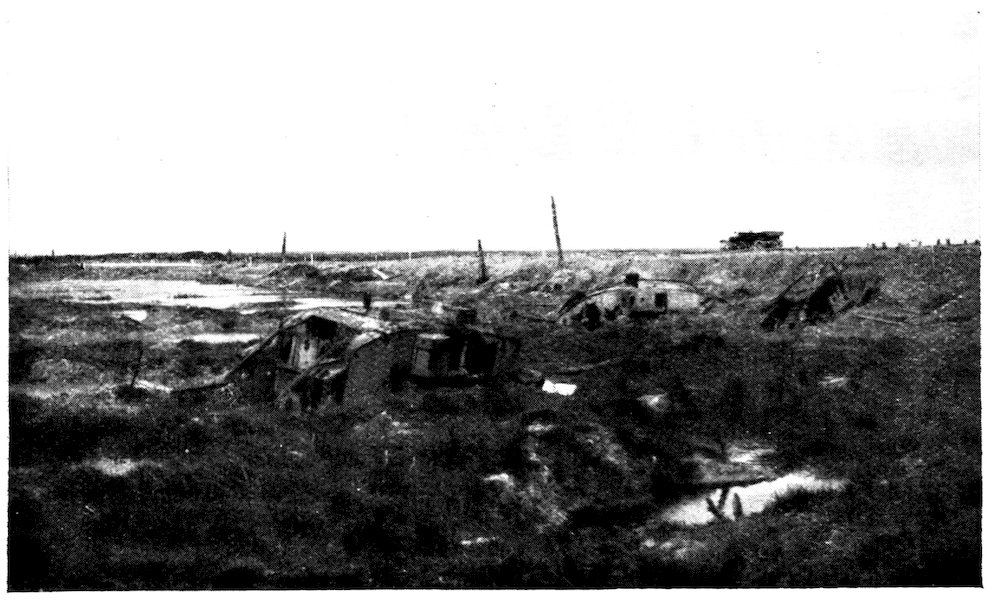
THE MENIN ROAD AT HOOGE.
Immediately the news of the loss of the post reached Battalion Headquarters, Maj. Whitty gave instructions to Capt. Wenyon to go up and restore the situation. No. 2 Platoon of A Company was sent up to assist, and bombs and rifle grenades were rushed forward. Capt. Wenyon very quickly grasped the situation, and his preparations for counter-attack were rapidly made. The plan was of the simplest, and was consequently brilliantly successful. The attack was carried out by C Company, with two parties under 2nd Lieuts. Pfeuffar and Beattie, working from different directions, the covering fire being supplied by bombs, rifle grenades, and Lewis-gun fire at very close range. L.-Cpl. Cook, with the Lewis-gun section of No. 2 Platoon, worked his way to a very exposed position, within twenty-five yards of the pill-box, at considerable risk, and was able to pour in a murderous fire which greatly assisted the attack. The fire of this Lewis gun, added to the very accurate rifle-grenade barrage, kept the heads of the enemy very much down, and enabled 2nd Lieut. Pfeuffar to lead his party right across the front of the dug-out and to launch his attack from the unexpected flank.
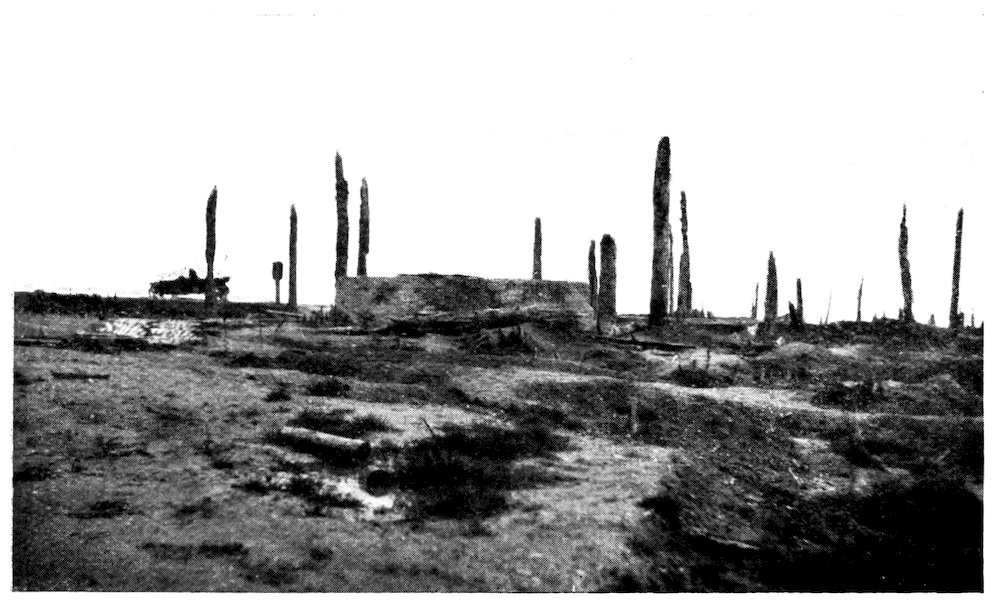
INVERNESS COPSE. Showing the concrete Pill Box recaptured on September 9, and the Menin Road
129The attack, with 2nd Lieut. Pfeuffar and Sergt. Purfield very much to the fore throughout, was a great success, and resulted in the complete re-establishment of the line and the capture of fifteen prisoners, one machine gun, and one light trench mortar, while in addition the enemy casualties both in the attack and counter-attack were known to be heavy, and several of their dead were left in and around the post. The Lewis guns of D Company on the north side of the road did great execution and were very valuable. After the attack L.-Cpl. Cook worked his way with his Lewis-gun team along the embanked Menin road, 100 yards in front of our positions, and covered the work of consolidation.
The success of the counter-attack clearly demonstrated the value of immediate action being taken by the troops on the spot, based on a bold but simple plan, and supported solely by the infantry weapons, thereby saving the time required in making elaborate arrangements for artillery support, which the enemy would gain for consolidating and organising his defences. Capt. Wenyon was to be heartily congratulated on the result.
The following decorations were awarded for 130this action: Capt. H. J. Wenyon, acting 2nd-in-Command, D.S.O.; 2nd Lieuts. K. Pfeuffar and H. W. Beattie, C Company, M.C.; and Sergt. Purfield, C Company, and L.-Cpl. Cook, A Company, the D.C.M.
2nd Lieut. H. C. Walton, of D Company, was killed in the bombardment, and Lieut. W. R. C. Hodge, also of D Company, was severely wounded. The casualties to other ranks during the day included twelve men killed.
While we were there the enemy made no further attempt to clear us from our footing in Inverness Copse, and the rest of that day and the next were as quiet as could be expected in such a very volcanic neighbourhood. On September 11 we were relieved in daylight by the 1st Battalion Royal Fusiliers, and we returned to Mic Mac without undue molestation by the Hun.
It turned out that we were about to shake the mud of Flanders from our feet for the last time, and it was with mixed feelings that we learnt of our impending departure for pastures new. It may surprise many of those who read the foregoing account of our stay up north to hear that there could be anything but joy at the prospect of departure. They read of shells and mud, of battles, gas, and air-raids, with particular emphasis on shells and mud, and it must be admitted that the dominant sensation on getting our orders for the move was one of joy—and yet somehow the life up there was not all bad. In spite of night bombing and long-range shelling there was something quite restful about Mic 131Mac Camp and those camps at Dickebusch, and the good fellowship throughout the Battalion seemed to increase in the mud of those Ypres trenches. If the tours in the forward area were bad, the arrangement of reliefs was such that, at least for the two final months, we got more time out of the line than ever before or since, and so we were leaving evils which we knew for evils which we knew not, and there was at least a possibility that the last state might be worse than the first.
In the early morning of September 14 we got into motor-buses and lorries which took us to Merris, a very nice farming village six miles south-west of Bailleul. The billets, which were scattered about the various farms, covered an extended area. It was good to be out again in fresh country unspoiled by shell-holes, and the place had an air of rest and peace which was very pleasant. It is sad to think now of the state to which this area was reduced by the fighting of 1918.
First we set to work cleaning up, and then training was started, but not too strenuously. Some football was played, and a very good match between the officers of the Battalion and Brigade Headquarters ended in a draw, one of the features of the match being the goalkeeping of Gen. Sweny. A great rugby match was also played, the only one we remember in France in our Brigade, in which The Queen’s Own and Brigade Headquarters beat The Queens, East Surreys, and North Staffords by one goal and one try (eight points) to nil.
132On the 18th Maj. Whitty went on leave, and Capt. Wenyon took over temporary command. The Battalion was inspected on that day by Maj.-Gen. A. C. Daly, the new Divisional Commander, who succeeded Maj.-Gen. L. J. Bols, C.B., D.S.O., when the latter left to join Gen. Allenby in Palestine as Chief of the General Staff. Gen. Daly remained in command of the Division until it was disbanded in 1919. Capt. T. P. P. Walker here rejoined the Battalion, and resumed the command of C Company.
We finally left the area on September 21, when we marched out of Merris at 5.30 a.m. and entrained at Caestre, which we left about midday. B Company had gone to Caestre the day previous, and had been engaged in entraining the transport for the whole Brigade.
And so we left the Salient for the last time. There were few square inches of mud there from the Menin road southwards with which the Battalion had not been closely associated, either in the autumn and winter of 1915–16 or in the summer of 1917, and our experience had always been of fighting and shelling and mud, never of the more peaceful periods which were known in its history; and as our train moved out of the station at Caestre, we thought of the many good comrades who remained behind sleeping beneath the wooden crosses in Flanders’ fields, which marked the places where the Battalion so dear to us all had fought and won; and we were proud that it was ours to hold high the torch which their hands had thrown to us.
THE YPRES SALIENT
[Click on map for high resolution image.]
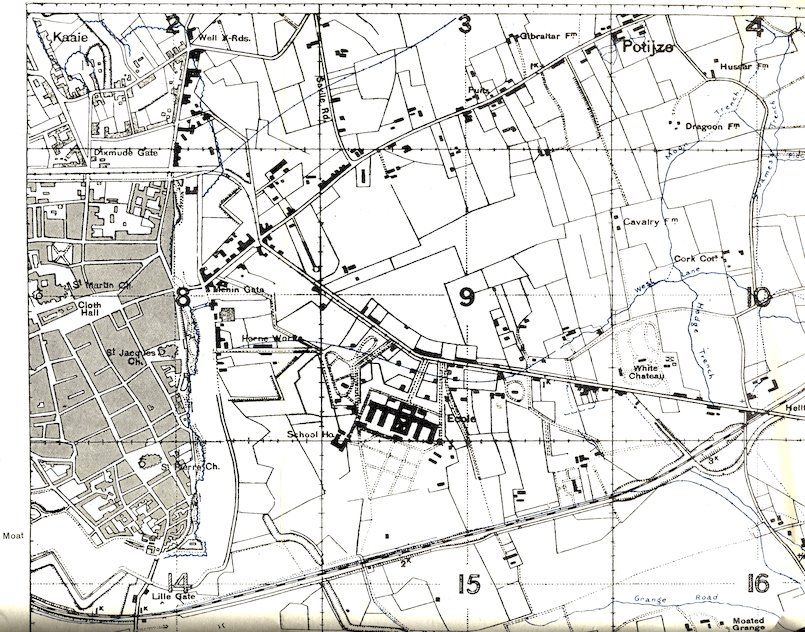
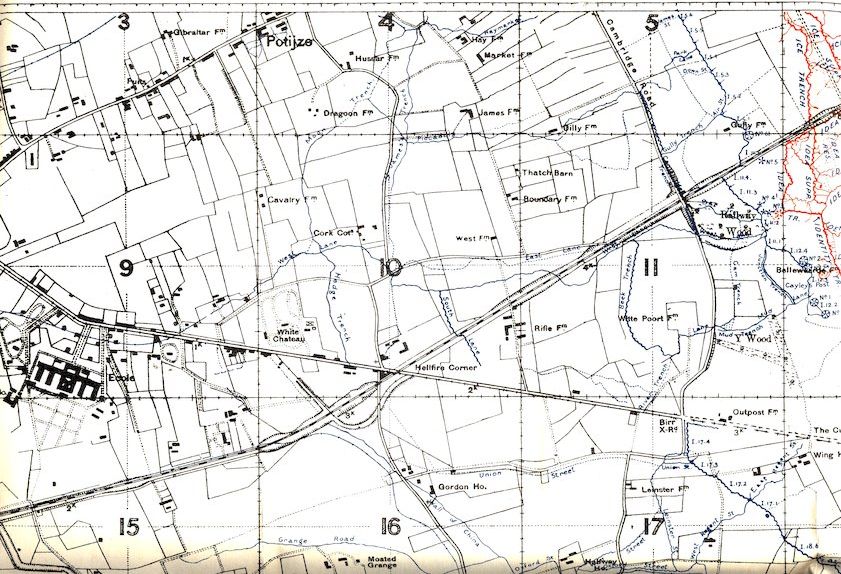
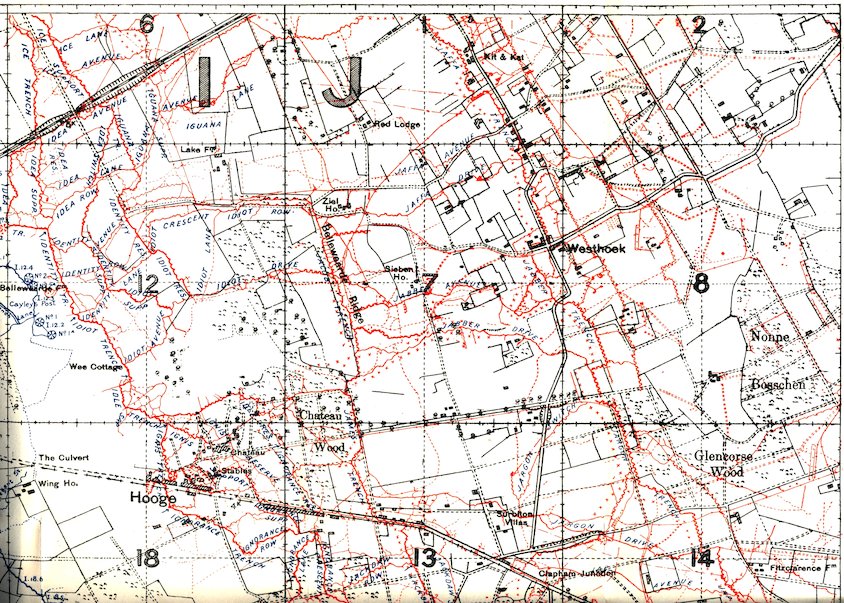
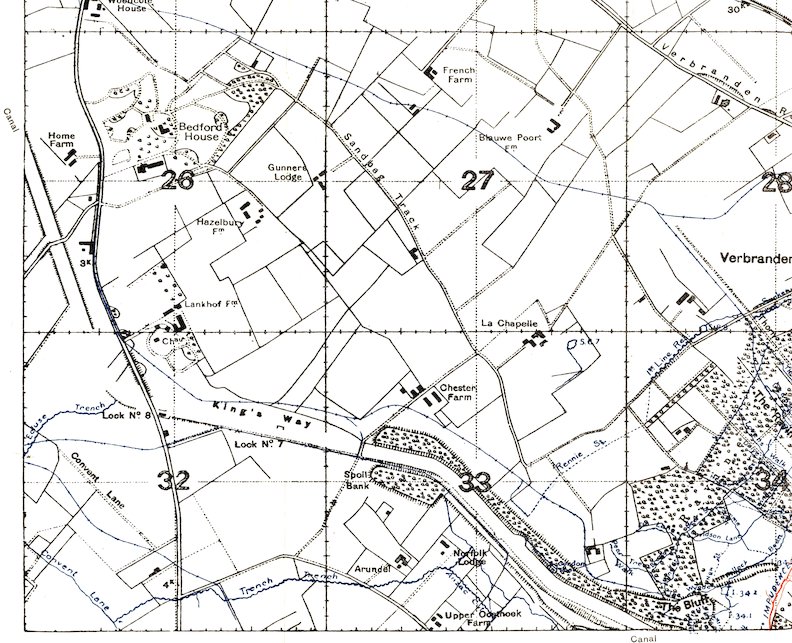
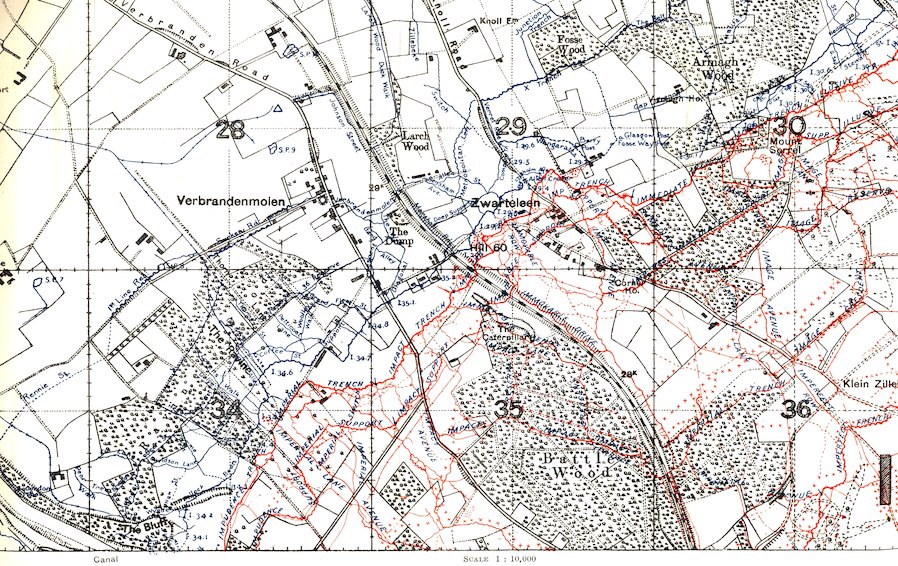
To illustrate Phases II and V.
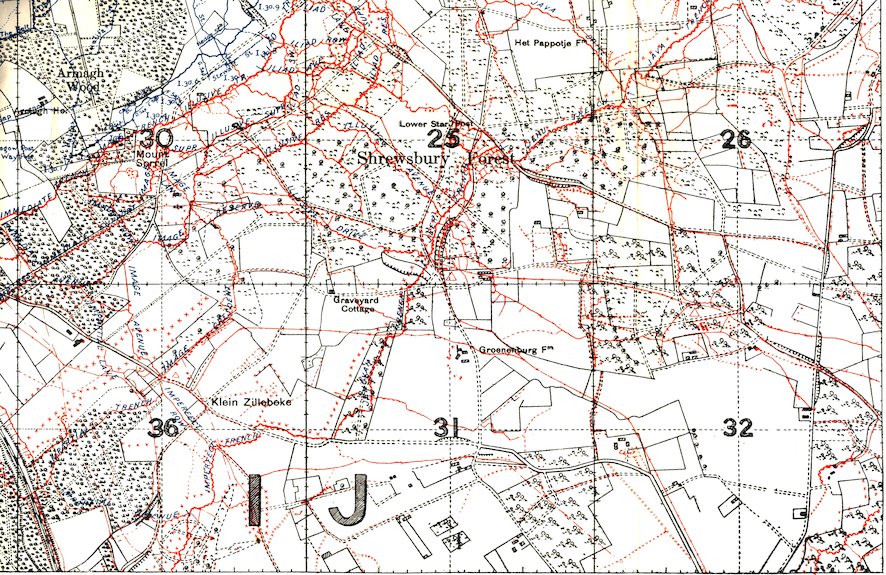
[Reproduced by permission of the Geographical Section, General Staff.
133