PHASE IV TRENCH WARFARE AT VIMY RIDGE, HULLUCH, AND MAROC—THE ADVANCE ON LENS September 1916–April 1917
Reading edition
Our stay at Vauchelles was pleasant, but short. The billets were all quite good, and Battalion Headquarters occupied sumptuous quarters at the château of the Baron de Rocquigny. Reorganisation was taken in hand.
The commands were as follows:
Commanding Officer, Maj. N. I. Whitty; A/Adjutant, Lieut. H. S. Brown, vice Lieut. and Adjutant S. J. F. Mills, who broke his ankle as the result of a fall from his horse.
Company Commanders: A Company, Capt. H. J. Wenyon; B Company, 2nd Lieut. E. G. Brown; C Company, Lieut. Sir H. C. W. Hawley; D Company, 2nd Lieut. W. G. Lock.
On September 19 we entrained at Abbeville under orders to move to the 1st Army Area. After a four days’ halt at Sains-les-Pernes, where training and reorganisation were continued strenuously, a further move was made to Haillicourt, near Bruay, for a couple of days before the Battalion arrived in the new area behind the Vimy Ridge and went into Divisional Reserve at Gouy-Servins on the 26th. The 62civilians were inclined to be hostile here, and we were not very comfortable. The Battalion was billeted in the château, which was in a very dilapidated condition. On October 2 we moved up to the front line in the right subsection (Berthonval Section), and spent an uneventful spell of eight days there. The Hun did a certain amount of trench mortaring, but after the Somme these trenches were really a peaceful home from home. The communication trenches were in very fair condition, but the front line was not so good. A, C, and D Companies were in the front line, with B in support.
On October 10 the Battalion went back into support in Zouave Valley, Coliseum, and Alhambra Trenches and Cabaret Rouge. Here the chief sports were working parties of all sorts, and rat-hunting. On the 18th we moved to Gouy-Servins again, and while there the officers gave the sergeants a good trouncing at football, and later played a very even game with the whole of the rest of the Battalion.
Orders were soon received for us to move up to the Hulluch Sector. On the 24th the Battalion marched to Mazingarbe, and on the 25th moved into the line opposite Hulluch, relieving the 14th Highland Light Infantry, a bantam battalion of the 40th Division.
Many tragic memories were here revived, for we were holding the very trenches over which the attack on Hulluch had been launched on September 26, 1915.
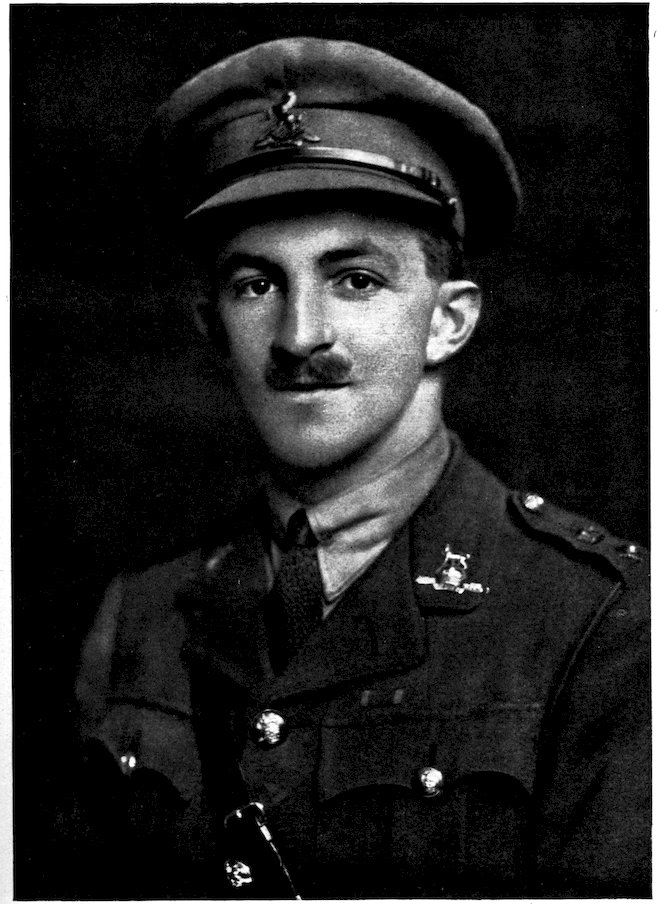
Photo by] [Swaine, London. LIEUT.-COL. N. I. WHITTY, D.S.O. Commanding the Battalion August 1916–January 1917 and October—December 1917.
The 72nd Brigade was on a two-battalion 63front, holding the left sector of the 24th Divisional front. We shared the right subsector with the 1st North Staffordshire Regiment. The trench system consisted of a front line running along the Lens-La Bassee road, a close support 40 yards in rear, a support line “Reserve Trench” 600 yards behind, and a reserve line “Tenth Avenue” for the Battalion in support about 1,000 yards behind “Reserve Trench.” The Battalion in Divisional Reserve was in billets at Philosophe. The forward trenches were fairly good except on the left, but they had been recently knocked about considerably, and one portion of the front line on the centre company front, which jutted out rather prominently into No Man’s Land, was practically extinct. A trench called New Cut was dug across later on to replace this. There was another very bad place 200 or 300 yards in length between the centre and left companies which was unoccupied. The communication trenches on our front, Posen Alley, Broadway, and Vendin Alley, were very poor.
We found the Hun was very out of hand on this front. On our right company front No Man’s Land was about 100 yards wide, and it increased to about 300 yards on the left company front. The enemy had a different treatment for each company. On the right, where the enemy held Posen Crater, a big chalk mound where a mine had been blown some time before, he had developed his light trench mortars, “Grenatenwerfer,” or “Pineapples,” to an extraordinary extent. On the centre company, 64where our trenches were bad, he used medium trench mortars, “Rum Jars,” very extensively, particularly on the roof of Company Headquarters. The left company used to be shelled a good deal, and medium trench mortars dropped there quite frequently as well. We went into the line in the early morning of October 25, A Company on the right, B Company in the centre, D Company on the left, and C Company in support in Reserve Trench. Battalion Headquarters were in dug-outs in Curzon Street, 500 yards behind Reserve Trench. During the day all was quiet, but as soon as it got dusk in the evening the fun began. On the right the Hun fairly let fly with his “Pineapples,” in the centre he began to drop “Rum Jars” with startling accuracy on the roof of Company Headquarters, and on the left he served up all kinds of stuff. We had very little means of retaliation, and something had to be done. By the second night we had arranged one or two artillery concentrations, which could be switched on to various parts of his trenches, and on the right we had got one or two rifle-grenade batteries in position for retaliation for his “Pineapples.” On this night 2nd Lieut. F. G. Yeo, who had just joined A Company, was killed by a “Pineapple,” and his platoon sergeant, Sergt. Champion, was badly wounded and died a few days after. For a fortnight a desperate duel for supremacy in these trenches went on. At first we could only manage to give him about two rifle grenades for each “Pineapple” he sent over, with a mild artillery 65strafe if things got very bad. But by the end of the fortnight he must have been getting twelve rifle grenades for every “Pineapple.” Also, our artillery liaison had been greatly improved. Officers who were with the Battalion at that time will remember the code words, “Air,” “Love,” “Hate,” “Fortnum,” and “Mason,” among those used to bring down fire and brimstone on the head of the Hun. The Stokes mortars were really being used as a mobile weapon. We made temporary emplacements all along the trench during the daytime with a few sandbags, and during the night 2nd Lieut. H. J. Dunn, with a party of men, used to carry a mortar along from emplacement to emplacement, firing off a couple of rounds as required here or there. The rifle-grenade batteries were manned all the time, but no firing took place until the friendly Boche saw fit to commence.
It was a most amusing fortnight. It would be difficult to say how many hundreds of rifle grenades and Stokes shells fell into the Hun trenches. One morning, when all was quiet, a company commander was looking at some old boxes of Mills bombs in the front line. In order to test them, he threw one over the parapet. It exploded all right—but the parties with the rifle-grenade batteries in the support line thought it was a “Pineapple” going off, and before you could say “knife” a hail of rifle grenades dropped into the unfortunate Posen Crater. By the end of the first week in November the Hun had given it best, and he was kept well in his place 66during the rest of our stay in this sector. We got on steadily with improving the trenches, and a lot of new wire was put up, and constant patrolling gave us the complete mastery of No Man’s Land. Normal tours up here were six days in the line, six days in support in Tenth Avenue—with rat hunts and working parties galore to keep us busy; six days in the line again, and then six days in reserve at Philosophe. We remained in the sector for nearly four months, and it was on the whole a very happy winter.
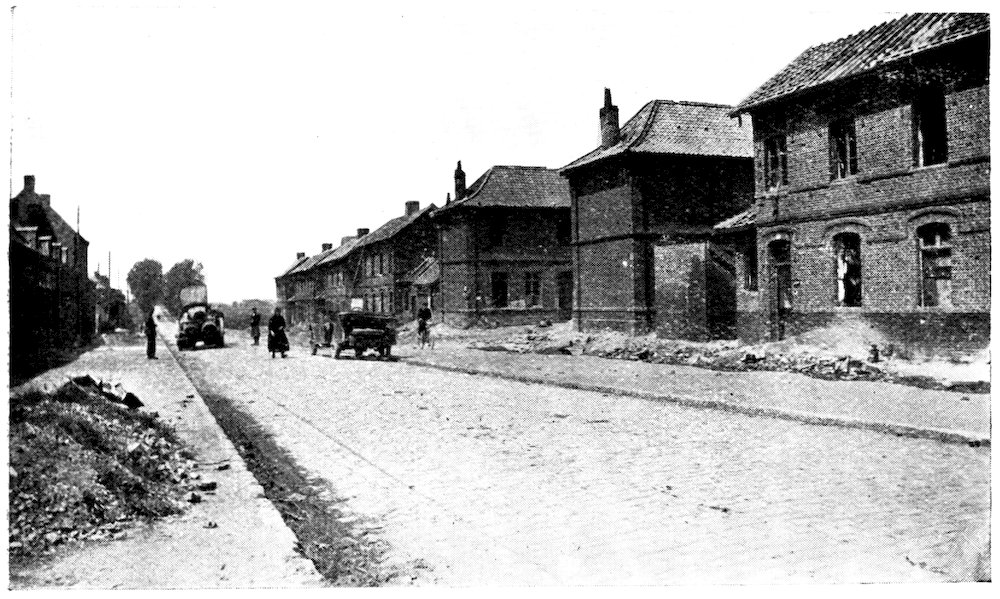
PHILOSOPHE VILLAGE. The billets of the Battalion in reserve.
During the greater part of this time A, B, and D Companies retained the right, centre, and left positions respectively, each one being relieved in turn by C Company when it was due for a tour in support. For the last two tours A and B Companies changed round in order to give B Company a rest from the centre sector, which had the reputation of being the most trench mortared. From the neighbourhood of Battalion Headquarters we had a very fine view of the whole of the enemy’s trench system and the country behind his line, and sniping with artillery became one of the principal amusements. It was great fun chasing groups or single Huns about behind their lines with whizz-bangs or sniping with a 60-pounder at the intrepid cyclist who rode into Hulluch regularly every afternoon, and the effort to knock down Wingles Tower was another constant sport for the heavier artillery. We got to know the gunners very well in these days. In addition to having the liaison officer actually with the Battalion, most of their observation posts were in the neighbourhood of our headquarters, and the F.O.O. usually dropped in to see us on his way up to ask if anyone wanted to do a shoot.
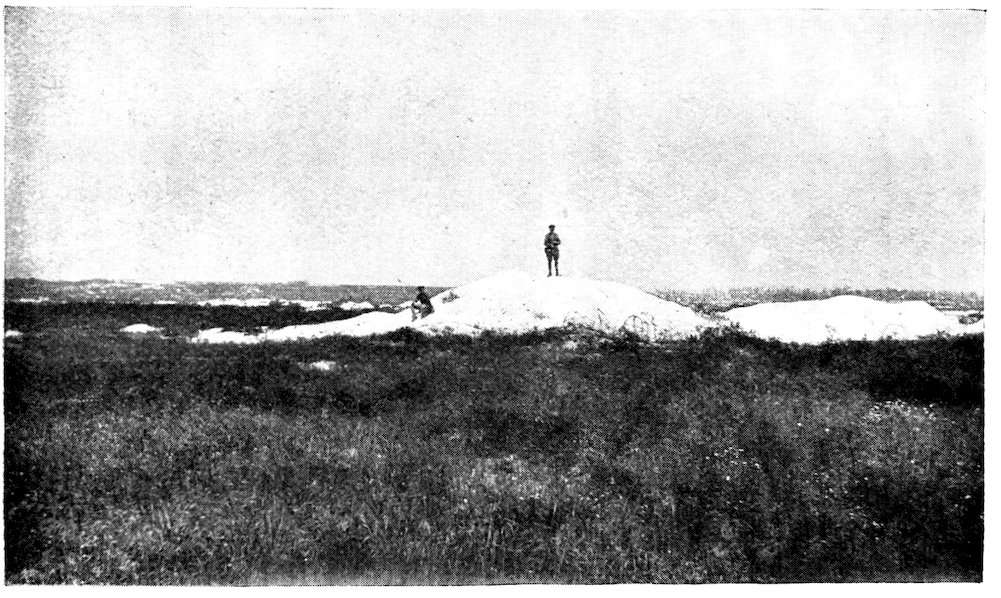
POSEN CRATER. In the enemy front line near Hulluch.
67We used to have good times at Philosophe for six days in twenty-four. It was just a one-street miners’ village, with the outer shells of most of the houses intact, but lacking such comforts as window-panes and furniture. Our first tour the billets were far from comfortable, but we and the other battalions in the Brigade made improvements every time we were there, and when we left the sector it was a very satisfactory rest area. There were still some very dirty civilians about, mostly those connected with the mines, and some of them did quite a good trade selling odds and ends to the troops at a very large profit. Bethune was only a few miles away, and was very popular. Shops and estaminets were open there almost as in normal times, and divisional cinemas or concert parties often gave their shows in the town. We sometimes got motor buses or lorries to take a proportion of the Battalion into Bethune or to an entertainment elsewhere, and several very successful Battalion concerts were held at Philosophe during the winter.
Just before Christmas a draft of 200 arrived to make up our losses on the Somme. Christmas Day was not very exciting. We moved into the line from Philosophe on the morning of December 24, but we had all the excitement we wanted that day, as the Boches elected to give us one of the worst strafes we ever had in this sector. 68Christmas was kept up during our next visit to Philosophe. Each company had one day set apart for it, on which the concert hall was at its disposal. The programme consisted of some form of sports or football in the morning, a colossal midday meal washed down with a plentiful supply of beer, and the afternoon divided up between the Divisional Band, a company concert, and a big tea. Everyone thoroughly enjoyed the Christmas of 1916, although it was celebrated in 1917.
From the beginning of January until a day or two before we left this sector, on February 12, the weather was very cold. There was some snow at the beginning of this long period, and the frost held so consistently that it was lying on the ground for over five weeks. All this time it was perfectly dry, and the trenches were in a far better state than at any other time during the winter. When we left the sector the thaw was just making itself felt, and we fear that our successors must have had a lot of trouble repairing the trenches, which were bound to collapse as the frost came out of them. During the latter days of January we were preparing a raid to be carried out by a party of C Company, under Lieut. H. L. Lewis and 2nd Lieut. K. Pfeuffar, but we were relieved before it could take place.
On January 20 Lieut.-Col. J. C. Parker returned after an absence of over four months, and resumed command of the Battalion.
Our last days at Hulluch were marked by raids and counter-raids, and a considerable increase 69in strafing all round. The 9th East Surreys captured a prisoner in a daylight raid on the left battalion front, and inflicted several other casualties on the enemy, but the 1st North Staffords had a bad time in attempting to enter the enemy trenches at night. The Hun was apparently sitting up waiting for them. The enemy made one or two attempts to raid our trenches in return without success, one of them being repulsed by the North Staffords, who captured half a dozen prisoners in addition to killing a number of the party.
On February 12 we were relieved by the 13th K.R.R.C. of the 37th Division, and moved out to rest at Busnettes, near Lillers, spending one night at Noeux-les-Mines on the way.
We were really sorry to leave Hulluch. We had been in the area so long that we knew its advantages and disadvantages, and were able to make full use of the former and avoid the latter to a great extent. Also we had done a lot of work to improve the accommodation, both in the line and the rest billets, and it always seemed to be our fate to leave to others an area which we had made comfortable, and move to a new front which had been neglected by our predecessors.
It had been a strenuous winter of trench warfare, but, knowing how unpleasant war can be at its worst, we must admit that it was a comparatively pleasant period and we had very few casualties.
The Battalion was very scattered at Busnettes, billets were not too good, and there was practically 70no ground at all available for training, which had to be carried out on the roads. However, it was a good rest, and we were more or less out of sound of the guns for a time. Lillers was quite close, and most of the Battalion paid one or two visits there. Battalion Headquarters was provided with a piano, and the officers will remember the wonderful playing of Lieut. H. J. Dunn, which helped to pass many pleasant hours.
At the beginning of March orders for a move were received, and at 9.30 a.m. on March 3 the Battalion left Busnettes and marched via Choques to Fouquereuil, where it was billeted for the night. The next morning the march was resumed via Drovin, Noeux-les-Mines, and Petit Sains to Bully-Grenay, where dinners were taken on arrival at 1 p.m., and where a few hours’ rest were obtained in billets before moving up into the line at dusk. The part of the line being taken over by the Division was from immediately north of the Vimy Ridge, about Souchez to the Double Crassier, south of Loos. The 72nd Brigade was on the left of the Division in the Calonne Sector, with the right battalion holding the line east of Calonne, known as Calonne I, and the left battalion holding the trenches east of South Maroc, known as Calonne II. The support Battalion Headquarters and three companies were in cellars in Calonne ready to man the Calonne defences, and the 4th Company was in support to the left battalion in cellars in South Maroc. The reserve battalion was in billets in Bully-Grenay.
71On the evening of the 4th we took over Calonne II from the 14th Canadian Battalion, A Company being on the right, with B Company in support in the southern portion of Maroc, near Fosse 11 de Bethune, and C Company on the left, with D Company in support. The trenches were in a very bad condition, particularly the main communication trenches, Edgware Road, Neuf Alley, and Treize Alley—so bad were they, indeed, that most people preferred to walk “over the top,” even in broad daylight, to plodding painfully along the trench up to the knees in a particularly thick and clinging specimen of mud. The state of the trenches was not due to the fact that they were not revetted, but to neglect, as duck-boards and A frames were discovered after removing a couple of feet of mud, which had been gradually allowed to cover them. Needless to say, the Battalion set to work to improve this state of affairs, but it was some time before any great improvement was noticeable. We were indebted to the pioneer battalion, the 12th Sherwood Foresters, for one of the finest specimens of communication trench we ever had the pleasure to use. In a remarkably short space of time, considering the state when they started, they turned Edgware Road into a model, which for width, slope, and draining might have come straight out of a text-book.
Each of the two companies in the line held its trenches by means of three defended localities, with gaps of 200 to 300 yards between them filled with wire. Patrols used to move about 72between these localities at frequent intervals along the support line. There were a few deep dug-outs here and there in the support line, but the majority of the garrison had no cover either from the elements or the attentions of the Boche. On the right No Man’s Land was only about 100 yards wide, and locality A got a considerable amount of light trench mortaring, but in the centre it widened to nearly 600 yards, and consequently the line there was not favoured with the attentions of the “Pineapple.”
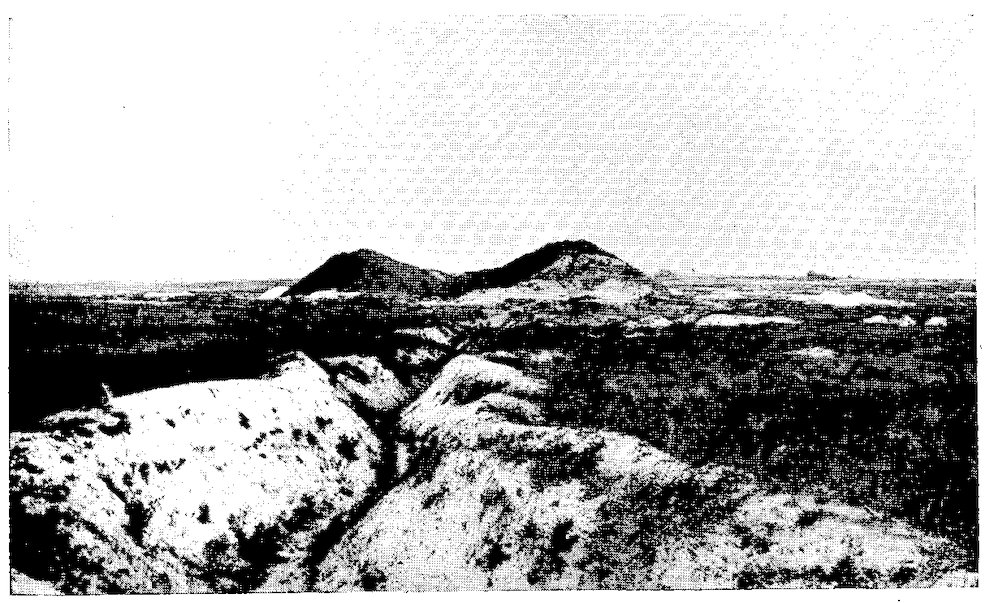
THE DOUBLE CRASSIER. In the front line at Maroc.
The most prominent feature on the Battalion front was the Double Crassier, situated on the extreme left, which consisted of two long parallel embankments of slag running out from Fosse 11 de Lens in the Boche lines. About 50 yards at the western end of each crassier, which was there about 50 feet high, was occupied by the British, C Company holding the southern crassier, and the northern being in the possession of the 6th Division, who were on our left. The situation on the crassier was somewhat peculiar. The enemy post was within easy bombing distance of our own, and consequently neither side cared about stirring up strife, as it was apt to become unpleasant for the instigator. Shelling was impossible, as the posts were too close together, but the garrison found these advantages were somewhat discounted by a feeling of insecurity and of being in the air, in two senses. Sniping on both sides was very deadly, and although it was most interesting to look from this point of vantage right back into the enemy trenches to the south, it was a pleasure which could only be taken with the assistance of a periscope.
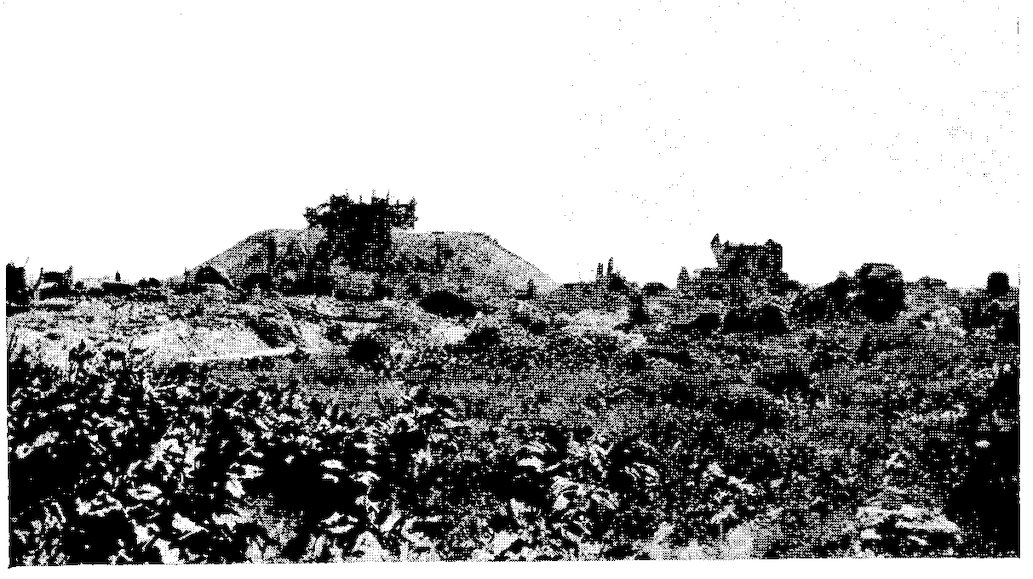
LOOS VILLAGE AND PUITS 15, KNOWN AS TOWER BRIDGE.
73Battalion Headquarters and the two support companies were in fairly comfortable cellars in Maroc, and were not often shelled, but machine-gun bullets used to whistle up the roads at intervals all night.
D Company supplied a platoon nightly to assist C in the defence of the crassier, and the rest of the two support companies were fully employed at work and carrying parties. The first tour passed without special incident, and on the night of March 8/9 the Battalion was relieved by the 1st Battalion North Staffordshire Regiment, Headquarters, A, B, and C Companies moving to Calonne, and D remaining in support to the North Staffords in Maroc. The cellars which served the Battalion as billets were fairly good, and many of them were provided with stoves, fuel being plentiful in the shape of beams from ruined houses. Baths were also obtainable, but these advantages were, of course, mingled with plenty of working parties. Considering its proximity to the line, shelling was very rare in Calonne, but, as at Maroc, machine-gun bullets were plentiful at night.
One of the principal forms of recreation, both in Maroc and Calonne, was rat-hunting. To assist in this excellent sport A Company Headquarters collected a pack consisting of Charles, who might, with a stretch of the imagination, be described as a fox terrier, and who had a perfect genius for catching rats, and John Willie, a large 74dog of no particular extraction, but perhaps with a touch of great dane about him. The rest of the party consisted of one person armed with a crowbar, usually 2nd Lieut. B. Wade, probably someone with a pick and a shovel, and various persons with revolvers and sticks. Wade would lead the pack to the scene of operations, and would mention the word “rat” to Charles, who would immediately take two sniffs, and then say in no uncertain fashion whether rats were present or not. Crowbar, spade, and shovel would then be employed until the victims were forced to break cover, when Charles and John Willie would do the rest. The sticks and revolvers were very seldom called into use. Thirty-seven was a record bag for a hunt, twenty-five being taken in one hour. At dusk great execution could be done with sticks or revolvers without the assistance of the pack.
Another diversion was the “Flying Pig.” For the benefit of the uninitiated it should be said that the “Flying Pig” is the shell of a 9·45-inch trench mortar, is some two feet long, and has a tail with fins of about the same length. When it lands in moderately soft ground and explodes, it makes a crater some ten feet deep by twenty feet across, and is considered an unpleasant thing to have within fifty yards of one. The interesting part of a “Flying Pig” shoot consisted in counting the number of shells which fell in the Boche lines compared with the number which fell in our own. If the ratio was as much as four to one, it was considered a good shoot. Quite good 75sport could also be obtained by laying odds as to whether each shot would or would not be a dud. In the comparatively short time it was in action on our front it got two wonderful direct hits (which were not duds!) on our own front line trench.
On the night of the 14th/15th the Battalion relieved the North Staffords on its old front, Calonne II, B Company being on the right and D on the left. There had been a good deal of rain, and the trenches were, if anything, worse than on the previous tour. The next evening the enemy shelled the left company front for a short time, but did very little damage; the majority of the shells exploded very high in the air, and it is probable that they were a form of star shell, being used to range the guns for the raid which was attempted a few days later.
On the 18th, at 8 p.m., a shoot of old S.O.S. rockets was arranged to test their efficiency and give practice in their use. The Boche, though he used fireworks considerably himself, was always suspicious of other people playing with fire, and proceeded to shell our lines heavily. He even went so far as to put up his own S.O.S., and our artillery had to reply before he quietened down.
At about 4 o’clock the next morning, under cover of a heavy barrage, the enemy attempted to raid the Double Crassier, our part of which was then held by 2nd Lieut. F. Proctor and No. 13 Platoon of D Company. It is very largely due to the coolness and initiative of 76L.-Cpl. Dent that the raid was repulsed without any casualties to us. At least four Boches, including an officer, were known to be killed on the Southern Crassier by us, and two or three more were killed on the Northern Crassier, where the Yorks and Lancs of the 6th Division had one officer and one other rank killed. Two heavy mobile charges were discovered with two dead Boches at the foot of the crassier, and it was evidently their intention to blow in the entrance to the tunnel in the Southern Crassier from which extensive underground workings started. The dead Boches gave us a very useful identification. L.-Cpl. Dent and Pte. Gale, who were with the support section, did very good work in repulsing the raiders with bombs when they had already worked their way round the forward section along the sides of the crassier. L.-Cpl. Dent was awarded a well-deserved Military Medal.
On the night of the 20th/21st, after some considerable enemy activity early in the evening, which was checked by our retaliation, we were relieved by the 1st North Staffords, and moved back to reserve in Bully-Grenay. The billets were moderately comfortable and shelling was rare. One afternoon, however, the enemy appeared to resent the presence of an Archie gun in the eastern part of the village, and dropped some 4·2’s about the spot. Little damage was done, except for one shell which burst in the road not far from Brigade Headquarters and cut a water-pipe.
Very soon after our arrival in this area we 77lost our old friend, Brig.-Gen. B. R. Mitford, C.B., D.S.O., who had commanded the Brigade since its formation in September 1914. Gen. Mitford left to command the 42nd Division, and was succeeded by Brig.-Gen. W. F. Sweny, D.S.O., Royal Fusiliers.
Even in reserve we found many working and carrying parties in store for us, the principal one being a company each night for wiring the reserve or “Village Line.”
On the evening of the 26th the Battalion relieved the North Staffords in the line. This tour we took over in addition to our old front, the Northern Crassier, from the 6th Division. A Company were in their old front on the right, with B in support, while D Company, in the centre, and C Company, holding the crassiers, each found their own supporting platoons. During this tour there was a considerable increase in the enemy’s trench-mortar and artillery activity. The whizz-banging of various portions of the line was fairly frequent and quite alarmingly accurate. The weather during the tour was very bad.
On the evening of April 1 we were again relieved by the North Staffords and proceeded to support, Headquarters and three companies in Calonne and one company in Maroc. As during the last tour in the line, there was a considerable increase in enemy artillery activity during our stay in Calonne. This was doubtless caused by the fact that preparations for the British attack on the Vimy Ridge and east of 78Arras had been in progress since about the middle of March, and that the enemy was not quite sure how far north our attack would extend, and that some of the heavy guns employed in the preliminary bombardment were operating from our front.
On the night of the 7th/8th we returned to the line, B Company taking over the right, with A Company in support, and D and C Companies in the centre and on the left as before.
Throughout our stay at Maroc the patrolling of No Man’s Land had been carried out regularly. The Boche was very seldom seen, and we had practically taken possession of the ground between the two trenches. During this tour patrolling became very active, two patrols going out nightly from each company in the line with orders to penetrate if possible into the enemy trenches and secure an identification. As was expected, however, it was found that the Boche wire was very thick, the whole line being protected by two and in places three good deep belts.
At dawn on April 9 the Battle of Arras opened with a terrific bombardment, but nothing could be seen of it, as there was a very heavy snowstorm at the time. Later in the day the weather cleared, and from the Battalion observation post in the school building the British barrage could be seen rolling across the more northern slopes of the Vimy Ridge. The weather continued bad for the next few days, alternate snow, hail, and rain making the trenches very unpleasant.
79On the morning of the 12th the right brigade of the 24th Division, in conjunction with a Canadian attack further south, captured the Bois-en-Hache, and this apparently finally decided the enemy that the salient now formed west of Lens was an unhealthy place to stay in. That afternoon the enemy commenced to shell our trenches, and more particularly Maroc, in a way which we had never before experienced there. Eight-inch and 5·9-inch shells dropped into the south-eastern corner of the village with alarming frequency, and the company in support had to be brought back to cellars nearer Fosse 11 de Bethune. All through the night of the 12th/13th the shelling continued, mostly with 4·2’s, which fell in all parts of the village, and there was very little sleep for anyone in Maroc that night.
Lieut. H. J. Dunn had a most wonderful escape. It sounds very like a fairy tale, but is nevertheless quite true. A shell penetrated the outside wall of the house and exploded on the ceiling of the cellar in which Dunn was sleeping. Absolutely the whole ceiling collapsed into the cellar, filling it to two feet deep with debris, with the single exception of a portion of about eight feet by four feet in the corner directly over Dunn’s bed. Those who saw the scene next morning will never forget the sight of that bed, absolutely untouched in one corner of the cellar, which everywhere else was covered with ruins. Dunn seemed little the worse for the experience except for the absence of collar and tie, which, with 80sundry other articles of kit, were buried under the wreckage.
The next day there was considerable speculation as to the meaning of this sudden artillery activity, and the possibility of an enemy withdrawal on our front was considered quite likely in view of the salient which had been created between Vimy Ridge and Loos by the Battle of Arras. Throughout the day the enemy continued to shoot at our aeroplanes with rifles and machine guns, and did a certain amount of shelling. In the afternoon news was received that it was considered probable that the Boche had retired. Patrols from the front-line companies were immediately sent out to investigate, and these found the enemy trenches unoccupied except for small parties evidently left behind to shoot at aeroplanes and generally give the impression that the line was still held. The B Company patrol, under 2nd Lieut. G. S. L. Hayward, captured two prisoners of the 35th Fusilier Regiment, and the D Company patrol, under 2nd Lieut. D. F. W. Tanner, was engaged with and drove off an enemy rearguard. Orders were at once given for the front-line companies to move forward and occupy the front and support lines, which was accomplished by dusk. Capt. T. P. P. Walker and 2nd Lieut. K. Pfeuffar, both of C Company, leading their company over were wounded by a Boche sniper. When the enemy knew we had occupied his front-line trenches, he strafed pretty heavily for about an hour. Patrols were pushed forward and encountered no 81opposition, but orders had been received that no further advance was to take place for the present. Battalion Headquarters and A Company from Maroc moved up to our old front line in the course of the evening, while during the night the three front companies occupied the enemy’s third line of trenches, known as Corsair, Cord, and Corporal. The night was very dark, which made moving about in unknown country difficult, particularly on the right and in the centre among the ruined buildings of Fosse 16 and the adjacent cottages. The occupation of this line represented a maximum advance of about 1,100 yards on the left and about 800 yards on the right.
Patrols continued active, and penetrated very much further into the enemy lines, but we had orders not to advance from the positions we had reached. The enemy kept up spasmodic shelling all night, but apparently did not know where we were, and a lot fell short of our lines altogether.
The next morning the 8th Queen’s passed through us and continued the advance in Cité St. Pierre, meeting with only a little more resistance than we had had before. A Company moved into line with the other three companies, going into Corsair trench between B and D Companies, and Battalion Headquarters moved up into Fosse 16. The Battalion found working parties during the day consolidating a line of resistance which ran near the church in St. Pierre. Mindful of the experiences of others in the Boche retirement to the Hindenburg line 82earlier in the year, we were very chary about entering inviting-looking dug-outs, and treated new duck-boards and all movable objects and souvenirs with great suspicion. As it happened, however, the enemy had had very little time to prepare such surprises as booby-traps for us. Only one serious case occurred, in which a deep dug-out in the old enemy front line blew up and killed two men and wounded one. The Boche had made very extensive use of concrete throughout St. Pierre, and there were numbers of cellars so strongly protected that from our side they must have been nearly indestructible, but, of course, when we got them, the weaker sides and the entrances were facing the enemy.
Hostile shelling increased during the afternoon, and remained fairly active all night. In the early morning of the 15th, Battalion Headquarters moved up to a cellar just off Corsair trench. B and D Companies then went forward and sent patrols to try to make good the trenches between the two railway embankments east of the Cité. Cowden Trench and part of College Trench were occupied, but the enemy was found to be holding a strong point at the railway junction at the far end of College Trench. Late in the afternoon the 6th Division twice attempted to get forward on the left, and on each occasion the Boche gave us a very hot time, barraging Corkscrew Alley, the communication trench running along the railway, and strafing the village very severely. At dusk A and C Companies moved up to take over from B and D respectively. 83Throughout the night the enemy shelled heavily, and as it was also very dark, the relief was not complete until daylight the next morning. Shells fell all over the village, but the enemy seemed to make a special target of the neighbourhood of the church, where A and B Company Headquarters and a support platoon of B Company were situated.
News was received at Company Headquarters about 5 a.m. that the relief of the forward platoons was complete. The dispositions were now A and C Companies in Cowden and College Trenches, C Company Headquarters being in a tunnel under the northern railway embankment, and A Company Headquarters in a tunnel under the southern embankment; B Company in support were in the trench near the church, which had been so badly shelled during the night; and D Company were in reserve near Battalion Headquarters.
It was soon after the completion of the relief that a very sad event occurred. The enemy were shelling with 5·9’s the northern railway embankment and neighbouring trench, which was our most advanced position, and the tunnel which served C Company as headquarters was blown in. The tunnel appeared fairly safe, but although there were a good ten feet of embankment above it, it was only made of slag, and it turned out to be a regular death-trap. 2nd Lieut. R. C. Vaughan, commanding C Company, and 2nd Lieut. N. T. Johnson, of A Company, Coy.-Sergt.-Maj. Verrall, of C Company, and three men of the Company Headquarters were 84killed, and 2nd Lieuts. Lanaway, Holmes, and Woolley were dug out wounded. The last-named died of his wounds the next day. It had taken the whole day and the assistance of skilled miners to extricate him, and throughout that time he was perfectly cheerful and hopeful. He set a wonderful example of courage to everyone, and it was not until he was practically safe that the reaction set in and he seemed to collapse. We could ill afford to lose such officers as Vaughan, Johnson, and Woolley, and Coy.-Sergt.-Maj. Verrall was one of the best and most popular of warrant officers, and had been with the Battalion since its formation. The padre, the Rev. G. D. Barlow-Poole, came up in the afternoon and read the burial service, and a memorial tablet was subsequently erected.
All the officers of C Company were now casualties, and 2nd Lieut. Wade, of A Company, took temporary command of C.
At about 8.30 a.m. orders were received by the front companies to push forward patrols at 9 o’clock and try to make good more ground, and Maj. Whitty came up to establish advanced Battalion Headquarters with A Company and superintend the operations. The patrols found that the enemy was still holding strongly his position at the railway junction, and the houses to the north of the railway embankment contained snipers and machine guns. It was quite evident that the enemy had carried his voluntary retirement as far as he intended for the present, and that no further advance could be made without 85an organised attack, which was contrary to our instructions. A bombardment of the positions known to be held by the enemy was therefore arranged in the hope that he would evacuate them, but though patrols were able subsequently to penetrate to the north of the railway embankment and examine Puits 12 bis and the neighbouring buildings, the strong point remained held, and with the sniping continuing from the houses, it was found impossible to make good any more ground. The trench west of the railway strong point had been filled in, and Cpl. Kirby twice led patrols over this exposed part; but the enemy was watching it very carefully, and they were driven back by rifle and rifle-grenade fire. The shelling of St. Pierre continued spasmodically throughout the day. 2nd Lieut. E. B. A. Harvey, of B Company, was killed by a shell near the church, and Capt. Lock, Officer Commanding B Company, was wounded slightly for the second time in three days, but remained at duty.
The A and B Companies’ Headquarters of the night before in the cellar near the church, which B Company had retained throughout the day, was blown in completely late in the afternoon, but fortunately it had been vacated only a few minutes before, as things were becoming altogether too hot there. Throughout the day fires and explosions were going on in Lens, which showed that if he did not definitely intend to retire further, the Boche was at least preparing for that possibility.
86At 9 p.m. relief was commenced by the 9th East Surreys, and, owing to the somewhat complicated situation of the companies and the darkness of the night, combined with a considerable amount of shelling, it took all night, as before. The Battalion returned to support in the positions it occupied on the first night of the advance in Corsair and Corporal Trenches, and had fairly good and very welcome cellars and dug-outs. The next day was spent in consolidating the positions we were occupying as a second line of defence and carrying up ammunition and bombs to make forward dumps. Shelling was again fairly heavy, but not quite so bad as on the previous day. The 18th was also spent on consolidation, interrupted by considerable shelling, and in the evening a rather unexpected but very welcome relief turned up, the 4th Battalion Leicester Regiment of the 46th Division taking over from us. We were by no means sorry for the relief. We had been in the line, either at Maroc, Calonne, or in the advance, since March 26, that is twenty-three days, and if the last five days had been child’s play to the Battle of the Somme, or to what we were to experience in the summer campaign, it had nevertheless been a rude awakening from the comparative quiet of the winter. The shelling was severe nearly the whole time. The five days cost us four officers and fifteen men killed or died of wounds, and five officers and forty-three men wounded; while the casualties for the whole of the six weeks at Maroc preceding the 87advance were only four other ranks killed and twenty-six wounded. We were strongly of the opinion that had we been allowed to push on further on the first and second days of the advance, that we could certainly have gained more ground and probably have taken Lens. As it was, after that time the enemy had strengthened his positions and was able to withstand anything short of an organised attack. The policy of caution, however, was doubtless due to the fact that the Division had all three brigades in the line occupying an extended frontage of about six miles, and with very little artillery supporting it on account of the demands of the Battle of Arras.
On relief we marched via Maroc and Bully-Grenay to rather crowded billets for the remainder of the night at Petit Sains (Fosse 10), which was reached about 3 a.m., and where the enemy greeted us by shelling the fosse.
88