PHASE II TRENCH WARFARE IN THE YPRES SALIENT AND AT MESSINES September 1915–July 1916
Reading edition
After Loos the work of rebuilding the Battalion was commenced at once.
From the plains of Hulluch the remnant of the Battalion was withdrawn to Mollinghem, thence to Houtkerque, and finally to the muddy camps at Reninghelst.
Here, on Oct. 6, Maj. J. C. Parker came to take over command of the Battalion. Large drafts of officers and other ranks had been arriving from the 3rd and 9th Battalions, but it was not possible to give many days to the important work of reconstruction, and on October 15 Major Parker took the Battalion into the trenches at Spoil Bank, on the Ypres-Commines canal. Six-day trench tours with four-day intervals spent in the Reninghelst mud were the order of the day.
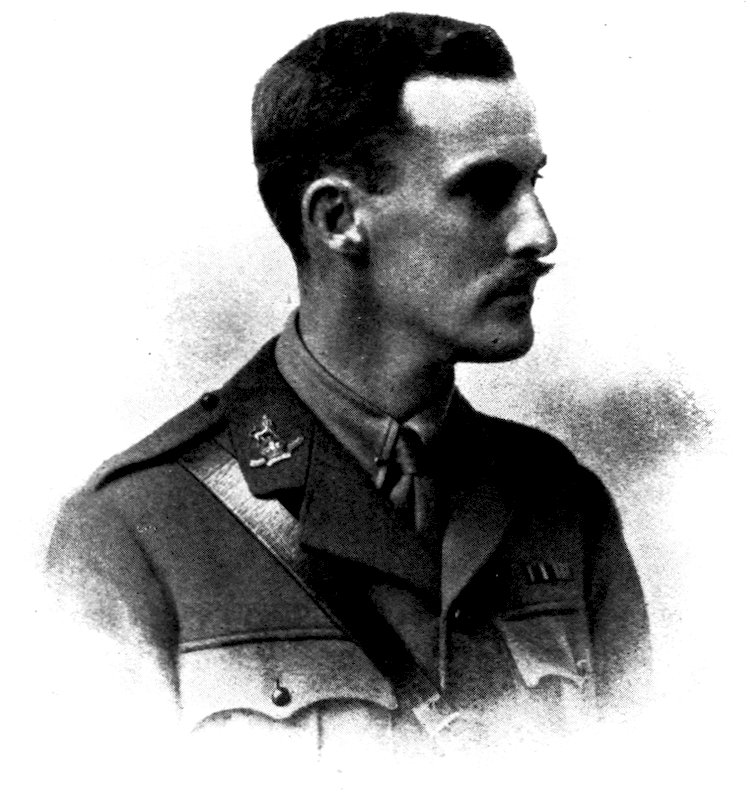
Photo by] [J. Weston & Son, Folkestone. LIEUT.-COL. J. C. PARKER. Commanding the Battalion October 1915–August 1916 and January-October 1917.
During the tour on the Bluff, November 3 to 7, the Germans blew a crater in front of our lines. This was distinctly an “experience” for the Battalion in the trenches for almost the first time. This trench work was a very trying time indeed. The state of our positions at St. Eloi, 27where we held the trenches from November 12 to 19, was almost indescribable. Our trenches were towards the bottom of the slope east of St. Eloi village, and all water drained into the bottom of the valley. Rain was continuous, there were practically no shelters whatever in the front line, and the trenches were nearly waist deep in water. The enemy whizz-banged our tottering parapets at all hours, and the sniping from the trenches on the high ground was wonderfully accurate. The removal of wounded was a matter of extraordinary difficulty and danger. The rests at Reninghelst between trench tours were rests only in name. Large working parties had to go up every day to St. Eloi, the Bluff, or Spoil Bank. Parades were usually at 5.30 a.m., and the parties were conveyed to Café Belge in G.S. wagons. From there a march of two hours, often in a deluge of rain, brought the party to its work. About 5 p.m. the return journey from Café Belge would commence, and the tired party—usually depleted by a few casualties—would be swallowed into the mud of the camp again between 6 and 7. Training was almost impossible. It was with great relief that the Battalion heard during that terrible tour in the St. Eloi trenches that it was to be the last for the time being. On November 19 the Battalion came out of the trenches at St. Eloi, and marched, via Eecke, Ochtezeele, and Houles, to Bonningues, a small village some ten miles from St. Omer.
Towards the end of this march Capt. N. I. Whitty, 2nd Battalion, joined as 2nd-in-Command.
28The Battalion arrived at Bonningues on November 25, 1915, and stayed there till January 4, 1916. Few who were with the Battalion during those five weeks will ever forget the stay there. The villagers were very kind to us, and the rest and peace after the terrible shock of the Battle of Loos, and the very trying trench life which had followed, were just what were required to knit together the Battalion and set it firmly on its feet again. New officers got to know their men, and the men got to know their platoon commanders. Training and refitting occupied most of each day, but on half-holidays and on Sundays one could roam on to the hills and gloat over the really beautiful scenery. The weather was fine on most days. During the month a good deal of football was played. In the Inter-company Competition B Company won, while in the Officers v. Sergeants’ match the Sergeants lost by 14 goals to nil! B Company also reached the semi-final in the Divisional Inter-company Competition. An inter-company cross-country run was arranged, forty runners per company, and was won by A Company.
The whole Battalion spent a very happy Christmas at Bonningues.
Before we watch the Battalion marching into the line again, we might recall the names of some of the officers and N.C.O.s of the Battalion at this time. Lieut.-Col. J. C. Parker was commanding the Battalion, with Capt. N. I. Whitty as 2nd-in-Command. Capt. W. K. Tillie, M.C., was adjutant. The company commanders 29were: A Company, Capt. W. Wood (one of the family of Wood which has been so long associated with the Royal West Kent Regiment); B Company was commanded by Capt. W. V. Ross (who had till recently been an N.C.O. in the Argyll and Sutherland Highlanders); C Company, Capt. T. P. P. Walker (from the 9th Battalion); and D Company, Capt. C. F. Penton (who had been with the 8th Battalion in England). Lieut. Evans was Quartermaster. The Warrant Officers were: Regt.-Sergt.-Maj. Lee, Regt.-Quartermaster-Sergt. Dadd; A Company, Coy.-Sergt.-Maj. Elson; B Company, Coy.-Sergt.-Maj. Ackhurst; C Company, Coy.-Sergt.-Maj. Verrall; D Company, Coy.-Sergt.-Maj. Acland; Cpl. W. C. Carr was chief clerk in the orderly room, and Sergt. Wood was Transport Sergeant.
During the rest at Bonningues two very successful Sergeants’ suppers and concerts were organised under Regt.-Sergt.-Maj. Lee.
A few days before leaving the rest area the whole of the 72nd Brigade, still under the command of Brig.-Gen. B. R. Mitford, C.B., D.S.O., were reviewed by Gen. Plumer, whose army in the Ypres Salient the 24th Division was about to join.
The usual reconnoitring party set off early on the morning of December 28, by motor bus, to reconnoitre the Boesinghe Area with a view to taking over those trenches. On arrival it was found that a gas attack had been launched by the Boche a few days previously, and he had attempted to come over, but had been 30driven back by the 47th Division, whom he had then shelled mercilessly and with little reply for thirty-six hours. The 47th Division had suffered many casualties and were very weak in numbers, one company being down to twenty-three men. The reconnoitring party was hailed with joy by the men in the line. The trenches were in a bad state and reeking of asphyxiating and lachrymatory gas.
Having spent thirty-six hours in the trenches and thoroughly reconnoitred the area and the Canal Bank Dug-outs, the party returned, not very favourably impressed with what it imagined to be its next trench area.
The next few days were spent by the Battalion in rigorous gas training, a special expert being sent down by General Headquarters to lecture on the subject. On January 2 orders were received that the Battalion would entrain on the 4th and 5th, and proceed to Poperinghe, preparatory to taking over the Hooge Sector. Although not very sweet on the Boesinghe Area, the name of Hooge struck an almost more unpleasant chord with some of us.
On January 5 the Battalion, now quite up to strength again, entrained at Audrieq for Poperinghe.
On January 6 the Battalion moved up and took over from the 12th Manchester Regiment the right sector of the Hooge Trenches B1-C3, being disposed as follows: B Company on the right, A Company on the left, D Company in support, C Company in reserve.
31A quiet five days were passed, B Company being slightly shelled from the direction of Hill 60, and suffering a few casualties.
On the night of January 11 the Battalion moved back to Belgian Château, and remained there in support till the evening of January 14, whence it moved back to Ouderdon, forming part of the 24th Divisional Reserve.
Here from January 15 to 26 training was continued.
On January 27 the Battalion took over the left of the left sector of the Hooge trenches from the 8th Queens, where it remained till January 31. A very quiet few days were spent in the trenches, only two casualties being recorded.
On the night of January 31, B Company and half C Company moved back to camp at Ouderdon, and A Company, D Company, and half C Company moved across to the left in support to the Railway Wood Trenches, A Company and half C Company being in the Ramparts, and D Company in direct support.
Working parties were the order every night while in this position, assisting the Mining Company in making deep dug-outs in Hill 20 and Leicester Alley.
On the night of February 5, A and D Companies moved up and took over trenches A1, A2, and Hill 19 and 20 from the 8th Queens, D Company taking over A1 and A2. A1 was a trench entirely unconnected with the remainder of the system, there being no access to it except a duckboard walk “over the top”.
32As this was about the date of the Kaiser’s birthday, the Boche became very bombastic, and prophesied large attacks, but nothing of any importance took place.
On the night of February 8 the Battalion was relieved in this sector by the 2nd Leinsters, and moved back to rest in Camp C, where it remained for a week, training being continued, chiefly in bombing.
On the 16th the Battalion moved up and took over the Belgian Château Dug-outs from the 8th Buffs.
The Boche was now getting considerably more aggressive all round the Salient, and it was thought that he might attack during the coming spring.
On the afternoon of the 19th a disaster occurred which shook the Battalion very considerably, and carried off some of its best officers. The Battalion was due to move into the Sanctuary Wood Trenches about 5 p.m., and all orders had been issued to that effect. At about 3 p.m. a long-range naval shell fell in the neighbourhood of B Company’s Headquarters Dug-out, followed by another at a short interval which obtained a direct hit on the dug-out. Capt. Ross and Lieut. Atkinson, who were in the dug-out, were badly wounded. Capt. Ross subsequently died, and Lieut. Atkinson lost a leg. As D Company’s Headquarters’ Dug-out was close by, the Officer Commanding D Company at once left his dug-out and tried to summon aid and render what assistance he could. He had only got about six 33yards from the entrance of D Company’s Dug-out when another shell followed, which burst right in the dug-out entrance, severely wounding its three occupants, all of whom subsequently died of their wounds. Thus perished Lieut. W. L. Wigan, a regular officer, who had served with the 1st Battalion, and who was universally loved by all ranks. His loss to D Company could not be adequately expressed. Also 2nd Lieut. Cadell of D Company, a bright, cheery boy, and 2nd Lieut. G. M. Stanton, who had only been with the Company about a week.
The commotion caused by this unhappy event seems to have been observed somehow by the Boche, who shelled the whole length of the dug-outs for the next hour or so, though without inflicting much further damage.
D Company was thus left to take over its portion of the Sanctuary Wood Trenches, B1 and B2, with only Capt. Penton of commissioned rank. Lieut. S. B. Smith was therefore ordered to report to D Company for this tour in the trenches. About 5.30 p.m. the Battalion moved up and relieved the 8th Queens in the right of the Right Sector of the Sanctuary Wood Trenches.
During this tour, February 19–23, considerable apprehension of attack would appear to have existed in high quarters. On the 21st the following messages were received in the front line in the space of three hours:
(1) “Gas reported by troops in Boesinghe Area, coming from the north-east.”
34(2) “Aeroplane reports enemy massing behind Sanctuary Wood.”
(3) “Prisoner taken at St. Eloi this morning states that an attack on Sanctuary Wood is imminent.”
About two hours later another message came through:
“Cancel statement of prisoner taken this morning at St. Eloi; prisoner misunderstood.”
Nothing, however, came of all the reported Boche preparations, and the Battalion moved back to Belgian Château Dug-outs on the 23rd after a quiet tour, during which a considerable amount of good wire had been put up to cover the front-line system.
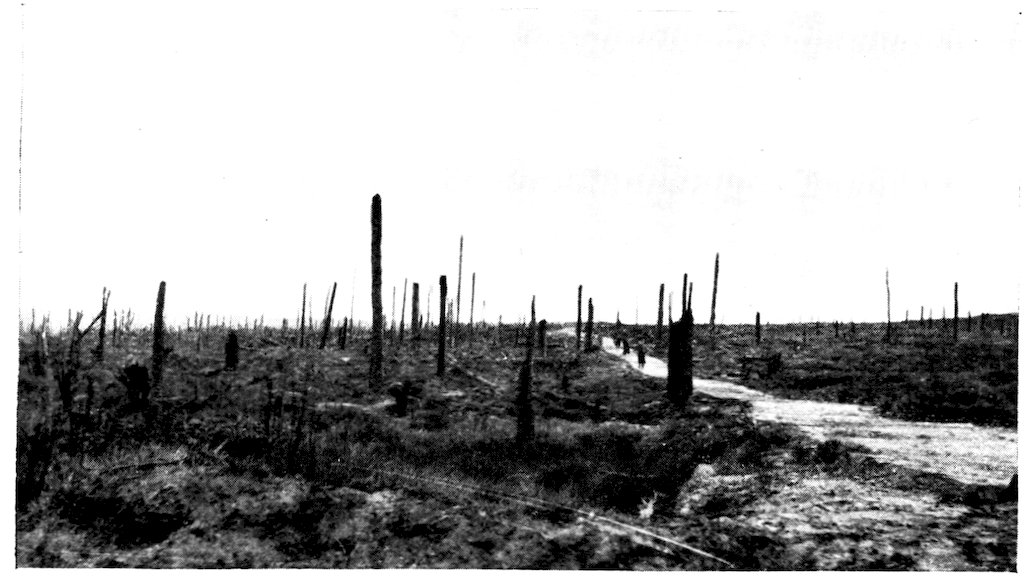
SANCTUARY WOOD.
About this date the Boche was becoming rather troublesome in and about the Salient, exploding a mine at Hooge and attempting to take the crater. Though causing a number of casualties in the 9th Sussex, he was completely stopped, and vented his anger in considerable shelling, destroying a number of the communication trenches behind the front-line system. He also persistently shelled the Belgian Château Dug-outs, though whether this was directed at the large number of batteries stationed about that spot or at the dug-outs is open to doubt. During the period February 24–27 spent in these Dug-outs he caused a number of casualties in the Battalion by shelling, D Company being particularly unlucky, as he managed one night to drop a shell into the dug-out occupied by No. 13 Platoon, which killed four and wounded fourteen.
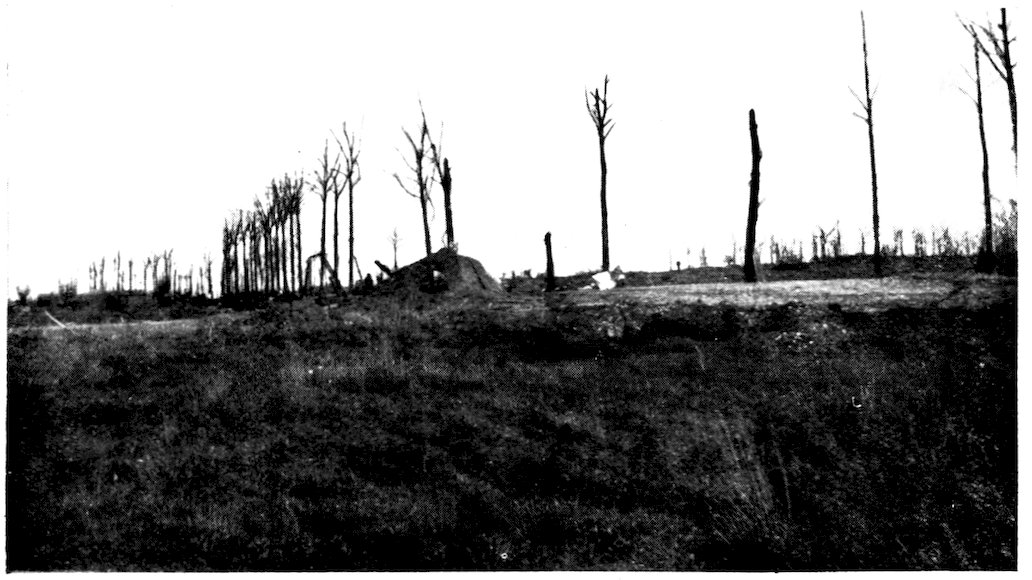
CAFÉ BELGE. On the Ypres-Dickebusch Road.
35About this date also the Germans attacked and captured The Bluff from the division which occupied the trenches on the right of the 24th Division.
This success of the Germans caused considerable uneasiness at 2nd Army Headquarters, and it was thought probable that the 24th Division would be ordered to retake the Bluff; this operation was, however, carried out by the 3rd Division, who had just moved into rest as Corps Reserve. The taking of the Bluff by the Germans caused “a certain liveliness,” however, in the 24th Division, and the system of reliefs had to be altered, owing to a whole brigade being kept in Divisional Reserve complete, instead of one battalion of each brigade.
On the night of February 27 the Battalion moved up again, and took over the Sanctuary Wood Trenches from the 8th Queens, the sector taken over being the right of the Right Sector and Maple Copse.
On February 29 orders were received to move back to Belgian Château, and the 8th Queens took over the Sanctuary Wood Trenches.
It was thought at first that the Battalion was going to take part in retaking the Bluff, but nothing transpired, and the Battalion remained at Belgian Château Dug-outs till March 3, when they moved up and took over the sector occupied by the 8th Queens. Coy.-Sergt.-Maj. Acland was wounded during the stay at Belgian Château.
36This proved a quiet tour from March 3–7, though a considerable amount of work was put in building up the trenches, orders having been received that everything possible was to be done to strengthen the system, as it was believed that the Germans meditated an attack in the spring.
During this period the Battalion lost a valued officer in 2nd Lieut. Hamilton of C Company, an original officer of the Battalion from its inception. He was sniped while going down a communication trench to Company Headquarters.
A few casualties occurred during this tour, chiefly from rifle grenades, which the Boche had now begun to use extensively.
On March 8 the Battalion moved back into rest and took over A Camp at Ouderdon from the 13th Battalion Middlesex Regiment.
Here the Battalion was strengthened by the arrival of a fresh batch of officers, among whom was Sir Henry Hawley, an original member of the Battalion and afterwards Officer Commanding C Company.
During the period spent at A Camp, March 9–15, the Battalion had to find working parties, two companies strong, every night for work in the Salient, building machine-gun emplacements, and wiring and repairing trenches. These parties proceeded by train to Ypres, and then marched to their rendezvous. A number of casualties by shell-fire were caused on these working parties, the Germans showing the most uncanny knowledge of the whereabouts of the sites of proposed machine-gun emplacements.
37On the night of March 15 the Battalion moved forward and took over the dug-outs at Belgian Château. Rumours of relief by the 3rd Canadian Division were now rife.
Working parties on the support defences south of the Lille Gate continued unceasingly; much of this work was observed by the Germans daily, by the aid of their Fokker aeroplane, which at this time was superior to any British machine in use, and it was no rare sight to see two or more of our machines crashed daily by Fokkers.
The night March 20/21 saw the relief of the Battalion by the 4th Canadian Mounted Rifles, and the Battalion moved back to Camp F. It may safely be said that all ranks were glad to leave the Ypres Salient after nearly three months of monotonous trench warfare. Moreover, the Boche was undoubtedly meditating mischief, which culminated in his lightning attack on the Canadian Corps, an attack which the Canadians heroically withstood, though it cost them enormous casualties.
On March 22 the Battalion moved to Berthen, near Bailleul. Excellent billets were found for all, and the contrast of unshelled fields, spring weather, and peaceful nights soon put all ranks on good terms with themselves.
Training was carried out for three days, the usual reconnoitring party proceeding to the Wulverghem Sector on the 24th to reconnoitre the new area to be taken over from the Canadians.
The new sector was found to be extraordinarily quiet, and the lack of shelling amazing, whole 38houses and farms being untouched by shell-fire within 1,400 yards of the front line.
On the 26th the Battalion moved to Dranoutre and took over the rest area for the night, the men being well pleased with the hutments and the look of Dranoutre, which at this time was absolutely untouched and full of its original inhabitants, plying a thriving trade with “Tommy.”
On the 27th the Battalion moved up to Wulverghem and took over trenches C3 and C4, B1 and B2, facing Messines, from the 1st Canadians, moving in by sections in daylight about 4 p.m., the relief being accomplished without loss.
Headquarters took over St. Quentin Cabaret, a small inn within 1,000 yards of the front line, absolutely intact and undoubtedly the best headquarters in the whole of the British front at that time. The support company lived even nearer to the line in Souvenir Farm, also intact.
During the months previous to our taking over there had been something like an understanding between our artillery and the enemy’s: “If you don’t shell, we won’t.” So estaminets and small shops were open in and around Wulverghem, less than three-quarters of a mile from the front line, and farmers were working in the fields just as close.
There was only one line of trenches on our front, and, as was the custom in those days, every firebay had a section of men in it. About 400 yards behind the line were absurd Strong Points built overground of sandbags. Each was held by 39a platoon. The two on our front were known as S.P.4 and S.P.5. The chief incident during our first five-day tour in the front line was the destruction of S.P.5 by enemy artillery fire. He shelled it very accurately for over an hour with 5·9s. The garrison stuck it out under Sergt. “Miffy” Mills, who, though badly shaken, was merry and bright when it was over. Cpl. Hogg was wounded.
After five days we moved into support, not very far back, all living in farm buildings. Battalion Headquarters and A Company went to Tea Farm, B and C Companies to Aircraft Farm, and D Company to Kandahar Farm.
Trouble began during this tour in support. Our artillery had given up the policy of peace, and had been steadily strafing the Hun during the previous days. So he started. First of all on Tea Farm. At 5.30 a.m., on April 6, he put a 5·9 shell into the loft of one of the barns where the Battalion bombers were sleeping. It was real bad luck that he hit the place first shot, because we had trenches a short way off to go to; and before the next shell came over a few minutes after, everyone not actually employed on attending to casualties was safely away. That first shell accounted for thirteen casualties, eight killed and five wounded. He shelled the farm then for two hours, and off and on all day for three days, until it was a wreck. Cpl. Bates greatly distinguished himself evacuating the wounded under heavy fire. Battalion Headquarters moved up to Kandahar Farm with D 40Company, and we had peace for the rest of the five days out.
Our next tour in the trenches was uneventful. We had a few casualties, including 2nd Lieut. Eldridge, who was wounded in the knee. On April 10 we were relieved by the 8th Queens, and moved back into reserve at Dranoutre, where everyone was fairly comfortable.
So things went on for a time—five days in the line, five days in support; five days in the line, five days in reserve.
At the end of April the enemy released gas against us. The 8th Queens and 1st North Staffordshire Regiment were in the line. We were in support and the 9th East Surreys were in reserve. We had to take up our battle positions, and assist in the work of getting up new gas-masks and rations after the attack was over. We escaped lightly, but the battalions in the line had fairly heavy casualties. Shortly after this it was decided to organise a big raid in retaliation for the gas attack, and our Battalion was ordered to carry it out. Maj. N. I. Whitty organised the raid, Capt. W. Wood was in command, and other officers were Lieut. N. B. Green, 2nd Lieuts. S. E. Dove, S. B. Smith, and T. Bowling. During the greater part of May the party were out of the line, training at Dranoutre. The sector had become decidedly “lively” by this time, and the Boche had “set about” most of the open farms in the district. The civilians had given it best and left.
On May 6, Capt. W. K. Tillie left to command 41the 72nd M.G.C., and Lieut. S. J. F. Mills became adjutant.
On May 31 occurred one of the tragedies in the history of the Battalion. Capt. W. Wood was killed by a German sniper when out in No Man’s Land patrolling with some of his raiding party.
It is impossible to exaggerate the worth of Capt. Wood’s work while he was with the Battalion, or the sense of personal loss felt by all ranks when the news of his death reached us. Brave as a lion himself, he was a strict disciplinarian. His work and influence as Officer Commanding A Company had been marvellous, and the effect of his example upon the whole Battalion was seen at every turn. Perhaps one can sum up his record with the Battalion by saying that at first most of us were afraid of him, then we came to respect him, and last we came to love him. He was buried at Dranoutre on June 1. Gen. Mitford and his staff were present, and practically all the Battalion. Gen. Capper, the Divisional Commander, in a letter to Col. Parker, spoke of the personal loss he had sustained by Wood’s death, and alluded to him as the finest company commander in the Division. “Quo fas et gloria ducunt.”
On the night of June 4/5 the raid was attempted. 2nd Lieut. S. B. Smith behaved with great gallantry in trying to cut the enemy’s wire, but it was found impossible to get through. We had a number of casualties, and 2nd Lieut. Bowling was killed. 2nd Lieut. Smith, although 42he had been working hard nearly all night and was dead beat, went out just after dawn and got in Bowling’s body.
June 1916 will be remembered long by all who were with the Battalion. We were out of the line, in support again, for the enemy’s second gas attack on June 17. The Queens and the North Staffords had the misfortune to be again in the line. This time the enemy used phosgene for the first time, and the Brigade suffered severely. Most of our Battalion were in the front line or in the communication trenches as working parties, and they behaved magnificently. All night and long into the next day they helped with casualties. Gas discipline among our men was then, as it always has been, very good, and we had comparatively few casualties. Apart from these few days in support, which were far from a rest, we were in the front line the whole month, and after the enemy gas attack it was no picnic.
It was arranged that we should release gas in retaliation, and all labour was devoted to installing the cylinders in our trenches. Work was carried on at feverish speed, and at the same time the enemy had brought up his well-known “travelling circus” of trench mortars opposite us, and he made a practice of blowing us up every evening. The trenches came to be known humorously as the “Wulverghem Empire”—Two Houses Nightly.
On the 28th we released our gas, and the Queens followed it up and raided the enemy’s 43trenches. The wire had been previously cut by artillery, the raiding party got in successfully and captured about six prisoners. In this raid one of our officers, 2nd Lieut. Reynolds, who had been transferred to the Queens, did splendidly. This night’s work annoyed the Hun no end, and he made our positions a positive inferno. The next evening he set about us with trench mortars of the heaviest type, and fairly wrecked the trenches. All ranks behaved with the greatest gallantry, and were ready to repel an enemy attack at any moment. We had forty casualties, and 2nd Lieut. E. F. Vinicombe, of D Company, was killed.
On the next day, June 30, we were relieved by the 7th Australian Battalion, and moved out to Kortipyp Huts, very tired but greatly exhilarated by the experiences of the past weeks. We knew very little about the coming Somme offensive, but we had rumours, and we assumed, correctly, that we were “for it” there sooner or later. It was with surprise, therefore, that we received orders after a few days out at Meteren to go into the line again at Ploegsteert. Here some of us were served out with Australian hats, which we were to wear, and show ourselves in order to give the enemy the idea that the Australians were still in the line. Our stay in these trenches only lasted two days, when we were relieved by a battalion of the 20th Division, and moved out to Berthen. Here we remained for a few days until orders were received to move by train to Amiens, behind the Somme Battle. Then we knew.
44The end of June 1916 saw the Battalion in good spirits, united and keen. We had had real hard trench experience, and the Battalion had proved itself worthy of the trusts which had been put upon it. All ranks looked forward with confidence, even with eagerness, to the Somme, and all the possibilities of getting at the Hun in the open and really finishing the war which it promised. How things actually turned out on the Somme are well known, and the next phase of the Battalion’s history will give details of our part in that great struggle.
45