PHASE III THE BATTLE OF THE SOMME August–September 1916
Reading edition
After a few days at Berthen the Battalion entrained at Bailleul and detrained at Longeau, near Amiens.
By this time we had all formed a pretty clear idea of what was happening in the Somme Battle. News of the terrific fighting had been digested. We had read with pride of the work of our 7th Battalion in Trones Wood, where we were ourselves very soon destined to be, and we knew we were in for serious business.
During July 25 we marched seventeen miles to the village of Saisseval. It was intensely hot and very dusty, but we arrived at Saisseval about noon. This village was without exception the dirtiest and nastiest the Battalion had ever been quartered in. However, there was some excellent country round the village, and for a week we trained strenuously in the new methods of following a barrage and attacking in waves.
On July 31 and August 1 we moved to the Sandpits, near Meaulte, just outside Albert. We were here for ten days continuing the training. On August 8 A and B Companies were suddenly ordered up into Montauban. An enemy counter-attack 46was expected at Delville Wood, and it was apparently not certain whether the troops detailed for the Montauban defences would be able to get there. The two companies got into position in the afternoon, took over the dispositions, and arranged to continue work on the trenches at dawn the next day. However, during the evening the troops for Montauban arrived, and our companies marched back again to the Sandpits.
On August 9 orders were received to take over the front-line positions between Trones Wood and Guillemont the next day.
Early in the morning of August 10 our advance parties went up and thoroughly reconnoitred the positions. The rest of the Battalion followed in the afternoon. We were treated to quite a healthy bombardment on the way in, but the Battalion was finally settled in position before dusk. In front D Company were on the right, A Company on the left, in Edward Trench, B Company were in support just outside Trones Wood, and C Company and Battalion Headquarters in positions round the Sunken Road at the south-east corner of Trones Wood.
Such trenches as there were had only just been scratched out, and were mostly not more than a foot deep. From dusk till dawn work by the front companies was continuous. It was a case of digging for our lives, and at stand to in the morning every man had trench room nearly six feet deep. The positions were heavily shelled by the enemy in the morning, and our casualties 47would have been very heavy had it not been for the strenuous digging of the night before. As it was, very few were hit, and the experience was a very healthy object-lesson to all of us.
The unfortunate village of Guillemont in front of us was practically gone. Our shelling was continuous. During the day the place was usually obscured from view by clouds of red brick-dust from bursting shells, and at night the crashing of shells was continuous. The Hun did no persistent shelling, but he gave us hurricane bombardments at intervals, which were most unpleasant.
During the afternoon of August 12 a partial attack by the French on our right took place. We had a good view of the creeping barrage, and a very considerable amount of retaliation by the enemy on our trenches. Capt. Penton, Officer Commanding D Company, was wounded during the afternoon. In the evening things quietened somewhat, and we were relieved by the 1st North Staffordshire Regiment. We were out for forty-eight hours, just in front of the Briqueterie, during which time the whole Battalion was up at night digging a new trench, Nott Trench, some 400 yards in advance of our front line. On the 15th we went up again, D Company into Nott Trench, C Company into Edward Trench, B Company into the Trones Wood position, and A Company to Carnoy Craters. The enemy set about our new trench that night, and we had a bad time. 2nd Lieut. S. E. Dove, who was commanding D Company, was killed. There was no enemy 48attack, however. After two days we were relieved again, and the Battalion concentrated at Carnoy Craters.
It had been a stiff week. We had casualties to six officers and 146 other ranks. While in the line the Reserve Company had been working continuously in salving. As a consequence, huge dumps were made at Battalion Headquarters, which were used as forward dumps in future for all troops coming into the area.
An outstanding feature of this week’s fighting was the magnificent work of Capt. McLarty, the Medical Officer. He was working almost continuously in the open in the Sunken Road by Battalion Headquarters, and he must have dressed hundreds of cases during the week. An abortive attack on Guillemont had taken place just before we took over, and wounded were coming down and being brought in by our stretcher-bearers continuously. Practically every shell-hole in front of us had a corpse or a wounded man in it. All night cries for “water” were heard. We had large parties out every night, and every soldier in front of us who was not past human assistance was got back.
On August 18 the 24th Division attacked Guillemont.
The 72nd Brigade was in support, concentrated at Carnoy Craters. The whole attack was on a frontage of fourteen miles. On our Division’s front Guillemont Station and a post in the village near the famous Quarries were captured. In the evening we moved up, and as a first step 49we occupied our old positions in Nott and Edward Trenches. Battalion Headquarters were now in a dug-out in Edward Trench. A Company held Nott Trench, C and D Company Edward Trench, and B Company the Trones Wood positions.
On August 19 A Company was ordered up into the village to take over the post captured there and held by elements of the 73rd Brigade. From Nott Trench the Company marched in three sections into the village on a compass bearing after dark. The relief was completed before midnight, B Company having taken over Nott Trench. The Company in Guillemont was in a peculiar position. Our new line ran from the post in the village northwards to the Station. There were trenches of sorts here, and touch was established with the 3rd Rifle Brigade, who were holding the Station. But southwards and eastwards our post in the village was in touch with the enemy only, and that at very close quarters. The post itself consisted of shell-holes in a very early stage of consolidation. The quarries which faced our positions from the south at about 40 yards’ distance were strongly held by the enemy, and he made the work of consolidation exceedingly difficult for our men by constantly harassing them with machine-gun and rifle-grenade fire.
By daylight on the 20th we had succeeded in getting a continuous trench facing south to the quarry, and two enormous shell-holes were consolidated as a defensive position facing east. The enemy seemed to have no settled position in 50the village, and he was evidently occupying shell-holes in a very irregular fashion. During the day he showed himself a great deal, and we did a lot of very successful shooting. In view of the enemy’s unsettled position in the village, it was decided to make an attempt to continue our trench which faced south in an easterly direction, to form a jumping-off position for another attack on the village.
A large party of the 12th Sherwood Foresters (Pioneers) was to come up at night to do the digging, and the area where they were to work was to be previously cleared of and held from the enemy. At dusk, therefore, 2nd Lieut. A. Roscoe took out a big fighting patrol of a platoon in strength. He first worked eastwards from our shell-hole position to the eastern extremities of the village, then southwards towards the low ground in the centre of the village. It was a very difficult operation indeed, but his work was splendidly successful. The patrol had several encounters with isolated posts in shell-holes. One of these fights developed into a wrestling match in which one Hun was killed and one wounded. We had a few casualties, but succeeded in establishing two positions south of the site of the new trench. The garrisons of these posts remained out all night, frustrated all attempts by the Boche to filter northwards again, and covered the party digging the new trench. In the small hours of the morning of August 21 A Company was relieved by two companies of the 8th Queens, and moved back to Dublin 51Trench, near the Briqueterie. It had been a highly exciting thirty hours up in the village, and the memory of it will live long in the minds of all who were there. The relieving feature had been the absence of shelling; our positions in the village were too near the enemy’s, and the Boche positions east of ours were too indefinite for the enemy to shell us with safety to his own men. The other companies had been holding the old trenches, and had been subjected to the same old hurricane bombardments several times a day. We moved back to Citadel Camp, near Fricourt, on August 22, and on the 25th to camps near Ville-sur-Ancre.
On the 27th the Battalion was inspected by Maj.-Gen. J. E. Capper, C.B., the Divisional Commander, who in a short speech thanked us for what had been done, and gave us his well-known doctrine of hatred of the Hun, as displayed by blood on the bayonet. He also spoke of our forthcoming work in Delville Wood. On this day company commanders had paid their first visit to Delville Wood, and Inner Trench, which had just been taken from the enemy in his final ejection from the wood, was reconnoitred. As a result of the reconnaissance it was clear to all of us that the enemy would never allow us to hold the trench without desperate efforts to retake it. The Battalion went into billets at Ribemont on the evening of the 27th, and stayed there till the morning of the 30th, when we marched to Fricourt. In the evening we went up to Delville Wood. Will anyone who was with the Battalion 52ever forget that night? At Bernafay Wood we were to be met by guides, and from there to Inner Trench the distance was about a mile “as the crow flies.” The men were excessively heavily laden. Each company carried three days’ rations, 25 petrol tins of water, 25 boxes of bombs, 12 boxes of flares, 12 boxes of Very lights, and some boxes of S.A.A. It had rained hard all day, and showed no signs of abating at night. The guides were picked up successfully at 9.30 p.m., and the crawl across Caterpillar Valley and through the wood began. Nominally there was a communication trench leading all the way, but there was little or nothing of it left, and the guides could scarcely be expected to keep direction. Delville Wood was notorious for changing its shape and appearance every hour. Details of that terrible night’s march are innumerable, and cannot be dwelt on here. Most of them can be recalled by those who were there, and they can be imagined when it is stated that the rain was continuous, the shelling of the wood heavy and incessant, and the mud knee-deep at least. Added to this it should be remembered that the Battalion had already marched ten miles during the day, and the men were loaded up like desert camels. The leading company began to get into its position at 5 a.m. on August 31, but it was nearly 8 o’clock before the trenches were really taken over—eleven hours after we had picked up our guides a mile away!
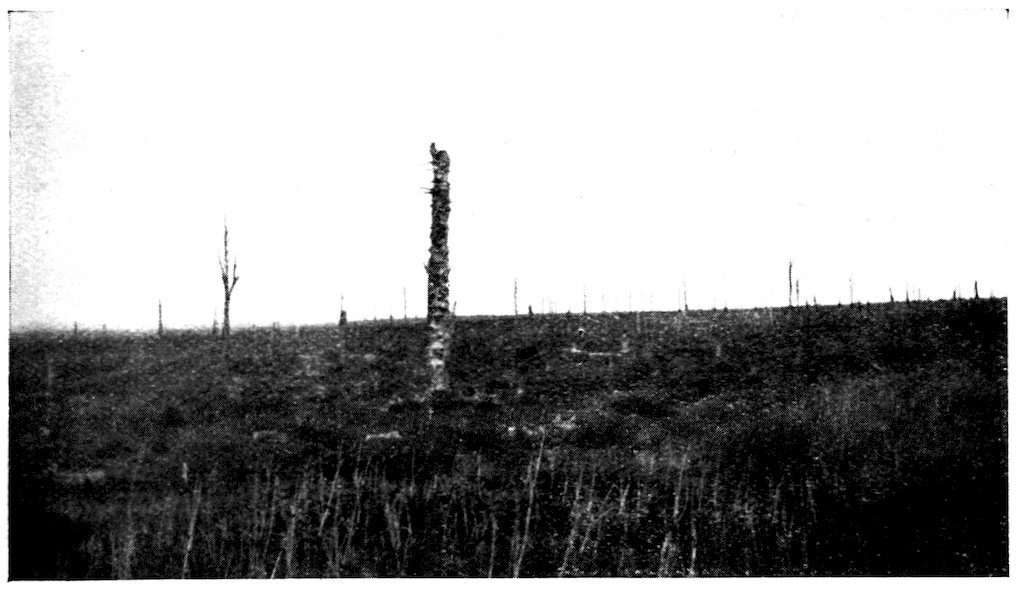
DELVILLE WOOD.
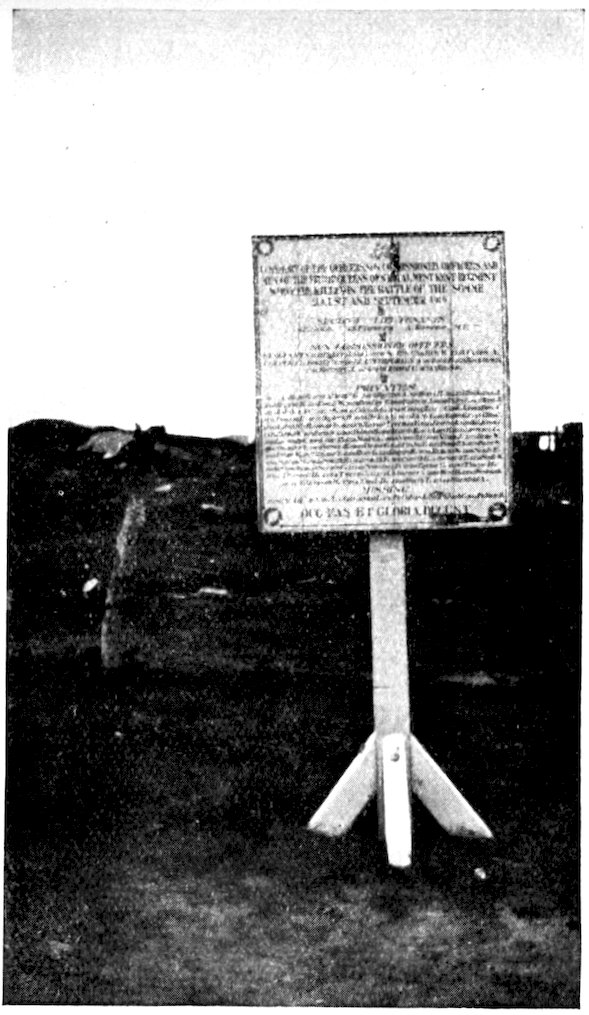
THE MEMORIAL BOARD TO THOSE WHO FELL ON THE SOMME, 1916, PLACED IN GUILLEMONT CEMETERY.
A Company occupied Inner Trench and a new trench forward of the wood facing north-east. 53B Company occupied Edge Trench in touch with the left flank of A Company. C Company were in support in the wood, and D Company in reserve behind the wood. Battalion Headquarters were in a dug-out at Longueval Church. Col. Parker had gone down sick with malaria and trench fever, and Maj. N. I. Whitty took over command of the Battalion. The Company Commanders were: A Company, Capt. H. J. Wenyon; B Company, 2nd Lieut. H. Flowers; C Company, Capt. Sir Henry Hawley, Bt.; D Company, 2nd Lieut. W. G. Lock.
We were allowed very little respite after the position had been taken over. If the night’s march had been deadly, the day which followed was far worse. It was the day of the enemy’s last and biggest attempt to retake the high ground from High Wood to Guillemont. We just had time to have our breakfast of sodden biscuits and cold bacon, when the shelling began, shortly after 8 a.m. It is not intended to paint lurid details of this shelling. Suffice it to say that Delville Wood went up in fire and smoke for five and a half hours. In Inner Trench was one deep dug-out. In this we kept five machine guns and crews of the 72nd M.G.C., also some of our Lewis guns and teams. The shelling round the dug-out was particularly heavy, but by the grace of God the enemy failed to demolish it. In Edge Trench cover was scanty and the shelling terrific. Most of the forward platoons of A Company were casualties before 10 a.m., and B Company on the left suffered very severely too. 54The garrison of the two front companies became very thin, and two platoons of D Company from reserve were sent up to hold the centre.
At 1.30 p.m. the shelling suddenly and very obviously lifted on to the south edge of the wood. Shelters and dug-outs were immediately cleared, machine guns and Lewis guns were got into position, and our depleted garrison disposed to meet an attack.
Scouts crawled out in front to beyond the edge of the wood to watch a piece of dead ground there. On the right we were in fair order for meeting an attack. We had our machine guns and most of our Lewis guns intact, and quite a fair supply of ammunition. The enemy was some 600 yards away, and was bound to show himself clearly at 500 yards’ range. On the left our position was more difficult, the enemy was much closer, and there was a covered way of approach opposite the front of the Battalion on our left. The men were tremendously eager. After terrific shelling which numbs the senses while it lasts, the reaction often took this form. As the first of the attacking troops began to trickle into view it was difficult to hold our rifle fire down. We kept perfectly silent, however, and, encouraged by this, the enemy came forward in considerable numbers till he arrived at an intermediate jumping-off trench some 500 yards away. Here he collected for half an hour, and word was passed down our line that as soon as he debouched from these positions in force, every rifle, machine gun, and 55Lewis gun was to open fire. At about 2.30 p.m. the enemy came forward all along the front, at a slow trot. Immediately all along our line machine guns, Lewis guns, and rifles let fly at him. He was stopped dead within 50 yards of his trenches, while his men fell right and left. For a moment his line wavered, and the next his troops were running back in a mad rush to their original positions, followed all the way by our fire.
Baulked of his desire, the enemy shelled us again for an hour and an half, and then in the early evening he repeated his attempt. This time we knew exactly what to do, and we carried out the same programme as before with the same result. Inner Trench and Edge Trench were still entirely held by us at the end of the day. On the left of Edge Trench, however, the enemy had gained a footing in Orchard Trench, held by the battalion on our left, and B Company had a very nasty time in the evening. The Company Commander, 2nd Lieut. Flowers, was killed, and 2nd Lieut. E. G. Brown took over command. He and his Sergeant-Major, Coy.-Sergt.-Maj. R. Rankin, did splendid work, and organised their exposed flank for defence. Away on our right, too, the enemy gained a footing in the trenches of a battalion of the 7th Division, but he was ejected. A counter-attack the next day expelled the enemy from Orchard Trench and re-established the position all along the front. The enemy’s great bid for the high ground had failed, and the night of August 31/September 1 was comparatively quiet.
56Everyone was absolutely dead beat. In turns most of us managed to snatch some sleep that night, and the next morning we heard we were to be relieved during the day. The Queens relieved us in the afternoon, and we moved back into Check Trench in Caterpillar Valley, between Bernafay Wood and Delville Wood. The valley was stiff with our guns, and Check Trench was about thirty yards in front of their muzzles. At about 9 p.m., just when we were all hoping to get a bit of sleep, the enemy commenced a concentrated counter-battery bombardment with gas shell of the guns in Caterpillar Valley. We got the full benefit of this. Everyone was ordered to put on gas helmets (the old P.H.) at once. We spent a most uncomfortable night: the bombardment was kept up for five hours, and many of us had our first experience of sleeping in a gas helmet—quite possible, but most unpleasant. We had practically no casualties from that night’s gas shelling.
We remained in Caterpillar Valley till September 5. The batteries were constantly shelled, and we usually got the benefit of it. On the first afternoon we had ten signallers buried in one firebay by an 8-inch shell. 2nd Lieut. Roscoe organised a digging party at once, and after two hours he succeeded in clearing the whole firebay; only one man was killed. A similar fate overtook another bay shortly after, and again all except one man were dug out alive. On the next day 2nd Lieut. Roscoe took up a party at 57daybreak to get rations up to the Queens, who were now in a new trench in front of Inner Trench. The party ran into very heavy shelling in Inner Trench, and had several casualties, including 2nd Lieut. Roscoe, who was severely wounded in the leg. He died of wounds at Corbie the next day. Throughout the fortnight at Guillemont and Delville Wood he had done magnificently. His cheerfulness was wonderful, and he was ready at all times for any job there was going. After 2nd Lieut. Roscoe was hit in Inner Trench, Sergt. Greenaway took the remains of the party on, though it was now broad daylight. They crawled across the open to the new trench, and delivered the rations and water successfully to the officers in command there.
On September 3 a big attack on Ginchy and Guillemont on our right took place, and on the evening of the 5th the 24th Division was relieved, and moved back to a camp near Fricourt. On September 7 the Battalion arrived at Vauchelles-les-Quesnoy, a delightful little village close to Abbeville, where we were very comfortable. A large draft of new officers joined us on our way, and the Battalion settled down to refit and train for what was to follow. As things turned out, we had finished with the Somme, and we were soon hurried off north to the 1st Army.
Our sojourn in the historic battlefields of the Somme had been crammed with incident. It coincided with the period in which the enemy was making his most strenuous efforts to drive us from the high ground, which gave the British 58their first sight of Bapaume. We had learnt what shelling meant at Ypres and Messines, and during the terrific bombardments at Guillemont and Delville Wood the Battalion was always steady. Apart from the holding and exploiting of the forward positions, the Battalion did a tremendous amount of work in their brief spells out of the front posts. As examples, one may mention Nott Trench, 800 yards long, dug in two nights right in front of our front line and under constant fire from the enemy, and the work of salvage done by the Reserve Companies in the Trones Wood area.
Of fighting the enemy we had had it at close quarters in Guillemont Village, and we had had it after a shattering bombardment in Delville Wood, where the enemy was not allowed to get within 400 yards of us. In both cases he had been beaten.
It is difficult to pick out any isolated cases of brave deeds among the countless acts of heroism of those weeks. 2nd Lieut. Roscoe’s work has already been mentioned. 2nd Lieut. E. G. Brown and Coy.-Sergt.-Maj. R. Rankin in Edge Trench did wonderful work in an awful position in keeping the enemy at bay. The Battalion stretcher-bearers one and all did magnificently all through. They worked seemingly without sleep or food, and without ceasing, as also did Capt. McLarty, the Medical Officer. An act of two private soldiers may be mentioned as indicating very truly the spirit of the Battalion during the day of the enemy’s counter-attack at 59Delville Wood. Towards the end of the bombardment, when one front company had lost over a third of its men, the Company Commander considered it imperative to send back a report to Battalion Headquarters. He hesitated to do so for a time, because it seemed certain death to the men taking the message. Finally volunteers were called for, and two wounded men, Pte. Skerry and Pte. Tyrrell, came forward. The message was given to them, and they were told to deliver it at Battalion Headquarters, and then to go down to the field ambulance. The wood was a perfect inferno at the time, but they started off with the greatest bravery, although one of them could scarcely walk. Something more than an hour later the Company Commander was astounded to see them back in Inner Trench, and assumed they had not been able to get through the barrage. The fact was, however, that they had not only got back to Battalion Headquarters with the message, but they had insisted on bringing an answer back to their Company Commander rather than go straight back to the safety of the field ambulance. As the result of this message the reinforcements from D Company already mentioned came up to fill the gaps in the two front companies.
One other case may be mentioned. At the end of a long night’s work in front of Guillemont, dawn broke with a slight mist. Cries for “water” could still be heard in front, so under cover of the mist a large party went out and brought back many wounded men. While they 60were out, a cry was heard from a long way in front. An officer who was with the party went forward as far as possible and discovered that the wounded man was in the enemy wire. The stretcher-bearer party was following up, but the officer ordered them not to go forward, as it seemed obviously hopeless to get the man back. The whole party therefore returned to Edward Trench. It was then discovered that one man, Pte. Allchin, was missing. A few men went out again to find him, and after about an hour he was seen coming back from the enemy wire carrying the wounded man on his back. That he had got there and back was nothing short of a miracle, because the enemy was exceedingly vigilant at this time, and he was sniping incessantly.
The fighting on the Somme had taken a heavy toll of the Battalion. The Battalion memorial erected in Guillemont Cemetery gives the names of 3 officers and 91 N.C.O.s and men who were killed or who died of wounds. Our total casualties were 13 officers and about 300 N.C.O.s and men.
The impression left in the minds of most people who fought on the Somme was that the enemy was being taught there once for all that the British Army was going to beat the Germans at all cost.
The 8th Battalion of the Royal West Kent Regiment can justly claim to have done much to drive home that lesson to the enemy at Guillemont and Delville Wood.
61