PHASE I THE FORMATION OF THE BATTALION—TRAINING IN ENGLAND—OVERSEAS TO FRANCE—THE BATTLE OF LOOS September 1914–September 1915
Reading edition
The formation of the 8th Battalion, The Queen’s Own, Royal West Kent Regiment may be said to have commenced early in September 1914. The men who enlisted at the various recruiting offices of the Royal West Kent Regiment at that time were sent down to the regimental depot at Maidstone. The depot was not built to accommodate half the number of recruits which came pouring in, and the new-comers got a very bad impression of what the Army would be like. The feeding arrangements were bad, and they found that a man was lucky if he got someone else’s dirty plate, and still luckier if he got some food to put on it. After 5 p.m. all were allowed out into the town, and it was there that the majority got their only real meal of the day.
The sleeping accommodation was quite inadequate. There were about a dozen tents, and 2the gymnasium, dining-hall, and all available spaces were crowded. But even then many men had to sleep out of doors. A few slept in the town, as, although no one was allowed out of barracks, the military police on duty let it be known that it was possible to get through the railings without being seen.
The average stay at Maidstone was about three days, and on Saturday, September 12, some 600 or 700 men were collected and taken by train to Shoreham-by-Sea, under the command of Major Venables, who returned at once to Maidstone. The reception at Shoreham was even less encouraging than at Maidstone. After considerable difficulty the men were got into some sort of order and marched in simply pouring rain to a field opposite the infirmary, where there was no accommodation at all, and they were told to stay under the trees to keep dry. By this time every man was wet through, and as there was apparently nobody present with much authority and no likelihood of an improvement, it is small wonder that many men took train for home, returning on Monday, when things were rather better. For those that remained bell tents were eventually pitched, the men being told off ten to a tent. Later some wet blankets and equally wet loaves of bread were distributed. No feeding utensils were issued for some days, and a piece of wood or newspaper had to serve as plate, and the fingers as knife, fork, and spoon. The tea invariably had half an inch of grease on the top, while the food was almost uneatable.
3On Monday, September 14, the majority of those who had gone away on the Saturday returned, and a further detachment of some three hundred arrived, bringing the number up to nearly one thousand. Up to this time there seems to have been no officer present at all, and the Battalion had been under the command of Sergt.-Maj. Evans, but on the 14th Col. E. Vansittart, Commanding Officer, and Lieut. and Quartermaster Guess arrived, and things began to improve. Capt. Middleton arrived on the 17th, and took up the duties of Adjutant.
The difficulties of maintaining discipline will be understood when it is said that there were now in camp at Shoreham the infantry of a whole division, all in mufti, and all, with the exception of a very few officers and a few N.C.O.s, absolutely untrained. The only man in the Battalion in uniform was Sergt.-Maj. Evans. The other N.C.O.s were recognised by a red arm-band for sergeants and a white arm-band for corporals, while an officer was only distinguishable by the carrying of a walking-stick. The number of experienced N.C.O.s was quite inadequate, and the necessary establishment had to be made up by picking out the men who seemed most intelligent and likely to act as leaders.
The Battalion was brigaded with the 8th Battalion, The Queen’s, Royal West Surrey Regiment, the 8th Battalion, The Buffs, East Kent Regiment, the 9th Battalion East Surrey Regiment, and for the first few weeks the 13th 4Battalion Royal Fusiliers, which made up the 72nd Infantry Brigade, under the command of Brig.-Gen. B. R. Mitford, C.B., D.S.O. This Brigade, with the 71st and 73rd Brigades, formed the infantry of the 24th Division, under Maj.-Gen. Sir John Ramsay, K.C.B.
By the end of the month the camp was moved to the Oxenfield, or Recreation Ground, and the commands in the Battalion were then as follows:
Commanding Officer, Col. E. Vansittart.
2nd-in-Command, Maj. L. Brock-Hollinshead.
Adjutant, Capt. C. de C. Middleton.
Quartermaster, Lieut. C. Guess.
Sergt.-Maj. H. Evans.
Quartermaster-Sergt. W. Dadd.
Officer Commanding A Company, Maj. F. M. Walters.
Colour-Sergt. Skinner.
Officer Commanding B Company, Maj. E. V. O. Hewett.
Colour-Sergt. Lee.
Officer Commanding C Company, Maj. O. J. Daniel.
Colour-Sergt. Fisher.
Officer Commanding D Company, Maj. J. C. Chillingworth.
Colour-Sergt. Burn.
And about four subalterns per company.
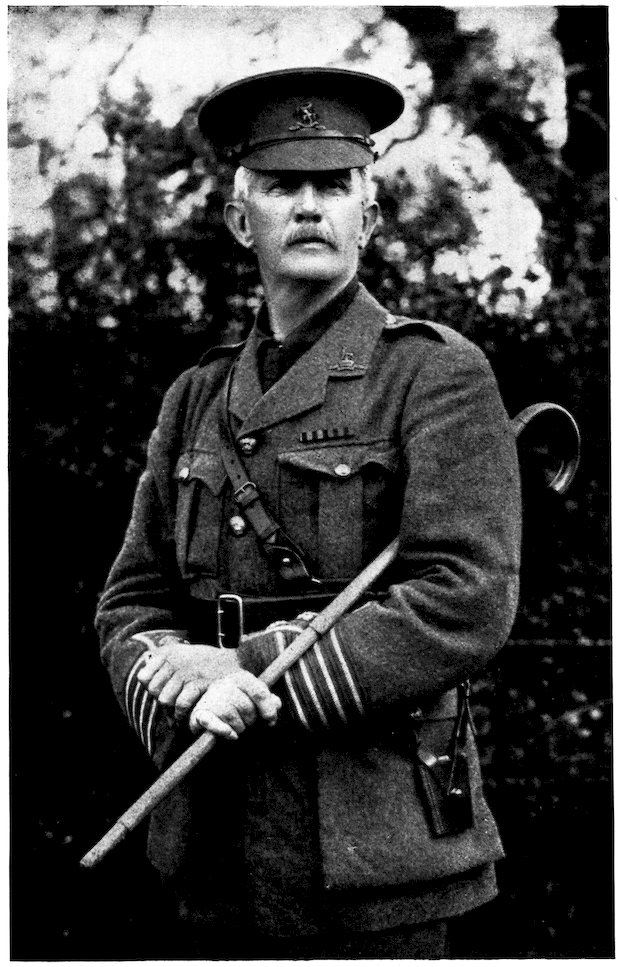
Photo by] [Elliott & Fry, London. COLONEL E. VANSITTART, D.S.O. Commanding the Battalion September 1914–September 1915.
Training was, of course, very quickly in full swing. It consisted for the first few weeks of squad drill and marching and nothing else. 5Squad drill from 6.30 a.m. until 8 a.m., squad drill and a little marching from 9 a.m. to 1 p.m., and squad drill from 2 to 5 p.m. It became rather monotonous, but was, of course, very necessary. After a while a little physical drill was added as a slight variation, and just occasionally an afternoon was employed in marching down to the sea for bathing. On Saturdays work stopped at 4 p.m. instead of 5 p.m., while even on Sundays the 6.30 to 8 a.m. parade was held in addition to church parade, so that it can be seen that we were starting in no half-hearted fashion. So seriously indeed were we setting out on our training, that officers did not dare to ask for permission to go to Brighton after hours, unless it was to get their hair cut, and it must be admitted that hair seemed to grow rather quickly in those days.
By this time the interior economy of the Battalion was more or less on an organised basis, and considerable progress began to be seen in all directions. In physique and keenness a very large majority of the men were splendid, and there was no doubt that we had the nucleus of a very fine battalion. On the other hand, there were some men who were obviously medically unfitted for an army life, and who ought not to have been passed in at all. Fortunately it was quite easy in these early days to discharge such men, and by the end of October those “unlikely to make efficient soldiers” had been pretty well weeded out. No one could have wished for a finer set of men than the 1,026 who were retained.
6It was about this time that the blue uniforms were issued. They were blue serge, and though not beautiful and not particularly military, they gave the Battalion an appearance of uniformity, and were an enormous improvement on the very varied collection of mufti previously in use. In addition to appearance, the change was very beneficial to discipline, as it had been formerly impossible to tell whether a man was a soldier or not.
The month of October was brilliantly fine, and very great progress was made with the training, but November was not so kind, and the weather got worse and worse, until by the end of the month the camp was no better than a mud patch about six inches deep, and, as always happens in a muddy camp, had become very unhealthy, and was condemned by the sanitary authorities.
The Division then went into billets at Brighton, Shoreham, and Worthing. The 72nd Brigade went by train on November 30 to Worthing, where the Battalion was billeted at the western end of the town, and had very good billets indeed. The people of Worthing were most kind to us, and no one will forget the very pleasant four months’ stay there. Right up to the end of the war we continued to get regular parcels of comforts sent out by the townspeople, and we cannot be too grateful to the town of Worthing for their kindness both during our stay and afterwards.
The training facilities were perhaps not quite so good at Worthing, but the Downs could still 7be reached by a short march, and the Recreation Ground was excellent for close-order drill parades.
One of the difficulties at Shoreham had been the absence of rifles. At first only a few imitation rifles made of solid wood were available; then a little later six D.P.s (i.e. for drill purposes only, unsafe for firing) were issued per company, and were used for training the officers and N.C.O.s in musketry. Shortly after reaching Worthing, D.P.s were issued to the whole Battalion, and arms drill became for a time one of the principal items on the programme of work.
The extreme, and in fact excessive ardour with which we had entered into our training had been wisely tempered down, and parades now lasted about seven hours a day, instead of eight and a half; we also had a proper half-holiday on Saturdays, and the early morning parade on Sundays had been knocked off. Christmas leave of four clear days was given to the whole Battalion in batches between the third week in December and the second week in January. When this was over, company training was started, and this was the order of the day for the rest of the stay at Worthing.
We now had supplies of full-dress scarlet tunics, which were obtained from the depot, and which were worn for church parades and when proceeding on leave. There were not enough to go round the whole Battalion, only 460 coats and trousers and 420 caps, so the men who appeared on parade in the ordinary blue 8were either excused or marched to church as a separate party.
About the beginning of March the Battalion was issued with its first khaki service dress, and this was a most cherished possession, and was only worn for battalion drill parades, which took place each Saturday, and for church parades on Sunday, the scarlet being then returned to Maidstone. We had previously, however, about the beginning of January, been issued with khaki greatcoats, which had been taken into general use. Five miniature rifle ranges were erected at Worthing, and much morris-tube firing was done, and the musketry made great progress all round.
At the end of March the Battalion moved by train from Worthing, which was left with many regrets, to Redhill, where we were again in good billets. The only work or training done during the three weeks’ stay there was digging trenches for the London defences at Merstham. This meant parading at about 7.30 a.m. and marching four and a half miles, working until 3 p.m., with half an hour’s break for eating haversack rations, and then marching home, a somewhat exhausting job and very tedious when repeated day after day.
In the third week of April the Battalion returned by train to Shoreham-by-Sea, and went into a new hutment camp which had been erected on the southern slopes of the Downs, just north of the village. The accommodation was quite up to the normal, except that we had by this time amassed something like seventy 9officers (every platoon had at least three, and most platoons four), and as a consequence the officers’ accommodation, which was only meant for a normal establishment, was rather overcrowded.
From the point of view of training it was much more satisfactory to be back in camp again. Most of this stay at Shoreham was devoted to battalion training, and no more suitable piece of country could have been found. The only difficulty was that the whole division was now at Shoreham, and that in order to save congestion the ground was divided into areas and allotted weekly to units, which meant very often a long march before the actual training could be started. Usually the Battalion had covered some twenty miles as well as carrying out a tactical exercise by the time that it returned to camp in the afternoon. Night work by companies was carried out frequently.
Some of the transport wagons and animals were issued here, and cookers occasionally accompanied the Battalion. Many of the mules were untrained, and were taken in hand by Lieut. S. R. Paul and Sergt. Wood, up to that time Sergt. Master-Cook, who became transport officer and transport sergeant respectively. The majority of the transport, however, was not issued until we reached Aldershot.
The weather was, on the whole, very fine and hot, and although these long days in such weather were very tiring, there is no doubt that they got us into the very pink of condition.
10The second suit of khaki was issued on arrival at Shoreham, and from that time was taken into general use, and we felt that we really were soldiers at last.
It was at Shoreham also that our band was formed from men who already had a knowledge of, and were able to provide, their own instruments. These were later supplemented by gifts from various officers. The band was taken in hand by Sergt. Baker, and was the pet hobby of Capt. Middleton, the adjutant. We had possessed our own drums for a long time.
At the end of June we moved by road to Blackdown Camp, near Aldershot. The march occupied three days, halts being made at Horsham and Guildford, where billets for the night were provided. Blackdown, though of course a satisfactory place from a purely military point of view, was by no means so pleasant in other respects as our former stations. It had a dirty appearance and the country was anything but beautiful. It also had the disadvantage of being a long way from a station or town, being almost equidistant from Aldershot, Farnborough, and Camberley.
The men were in huts and the officers either in the old married quarters of the barracks or else under canvas.
Soon after arrival at Blackdown service rifles were issued, and the bulk of the training was devoted to brushing up musketry prior to firing the general musketry course. Most of July and the early part of August were devoted to firing, 11and little else was done all through this period, as companies not actually firing were nearly always on duty in the butts. The results were rather disappointing, due very largely to the abominable weather. After the lovely days of the early part of the summer it was very unfortunate that we should have such bad luck for the musketry course. It became very much colder, the light was often most indifferent, and we were also bothered by frequent high winds and a lot of rain. On many of the days on which we fired, shooting would have been cancelled under peace conditions; but time was short, and we were forced to get on with the work if the targets could be seen at all. However, the course gave the men confidence in their new rifles, and a very large majority attained at least the standard of second-class shot in spite of the weather. Bombing instruction, under 2nd Lieut. Hough, and scouting, under 2nd Lieuts. Harris and Eccles, was also carried out, and the Lewis guns were issued and used for training.
On August 12 the Division was inspected by Field-Marshal Earl Kitchener, the Secretary of State for War. The whole Division was drawn up in one line of battalions in mass, and Earl Kitchener rode down the line from the right, and was received with the general salute. The whole proceedings, as far as each battalion was concerned, lasted about two minutes, but no one with experience of these functions will be surprised to hear that we were on parade waiting for over one and half hours before anything happened.
12The rest of the month of August was devoted to training in trench warfare, final preparations for proceeding overseas, and embarkation leave. The trench-warfare scheme was carried out by the whole division. The two opposing forces marched under war conditions until they met on Chobham Common after dark, when each side commenced to dig in with entrenching tools until the large tools were brought up. Work was continued under war conditions until 7 o’clock the next morning, when peace conditions were resumed in order to enable the work of completing the trenches to be pushed on more quickly. It was intended that the troops should occupy the trenches for some days and that reliefs should be practised, and finally a trench-to-trench attack and consolidation carried out. It happened, however, that the weather was very bad, and the scheme was abandoned on the second day.
On that day the King and Queen visited the Division and walked along the trenches, speaking to many of the officers and men, and we felt that this foreshadowed a fairly imminent departure for other trenches. Immediately the trench-warfare scheme was abandoned, embarkation leave commenced, each man getting four clear days.
On about Wednesday, August 25, instructions were received to be ready to proceed overseas on the following Sunday. All leave was cancelled from Friday, and the last three days were spent in one long rush of packing up, kit inspection, 13exchange and issue of new kit, and all the necessary preliminaries for proceeding on active service.
On Sunday, August 29, the Battalion actually left Blackdown for Southampton. The organisation of the Battalion as it proceeded overseas was as follows:
Commanding Officer, Col. E. Vansittart.
2nd-in-Command, Maj. L. Brock-Hollinshead.
Adjutant, Capt. C. de C. Middleton.
Machine-Gun Officer, Lieut. W. K. Tillie.
Transport Officer, Lieut. S. R. Paul.
Quartermaster, Lieut. H. Evans.
Regt.-Sergt.-Maj. A. Lee.
Regt.-Quartermaster-Sergt. W. Dadd.
A Company:
Commander, Maj. A. H. Pullman.
2nd-in-Command, Lieut. R. M. Old.
Coy.-Sergt.-Maj. Campion.
No. 1 Platoon, Lieut. L. Gibbs.
No. 2 Platoon, Lieut. R. M. Old.
No. 3 Platoon, Lieut. H. S. Brown.
No. 4 Platoon, 2nd Lieut. C. D. N. Lawson.
B Company:
Commander, Capt. R. W. Grant.
2nd-in-Command, Lieut. P. T. Smith.
Coy.-Sergt.-Maj. Ackhurst.
No. 5 Platoon, 2nd Lieut. E. A. Bigsby (Billeting Officer).
No. 6 Platoon, Lieut. N. B. Green.
No. 7 Platoon, 2nd Lieut. V. G. Don.
14No. 8 Platoon, Lieut. O. Jones (Engineering Officer).
C Company:
Commander, Capt. A. C. Edwards.
2nd-in-Command, Capt. C. A. Hutchinson.
Coy.-Sergt.-Maj. Mills.
No. 9 Platoon, 2nd Lieut. D. H. Watts.
No. 10 Platoon, 2nd Lieut. M. S. Ell.
No. 11 Platoon, Lieut. H. L. Lewis.
No. 12 Platoon, 2nd Lieut. A. N. Harris (Scout Officer).
D Company:
Commander, Major J. C. Chillingworth.
2nd-in-Command, Capt. P. M. Robertson-Ross.
Coy.-Sergt.-Maj. Acland.
No. 13 Platoon, 2nd Lieut. R. F. T. Burrell.
No. 14 Platoon, 2nd Lieut. H. O. Beer.
No. 15 Platoon, 2nd Lieut. G. de L. Hough (Bombing Officer).
No. 16 Platoon, 2nd Lieut. D. W. Plant (Signalling Officer).
We journeyed to Southampton in two trains, half of the transport going with each half battalion, and on arrival in the afternoon the Battalion was marched to the docks and there detained in a large shed, on account of submarines. The next day was spent in the shed, and the Battalion embarked late in the afternoon, and left the docks in time to reach the open sea, where the convoy was met by a patrol of destroyers, as it was getting dark. The sea, 15without being particularly rough, was sufficiently uncomfortable to make many people wish for dry land again. We anchored outside Havre in the early hours of the morning, and went into the harbour soon after daylight. There we disembarked, and marched up to camp on the high ground about Honkville. The troops were delighted with the new experience of being in a foreign country, and were in most excellent spirits. We remained in this camp until the next morning, when we marched down to the Gare des Marchandises and entrained at about 11 o’clock. This being the Battalion’s first experience of travelling in cattle trucks (40 hommes and 8 chevaux), considerable disgust was expressed. But this mode of travelling became quite a normal thing for those who had an extended career in France. After a very slow journey of seventeen hours, via Rouen and Abbeville, we detrained at Montreuil at about 4 a.m. and marched to Hucqueliers, a halt being made on the way for breakfast.
The billets at Hucqueliers were very good, and the population was most kind to us. Training was continued by companies, considerable time being devoted to field firing, which was carried on in any likely spot, and seven ranges were constructed for target firing. Later some big divisional field days were included in the programme, the most memorable being an alarm in the night, followed by a field exercise lasting until 6 p.m. the next evening.
After a stay of nearly three weeks the Battalion 16marched out of Hucqueliers at 6 p.m. on September 21, and proceeded to Dennebroeucq, which was reached in the middle of the night. There were no billets or camp available, and the men bivouacked in a field with no covering except their own waterproof sheets. There was a barn available for the officers, but it was so plentifully supplied with fleas that many wished they had remained in the field.
The next night the march was continued to Isbergues, the Battalion being billeted in the brewery, and a much more comfortable day was spent than the last. The next night a short move of about three miles was made and quite satisfactory barns and billets occupied; while on the night of the 24th the march was continued through Choques, which was full of guns, ambulances, and other very warlike appliances, to Bethune, where the Battalion was billeted in the tobacco factory, with the officers in an empty house on the opposite side of the road.
The four nights’ marching had been rather exhausting, not so much on account of their length as on account of the congestion of traffic on the roads, which, combined with the darkness, made progress very slow.
The officers had already been told that they were going into the biggest battle the world had ever known, and were also told that their rôle would be to march through to Douai and hold it, a task which was considerably modified before we actually reached the battle.
On the morning of September 25 the 72nd 17Brigade moved to Beuvry, and from there marched to a point behind Vermelles, where the battalions rested on the road-side. The Battle of Loos was now in full swing, and many prisoners and wounded were coming down from the line, but no very definite information could be got from them. The task now allotted to the Division was that it should pass through the village of Hulluch, which was believed to be in our hands, and then capture and organise the Pont-a-Vendin bridgehead some three and a half miles further east. As a matter of fact, the 73rd Brigade and two battalions of the 71st were detached to other parts of the line, leaving only the 72nd Brigade to carry out the attack.
When night fell the Brigade moved up from Vermelles, and opened out into artillery formation, as the exits to the village were being shelled, advancing first on Le Rutoire Farm and then on a compass bearing to the Lone Tree, where the Battalion halted and got into touch with the other battalions of the Brigade. Later the advance was resumed, with the Battalion leading the Brigade, and the final position reached during the night was a line of old German trenches parallel to and some 1,000 yards west of the Lens-La Bassee road. It is interesting to note that although this part of the line was supposed to be occupied, no troops were passed on the way up, and there were none in the trenches to be relieved.
Although the shelling had been fairly heavy, the casualties were not very serious, but included 18Lieut. P. T. Smith, slightly wounded in the foot. He refused, however, to be sent down to hospital. Col. Vansittart was also slightly wounded in the hand during the night.
Our instructions were that we should attack at dawn, the objective for the Brigade being the main German position some 2,000 yards away, which stretched from Hulluch village on the left to the Bois Hugo and on to Hill 70 on the right, our frontage being from Hulluch to the Bois Hugo.
Considerable sniping and random shell-fire was kept up by the enemy during the night, but did very little damage. The Battalion scouts, under 2nd Lieut. Harris, were sent forward during the night, 25/26th, and came back with the report that Hulluch was in the hands of the enemy and strongly organised, and that they were also holding the line of the Lens-La Bassee road. The whole Battalion could not be accommodated in the main firing trench, and an attempt was made by C and D Companies to dig a parallel trench in front, but, owing to the approach of daylight, and the increasing attentions of the enemy’s whizz-bangs and machine-gun fire, this was abandoned, and the surplus was withdrawn into a communication trench, where the men hollowed out scoops for themselves as additional protection from the shelling which was enfilading them.
No orders for the attack at dawn came to us, and we had to wait. As the light grew stronger, the enemy’s artillery fire increased and casualties 19became more numerous, while our guns did heavy counter-battery work. At about 10.20 a.m. Col. Vansittart was sent for by the Brigadier and got orders to attack at 11 a.m.; he reached the Battalion again at 10.53, and only had time to give orders for the whole Battalion to move up into the fire trench, and to tell off companies as firing line and supports. We were told that there were plenty more fellows in reserve to go through us, and that the troops on either flank would attack simultaneously with ourselves. We were to leave Hulluch village on our left, and it would be dealt with by the troops on our flank.
Punctually at 11 o’clock the first wave, with B and D Companies in the front line, left our trenches, followed at short intervals by the subsequent waves. The 9th East Surreys were on our right, and the 8th Buffs (right) and the 8th Queen’s (left) were in support. Instead of a whole division attacking on our left, a handful of some fifty to seventy-five men, belonging to a Welsh regiment, alone left our trenches, the orders apparently having arrived too late, while the right flank of the East Surreys also appears to have been in the air.
The ground to be covered sloped gradually down to the Lens-La Bassee road, and from there rose to the main German positions, about 1,100 yards beyond, near the crest of the ridge running north from Hill 70. The attack was carried out at a marching pace in order to save the men’s breath for the final charge and bayonet work, and the advance was so steady and the formations 20so regular that it looked more like a field day at Aldershot than part of a great battle. The enemy brought a very heavy rifle, machine-gun, and artillery fire to bear on the attacking lines, and shortened his range to keep pace with the advance with wonderful precision; but the casualties up to this point, though severe, were not inordinately heavy.
When the first wave was still some hundred yards short of the main road, the enemy withdrew, some retiring in very open order up the hill, and many of these were shot down by our men, while stronger parties made off to either flank, those on our left gaining the village of Hulluch, and those on the right reaching a sunken road on the near side of the Bois Hugo. A very severe machine-gun fire from either flank swept the road, and very heavy casualties were sustained in crossing it. About 400 yards east of the road the Battalion passed a forward German trench full of enemy dead.
As the advance swept up the long slope towards the main German trenches the machine-gun fire increased in intensity, being very severe from both flanks. Shelling directed from behind Hill 70 and from the south-eastern part of Hulluch was also very heavy, and two field guns were brought up to a position from which they took the attack first from the flank and later from the left rear, firing practically over open sights. In spite of the very heavy casualties which were being sustained, the Battalion continued its advance up the slope with the utmost gallantry, 21but it was found on reaching the enemy’s main position that the barbed wire protecting it was absolutely intact. What more hopeless situation could possibly have arisen? When the orders for the attack were issued, it had been assumed that all the enemy’s wire had been cut by our bombardment, but here, after a most gallant advance of about 2,100 yards in face of a murderous fire, not only from the front, but also from both flanks, the Battalion, and in fact the whole Brigade were faced with a thick belt of uncut wire, swept by artillery, rifle, and machine-gun fire from three different directions. With assistance on our flanks to keep the enemy occupied and to draw a due proportion of his fire, it would perhaps still have been possible to force a way through the wire and capture the trench. We wish to make it quite clear that we are not blaming our comrades on either flank for their failure to help us. The facts appear to be that at the time fixed for our attack the enemy himself launched a counter-attack against the troops on our right, who were consequently pinned to their ground, while the orders did not reach those on our left in time, with the consequence that the 72nd Brigade had both its flanks exposed, and the enemy was able to concentrate on the one brigade the fire of the artillery and small arms which would normally have been used on the front of three divisions. Many men made gallant attempts to get through the wire, 2nd Lieut. Don being killed when half-way through. The remainder dropped to the ground 22where they were and returned the heavy fire from the enemy’s trench. The situation, however, was hopeless. In front was an impenetrable belt of wire, and the line, such as was left of it, raked with rifle and machine-gun fire from the front and both flanks, and enfiladed by an equally deadly artillery fire. What were the men to do? Turn to their officers for orders? Out of the twenty-five officers who had left our trench little more than an hour before, only one was now unhit. To stay where they were, outflanked on both sides, was impossible, and the poor remnant of that gallant Battalion was forced to make its way back to the line of German trenches from which it had started. There they remained for the rest of the day, subjected to heavy shell-fire. Lieut. W. K. Tillie, the Battalion M.G.O., the only officer who was not a casualty, brought the Battalion out of the line the same night, when it was relieved and moved back to bivouac in a field near Noeux-les-Mines.
Had the Battalion had more experience of modern warfare, it is probable that a nucleus of officers, N.C.O.s, and specialists would have been left behind at the transport lines before entering a big battle; but, as it was, every available officer and man went into the line, and with casualties to every combatant officer except one, and over 550 other ranks out of about 900, the organisation of the Battalion was temporarily ruined, and what remained of one of the finest and most gallant battalions that ever left England required months of careful rebuilding before it was a 23semblance of its old self. To those who had seen the Battalion grow from its infancy and who lived to look back on that day, there remained, and will remain, an everlasting regret that it should have been frittered away in two short hours on a hopeless task; but at least we know and are proud that the task was undertaken with a determination and bravery which could not have been excelled, and the fact that it was impossible is the only reason why it was not accomplished.
Of the twenty-four officer casualties, thirteen were killed. Major Brock-Hollinshead, the 2nd-in-Command, Lieuts. Gibbs and Lawson of A Company, Lieuts. Smith, Bigsby, and Don of B Company, Capt. Edwards and Lieuts. Watts and Harris of C Company, and Capt. Robertson-Ross and Lieuts. Burrell, Beer, and Plant of D Company; Col. Vansittart and Major Chillingworth, Capts. Middleton and Hutchinson, Lieuts. Old and Ell were badly wounded, and were picked up by the enemy after lying exposed in No Man’s Land for many hours; and the only five to reach England were Major Pullman, Capt. Grant, and Lieuts. Green, Lewis, and Hough.
For gallantry in this battle Major Pullman was awarded the D.S.O., Lieut. Tillie the Military Cross, and Col. Vansittart and 2nd Lieut. Don were mentioned in dispatches. After the Armistice a further award of the Distinguished Service Order to Col. Vansittart was announced, and was a most fitting tribute to his gallant personal leading and a great compliment to the 24Battalion which he had brought to such a high state of efficiency during the period of training.
When he was back in England in 1917, Col. Vansittart closed his report to the War Office with the following paragraph: “Might I add that the 8th Royal West Kents actually got from half to three-quarters of a mile east of Hulluch—that although the fire was very heavy and from every direction, officers and men alike showed not the least semblance of any check or stop. They advanced as if on parade and under perfect discipline till they reached the enemy’s undamaged barbed-wire entanglement, beyond which they were unable to go; and here our losses were very heavy.”
Writing to Mrs. Vansittart after the battle, Gen. Mitford said: “Nothing too much can be said for the 8th Royal West Kent Regiment; notwithstanding the shell and machine-gun fire under which they advanced over open slopes destitute of cover, they never wavered an instant, but moved on towards their objective as if on parade.”
The other three battalions of the Brigade were nearly as badly hit, and the total casualties were approximately 78 officers, and 2,000 other ranks, out of about 3,600.
The following address by Brig.-Gen. B. R. Mitford, C.B., D.S.O., was read to the 72nd Infantry Brigade at the Parade Services on October 3, 1915:
“72nd Infantry Brigade,
“Last Sunday the Brigade went into action for the first time, only a year after they came forward at their Country’s call.
25“The way the Brigade advanced under very heavy machine-gun and artillery fire from flanks and rear has evoked the approbation of the Divisional and Corps Commanders. You were an example in steadiness and determination to carry out your task, not only to the new Armies, but also to seasoned troops, who could not have done better than you have.
“As I say, you carried out your task, but you had to retire. Yet do not think it was a failure, for it was not, as you caused 16 battalions of the enemy reserves to be brought up into your area and taken away from the French just South of us, thereby enabling the French to make an appreciable advance.
“I should like all of you who know the relatives of those who are no longer with us to tell them how gallantly they fought and how nobly they served their Country, in whose service they fell, and what prestige they brought on the names of the Regiments to which they belonged.
“Men of the Queen’s, Buffs, East Surreys, Royal West Kents, you have added glory to the ancient Regiments of which you are the children. You have made for the 72nd Infantry Brigade a name which none of you can be anything but proud of, and which I know, in the future, you will never allow to diminish.
“I feel it a great honour to have had the chance of commanding such troops on service, and I shall never forget the ground about Hulluch village.”
26