PHASE IX THE FINAL ADVANCE FROM CAMBRAI TO MAUBEUGE October—November 1918
Reading edition
After five days’ training at Sus-St.-Leger—chiefly on the lines of open fighting in co-operation with artillery and machine guns—we entrained on Sunday, October 6, detraining at Ribecourt from the first troop train to run into the station. We marched to the ruins of Graincourt and bivouacked in fields for the night, among constant visits from enemy aeroplane bombs. On the following day positions were reconnoitred at Rumilly, and we moved up into trenches at Cantaing for the night.
At this time the British positions near Cambrai were, roughly, the same as those reached in the advance of November 1917.
On Tuesday, October 8, a general attack on the enemy’s Cambrai positions in conjunction with other attacks on a wide front opened at dawn. The 72nd Infantry Brigade was in close support to the 63rd Division, and we were assembled in trenches near Rumilly at 8 a.m.
The attack immediately in front of us on the village of Niergnies was successful. In spite of several counter-attacks during the day, the 235village was still in the hands of the 63rd Division when the 72nd Brigade moved up to relieve them at night. The 1st North Staffordshire Regiment and the 9th East Surrey Regiment took over the line, and we were in close support behind the village. The enemy shelled the area just behind the village very heavily with gas shells all night.
About 9 p.m. we received orders that the Battalion would attack the village of Awoingt at dawn the following morning. The orders were received over the telephone, and details were very meagre. Battalion Headquarters had been pushed forward to a new position, where there was a telephone, close to the village. The intense blackness of the night and the heavy gas shelling made it most difficult to get in touch with the companies, and the final arrangements for the attack were not completed until nearly 4 a.m., when the written orders reached us.
The operation order was rather historic. It opened as follows: “The 8th Royal West Kent Regiment will capture the village of Awoingt at 5.20 a.m. on October 9, 1918. The Guards’ Division will attack on their right, the Canadian Corps from north of Cambrai on their left.”
The object of the attack was the final cutting off of the town of Cambrai, which lay away on our left burning all through the night and the next day. The assembly for our attack was successfully completed by 5 a.m. and our barrage opened at 5.20. The barrage was very heavy, and, apart from one or two isolated guns which 236were shooting short, very accurate. B Company attacked on the right in touch with the Guards, C Company on the left with D Company in support, and A Company in reserve. The enemy was not holding the village in great strength, and all objectives were taken without difficulty before 8 a.m. The captures by the Battalion included thirty-five prisoners, two field guns, three tanks, one limber with horses complete, a number of machine guns, and several dumps of ammunition. We had a few casualties from our own shells falling short, and a number from the enemy’s heavy shelling of the railway after the objectives had been taken. A strong enemy detachment with machine guns had been left behind at the railway bridge just south of the village, and they were making desperate efforts to destroy it. A party from D Company, under Lieut. Dean, captured the whole detachment with machine guns, and so saved the bridge intact.
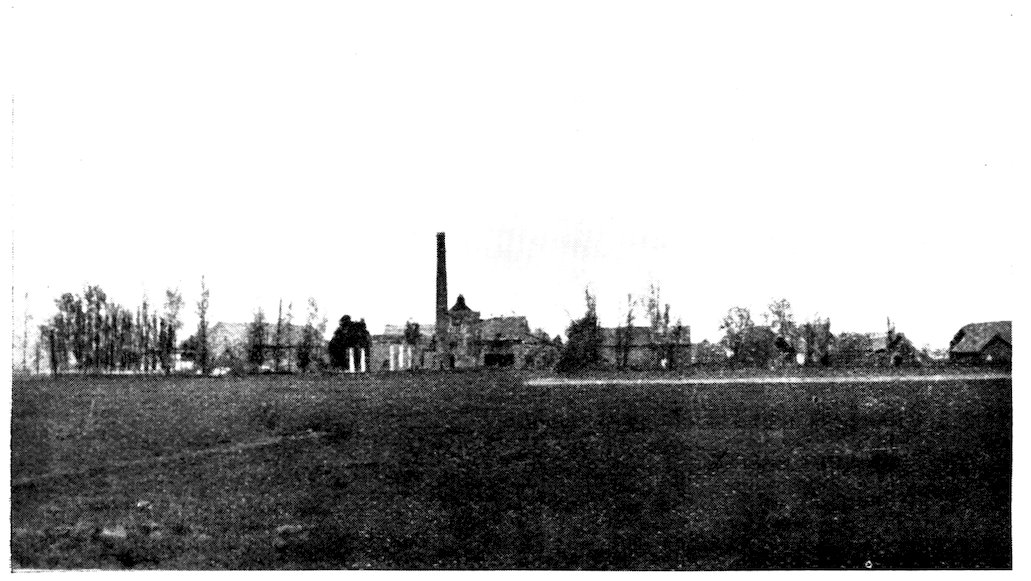
AWOINGT.
The attack, though it did not involve heavy fighting, was a splendid exercise for the Battalion in following a hastily arranged barrage and in keeping direction in open country. The leading companies were on the heels of the barrage all the way, touch was maintained with the Guards throughout, and direction was never lost. It was almost dark when we commenced to advance, we could not see the village, and we went forward on a compass bearing. Soon, however, the sun came out and the morning mist cleared, and we wish we could have had photographs of the plain at about 7 o’clock that morning. The whole Battalion was spread out in extended order over our front of 1,000 yards. In front of the leading companies was the steadily advancing line of the creeping barrage, in front again, round the near outskirts of the village, smoke shells were bursting in profusion, while our big crumps falling continually in the village were sending up huge clouds of red dust from the unfortunate houses. On our left flank the town of Cambrai seemed to be one huge bonfire. It was the most wonderful view of a battle we ever saw during the war. Our casualties were 2nd Lieuts. Winch, H. A. Green, and nine other ranks killed, and 2nd Lieut. Taylor and forty-eight other ranks wounded. We remained on the objectives at Awoingt.
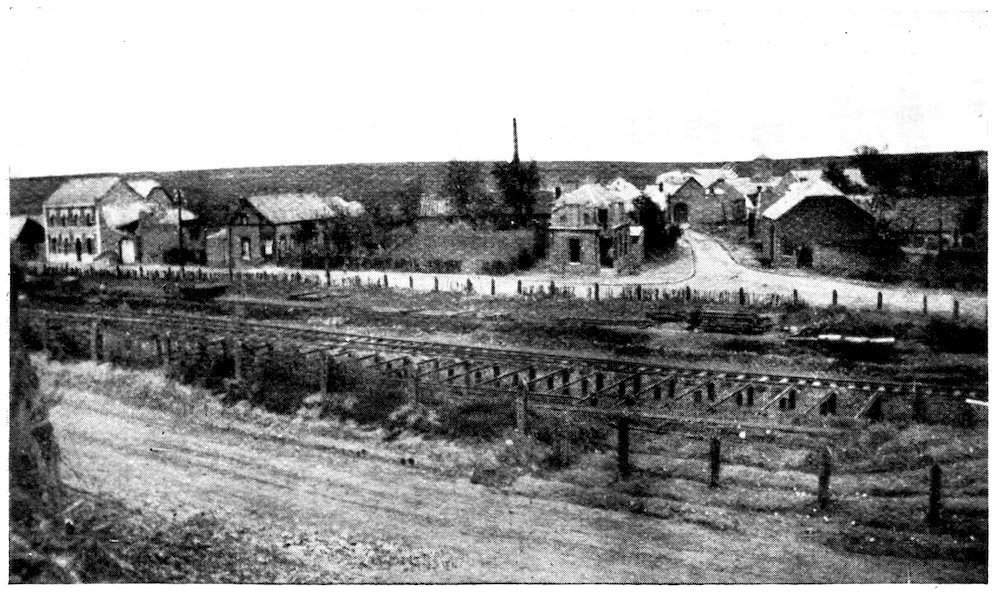
HAUSSY. The house at the corner was Battalion Headquarters. The ground attacked over was beyond the village.
237The village had been considerably knocked about by the shelling, and the enemy continued to add to the damage by his counter-shelling during the rest of the day. The 73rd Brigade passed through us in the afternoon and took over the advanced guard work. On the following morning the 17th Brigade followed the 73rd, and we became brigade in Divisional Reserve. During the day, October 10, we moved from Awoingt to Cagnoncles, where we were very comfortably billeted for the night.
The advance continued on the 11th, and we moved forward in the early morning to positions south of Rieux, where we dug in in artillery formation and remained for the night. It was during this digging in that Lieut. Dean was 238wounded. He was loudly cheered by the Battalion, and particularly by No. 16 Platoon, as he was carried away on a stretcher. This ended Dean’s active service with the Battalion, as after a critical time in hospital in England he did not become convalescent until long after hostilities had ceased, and he was not sent out again. After the charmed existence he had had during the past weeks, it was the irony of fate which decided that he should be the only casualty in the Battalion on the day when he was wounded.
On October 12 the enemy was reported to have retired across the River Selle, and the 17th Brigade were following. The enemy had, however, left strong rearguards behind, and the 17th Brigade had very heavy casualties during the advance on St. Aubert.
At night we moved forward into billets in Avesnes.
In the early morning of the 13th we relieved the Rifle Brigade on the Selle river in front of Haussy. The 1st North Staffordshire Regiment were holding similar positions on our left, and the 9th East Surrey Regiment were in reserve in St. Aubert. Our forward positions were on high ground just short of the ravine through which the Selle flowed. The enemy shelled us persistently in these positions, and the North Staffordshire Regiment had heavy casualties from gas in Montrecourt Wood.
During the night of the 13th/14th our patrols were very active along the line of the river. They found all bridges had been demolished, and the 239enemy was holding the line of the railway beyond with machine guns in considerable strength. During the early morning of the 14th small patrols from A Company succeeded in penetrating into the village of Haussy. The village was strongly held by the enemy, and the civilians were still there. Our patrols were immediately reinforced by two platoons, the men crawling two at a time behind a low hedge into the village. Capt. Selfe and a few men succeeded in crossing the river at one of the broken bridges, and brought back three prisoners as a result of some hand-to-hand fighting in the streets. The civilians were very much on our side. They gave us information as to the whereabouts of the enemy, they concealed our men in their houses, and fed them on coffee and eggs.
In the afternoon the enemy realised what we had done, and attacked our new positions in the village, but we succeeded in holding on. Lieut. Piggott and Sergt. Ashdown were killed.
At a brigade conference held later in the day, plans for an attack on the river line were discussed. The attack was to be carried out by ourselves and the North Staffordshire Regiment, and was to have as its objective the high ground from the chapel in the northern outskirts of the village northwards to the railway opposite Montrecourt. The village itself was not to be attacked. Our attack on the right was complicated by several sunken roads and a sand pit, and we decided to try a new experiment in the nature of the artillery barrage to be used, in 240order to avoid a frontal attack on the sunken roads. The attack was to take place in the early morning of October 16.
We spent the 15th in the same positions. The ground leading to the assembly positions was thoroughly reconnoitred by officers and N.C.O.s, and all arrangements for the attack were completed by midnight. 2nd Lieut. Thomas, who spoke French like a native, went into the village at night, and 150 civilians were escorted back behind our lines.
It was decided to make an effort to assemble for the attack on the far side of the river. To do this it was necessary to ensure that there were no enemy outposts remaining between the river and the railway. During the early part of the night of the 15th/16th, therefore, harassing fire by our artillery was brought down on the railway and on the ground between the railway and the river. From 3 a.m. on the 16th this fire continued on the railway only, and a strong patrol from C Company (under 2nd Lieut. Wallis) advanced across the river and cleared the ground as far as the railway, and took up a line as close to it as the shelling would permit. There was only one temporary bridge available, and all our assembling troops had to cross at this point. From about 3.30 a.m. the enemy commenced a counter-preparation on a wide front. All roads and approaches to the village and river were shelled with gas. In spite of this, and largely on account of the thoroughness with which the reconnoitring had been done, and thanks also 241to the work of 2nd Lieut. Wallis and his covering party, the two companies, D on the right and B on the left, were successfully assembled across the river by 5 a.m. Owing to the lack of bridges, and the winding nature of the river, the assembly positions were on the left flank of our attack, but the special barrages which had been arranged assisted us in launching the attack from these positions.
The barrage opened at 5.10, and our men advanced to the railway without difficulty. It was then discovered that the battalion who were to have attacked on our left had failed to assemble on account of the enemy’s shelling, and the left flank of our attack was therefore in the air. The enemy had several machine guns mounted on the railway north of us, and B Company suffered heavy casualties in crossing the railway. A large number of prisoners were captured in the shelters behind the railway embankment and in the sunken roads and the sand pit.
The enemy was obviously surprised by the novelty of the barrage, combined with an attack from the flank. In spite of the opposition from the left flank the attack progressed, and by 7 a.m. all objectives had been taken, together with over 200 prisoners, many machine guns, and a few trench mortars.
Our successful penetration into the village two days before, and our capture of one bridgehead, had led the Corps to include the village itself in the objectives of the attack, and the 9th East Surrey Regiment were detailed for this 242work. The greater part of the village was successfully taken, and we were in touch with their posts at the chapel.
We had a very long exposed northern flank, and it was necessary to put the greater part of our strength to protect it. A protective barrage was arranged to assist in this, and by 10 a.m. a defensive position had been made which seemed satisfactory. Had we had the men, and had the attack on our left been carried out, we could have exploited our success across the open country east of us, and could probably have got among the enemy’s battery positions. As it was, with greatly depleted numbers and with the necessity of guarding our left flank, we had to adopt a defensive attitude on our final objectives.
All the B Company officers had become casualties, and the sergeant-majors of both B and D Companies. Capt. J. C. Orchardson, commanding D Company, took command of the whole garrison, and he made the dispositions for defence, which successfully held the positions during the day.
As a result of their advance the East Surrey Regiment had an exposed southern flank. A company of the Guards were to come up to protect this flank, but until they came this was obviously a danger point, and there was no certainty that the Guards would be able to get through. From about 10 a.m. the enemy commenced to shell the village. The fury of his concentrated bombardment from then onwards beat almost anything we could remember in the 243way of shelling, with the possible exception of the attack on Delville Wood in 1916. Eight-inch and 5·9-inch shells were falling in the village at the rate of from six to ten a minute, and it became impossible to move troops anywhere in the streets. We had no troops ourselves in the village, except Battalion Headquarters and the Dressing Station, both of which had a most unpleasant day. The Guards’ Company on their way up shortly after 1 p.m. got caught in the shelling, suffered very heavy casualties, and were unable to get to their positions. There was thus an unprotected flank on the right of the East Surrey positions.
A lot of gas shell was mixed with the other shelling, and this, in spite of the fact that there were still several hundred civilians in the village—a fact well known to the enemy. Months afterwards we visited Haussy, and were told on all sides of scores of civilians who had died from the effects of the gas on October 16. In the early afternoon, after the continuous shelling for over four hours, the enemy counter-attacked. He succeeded in penetrating the exposed flank south of the village, and he advanced as far as the river, some 300 yards south of the church. From this point, under the cover of an intense barrage, he worked through the village on the eastern bank of the river, and large numbers of the 9th East Surrey Regiment, holding positions on the eastern outskirts of the village, were thus cut off, and our situation north of the village became critical. Capt. Orchardson was ordered 244to take up the line of the sunken road from the chapel to the railway, and to form a strong post at the chapel facing south, to deny the enemy the northern exits from the village. All this was done promptly, and just in time, and the enemy made no further progress. In the midst of all this inferno we were informed that two companies of the 7th Northamptonshire Regiment were on their way up to relieve us. It was a precarious position to hand over to them. We were the only troops left holding positions on the east of the river, but it was still a fact that we were able to hand over to them at the close of the day the whole 600 yards of river and bridge-heads captured by us in the early morning. During the day also we had added one or two improvised bridges, and the position we left was a very valuable one.
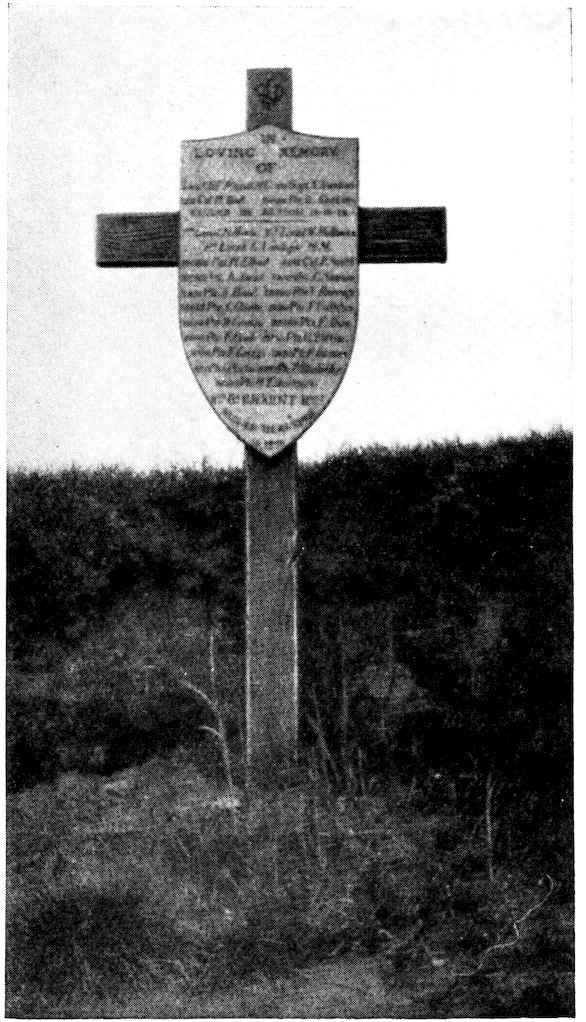
THE MEMORIAL BOARD AT HAUSSY.
We feel that the Battalion can be justly proud of its share in the Battle of Haussy. The very daring and successful work of A Company, in cutting out part of the village two days before the attack and holding it, had a most important bearing on the operations. On the day of the attack the work of the attacking companies was beyond praise. In spite of very heavy casualties at the outset, all ranks displayed the greatest determination. The fact that all objectives were taken, together with a large number of prisoners and a great deal of material, reflects the very greatest credit on Capt. Orchardson and the other officers, N.C.O.s, and men. Throughout the very trying day which followed they held their ground with the greatest tenacity, in spite of repeated enemy attempts to dislodge them, and the crossings of the river were handed over intact at the close of the day.
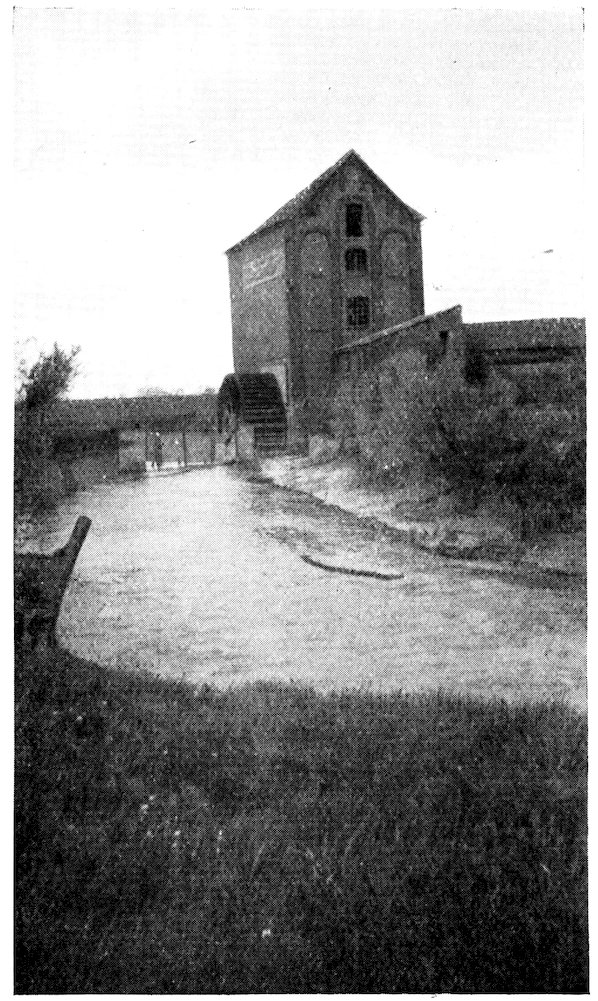
THE RIVER SELLE AND THE MILL FROM WHICH MANY PRISONERS WERE TAKEN.
245At the chapel is a cross erected to the memory of our men who were killed in the Battle of Haussy. 2nd Lieuts. Laskey, Bain, Holman, and twelve other ranks were killed, 2nd Lieut. Wallis and Coy.-Sergt.-Maj. Gutteridge died of wounds, and Capt. Porter, Coy.-Sergt.-Maj. Dyer, and seventy-five other ranks were wounded.
The following decorations were awarded to the Battalion for the Battle of Haussy and the period preceding it:
The Military Cross
Capt. J. C. Orcharson, Capt. A. J. Porter, Capt. J. H. Selfe.
The Distinguished Conduct Medal
Coy.-Sergt.-Maj. J. Gutteridge, Cpl. H. Stoneham, Pte. A. Woodmore.
Bar to the Military Medal
Pte. E. Bowes.
The Military Medal
L.-Cpl. F. H. Apps, L.-Cpl. J. Bellamy, Pte. C. R. Brown, Sergt. H. H. Cater, Coy.-Sergt.-Maj. C. R. Dyer, Pte. A. French, Pte. H. Lang, Pte. A. Miller, Sergt. W. Mitchell, D.C.M., Pte. H. Pipler, L.-Sergt. R. Taylor.
The Meritorious Service Medal
Sergt. H. R. Swain.
246After relief on October 16 we moved back to billets at Avesnes, and the next day we marched to Cambrai, where we remained until the 26th, cleaning, refitting, and training. Cambrai was still in an uncertain state. Parts of it were liable to be blown up by delay-action mines. During our stay there the railway lines at and near the station were constantly blowing up. The houses, even if undamaged outside, were wrecked inside. Furniture, pictures, books, and crockery had been broken or mutilated very thoroughly and wantonly in almost every house by the enemy before he left. Our first work was to try to get the houses we were to use as billets into something like order.
A large part of the town—the part which had been burnt—was barricaded off, and no one was permitted to explore. After a day or two we had got our billets into shape, and, having become accustomed to the constant explosions in the town, we had a comfortable time.
While we were at Cambrai the Quartermaster went into hospital after struggling gamely with very indifferent health throughout the whole summer, and there can be no doubt that the loss of Capt. Wood was more keenly felt by all in the Battalion than would have been the case with any other individual. In the opinion of everyone who served with him, he was the finest quartermaster who ever issued a rum ration. He joined the Battalion early in 1916, and for more than two and half years he worked untiringly for the welfare of the men.
247Nearly every officer who passed through the Battalion will remember the kindly hospitality he received at one time or another at the Quartermaster’s Mess, and Wood had the happy knack of making all feel at home at once. One of his great troubles was getting the stores loaded on to the baggage wagons for a move. Almost invariably, after eyeing the amount to be taken, and with a particularly severe glance at the size of the officers’ kits, he would say, “I can’t carry it,” but, as he always did succeed in carrying it, this became a standing joke. His work may be summed up by saying that he was the friend of everyone in the Battalion.
On October 26 we returned to Avesnes, where we remained till November 2. On November 2 we moved up to Haussy, now some distance behind our advanced guards, and perfectly peaceful. We spent one night there. We met again many of the civilians who had received us so well and helped us during the fight. They were greatly rejoiced at being free of the Boche, but they were perturbed at the damage done to their village, and very bitter about the enemy’s use of gas shells on October 16. During the night the enemy threw over three or four shells from very long range.
On November 4 the 24th Division relieved the 61st Division. The 73rd Brigade formed the advanced guard, the 17th Brigade were in support, and the 72nd Brigade were in reserve. We moved up to Sepmeries, where we were billeted for the night.
248The nature of the fighting had changed considerably since we were last in it. Up to the Battle of Haussy the enemy had been putting up a stubborn resistance, especially where he was defended by a natural obstacle such as the River Selle. Up to then, when there was a fight, it was a very stiff affair, and counter-attacks in great force, supported by annihilating artillery fire, were always likely.
Now it was a case of taking up the hunt of a really retreating enemy. We would still look for fights and we would expect to be shelled at intervals, but the fights were likely to be skirmishes with rear guards of machine gunners rather than with the main enemy force, and the shelling was not likely to be concentrated and continuous as it had been at Haussy. We were to find the advance trying enough, however, for the distances we were to be called on to cover each day were very great, and often in unexpected quarters a company or a platoon would get involved in a pretty desperate local encounter.
However, we felt we were now really entering into the open fighting we had hoped for all through the long years of the war. Although we were still in Divisional Reserve, we could realise by the length of our marches each day what sort of thing was going on in front of us.
On November 5 we marched again forward to Wargnies-le-Grand, where we remained in billets for two nights. Rain was almost continuous while we were there, but the whole Battalion was in excellent spirits. Our long stay at Wargnies 249was on account of a hold-up on another river line at St. Waast-la-Vallée in front. The advanced guard had not succeeded in taking this in its stride, and an attack was therefore arranged for November 7 at 6 a.m.
The 17th Brigade were to take St. Waast and stop there, and the 72nd Brigade were to advance through them and take up the advanced guard work. At 4 a.m. on the 7th we left Wargnies, and our Battalion remained the advanced guard of the Brigade for the rest of the war.
So little news had penetrated through to us that we had no idea as we marched off in the pitch blackness of that November morning that we were in the last days of the war. We had begun to feel that we should advance on and on to the Meuse, then to the Rhine, then across the Rhine, and then anywhere—to Berlin perhaps. The idea of an armistice had never occurred to us. The village of St. Waast was found to be evacuated by the enemy, and we passed through the Rifle Brigade on to the high ground running north-west from Bavai. The Guards entered Bavai from the south at the same time, and we continued our advance during the day to positions some 2,000 yards east of Bavai. Here we were met by very heavy machine-gun fire, and any advance beyond this line was found to be impossible, and we therefore dug in for the night and pushed patrols forward. Strenuous efforts were made by these patrols during the night to cut out some of the enemy’s machine-gun positions, but he maintained a very 250heavy fire throughout the night from positions which had obviously been carefully chosen beforehand, and dug by the unfortunate French civilians of the district. Lieut. H. R. Smith and 2nd Lieut. Everson were killed at St. Waast at the commencement of the advance.
At Bavai on this day and the next we attached to ourselves various units, some officially sent to us, some found by the wayside. In this way our Battalion for the rest of the war became a small field force, complete in almost every branch of the service. The force consisted of:
8th Royal West Kent Regiment (ourselves), 6th Dragoon Guards (found at Bavai, and glad to come along with us), one section of 18-pounder guns (sent to us officially), one section of 4·5-inch howitzers (found, and keen to remain with us), two sections machine gunners (sent to us officially), one section Stokes Mortar Battery (sent to us officially), one section 6-inch Newtons, under command of our old friend Lieut. Bennett of Hargicourt days. He had brought up his section complete, looking for work, and was delighted to come with us. How all these units were fed during these last days remains a mystery, but we had a splendid time together, and we certainly did not starve.
At 6 a.m. on Friday, November 8, we continued the advance with the North Staffordshire Regiment on our right. The 6th Dragoon Guards did our scouting for us during the whole day, and fairly cleared the ground of the enemy.
By 2 p.m. we had advanced 7,000 yards or 251more over difficult wooded country. It was great fun, but very tiring. The work of the junior N.C.O.s was particularly good. A lance-corporal with his section of six men would constantly find himself advancing entirely out of sight of the sections on either side. As far as possible we had provided every section commander with a sketch map, and the way they kept direction was really splendid.
On a line some 3,000 yards west of Feignies Station and the village of La Rolies the enemy was again found in very strong positions, and very heavy machine-gun fire was again encountered.
We got up the 6-inch Newtons and the Stokes, and these, with the assistance of the 18-pounders and the 4·5-inch howitzers, shot up the likely places for machine guns. We dislodged a number, and the civilians at La Rolies next day told us of casualties being carried through the village during the night. We advanced a little further before nightfall, and then found ourselves fairly up against it. The enemy machine gunners evidently had instructions to get rid of all their ammunition, and they shot almost without ceasing and made the work of our patrols very difficult. It was bitterly cold, and every man in the Battalion was absolutely beat. We had received orders during the day that we were to stop at night, and other troops would pass through us to take up the chase next day. We had therefore put absolutely every ounce we knew into it that day.
252Then at 11 o’clock at night our Commanding Officer was called to Brigade Headquarters to a council of war, in which orders were read to the effect that the 72nd Brigade would continue the advance, and the 8th Royal West Kent Regiment would again lead the advanced guard. It is reported that our colonel, who was almost asleep in his chair, on hearing the orders, uttered two words, “Good God!” and fell asleep with his head on his hands. This was Gen. Morgan’s story, and it was vouched for staunchly by his staff afterwards, but we can hardly believe it. Still it gives some idea of the fatigue which had almost overcome everyone of us on this night of November 8. The pace had been very hot indeed for nearly a week, and on this last day, believing it to be our final go for a time, we had put in that extra spurt which had left us pretty limp.
So on November 9 we were to take Feignies Station and the village of La Rolies, stop there, and let the rest of the Brigade—and we hoped the rest of the British Army—pass through us.
Col. Wenyon tells us that he was most distracted when he got back from that Brigade Conference. He did not know if the men could march the two and half miles to Feignies Station, and, if they could, they certainly could not be expected to fight much, and there was a nasty looking embanked railway to cross.
It was decided finally that the patrols which were out already should be instructed to push on immediately it was light and find out whether 253there was likely to be a fight. A message was sent to our friends the Cavalry, who were only too pleased to assist. So soon after dawn the mounted men set off. Two platoons, one from D Company, under Lieut. Gedge, one from B Company, under Lieut. Michie, continued the advance they had made during the night, followed by our Commanding Officer and his groom. It was a close finish. The Cavalry men just got there first. Lieut. Gedge, unshaven and dirty, looking like a backwoodsman, was just extricating himself from his tenth embrace by the worthies of the village of La Rolies, when Col. Wenyon arrived. Flags began to flutter from the windows, gallons of coffee were brought out in small cups from every house in the village, and a rusty old gramophone began to play the Marseillaise—the first time for over four years. The enemy had left on bicycles a few minutes before we got there! Our cavalry friends were after them, and got a few later on. Message was at once sent back to the rest of the Battalion that all was well, and they could come quietly up into billets. During the next two hours they all arrived, and were received with the greatest jubilation on all sides. Coffee was poured down throats, cauldrons of hot water were produced, and sore feet and aching limbs were washed and bathed in a most reverent manner by the admiring civilians. Battalion Headquarters was established in the Hôtel du Nord, opposite the demolished station. The rusty gramophone continued to play the Marseillaise all day, the 254village ladies donned such finery as they had left to them, and strutted the village street, trumpets were blown, more flags were produced, and with laughter and tears the men and women of that little village passed from war to peace. These people had seen the first great onrush of the German Army in 1914—for Maubeuge was only a stone’s throw away—they had borne the German tyranny over four years, the railway station had been burnt to the ground during the last week, and now, almost before the hated enemy had beaten it out of the village, voila les Anglais—et liberté.
So ended the fighting of our Battalion in the Great War. That night we heard of the abdication of the Kaiser and the offer of the Armistice.
We slept long and comfortably, almost every man in a proper bed. We began to feel somehow that this was the end. It was more than a trifle disappointing to the soldier in the field of course. We wanted to see the German Army, if not annihilated, at least squarely beaten in a fight. And it looked as though he was to get away without his whipping.
If this was not the end, we were ready to take up the chase again, and run after the Hun to the end of the world; if it was the end, we had a notion that in our small corner of this world-wide four years’ struggle we had tried to do our job.
CAMBRAI TO MAUBEUGE.
[Click on map for high resolution image.]
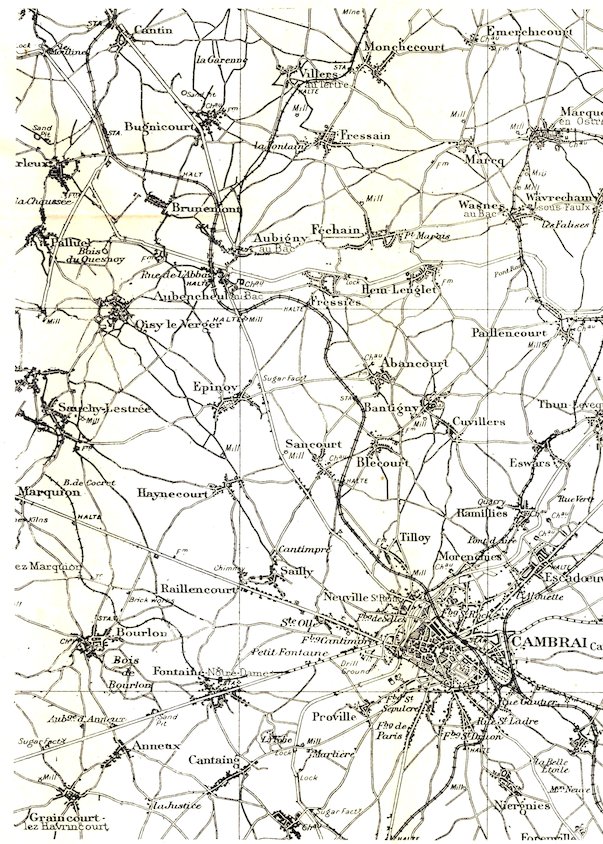
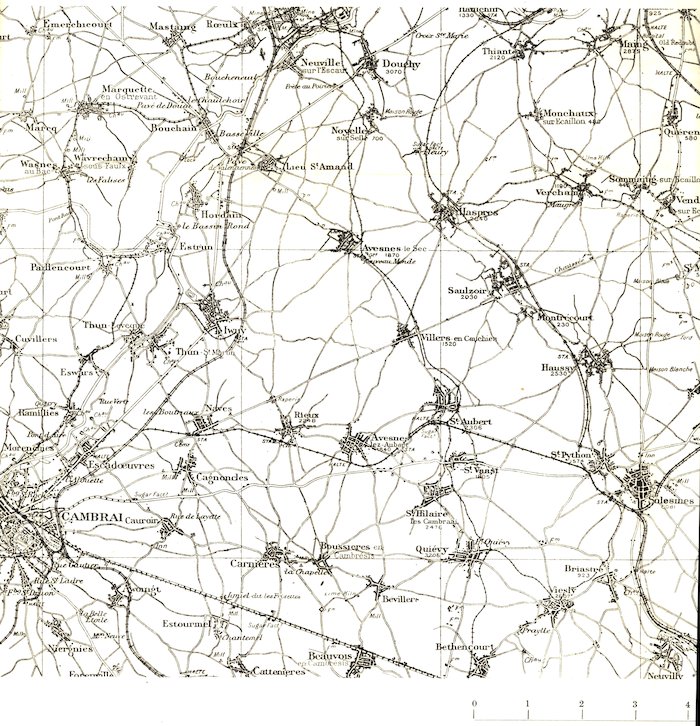
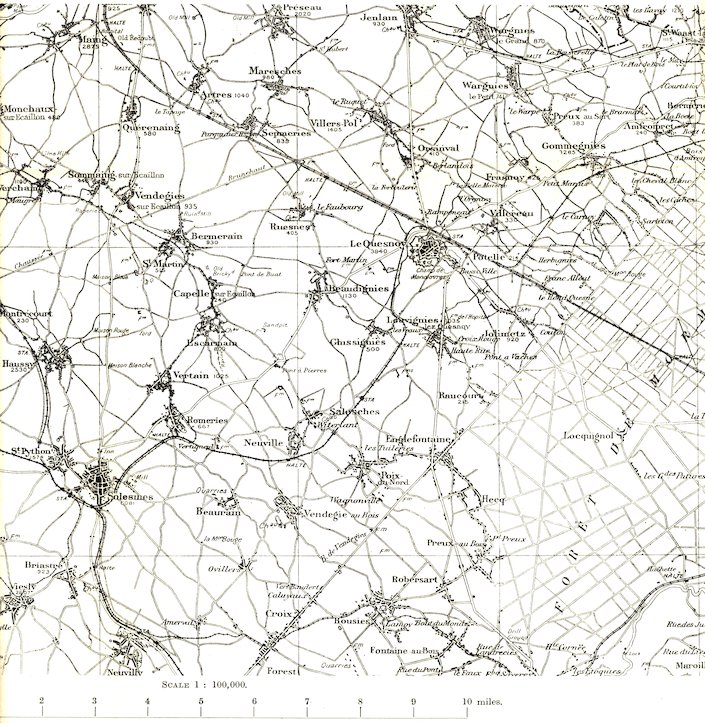
To illustrate the Final Advance. Phase IX.
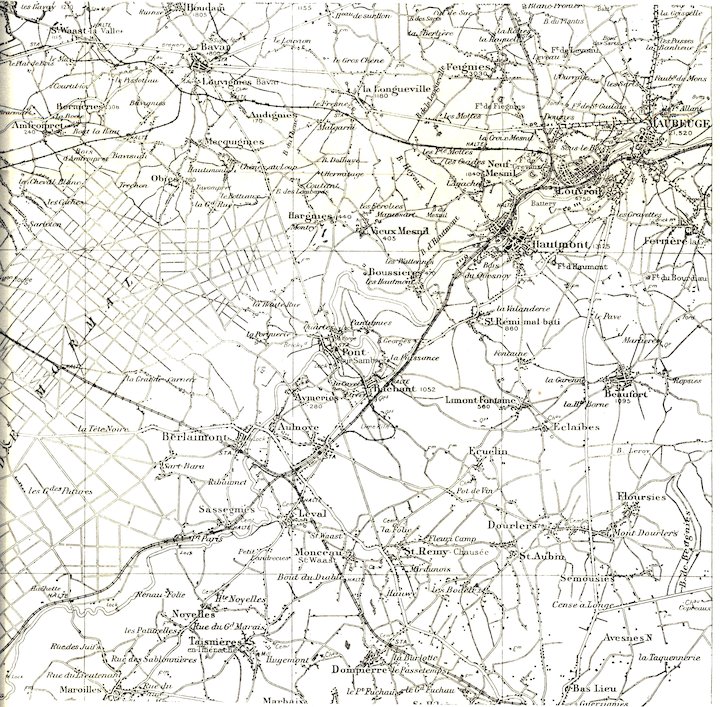
[Reproduced by permission of the Geographical Section, General Staff.
We must mention that at Feignies Station on this last day we captured an enemy minenwerfer factory complete. It was an enormous place, with sufficient ammunition to blow up most of 255the German Army, and we think we are probably safe in saying the most valuable single capture made in a single day by any battalion in the war. It was a pity it could not have been captured years earlier.
During the whole of this final advance from Niergnies to the Mons—Maubeuge road the 24th Division advanced during the six weeks a distance of fifty miles. During the last three days, from Wargnies-le-Grand to Feignies, our Battalion led the advanced guard over seventeen miles.
During the six weeks the Battalion captured 250 prisoners, two field guns, three tanks, one enemy minenwerfer factory, and large numbers of dumps of all kinds.
Our casualties were 9 officers and 48 other ranks killed or died of wounds, and 5 officers and 113 other ranks wounded.
256