PHASE VII WITH THE FIFTH ARMY AGAINST THE GREAT GERMAN OFFENSIVE March-April, 1918
Reading edition
We detrained at Villers Brettoneux at about 6 o’clock in the evening of February 27, and marched through the rain to Corbie. There was some difficulty in getting into billets, and the position was not eased by the rain, which had now become a positive deluge. However, we were back in civilisation, and we were looking forward to a few weeks of it.
So much for our vain hopes. Soon after midday on the first day of our rest, rumour—which ever travelled faster than orders—indicated that everything was not right on the 5th Army front. During the afternoon we received orders that our long-expected rest was cancelled, and we were to entrain in the early hours of the next morning to take up a position in reserve behind Vermand. The disappointment of this turn of events may be imagined, and the situation is put before the reader here because it is one of those cruel turns of fortune which, apart from fighting and the trials of the trenches, made the lot of the infantry soldier a very hard one. The next morning back we all went into camp near Devise, a little village near Péronne.
155We trained strenuously at Devise for a few days. We were now in the 19th Corps, commanded by Lieut.-Gen. Sir Herbert Watts, and were in reserve to the Dismounted Cavalry Division, who held the line in front of Vermand.
On Sunday, March 10, the 72nd Infantry Brigade were inspected by our new Corps Commander. Afterwards the whole Brigade marched past the General by platoons. One of our platoons (No. 4 of A Company) was placed as the smartest platoon on parade.
From time to time during our stay at Devise we reconnoitred the line we were shortly to take over. Finally, on March 11, we moved up to relieve troops of the 2nd Dismounted Cavalry Division at Vadencourt, and took the position of left forward battalion of the 72nd Brigade. Vadencourt was a beautiful place—once it must have been a superb château. All buildings were of course demolished, but the grounds remained practically untouched.
In view of the importance which later attached to the position at Vadencourt, it is necessary to give a brief description of the lie of the land and the method of holding the line.
The 72nd Brigade were on the right of the 24th Divisional front, and held a front of about 3,000 yards, with two battalions forward and one in reserve. The country was “rolling” from east to west. Vadencourt Château was in a commanding position on a ridge which practically formed our main line of resistance. A road ran due south from our Headquarters to 156Maissemy, about a mile and a half from us, where was the headquarters of the Right Battalion. About 600 yards east of us was another ridge, on which and in the plain in front was the outpost zone to a depth of about 800 yards, and on a front of 1,500 yards. The Omignon River formed the right flank of our Battalion front, and ran at right angles to our position from Vermand, some 2,000 yards behind Vadencourt, into the enemy territory in front of us. The forward positions were held by isolated posts. There were no continuous trenches. There was a double line of trenches in the ridge in front of Battalion Headquarters already referred to, and Vadencourt itself was a large organised and well-sited redoubt, with trenches with good field of fire and machine-gun positions. The main road, known as Watling Street, from Vermand to Estrees, was our left flank. Almost in the centre of our outpost zone was a huge mound known as The Tumulus, standing some fifty feet high. Such registration as the German gunners did was usually carried out on this mound.
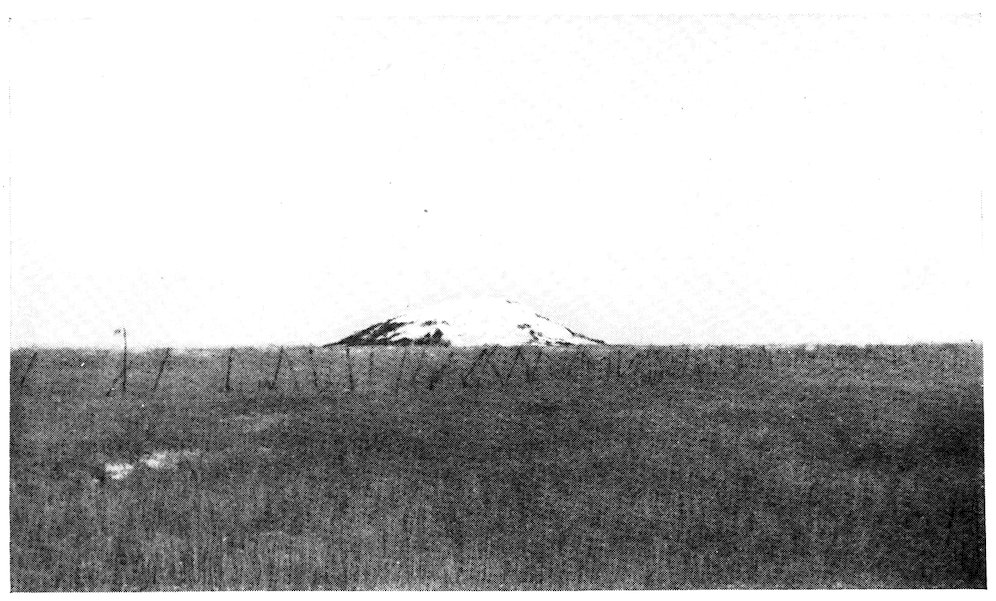
THE TUMULUS.
Most of our positions were moderately well wired, and had a good field of fire. There was a very wide No Man’s Land—about 1,000 yards. At Vadencourt itself, in addition to the flank defence formed by the Omignon, there was strong and well-sited wire, and on our right front an arm of the river formed a swamp at the bottom of the valley about 300 yards from our fire positions. From the point of view of stationary warfare, this seemed to be an ideal sector of the line. There was little shelling, and it was a case of lying dogo simply during daylight, and thoroughly beating up No Man’s Land during the night. Large patrols were out each night from dusk till dawn, about eighty men and four officers being employed.
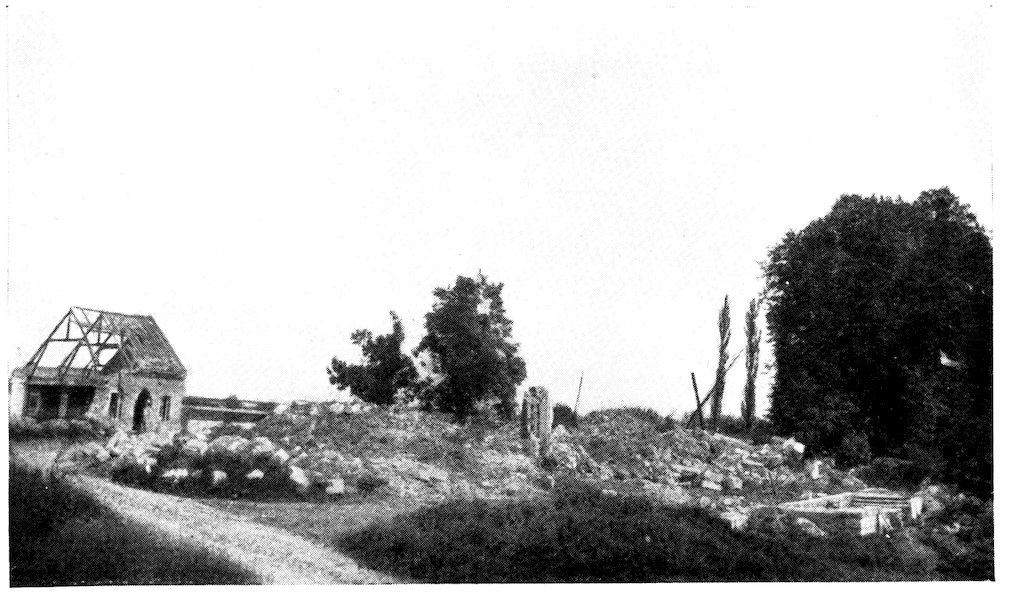
VADENCOURT CHÂTEAU. Battalion Headquarters was near the two trees on the right.
157On the whole all the positions except one or two of the foremost were comfortable, the weather was fine; and when we first had a good look at the delightful countryside, it was almost impossible to think of anything but a peaceful life there. Very soon, however, it was to become an inferno of every kind of beastliness in the way of shot and shell. We knew we were brought back into the line for a reason, and work on the improvement of defences at all possible times, the constant instructions of all ranks as to the exact importance of the various positions, and constant intelligence reports of activity extraordinary behind the enemy lines made us feel in our bones that the charm of our present outlook might not last for ever. We started then on this evening of March 11 for a long tour in this position. Two companies were in the outpost zone in front; two companies and Battalion Headquarters in the Vadencourt defences. Inter-company reliefs were carried out every four days, and we began to settle down to routine work.
In spite of the seeming uncertainty of things, leave was never better in the whole war. When the great enemy offensive commenced on March 21, about 200 officers and other ranks of 158the Battalion were on leave to England. On March 19 B Company were holding the outpost zone on the right, D Company on the left. A and C Companies were at Vadencourt Château with Battalion Headquarters. On our right the 1st North Staffordshire Regiment were in the front line with Headquarters at Maissemy.
On our left were the 3rd Rifle Brigade (17th Brigade).
On March 20, which was very quiet, the adjutant, Capt. Baker, went on leave. In the evening report was received at Battalion Headquarters that according to information given by a German prisoner, an enemy attack might take place on March 20 or 21. The usual patrolling was carried out on the night of the 20th/21st, and no abnormal enemy activity was reported. The night was clear and fine, but just before dawn a thick mist began to develop which shortly became so dense that it was impossible to see more than fifteen yards. It was in this famous mist that the Germans commenced their grand offensive against the British 3rd and 5th Armies, which was designed to cut between the British and French Forces and win the war in a few weeks.
At 4.30 a.m. on March 21 a general bombardment by the enemy commenced, and we were in the thick of it.
Vadencourt Château was very heavily shelled for six hours, largely with gas shells. The outpost zone and trenches on the ridge were being knocked to pieces.
159A very gallant young officer of C Company, 2nd Lieut. C. C. Baring, unfortunately got badly gassed by almost the first gas shell thrown over, and later died of the effects. Apart from this there was no known case of a gas casualty in the Battalion. About 7 o’clock Lieut. G. S. Bowen, the Intelligence Officer, set out to visit the forward companies. He got safely through a perilous journey, and returned to Battalion Headquarters about 9 o’clock. The trenches in which were the Company Headquarters on the ridge in front had been badly knocked in in parts, but no attack had developed in this area.
The enemy gunnery had certainly been marvellous. In the previous weeks there had been practically no registration by their artillery, and almost all shooting on March 21 must have been by map or by sound ranging. Yet there was scarcely a battery behind our front which did not lose half its guns, and trenches and redoubts were shot up with wonderful precision. Just behind Vadencourt were two 4·5-inch howitzers, which had been in position two days, and fired a few rounds only.
Both these guns were knocked out by direct hits very early.
About 10.30 a.m. the order was given for gas masks to be removed, and a few minutes later the first report of the enemy advance came in. It was still too misty to see more than a few yards, and scouts had therefore been sent out on the flanks. One of these from the road to Maissemy reported that the enemy had attacked 160the North Staffordshire Regiment from the right flank and rear, and had overwhelmed them and was now advancing on us straight up the Maissemy road. How much of this was true it was impossible to say, but it was soon obvious that something serious was wrong, for machine-gun and rifle bullets began to whistle among us from the direction of Maissemy on our right, and slightly from the rear. The bridge over the Omignon was demolished at once, and just in time, by Lieut. Christison, R.E., of the 103rd Field Company, in the face of the enemy. This bridge was the only crossing of the river anywhere near our position, and we now had a fair protection on our right flank against direct assault, but not against enfilade fire, which was very troublesome all day long.
About 11.30 a.m. the fog began to clear and the sun came out.
At this point it may be well to mention the officers and warrant officers who held the commands within the Battalion:
Commanding Officer, Lieut.-Col. H. J. Wenyon.
Adjutant, 2nd Lieut. J. B. Cryer.
Intelligence Officer, Lieut. G. S. Bowen.
Medical Officer, Capt. W. A. Kellogg (U.S. Army).
Company Officers:
B Company (Right Forward Company), Capt. C. R. H. Allworth.
D Company (Left Forward Company), Capt. F. C. Needham.
A Company (at Vadencourt), Capt. W. J. Ewen.
C Company (at Vadencourt), Capt. S. G. Thompson.
Regimental-Sergeant-Major, Regt.-Sergt.-Maj. R. Rankin.
Transport Officer, Capt. J. N. Arnaud. A/Quartermaster, Lieut. H. E. Outram. Regimental-Quartermaster Sergeant, Regt.-Quartermaster-Sergt. R. Ifould.
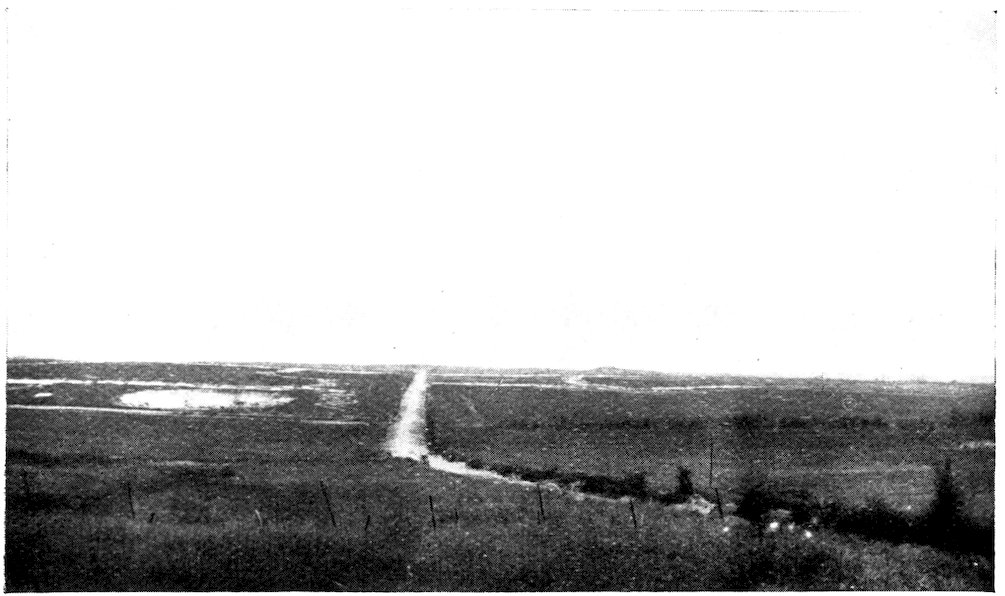
WATLING STREET, COOKER QUARRY, THE SUPPORT POSITIONS, AND IN THE DISTANCE THE TUMULUS.
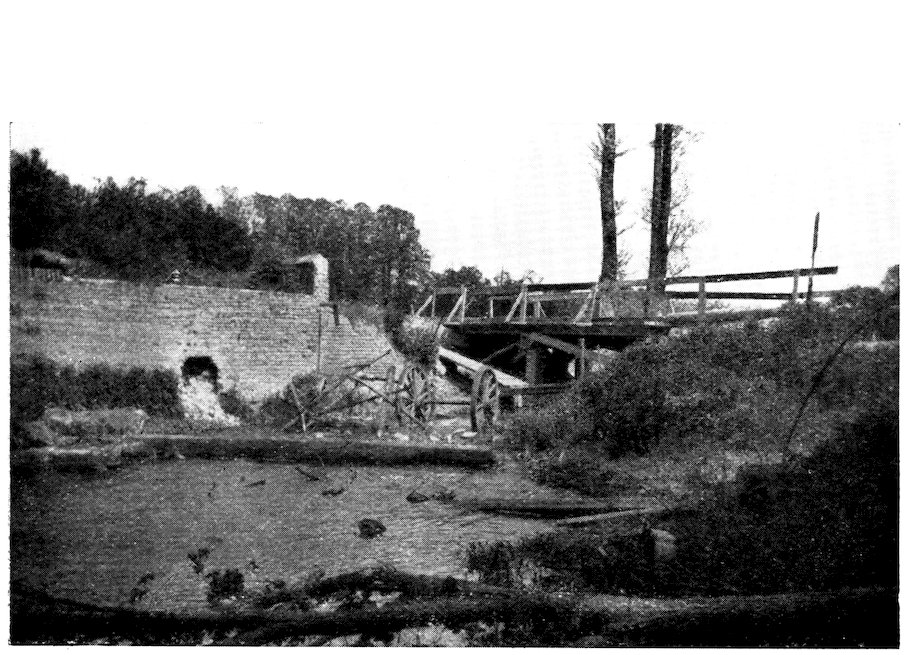
THE BRIDGE OVER THE OMIGNON RIVER.
161A number of officers, including the Adjutant, Capt. Baker, the Quartermaster, Capt. J. R. Wood, and the Officer Commanding D Company, Capt. F. Proctor, were on leave.
As visibility became better at 11.30 a.m., it was possible to discover at last something of what had happened.
The enemy were seen to be occupying Mareval and Pontru Trenches on the ridge in front of Vadencourt. Capt. Needham, Officer Commanding D Company, got back wounded to Battalion Headquarters. He reported that after very heavy shelling, his company had been attacked from the right flank and from the rear, and very few could have escaped. Shortly after this two prisoners were brought back by one of B Company’s runners, and a few men of B Company (mostly wounded) came to the dressing station. The following account of the fate of B Company is given by Capt. C. R. H. Allworth:
“At 4.30 a.m. on March 21 the enemy opened a very heavy bombardment on our positions, chiefly on the village of Pontru and on the forward 162outpost positions; a great number of gas shells were used, together with the high explosive. By 5 o’clock the telephone wires between Company Headquarters and the forward platoons and Battalion Headquarters had been cut by shell-fire. During the bombardment the Battalion Intelligence Officer and a runner visited me; they stayed for about ten minutes, and then returned. I then decided to go up to visit the forward platoons; my runner accompanied me. We had left the trench, and had proceeded about 200 yards, when two Germans appeared out of the mist, one was a wounded man and the other a medical orderly or a stretcher-bearer; the latter escaped in the mist, but we captured the man and brought him back to Company Headquarters. He could speak neither French nor English, and since I could not speak German, he was not of much use to us. This was our first indication that the enemy had attacked.
“The enemy had occupied Pontru village and all the foremost positions. About 8.30 a.m. they attacked our line (Pontru Trench and Mareval Trench). The wire in front of the trench had been untouched by the bombardment, and owing to our Lewis-gun and rifle fire they failed to get through it. The enemy then brought up a machine gun on the flank bridge across the Omignon River on the right of our sector; this was put out of action at once by our right Lewis gun. They then brought up another gun, and, owing to a jam in our Lewis gun, put our team 163out of action. A number of the enemy came down the banks of the stream and rushed the post and occupied the right of Pontru Trench. We attempted to bomb them out, but they got round in the rear of the trench, and we had a rather exciting retreat down the trench to Company Headquarters, where we established a block.
“By this time the enemy had broken through on the left, and were coming down the Bellenglise-Vermand road. I ordered a few men to hold the “block,” and the remainder I sent up the trench to convenient positions to fire at the enemy on the road. The Germans suffered very heavy casualties on the road; a machine gun from Cooker Quarry did some splendid shooting. After about three-quarters of an hour of this, which under different conditions would have been very good sport, we ran out of ammunition. The enemy had been rifle grenading us and sniping us very heavily, and only very few men remained. We could see the Germans digging our support line, and there were great numbers attacking our rear positions. We then, with fixed bayonet, got out of the trench and attempted to get back to the Battalion’s main positions, but we ran into large numbers of Germans and were overpowered.
“The men of my company behaved splendidly. Though several of them were wounded, they carried on firing, and the enemy suffered very heavily.”
Had we not known it from the weight and length of the bombardment, it was obvious, as 164soon as we could see, that this was no ordinary attack. The effrontery of the enemy was astounding. He was marking out the line of his advance with white flags, and far in the rear the forward movement of battalions with full transport could be seen in all directions. Message after message was sent down asking for artillery fire to be brought to bear on these wonderful targets, but our guns were practically all silenced, and not till late in the day did any begin to speak at all, and these were shooting very short into our own positions. The general advance of the enemy in large numbers towards Vadencourt and Cooker Quarry (held by the Rifle Brigade on our left) began about 12 noon. Vadencourt was subjected to very heavy machine-gun fire from three directions. Finding the obstacle of the river and swamp on our right front too difficult, the enemy attempted to advance across our front towards Cooker Quarry. He was in close formation about a battalion strong. Our Vickers guns, Lewis guns, and rifles did tremendous execution, and very few of the enemy got back. This success braced us up considerably, and we felt there was yet a chance of holding on to our position if only our flanks could hold. No information came through to us as to the general position, even on our own divisional front.
In the afternoon the Rifle Brigade were still holding a line level with ours, but on the right the enemy was established in Maissemy and had advanced about a mile beyond it, and was trying to get machine-gun posts on the river bank.
165The scene on our front during the afternoon was most exasperating. Several frontal attacks by the enemy were frustrated by our rifle fire, but the steady movement of enemy forces from the rear could not be checked. All we could do was to engage them with Vickers guns at 2,000 yards’ range. Enemy aeroplanes swarmed overhead and bombed us at intervals. An observation post had been established on The Tumulus, and a group of mounted men remained there all the afternoon.
In the early evening the enemy commenced to shell Vadencourt and its surroundings heavily again; trench mortars had been brought up, and things began to get very unpleasant. In spite of the precarious nature of our line, it appeared that we could hold on if the troops on our left in Cooker Quarry held. We had plenty of ammunition, and although we were reduced in numbers and several machine guns had been knocked out, we could still bring a very withering fire to bear on anything like a frontal attack.
At 7.15 p.m. the enemy commenced to advance towards Cooker Quarry, and unfortunately both quarry and trench were captured, the garrison, some 200 strong, retiring in the direction of Vermand. The enemy immediately commenced to advance in large numbers up Watling Street, and towards the high ground on our left flank. This left us with both flanks hopelessly in the air. We engaged the enemy with every available rifle, Lewis gun, and machine gun, and considerably delayed his advance. About this time we 166received the only written message of the day from Brigade Headquarters, sent off about five hours before. This informed us that a counter-attack to retake Maissemy under an artillery barrage would take place at 7.30. In view of this we decided to hold on. This message, as we learned afterwards, was cancelled by another one which we never received, and the counter-attack did not take place. We were now truly in “Queer Street.” Every minute we were expecting the bombardment and attack on Maissemy to commence, every minute also we were expecting an overwhelming attack from our left flank. The outposts of A Company on this flank did splendidly during these tense minutes. They harassed the enemy furiously, and undoubtedly deceived him as to our actual strength at this particular spot. It was barely a platoon, but it might well have been half a battalion. However, it was obvious this could not go on for long. We were badly placed to meet an attack from this flank, and as soon as the enemy discovered the real position he could overwhelm us by probably twenty to one. Still there was the hope of the Maissemy attack, and we held on.
The next move by the enemy was a bombardment by howitzers and trench mortars, added to a rattling and continuous machine-gun fire on this unfortunate left flank of ours. Tyler and Malby, two young officers of A Company, were in charge up there, and they and their men stuck it splendidly. But they were losing men 167steadily, and something had to be done at once.
At 8.30 p.m. it was decided that we would make an attempt to withdraw under cover of darkness to the Brown Line at Bihecourt some 600 yards behind. This was no easy matter, and it was essential that we got away unknown to the enemy. A strong rearguard was organised, and took up positions on the threatened flank.
Lieut. Goulden, 2nd Lieut. Pfeuffar, and 2nd Lieut. Tiley, with a number of men with four Lewis guns formed the guard, and they set up a powerful demonstration of fire for nearly an hour. There was no panic in the Battalion whatever. A definite order of march was laid down, and a section at a time the whole garrison withdrew to Bihecourt.
The rearguard got back about 10 p.m., and, thanks to their work, we had achieved almost a miracle in getting back without a single casualty. Two companies of the 13th Middlesex reinforced us in this line, and the whole force was properly organised from the river northwards, and into touch with the 17th Brigade by 12 midnight.
So ended March 21, 1918, one of the most memorable days in the whole history of the Battalion. The brief sketch of the main events of the day gives a very feeble picture of the actual fight. Countless acts of heroism could be recorded if space allowed. The whole Battalion fought splendidly. Vadencourt could well have been described as hell during almost the whole of that day, yet no one ever thought of wavering, 168and again and again the enemy was thrown back with heavy losses. It was not till afterwards that we learnt with pride that the holding of the ridge north of the Omignon River had such an important tactical bearing on the general situation, and that the 24th Division was the first division in the British Army to be mentioned by the Commander-in-Chief in his first dispatch on the great fight against the German offensive.
Congratulations were showered on the Commanding Officer for the work of the Battalion. A message had been sent to us ordering us to withdraw to Bihecourt in the early afternoon. The message had never arrived, but the Brigade Staff, seeing that we did not come back, had given us all up for lost. A council of war took place in an old cellar in Vermand at midnight. Everything was fairly quiet now, but it was obvious that by the morning the enemy would be ready for another great smash. So far he had achieved very little success on our front, but our numbers were sadly depleted, and we had seen almost countless numbers of men, horses, guns, and trench mortars being hurried into the forward positions obviously for the next day’s work. It was decided that a stand should be made on the Brown Line, and the 72nd Brigade was hastily reorganised.
Col. Le Fleming of the 9th East Surreys had been killed in the afternoon; Col. Pope of the 1st North Staffordshire Regiment severely wounded in the morning.
Col. Anderson, who came up to reinforce with 169dismounted cavalry, joined the East Surreys, and took command of the force south of the Omignon. Col. Wenyon was given command north of the river.
A certain amount of fitful sleep came to most of us during the night, and food was taken very early in the morning. There was another very dense fog at dawn, and the enemy did not begin his advance so early. About 9 o’clock he commenced a hurricane bombardment of Vermand and the Brown Line area, and immediately launched his attack on Bihecourt. Possibly the cases of excellent port wine which we had been compelled to leave behind at Vadencourt had made him reckless, and in spite of casualties the enemy advanced almost right up to our trenches. Fortunately there was some wire in front of this line, and most of the attacking force that had got so far died a few yards only in front of the muzzles of our rifles. Here and there over the 300 yards of open country in front of us small pockets of the enemy established themselves in shell-holes and old trenches. A supply of rifle grenades which were found in the Brown Line were used with great effect by C Company in driving away these enemy posts. The enemy’s trench mortaring was again very unpleasant. The manner in which he had moved up these great engines was almost uncanny.
Constantly during the morning the attacks were renewed, but he met the same steady front he had tasted the day before. The two companies 170of the 13th Middlesex took up the fight splendidly, and we can really be said to have taken tea with the Hun on this morning. Several times he reached our wire in small numbers, but he never got into our trenches. From the noise on our left we were under the strong impression, however, that all was not well there. It was pretty clear that the enemy had fairly penetrated, but it was not until much later in the day that we knew that during the morning he was fighting through Bernes, some five miles behind us.
About 1 p.m. the enemy succeeded in driving in our troops at Villecholles, south of the river, and reached the outskirts of Vermand. So suddenly did this happen, that it seemed that the only way back for our men was going to be closed before we could move. An immediate order to withdraw was given, but it was not until 2 p.m. that we actually left the Brown Line. By all the rules of warfare, none of us should have got back alive. Our only way back was along a dead straight road (our own wire made it impossible to go across country). This road was being shot along and across by a murderous fire from well-placed machine guns. We certainly had many casualties on the Vermand road, but the miracle was that so many did get safely back.
We got on to the road from Vermand to Monchy Lagache, and it was a case of a straight march in small parties. The enemy was through a long way on our left, and too close to our flank to be pleasant. He was through even further on our right, but beyond the river, and not so 171close. We were peppered with machine guns along the road, but we got through, and we were ready for a rest and some food when the Brigade concentrated in some old trenches at Monchy at 8 o’clock in the evening. After these two days of battle we realised the tactics, now so well known, which the enemy was using for his great offensive. The battling all along the line was calculated by him to discover some weak spots in our resistance. Immediately he had penetrated anywhere, he sent reserve mobile troops with motor machine-gun sections if possible through the gap, and very often succeeded in cutting off troops which had resisted. This is what happened to part of our front companies on the first day. The enemy had penetrated right through on their right, and, crossing the river between Vadencourt and their trenches under cover of fog, he had attacked them simultaneously from the flank and the rear. So it was all the way back on this sustained rearguard fight. Every day we were fighting the Hun very hard, and at close quarters; at the end of the day we found our positions intact, and were ready to take up the fight with him again at dawn. Then, just as we were hoping to snatch an hour’s rest, we were ordered back to conform with a new line for the next day’s battle, the enemy having succeeded in getting through some miles on one of our flanks.
We passed through the Green Line, held on this front by the 50th Division, who had been hurried up from rest in motor-buses. The 172position did not inspire us with much confidence as we passed through it. On most of the front the trenches were only a few inches deep, and the front held by the 50th Division must have been a wide one, for the troops were very scattered. However, the trenches were well sited and the wire was quite good. One party of our men, under the Regimental-Sergeant-Major, stayed and held a post in the Green Line until nightfall, when they joined us at Monchy Lagache.
We found the transport under Capt. Arnaud at Monchy, and heard the first news of their experiences. The transport lines had been fairly blown up at Vermand on the 21st. Cpl. Verrall and one or two men, directly the bombardment started, got the animals out and stampeded them on the road behind Vermand. Here they were all collected, and it was a miracle that we did not lose a single horse. Had they remained in their lines for half an hour, most of them must have been killed. The Brigade Transport Officer had taken the transport right back to Monchy straight away, and in consequence there were no vehicles available forward to remove our Quartermasters’ stores from Vermand, most of which had to be abandoned. The cookers were going strong at Monchy, and we had a very welcome hot meal before getting our first rest for forty-eight hours.
All night the hangars at the great aerodrome at Monchy were burning, and lit up the country for miles. The enemy shelled the village in a random way, and the night was bitterly cold.
173At dawn breakfast and as fine a tot of rum as was ever drunk was issued. The Commanding Officer was called to a council of war at Brigade Headquarters in the village.
Col. Wyatt, who was commanding the Brigade in the absence of Gen. Morgan, set out the plan for the day. The Green Line had apparently been fairly easily forced by the enemy, and our Division was ordered to withdraw across the Somme at Falvy. The 24th Divisional Reinforcement Camp had been formed into a battalion, and were attached to the 72nd Brigade for the day. Our brigade was detailed to form the rearguard on the eastern bank of the Somme for the rest of the Division to pass through. The other brigades were in the trenches on our right, and we were to stop at Monchy till they had all moved off. It was the third foggy morning, and this seemed all to the good for our particular job. However, it seemed the orders had not reached the other brigades so soon, and we had to wait for them to move. All orders were issued and the order and manner of march laid down, but it was after 10 o’clock before we started.
Then, just as we were leaving Monchy to take the track across the three miles of plain to Falvy, our Commanding Officer, who was in command of the rearguard, found the Rifle Brigade digging themselves in behind the village. Gen. Stone, commanding 17th Infantry Brigade, was in attendance, and he was of opinion that one battalion ought to be left there for a time to prevent the enemy if he took the village from 174debouching on to the plain. The fog was just beginning to disappear, and it appeared that this plan was unwise in the circumstances. However, Gen. Stone wished the Rifle Brigade to fight this position, and he asked for one company of the East Surreys to scout through the wood as a flank guard on his left. The company was accordingly detached, and worked its way through the wood. Later in the day this company got to the Somme, when it was a perfect inferno, and at a place where there was no bridge. Many of the men were lost, and the remnants had to swim the river.
The remainder of the Brigade got to a position on the east bank of the Somme, as ordered, and by this time the whole of the Division could have been safely over the river. About 11 o’clock the sun came out, and every blade of grass on this wide plain was visible. The whole Division, including attached troops, were there. When the Rifle Brigade began to come back at about 11.30 they were shelled unmercifully, so were the Reinforcement Camp Battalion just behind them, and so were the rest of the Division on the bank of or crossing the river.
Our cheery little friend, the Brigade Signalling Officer, Lieut. G. F. Hopkinson, did marvellous work during the terrible time that followed. Again and again he went up on his motor-bicycle across the plain and brought back wounded men to the dressing station across the river.
After every other unit of the Division had crossed the river the 72nd Brigade crossed at 175about 3.30. It had been a horrible day, and we are firmly convinced that had the whole division marched away from Monchy in the fog, the retirement would have been completed without a casualty.
Just before we crossed the Somme a squadron of cavalry rode over the bridge eastwards. They could do very little at this stage, but they seemed to be spoiling for a fight, and were acting under orders given several hours earlier. With the greatest gallantry they attempted to round up the machine-gun nests which the Germans had now pushed forward, but they suffered very heavy casualties both to horses and men, and had to return. A battalion of the 8th Division passed us as we crossed the river. They were to act as an outpost to the main line on the west side of the river. The division had been sent up from a rest area to hold the line of the Somme, and the men were in splendid fettle as they swung across the bridge.
So with wishes of good luck on both sides we passed through the 8th Division to the village of Licourt, some four miles off. We could not have gone to a more unfortunate place. It was peaceful enough, and our Battalion was got together and camped under the sky in a big field. But in the village was the headquarters of an Infantry Brigade of the 8th Division.
The Brigadier-General commanding this brigade was in doubt about his positions on the river. He found Col. Wyatt, who was commanding our Brigade, and our Commanding Officer 176was summoned to the Brigade Headquarters. The General stated that he had not received information of the arrival of one of his battalions. Our Commanding Officer pointed out that this battalion had passed through in the direction of the river in buses some time before. This would not do for the General. He ordered us to go.
Our men had been at it fighting or footing it for twelve hours, after two days of hell. They were very nearly dead beat, and now they were ordered back to the crossing of the river they had just passed, almost certainly on a wild goose chase. The Colonel decided to go down to the place himself first, and orders were left with the Adjutant that the Battalion should move off half an hour later.
Arrived at the river, he left his horse and groom at an old church and went on. He found, as expected, the Battalion was in position, and had been on the spot for some hours. It was now getting dusk and he could not find the horses, so he came back on foot, but unfortunately by a road parallel to the one down which the Battalion was marching. The Battalion had to proceed right to the river, and were then sent back. They arrived back at Licourt about midnight, and shortly afterwards Capt. Arnaud brought up the cookers and a wonderful hot meal. The night was again very cold indeed, and it was a case of lying down in the open. This meal was the finest thing we had seen for a long time. In spite of the cold and soreness of limb, we slept like logs.
177On the next day, Sunday, March 24, the 72nd Brigade was ordered back early in the morning to Chaulnes, some six miles back. There were welcome signs of our own artillery on this march back. Big guns were in position, and speaking to some purpose on all sides, and more were lumbering up as we marched. At this time we were supposed to be marching out to be relieved by French troops, but we did not really believe it. We had heard that there had been some hitch about demolishing some of the Somme bridges, and the river positions did not seem to be altogether secure.
We arrived at Chaulnes about 9 a.m., and as we were now some miles at any rate from the enemy, we had a few hours’ relaxation. The feet of every man in the Battalion were attended to first, and much-needed water and soap were brought into use. Kellogg, the Medical Officer, had a busy morning.
At noon a council of war was summoned hastily at Brigade Headquarters. The enemy was reported to have forced a crossing of the Somme at Béthencourt, and a gap had been formed between the 8th and 20th Divisions. The 72nd Brigade was ordered to march to Fonches to take up a position there. The American officer in command of a big dump, which had been set on fire, met us just before we left Chaulnes with the comforting news that the enemy was in sight and that we would never reach Fonches. As we marched across the railway, some excited French Engineers were trying 178to blow up the permanent way, and were doing their best to bring it off as we were crossing. In view of the news we marched to Fonches by companies, with strong flank guards and advanced guards thrown well out. We arrived there without incident at 3 p.m., and found Fonches was a place of perfect peace. The Brigade was disposed in trenches defending the Hattencourt-Fonches-Fonchette road, the 9th East Surrey Regiment on the right, the 8th Royal West Kent Regiment on the left. The 73rd Brigade were on our left in front of Punchy, and the 17th Brigade on their left in front of Omiécourt. The Battalion’s dispositions were quickly made, and close liaison established with the battalions on our right and left. Battalion Headquarters were established at Fonches Church. Very soon it was clear that the enemy was not within miles of us yet, and the cookers, which had been kept a little behind, were ordered up. Fonches was a pretty little village, with an old village green; the weather was delightful, and we wonder if anyone who was there will ever forget the wonderful picnic on the green which we had on the arrival of the cookers.
We felt much fitter after this, and every man was given a task in strengthening our trench positions. The work went on right through the night, while joint patrols of our men and the 7th Battalion Northamptonshire Regiment were out under 2nd Lieut. Pfeuffar, through the dense wood and along the valley east of Fonches as far as Curchy. By daybreak we 179had greatly strengthened our positions along the road.
About 7 a.m. it was reported that the 8th Division were to make an attack in the direction of Morchain and Béthencourt, in conjunction with French troops. The 24th Division was ordered to move up in support of the attack, and the 17th and 73rd Brigades took up a position on the line Dreslincourt to Pertain. The 72nd Brigade took up a position in support, astride the railway west of Hyencourt-le-Petit. This meant a march of about two miles north from Fonches. The Royal West Kent Regiment deployed north of the railway in three lines, D and C Companies and the North Staffordshire Regiment (the remnants of whom were now attached to us) in front, A and B Companies in support, Headquarters in reserve. The enemy shelling became very unpleasant—the 17th and 73rd Brigades were driven in, and at about 1 p.m. the 72nd Brigade was ordered to return to Fonches and hold the line Hattencourt-Fonchette to the main cross-roads 800 yards north-east of Fonchette. After some difficulty—the main road being now the mark for enemy guns—we took up the new positions, and the Commanding Officer inspected the left flank of our position. It was found that the 73rd Brigade front was at right angles to ours, and running back towards Hallu. We had a telephone line to Brigade from Fonches Church, and the position was immediately explained to General Morgan, who had just got back from leave full of martial ardour.
180Our Colonel was ordered to do all he could to re-establish this flank. In any case we were to hold out at Fonches to the last. The 9th East Surreys were in position on our right, and, leaving Maj. Clark in charge, Col. Wenyon went with his servant (Pte. Smith) to see what could be done on the left. The enemy had advanced considerably opposite the 73rd Brigade front, and appeared to be occupying Hyencourt-le-Petit, and positions south of that village. Heavy machine-gun fire was being directed on the area north and west of the cross-roads which formed our left flank. After about two hours, two battalions of the 73rd Brigade were got forward to the belt of wire running north and south just west of the Fonchette-Omiécourt road. Our position being now secure, Col. Wenyon returned to Fonches.
The Battalion had been having a bad time. The Fonches cross-roads was, and had been for some time, the mark for most things the enemy could throw over. The spot was under particularly heavy machine-gun fire, and we had our first experience of being shot up by field guns at point-blank range. Capt. Ewen, commanding A Company, had been killed, the Adjutant, 2nd Lieut. J. B. Cryer, had been wounded, and we had had many other casualties.
Kellogg and the medical officer of the East Surreys had their dressing station in the village road by the green, where we had picnicked so peacefully the day before, and they were attending 181to wounded without ceasing all the afternoon. The enemy was desperately close to this horrible cross-roads, and once again we could see hordes of men coming up from the rear, ready to reinforce his forward battalions. Still our garrison was well disposed to meet attack, thanks largely to the hard work of the night before, and the officers and men were ready to fight the position to the last. We had an exciting evening, and thrust back attack after attack. All the afternoon the enemy had been collecting in large numbers in the wood just south of this valley. After many messages had been sent down, at last some real heavies of ours got on to this wood and did excellent work for some hours.
Shortly after 8 p.m. determined efforts were made by the enemy to break through our lines. A party succeeded in getting into a disused trench about twenty yards in front of A Company. A cutting-out movement was at once organised, and after a stiff fight, in which 2nd Lieut. Stevens was wounded, the enemy retired, leaving behind a store of bombs and ammunition. We then put a post in this disused trench and established a block there.
The night was clear and moonlight, and, apart from isolated sallies by the enemy, which were met by our fire and dispersed, nothing of note occurred. In one of these sallies we secured a hefty Prussian prisoner.
The action of our Padre, Rev. G. D. Barlow-Poole, might be mentioned here. Having heard at Brigade Headquarters the orders that we 182were to fight Fonches to the last, he deliberately came up and spent the whole time with us.
Knowing what our orders were, 2nd Lieut. Cryer, though shot through the arm and in considerable pain, had refused to go to the Field Ambulance, and behaved with the greatest gallantry.
Numberless acts of splendid heroism could be mentioned, but space does not permit. To mention one would be to mention every man. Throughout the companies the word had passed, “When it comes to it, three Huns for each of us,” and every man was determined to carry this out. Men were not recklessly throwing away their lives, but wherever the fight became hottest, or when any point was gravely threatened, there was a spontaneity about the measures to put things right which made our attacks irresistible. In the midst of all this noise and fury Capt. Arnaud succeeded in getting a cooker up near enough after dark for us to carry hot soup and stew, if you please, to every man in the Battalion.
The cross-roads at Fonches will surely always live in the minds of the little garrison who hung on by the teeth there through that awful day.
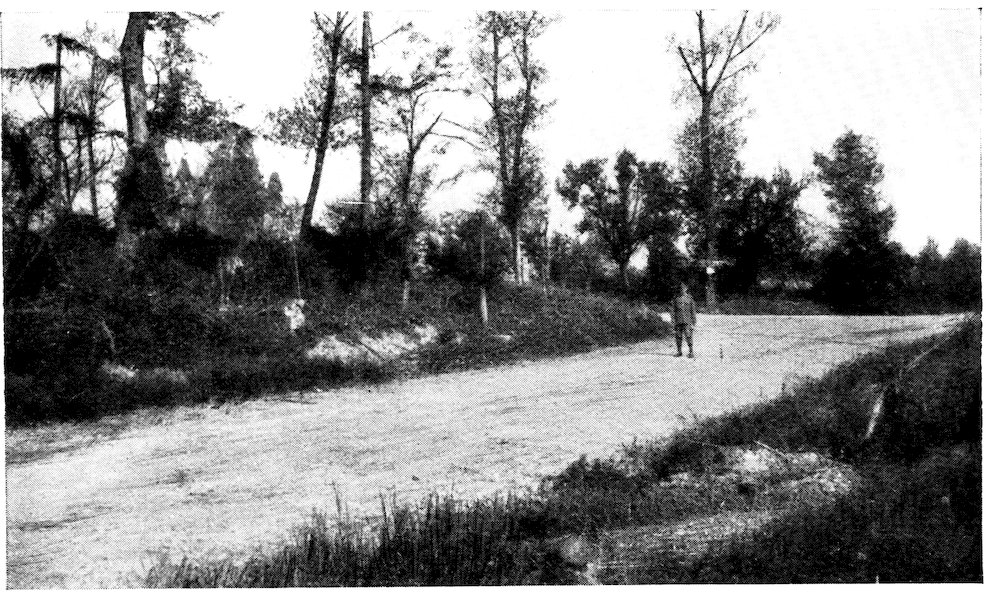
FONCHES. The Cross Roads.
The end of it was that at midnight we had orders from Brigade to withdraw to positions at Hallu. We could hardly believe it, but the orders were clear enough. The enemy was very close, and the withdrawal had to be done with great care. It took a long time creeping, section by section, along the grass border of the village road, 183out beyond the village, until it was safe to march in column of route on the road itself. The withdrawal was made in perfect order, without casualties, and we took up positions at Hallu by 3.30 a.m. About 5 a.m. it was possible to inspect the new line, and a gap was found between ourselves and the 9th East Surreys on our right. A Company, now commanded by Capt. J. H. Selfe, moved up from support to fill the gap.
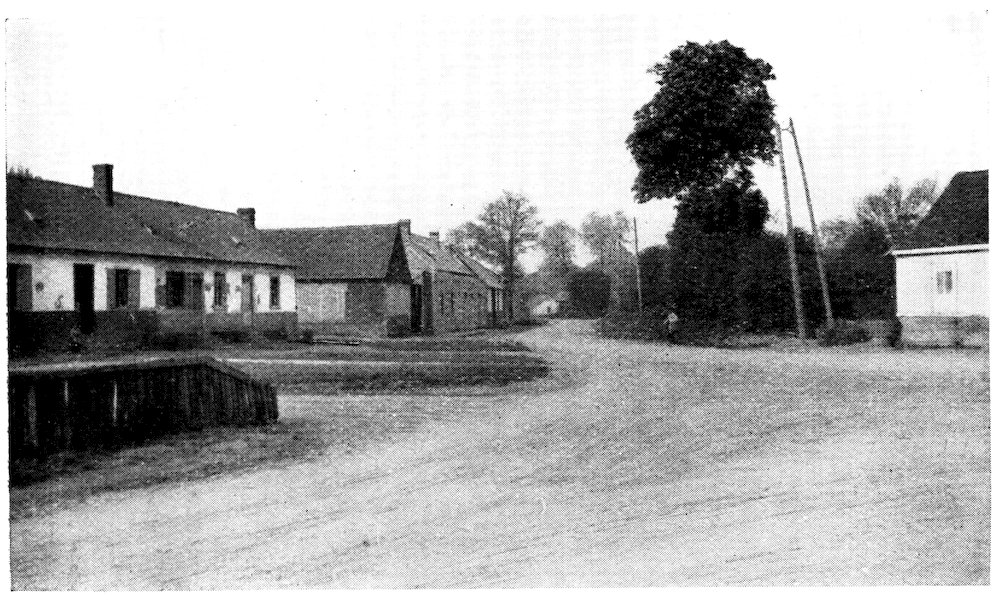
WARVILLERS. Some of the billets occupied by the Battalion.
We had had practically no rest, and the mental strain of the day before, added to the cold and physical weariness, left us particularly limp at dawn on March 26. We got a hurried breakfast, which improved matters considerably, and it was clear that we were soon to be at it again. At 6 a.m. the empty village of Fonches was being shelled to extinction, and the positions we were in at Hallu did not inspire us with a great deal of hope.
Col. Wenyon was ordered to take up Headquarters at Hallu in a dug-out with a direct telephone to Divisional Headquarters. We managed by this means to get some artillery fire to bear on the advancing Hun, but the shooting was wild, and many shells fell in our trenches. At 8 a.m. we received information from Brigade that the enemy had broken through the entrenching battalion on the right of the 9th East Surreys, and we were to withdraw fighting in echelon from the right. Capt. Thompson, who was commanding in our forward trenches, was accordingly ordered to conform with other units. Shortly after this the left broke also, and 184the 73rd Brigade withdrew. This left the remnants of the 72nd Brigade with both flanks in the air once more. The advanced enemy were within 200 yards of our trenches, and were advancing in vast numbers. Capt. Thompson informed the East Surreys that he proposed to withdraw by platoons from the left. The enemy was now very near our trenches, but was being well held by our fire. An orderly retirement commenced. Maj. Clark, with part of the East Surrey Regiment, still hung on to his position, and their battalion headquarters and a considerable proportion of their men were overwhelmed and captured.
We can well imagine Clark, dogged old soldier that he was, hanging on like grim death to that bit of trench. It was not till long afterwards that we heard he was wounded and a prisoner, and we all missed him greatly in the Brigade for the rest of the war. There can be no question of the gallantry of himself and his officers and men.
After the Battalion left Hallu, they were harassed from all sides by machine-gun fire, and some half a mile back they were stopped by a senior officer, who attempted to form a line in shell-holes. It seemed that he on this morning had more or less lost his reason, and by his action he placed a large body of men in great danger of capture. Capt. Thompson finally withdrew, and most of the men succeeded in getting back.
The Division now concentrated for the defence 185of Rouvroy. Our men were utterly exhausted, and were kept in reserve at Warvillers, where they got a clean up and a night’s rest. Here the Battalion was reorganised, and from now onwards was composed of the remnants of the whole brigade. A number of new Lewis guns were issued to the Battalion on that day. The 72nd Brigade now consisted of the Composite Battalion under Col. Wenyon, the 15th and 19th Entrenching Battalions, and a battalion formed from the officers and men of the 18th Corps School.
After close observation by low-flying enemy aeroplanes, the battle for Rouvroy and a Copse known as “Eight Trees” commenced about 10 a.m. on March 27, and continued throughout the day. C Company were disposed in trenches north-east of Rouvroy; A Company and the North Staffordshires in the outskirts of Rouvroy. The East Surrey remnant were with Battalion Headquarters in Warvillers. After ding-dong fighting all the morning, the enemy took Rouvroy from the Entrenching Battalion at about 2 p.m., the locality about “Eight Trees” having been forced by the enemy some time earlier.
Dispositions were then made for the defence of Warvillers after the North Staffordshires had made an attempt to re-establish the position in the south-west part of Rouvroy with the bayonet. A strong line was selected defending the villages of Beaufort, Warvillers, and Vrély. In this line were the two Entrenching Battalions and the 18th Corps School. After dark the 186Composite Battalion was withdrawn into reserve in Warvillers.
Throughout the afternoon and evening parties of the enemy frequently attempted to debouch from the south-west of Rouvroy towards the trenches held by A Company and the North Staffordshires. Many casualties were inflicted on the enemy by our fire, and any serious attempt to advance was stopped. The new dispositions were completed early in the morning of March 28, the 72nd Brigade, reinforced by the Machine-gun Battalion, being in the line defending Warvillers, the 73rd Brigade being on our left, and the 17th Brigade in front of Vrély on their left. The enemy attacked at 8.30 a.m. in large numbers. The line on our Brigade front held firm, and great loss was inflicted on the enemy by rifle and machine-gun fire. In front of Vrély, however, our troops were beaten back, and on the right south of Beaufort a break also occurred. Warvillers had been shelled very heavily during the infantry attack, but we held on to the last possible moment. When the order was finally given to withdraw, there were a number of the enemy established in the village with us. We had several men sniped at very close quarters, a German post being in one corner of the Château grounds before we left.
The company commander in the front line, when he received the message to withdraw, did so reluctantly after manning his parapet all along the line, and giving the enemy ten rounds rapid fire.
187Altogether the Hun had a pretty bad time in this attack on Warvillers.
The Division moved from here to the line between the villages of Caix and Le Quesnel, which was manned by about 1 p.m. Masses of artillery, including the first groups of French 75s we had seen were congregated just behind this line. The artillery horses had had a bad time from aeroplane bombs shortly before we arrived. The position was a good one, and we had a splendid view of the country and a good field of fire from some old trenches. But there were ominous-looking woods some 600 yards in front, and our flanks were very heavily wooded. It took some time for the enemy to move from Warvillers on to our front, but by about 2 o’clock he had got machine-gun posts in the edge of the wood in front, and one or two in some isolated orchards nearer to us.
Our ammunition was, as may be imagined, very limited, and we could not afford to do any continuous shooting at long range. Not so the enemy, who kept an almost continuous machine-gun fire across our trenches all the afternoon. Several times attempts were made to advance against us, but these were all easily frustrated. Our friend, Col. Spiller of the Divisional Artillery, was doing great work with direct shooting of his 18-pounder batteries on this afternoon. He hit the enemy very hard in the orchards where they were trying to collect, and no doubt in the edge of the wood also.
The break which had occurred further on the 188right early in the morning was, however, the danger point, and it became very evident during the afternoon that the enemy was executing an encircling movement some two miles on our right. So little regard had the Hun at this stage for hiding his positions, that he had adopted the practice of making his forward troops fire Verey lights as they advanced to show his own gunners where they had reached. These lights at about 5 p.m. were going up well behind us on the right; the enemy was evidently approaching Le Quesnel from the south, and there was grave danger of a very large force being cut off. A hurried council of war was held, and the order to withdraw from the right of the Division was given. It seemed that it was none too soon. The whole Division had to get back through a bottle-neck, harassed all the way by machine-gun and artillery fire. The withdrawal was orderly, and by great good chance rain set in and made observation difficult for the enemy. Our own aeroplanes were also getting more in evidence.
Through the rain on this day we had a long and weary march to the Bois de Sencat, west of Castel, where the Brigade was ordered to concentrate. The last five miles of the march was across heavy country. The fatigue on that night after the strain of the day was almost the worst of the whole retreat. Scores of men were dead asleep as they stumbled along.
We arrived at the rendezvous at about 3 a.m., where we found our transport, had a hot meal, 189and lay down in the rain for the rest of the night. In the morning our Colonel was visited by the Divisional Commander, Maj. Gen. Daly, who thanked the whole Battalion for the work of the past eight days. This was the morning of March 29, and as there was no sound of battle very close to us, we felt we were in for a bit of a rest.
It appeared later that the enemy had taken Montdidier away south, and was thrusting on in front of us at a great pace. The Division was to go up in the evening to take up a position in front of Thezy from Berteaucourt to the Domart-Amiens road—the main road from Villers Brettoneux to Amiens. The 73rd Brigade were to be on the right, 72nd Brigade on the left, 17th Brigade in reserve. We moved up just before dark. The Entrenching Battalion took up positions in the line, which consisted of a series of disconnected posts, just dug by army engineers. We took up a position in the Copse behind them, where we proceeded to dig in. By 10 a.m. we had formed a series of posts just in front of the copse on a front of 1,200 yards, our left resting on the Amiens road. The enemy was reported to have advanced through Mezières, and was proceeding towards Moreuil and Castel.
There were now a considerable number of troops—French and British—between our positions and the enemy, and as there was no immediate threat to Thezy, the Battalion—less the East Surreys, who remained in the Copse manning a few of the posts—moved back to the village. 190We got good billets in Thezy, and we were able to get a feed and some rest.
At dawn on March 31 we relieved the Entrenching Battalions in the forward posts. In the afternoon considerable activity commenced. The enemy had got into very difficult country now, and his lines of communication with his rapid advance must have been stretched near to bursting point, but he was making strenuous efforts for Amiens, the spires and towers of which he could now see in the distance.
The lines in front appeared to be wavering, but a series of counter-attacks was carried out between 4 and 7 p.m., and the position was more than re-established. The night was quiet and very cold, and we remained in position in the posts. Our artillery pounded the enemy’s positions very severely all night.
At dawn on April 1 we were relieved by two companies of the Entrenching Battalion, and moved back to Thezy. The men rested most of the day and did all they could to clean up. There were a few civilians in the village and plenty of food. The day passed quietly and uneventfully.
On April 2 we were again at rest in Thezy. We were beginning to feel much fitter, and the past ten days felt like some horrible nightmare that is past. The Commanding Officer inspected all the companies during the morning. The day was quiet—hardly a shell had fallen in Thezy. Our own artillery cheerfully enough provided all the fireworks, and continued to shoot incessantly. 191Clean underclothing and socks—a very welcome event—were issued to the men during the day.
At dawn on April 3 the East Surreys and the North Staffordshires relieved the two companies of the Entrenching Battalions in the forward posts. C Company were detailed for making an advanced Brigade Headquarters, and our indefatigable Staff-Captain and staunch friend, Capt. Ward, who had just returned that day from a course in England, organised baths, if you please, at the Château. We were getting entirely civilised.
The next morning, April 4, we did another side-slip northwards, to take up a position in support to the Australians behind Villers Brettoneux. At 4.30 a.m. we left Thezy and marched across the Amiens road through Gentelles to the Bois l’Abbé, where the Brigade concentrated. The Divisional Reinforcement Battalion, which had been with the 17th Brigade, relieved our forward posts in front of Thezy, and the concentration of the Brigade in the new positions was completed by 6.30 a.m.
The march through Gentelles was unpleasant. The enemy was just beginning his first big attack on Villers Brettoneux, and was shelling everything within reach which might be a billet. Thezy received a few just as we left, and as we marched through Gentelles several shells were about. One fell in the road as a platoon of A Company was passing, and we had eight casualties.
The forward part of the Bois l’Abbé received a lot of attention during the morning, and our 192old friend the gas shell was much in evidence. Fairly heavy rain set in, however, and the gas did little damage. The bombardment throughout the day was directed mainly against our batteries all along the front. The posts in front of Thezy—which were fairly in the midst of guns—had a bad time after we had left them.
In the course of the day it transpired that the enemy had attacked opposite Villers Brettoneux and Marcelcave and further south. He had made some progress, but the ground was very heavy, and in places he had been driven back. In the afternoon the 72nd Brigade, which was in support to the northern half of the 17th Brigade (Gentelles to Bois l’Abbé), moved back about 3,000 yards to a copse a mile or so east of Boves, where Brigade Headquarters was established. The weather had now properly broken, and the rain streamed down. C Company moved up during the night to a position in the Bois l’Abbé in touch with the 7th Londons, and the rest of the Battalion dug in in front of the copse. A number of cavalry officers and others dropped in to Battalion Headquarters during the night. There had evidently been some heavy fighting at Villers Brettoneux, but the result was good, and everyone seemed cheerful. They were all surprised to find us still in the line. Numbers of our visitors told us they had heard of the 24th Division on all sides, and had imagined that we were all killed long ago.
The next morning, April 5, broke chilly, but quiet. We were so soaked that it did not matter 193how much it rained. We had dug some very fair positions, and the cookers gave us quite a good breakfast.
During the morning we got the breath of a rumour that we were to be relieved. We paid not much attention to it, because we had heard the same thing at least three times before, and we were beginning to think we were in this business for the rest of our lives.
But this time it was true. Orders were issued from Brigade during the afternoon. We were to move off after dusk, and motor-lorries were to take us away back behind Amiens and then to goodness knew where. A significant thing, however, was that during the afternoon maps were sent up to us with Dieppe and St. Valerie and expanses of blue sea on them. Even then we were doubtful, and longed for 8 o’clock to come before the orders were cancelled. We wonder if the reader can imagine what our feelings were. On March 21 we were at the end of a long term—ten days in the line. Since then we had been fighting almost continuously—at most times in desperately tight corners. We were reduced in numbers to about 100 men and five officers. Our boots were worn through, our clothes were torn; mentally and physically we were as tired as men could well be. Up and down the line there were cases of men losing their reason during these fiendish days—and small wonder. So it was a very quiet, but yet a very triumphant little band that finally reached an old town miles west of Amiens in the small hours of April 6. 194It had not taken many lorries to convey our Battalion home that night.
About midday we entrained and were taken down to St. Valerie. From there we had a ten-mile march—who minded that?—to billets in the village of St. Blimont. The deathly stillness of the place was almost uncanny. We were splendidly received by the villagers. Although it was 2 o’clock in the morning, they tumbled out of bed to give us a welcome. Amiens had been saved—the Royal West Kents had arrived!
Many messages of congratulation were received by the 24th Division for their conduct during the March Retreat, notably from Lieut.-Gen. Sir H. E. Watts, commanding the Corps, from Lieut.-Gen. Sir C. T. McM. Kavanagh, commanding the Cavalry Corps, and from our two late Divisional Commanders, Maj.-Gen. Sir J. E. Capper and Maj.-Gen. Sir L. J. Bols.
The following honours were awarded to the Battalion for service between March 21 and April 5, 1918:
Bar to the Distinguished Service Order
Lieut.-Col. H. J. Wenyon, D.S.O.
The Military Cross
Rev. G. D. Barlow-Poole, Lieut. G. S. Bowen, 2nd Lieut. J. B. Cryer, Lieut. E. O. Goulden, 2nd Lieut. B. Stephens, Capt. S. G. Thompson, 2nd Lieut. P. H. Tyler.
Bar to the Distinguished Conduct Medal
Regt.-Sergt.-Maj. R. Rankin.
ST. QUENTIN TO AMIENS
[Click on map for high resolution image.]
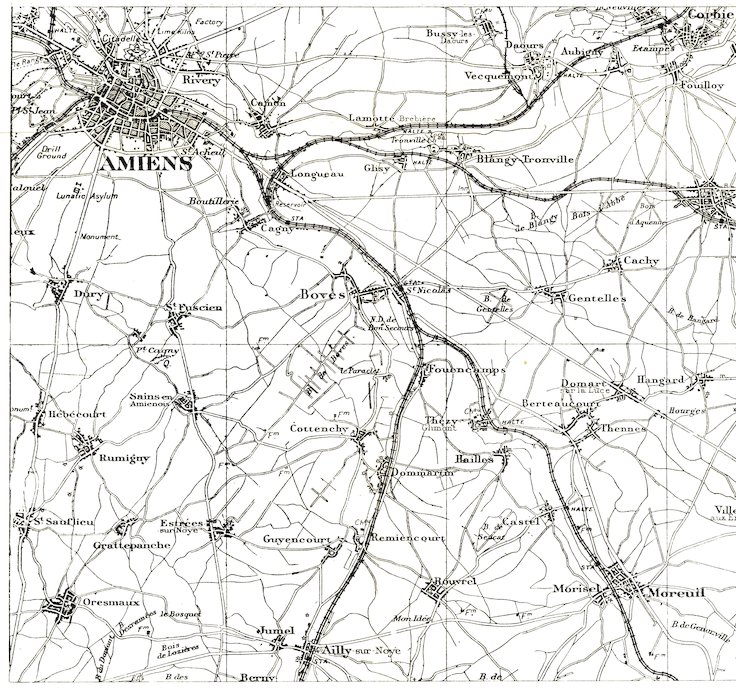
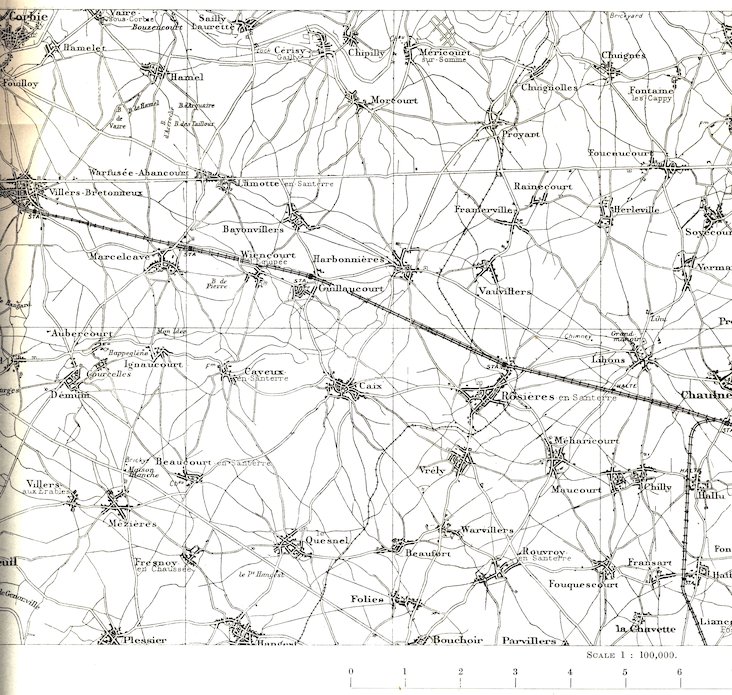
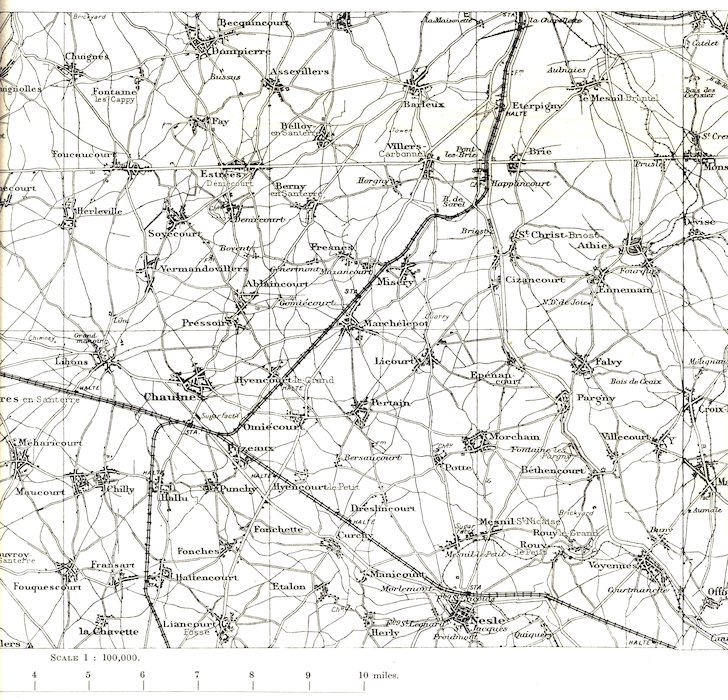
To illustrate Phase VII.
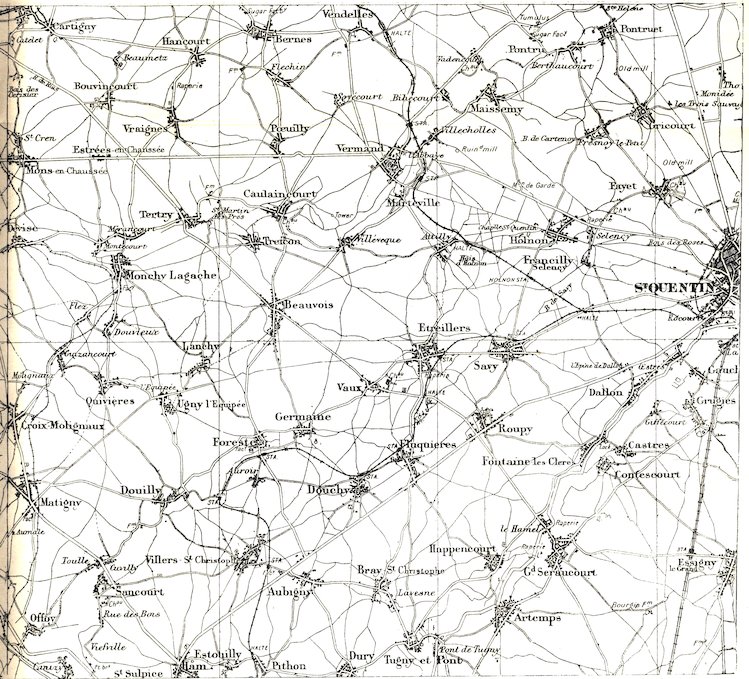
[Reproduced by permission of the Geographical Section, General Staff.
195Distinguished Conduct Medal
Cpl. E. H. Cherriman, M.M., Pte. A. E. Smith.
The Military Medal
L.-Cpl. G. Boylan, Pte. J. Bradley, Sergt. L. Green, L.-Cpl. F. Holford, Cpl. W. Jasper, Pte. W. Paine, Pte. J. Scripps, L.-Cpl. T. Shewry, Pte. R. Simmons, Sergt. C. A. Taylor, Pte. S. G. Wells, Sergt. C. Williams, Pte. J. Winder, Cpl. C. Woodrow.
The Meritorious Service Medal
Regt.-Quartermaster-Sergt. F. A. Ifould, Cpl. H. R. Verrall.
196