Part 2 / Book 4 — BOOK IV. (continued 4)
T. (Tobias) Smollett translation
From this information, his grace took the opportunity to connive this last adventure, so much was he delighted with the behaviour of Sancho and Don Quixote. He ordered a great number of his people on horseback and a-foot, to scour the country far and near, and a patrole through every road by which he thought the knight could possibly return, with orders to bring him to the castle, either by fair means or foul. Accordingly, when they found him, they gave notice to his grace, who having already pre-concerted what was to be done, no sooner heard of his coming than he directed that the torches and tapers should be lighted around the court, and Altisidora placed upon the tomb, together with all the apparatus already described; which was so naturally and artfully executed, that it differed very little from the real truth. Nay, Cid Hamet moreover observes, that he looked upon the jokers to be as mad as those who were joked; and the duke and duchess to be within two-fingers-breadth of lunacy, seeing they placed such happiness in playing pranks upon two confirmed madmen; one of whom the new day found sleeping at full snore, and the other watching over his disastrous thoughts, and very impatient to quit his couch; for, whether vanquished or victor, Don Quixote never took pleasure in lolling on the lazy down.
It was now that Altisidora, who in the knight’s opinion had returned from death, in compliance with the humour of her lord and lady, entered his apartment crowned with the same garland she had worn on the tomb, clad in a robe of white taffety powdered with flowers of gold, her hair flowing loose upon her shoulders, and supporting herself upon a staff of fine polished black ebony. This apparition discomposed our hero to such a degree, that he shrunk within his nest in silent confusion, and almost covered himself wholly with the sheets, fully determined against making any return of compliment. Meanwhile, Altisidora sitting down upon a chair, at his bed’s head, heaved a profound sigh, and thus addressed herself to him, in a faint and tender tone—‘When women of fashion, and damsels of reserve, trample upon honour, and give their tongues the liberty to break through all inconveniences, so as to divulge the secrets which their hearts conceal, their condition must be desperate indeed. I am one of those, Signior Don Quixote de La Mancha; sorely hampered, vanquished, and enamoured; but withal so patient and modest, that my soul broke through my silence, and I lost my life: in consequence of thy rigour, O flinty-hearted knight! more deaf than marble to my complaints, have I been dead for two days, or at least supposed to be dead by those who saw me; and if love, in pity to my fate, had not deposited a remedy in the tortures of that worthy squire, I should have remained for ever in the other world.’—‘Love,’ said Sancho, ‘might as well have deposited the remedy in the tortures of my ass, and I should have thanked him for it heartily: but pray, Madam, tell me, so may Heaven send you a kinder lover than my master, what did you see in the other world? What is going forward in hell? for surely those who die in despair must go to that baiting-place.’—‘To tell you the truth,’ answered Altisidora, ‘I could not be quite dead, seeing I did not enter the infernal regions; for, had I been once fairly introduced, I could not have left the place again, whatever inclination I might have had to return. The truth is, I went no farther than the gate, where I saw about a dozen devils playing at tennis, in their drawers and doublets, having bands edged with Flanders lace, and ruffles of the same at their wrists, which were naked to the length of four inches, in order to enlarge the appearance 575of their hands, in which they wielded rackets of fire: but what I chiefly admired was, that instead of balls, they made use of books, which seemed to be filled with wind and flocks; a circumstance equally new and surprizing! and yet there was another particular which still increased my astonishment; for, whereas among the gamesters of this world, it is natural for the winners to be merry, and for the losers to be sad; in that diabolical pastime, all the players growled and grumbled, and cursed one another.’—‘That is not to be wondered at,’ replied the squire; ‘for the devils, play or not play, win or not win, can never be content.’—‘That must certainly be the case,’ answered Altisidora; ‘but there was likewise another peculiarity at which I wonder, I mean, at which I then wondered; namely, that after the first toss, the ball was useless, and could not be used a second time; so that they whirled them away, new and old, in a marvellous manner. On one of these, which was finely gilt and lettered, they bestowed such a violent stroke, that the guts flew out in scattered leaves. “What book is that?” said one devil to his fellow. The other answered, that it was the second part of the history of Don Quixote de La Mancha, composed not by the original author Cid Hamet, but by an Arragonian, who calls himself a native of Tordesillas. “Away with it!” cried the first, “plunge it into the lowest abyss of hell, that mine eyes may never behold it again.”—“What, is it so bad!” said the second. “So very bad,” replied the other, “that if I myself had endeavoured to make it worse, it would not have been in my power.” They proceeded with their play, driving about the unfortunate books; and I hearing them mention Don Quixote, whom I love and adore, endeavoured to retain the vision in my memory.’—‘A vision it must have been, without all doubt,’ said Don Quixote; ‘for there is no other I in the whole world; and as for that history, it is bandied from hand to hand, without finding a resting place, and every body has a fling at the author: nor am I in the least mortified to hear that I wander like a fantastick shadow through the dark abodes of hell, as well as through the enlightened mansions of this globe, as I am not the person recorded in that history; which, were it elegant, faithful, and authentick, would live for ages; but, being false and execrable as it is, there will be no great distance between its birth and burial.’
Altisidora was going to proceed with her lamentations, when she was prevented by the knight; who said, with great solemnity, ‘I have often told you, Madam, that I am sorry you have placed your affection upon me, who can make no other return than that of gratitude and thanks; I was born for Dulcinea del Toboso; and the Fates, if such there be, have consecrated me for her service; so that to imagine any other beauty shall ever occupy the place which she possesses in my heart, is to suppose a mere impossibility. Let this declaration, therefore, undeceive and prevail upon you to retire within the limits of virtue and decorum, seeing no man is obliged to perform impossibilities.’ Altisidora, in consequence of this repulse, assumed an air of indignation, and in an affected transport of rage, exclaimed, ‘How now, Don Stockfish! soul of a mortar! stone of a date! more positive and obstinate than a courted peasant when his harrow hath chanced to hit the mark, by the Lord! if I once fall upon you, I will tear your eyes out. Hark ye, Don Beaten-and-cudgelled, are you such a wiseacre as to suppose I died for love of you? All you have seen this last night was a pure fiction; for I am not the woman to have a finger ache, much less to die for such a camel.’—‘O my conscience! I believe what you say,’ cried Sancho; ‘that of dying for love is a most ridiculous affair: your lovers, indeed, may easily say they are dying; but that they will actually give up the ghost, Judas may believe it for me.’
During this conversation, the musician and poet, who had sung the two stanzas which we have already repeated, came into the apartment, and made a profound bow to Don Quixote, saying, ‘Sir Knight, I beg you will esteem and reckon me among the number of your most humble servants; for many days are elapsed since I have conceived the warmest affection for your 576person, from the fame of your character and atchievements.’ When Don Quixote desired to know who he was, that he might respect him according to his merit, he answered, that he was the musician and panegyrist of the preceding night. ‘Assuredly, your voice is extremely sweet,’ said the knight; ‘but, methinks, the verses you sung were not much to the purpose; for what affinity is there between the stanzas of Garcilasso and the death of this young lady?’—‘Your worship must not wonder at that impropriety,’ answered the musician; ‘it is a common practice among the beardless poets of this age to write what they will, and steal from whom they please to pillage, whether it be or be not to the purpose; and every absurdity that occurs in their singing or writing, they attribute to the licentia poetica.’
Don Quixote’s reply was prevented by the entrance of the duke and duchess, who came to visit him in his chamber, and a long diverting conversation ensued, in the course of which Sancho uttered so many humorous sallies, and satirical jokes, that their graces admired anew the mixture of his acuteness and simplicity. As for the knight, he humbly requested that he might be allowed to depart that very day, as it was much more proper that vanquished knights, like him, should live in hog-sties than in sumptuous palaces. They graciously complied with his request; and when the duchess enquired if Altisidora had, as yet, acquired his good graces, ‘Your grace must know,’ said he, ‘that damsel’s distemper wholly proceeds from idleness, which may be easily cured by continual and decent occupation: she tells me it is the fashion in hell to wear lace, and as she knows how to make it, let the work never be out of her hand, which being employed in moving the bobbins, the idea or ideas of what she loves will no longer move in her imagination; and this is the truth, the substance of my opinion, and the marrow of my advice.’—‘Aye, and of mine too,’ cried Sancho; ‘for never in my born days did I know a lace-maker die for love: the thoughts of girls employed at that work, run more upon the finishing of their tasks than upon the idle fancies of love; and, for myself, I can safely say, that while I am digging in the field, I never so much as dream of my duck; I mean, my wife Teresa Panza, whom I love as the apple of mine eye.’—‘You talk like an oracle, Sancho,’ said the duchess: ‘and I will take care, that, from this day forward, Altisidora shall be employed in some plain work, which she understands to perfection.’—‘Your ladyship shall not need to use any such expedient,’ replied Altisidora; ‘for the consideration of the cruelty with which I have been used by that felonious monster, will blot him effectually from my remembrance, without any other assistance; and, in the mean time, with your grace’s permission, I will retire, that I may no longer have before my eyes—I will not say his rueful countenance, but his frightful and abominable aspect.’—‘These reproaches,’ said the duke, ‘put me in mind of the old observation, that Scolding among lovers is the next neighbour to forgiveness.’
Altisidora, making a shew of wiping the tears from her eyes with a white handkerchief, dropped a low curtsey to her lord and lady, and withdrew; and Sancho sending after her an earnest look, ‘Poor damsel!’ cried he, ‘I can bequeath, bequeath thee nothing, I say, but bad luck, seeing thou hast placed thine affection upon a soul of rush, and an heart of oak: had it lighted upon me, another sort of a cock would have crowned thy fortune.’
Thus the conversation ended, Don Quixote put on his cloaths, dined with the duke and duchess, and set out that same evening for his own habitation.
CHAP. XIX. OF WHAT HAPPENED TO DON QUIXOTE AND HIS SQUIRE, IN THEIR JOURNEY TO THEIR OWN VILLAGE.
The perplexed and vanquished Don Quixote travelled along, extremely chagrined on one account, though greatly rejoiced on another: his melancholy was occasioned by his overthrow, and his joy produced from the consideration of that virtue inherent in his squire, which he had seen demonstrated 577in the resurrection of Altisidora, though he had some scruples in persuading himself that the enamoured damsel was actually dead. As for Sancho, he felt no sort of pleasure; but, on the contrary, was much mortified to find that Altisidora had failed in performing her promise touching the present of the shifts; and his imagination dwelling upon this circumstance, he said to his master—‘Truly, Signior, I must certainly be the most unfortunate physician that ever lived upon the earth, in which there are many leeches, who, though they kill their patients, insist upon being paid for their trouble, which, by the bye, is no more than writing and signing a list of medicines upon a scrap of paper; for the apothecary makes up the prescription, and so the farce is acted; whereas, I receive not a doit, though I cure other people’s maladies at the expence of pinches, twitches, pin-pricks, lashes, and drops of blood; but, I vow to God! if any other patient is put into my hands, they shall be well anointed before I undertake the cure; for, The abbot chants but to supply his wants: and I cannot believe that Heaven hath bestowed such virtue upon me, in order that I should throw it away upon the undeserving.’—‘Thou art in the right, friend Sancho,’ replied Don Quixote; ‘and Altisidora is much to blame in having witheld the promised shifts, although thy virtue is gratis data, without having put thee to the trouble of studying aught but the art of enduring personal torture; for my own part, I can say, that if thou hadst demanded payment for the disinchanting stripes, I should have allowed it to thy own satisfaction; though I know not how such hire might interfere with the cure; and I should not wish that the premium might impede the effect of the medicine: nevertheless, I do not think the experiment could be attended with any bad consequence. Consider, Sancho, what thou wouldst have; then proceed to the flagellation, and pay thyself fairly out of my money which is in thy own hands.’
At this proposal, the squire opened his eyes and ears a full span, and resolving in his heart to scourge himself with good will, answered in these words—‘Aye, now, Signior, I find myself extremely well disposed to comply with your worship’s desire, since my compliance will be attended with some profit; and, I own, my regard for my poor wife and children makes me seem a little selfish.—Pray what will your worship chuse to give for every stripe?’—‘Were I to pay thee, Sancho,’ said the knight, ‘according to the greatness of thy deserts, and the quality of the cure, the bank of Venice and mines of Potosi would not afford a sufficient recompence: but, see how much of my money thou hast got, and set thy own price upon every lash.’—‘The number of stripes to be given,’ answered the squire, ‘amounts to three thousand three hundred and odd: of these I have received about five, which shall stand for the odd; so that three thousand three hundred remain. Now, if we value each lash at a quarter of a rial, and I would not bate a doit though the whole world should desire me, the sum will be three thousand three hundred quartillos; the three thousand quartillos make fifteen hundred half-rials, which are equal to seven hundred and fifty rials, and the other three hundred quartillos make one hundred and fifty half-rials, which are equal to seventy five rials, and these being added to the former seven hundred and fifty, the whole reckoning amounts to eight hundred and twenty five rials. These I will deduct from your cash that is in my hands, and then I will return to my own house, rich and satisfied, though well scourged; for, We cannot catch trouts without wetting our clouts: and I will say no more upon the subject.’—‘O blessed Sancho! O lovely Sancho!’ cried Don Quixote; ‘Dulcinea and I will be bound to serve thee all the days that Heaven shall permit us to live; provided she shall retrieve her lost-form: and, in this hope, we cannot possibly be mistaken; her misfortune will prove fortunate, and my overthrow a most happy triumph. And now, Sancho, consider when thou wilt begin this discipline; towards the speedy performance of which, I add another hundred rials.’—‘When?’ replied 578the squire; ‘this very night, without fail: if your worship will take care to chuse our lodging in the open field, I will take care to open my own carcase.’
At length the night arrived, after it had been impatiently expected by Don Quixote, who thought the wheels of Apollo’s car had broken down, and that the day was extended to an unusual length; like those lovers whose desires ever outstrip the career of time.
In the evening, they betook themselves to the covert of some pleasant trees at a little distance from the highway, and vacating the saddle of Rozinante, and the pannel of the ass, sat down together upon the grass, and supped upon the store contained in the wallet of Sancho; who, forming a strong and flexible scourge with Dapple’s halter, retired into a tuft of beeches about twenty paces from his master. The knight seeing him withdraw so brisk and resolute—‘Beware, friend Sancho,’ said he, ‘of scourging thyself to pieces; perform thy discipline at leisure; let the stripes follow one another in regular succession, and do not run so fast as to be out of breath in the middle of thy career; I mean, do not lash thyself so severely, as to destroy thy own life before the number be compleated; and, that thou mayest not lose it by a card too many, or too few, I will stand aside and count the stripes upon my rosary. Mayest thou enjoy the protection of Heaven, which thy christian intention so richly deserves!’—‘A good paymaster needs no bail,’ answered the squire: ‘I intend to scourge myself in such a manner as will mortify my flesh, without any hazard of my life; for, in that medium the substance of the miracle must consist.’ He forthwith stripped himself naked from the waist upwards, and snatching the scourge, began to whip himself, while his master reckoned the stripes. About half a dozen or eight lashes had Sancho bestowed upon himself, when he found the joke very expensive, and the reward dog cheap; and suspending the instrument, told the knight he had been deceived, and claimed the benefit of an appeal; for every one of these stripes was worth half a rial instead of a quartillo. ‘Proceed, friend Sancho, without dismay,’ replied Don Quixote, ‘and I will double the allowance.’—‘At that rate,’ replied the squire, ‘to it again, by the grace of God, and let it rain lashes.’ But, the cunning knave no longer made application to his own shoulders, in lieu of which he began to scourge the trees, venting between whiles such dismal groans as seemed to tear his very soul up by the roots. The knight, from the tenderness of his own disposition, being apprehensive that he would actually put an end to his life, and of consequence defeat the purpose of his flagellation by his imprudence, exclaimed—‘I conjure thee, by thy life, friend Sancho, to let the business rest where it now stands: the medicine seems to have a very rough operation, and it will be better to proceed leisurely; for Zamora was not taken in one hour. Above a thousand stripes hast thou already inflicted upon thyself, if my reckoning is just, and these shall suffice for the present; for, if I may use a vulgar expression, Though the load must lie over the ass, he must not be overloaded.’—‘No, no, Signior,’ replied Sancho, ‘they shall never say of me, When money’s paid before its due, a broken limb will straight ensue. Pray stand aside a little, Signior, and let me lay on another thousand, if you please: two such bouts will perform the bargain, and leave something to boot.’—‘Since thou findest thyself in such an excellent frame and disposition,’ said the knight, ‘Heaven protect thee; stick to the stuff, and I shall withdraw.’ Sancho, resuming his task and reckoning, had already disbarked a number of trees, with the rigorous application of his scourge; when, bestowing a dreadful stroke upon an unfortunate beech, he exclaimed with great vociferation—‘Here, Sampson, shalt thou die, with all thine abettors.’ Don Quixote hearing this dismal ejaculation, and the terrible sound of the stroke, ran up to the spot, and seizing the twisted halter that Sancho used instead of a bull’s pizzle—‘Fate,’ said he, ‘friend Sancho, will not permit that for my pleasure thou shouldst lose that life on which the sustenance of thy wife and family must depend. Dulcinea shall wait for a more favourable conjuncture, and I will contain 579myself within the limits of the nearest hope, until thou shalt recover new strength to conclude this affair to the satisfaction of all parties.’—‘Since your worship is so inclined,’ answered the squire, ‘so be it in happy time; and pray, good Signior, throw your cloak, about my shoulders; for I am all in a sweat, and would not willingly catch cold, which is so often the case with new disciplinants.’ The knight, in compliance with this request, stripped himself of his upper garment, with which he covered up Sancho, who slept until he was wakened by the sun; then they proceeded on their journey, which, for that day, did not exceed three leagues.
They alighted at an inn; for such it was acknowledged by Don Quixote, who did not, as usual, suppose it a castle furnished with a fosse, turrets, portcullices, and draw-bridges: indeed, since his defeat, he had talked with more sanity on all subjects, as will presently appear. He was shewn into a low apartment, hung with old painted serge, instead of tapestry, such as is used in country places, in one piece of which some wretched hand had drawn the rape of Helen, who was carried off from Menelaus by his presumptuous guest; and in another was represented the story of Dido and Æneas, the unhappy queen standing upon a lofty tower, making signals with a white sheet to her fugitive lover, who, in a frigate or brigantine, was flying from her coast. He observed, of these two history pieces, that Helen shewed no marks of compulsion; but rather exhibited her satisfaction in a roguish smile; whereas, from the eyes of the beautiful Dido, tears as big as walnuts seemed to fall. Don Quixote having considered both pictures, ‘These two ladies,’ said he, ‘were most unfortunate, because they did not live in this our age; and I, above all men unhappy, because I did not live in theirs. Had I encountered these gentlemen, Troy had ne’er been burnt, nor Carthage laid in ruins; for, by killing Paris only, I should have prevented such disasters.’—‘I’ll lay a wager,’ said Sancho, ‘that in a very little time, every cook’s cellar, tavern, inn, and barber’s shop in the kingdom, will be ornamented with pictures containing the history of our atchievements; but I should be glad to see them painted by a better workman than him who made these daubings.’—‘Thou art in the right,’ replied Don Quixote; ‘he that painted these pieces is just such another as Orbaneja, a painter of Ubeda, who being asked what he was about, answered, “Just as it happens;” and if he chanced to represent a cock, he wrote under it, “This is a cock,” that it might not be mistaken for a fox. Such a person, I suppose, is that same painter or author, for it is the same thing, who ushered into the world the lately published history of the new Don Quixote: for he has painted or described whatever came uppermost; or, perhaps, he resembles an old court poet called Mauleon, who pretended to answer every question extempore; and being one day asked the meaning of Deum del Deo, replied, “De doude diere[211].” But, waving this subject, tell me, Sancho, if thou art resolved to take the other turn to-night, and whether thou wouldst chuse to go to work under an humble roof, or beneath the high canopy of Heaven?’—‘’Fore God! Signior,’ replied the squire, ‘as to what I intend to take, it matters not much, whether it be taken within doors or without: nevertheless, I should chuse to go to work among trees; for they seem to accompany and assist me wonderfully in bearing the brunt of the application.’—‘But it must not be so at present, friend Sancho,’ answered the knight; ‘in order to recruit your strength, the execution shall be postponed until we arrive at our own village, which we shall reach the day after to-morrow, at farthest.’ Sancho said he might take his own way; though he himself should be glad to dispatch the business now he was warm, and while the mill was a going; ‘For, Delay breeds danger; and We ought still to be doing while to God we are suing. I will give thee, is good; but, Here, take it, is better. A sparrow in hand is worth an eagle on wing.’—‘No more proverbs, Sancho, for the love of God!’ cried 580the knight; thou seemest to be returning to sicut erat. Speak plainly and perspicuously, without such intricate mazes, as I have often advised thee, and thou wilt find thyself one loaf per cent. in pocket.’—‘I am so unlucky,’ answered the squire, ‘that I cannot give a reason without a proverb, nor a proverb that I do not think a good reason; but I will mend if I can!’ And here the conversation ended for that time.
CHAP. XX. GIVING AN ACCOUNT OF DON QUIXOTE’S ARRIVAL AT HIS OWN HABITATION.
That whole day Don Quixote and Sancho tarried at the inn, waiting for night, during which the one intended to finish his whipping task in the open field, and the other hoped to see the accomplishment of that discipline on which depended the accomplishment of his desire. In the mean time, a gentleman on horseback arrived at the door, attended by three or four servants, one of whom said to him who seemed to be the master, ‘Signior Don Alvaro Tarfe, your worship may pass the afternoon in this house; the lodging seems to be cool and cleanly.’ Don Quixote hearing this address, ‘Hark ye, Sancho,’ said he, ‘when I glanced over the second part of my history, I am very much mistaken if I did not perceive, as I turned over the leaves, this very name of Don Alvaro Tarfe.’—‘Very likely,’ replied the squire; ‘first let him alight, and then we can ask questions.’ Accordingly the traveller having alighted, was conducted by the landlady into a room that fronted the knight’s apartment, and was ornamented with the same kind of paintings which we have already described. This new-come cavalier, laying aside his upper garment, came out into the porch, which was cool and spacious, where seeing Don Quixote walking backwards and forwards for the benefit of the air, he asked in a courteous manner, which way his worship was travelling. The knight told him he was going to the place of his nativity, which was a village in the neighbourhood; and, in his turn, expressed a desire of knowing the direction of the stranger’s course. ‘Signior,’ said the cavalier, ‘I am travelling to Grenada, which is my native country.’—‘And a good country it is,’ replied Don Quixote; ‘but will your worship be so good as to tell me your name, which I believe is of more importance to me to know, than I can well explain.’—‘My name,’ said the stranger, ‘is Don Alvaro Tarfe.’—‘Without doubt, then,’ replied the knight, ‘you must be the gentleman mentioned in the second part of the history of Don Quixote de La Mancha, lately printed and published by a modern author.’—‘The very same,’ answered the cavalier: ‘Don Quixote, the principal character of that history, was an intimate acquaintance of mine: I brought him from his own habitation; at least I persuaded him to assist at the tournament of Saragossa, whither I was going, and where I really and truly did him signal services; and particularly saved his back from being very roughly handled by the hangman, for his excessive impudence and knavery.’—‘And pray, Signior Don Alvaro, is there any resemblance between me and that Don Quixote whom your worship mentions?’ said the knight. ‘No, surely, none at all,’ replied the stranger. ‘Is not that Don Quixote attended by a squire, called Sancho Panza?’ resumed our hero. ‘Yes, he is,’ answered the other; ‘and although he was reported to be a very humorous companion, I never heard him utter one merry conceit.’—‘That I can very well believe,’ said Sancho, mingling in the discourse; ‘it is not every body that can utter conceits; and that same Sancho, whom your worship mentions, must be a very great knave, and indeed both fool and knave; for I am the true Sancho Panza, who have as many conceits as there are drops of rain. If your worship will but try the experiment, and keep me company for a year or so, you will see them fall from me at every step; nay, they are so merry and so numerous, that very often when I myself know not what I have said, they make all the hearers burst their sides with laughing; and the true Don Quixote de La Mancha, the renowned, the valiant, the sage, the enamoured knight, the undoer of wrongs, 581the tutor of wards and orphans, the protector of widows, the destroyer of maids, he who owns no other mistress than the peerless Dulcinea del Toboso, is my master, this very gentleman here present: every other Don Quixote, and every other Sancho whatsoever, is no better than a dream or delusion.’—‘Before God! I am of the same opinion,’ replied Don Alvaro; ‘for, truly, my good friend, you have uttered more pleasantry in these few sentences you have spoke, than ever I knew come from the mouth of the other Sancho Panza, though he was an eternal babbler; he was much more of a glutton than an orator, and rather idiotical than humorous. Indeed, I am fully persuaded, that those inchanters who molest the good Don Quixote, have been pleased to persecute me with the bad Don Quixote: and yet I know not what to say; for I can take my oath that I left him at Toledo in the nuncio’s house, under the care of surgeons; and now, another Don Quixote starts up in his place, though of a very different character and complexion!’—‘I know not whether or not I am the good Don Quixote,’ replied the knight; ‘but, I will venture to say, I am not the bad Don Quixote; and, as a proof of what I alledge, my good Signior Don Alvaro Tarfe, your worship must know, that in the whole course of my life I never was at Saragossa; on the contrary, having been informed, that the fantastical Don Quixote had been present at the tournament of that city, I would not set foot within its walls, that I might demonstrate his imposture to the satisfaction of the whole world: I, therefore, openly repaired to Barcelona, that repository of politeness, that asylum of strangers, that hospital of the poor, that native place of gallantry, that avenging tribunal of the injured, that agreeable scene of unshaken friendship unparalleled both in beauty and situation! and although certain adventures which there befel me did not so much contribute to my satisfaction, but, on the contrary, conduced to my unspeakable disquiet, I bear my fate without repining, and count myself happy in having seen that celebrated place: finally, Signior Don Alvaro Tarfe, I am the real Don Quixote de La Mancha, so well known to fame, and not that wretched impostor who has thought proper to usurp my name, and deck himself with the spoils of my reputation. I must therefore entreat your worship, as you value yourself on the character of a gentleman, to make a declaration before the alcalde of the place; importing, that, before this day, you never saw me in the whole course of your life; and that I am not the Don Quixote described in the second part, nor this Sancho Panza the squire whom your worship knew in his service.’—‘With all my heart,’ said Don Alvaro; ‘and yet I cannot help being astonished to see two Don Quixotes, and two Sanchos, at the same time, so similar in name, and so unlike in character; so that I say again, and even affirm, that I have not really seen that which I thought I had seen, nor met with those incidents in which I supposed myself concerned.’—‘Doubtless,’ cried Sancho, ‘your worship must be enchanted, like my Lady Dulcinea del Toboso; and would to God your disinchantment depended upon my undergoing another tale of three thousand three hundred lashes, such as I have undertaken in her favour; I would lay them on without interest or deduction.’ When Don Alvaro said he did not understand what he meant by lashes, the squire answered it was a long story, which, however, he would relate to him should they chance to travel the same road.
Don Quixote and Don Alvaro dined together; and the alcalde of the town chancing to enter the inn with a scrivener, our hero demanded, by a formal petition, that Don Alvaro Tarfe, the gentleman there present, should depose before his worship, that he was not acquainted with him, Don Quixote there present also; and that he the said Don Quixote was not the person described in a certain history, intitled, The second part of Don Quixote de La Mancha; composed by one Avellanada, native of Tordesillas. In a word, the alcalde proceeded in form; the deposition was drawn up in the strongest terms, and the knight and squire were as much rejoiced as if this certificate had been of the utmost consequence to their identity, 582and as if the difference between the two Quixotes and Sanchos would not have plainly appeared from their words and actions.
Many compliments and proffers of service passed between Don Alvaro and Don Quixote; and our great Manchegan gave such proofs of discretion as undeceived Don Alvaro, who persuaded himself that he was certainly inchanted, seeing he had felt, as it were with his hand, two such contrary Don Quixotes. In the evening they departed from the village, and travelled together about half a league, until they found the highway divided into two roads, one of which led to the habitation of Don Quixote, and Don Alvaro’s journey lay through the other: yet, in that small space, the knight recounted the misfortune of his overthrow, together with Dulcinea’s inchantment, and the remedy proposed; so as to excite anew the admiration of the stranger; who, embracing Don Quixote and Sancho, took his leave, and proceeded on his own affairs, while our knight jogged on at an easy pace, and passed the night in a grove of trees in order to give Sancho an opportunity to perform his penance, which he accomplished as before, at the expence of the beeches, and not of his own shoulders; these he defended with such care, that they felt not even the whiff of any stripe sufficient to displace a fly. The credulous knight lost not one in his reckoning of the lashes; which including those of the preceding night, amounted to three thousand and twenty-nine: the sun seemed to rise early on purpose to behold this sacrifice, and to light our adventurer on his way, which he prosecuted, conversing with Sancho upon the mistake and deception of Don Alvaro, and his own presence of mind in obtaining such an authentick testimonial before the justice.
The whole day and night they travelled without encountering any adventure worthy of record, except that, in the dark, Sancho finished his discipline, to the unspeakable satisfaction of the knight, who waited with impatience for the day in hope of finding his mistress Dulcinea disinchanted upon the road: indeed, he was so much engrossed by this notion, that he went up to every woman he met in the remaining part of his journey, to see if she was not Dulcinea del Toboso; infallibly persuaded that there could be no deceit in the promises of Merlin. While he indulged these reflections and desires, they ascended a rising ground from whence they descried their own village; which Sancho no sooner perceived, than he fell upon his knees, saying, ‘Open thine eyes, beloved country! and behold the return of thy son Sancho Panza; who, though not very rich in coin, is well stored with lashes: open thine arms at the same time, and receive thy son Don Quixote; who, though vanquished by a stranger’s hand, returns the victor of himself; and that, as he hath often told me, is the greatest conquest which can be desired. With regard to my own fate, I have money in my purse; for, though the stripes fell thick and heavy, I was rewarded like a gentleman.’—‘Leave these fooleries,’ said the knight, ‘and let us go directly home, where we will indulge our imagination with free scope, in contriving the scheme of pastoral felicity which we intend to enjoy.’
They accordingly descended the hill, and made the best of their way to their own village.
CHAP. XXI. OF THE OMENS THAT OCCURRED TO DON QUIXOTE WHEN HE ENTERED THE VILLAGE— WITH OTHER INCIDENTS WHICH ADORN AND AUTHENTICATE THIS SUBLIME HISTORY.
Cid Hamet relates, that Don Quixote, as he entered the village, perceived two boys quarrelling in a threshing-floor, and heard the one say to his antagonist, ‘Struggle thy fill, Periquillo, thou shalt never see it in all the days of thy life.’ These words no sooner reached the knight’s ears, than turning to his squire, ‘Friend Sancho,’ said he, ‘didst not thou mark what the boy said? “Thou shalt never see it in all the days of thy life.”’—‘And what signifies what the boy says?’ answered the squire. ‘What!’ replied the knight, ‘dost thou not perceive that these words, applied to my concerns, signify, 583that I shall never behold Dulcinea?’ Sancho was just going to answer, when he was prevented by the sight of an hare, which being pursued by a number of greyhounds and hunters, came running through the field and squatted down in a fright under Dapple; the squire immediately saved it from the dogs, by seizing and presenting it to his master, who said, ‘Malum signum, malum signum! the hare flies, the hounds pursue, and Dulcinea does not appear.’—‘That is a strange fancy in your worship!’ replied the squire; ‘let us, for example, suppose it Dulcinea del Toboso, and these pursuing hounds the felonious inchanters who have transformed her into a country-wench; she flies, I catch and deliver her to your worship, who hold and fondle her in your arms; what bad sign is that? or what ill omen can be conjured from such a circumstance?’ At this juncture the two boys who had been quarrelling, came up to see the hare; and Sancho having asked the cause of their quarrel, was answered by him who said, ‘Thou shalt never see it in all the days of thy life,’ that he had taken a cage full of crickets from the other boy, which he did not intend to restore in the whole course of his life. In consequence of this information, the squire pulled out of his pocket four farthings, and gave them to the boy for the cage, which he put into the hands of Don Quixote, saying, ‘Behold, Signior, the wreck and destruction of those omens, which I (though a fool) imagine have no more to do with our affairs than last year’s clouds; and if I right remember, I have heard the curate of our parish observe, that no Christian of common sense ought to mind such childish trifles; nay, even your worship made the same remark some time ago, and told me those Christians were actually mad who put any faith in omens; and therefore we have no occasion to make a stumbling-block of this accident: but let us proceed, and enter the town a-God’s name.’
The hunters coming up, demanded the hare, which was delivered to them by our knight, who jogging on with his squire, perceived the curate and batchelor Carrasco busy at their devotion, in a little meadow that skirted the town. Now the reader must know, that Sancho Panza had, over the bundle of armour carried by Dapple, thrown, by way of sumpter-cloth, the buckram robe painted with flames of fire, which he had worn in the duke’s castle on the night of Altisidora’s resurrection; and he, at the same time, had fixed the mitre upon the head of the ass, which, thus adorned, exhibited the strangest transformation that any beast of burden in the world had ever undergone. Our adventurers were immediately recognized by the curate and batchelor, who ran to receive them with open arms; when Don Quixote alighting, embraced them with great cordiality; and the boys, who are quick-sighted as lynxes, descrying the mitre of the ass, came running in crowds to behold this new spectacle, crying to one another, ‘Come along, boys, and see Sancho Panza’s Dapple, as fine as a May-morning[212], and Rozinante more lean than ever.’
In a word, they entered the town, surrounded with boys, and accompanied by the curate and batchelor, who attended them to the knight’s house, at the gate of which they found the niece and housekeeper, already apprized of his arrival. The same intimation, neither more nor less, had been given to Sancho’s spouse Teresa Panza, who came running to see her husband, half naked, with her hair hanging about her ears, and her daughter Sanchica in her hand; but, seeing he was not so gayly equipped as she thought a governor should be, ‘Hey-day, husband!’ cried she, ‘you come home a-foot, and seem to be quite foundered, and look more like a governor of hogs, than a ruler of men.’—‘Hold your tongue, Teresa,’ replied the squire; ‘you will often find hooks where there is no bacon; let us e’en trudge home, where I will tell thee wonders: I have money in my purse, (and that’s the one thing needful) earned by my own industry, without prejudice to any person whatsoever.’—‘Do you bring home the money, good husband,’ said Teresa, ‘and let it be earned here or there, or got in what shape you please, I give myself 584no trouble about the matter; I am sure, in getting it, you have introduced no new fashion into the world.’ Sanchica embraced her father, and asked if he had brought any thing for her, who had expected him as impatiently as if he had been May-dew: then taking hold of his girdle with one hand, and leading Dapple with the other, while her mother held him by the fist, they repaired to their own house, leaving Don Quixote to the care of his niece and housekeeper, and in company with the curate and batchelor.
The knight, disregarding times and seasons, instantly retired into an apartment with his two friends, to whom he briefly related his overthrow, and the obligation under which he lay, to stay at home for the space of one year, which obligation he intended literally to observe, without failing in the least tittle, like a true knight-errant, bound by the punctuality of the order which he had the honour to profess. During this term of retirement, he proposed to turn shepherd, and enjoy the solitude of the field, where he would give full scope to his amorous sentiments, and exercise himself in all the virtues of a pastoral life: he, at the same time, besought them (provided they had any time to spare, and were not hindered by business of more consequence) to become his companions; assuring them he would purchase a flock of sheep sufficient for a number of swains, and that the principal part of the scheme was already effected, inasmuch as he had invented names that would suit them with the utmost propriety. The curate expressing a desire to know these appellations, the knight said, he would call himself the shepherd Quixotiz, the batchelor should be distinguished by the name of the swain Carrascon, the curate he denominated Curiambro, and the squire, Pancino. They were confounded at this new species of madness; but, lest he should once more forsake his habitation to follow his new chivalries, and in hope that he might possibly be cured during the year of his confinement, they seemingly assented to this new proposal, extolled his madness as the very essence of discretion, and promised to be his companions in the exercise he had planned. ‘All the world knows that I am a celebrated poet,’ said Sampson Carrasco, ‘and at every turn I shall compose verses, pastorals, or courtly sonnets, or such as will best answer the purpose of entertaining us in the fields through which we shall rove: but there is one circumstance, gentlemen, which we must by no means neglect; and that is, every man shall chuse a name for the shepherdess he intends to celebrate, and inscribe and engrave it on every tree, let it be never so hard, according to the constant practice of enamoured swains.’—‘A very seasonable suggestion,’ answered Don Quixote: ‘but, although I am at liberty to chuse a fictitious name, I shall not employ my invention for that purpose, while there is such a person as the peerless Dulcinea del Toboso, the glory of these banks! the ornament of these meadows! the support of beauty! the cream of all gentility! and, finally, the subject that suits all praise, how hyperbolical soever it may be.’—‘Very true,’ said the curate; ‘but we must put up with nymphs of an inferior rank; who, though they will not square, may corner with our desires.’—‘And should we be at a loss,’ added Sampson Carrasco, ‘we will borrow names that abound in printed books; such as Phillis, Amaryllis, Diana, Florida, Galatea, and Belisarda; which, as they are publickly sold, we may purchase and appropriate to our own use. If, for example, my mistress, or rather shepherdess, be called Ann, I will celebrate her under the name of Anna; if her name is Frances, she shall be called Francenia; if Lucia, she shall be known by the appellation of Lucinda: in the same manner shall other names be metamorphosed; and if Sancho Panza is inclined to be one of our fraternity, he may celebrate his wife Teresa Panza, under the name of Teresayna.’ Don Quixote could not help smiling at this transformation; and the curate, in very high terms, applauded his honourable and virtuous resolution, promising anew to spend in his company all the time he could spare from his indispensible obligations. And now they took leave of the knight; after having advised and entreated him to have a reverend care of his health, and comfort his stomach with something good and substantial.
585The niece and housekeeper having by accident overheard this conversation, entered the apartment as soon as the curate and batchelor were gone; and the former, addressing herself to Don Quixote, ‘Uncle,’ said she, ‘what is the meaning of all this! Now that we thought you was returned to stay at home, and lead a quiet and honourable life in your own house, you want to re-entangle yourself in new labyrinths, and turn a poor shepherd. Thou cam’st with a crook, and with a scrip thou wilt go, as the saying is; for, in good faith, the straw is too old to make pipes of.’—‘And does your worship think,’ added the housekeeper, ‘that you can stay in the field, during the heats of summer, and the frosts of winter, to hear the howling of wolves! no, truly, that is the office and employment of robust clowns, tanned by the weather, and brought up to the business, even from their christening blankets and swaddling cloaths; and, weighing one evil against another, you had better still be a knight-errant than a shepherd. Consider, Signior, and take my advice, which I do not give from a full stomach, but fresh and fasting, with fifty good years over my head: stay at home in your own house, look after your estate, go frequently to confession, be good to the poor, and let my conscience answer for the rest.’—‘Hold your peace, my good children,’ answered Don Quixote; ‘I know my own duty, and what I have to do; meanwhile carry me to bed, for methinks I am not very well; and be assured, that whether I continue knight-errant or turn shepherd, you may depend upon my good offices and assistance, as you shall find by experience.’
Comforted by this declaration, the good souls (for so they were, without doubt) carried the knight to bed, where they presented him with victuals, and cherished him with all possible care.
CHAP. XXII. GIVING AN ACCOUNT OF DON QUIXOTE’S LAST ILLNESS AND DEATH.
As nothing human is eternal, but every sublunary object, especially the life of man, is always declining from its origin to its decay; and Don Quixote had no particular privilege from Heaven, exempting him from the common fate, the end and period of his existence arrived, when he least expected its approach. Either in consequence of the melancholy produced by his overthrow, or by the particular dispensations of Heaven, he was seized with a calenture which detained him in bed for the space of six days, during which he was often visited by his friends; the curate, batchelor, and barber, and his good squire Sancho Panza never stirred from his bedside. These gentlemen, supposing his distemper proceeded from the chagrin inspired by his overthrow, and the disappointment of his hope, concerning the liberty and disenchantment of Dulcinea, endeavoured by all possible means to exhilarate his spirits. The batchelor exhorted him to chear up his heart, and forsake his couch, that they might begin their pastoral exercise, towards which he had already composed an eclogue which would disgrace all the pastorals that ever Sannazarius wrote. He likewise gave him to understand, that he had purchased with his own money from an herdsman of Quintanar, two famous dogs called Barcino and Butron, to defend their flock from the wolves. All these consolations, however, could not dispel the melancholy of Don Quixote; so that his friends called a physician, who having felt his pulse, made a very doubtful prognostick; saying, happen what would, they ought to provide for the health of his soul, as that of his body was in imminent danger; and he gave it as his opinion, that the poor gentleman was overwhelmed with melancholy and vexation. The knight heard this sentence with the most heroick composure; but that was not the case with his housekeeper, niece, and squire, who began to weep and wail most bitterly, as if they had already seen him deprived of life.
Don Quixote finding himself inclined to slumber, desired he might be left alone; and the company retiring, he is said to have slept six hours at a stretch; so that the housekeeper and niece began to fear he would never awake. Nevertheless, he awoke at the expiration of the aforesaid time, and exclaimed aloud, ‘Praised be the Almighty God, for the great benefit I 586have received from his bounty! His mercies know no bounds; nor are they abridged or impeded by the transgressions of man!’ The niece, who listened attentively, hearing this ejaculation, more sensible and connected than any thing he had uttered since the beginning of his illness; ‘Uncle,’ said she, ‘what do you mean? Has any thing new befallen us? What mercies and transgressions are these you mention?’—‘Mercies,’ replied the knight, ‘which Heaven hath this instant been pleased to vouchsafe unto me, notwithstanding the heinousness of my transgressions. I now enjoy my judgment undisturbed, and cleared from those dark shadows of ignorance, in which my understanding hath been involved, by the pernicious and incessant reading of those detestable books of chivalry. I am now sensible of the falsity and folly they contain; and nothing gives me concern, but that this conviction comes too late to give me time sufficient to make amends, by reading others, which would enlighten my soul. I feel myself, cousin, at the point of death; and I would not undergo that great change, in such a manner as to entail the imputation of madness on my memory; for, though I have acted as a madman, I should not wish to confirm the character, by my behaviour in the last moments of my life. Be so good, my dear child, as to send for my worthy friend the curate, the batchelor Sampson Carrasco, and master Nicholas the barber; for I want to confess, and make my will.’
The accidental arrival of these three, saved her the trouble of sending a message to each in particular; and Don Quixote seeing them enter, ‘Good gentlemen,’ said he, ‘congratulate and rejoice with me, upon my being no longer Don Quixote de La Mancha, but plain Alonzo Quixano, surnamed the Good, on account of the innocence of my life and conversation. I am now an enemy to Amadis de Gaul, and the whole infinite tribe of his descendants; now are all the profane histories of knight errantry odious to my reflection; now I am sensible of my own madness, and the danger into which I have been precipitated by reading such absurdities, which I, from dear-bought experience, abominate and abhor.’ The three friends, hearing this declaration, believed he was certainly seized with some new species of madness; and, on this supposition, Sampson replied, ‘Now, Signior Don Quixote, when we have received the news of my Lady Dulcinea’s being disenchanted, do you talk at this rate? When we are on the point of becoming shepherds, that we may pass away our time happily in singing, like so many princes, has your worship taken the resolution to turn hermit? No more of that, I beseech you; recollect your spirits, and leave off talking such idle stories!’—‘Those which I have hitherto believed, have, indeed, realized my misfortune,’ said the knight; ‘but, with the assistance of Heaven, I hope my death will turn them to my advantage.—Gentlemen, I feel myself hastening to the goal of life; and therefore, jesting apart, let me have the benefit of a ghostly confessor, and send for a notary to write my will; for in such extremities, a man must not trifle with his own soul: I entreat you, then, to call a notary; and, in the mean time, I will confess myself to Mr. Curate.’ They looked at one another, surprized at this discourse; and, though still dubious, resolved to comply with his desire: they considered this sudden and easy transition from madness to sanity, as a certain signal of his approaching death; for to those expressions already rehearsed, he added a great number so rational, so christian and well-connected, as to dispel the doubts of all present, who were now firmly persuaded, that he had retrieved the right use of his intellects. The curate having dismissed the company, confessed the penitent; while the batchelor went in quest of the notary, with whom he in a little time returned, accompanied also by Sancho, who having received an account of his master’s condition, and finding the niece and housekeeper in tears, began to pucker up his face, and open the flood-gates of his eyes.
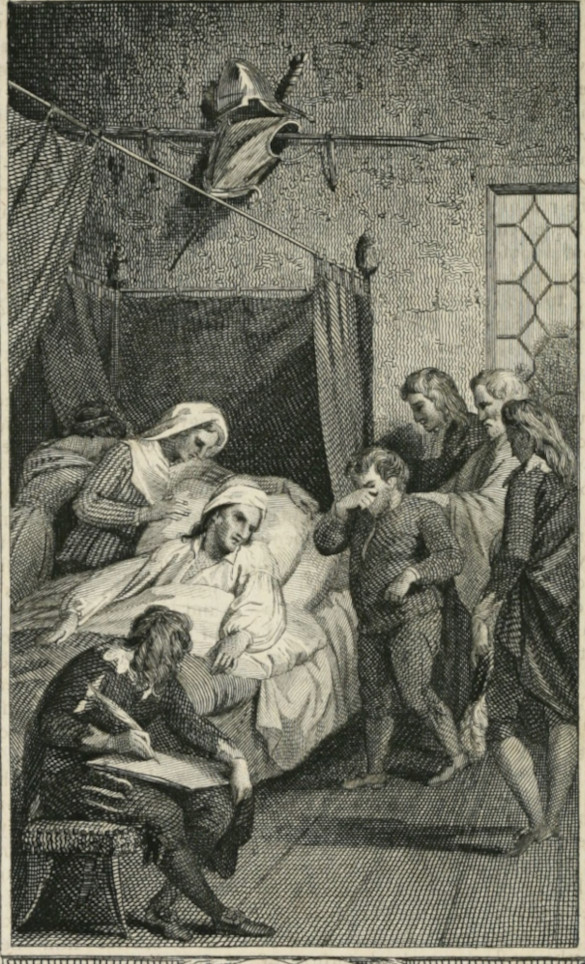
Plate XV: Don Quixote on His Death-Bed.
Confession being ended, the curate came forth, saying, ‘The good Alonzo Quixano is really dying, and without all doubt restored to his senses; we may now go and see the will attested.’ These tidings gave a terrible stab to the overcharged hearts of 587the two ladies and his faithful squire, whose eyes overflowed with weeping, and whose bosoms had well-nigh burst with a thousand sighs and groans; for, indeed, it must be owned, as we have somewhere observed, that whether in the character of Alonzo Quixano the Good, or in the capacity of Don Quixote de La Mancha, the poor gentleman had always exhibited marks of a peaceable temper and agreeable demeanour, for which he was beloved, not only by his own family, but also by all those who had the pleasure of his acquaintance.
The notary entering the apartment with the rest of the company, wrote the preamble of the will, in which Don Quixote disposed of his soul in all the necessary Christian forms: then proceeding to the legacies, he said, ‘Item, Whereas Sancho Panza, whom, in my madness, I made my squire, has in his hands a certain sum of money for my use; and as divers accounts, disbursements, and pecuniary transactions have passed between us; it is my will, that he shall not be charged or brought to account for the said money; but, if there be any overplus, after he has deducted the payment of what I owe him, the said overplus, which must be a mere trifle, shall be his own, and much good may it do him! and as, during my disorder, I contributed to his being made governor of an island, I would now, while I enjoy my perfect senses, confer upon him, were it in my power, a whole kingdom; which he richly deserves for the innocency of his heart, and the fidelity of his service.’ Then turning to the disconsolate squire, ‘Forgive me, friend,’ said he, ‘for having been the cause of thy appearing in the eye of the world a madman, like myself; by drawing thee into my own erroneous notions, concerning the existence and adventures of knights-errant.’—‘Lack-a-day, dear Sir!’ cried Sancho, blubbering, ‘do not die; take my advice, and live many years upon the face of the earth; for the greatest madness a man can be guilty of in this life, is to let himself die outright, without being slain by any person whatever, or destroyed by any other weapon than the hands of melancholy. Hark ye, Signior! hang sloth! get up, and let us take the field in shepherds apparel, according to our agreement; who knows, but behind some bush we may find my Lady Dulcinea disenchanted, and a comely sight for to see? If you take your overthrow so much to heart, lay the blame at my door, and say you was vanquished by my carelessness, in girting Rozinante; besides, your worship must have read in your books of chivalry, that it was common for one knight to unhorse another, and for him who was vanquished to-day, to be victor to-morrow.’—‘Very true,’ said Sampson; ‘honest Sancho seems to be very well informed of these matters.’—‘Gentlemen,’ replied the knight, ‘let us proceed fair and softly, without looking for this year’s birds in last year’s nests. I was mad; but now am in my right senses. I was Don Quixote de La Mancha; but now, as I have already observed, I am Alonzo Quixano the Good: and I hope, I shall, by my veracity and repentance, recover that degree of your esteem, which I formerly enjoyed. So let Mr. Notary proceed.’
‘Item, I bequeath my whole estate, real and personal, to my niece Antonia Quixano here present, after deducting what shall be sufficient for the payment of my debts and legacies; and it is my will, that from the first of the money thence arising, the wages due to my housekeeper shall be paid, together with twenty ducats for a suit of mourning; and I appoint Mr. Curate, and Mr. Batchelor Sampson Carrasco, here present, my executors. Item, It is my will, that if my niece Antonia Quixano inclines to marriage, she shall not wed any man until she is fully satisfied, from previous information, that he is an utter stranger to books of chivalry; or, if she finds he is addicted to this kind of reading, and marries him nevertheless, she shall forfeit the whole legacy, which my executors may, in that case, dispose of in pious uses. Item, I beseech the said gentlemen, my executors, if perchance they should become acquainted with a certain author, who composed and published an history, entitled, “The Second Part of the Atchievements of Don Quixote de La Mancha;” that they will, in my name, most earnestly entreat him to forgive me for having been the innocent cause of his writing such a number of absurdities as 588that performance contains; for I quit this life with some scruples of conscience arising from that consideration.’ The will being thus concluded, he was seized with a fainting-fit, and stretched himself at full length in the bed; so that all the company were alarmed, and ran to his assistance. During three days which he lived after the will was signed and sealed, he frequently fainted, and the whole family was in confusion: nevertheless, the niece eat her victuals, the housekeeper drank to the repose of his soul, and even Sancho cherished his little carcase; for the prospect of succession either dispels or moderates that affliction which an heir ought to feel at the death of the testator.
At last Don Quixote expired; after having received all the sacraments, and in the strongest terms, pathetically enforced, expressed his abomination against all books of chivalry; and the notary observed, that in all the books of that kind which he had perused, he had never read of any knight-errant who died quietly in his bed, as a good Christian, like Don Quixote; who, amidst the tears and lamentations of all present, gave up the ghost, or in other words, departed this life. The curate was no sooner certified of his decease, than he desired the notary to make a testimonial, declaring, that Alonzo Quixano the Good, commonly called Don Quixote de La Mancha, had taken his departure from this life, and died of a natural death; that no other author, different from Cid Hamet Benengeli, should falsely pretend to raise him from the dead, and write endless histories of his atchievements.
This was the end of the sage Hidalgo de La Mancha, whose native place Cid Hamet would not punctually describe, because he wished that all the towns and villages of that province should contend for the honour of having given him birth, as the seven cities of Greece contended for Homer. We shall here omit the lamentations of the housekeeper, niece, and squire, together with all the epitaphs, except the following, by Sampson Carrasco.
Here lies a cavalier of fame,
Whose dauntless courage soar’d so high,
That death, which can the boldest tame,
He scorn’d to flatter or to fly.
A constant bugbear to the bad,
His might the world in arms defy’d;
And in his life though counted mad,
He in his perfect senses dy’d.
The sagacious Cid Hamet addressing himself to his pen, ‘And now, my slender quill,’ said he, ‘whether cunningly cut, or unskilfully formed, it boots not much; here, from this rack, suspended by a wire, shalt thou enjoy repose, and live to future ages, if no presumptuous and wicked hand shall take thee down, in order to profane thee in compiling idle histories. But ere such insolent fingers can touch thine hallowed plume, accost, and warn them, if thou canst, in words like these:
“Caitifs, forbear!—Illustrious prince, let none
”Attempt th’ emprize reserv’d for me alone[213].”
‘For me alone was Don Quixote born, and I produced for him; he to act, and I to record: in a word, we were destined for each other, maugre and in despight of that fictitious Tordesilian author, who has presumed, or may presume, to write with his coarse, aukward ostrich quill, the atchievements of my valiant knight; a burden too heavy for his weak shoulders, and an undertaking too great for his frozen genius. Advise him, therefore, if ever thou shouldst chance to be in his company, to let the wearied and mouldering bones of Don Quixote rest in the grave, without seeking to carry him into Old Castile[214], in opposition to all the prerogatives of death; or to drag him from his tomb, where he really and truly lies extended at full length, and utterly incapable of making a third sally: for all the exploits performed by the whole tribe of knights-errant are sufficiently ridiculed by the two expeditions he has already made, so much to the satisfaction and entertainment, 589not only of Spain, but also of every foreign nation to which the fame of his adventures hath been conveyed. In so doing, thou wilt conform to thy Christian profession of doing good to those who would do thee harm; and I shall rest satisfied and perfectly well pleased, in seeing myself the first author who fully enjoyed the fruit of his writings in the success of his design: for mine was no other than to inspire mankind with an abhorrence of the false and improbable stories recounted in books of chivalry; which are already shaken by the adventures of my true and genuine Don Quixote, and in a little time will certainly sink into oblivion. Farewel.’
FINIS.
Footnotes
Transcriber’s Notes: Footnotes have been collected at the end of the text, and are linked for ease of reference.