Part 2 / Book 4 — BOOK IV. (continued 2)
T. (Tobias) Smollett translation
So saying, he rose from his seat with great fury and demonstrations of wrath, leaving the whole company astonished, and doubting whether they should consider him as a lunatick or person of sound intellects. However, they endeavoured to dissuade him from publishing such a declaration, saying they took his gratitude for granted, and that there was no need of new proofs to demonstrate his valour, seeing those were sufficient which they had seen recorded in the history of his atchievements.
Notwithstanding this remonstrance, the knight executed his design; he mounted Rozinante, embraced his shield, and grasping his lance, posted himself in the middle of the king’s highway, which was not far from their verdant habitation, being followed by Sancho upon Dapple and the whole flock of those pastoral gentry, who were curious to see the issue of his arrogant and hitherto unseen enterprize.
Having taken possession of the ground, he wounded the very vault of heaven with the loudness of the tone in which he pronounced these words: ‘O ye passengers and travellers, knights, squires, persons on horseback or a-foot, who come or are to come this way, within the space of two days, from this present hour, know that Don Quixote de La Mancha, knight-errant, is here posted to maintain that the nymphs who inhabit these meadows and woods, excel in beauty and courtesy all the ladies upon earth, exclusive of Dulcinea del Toboso, the mistress of my soul. Let him who thinks the contrary, advance; here I am ready to receive him.’
Twice did he repeat this declaration, and twice was it repeated unheard by any knight adventurer; but fortune, which was bent upon directing his affairs to better purpose, ordained, that in a very little time he descried upon the road a great number of men on horseback, some of them armed with lances riding towards him in great haste, and all in a cluster. Those who were with Don Quixote no sooner perceived this troop, than they turned their backs and retired a good way from the road, knowing that some mischief would befal them, should they keep their ground: the knight alone maintained his post with an undaunted heart, and Sancho Panza shielded himself with the flanks of Rozinante.
When this troop of lancemen advanced, one of them that rode before the rest, began to halloo as loud as he could cry to Don Quixote, ‘Get out of the way, thou servant of the devil, or these bulls will trample thee to dust!’—‘So ho, caitiffs!’ replied the knight; ‘your bulls shall not avail against me, even though they are the fiercest that ever fed upon the banks of Xarama; confess, ye miscreants, unsight, unseen, the truth of what I have proclaimed, or meet my vengeance in the field of battle.’
530The herdsman had no time to reply, nor Don Quixote to retire, had he been never so willing; so that the drove of wild bulls and tame cattle, together with a multitude of drivers and other people employed to convey them to a place where, in a few days, they were to be baited—the whole throng, I say, passed over the bellies of Don Quixote, Sancho, Rozinante, and Dapple, whom they in a twinkling overthrew and rolled in the mire, in such a manner that the squire was squeezed as flat as a pancake, his master astonished, Dapple terribly bruised, and Rozinante in no very catholick condition. At length, however, all the four got upon their legs; and Don Quixote, staggering here, and tumbling there, began to pursue the drove on foot, calling aloud—‘Halt, and wait a little, ye felonious plebeians; he is a single knight who defies you to the combat, and not of the disposition and opinion of those who say—“Lay a bridge of silver for a flying enemy.”’
But notwithstanding all his exclamation, the drovers did not slacken their pace, or mind his threats, more than they minded last year’s weather. Don Quixote being so tired, that he could run no farther, sat down upon the side of the road, more incensed than revenged, and waited for Sancho, Rozinante, and Dapple, who soon arrived. Then the knight and squire, mounting their beasts, proceeded on their journey with more shame than satisfaction; and never dreamed of returning to take a formal leave of the feigned or counterfeit Arcadia.
CHAP. VII. IN WHICH IS RECOUNTED THE EXTRAORDINARY INCIDENT THAT HAPPENED TO DON QUIXOTE, AND MAY WELL PASS FOR AN ADVENTURE.
The dust and drought which Don Quixote and Sancho derived from the uncivil behaviour of the bulls, were remedied by a clear and limpid stream which they had the good fortune to find in a good shade, and on the margin of which this down-trodden pair, the master and man, seated themselves, after Rozinante and Dapple were unbridled, and unhaltered, and left to the freedom of their own will. Sancho immediately had recourse to the store of his wallet, from which he drew forth what he usually called his belly-timber; but not before he had rinsed his mouth, and his master had washed his own face, in consequence of which refreshment they recovered their exhausted spirits. Nevertheless, Don Quixote forbore eating, out of pure vexation; while Sancho, who durst not touch the food that was before him, waited, out of pure good manners, until his master should begin. Seeing, however, the knight so absorbed in his own imagination, that he forgot to lift the bread to his mouth, he, without letting one word escape his own, but trampling under-foot all kind of good-breeding, began to cram his paunch with the bread and cheese which constituted his provision. ‘Eat, friend Sancho,’ said Don Quixote, ‘and support life, which is of more importance to thee than to me, and leave me to die by the strength of imagination and the severity of my misfortunes. I, Sancho, was born to live dying, and thou to die eating; and that thou mayest be convinced of this truth, consider me recorded in history, renowned in arms, courteous in demeanour, respected by princes, courted by damsels; and, after all, when I expected palms, triumphs, crowns of laurel, obtained and merited by my valiant atchievements, I have this morning seen myself trampled, spurned, and bruised, by the feet of filthy, unclean animals! This consideration blunts my teeth, stupifies my grinders, benumbs my hands, and deprives me wholly of appetite; so that I believe I shall die of hunger, the most cruel of all deaths.’—‘At that rate,’ answered the squire, without suspending the action of his jaws, ‘your worship will not approve of the proverb which says—“Let Martha die, but not for lack of pye.” At least I, for my own part, have no intention to starve myself; on the contrary, I am resolved to follow the example of the cordwainer who stretches the leather with his teeth until it is sufficient for his purpose; now, I will also employ my teeth in stretching out my life with eating, to that end which is ordained 531by Heaven; and you must know, Signior, that it is the greatest madness in nature to seek to despair like your worship. Take my advice; eat a little for refreshment, and then take a nap upon the green couch of this delightful grass, and when you awake you will see how much you’ll be relieved.’
The knight relished his advice, which he thought savoured more of the philosopher than of the ideot; and said to him, ‘Now, Sancho, if thou wouldst do that for me which I am going to mention, my relief would be more certain, and my affliction diminished: my proposal is, that while I sleep, in compliance with thy advice, thou wouldst go aside a little farther, and, exposing thy flesh to the air, bestow upon it, with the reins of Rozinante’s bridle, three or four hundred stripes, of the three thousand three hundred which thou hast undertaken to endure for the disinchantment of Dulcinea; for it is a lamentable circumstance that the poor lady should remain so long inchanted, through thy carelessness and neglect.’—‘There is much to be said on that subject,’ replied Sancho: ‘let us both go to sleep in the mean time; and afterwards God must ordain that which will come to pass. Your worship must know, that it requires great resolution in a man to scourge himself in cold blood; especially when the stripes fall upon a body which is poorly fed and supported: let my Lady Dulcinea have a little patience; when she least thinks of it, she will see my body scourged into a perfect sieve; and while there is life there is hope; my meaning is, that while I hold life, I shall never quit the desire of performing my promise.’
Don Quixote, thanking him for his good-will, took a little sustenance, Sancho ate voraciously, and then both laid themselves down to sleep, leaving Rozinante and Dapple, those two friends and inseparable companions, at full liberty to feed, without restraint, upon the luxuriant grass with which the meadow abounded.
The day being far spent before they awoke, they remounted their cattle, and pursued their journey with uncommon expedition, in order to reach an inn which they descried at a league’s distance. I say, an inn, because it was so called by Don Quixote, contrary to his former custom of mistaking every inn for a castle. When they arrived at this place of entertainment, they asked if they could be accommodated with lodging; and the landlord replied in the affirmative, telling them at the same time, that his house afforded as good conveniences and entertainment as could be found in the whole city of Saragossa. They alighted accordingly, and Sancho carried his bags into an apartment, of which the innkeeper gave him the key; then he led the cattle to the stable, where he gave them their allowance; from thence he went to receive the commands of his master, who had sat down upon a bench, and thanked Heaven, in a particular manner, that Don Quixote had not committed his usual mistake. They retired to their chamber, and supper-time approaching, Sancho desired to know what they could have for that meal. To this interrogation mine host replied, that his taste should be fitted to a hair, and that he might bespeak what he liked best; for, as far as the birds of the air, the fowls of the land, and the fish of the sea could go, he would find the house provided. ‘Less than all that will serve,’ answered Sancho: ‘we shall be satisfied with a couple of chickens roasted; for my master has a very delicate taste, and eats but little; and as for myself, I am not a very unconscionable cormorant.’
The other frankly owned he had no chickens; for the kites had destroyed the whole brood. ‘Well, then, Mr. Landlord,’ said the squire, ‘you may order a pullet to be put to the fire; but see it be very tender.’—‘A pullet!’ cried the innkeeper; ‘body o’ my father! now, as I’m an honest man, I sent above half a hundred yesterday to market; but setting aside pullets, you may have what you will.’—‘If that be the case,’ said Sancho, there will be no want of veal or kid.’—‘At present,’ replied the innkeeper, ‘there is really none in the house; we are just out of these articles; but next week she shall have enough and to spare.’—‘To be sure, we shall be much the better for that!’ answered Sancho; ‘I’ll lay a wager all these 532wants will be supplied with plenty of eggs and bacon.’—‘’Fore God!’ said the host, ‘my guest has an admirable knack at guessing; I have told him there is neither hen nor pullet in the house, and he would have me treat him with eggs[201]! Shift about, if you please, to some other delicacies, and think no more of poultry.’
‘Body o’ me!’ cried Sancho, ‘let us come to some resolution; tell me at once what is in the house, and pray, Mr. Landlord, no more of your shiftings.’—‘What I really and truly can afford,’ said the innkeeper, ‘is a dish of cow-heel, so delicate they might be taken for calves-feet; or you may call them calves-feet, that might pass for cow-heel. They are stewed with pease, onions, and bacon, and this blessed minute cry—“Come, eat me; come, eat me.”’—‘I mark them for my own,’ cried Sancho, ‘from henceforth for ever, amen. Let no man touch the mess, for which I will pay you handsomely; for nothing in the whole world could be more agreeable to my taste; and, provided I have cow-heel, the calves-feet may go to the devil.’—‘No man shall interfere with you,’ replied the landlord; ‘as for the other company in the house, they, out of pure gentility, bring along with them their own cook, butler and sumpter mule.’—‘Nay, as for gentility,’ said the squire, ‘no man has more of that than my master; but his profession will not admit of travelling stores and butteries: lack-a-day! we lay ourselves down in the middle of a green field, and fill our bellies with medlars and acorns.’ Such was the conversation that passed between the innkeeper and Sancho; who would not, however, go any greater lengths in satisfying the curiosity of mine host, who was very desirous to know the office or profession of his master.
Supper being ready, Don Quixote retired to his apartment, whither the landlord brought the pot just as it was, and very decently sat down to partake of the meal. At that instant, the knight heard people talking in the next room, from which he was divided only by a partition of lath, and could plainly distinguish these words: ‘As you hope to live, Don Geronimo, I conjure you, as supper is not yet ready, to read another chapter of the second part of Don Quixote de La Mancha.’
The knight, hearing his own name mentioned, started up immediately, and listening with great attention, heard Geronimo reply to this effect: ‘What pleasure can you have in reading such absurdities, Don John? No person who has seen the first part of the history of Don Quixote de La Mancha, can possibly be entertained with this which is called the second.’—‘Nevertheless,’ said Don John, ‘it will not be amiss to read a little; for there is no book so bad as to contain nothing that deserves regard. What displeases me most in this performance is, the author’s describing Don Quixote as altogether disengaged and detached from Dulcinea del Toboso.’
The knight, hearing this remark, was filled with rage and vexation, and exclaimed aloud, ‘If any person whatever affirms that Don Quixote de La Mancha either has forgotten or can forget Dulcinea del Toboso, I will, with equal arms, make him know and own, that his affection is far distant from the truth; for the peerless Dulcinea del Toboso cannot possibly be forgot; nor is Don Quixote susceptible of forgetfulness: his motto is Constancy, which he professes to maintain with gentleness and suavity of manners.’—‘Who is he that answers?’ cried the voice. ‘Who should it be,’ replied Sancho, ‘but Don Quixote de La Mancha, in his own person, who will make good whatever he has said, and whatever he shall say; for, “A good paymaster wants no pawn.”’
Scarce had the squire pronounced these words, when two gentlemen, for such they appeared, entered the apartment; and one of them throwing his arms about Don Quixote’s neck, ‘Your appearance,’ said he, ‘does not belye your name, and your name cannot but give credit to your appearance. Without all doubt, you, Signior, are the true Don Quixote de La Mancha, the north-star and luminary of knight errantry, maugre and in despite of him who has thought proper to usurp your name, and annihilate your exploits; I mean, the author of this here book:’ which he 533took from his companion, and put into the hand of Don Quixote; who, without answering one word, began to turn over the leaves, and in a very little time gave it back to the stranger, saying—‘In the little I have read, I find three things worthy of reprehension in the author; first, some expressions in the prologue or preface; secondly, his using the Arragonian dialect, and writing sometimes without articles; and thirdly, that which confirms my opinion of his ignorance, his erring and deviating from the truth in the most material circumstances of the history; for he says, the wife of my squire Sancho Panza, is called Mary Gutierrez, whereas her name is Teresa Panza; now, if he blunders in such an essential circumstance, we may justly conclude that his whole history is full of mistakes[202].’
‘A pleasant historian, i’faith!’ cried Sancho: ‘he must be well acquainted with our adventures, to be sure, when he calls my dame Teresa by the name of Mary Gutierrez! Take the book again, Signior, and see if he has lugged me in, too, under a borrowed name!’—‘From what you have said, friend,’ replied Don Geronimo, ‘I find you must certainly be Sancho Panza, squire to Signior Don Quixote.’—‘Even so,’ answered the squire; ‘and I am proud of the occupation.’—‘Then, in good sooth!’ said the cavalier, ‘this author has not treated you so handsomely as from your appearance I conclude you deserve; he represents you as a gormandizer, a simpleton without the least vein of humour or pleasantry; and, in short, quite different from the Sancho described in the first part of the history of your master!’—‘The Lord in heaven forgive him!’ cried Sancho: ‘he might have let me sleep in my corner, without remembering there was such a sinner as me upon the face of the earth: for, “He that has skill should handle the quill[203];” and I know that St. Peter is well at Rome.’
The two gentlemen invited Don Quixote to sup with them in their apartment, as they knew the inn could not afford any thing proper for his entertainment; and the knight, who was always the pink of courtesy, complied with their request; so that Sancho remained undisputed master of the pot. Cum mero mixto imperio, he seated himself at the head of the table, in company with the landlord, who vied with him in affection for the cow-heel and calves-feet.
Don John, in the course of the conversation at supper, asked what news Don Quixote had concerning the Lady Dulcinea del Toboso; he begged to know if she was married, brought to-bed, or in a state of pregnancy; or, if still single, she, as far as modesty and decorum would permit, smiled upon the passion of her lover Don Quixote. ‘Dulcinea,’ answered the knight, ‘is still unmarried, and my passion more intense than ever: our correspondence stands on the old footing, and her beauty is transformed into the appearance of a base-born, rustick wench.’
Then he, in a very circumstantial manner, related the inchantment of his mistress, together with his adventure in the cave of Montesinos, and the means prescribed by the sage Merlin for her relief; namely, the flagellation of Sancho.
Unspeakable was the satisfaction which the two cavaliers enjoyed in hearing Don Quixote recount the strange incidents of his history; and they were equally astonished at the folly of his adventures and the elegance with which he related them: here they esteemed him as a man of sound understanding; and there he slipped through their opinion into the sink of madness; so that they could not determine what rank he should maintain between lunacy and discretion.
Meanwhile, Sancho having finished his meal, left his landlord more than half seas over; and entering the chamber where his master sat, ‘Gentlemen,’ said he, ‘I’ll be hanged if the author 534of that book your worships were talking of, has any mind or inclination that he and I should be messmates. Since he has given me the character of a glutton, as your worships have observed, I wish he may not have likewise called me a drunkard.’—‘He has indeed,’ replied Don Geronimo: ‘but I do not remember the expression, though I know the words are very scurrilous and false above measure, as I can plainly perceive in the physiognomy of honest Sancho here present.’—‘Take my word for it, noble gentlemen,’ said the squire, ‘the Sancho and Don Quixote of that history must be persons quite different from those recorded by Cid Hamet Benengeli, who are no other than we ourselves, here standing and sitting in your presence: my master, valiant, sagacious, and enamoured; and I simple, and withal pleasant, but neither sot nor gormandizer.’—‘I believe what you say,’ replied Don John: ‘and wish it were possible to obtain a mandate, prohibiting any person or persons from presuming to meddle with the affairs of the great Don Quixote, excepting Hamet, his original author; in the same manner as Alexander the Great decreed that no painter but Apelles should draw his portrait.’—‘Any body may draw my portrait,’ said the knight; ‘but let no man maltreat my character; for patience often falls to the ground, when it is overloaded with injuries.’—‘No injury can be done to Don Quixote, but what he can easily revenge,’ answered Don John: ‘unless he chuse rather to ward it off with the buckler of his patience, which, I believe, is both strong and ample.’
In this and other such conversation they spent great part of the night; and although Don John would fain have persuaded Don Quixote to read a little more of the book, that they might hear him descant upon particulars, he could not accomplish his purpose; the knight assuring him he considered it as good as read, and pronounced the whole an heap of absurdities; nor did he chuse that the author, who might perhaps hear it was in his hands, should have the satisfaction of thinking he had perused his performance; for, from objects of obscenity and turpitude, not only the eyes but even the imagination ought to be kept sacred. When they asked, whither his course was at present directed, he told them he was bound for Saragossa, in order to signalize himself in the prize-jousts which are yearly solemnized in that city.
Then Don John gave him to understand that the new history gives an account of the spurious Don Quixote’s having been in that place at a course, the description of which was barren of invention, low in stile, miserably poor in devices, and rich in nothing but folly and impertinence.—‘For that very reason,’ said Don Quixote, ‘I will not set foot in Saragossa, and so demonstrate to the wide world, the falshood of this modern historian, and let the nations see I am not the Don Quixote whom he has described.’—‘I applaud your resolution,’ replied Don Geronimo; ‘and there will be a tournament in Barcelona, where Don Quixote will have an opportunity to signalize his valour.’—‘And that I shall surely embrace,’ answered the knight: ‘at present, gentlemen, as it is high time, you will give me leave to retire to bed; and I beg you will esteem and place me among the number of your most sincere friends and humble servants.’—‘And me also,’ said Sancho: ‘peradventure my service may be good for something.’ They accordingly took their leave, and retired to their apartment, leaving Don John and his companion astonished at the medley of sense and madness they had observed in his discourse: they believed, without hesitation, these to be the real Don Quixote and Sancho, and not the persons described by the Arragonian author.
Don Quixote rising early next morning, tapped at the partition, and bade farewel to his entertainers: and Sancho paid his reckoning like a prince; advising the landlord, however, either to furnish his house better, or to brag less of his accommodations.
CHAP. VIII. OF WHAT BEFEL DON QUIXOTE IN HIS WAY TO BARCELONA.
The morning was cold, and seemed to promise but little less for the day on which Don Quixote departed 535from the inn, after having informed himself of the nearest road to Barcelona which he could travel without touching at Saragossa; so eager he was to fix the lye upon the new historian by whom they said he was so scurvily treated.
So it happened that he met with nothing worthy of record within six days; at the end of which, having quitted the high road, he was benighted among a thick cluster of oak or cork-trees; for, in this particular, Cid Hamet has not preserved his usual punctuality. The master and man alighting from their beasts, and accommodating themselves at the roots of two separate trees, Sancho, who had laid in a good afternoon’s luncheon, entered the gates of sleep abruptly, and without hesitation; whereas the knight, who was kept awake more by fancy than by hunger, could not close an eye; but, on the contrary, rambled in his imagination through a thousand different scenes. Sometimes he conceived himself to be in the cave of Montesinos; sometimes he thought he saw Dulcinea skipping and leaping upon her ass, in that dismal state of rustick transformation; and then his ears seemed to tingle with the words of the sage Merlin, who pronounced the conditions and endeavours to be observed and exerted for the disinchantment of his mistress. He was driven almost to desperation, when he reflected on the sloth and uncharitable disposition of his squire Sancho, who, to the best of his belief, had hitherto given himself only five stripes; a number poor and inconsiderable in comparison with the infinite score unpaid: and this consideration overwhelmed him with such anxiety and chagrin, that he thus argued with his own bosom.
‘If Alexander the Great ventured to cut the Gordian knot, on the supposition that cutting would be as effectual as untying it; and notwithstanding this violence, became sole master of all Asia, the same success may now attend my efforts in disinchanting Dulcinea, should I scourge Sancho against his own consent; for if the condition of this remedy be, that Sancho shall receive three thousand three hundred stripes, what signifies it to me whether they are bestowed by his own hand, or that of some other person, seeing the essential point is in his receiving them, from what quarter soever they may come?’
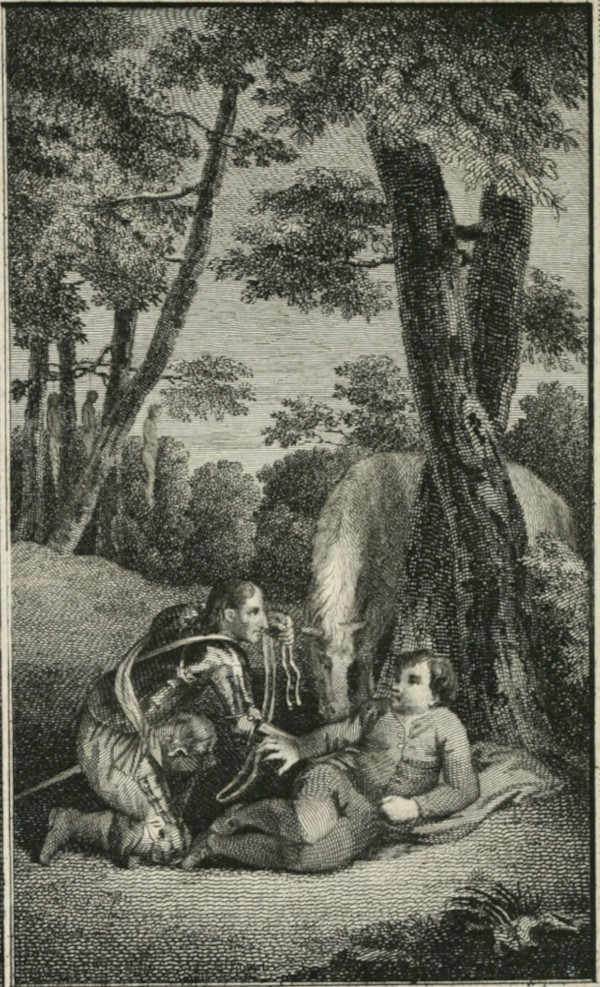
Plate XVI: Don Quixote Attempts to Scourge Sancho Panza.
Inspired with this notion, he took the reins of Rozinante’s bridle, which he formed into an instrument of flagellation; and, approaching the sleeping squire, began to untruss his points: indeed, it is the general opinion, that he had but one before which kept up his breeches. But scarce had he began to perform this operation, when Sancho, shaking off the fetters of slumber at one start, exclaimed aloud, ‘What’s the matter? Who the devil is that so busy untrussing me while I’m asleep?’—‘It is I,’ answered the knight, ‘who mean to atone for thy omissions, and remedy my own misfortunes. I come to scourge thee, Sancho, and discharge some part of the debt which thou art obligated to pay. Dulcinea pines in a state of transformation; and, while thou livest at thine heart’s ease, I am dying with desire: untie these points, therefore, of thy own free-will; for mine, I assure thee, is to afflict thy posteriors with two thousand stripes at least, before we quit this unfrequented place.’—‘By no manner of means!’ cried Sancho; ‘I advise your worship to be quiet, or, by the God of Israel! the deaf shall hear us: the stripes I have obliged myself to receive, must be given with my own free-will and consent, not by force or compulsion; and, at present, I have not the least inclination to discipline my own flesh: let it suffice, I give your worship my word and honour, that I will flog and fly-flap my carcase as soon as ever I find myself disposed for such exercise.’—‘I must not leave it to thy courtesy,’ replied the knight; ‘for thou hast a stony heart, and though a peasant, art very tender of thy flesh.’ He accordingly struggled with all his might to unbreech the squire; who, finding the affair become very serious, started up from the ground, sprung upon his master, and closing with him in a trice, tripped up his heels, so that the knight came instantly to the ground, where he lay with his face uppermost: then the victor, clapping his right knee to the breast of the vanquished party, and griping him fast by both wrists, hampered him in such a manner, that he could scarce either breathe or move. Nevertheless he made shift to pronounce these words: ‘How now, traitor! dost 536thou presume to rebel against thy master and natural lord, whose bread thou hast eaten?’—‘I neither exalt kings nor dethrone them,’ answered Sancho; ‘but, being my own master, I stand up in my own defence: if your worship will promise to be quiet, and think no more of scourging me for the present, I will forthwith free and disencumber you from these bonds: otherwise, here thou shalt die, traitor and enemy to Donna Sancha.’
The knight subscribed to the conditions, swearing by the life of his inclinations, that he would not touch the nap of his garment, but leave him at full liberty to begin the flagellation when he himself should think proper. On these considerations Sancho arose, and went aside a good away to another tree, at whose root he resolved to take his lodging for the remaining part of the night. There he felt something bob against his head, and putting up his hand, found two legs provided with shoes and stockings: trembling with affright, he moved with great expedition to another tree, where he met with the same salutation, which increased his terror to such a pitch, that he roared aloud for assistance. His master hearing this exclamation, ran towards the place, and enquired into the cause of his fear and confusion; when the squire gave him to understand that all these trees were loaded with human legs and feet. The knight reaching up his hand, immediately conceived the meaning of this strange circumstance, and said to Sancho, ‘Thou needest not be afraid, for those legs and feet which thou hast felt without seeing, certainly belong to some robbers and outlaws who are hanged upon the trees; for, when they are apprehended in this place, the officers of justice string them up by twenties and thirties; and from this particular, I am convinced that we must now be near Barcelona.’ And, indeed, his conjecture was right. Soon as objects were rendered visible by the dawn, they lifted up their eyes, and saw that the clusters depending from the trees were no other than the bodies of banditti. The morning forthwith ushered in the day; and if they were scared by the dead, they were no less aghast when they found themselves all of a sudden surrounded by above forty living robbers, who called to them in the Catalonian language to be quiet, and stand still until their captain should arrive.
Don Quixote being a-foot, his horse unbridled, his lance leaning against a tree, and, in short, his person without any means of defence, he thought proper to cross his arms upon his breast, and hung his head, reserving himself for a better season and more happy conjuncture. Meanwhile, the robbers made such dispatch in plundering Dapple, that in the twinkling of an eye there was not the least crumb left in the wallet and pillion; and lucky it was for Sancho that he had secured, in a concealed girdle, the duke’s crowns and the money he had brought from home; nay, notwithstanding this precaution, those honest gentlemen would have searched and rummaged him in such a manner as to have found the cash, even though it had been hidden between the flesh and the skin, had not they been interrupted by the seasonable arrival of their captain, who seemed to be about four and thirty years of age, of a robust make, middling stature, grave countenance, and brown complexion; he rode a strong horse, was provided with a coat of mail, and he had slung a pair of pistols with firelocks at each side of him. Seeing his squires (for so they call the gentlemen of that profession) very busy in rifling Sancho Panza, he ordered them to desist; and, as they immediately obeyed his command, the girdle happily escaped. Surprized to see a lance leaning against a tree, a shield lying on the ground, and Don Quixote armed at all points and in manifest despondence, exhibiting the most rueful and melancholy figure that Melancholy herself could have formed, he approached the knight, saying, ‘Be not so dejected, honest friend; you have not fallen into the hands of a cruel Osiris, but of those of Roque Guinart, who has more of compassion than cruelty in his disposition.’
‘My dejection,’ answered the knight, ‘does not proceed from my having fallen under thy power, O valiant Roque, whose fame the limits of this earth cannot confine; but from the consciousness of my own neglect, in consequence of which thy soldiers found me unprepared: whereas I am bound by the order of chivalry, which 537I profess, to be always alert and vigilant, and to stand as it were at all times sentry upon myself; and give me leave to tell thee, O renowned Roque! they would not have found it such an easy task to subdue me, had I been on horseback, armed with my lance and shield: for know, I am Don Quixote de La Mancha, whose exploits are celebrated through this whole terraqueous globe.’
Roque Guinart immediately perceived that the knight’s infirmity partook more of madness than of valour; and although he had frequently heard him named, he looked upon his atchievements as altogether fabulous, and could not believe that such a humour did ever prevail in the heart of man: he was therefore extremely well pleased with this encounter, that he might with his own eyes see immediately before him what he had heard reported afar off. ‘Valiant knight,’ said he, ‘do not vex yourself, or consider your present situation in the light of a misfortune; perhaps, by stumbling in this manner your crooked fate may be made straight; for Heaven, by strange unforeseen windings, which mankind cannot comprehend, is wont to raise the fallen, and enrich the needy.’
Don Quixote’s mouth was already open to thank him for his courteous behaviour, when they heard behind them a noise like that of a whole troop of horse, though there was only one, upon which came at full speed a youth who seemed to be about the age of twenty, dressed in green damask laced with gold, long breeches, a loose coat, a hat cocked in the Walloon fashion, with strait waxed boots and spurs; armed with a gold hilted sword and dagger, a small fusil in his hand, and a case of pistols by his side.
Roque hearing the noise, turned about, and was surprized with the sight of this handsome figure, who accosted him in these terms: ‘In search of thee, courageous Roque! I came hither, hoping by thy means to find, if not a remedy, at least an alleviation, of my misfortune: and, to keep thee no longer in suspense, as I am certain you never saw me before, know that I am Claudia Geronima, daughter of Simon Forte, who is thy intimate friend, as well as the particular enemy of Clauquel Torellas, thy inveterate foe, as being head of the party which thou hast always opposed. This Torellas, thou knowest, has a son called Don Vincente Torrellas, at least he was, two hours ago, distinguished by that name. I will be as brief as possible in the account of my disaster, and explain the occasion of it in a few words. That youth happened to see me, and courted my good graces; I listened to his addresses, and gave him my heart, without the knowledge of my father; for there is no woman whatsoever so retired and mewed up, but she will find a time to execute and gratify her irresistible desires. In a word, he promised to be my husband, I consented to become his wife, and this was the farthest extent of our correspondence. Yesterday I was informed, that, forgetting this obligation, he intended to marry another woman, and that this morning he had set out to celebrate his nuptials. My brain was disturbed, and my indignation arrouzed to such a degree by these fatal tidings, that, taking the advantage of my father’s absence, I disguised myself in this apparel, pursued a-horseback my perfidious lover, whom, having overtaken about a league from this place, I, without staying to make complaints, or hear apologies, discharged upon him this fusil and these two pistols; so that, I believe, he has more than a brace of bullets in his body: thus I opened a gate through which my honour, though bathed in his blood, may escape, and left him in the hands of his servants, who neither could nor presumed to exert themselves in his defence. Thence I came in quest of thee, to beg that thou wilt conduct me safely to France, where I have relations; and, at the same time, promise to defend my father from the numerous kindred of Don Vincente, who may otherwise sacrifice him to their insatiable revenge.’
Roque was struck with admiration at the gallantry, gay appearance, genteel mien, and adventure of the beauteous Claudia, to whom he replied, ‘Come, Madam, let us first see whether or not your enemy is actually dead, and then we will consider about the most proper measures to be taken in your behalf.’ Here Don Quixote, who had 538listened with great attention to Claudia’s address, and Roque’s reply, interposing in the conversation, exclaimed, ‘No man has any occasion to give himself the least trouble about the defence of this lady, which I take upon my own shoulders. Give me my horse and my arms, and stay where you are; I will go in quest of the gentleman, and dead or alive compel him to perform the promise he hath made to so much beauty.’—‘Who doubts that!’ cried Sancho; ‘adad! my master has an excellent hand at match-making; a few days ago, he compelled another person who likewise refused to keep his word with a young woman; and if those plaguy inchanters who persecute him so much, had not transmographied the gallant into a lacquey, that very hour, She that was a maid before, would have been a maid no more[204].’
Roque, whose attention was engrossed by the adventure of the beautiful Claudia, paid very little regard to what was said either by the master or the man; but, ordering his squires to restore the spoils of Dapple to Sancho, and retire to the place appointed for their quarters that night, he set out with Claudia, in great haste, to reconnoitre the situation of the dead or wounded Don Vincente. When they arrived at the spot where he had been overtaken by the young lady, they found nothing but some recent blood; but, casting their eyes around, they discovered some people on the side of a hill, and conjectured they could be no other than the servants of Don Vincente carrying their master to a proper place, where he might be cured, if alive, or buried, if dead. Their supposition was just; and spurring up their horses, they soon overtook the unhappy cavalier, whom they found in the arms of his attendants, whom he entreated, with a faint and languid voice, to let him die where he was; for the pain of his wounds would not suffer him to proceed farther. Then Claudia and Roque approached him, to the great terror of his servants, who stood aghast at sight of this famous free-booter; but Claudia was greatly disturbed at the melancholy situation of Don Vincente; and agitated by the conflicting passions of tenderness and resentment, took him by the hand, saying, ‘Hadst thou given me this of thy own accord, conformable to the mutual promise subsisting between us, thou wouldst never have been in this condition.’
The wounded cavalier opened his eyes, which were almost shut for ever, and recognizing Claudia, ‘I plainly perceive,’ said he, ‘most beautiful and misled young lady, that I owe my death to your hand; a punishment altogether unmerited and unsuited to my inclinations, which, as well as my conduct, were, in regard to your person, altogether void of offence.’—‘What!’ cried Claudia, ‘is it not true, that you, this morning, intended to marry Leonora, daughter of the rich Balvastro?’—‘No, surely,’ replied Don Vincente; ‘my evil genius must have alarmed you with such information, that, your jealousy being inflamed, you might deprive me of life, which, as I leave it in your arms, and your embrace, I consider as happily lost; and, that you may be convinced of my sincerity, give me your hand, and, if you please, receive me for your husband, this being the only satisfaction I can make for the offence I was supposed to have given.’ Accordingly, Claudia and he joined hands and hearts together, in such a manner that she fainted away upon his bloody breast, and he sunk into a mortal paroxism.
Roque being confounded and perplexed, the servants ran for water which they sprinkled upon their faces, and Claudia recovered from her swoon; but this was not the case with her unhappy lover, who had already breathed his last. The young lady, perceiving her beloved husband was no more, rent the air with her groans, wounded the heavens with her lamentation, tore her locks and scattered them to the winds, and disfigured her face with her own nails, exhibiting all the marks of the most severe grief that ever took possession of an afflicted bosom. ‘O cruel and inconsiderate woman!’ she cried; ‘how easily wast thou provoked to execute such dire revenge! O furious jealousy! to what dire despair dost thou conduct all those who give thee harbour in their breasts! O my dear 539husband! whose unhappy fate, in being mine, hath made thy marriage-bed thy grave!’
Such were the melancholy exclamations of Claudia, which brought water into the eyes of Roque, who had seldom or never shed tears before; their servants wept bitterly; the young lady swooned almost at every step, and this whole circuit seemed to be the scene of sorrow, and field of misfortune. At length Roque Guinart ordered the servants to carry their master’s body to his father’s country-seat, which was hard by, that it might be buried according to the old gentleman’s directions; and Claudia expressed her desire of retiring to a certain monastery, the abbess of which was her aunt, where she intended to finish her life, in company of a better and more eternal husband. Roque applauded her design, and offered to conduct her to the place, promising, at the same time, to defend her father from the kindred of Don Vincente, and all the world, should they conspire against his peace. She would by no means avail herself of his attendance; but, thanking him for his obliging offers in the most courteous terms she could use, took her leave of him, shedding a torrent of tears: the servants of Don Vincente carried off the body, Roque returned to his gang, and thus ended the amour of Claudia Geronima; a catastrophe not to be wondered at, when we consider that the web of her melancholy fate was woven by the baleful and invincible force of jealousy.
Roque Guinart found his squires in the place where he had ordered them to take up their night’s lodging, and in the midst of them Don Quixote upon Rozinante, exhorting them in a long harangue, to quit that way of life, so dangerous both to soul and body; but as the greatest part of them were Gascons, a brutal and disorderly sort of people, the knight’s arguments made but little impression. The chief arriving, asked Sancho Panza if the men had restored the furniture and effects they had taken from Dapple; and the squire replied in the affirmative, excepting, however, three night-caps worth as many royal cities. ‘What the devil does the fellow say!’ cried one of the gang; ‘here they are, and any body may see they would not sell for three rials.’
‘True,’ said Don Quixote; ‘but my squire values them at that rate, on account of the person of whom I received them in a present.’ Roque commanded the man to restore them instantly; then, forming his people into a line, gave orders for bringing before them all the cloaths, jewels, money, and every thing they had acquired by robbery since the last partition; then, making a short valuation, and reducing the indivisibles into cash, he shared the whole among his company, with such equity and discretion, that in the most minute article, he neither exceeded nor fell short of distributive justice.
Having made this partition, with which every individual was perfectly well satisfied and contented, Roque turning to Don Quixote, ‘If we did not observe this punctuality,’ said he, ‘there would be no living among such a crew.’ To this declaration Sancho replied, ‘From what I have seen, I find justice so excellent in itself, that the practice of it is necessary even among thieves.’
One of the squires overhearing the remark, lifted up the butt-end of his musket, with which, in all probability, he would have shattered Sancho’s scull, had not the general commanded him to desist; while Panza, trembling in every limb, resolved never to open his lips again so long as he should sojourn among such ruffians.
About this time arrived one of the gang, who was placed centinel on the road to reconnoitre travellers, and bring intelligence; and riding up to their chief, ‘Signior,’ said he, ‘not far from hence, there is a large company of people travelling to Barcelona.’—‘Have you perceived,’ answered Roque, ‘whether they are such as we seek, or such as are in quest of us.’ When the squire replied that they were such as he sought; ‘Set out, then, all together,’ said he, ‘and bring the whole company hither, without suffering one to escape.’
This whole gang departed accordingly, leaving their chief alone with Don Quixote and Sancho, to wait the issue of their expedition; and during this interval, Roque addressing himself to the knight, ‘This life of ours,’ said he, ‘must appear very strange to Don Quixote, exposed as it is to infinite adventures and incidents replete with 540danger; and, indeed, I do not wonder that it should appear in that light; for I must know there can be no situation so full of terror and disquiet as that in which I live, and into which I was misled by the desire of revenge, which is often powerful enough to disturb the most philosophick breast. I am naturally benevolent and compassionate; but, as I have already observed, the desire of revenging an injury which I received, hath overturned all my virtuous inclinations in such a manner, that I persevere in this career, maugre and in despite of my own understanding; and, as deep calleth unto deep, and sin unto sin, different schemes of revenge are so linked together, that I undertake not only my own, but also those of other people; yet, by the blessing of God, although I find myself thus involved in a labyrinth of confusion, I have not lost the hope of being, one day, happily extricated from all my troubles.’
Don Quixote was surprized to hear Roque talk so sensibly and with such moderation; for he imagined, that among those who were in the daily practice of assaulting, robbing, and murdering their fellow-creatures, there could not surely be one single person of sense and reflection. ‘Signior Roque,’ said he, ‘the beginning of health is the knowledge of the disease, and the patient’s desire to comply with the physician’s prescription. You are now in the diseased condition, sensible of your infirmity, and Heaven, or rather God himself, who is the great physician, will apply those medicines which are proper for the cure of your distemper; but these remedies are wont to operate slowly, not in a sudden miraculous manner; and sensible sinners are much more likely to recover, than delinquents of little understanding. Now, as your discourse evinces your discretion, be of good chear, and courageously wait for the perfect recovery of your conscience. If you are in earnest inclined to quit this road, and enter at once into that which leads to salvation, come along with me and learn to be a knight-errant, in which capacity you will undergo such toils and disasters as will be deemed sufficient penance, and exalt you to Heaven in the turning of two balls.’
Roque could not help smiling at Don Quixote’s advice; but changing the conversation, he recounted the tragical adventure of Claudia Geronima, at which Sancho was exceedingly grieved; for he had been hugely pleased with the beauty, vivacity, and demeanor of the young lady.
About this time they were joined by the squires of the booty, who brought along with them two gentlemen on horseback, two pilgrims on foot, and a coach full of women, attended by six servants, partly mounted, and partly footmen, together with two muleteers, who waited upon the gentlemen. These came all in a troop surrounded by the squires, and universal silence prevailed among the victors and the vanquished; both sides expecting, with resignation, the commands of the great Roque Guinart, who, approaching the gentlemen, asked who they were, whither they were going, and what money they had.
To these interrogations one of them replied, ‘Signior, we are captains of the Spanish infantry, our companies are in Naples; our intention is to embark on board of four gallies, which, they say, are now in the harbour of Barcelona, ready to sail for Sicily; and our funds amount to two or three hundred crowns, with the possession of which we thought ourselves rich and happy, considering the narrow appointments of a soldier, which will not permit him to heap up a great deal of wealth.’
Then Roque putting the same questions to the pilgrims, they answered, that their design was to embark for Italy, in order to visit Rome; and that, between both, they could muster about sixty rials. He likewise desired to know the quality of those who were in the coach, the place to which they were going, and the state of their finances. In these particulars he was satisfied by one of the horsemen, who said, ‘The company in the coach consists of my Lady Donna Guiomar de Quinones, wife to the regent of the vicariate of Naples, her little daughter a damsel, and a duenna; I am one of the six servants who attend them, and her ladyship’s cash may amount to six hundred crowns.’—‘At that rate, then,’ replied the mighty Roques, ‘here are nine hundred crowns and, sixty rials; I have sixty soldiers; see 541what each man’s share will come to, for I am but an indifferent arithmetician.’ The robbers hearing this decision, cried aloud, ‘Long life to Roque Guinart, and confusion to the knaves who endeavour to effect his ruin!’
The captains exhibited evident marks of affliction, my lady regent assumed a very sorrowful countenance, and the pilgrims did not at all rejoice at this confiscation of their effects. Although Roque kept them for some time in suspense, he had no mind to protract their melancholy, which was plainly perceivable a gunshot off; but, turning to the captains, ‘Gentlemen,’ said he, ‘be so good as to lend me sixty crowns, and my lady regent will favour me with fourscore, in order to satisfy my squadron; you know, The abbot must not want, who for his bread doth chant; then you may prosecute your journey without fear or molestation, by virtue of a safe conduct I will grant; in consequence of which, you will be exempted from plunder, in case you should fall in with any other of those squadrons which I have posted up and down in different divisions; for it is not my intention to aggrieve either soldiers or ladies, especially ladies of quality.’
Infinite and well turned were the compliments in which the captains acknowledged their obligation to Roque for his politeness and liberality, for such they accounted it, in leaving them possessed of their own money. My Lady Donna Guiomar de Quinones would have thrown herself from the coach, in order to kiss the feet and hands of the great Roque; but he would by no means accept such marks of submission: on the contrary, he begged pardon for the injury which he was compelled to do them, in compliance with the precise duty of his wicked profession. The lady ordered her servant to pay instantly the eighty crowns which were demanded; the captains had already disbursed threescore; and the pilgrims were going to surrender their miserable pittance; when Roque desired them to desist, and turning to his gang, ‘Of these crowns,’ said he, ‘two shall fall to the share of each man, and then there will be an overplus of twenty, one half of which I give to the pilgrims, and the other ten to this honest squire, that he may make a favourable report of the adventure.’
After this decision, he took pen, ink, and paper, with which he was always provided, and writing a safe conduct directed to the chiefs of his squadrons, gave it to the company, whom he courteously dismissed, and they proceeded on their journey, struck with admiration at his noble demeanour, gallant disposition, and strange conduct, looking upon him rather as an Alexander the Great, than a notorious robber. One of the squires, displeased at the booty, said in his Catalonian dialect, ‘This captain of ours is fitter for praying than preying; if henceforth he has a mind to shew his generosity, let it be from his own purse, and not what is ours by right of conquest.’
The unhappy wretch did not speak so softly, but that he was overheard by Roque, who instantly unsheathing his sword, cleft his head almost in two, saying, ‘Thus I chastise mutiny and presumption.’ All the rest of the gang were terrified at this execution, and not one of them durst open his lips, so much were they over-awed by the character of their chief.
As for Roque, he went aside and wrote a letter to a friend at Barcelona, giving him to understand how he had met with the famous Don Quixote de La Mancha, that knight-errant whose exploits were in every body’s mouth; and, he assured him, that the adventurer was the most agreeable and understanding man in the whole world: he likewise gave him notice, that in four days from the date of the letter, on the feast of St. John, the said knight-errant would appear on the beach of the city, armed cap-a-pee, mounted on Rozinante, and accompanied by his squire Sancho upon an ass. He, therefore, desired his correspondent to communicate this intelligence to his friends the Nearri, that they might enjoy the character of Don Quixote, and wished his enemies the Cadelli might not partake of the diversion. But that was a vain desire, because the mixture of madness and discretion in the knight, and the pleasantries of his squire, were such as could not fail to yield entertainment to the whole world in general.
This letter was dispatched by one of his squires; who, disguising himself in 542the habit of a peasant, entered Barcelona, and delivered it according to the direction.
CHAP. IX. OF WHAT HAPPENED TO DON QUIXOTE ON HIS ENTRANCE INTO BARCELONA—WITH OTHER CIRCUMSTANCES THAT PARTAKE MORE OF TRUTH THAN OF DISCRETION.
Three days and three nights did Don Quixote remain with Roque, and had he staid as many hundred years, he would not have wanted subject for enquiry and admiration at their way of life: they lodged in one place, dined in another; sometimes they fled from they knew not what, sometimes waited for they knew not whom. They slept standing, and even that slumber was often interrupted; they shifted from place to place; in a word, their whole time was spent in appointing spies, examining centinels, and blowing matches for their musquets, though they had but few; for they chiefly used firelocks. As for Roque, he passed the night by himself, in private haunts and places concealed even from the knowledge of his own gang; for the repeated proclamations issued by the viceroy of Barcelona, setting a price upon his head, had rendered him restless, diffident, and fearful; so that he durst not confide in any person whatever, being apprehensive that even his own followers would either murder or deliver him up to justice; a life, of all others, assuredly the most tiresome and miserable! At length, this renowned freebooter, accompanied by Don Quixote and Sancho, and attended by six of his own squires, set out for Barcelona, through unfrequented roads, short cuts, and private paths, and arrived upon the strand, after it was dark, on the eve of St. John.
Here Roque, embracing Don Quixote, and giving to Sancho the ten crowns, which, though promised, had not hitherto been paid, took his leave and returned to his station, after mutual protestations of friendship had passed between him and our hero, who resolved to sit on horseback as he was till day, which was not far off. Accordingly, they had not tarried long in this situation, when Aurora disclosed her rosy face through the balconies of the east, infusing vigour and seeming joy into every plant and flower, instead of gratifying the ear, which, however, was also that instant regaled with the sound of waits and kettle-drums, together with the noise of morrice bells; the clatter of horses upon the pavement, and the repetition, of ‘Clear the way!’ pronounced by the couriers who came forth from the city. Aurora vanished before the sun; who, with a countenance ample as a target, gradually arose from below the horizon; then Don Quixote and Sancho, extending their view all around, perceived the sea, which they had never before beheld, and which seemed to be infinitely vast, and abundantly more spacious than even the lakes of Ruydera, which they had seen in La Mancha: they likewise beheld the gallies in the road, which, when their awnings were furled, displayed a glorious sight of pendants, flags, and streamers, that wantoned in the wind, and kissed and brushed the surface of the deep; while they were surrounded with clarions, trumpets, and other sorts of musick, which filled the air, for many leagues around, with sweet and martial accents. Now they began to move, and forming themselves into line of battle, exhibited the representation of a naval fight upon the tranquil bosom of the sea. At the same time, a mock skirmish was acted on the shore, by a great number of gentlemen, mounted on beautiful horses, who came forth from the city, in gay attire, with splendid liveries. The soldiers of the gallies discharged an infinite number of fire-arms, which were answered from the wall and forts of the city; and to the great guns, which seemed to rend the air with their tremendous sound, the midship cannons of the gallies made a suitable reply; the joy that resounded on board, the pleasure that appeared on shore, together with the serenity of the air, which was sometimes disturbed by the smoke of the artillery, seemed to infuse and engender a sudden flow of spirits and delight in every breast. As for Sancho, he could not conceive how those great hulks could use such a number of feet in moving through the sea.
About this time, the cavaliers so richly caparisoned, crying, hallooing, 543and shouting, in the Moorish manner, came riding up to the place where Don Quixote sat on horseback, overwhelmed with surprize and astonishment; and one of their number, who had been apprized by Roque, exclaimed in a loud voice, ‘Welcome to our city, thou mirrour; lanthorn, planet, and polar star, of all chivalry in its utmost extent! Welcome, valorous Don Quixote de La Mancha, not the false, fictitious, and apocryphal adventurer, lately in spurious history described; but the real, legal, and royal knight recorded by Cid Hamet Benengeli, the flower of historians.’
Don Quixote answered not a word; nor did the cavaliers wait for his reply; but, with their followers, began to wheel and turn, and curvet in a circle round the knight; who, addressing himself to Sancho, ‘As these people know us so well,’ said he, ‘I will lay a wager they have read our history, and even that of the Arragonian, which hath been lately printed.’ The gentleman who had at first accosted him returning, renewed his address in these words; ‘Signior Don Quixote, be so good as to go along with us, who are all the intimate friends and humble servants of Roque Guinart.’ To this entreaty the knight replied, ‘If courtesy engenders courtesy, yours, Signior Cavalier, is the daughter, or, at least, nearly allied to that which I experienced in the gallant Roque. Conduct me whither you please to go; my will shall, in all respects, be conformable to yours, and I should be proud if you would employ it in your service.’
The gentleman answered this compliment with expressions equally polite; and all his companions surrounding the knight in a body, they, to the musick of the waits and kettle-drums, conducted him to the city, his entrance into which was attended with a small misfortune. That mischief, from which all mischief is produced, ordained, that two bold and impudent boys, more mischievous than mischief itself, should squeeze themselves through the crowd, and approaching Rozinante and Dapple, clap a handful of furze under the tail of each: the poor animals, feeling the severity of this new kind of spurs, augmented the pain, by pressing their tails more closely to their buttocks; so that, after a thousand plunges, they came with their riders to the ground, to the unutterable shame and indignation of Don Quixote; who, with great dispatch, delivered the posteriors of his companion from this disagreeable plumage; while Sancho performed the same kind office for his friend Dapple.
The gentlemen would have willingly chastised the boys for their presumption; but it was not in their power to give the strangers that satisfaction; for, they had no sooner executed their purpose, than they concealed themselves among the crowd of above a thousand youngsters who followed the cavalcade: so that Don Quixote and Sancho were obliged to pocket the affront; and remounting their beasts, proceeded with the same musick and acclamation to the house of their conductor, which was large and magnificent, and in all respects suitable to the rank of an opulent cavalier. Here, then, we shall leave him for the present; for such is the will of Cid Hamet Benengeli.
CHAP. X. CONTAINING THE ADVENTURE OF THE ENCHANTED HEAD—WITH OTHER TRIVIAL INCIDENTS, WHICH, HOWEVER, MUST NOT BE OMITTED.
Don Quixote’s landlord was called Don Antonio Moreno, a wealthy gentleman of good understanding, who loved a joke in a fair and good-humoured way; so that finding our knight safely housed under his roof, he began to contrive means for extracting diversion from the madness of his guests, without prejudice to his person; for those are no jests that give pain; nor is that pastime to be indulged which tends to the detriment of a fellow-creature. His first step was to unarm Don Quixote, and in that strait shamoy doublet, which we have already painted and described, expose him to publick view in a balcony that jetted out into one of the chief streets in the city, where he was surveyed by the people and the children, who gazed upon him as if he had been a monster or baboon. While he stood in this situation, the gentlemen with the rich liveries 544performed their courses before him, as if for his sake only, and not in order to celebrate the festival, they had provided all their finery; and Sancho was ravished with the thoughts of having so luckily found, without knowing how or wherefore, another wedding of Camacho, another house like that of Don Diego de Miranda, and another place equal to the duke’s castle, where he had been so hospitably entertained.
Don Antonio had that day invited some friends to dinner, and all of them paid particular respect to Don Quixote, whom they treated as a renowned knight-errant, a circumstance that elevated his vanity to such a pitch, that he could scarce contain his satisfaction; and Sancho’s conceits flowed so fast and humourous, that all the servants of the family, and all who heard his sallies, seemed to hang upon his lips. While he waited at table, Don Antonio accosting him, ‘Honest Sancho,’ said he, ‘we are informed you are such a lover of fowls and balls of forced meat, that, when you can eat no longer, you pocket what remains for next day.’—‘No, Signior,’ answered Sancho; ‘that is not the case, and your worship must have been misinformed; I am a cleanly squire, and no such filthy glutton; for my master, here present, knows very well, that we have often passed eight whole days, without any other sustenance than an handful of nuts or acorns. True it is, If ever the heifer is offered, the tether is at hand; my meaning is, I eat what I get, and ride the ford as I find it[205]. If, therefore, any person whatever hath said that I am an exceeding glutton and foul feeder, your worship may take it for granted that he is in a mistake; and I would tell him my mind in another manner, if it was not for the respect I bear to the honourable beards of this company.’—‘Assuredly,’ said Don Quixote, ‘Sancho’s cleanliness, and moderation in eating, might be inscribed and engraved on tables of brass, for an everlasting memorial and example to succeeding ages. True it is, when very hungry, he may seem to be a little voracious; for he eats with precipitation, chewing with both sides of his jaws; but cleanliness he punctually maintains; and, while a governor, learned to eat so delicately, that he took up grapes, and even the grains of a pomegranate, with a fork.’—‘How!’ cried Don Antonio, ‘hath Sancho been a governor?’—‘Yes, sure,’ replied the squire; ‘and that of an island called Barataria, which I governed according to my own will and pleasure, for the space of ten days, during which I lost my natural rest, and learned to despise all the governments upon earth: I, therefore, fled from it as I would fly from the devil, and tumbled into a cavern, from whence, though I gave myself up as a dead man, I was brought up alive by a perfect miracle.’ Then Don Quixote gave them a circumstantial account of Sancho’s government, which afforded extraordinary entertainment to the whole audience.
Dinner being ended, and the table uncovered, Don Antonio took our hero by the hand, and conducted him into a private apartment, where there was no furniture but a table, that seemed to be of jasper, supported by one foot of the same substance; and upon this table was placed a bust of bronze, from the breast upwards, representing a head of one of the Roman emperors. Don Antonio, after having traversed the room with his guest, and more than once walked round the table, ‘Signior Don Quixote,’ said he, ‘now that I am assured no person overhears us, as nobody listens, and the door is bolted, I will impart to your worship one of the rarest adventures, or rather one of the greatest rarities, that ever was known; on condition, however, that you will deposit the secret in the most hidden recess of your heart.’—‘I swear to the condition,’ answered Don Quixote: ‘and, for the greater security, will put a tomb-stone over whatever you shall communicate; for, know, Signior Don Antonio,’ (by this time he had learned his name) ‘your worship is talking to one, who, though he has ears to hear, has never a tongue to tattle; so that you may securely transfuse the contents of your own breast into mine, and take it for granted, you have ingulphed them in the abyss of silence.’—‘On 545the faith of that promise,’ replied Don Antonio, ‘I will excite your worship’s admiration with what you shall see and hear; and I, myself, will enjoy some alleviation of the pain I have felt from having no person to whom I could communicate the secret, which is not to be trusted to every body’s discretion.’ Don Quixote waited with impatience and surprize to see the result of this preamble; when his entertainer, taking him by the hand, made him feel all around the bust, the table, and the jasper foot upon which it was supported; then accosting him with great solemnity of aspect: ‘This bust, Signior Don Quixote,’ said he, ‘was made and contrived by one of the greatest inchanters and necromancers that ever the world produced. He was, I think, a native of Poland, and disciple of the famous Escotillo[206], of whose knowledge such wonders are reported. As he chanced to be in this part of the world, I took him into my house, where, in consideration of a thousand crowns which I paid, he wrought this head, in which is centered the surprizing power and virtue of answering every question communicated to its ear. The master performed certain rites, erected schemes, consulted the stars, and carefully observed the lucky and unlucky minutes, until, at length, he brought it to that perfection which we shall perceive to-morrow; for on Fridays it is mute, and this being Friday, we must wait till another day: in the mean time, your worship may consider and prepare your questions, which I know by experience it will truly answer.’ Don Quixote was confounded and astonished at this property and virtue of the head, and indeed, almost tempted to disbelieve Don Antonio’s account; but, seeing how little time was required to make the experiment, he would not mention his incredulity; but, in very polite terms, thanked his entertainer for having entrusted him with such an important secret. They accordingly quitted the apartment, and Don Antonio having locked the door, returned to the rest of the company, who were highly entertained with Sancho’s recapitulation of many adventures and incidents to which his master had been exposed.
The same evening, they persuaded Don Quixote to make a progress along the streets with them, not in his armour, but in a loose coat of tawny-coloured cloth, which would have made ice itself sweat at that season; and, in the mean time, they directed their servants to amuse Sancho within doors, that he might not come forth and spoil their diversion. The knight was not mounted on Rozinante, but accommodated with an ambling mule, gaily caparisoned; and, upon the back of his coat or cloak, they, without his knowledge, pinned a parchment inscribed in large letters, ‘This is Don Quixote de La Mancha.’ The procession no sooner began, than this scroll attracted the eyes of the people; and, when they read it aloud, the knight was astonished to find himself known, and hear his name repeated by all the spectators. He, therefore, turning to Don Antonio, who rode by his side, ‘Great,’ said he, ‘is the prerogative that centers in knight-errantry, the professors of which are known and celebrated through all the corners of the earth: take notice, Signior Don Antonio, how my name is repeated by the very boys who never saw me before.’—‘It is even so, Signior Don Quixote,’ replied Antonio; ‘for, as light cannot be shut up and concealed, so neither can virtue remain unknown; and, that which is acquired by the profession of arms, shines with superior splendor over all other acquisitions.’
While our knight thus proceeded amidst the acclamation of the crowd, a certain Castilian happened to pass, and reading the scroll, exclaimed aloud, 546‘Now, the devil take thee, Don Quixote de La Mancha! how hast thou made shift to come so far without expiring under some of those infinite drubbings which thy ribs have received? A madman thou surely art: and if the defect of thine understanding affected thyself only, and was confined within the gates of thy own madness, the misfortune would be the smaller; but thy frenzy is of such a peculiar nature as to turn the brains of all those with whom thou hast any commerce or communication; witness these gentlemen by whom thou art now accompanied. Return to your own house, Mr. Goose-cap, mind your family-concerns; look after your wife and children; and discard these vain maggots, which have eaten and burrowed into your brain, and skimmed off the very cream of your understanding.’—‘Hark ye, brother,’ said Don Antonio, ‘go about your business; and do not pretend to offer your advice to those who want none of your counsel: Signior Don Quixote de La Mancha is renowned for wisdom, and we who accompany him are not so mad as you may imagine. Virtue ought to be honoured wheresoever it is found: therefore be gone with a vengeance; and seek not to meddle in those affairs with which you have no concern.’—‘’Fore God! your worship is in the right,’ replied the Castilian: ‘advising that honest man is kicking against the pricks. Nevertheless, I am extremely sorry that the good sense, which, they say, this madman displays in some things, should be unprofitably wasted through the canal of his knight-errantry: and may that vengeance which your worship imprecated, overtake me and all my posterity, if, from this day forwards, I give advice to any person whatever, asked, or unasked, even though I should live to the age of Methusalem!’ So saying, this counsellor went away, and the procession went on; but the throng was so great, occasioned by the boys and other idle people who pressed in to read the scroll, that Don Antonio was fain to take it off, on pretence of freeing the knight from some other annoyance.
In the twilight they returned to the house of Don Antonio, where they found a ball prepared by his lady, who was a woman of birth, beauty, good humour, and discretion; and had invited a number of friends to come and honour her guest, and enjoy the strange peculiarities of his madness: they accordingly came, and after supper, at which they were entertained in a very splendid manner, the ball began about ten o’clock. Among the company were two ladies who had a turn for satire, accompanied with a great deal of humour; and who, though persons of unblemished honour, indulged themselves with uncommon freedom of behaviour, in order to keep up the spirit of the diversion, that it might not flag. This pair of female wags persisted with incredible eagerness, in dancing with Don Quixote, until not only his body, but even his very soul, seemed fainting with fatigue; and nothing could be more ludicrous than the figure of the knight, so long, so lank, so lean, so yellow, capering about in a straight shamoy doublet, with an air unspeakably aukward, and legs that were never designed for such exercise. The young ladies affected to court his good graces by stealth; and he privately treated their advances with disdain, until, finding them become more and more pressing, he pronounced aloud, ‘Fugite partes adversæ! disturb not my repose, ye unwelcome thoughts! avaunt, ladies, with your unruly desires; for she who is queen of mine, the peerless Dulcinea del Toboso, will not consent that I should surrender or be subject to any other than her own!’
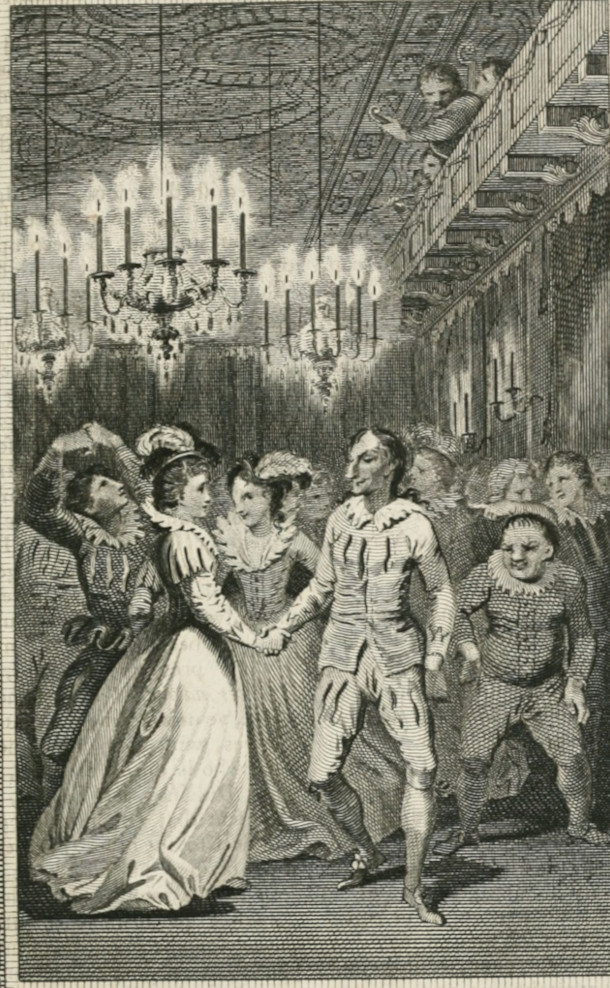
Plate X: Don Quixote Dancing.
So saying, he sat down upon the floor in the middle of the hall, quite exhausted and demolished with the violent exercise he had undergone; so that Don Antonio gave orders for his being carried forthwith to bed; and the first person who touched him in obedience to this order, was his own squire Sancho Panza; who, as he endeavoured to raise him upon his legs, could not help reprehending him in these words: ‘What a plague tempted your worship to fall a capering? Did you suppose every valiant man was as nimble as an harlequin, or that all knights-errant must needs be masterly dancers? If that was your opinion, I say you were much deceived: for there be men who would rather undertake to slay a giant, than to cut a 547caper. Had it been the shoe-slapping horn-pipe, I could have supplied your place; for I slap like a jerfaulcon; but as for your figured dances, I know not a stitch of the matter.’ With this address Sancho raised a laugh from the assembly, and his master from the floor, and carrying the knight to bed, covered him up very warm, that he might sweat out the cold caught in dancing.
Next day Don Antonio thought proper to try the experiment of the inchanted head, and for this purpose entered the apartment, accompanied by Don Quixote, Sancho, a couple of friends, with our hero’s two waggish partners, who had staid all night with Antonio’s lady. The door being fast bolted, he explained the property of the bust, after having laid injunctions on the company to keep the secret, and declared this was the day on which he intended to make the first trial of the virtue contained in the inchanted head[207]. Indeed, except his two friends, no other person knew the mystery; and if they had not been previously informed by Don Antonio, they would certainly have shared in the same admiration which necessarily seized the rest who were present at the execution of a scheme so artfully contrived.
The first who approached the ear of this inchanted head was Don Antonio himself, who said in a low voice, but so as to be overheard by all present, ‘Tell me, O head, by thy inherent virtue, what are my present thoughts?’ To this interrogation the head, without moving its lips, replied in a clear and distinct voice, which was heard by the whole company, ‘I do not pretend to investigate the thoughts.’ Those who knew not the plot were confounded at hearing this answer, as they plainly perceived there was not a living soul under the table or in the whole apartment to utter this reply. Don Antonio addressing himself again to it, asked, ‘How many persons are here in company?’ and was answered in the same key, ‘You and your wife[208], two friends of yours, and two of her companions, with a famous knight called Don Quixote de La Mancha, and his squire Sancho Panza by name.’ Here was fresh amazement! here was their hair standing on end with affright; while Don Antonio, stepping aside from the table, said, ‘This is enough to convince me that I have not been deceived by the person of whom I purchased thee; thou sage, speaking, oracular, and admirable head! Let some other person go and question it at will.’
As women are usually very curious and impatient, the next who approached was one of the two ladies, and her question was this: ‘Tell me, O head, what I shall do to be extremely beautiful?’ She received for answer, ‘Be extremely virtuous;’ and replied, ‘I ask no more.’ Then her companion advanced, saying, ‘I want to know, sagacious head, whether or not I am fondly beloved by my husband?’ and she was answered, ‘That you will learn by observing his behaviour.’ The married lady retired, observing that it required no magick to solve that question; for, in effect, an husband’s behaviour to his wife will always declare the state of his affection. The third person that approached the table was one of Don Antonio’s friends, who asked, ‘What am I?’ and when the voice answered, ‘Thou knowest best,’ he replied, ‘That is not the purport of my question; I desire thou wilt tell me if thou knowest my name?’—‘Yes,’ said the oracle; ‘I know thou art Don Pedro Noriez.’—‘Then I am satisfied,’ answered Don Pedro; ‘for that answer is sufficient to convince me, O head, that thou knowest every thing.’ Then he withdrew, and was succeeded by the other gentleman; who, advancing to the table, ‘Tell me, O head,’ said he, ‘the wish of my eldest son?’—‘I have already owned that I cannot dive into the thoughts of men,’ said the voice; ‘nevertheless, I will tell thee, that the wish of thy son is to bury his father.’—‘That is indeed his wish,’ replied the cavalier; ‘I see it with my eye, I touch it with my finger, and do not chuse to ask another question.’ Don Antonio’s lady 548approached, saying, ‘I know not how to interrogate thee, O head; but I should be glad to know if I shall long enjoy my good husband?’—‘Yes, you will,’ replied the voice; ‘his healthy constitution, and moderate way of life, promise a long succession of years and a good old age, of which many men deprive themselves by their own intemperance.’
Don Quixote now took his turn, and addressing himself to the bust, ‘Tell me then, whatsoever thou art,’ said he, ‘is my account of what befel me in the cave of Montesinos really fact, or only the illusion of a dream? Will the flagellation of my squire Sancho be certainly accomplished? and will the disinchantment of Dulcinea take effect?’—‘With respect to the cave,’ replied the oracle, ‘much may be said; the adventure partakes both of truth and illusion. The flagellation of Sancho will proceed slowly; but Dulcinea will be disinchanted in process of time.’—‘And that is all I desire to know,’ cried the knight; ‘for, in the disinchantment of Dulcinea, I shall reckon all my wishes at once happily fulfilled.’
The last interrogator was Sancho; who, approaching the table, ‘Pray, good Mr. Head,’ said he, ‘shall I peradventure obtain another government? shall I ever rise above the humble station of a squire? and lastly, shall I ever see again my wife and children?’ To these questions he received these answers: ‘If it be thy fate to return to thy own house, thou wilt govern thy family, and see thy wife and children; and in ceasing to serve, thou wilt cease to be a squire.’—‘’Fore God! an excellent response!’ cried Sancho; ‘that I could have foretold myself, and the prophet Perogrullo could have said no more.’—‘What answer would you have, you beast?’ said Don Quixote; ‘is it not sufficient that the responses delivered by the head, correspond with the questions you have asked?’—‘It shall suffice,’ replied the squire; ‘but I wish it had explained itself a little more fully, and told me some more of my fortune.’
Thus ended the questions and answers, but not the admiration of the whole company; except Antonio’s two friends, who had been let into the secret; which Cid Hamet Benengeli will now explain, that the world may not be kept longer in suspense, or imagine that any necromantick talisman or extraordinary mystery was contained in this wonderful bust. He gives us, therefore, to understand, that Don Antonio Moreno, in imitation of such another head which he had seen at Madrid, contrived by a statuary, ordered this to be made in his own house for his private amusement, and with a view to surprize the vulgar; and in this manner was the whole fabricated. The table was of wood painted and varnished like jasper, and the foot that supported it of the same materials, carved into the resemblance of four eagles talons, which kept it firm and steady in its position. The head formed from the medal of one of the Roman emperors, and covered with a copper colour, was hollow, as well as the table, in which it was so nicely fixed, that no eye could perceive the joining; the foot was likewise hollow, and answered to the neck and breast of the bust; and the whole corresponed with another chamber below, by means of a concealed tin pipe which passed through the bust, the table, and the foot. In this lower apartment, communicating with that of the inchanted head, did the person who uttered the responses fix his mouth to the pipe, so as that the voice ascended and descended in distinct and articulate sounds, and it was impossible for any person to discover the deception. The respondent was Antonio’s nephew, a student of acute parts, and a well-cultivated understanding, who, being previously informed by his uncle of the number and names of the persons whom he intended to introduce into the chamber of the inchanted head, was enabled to answer the first question with great facility and precision; and to the rest he replied by conjectures which were equally ingenious and discreet.
Cid Hamet moreover relates, that for ten or twelve days the virtue of this wonderful machine continued in full force; but a report diffusing itself through the city, that Don Antonio had in his house an inchanted head, which could answer all manner of questions, he began to be afraid that these tidings might reach the ears of the vigilant centinels of our faith; for which reason he explained the whole 549affair to the fathers of the inquisition, who forbade him to proceed with the deception, and gave orders that the head should be broke in pieces, lest it should give umbrage to the superstitious vulgar: but, in the opinion of Don Quixote and Sancho Panza, it passed for a head that was really inchanted and oracular; though it had given more satisfaction to the knight than the squire.
The gentlemen of the city, in complaisance to Don Antonio, and for the entertainment of Don Quixote, whom they wanted to furnish with an opportunity of discovering his diverting follies, appointed a running at the ring to be performed in six days; but this was prevented by an incident which will be explained in the sequel. Meanwhile, the knight was desirous of going out and viewing the city at leisure, and afoot; fearing that, should he appear on horseback, he would again be persecuted by the boys and vulgar. He accordingly went forth, attended by Sancho, and two of Antonio’s servants, whom their master had chosen for that purpose; and chancing to lift up his eyes in passing through one of the streets, he saw inscribed over a gate, in capital letters, ‘This is a printing-house;’ a circumstance which gave him uncommon satisfaction, as hitherto he had never seen a printing-press, and longed much to know something of that art: he therefore entered the house with all his train, and saw people casting off in one part, correcting in another, composing in a third, revising in a fourth, and, in short, the whole œconomy of a large printing-house. Going up to one box, he asked what was doing; and being informed by the workmen, expressed his admiration, and proceeded to a second. Among others, he went up to one, and putting the same question, the workman replied, ‘Signior, that there gentleman,’ pointing to a grave person of a very prepossessing appearance, ‘has translated a book from the Tuscan into the Castilian language, and I am now composing it for the press.’—‘What is the name of the book?’ said Don Quixote. ‘Signior,’ answered the author, ‘the book in the original is called, Le Bagatelle.’—‘And what is the signification of Le Bagatelle in our language?’ resumed the knight. ‘Le Bagatelle,’ replied the author, ‘is, as if we should say, in Castilian, Juquetes[209]: and, although the title of the book be so humble, it includes and contains a great deal of excellent and substantial writing.’—‘I am not altogether ignorant of the Tuscan language,’ said Don Quixote, ‘for I value myself upon singing some stanzas of Ariosto; but, pray tell me, Signior, (and what I am going to ask is not with any intention to sound your genius, but merely to satisfy my own curiosity) have you ever, in composing your books, met with the word pignatta?’—‘Yes, frequently,’ replied the author. ‘And how do you translate it into Castilian?’ resumed the knight. ‘How should I translate it,’ said the other, ‘but by the word olla?’—‘Body o’me!’ cried Don Quixote, ‘what progress you have made in the knowledge of the Tuscan idiom! I will lay a good wager that you translate piace into plaze, piu into mas, su into arriba, and giu into abaxo.’—‘Certainly,’ said the author, ‘because these words of the two languages correspond with one another.’—‘Notwithstanding all your learning,’ replied the knight, ‘I could almost swear you are hitherto unknown to the world, which is ever averse to remunerate a flourishing genius, and works of merit. What talents are lost, what abilities obscured, and what virtues are undervalued, in this degenerate age! yet, nevertheless, a translation from one language to another, excepting always those sovereign tongues the Greek and Latin, is, in my opinion, like the wrong side of Flemish tapestry, in which, though we distinguish the figures, they are confused and obscured by ends and threads, without that smoothness and expression which the other side exhibits: and to translate from easy languages, argues neither genius nor elocution, nor any merit superior to that of transcribing from one paper to another; but from hence I would not infer that translation is not a laudable exercise, for a man may employ his time in a much worse and more unprofitable occupation. At any rate, my observation cannot affect 550our two famous translators, Doctor Christoval de Figueroa, in Pastor Fido, and Don Juan de Xaurigui in Aminta, two pieces they have so happily executed, as to render it doubtful which is the original and which the translation: but pray, Signior, is this book printed on your own account, or have you sold the copy to a bookseller?’—‘I publish it on my own account,’ replied the author, ‘and expect to gain a thousand ducats at least upon the first impression, of which there will be two thousand copies, that will fetch six rials a piece in the turning of a straw.’—‘That is a very clear and comfortable reckoning,’ answered Don Quixote; ‘but you seem to be very little acquainted with the outgoings and the incomings, the schemes, conspiracies, and cabals of booksellers: when you find your back burdened with two thousand copies, I give you my word both your mind and body will be terribly fatigued; especially if the books should be harsh, or a little deficient in point of spirit.’—‘What!’ said the author, ‘your worship thinks, then, I ought to offer my performance to a bookseller, who would give me three maravedis for the copy, and insist upon it that he had done me a favour into the bargain? I do not publish with a view to acquire reputation in the world, where, thank Heaven, I am already well known by my works; I print for profit, without which, reputation is not worth a doit.’—‘God send you good luck, Signior,’ answered the knight; who, advancing to another box, where he saw the corrector employed on the sheet of a book, intitled, ‘The Light of the Soul;’—‘Aye,’ said he, ‘these are the books that ought to be printed; for, although there is already a pretty large number of this kind in print, numerous are the sinners for whose use they are intended; and for such multitudes who are in darkness, an infinite number of lights is required.’ He proceeded in his enquiry, and when he asked another corrector the name of a book on which he saw him at work, he understood it was the second part of The Sage Hidalgo Don Quixote de La Mancha, written by a certain person a native of Tordesillas. ‘I have heard of this performance,’ said the knight; ‘and really, in my conscience, thought it was long before this time burned into ashes, or pounded into dust, for the impertinence it contains; but, as we say of hogs, “Martinmas will come in due season[210].” Works of imagination are the more useful and entertaining the nearer they approach to truth, and the more probability they contain; and even history is valued according to its truth and authenticity.’
So saying, he quitted the printing-house with some marks of displeasure; and that same day, Don Antonio proposed that he should go on board, and see the gallies in the road; a proposal which was extremely agreeable to Sancho, who had never seen the inside of a galley in the whole course of his life; and he sent a message to inform the commodore of his intention to visit him in the evening, with his guest the renowned Don Quixote de La Mancha, whose name and person were already well known to this commander and all the citizens of Barcelona. What passed during this visit, will be related in the following chapter.
CHAP. XI. OF THE MISFORTUNE WHICH BEFEL SANCHO PANZA ON BOARD OF THE GALLIES, AND THE RARE ADVENTURE OF THE BEAUTIFUL MOOR.
Manifold and profound were the self-deliberations of Don Quixote on the response of the inchanted head, without his being able to discover the deceit; and the result of all his reflections was the promise of Dulcinea’s being disinchanted, on which he reposed himself with the most implicit confidence. This was the goal of all his thoughts, and he rejoiced, in full assurance of seeing it suddenly accomplished. As for Sancho, although he abhorred the office of a governor, as we have already observed, he could not help wishing for another opportunity of issuing out orders and seeing them obeyed; a misfortune which 551never fails to attend the exertion of power, even though founded on mock authority.
In a word, that very evening his landlord Don Antonio Moreno, and his two friends, went on board of the gallies with Don Quixote and Sancho; and the commodore being apprized of the visit intended by two such famous personages, no sooner perceived them coming towards the sea-side, than he ordered the awnings to be struck and the musick to play; the barge was hoisted out, covered with rich carpets, and furnished with velvet cushions, and the minute Don Quixote embarked, the cannon a-midships of the captain-galley was discharged, and the others followed her example. When the knight ascended the accommodation-ladder, on the starboard side, the whole crew saluted him with three cheers, a compliment usually paid to persons of the first quality; and the general, for by this name we shall henceforth call him, who was a noble Valentian, presented his hand, and embracing Don Quixote, ‘This day,’ said he, ‘will I mark with a white stone, as one of the happiest I shall ever enjoy, on account of seeing the renowned Signior Don Quixote de La Mancha, in whom the whole worth of knight-errantry is cyphered and concentered.’ No less courteous and polite was the reply of Don Quixote, who rejoiced above measure at seeing himself treated with such respect. The whole company having ascended the poop, which was very gaily ornamented, and seated themselves upon benches, the boatswain repaired to the gangway, and making a signal with his whistle for all the slaves to strip, was obeyed in an instant, to the no small discomposure of Sancho, who was terrified at the sight of so many naked backs; nor did his apprehension abate, when he saw the awning stretched with such incredible dispatch, that he thought all the devils in hell had assisted in the operation. Yet this was nothing but cakes and gingerbread to what I am going to relate.
The squire sat upon the stentril, close by the aftermost rower on the starboard side; who, in consequence of the previous instructions he had received, lifted up Sancho in his arms, and while the whole crew of slaves stood up, alert with the prospect of the joke, tossed him like a tennis-ball to his fellow, who in the same manner committed him to a third; and thus he was bandied forwards on the starboard side, from slave to slave, and bench to bench, with such expedition, that poor Panza lost his eyesight entirely, and firmly believed himself in the possession of the fiends: nor did they desist from this exercise, until he was reconveyed by the larboard-side to the poop, where this miserable object lay bruised, breathless, and covered with a cold sweat, and in such perturbation of spirits that he scarce knew what he had undergone.