Part 1 / Book 3 — BOOK III.
T. (Tobias) Smollett translation
CHAP. I. WHEREIN IS RECOUNTED THE UNLUCKY ADVENTURE WHICH HAPPENED TO DON QUIXOTE, IN MEETING WITH CERTAIN UNMERCIFUL YANGUESIANS.
The sage Cid Hamet Benengeli relates, that Don Quixote having bid adieu to his entertainers, and to all who were present at the funeral of the shepherd Chrysostom, entered, with his squire, the same wood to which Marcella had retreated; where, when they had wandered about upwards of two hours, without seeing her, they chanced to find themselves in a delightful spot, overgrown with verdant grass, and watered by a cool and pleasant stream; which was so inviting as to induce them to stay in it during the heat of the day, that now began to be very sultry; the knight and squire, therefore, dismounting, and leaving the ass and Rozinante at pleasure to regale themselves with the rich pasture, emptied their knapsack; and, without any ceremony, attacked the contents, which they eat together like good friends, laying aside all vain distinction of master and man.
Sancho had been at no pains to tether Rozinante; secure, as he thought, in knowing him to be so meek and peaceable, that all the mares in the meadows of Cordova could not provoke his concupiscence. Chance, however, or the devil, who is not often found napping, ordered it so, as that a drove of Gallician fillies belonging to certain Yanguesian carriers, happened, at that very instant, to be feeding in the same valley: for, it being the custom of these people to halt and refresh themselves and their beasts in places where there is plenty of water and grass, they could not have lighted on a more convenient spot than that where Don Quixote chanced to be. It was then that Rozinante, seized with an inclination to solace himself with some of those skittish females, no sooner had them in the wind, than deviating from his natural disposition and accustomed deliberation, without asking leave of his lord and master, he went off at a small trot, to communicate his occasions to the objects of his desire. But they, it seems, more fond of their pasture than of his addresses, received him so uncivilly with their hoofs and teeth, that, in a twinkling, his girth was broke, his saddle kicked off, and he himself remained in cuerpo. But what he chiefly suffered was from the carriers, who, seeing violence offered to their mares, ran to their assistance 78with long staves, which they exercised upon him so unmercifully, that he fell prostrate to the ground, almost battered to death.
The knight and Sancho seeing their steed thus bastinadoed, made all the haste they could to his rescue; the former addressing the latter in this manner: ‘I perceive, friend Sancho, that these are no knights, but fellows of low degree and infamous descent: this particular I mention, because thou mayest now assist me in taking just vengeance upon them, for the injury they have done to Rozinante before my face.’—‘What a devil of vengeance can we pretend to take,’ answered the squire, ‘when they are more than twenty, and we but two? Nay, I believe, if it was put to the trial, no better than one and a half.’—‘I myself am worth an hundred of such vagabonds!’ cried Don Quixote: and without uttering another syllable, he unsheathed his sword, and assaulted the Yanguesians, being seconded by Sancho, who suffered himself to be rouzed and encouraged by the example of his master; and, indeed, the knight lent the first he met with such a hearty stroke, as laid open a leathern jacket he wore, together with a large portion of his shoulder.
The carriers seeing themselves thus maltreated by two men only, took the benefit of their numbers, and ran to sustain one another with their staves; then surrounding the two assailants, began to drum upon their carcases with infinite eagerness and dexterity. True it is, at the second application, Sancho fell to the earth; a misfortune that also happened to his master; who, in spite of all his own address, together with the assistance of his good friend, soon found himself stretched at the feet of Rozinante, who had not as yet been able to rise: from whence we may learn what furious execution is often done by packstaves, when managed by the hands of such enraged clowns.
The carriers perceiving the havock they had made, thought proper to load again with all dispatch, and pursue their journey, leaving our adventurers in miserable plight and doleful dilemma. The first that recovered the use of his senses was Sancho Panza; who, finding himself laid along by the side of his master, pronounced, with a weak and lamentable voice, ‘Sir Don Quixote! ah, Sir Don Quixote!’—‘What wouldst thou have, brother Sancho?’ replied the knight, in the same feeble and complaining tone. ‘I wish,’ resumed Sancho, ‘your worship would, if it be possible, comfort me with a couple of gulps of that same balsam made by fairy Blas, if you have got any of it about you: perhaps it may be serviceable in bruises and broken bones, as well as in wounds and running sores.’—‘Would to God I had it here, unfortunate wight that I am!’ cried Don Quixote; ‘but I swear to thee, Sancho, on the faith of a knight-errant, that ere two days pass, if some mischievous accident does not intervene, I will have it in my possession, if my hands do not very much misgive me.’—‘In how many days does your worship think we shall be able to move our feet?’ said the squire. ‘With regard to myself,’ answered the battered knight, ‘I really cannot fix any number of days; but this I know, that I alone am to blame for what has happened, in condescending to use my sword against antagonists who were not dubbed and knighted like myself. I therefore firmly believe, that as a punishment for having transgressed the laws of chivalry, the God of battles hath permitted me to receive this disgraceful chastisement; for which reason, brother Sancho, it is proper that thou shouldst be apprized of what I am going to say, as it may be of great importance to the safety of us both: whenever thou shalt see us insulted or aggrieved for the future, by such rascally scum, thou shalt not wait for my drawing upon them; for I will in no shape meddle with such unworthy foes; but lay thy hand upon thy sword, and with thy own arm chastise them to thy heart’s content; but should any knights make up to their defence and assistance, then shall I know how to protect thee, and assault them with all my might; and thou art already convinced, by a thousand amazing proofs, how far extends the valour of this my invincible arm.’ So arrogant was the poor knight become by his victory over the valiant Biscayan.
This wholesome advice, however, was not so much relished by Sancho, but that he replied, ‘Sir, I am a quiet, meek, peaceable man, and can digest any injury, be it never so hard; for I 79have a wife and small children to maintain and bring up: wherefore, let me also apprize, (since I cannot lay my commands upon) your worship, that I will in no shape whatever use my sword against either knight or knave; and that henceforward, in the fight of God, I forgive all injuries, past, present, or to come, which I have already received, at this present time suffer, or may hereafter undergo, from any person whatsoever, high or low, rich or poor, gentle or simple, without exception to rank or circumstance.’
His master hearing this declaration, answered, ‘I with the grievous pain I feel in this rib would abate a little, so as that I could speak for a few moments with ease, and convince thee of thy damnable error, Panza. Hark ye me, sinner! suppose the gale of fortune, which hath been hitherto so adverse, should change in our favour; and, swelling the sails of our desire, conduct us safely, without the least impediment, into the haven of some one of those islands which I have promised thee: what would become of thy wretched affairs, if after I had won and given it into thy possession, thou shouldst frustrate my intention, by thy lack of knighthood, ambition, valour and courage, to revenge thy wrongs, or defend thy government? for I would have thee to know, that in all new-conquered kingdoms or provinces, the friends of their natural masters are never so quiet or reconciled to their new sovereign, as to dispel all fear of some fresh insurrection, to alter the government again, and, as the saying is, try fortune once more: it is therefore requisite that the new possessor should have understanding to govern, resolution to punish, and valour to defend himself, in case of any such accident.’
‘In this last accident which hath befallen us,’ said Sancho, ‘I wish the Lord had pleased to give me that same understanding and valour your worship mentions: but I protest, upon the word of a poor sinner, that I am at present more fit for a searcloth than such conversation. See if your worship can make shift to rise, and then we will give some assistance to Rozinante, though it be more than he deserves; for he was the principal cause of all this plaguy-rib-roasting: never could I believe such a thing of Rozinante, who I always thought was as chaste and sober a person as myself; but this verifies the common remark, that you must keep company a long time with a man before you know him thoroughly; and that there is nothing certain in this life. Who could have thought that those huge back-strokes your worship dealt so heartily to the unlucky traveller, would be followed, as it were post-haste, by such a mighty tempest of blows, as just now discharged itself upon our shoulders!’—‘Thy carcase, Sancho,’ said Don Quixote, ‘was formed for enduring such rough weather; but my limbs were tenderly nursed in soft wool and fine linen; and therefore must feel more sensibly the pain of this discomfiture; and if I did not believe (believe, said I) if I were not certain, that all these inconveniencies are inseparably annexed to the exercise of arms, I would lie still where I am, and die with pure vexation.’
To this protestation the squire replied, ‘Seeing these misfortunes are the natural crops of chivalry, pray good your worship, do they happen at all times of the year, or only fall at an appointed season; because, in my simple conjecture, two such harvests will leave us altogether incapable of reaping a third, if God, of his infinite mercy, will not be pleased to send us extraordinary succour.’—‘Thou must know, friend Sancho,’ answered Don Quixote, ‘that the life of a knight-errant is subject to a thousand dangers and mishaps; but then he enjoys the self-same chance of being a king or emperor, as experience demonstrates to have been the case of divers and sundry knights, the history of whose lives I am perfectly well acquainted with; and I could now relate, if this pain would give me leave, the fortunes of some, who, by their valour alone, have risen to that supreme degree: and those very persons, both before and after their success, have undergone various calamities and affliction; witness the valiant Amadis de Gaul, who saw himself in the power of his mortal enemy Arcalaus the inchanter, of whom it is positively affirmed, that while the knight was his prisoner, he caused him to be bound to a pillar in 80his court-yard, and gave him two hundred stripes with the reins of his horse’s bridle. There is likewise a certain secret author of no small credit, who relates that the knight of the sun was caught in a trap in a certain castle, and falling found himself tied hand and foot in a deep dungeon below ground, where was administered unto him one of those things they call clysters, composed of sand and water, which had well nigh cost him his life; and if he had not been succoured in that perilous conjuncture by a sage who was his good friend, the poor knight would have fared very ill. Wherefore what hath happened to me, may easily pass unheeded, among those much greater affronts that such worthy people have undergone: besides, I would have thee know, Sancho, that it is never reckoned an affront to be wounded by those instruments which are casually in the hands of our enemies; for it is expressly mentioned in the laws of duelling, that if a shoe-maker beats a man with a last he has by accident in his hand, the man cannot properly be said to be cudgelled, although the said last was made of wood. This particular I mention, that thou mayest not suppose us affronted, although we have been mauled in this unlucky fray; for the weapons with which those men threshed us so severely, were no other than their own pack-staves; and so far as I can remember, there was neither tuck, poignard, nor sword, among them.’
‘They did not give me time,’ answered Sancho, ‘to make any such observation: for scarce had I laid my fingers upon my Toledo[56], when there rained a shower of cudgels upon my poor shoulders, that banished the light from my eyes, and strength from my feet, and laid me flat upon the spot where I now lie, not so much concerned about thinking whether this drubbing be an affront or not, as about the intolerable pain of the blows, which remain imprinted upon my memory as well as upon my carcase.’——‘Notwithstanding all this complaining,’ said the knight, ‘I aver, brother Sancho, that there is no remembrance which time does not efface, nor pain that death does not remove.’—‘And pray, what greater misfortune can there be,’ answered Sancho, ‘than that which nothing but time can remove, or death put a stop to? If this mishap of ours were such a one as might be cured with a couple of snips of searcloth, it would not be altogether so vexatious; but so far as I can see, all the plaister of an hospital will not be sufficient to set us cleverly on our legs again.’
‘Truce with thy reflections,’ replied Don Quixote, ‘and collecting strength out of weakness, as I will endeavour to do, let us rise and examine Rozinante’s case; for, in all appearance, the poor beast hath not suffered the least part of the misfortune.’—‘That is not to be wondered at,’ said the squire, ‘he being a knight-errant also; but what surprizes me most is, that my dapple should get off without paying his score, when we are scored all over.’—‘Destiny, when one door is shut, always leaves another open, is a resource in all calamities,’ said Don Quixote: ‘this I observe, because thy ass will now supply the place of Rozinante, and carry me from hence to some castle, where my wounds may be cured: more especially as such carriage will be no dishonour to chivalry; for I remember to have read, that the good old Silenus, tutor and companion to the jolly god of mirth and wine, entered the city of the hundred gates, lolling at his ease upon a most comely ass.’—‘It may be very true that he rode upon an ass,’ replied Sancho; ‘but there is some difference, I apprehend, between riding, and lying across the beast like a bag of dirt.’ To this observation the knight answered, ‘Those wounds which are received in battle, may well give, but can never deprive one of honour: therefore, friend Sancho, do as I bid thee, without farther reply; get up as well as thou canst, and lay me upon dapple just as thou shalt find most convenient, that we may be gone before night comes to surprize us in this unfrequented place.’
‘And yet,’ said Sancho, ‘I have 81heard your worship remark, that it is usual for knights-errant to sleep upon commons and heaths the greatest part of the year; aye, and to be thankful for their good fortune in being able so to do.’—‘Yes,’ said the knight, ‘when they can do no better, or are in love; and this is so true, that there was a knight who lay upon a bare rock, exposed to the sultry noon and midnight damps, with all the inclemencies of the weather, during two whole years, before his mistress knew any thing of the matter: this was no other than Amadis, who, assuming the name of Beltenebros, took up his quarters upon the naked rock, for the space of either eight years, or eight months, I really do not remember which; only that he remained doing penance in that place, for some disgust shewn to him by his dame Oriana: but truce with this conversation, Sancho, and make haste, before such another accident can happen to thy beast, as that which hath already befallen Rozinante.’
‘Odds my life! that would be the devil indeed!’ cried Sancho, who uttering thirty ah’s and sixty oh’s! together with a hundred and fifty ola’s! and curses upon him who had brought him to that pass, raised himself up, though he could not for his soul stand upright, but in spite of all his efforts, remained bent like a Turkish bow; and in that attitude, with infinite labour, made shift to equip his ass, which had also gone a little astray, presuming upon the excessive licence of the time; he then lifted up Rozinante, who, could he have found a tongue to complain with, would certainly have surpassed both his master and Sancho in lamentation: in short, the squire disposed of Don Quixote upon the ass, to whose tail Rozinante was tied; then taking his own dapple by the halter, jogged on, sometimes faster, sometimes slower, towards the place where he conjectured the high road to lie; and indeed, they had not exceeded a short league, when by good luck, which now seemed to take the management of their affairs, they arrived at the highway, and discovered an inn, which, to Sancho’s great grief, was mistaken for a castle by the joyful knight. This difference of opinion begat an obstinate dispute that lasted until they arrived at the place, into which Sancho immediately conveyed his cargo, without farther expostulation.
CHAP. II. THE ADVENTURE THAT HAPPENED TO THIS SAGACIOUS KNIGHT AT THE INN, WHICH HE MISTOOK FOR A CASTLE.
The innkeeper seeing Don Quixote laid athwart the ass, asked what was the matter? to which interrogation Sancho replied, ‘Nothing but a few bruises which my master has received in a fall from a rock in this neighbourhood.’ The landlady, who differed in disposition from most of your innkeepers wives, being naturally charitable and sympathizing with the calamities of her fellow-creatures, came running to the relief of the battered knight, and brought her daughter, who was a very handsome girl, to assist in taking care of her guest. There was in the same house a servant-maid from the Asturies, remarkable for her capacious countenance, beetle brow’d, flat-nosed, blind of one eye, and bleared in the other: true it is, the gentility of her shape made amends for her other defects; she was something short of seven hands from head to foot, and moreover incumbered so much by her shoulders, that she was obliged to contemplate the dust beneath her feet oftener than she could have wished.
This comely creature, with the assistance of the other damsel, made up a sort of sorry bed for our hero in a garret; which gave evident tokens of having been formerly an hay-loft, and in which at that time a certain carrier had taken up his quarters, in a bed of his own making, a little on one side our knight’s: and though his couch was composed of the pannels and furniture of his mules, it had greatly the advantage over Don Quixote’s, which consisted only of four rough boards, supported on two benches of unequal height, covered by a mattras, so thin it might have passed for a quilt, and full of knots so hard as to be mistaken for pebble stones, had not the wool appeared through divers openings; with a couple of sheets made of bull’s hide, and a blanket so bare, that you might have counted every thread, without losing one of the reckoning.
In this wretched bed, Don Quixote 82having laid himself down, was anointed from head to foot by the good woman and her daughter, while Maritornes (that was the Asturian’s name) stood hard by holding a light. The landlady, in the course of her application, perceiving the knight’s whole body black and blue, observed that those marks seemed rather the effects of drubbing than of a fall; but Sancho affirmed she was mistaken, and that the marks in question were occasioned by the knobs and corners of the rocks among which he fell. ‘And now I think of it,’ said he, ‘pray, Madam, manage matters so as to leave a little of your ointment, for it will be needed, I’ll assure you; my own loins are none of the soundest at present.’—‘What, did you fall too?’ said she. ‘I can’t say I did,’ answered the squire, ‘but I was so infected by seeing my master tumble, that my whole body aches as much as if I had been cudgelled without mercy.’—‘That may very easily happen,’ cried the daughter: ‘I myself have often dreamed that I was falling from a high tower, without ever coming to the ground; and, upon waking, have found myself bruised and battered, as if I had actually got a great fall.’—‘Ah, mistress!’ replied the squire, ‘here is the point; I, without dreaming at all, but on the contrary, being as broad awake as I am this precious minute, found almost as many marks upon my own shoulders, as you have observed upon those of my master Don Quixote.’—‘What is the name of that knight?’ said the Asturian. ‘Don Quixote de La Mancha,’ answered the squire: ‘he is a knight-adventurer, and one of the greatest and most valiant that have been seen in this world for many ages.’—‘And what is a knight-adventurer?’ resumed the wench. ‘Are you such a suckling as not to know that?’ cried Sancho; ‘well, I’ll tell you, mistress of mine, a knight-adventurer is a thing, that before you count a couple, may be kicked and be crowned: to-day he is the most despicable and beggarly wretch upon earth, and to-morrow he will have a brace of kingdoms to bestow upon his squires.’—‘Methinks,’ said the landlady, ‘seeing you appertain to such a great man, you ought to be a count at least.’—‘All in good time,’ replied Sancho; ‘we have not been out a month in search of adventures, and have found none worth naming; besides, people sometimes go in quest of one thing, and meet with another: indeed, if my master Don Quixote gets well of this drubbing——fall, I mean, and I myself escape without being crippled, I won’t barter my hopes for the best lordship in Spain.’
The knight having listened attentively to this whole conversation, sat up in his bed as well as he could, and taking his landlady by the hand, ‘Believe me, beautiful lady,’ said he, ‘you may account yourself extremely happy in having within your castle my person as your guest; such a guest, that if I praise him not, it is on account of the common saying, that self-commendation is in effect self-dispraise. My squire, however, will intimate who I am; while I content myself with assuring you, that I will, to all eternity, preserve engraven upon the tables of my memory the benevolence you this day vouchsafed unto me, that I may be grateful for the favour, as long as life shall remain. And, oh! that it pleased you, Heaven supreme, that love had not so vanquished and enslaved my heart to the triumphant eyes of the beautiful ingrate whom I now mention between my teeth, but that the charms of this amiable young lady could be the authors of my freedom.’
The good woman, her daughter, and the gentle Maritornes, were astonished at this rhapsody, which they understood as much as if it had been delivered in Greek; though they could easily comprehend, that the whole of it tended to compliment and proffers of service: as they were therefore altogether unaccustomed to such language, they gazed at him with admiration, as a person of a different species from other men; and having thanked him for his courtesy, in their tapster phrase, left him to his repose; while the Asturian Maritornes administered to Sancho, who had as much need of assistance as his master.
She and the carrier had made an assignation to divert themselves that night; nay, she had given her word that as soon as the company should be quiet, and her master and mistress asleep, she would visit him in the dark, and give him all the satisfaction he desired; and 83indeed it is recorded, for the honour of this good creature, that she never failed to perform her promises of that kind punctually, although they had been made in the midst of a heath, and out of the hearing of all evidence: for she valued herself much upon her gentility, and did not look upon it as any affront to be servant at an inn, because, she observed, disappointments and misfortunes had reduced her to that condition.
The bed of Don Quixote, which we have described so hard, so narrow, crazy, and uncomfortable, stood foremost, and exactly in the middle of this ruinous hay-loft; hard by had Sancho taken up his quarters upon a rush-mat, covered with a rug, which seemed to be manufactured of hemp, rather than wool; and last of all was the carrier’s couch, composed, as we have already said, of the pannels and furniture of his two best mules; for he had no less than twelve plump, sleek, and notable beasts, being one of the richest carriers in Arevalo, according to the report of the author of this history, who makes particular mention of him, and says he knew him perfectly well; nay, some go so far as to affirm, that he was his distant relation: be this as it will, Cid Hamet Benengeli was a most curious historian, and punctual to admiration, as appears from what hath been related, which, though in itself mean and trivial, he would by no means pass over in silence. This ought to serve as an example to those important and weighty historians, who recount events so succinctly and superficially, that the reader can scarce get a smack of them; while the most substantial circumstances are left, as it were, in the ink-horn, through carelessness, ignorance, and malice. A thousand times blessed be the authors of Tablante and Ricamonte, and he that compiled that other book, in which are recounted the atchievements of Count Tomillas! How punctually have they described the most minute particular!—But, to return to our story.
The carrier having visited his cattle, and given them their night’s allowance, stretched himself upon his pannels, in expectation of the most faithful Maritornes; while Sancho, plaistered all over, and huddled up in his kennel, endeavoured with all his might to sleep; but the aching of his ribs would by no means allow him to enjoy that satisfaction; and Don Quixote, for the same uncomfortable reason, lay like a hare, with his eyes wide open. A profound silence reigned throughout the whole house, in which there was no other light than a lamp stuck up in the passage; and this wonderful quiet, together with those reflections which always occurred to our knight, relating to the events continually recorded in the books of chivalry, that first disordered his understanding; I say, those reflections suggested to his fancy one of the strangest whims that ever entered a man’s imagination. This was no other than a full persuasion that he was arrived at some famous castle; for, as we have before observed, all the inns he lodged at seemed castles to him; and that the landlord’s daughter was the governor’s only child, who, captivated by his genteel appearance, was become deeply enamoured of him, and had actually promised to come, without the knowledge of her parents, and pass the best part of the night in bed with him. Believing, therefore, this chimera (which was the work of his own brain) to be a firm and undoubted fact, he began to reflect with extreme anxiety upon the dangerous dilemma into which his virtue was like to be drawn; and resolved in his heart to commit no treason against his mistress Dulcinea del Toboso; even though Queen Ginebra herself, and the lady Quintaniona, should make him a tender of their favours.
While his mind was engrossed by these extravagant fancies, the hour of assignation arrived, and an unlucky hour it was for him, when the kind Asturian, barefoot and in her smock, having her hair tucked up under a fustian nightcap, entered the apartment in which the three guests were lodged, and with silence and caution directed her steps towards the nest of her beloved carrier. But scarce had she got within the door, when her approach was perceived by our knight, who sitting up in his bed, in spite of his plaisters and the aching of his ribs, stretched forth his arms to receive this beautiful young lady, who, on her part, holding in her breath, moved softly on her tiptoes, groping her way with her hands before her.
While she thus crept along, in quest of her lover, she chanced to come within arm’s-length of Don Quixote, who laid fast hold of her by the wrist, and without her daring to speak a syllable, 84pulled her towards him, and made her sit down upon the bed; he then felt her smock, which, though made of the coarsest canvas, to him seemed a shift of the finest and softest lawn; the string of glass beads she wore about her wrist, in his apprehension out-shone the brightest oriental pearl: her hair, which bore some resemblance to a horse’s mane, he mistook for threads of pure Arabian gold, that even eclipsed the splendor of the sun; and her breath, which doubtless smelt strong of broken meat and garlick, his fancy converted into an aromatick flavour, proceeding from her delicate mouth: in short, his imagination represented her in the same form and situation with that of a certain princess, recorded in one of his books, who came to visit a wounded knight of whom she was enamoured; with all the other embellishments there described. Nay, such was the infatuation of this poor gentleman, that he was not to be undeceived, either by the touch, the breath, or any other circumstance of this honest wench, though they were powerful enough to discompose the stomach of anybody but a rampant carrier.
But our knight believed he folded in his arms the goddess of beauty, straining her in his embrace, began to pronounce, in a soft and amorous tone, ‘Would to Heaven! I were so circumstanced, beautiful and high-born lady! as to be able to pay the transcendent favour bestowed upon me, in the contemplation of your amazing charms; but it hath pleased fortune, that never ceases to persecute the virtuous, to lay me upon this bed, so bruised and battered, that even if it was my desire to gratify yours, I should find it utterly impossible; how much more so, when that impossibility is linked to another still greater? I mean the plighted faith I have vowed to the peerless Dulcinea del Toboso, the sole mistress of my most hidden thoughts: did not that consideration interpose, I should not be such a simple knight, as to let slip this happy occasion which your benevolence hath tendered to my choice.’
Maritornes, sweating with vexation to find herself thus pinioned, as it were, by the knight, whose discourse she neither heeded nor understood; endeavoured, without answering a syllable, to disengage herself from his embrace: while the honest carrier, whose lewd desires kept him awake, and made him perceive his doxy from the moment she entered, listened attentively to every thing that Don Quixote said; and being jealous that the Asturian had broke her promise to him, in order to keep it with another, crept nearer the bed of his rival, to wait the issue of this rhapsody, the meaning of which he could not comprehend; observing, however, that the wench struggled to get loose, and that the knight endeavoured to detain her, he could not relish the joke, but lifting his arm on high, discharged such a terrible blow on the lanthorn jaws of the enamoured Don, as bathed his whole countenance in blood; and not satisfied with this application, jumped upon his ribs, and travelled over his whole carcase, at a pace somewhat exceeding that of a brisk trot, until the bed, which was none of the strongest, either in materials or foundation, unable to sustain the additional weight, sunk to the ground with both; and made such a hideous noise in its fall, as waked the inn-keeper, who immediately concluded that Maritornes was concerned in the adventure, because she made no answer when he called.
On this supposition he arose, and lighting a candle, went directly to the place where he had heard the scuffle: meanwhile, the poor wench, confused and affrighted at the approach of her master, who was a fellow of a most savage disposition, retreated to the kennel of Sancho Panza, who slept in spite of all this din, and nestling in beside him, wound herself up like a ball, and lay snug. The landlord now entered the apartment, and crying with a loud voice, ‘Where have you got, strumpet? to be sure these must be your jade’s tricks, with a vengeance!’ Sancho started, and feeling a prodigious weight upon him, thought he was labouring under the night-mare, and beginning to lay about him on all sides, chanced, in course of his efforts, to bestow divers cuffs on Maritornes, who feeling herself thus belaboured, forgot the care of her reputation, and returned the squire’s compliments so heartily, that sleep forsook him whether he would or not: without knowing the person who treated him so roughly, he raised himself up, as well as he could, and going to loggerheads with Maritornes, a most furious and diverting skirmish ensued.
85By this time, the carrier perceiving by the light the situation of his mistress, ran to her assistance; and the landlord followed the same course, though with a very different intention, namely, to chastise the maid; being fully persuaded, that she was the sole cause of all this uproar; and so, as the saying is, the cat to the rat, the rat to the rope, the rope to the gallows. The carrier drummed upon Sancho, Sancho struck at the maid, the maid pummelled him, the innkeeper disciplined her; all of them exerting themselves with such eagerness, that there was not one moment’s pause. But, to crown the joke, the landlord’s candle went out, and the combatants being left in the dark, such a circulation of blows ensued, that wheresoever the fist fell, there the patient was disabled.
There chanced to lodge at the inn that night, a trooper belonging to the ancient holy brotherhood of Toledo, who also hearing the strange noise of this fray, arose, and seizing his tipstaff, together with the tin-box that contained his commission, entered the apartment in the dark, calling aloud—‘Keep the peace, in the king’s name; keep the peace, in the name of the holy brotherhood.’ The first he encountered was the forlorn Don Quixote, who lay insensible on his demolished bed, with his face uppermost; so that groping about, he happened to lay hold of his beard, and cried—‘Assist, I charge you, the officers of justice:’ but perceiving that the person he held neither stirred nor spoke, he concluded that he must be dead, and that the people within were the assassins. In this persuasion he raised his voice, crying—‘Shut the gates of the inn, that none may escape; for here is a man murdered.’ This exclamation, which astonished them all, was no sooner heard, than every one quitted his share in the battle; the landlord retreated to his own chamber, the carrier sneaked to his panniers, and the damsel to her straw: while the unfortunate knight and squire were left on the spot, unable to move from the places where they lay. The trooper letting go the beard of Don Quixote, went out for a light to search for and apprehend the delinquents; but in this design he was disappointed; the landlord having purposely extinguished the lamp when he retired to his apartment; so that he was obliged to have recourse to the embers, at which, with great industry and time, he made shift to light another candle.
CHAP. III. CONTAINING THE SEQUEL OF THOSE INCREDIBLE GRIEVANCES WHICH THE VALIANT DON QUIXOTE, AND HIS TRUSTY SQUIRE SANCHO PANZA, UNDERWENT AT THE INN, WHICH FOR THEIR MISFORTUNE THE KNIGHT MISTOOK FOR A CASTLE.
About this time, Don Quixote recovering the use of his tongue, began to call in the same feeble tone with which he spoke the preceding day, when he lay stretched in the pack-staff valley—‘Art thou asleep, friend Sancho? friend Sancho, art thou asleep?’—‘God’s my life!’ replied Sancho, full of peevishness and pain, ‘how should I be asleep, seeing all the devils in hell have been upon me this whole night?’—‘That thou mayest assure thyself of,’ answered the knight: ‘for either I understand nothing at all, or this castle is inchanted. Thou must know, Sancho, (but what I am going to disclose to thee, thou shalt swear to keep secret till after my death.)’—‘I do swear,’ said Sancho. ‘This secrecy I insist upon,’ replied his master, ‘because I would by no means take away the reputation of any person.’—‘Well then,’ cried the squire, ‘I swear to keep it secret till the days of your worship be past and gone; and God grant that I may be at liberty to reveal it to-morrow.’—‘Have I done you so much mischief, Sancho,’ said Don Quixote, ‘that you wish to see me dead so soon?’—‘It is not for that,’ replied the squire, ‘but because I am an enemy to all secrets, and would not have any thing rot in my keeping.’—‘Be that as it may,’ said the knight, ‘I will trust greater things to thy love and fidelity. Know, therefore, that this very night I have been engaged in a most rare and wonderful adventure; which, that I may briefly relate, take notice, that a little while ago, I was visited by the constable’s daughter, than whom a more beautiful and gracious young lady is 86scarce to be found on this terraqueous globe. How shall I paint to thee the comeliness of her person? how delineate the acuteness of her understanding? or, how shall I describe those mysterious charms which, that I may preserve the fealty I have sworn to my own sovereign mistress Dulcinea del Toboso, I must pass over in sacred silence? I shall only tell thee, that Heaven itself was jealous of the happiness which fortune had put into my power; or, perhaps, which is more probable, this castle, as I have already observed, is inchanted: for, while I was engaged with her in a most delightful and amorous conversation, an unseen hand, belonging, doubtless, to the arm of some monstrous giant, descended, I know not whence, upon my jaws, leaving my whole face bathed in gore; and afterwards bruised me in such a manner, that I am infinitely worse than I was yesterday, when the carriers maltreated us, as thou knowest, for the excesses of Rozinante; from whence I conjecture, that the treasure of this fair damsel’s beauty is guarded by some inchanted Moor, and not destined for my possession.’—‘Nor for mine neither,’ cried Sancho; ‘for I have been drubbed by five hundred Moors, so unmercifully, that the pack-stave threshing was but cakes and gingerbread to what I now feel: so that I see no great cause you have to brag of that rare adventure, which has left us in this comfortable pickle. Indeed, your worship was not so badly off, because you had that same incomparable beauty in your arms; but what had I, except the hardest knocks, which, I hope, I shall ever feel in my born days? Cursed am I, and the mother that bore me; for though I neither am knight errant, nor ever design to be one, the greatest part of the mischief that betides us for ever falls to my share.’—‘It seems, then, thou hast suffered too,’ said Don Quixote. ‘Woe be unto me and my whole pedigree!’ cried Sancho; ‘have I not been telling you so all this time?’—‘Give thyself no concern about that matter,’ answered the knight; ‘for now I am determined to prepare that precious balsam, which will cure us both in the twinkling of an eye.’
About this time the officer of the holy brotherhood, having made shift to light his candle, came back to examine the person whom he supposed murdered; and Sancho, seeing him approach in his shirt and woollen night-cap, with a very unfavourable aspect, and a light in his hand, said to his master, ‘Pray, Sir, is this the inchanted Moor returned to spend the last drop of his vengeance upon us[57]?’—‘That cannot be the Moor,’ answered Don Quixote, ‘for inchanters never suffer themselves to be seen.’—‘If they won’t allow themselves to be seen,’ cried the squire, ‘they make no bones of letting themselves be felt; that my shoulders can testify.’—‘And mine too,’ said the knight; ‘but we have no sufficient reason to believe that he whom we now see is the inchanted Moor.’
Meanwhile, the trooper drawing near, and hearing them talk so deliberately, remained some time in suspence; then observing Don Quixote, who still lay on his back, unable to stir, on account of his bruises and plaisters, he went up to him, saying, ‘How do’st do, honest friend?’—‘I would speak more submissively,’ answered the knight, ‘were I such a plebeian as you. Is that the language used in this country to knights-errant, you blockhead?’ The officer finding himself treated with so little ceremony, by such a miserable wight, could not bear the reproach, but lifting up his lamp, oil and all, discharged it upon Don Quixote’s pate, which suffered greatly in the encounter; and the light being again extinguished, slipped away in the dark. Things being in this situation, ‘Sir,’ said Sancho Panza, ‘without doubt, that was the inchanted Moor, who keeps the treasure for other people, and the fisty-cuffs and lamp-leavings for us.’—‘It must be so,’ replied the knight; ‘but we must not mind those affairs of inchantment so much, as to let them ruffle or inflame us; because, they being invisible and fantastical, do what we can we shall never be able to take vengeance upon the authors of them: get up, therefore, Sancho, if thou canst, and desire the constable of this castle to supply me with some oil, wine, salt, and rosemary; that I may prepare the salutiferous balsam, which, 87really, I believe, I stand in great need of at present, for the wound which the phantom hath given me bleeds apace.’
Accordingly the squire made shift to rise, notwithstanding the intolerable aching of his bones; and creeping in the dark towards the innkeeper’s bed-chamber, happened to meet with the trooper, who stood listening, to know the intention of his adversary. ‘Signior,’ cried he, ‘whosoever you are, do us the benefit and favour to assist us with some rosemary, salt, wine, and oil; in order to cure one of the most mighty knights errant upon earth, who lies in that bed, desperately wounded by the hands of an inchanted Moor that frequents this inn.’ The officer, hearing such an address, concluded that the man had lost his senses; and it being by this time dawn, opened the inn-gate, and calling to the landlord, told him what this honest man wanted. The innkeeper having provided Sancho with the ingredients, he immediately carried them to his master; who lay holding his head between his two hands, and complaining very much of the effect of the lamp; which, however, had done no farther damage than that of raising a couple of large tumours upon his pate; that which he took for blood being no other than sweat forced out by the anguish and pain he had undergone. In short, he made a composition, by mixing the materials together, and boiling them a good while, until he found he had brought the whole to a due consistence: then he asked for a phial to contain the balsam; but as there was none in the house, he resolved to cork it up in a tin oil-flask, of which the landlord made him a present. Which being done, he repeated over it more than fourscore pater-nosters, with the like number of ave-maria’s, salve’s and credo’s, accompanying every word with the sign of the cross, by way of benediction: and this whole ceremony was performed in presence of Sancho, the innkeeper, and officer; the carrier having very quietly gone to take care of his beasts.
This precious balsam being thus composed, the knight was determined to make instant trial of the efficacy with which he imagined it endued; and accordingly swallowed about a pint and a half of what remained in the pot, after the oil-flask was full; which had scarce got down his throat, when he began to vomit in such a manner, as left nothing in his stomach; and a most copious sweat breaking out upon him, in consequence of the violent operation, he desired they would wrap him up warm, and leave him to his repose. They complied with his request, and he fell into a profound sleep that lasted three hours; at the end of which awaking, he found himself exceedingly refreshed, and so well recovered of his bruises, that he seemed perfectly well; and implicitly believed that he had now made sure of the balsam of Fierabras; which, while he possessed, he might, with the utmost confidence and safety, engage in the most perilous quarrels, combats, and havock, that could possibly happen.
Sancho Panza seeing his master recovered to a miracle, begged he would bestow upon him the sediment of the pot, which was no small quantity: and his request being granted, he laid hold of it with both hands, and setting it to his head, drank off, with strong faith and eager inclination, almost as much as his master had swallowed before. But the poor squire’s stomach chanced to be not quite so delicate as that of the knight; and therefore, before he could discharge a drop, he suffered such pangs and reachings, such qualms and cold sweats, that he verily believed his last hour was come; and in the midst of his wamblings and affliction cursed the balsam and the miscreant that made it. Don Quixote perceiving his situation, said, ‘I believe that all this mischief happens to thee, Sancho, because thou art not a knight; for I am persuaded, that this liquor will be of service to none but such as are of the order of knighthood.’—‘If your worship knew so much,’ cried Sancho, ‘woe be unto me and my whole generation! why did you allow me to taste it?’ At this instant the potion began to operate, and the poor squire to unload at both ends with such fury, that the mat upon which he had thrown himself, and the sheet that covered him, were soon in a woeful pickle: he sweated and shivered with such violent motions and fits, that not only he himself, but every body present, thought he would have given up the ghost.
This tempest of evacuation lasted near two hours; at the expiration of which, he found himself far from being relieved 88like his master, but, on the contrary, so much fatigued that he was not able to stand. The knight, as we have already observed, finding himself in good health and excellent spirits, longed fervently to depart in quest of adventures, thinking every minute he spent in that place was an injury to the world in general, and to those miserable objects who wanted his favour and protection; especially as he was now in possession of the certain means of safety and confidence, in that efficacious balsam he had made. Prompted by these suggestions, he himself saddled Rozinante, and with his own hands put the pannel upon the beast of the squire, whom he also assisted in getting on his cloaths, and mounting his ass. He then bestrode his own steed; and laying hold of a pitchfork that stood in the corner of the yard, appropriated it to the use of a lance; while all the people in the house, exceeding twenty persons, beheld him with admiration: the landlord’s daughter being among the spectators, he fixed his eyes upon her, and from time to time uttered a profound sigh, which seemed to be heaved from the very bottom of his bowels; and which, in the opinion of all those who had seen him anointed over night, was occasioned by the aching of his bones.
He and his squire being by this time mounted, he halted at the gate, and calling to the innkeeper, pronounced, in a grave and solemn tone, ‘Numerous and mighty are the favours, Sir Constable, which I have received in this castle of yours; and I shall think myself under the highest obligation to retain a grateful remembrance of your courtesy all the days of my life. If I can make you any return, in taking vengeance on some insolent adversary, who hath, perhaps, aggrieved you; know, that it is my province and profession to assist the helpless, avenge the injured, and chastise the false: recollect, therefore; and if you have any boon of that sort to ask, speak the word; I promise, by the order of knighthood which I have received, that you shall be righted and redressed to your heart’s content.’—‘Sir knight,’ replied the innkeeper, with the same deliberation, ‘I have no occasion for your worship’s assistance, to redress any grievance of mine; for I know how to revenge my own wrongs when I suffer any: all I desire is, that you will pay the score you have run up in this inn, for provender to your cattle, and food and lodging to yourself and servant.’—‘It seems, then, this is an inn,’ answered the knight. ‘Aye, and a well-respected one,’ said the landlord. ‘I have been in a mistake all this time,’ resumed Don Quixote, ‘for I really thought it was a castle; and that none of the meanest neither: but since it is no other than a house of publick entertainment, you have nothing to do but excuse me from paying a farthing; for I can by no means transgress the custom of knights-errant, who, I am sure, as having read nothing to the contrary[58], never paid for lodging nor any thing else, in any inn or house whatsoever, because they had a right and title to the best of entertainment, in recompence for the intolerable sufferings they underwent, in seeking adventures by night and by day, in winter as well as summer, on foot and on horseback, exposed to hunger and thirst, to heat and cold, and to all the inclemencies of heaven, as well as the inconveniencies of earth.’—‘All this is nothing to my purpose,’ said the innkeeper; ‘pay me what you owe, and save all your idle tales of knight-errantry for those who will be 89amused with them; for my own part, I mind no tale but that of the money I take.’—‘You are a saucy publican, and a blockhead to boot,’ cried Don Quixote; who, putting spurs to Rozinante, and brandishing his pitchfork, sallied out of the inn without opposition; and was a good way off before he looked behind to see if he was followed by his squire.
The landlord, seeing the knight depart without paying, ran up to seize Sancho; who told him, that since his master had refused to discharge the bill, he must not expect any money from him, who being the squire of a knight-errant, was, as well as his master, bound by the same laws to pay for nothing in taverns and inns. The publican, irritated at this answer, threatened, if he would not pay him, to indemnify himself in a manner that should not be so much to the squire’s liking: but Panza swore by the laws of chivalry his master professed, that he would not pay a doit, though it should cost him his life; for he was resolved that the honourable and ancient customs of knight-errantry should not be lost through his misbehaviour; neither should those squires, who were to come into the world after him, have occasion to complain of his conduct, or reproach him with the breach of so just a privilege.
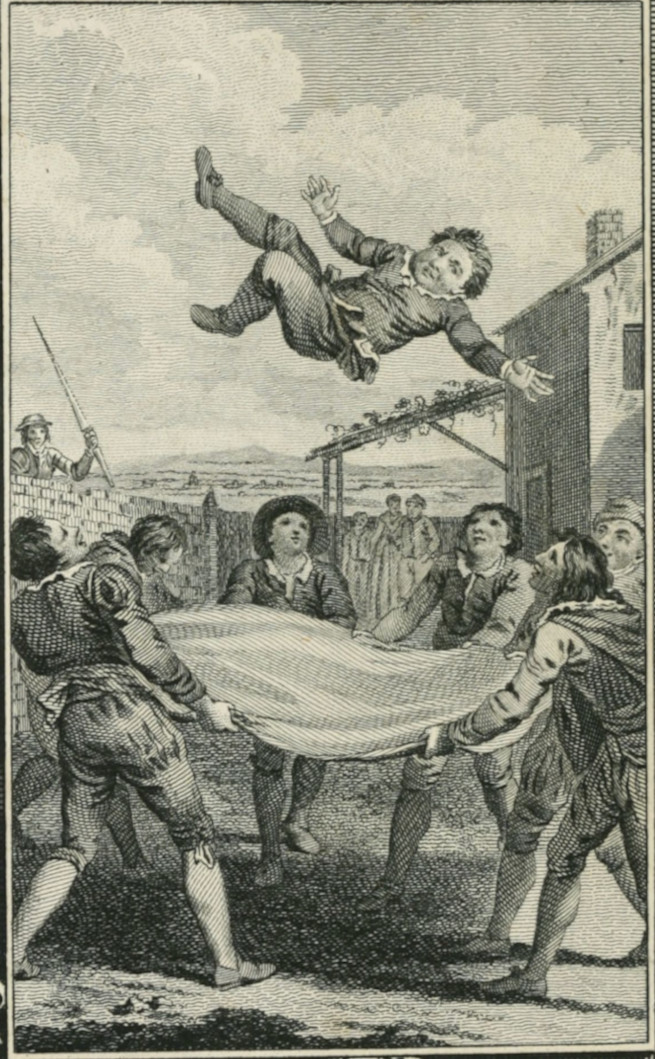
Plate I: Sancho Being Tossed.
As the unfortunate Sancho’s evil genius would have it, there were among the company that lodged that night in the house, four clothiers of Segovia, three pin-makers from the great square of Cordova, and a couple of shopkeepers from the market-place of Seville; all of them brisk jolly fellows, and mischievous wags. These companions, as if they had been inspired and instigated by the same spirit, came up to the squire, and pulled him from his ass; then, one of them fetching a blanket from the landlord’s bed, they put Sancho into it, and lifting up their eyes, perceived the roof was too low for their purpose; therefore determined to carry him out into the yard, which had no other ceiling than the sky: there placing Panza in the middle of the blanket, they began to toss him on high, and divert themselves with his capers, as the mob do with dogs at Shrove-tide. The cries uttered by this miserable vaulter, were so piercing as to reach the ears of his master, who halting to listen the more attentively, believed that some new adventure was approaching, until he clearly recognized the shrieks of his squire: he immediately turned his horse, and with infinite straining, made shift to gallop back to the inn; but finding the gate shut, rode round in search of some other entrance; and when he approached the yard-wall, which was not very high, perceived the disagreeable joke they were practising upon his squire, who rose in the air, and sunk again with such grace and celerity, that if his indignation would have allowed him, I verily believe the knight himself would have laughed at the occasion. He attempted to step from his horse upon the wall, but was so bruised and battered, that he could not move from his seat; and therefore, situated as he was, began to vent such a torrent of reproachful and opprobrious language against Sancho’s executioners, that it is impossible to repeat the half of what he said. This, however, neither interrupted their mirth nor their diversion, nor gave the least truce to the lamentations of Sancho, who prayed and threatened by turns, as he flew. Indeed, nothing of this sort either could or did avail him, until leaving off, out of pure weariness, they thought fit to wrap him up in his great coat, and set him on his ass again. The compassionate Maritornes seeing him so much fatigued, thought he would be the better for a draught of water, which, that it might be the cooler, she fetched from the well; and Sancho had just put the mug to his lips, when his draught was retarded by the voice of his master, who cried aloud, ‘Son Sancho, drink not water, drink not that which will be the occasion of thy death, my son; behold this most sacred balsam,’ holding up the cruse of potion in his hand, ‘two drops of which will effectually cure thee.’ At these words the squire eyed him, as it were, askance, and in a tone still more vociferous, replied, ‘Perchance your worship has forgot that I am no knight; or may be, you want to see me vomit up all the entrails I have left, after last night’s quandary. Keep your liquor for yourself, and may all the devils in hell give you joy of it; and leave me to my own discretion!’ He had no sooner pronounced these words than he began to swallow; and perceiving at the first draught, that the cordial was no other than water, 90he did not chuse to repeat it; but desired Maritornes to bring him some wine. This request she complied with very chearfully, and paid for it with her own money; for it was reported of her, that although she was reduced to that low degree in life, she actually retained some faint sketches and shadows of the Christian.
Sancho having finished his draught, clapped heels to his ass, and the inn-gate being thrown wide open, sallied forth very well satisfied with having got off without paying any thing, although he had succeeded at the expence of his shoulders, which were indeed his usual sureties. True it is, the landlord had detained his bags for the reckoning; but these Sancho did not miss in the confusion of his retreat. As soon as he was clear of the house, the innkeeper would have barricadoed the gate, had he not been prevented by the blanket companions, who were of that sort of people, who would not have valued Don Quixote a farthing, even if he had been actually one of the knights of the round-table.
CHAP. IV. IN WHICH IS RECOUNTED THE DISCOURSE THAT PASSED BETWEEN SANCHO PANZA AND HIS MASTER DON QUIXOTE; WITH OTHER ADVENTURES WORTHY OF RECORD.
Sancho made shift to overtake his master, so haggard and dismayed, that he was scarce able to manage his beast: and when the knight perceived his melancholy situation, ‘Honest Sancho,’ said he, ‘I am now convinced beyond all doubt, that this castle or inn is inchanted; for those who made such a barbarous pastime of thy sufferings, could be no other than phantoms and beings belonging to the other world. I am confirmed in this opinion, from having found, that while I was by the wall of the yard, a spectator of the acts of thy mournful tragedy, I could neither climb over to thy assistance, nor indeed move from Rozinante, but was fixed in the saddle by the power of inchantment; for I swear to thee, by the faith of my character! if I could have alighted from my steed, and surmounted the wall, I would have revenged thy wrongs in such a manner, that those idle miscreants should have remembered the jest to their dying day: although I know, that in so doing, I should have transgressed the laws of chivalry, which, I have often told thee, do not allow a knight to lift his arm against any person of an inferior degree, except in defence of his own life and limbs, or in cases of the most pressing necessity.’—‘So would I have revenged myself,’ said Sancho, ‘knighted or not knighted; but it was not in my power; though I am very well satisfied that those who diverted themselves at my cost were no phantoms, nor inchanted beings, as your worship imagines, but men made of flesh and bones, as we are, and all of them have Christian names, which I heard repeated, while they tossed me in the blanket; one, for example, is called Pedro Martinez, another Tenorio Harnandez, and the innkeeper goes by the name of Juan Palameque the left-handed; and therefore, Signior, your being disabled from alighting and getting over the wall, must have been owing to something else than inchantment. What I can clearly discern from the whole is, that these adventures we go in search of, will, at the long run, bring us into such misventures, that we shall not know our right hands from our left; and therefore, in my small judgment, the best and wholesomest thing we can do, will be to jog back again to our own habitation now, while the harvest is going on, to take care of our crops, and leave off sauntering from post to pillar[59], and falling out of the frying-pan into the fire, as the saying is.’
‘How little art thou acquainted, Sancho,’ replied Don Quixote, ‘with the pretensions of chivalry! hold thy tongue and have patience; for the day will soon arrive on which thy own eyes shall judge what an honourable profession it is: pray, tell me, now, 91what greater satisfaction can there be in this world, or what pleasure can equal that of a conqueror, who triumphs over his adversary in battle? None, sure!’—‘That may be,’ answered the squire, ‘though I know nothing of the matter. This only I know, that since we have taken up the trade of knights-errant, your worship I mean, for as to my own part I have no manner of title to be reckoned in such an honourable list, we have not gained one battle, except that with the Biscayan; and even there your worship came off with half an ear, and the loss of one side of your helmet: from that day to this good hour, our lot hath been nothing but cudgelling upon cudgelling, pummelling upon pummelling; except the advantage I have had over your worship, in being tossed in a blanket by inchanted Moors, whom I cannot be revenged of, in order to know how pleasant a pastime it is to overcome one’s enemy, as your worship observes.’—‘That is the very grievance, Sancho, under which both you and I labour,’ said Don Quixote: ‘but, for the future, I will endeavour to procure a sword tempered with such masterly skill, that he who wears it shall be subject to no kind of inchantment; and who knows but accident may furnish me with that which Amadis possessed, when he stiled himself the knight of the flaming sword; and truly it was one of the most excellent blades that ever a warrior unsheathed; for, besides that sovereign virtue it contained, it cut keen as a razor, and no armour, though ever so strong or inchanted, could stand before its edge.’—‘I am so devilishly lucky,’ said Sancho, ‘that if the case was really so, and your worship should light on that same sword, it would, like the precious balsam, be of no service or security to any but your true knights; and we that are squires might sing for sorrow.’—‘Thou must not be afraid of that,’ replied the knight; ‘Heaven will surely deal more mercifully with thee.’
In such conversation, Don Quixote and his squire jogged along, when the former descrying on the road in which they travelled, a large and thick cloud of dust rolling towards them, turned to Sancho, saying, ‘This, O Sancho, is the day that shall manifest the great things which fortune hath in store for me! This, I say, is the day on which the valour of this arm shall be displayed as much as upon any other occasion; and on which I am resolved to perform deeds that shall remain engraven on the leaves of fame to all posterity! Seest thou that cloud of dust before us? The whole of it is raised by a vast army, composed of various and innumerable nations that are marching this way.’—‘By that way of reckoning, there must be two,’ said Sancho, ‘for right over against it there is just such another.’ Don Quixote immediately turned his eyes, and perceiving Sancho’s information to be true, was rejoiced beyond measure; firmly believing that what he saw were two armies in full march to attack each other, and engage in the middle of that spacious plain; for every hour and minute of the day his imagination was engrossed by those battles, inchantments, dreadful accidents, extravagant amours, and rhodomontades, which are recorded in books of chivalry; and indeed every thing he thought, said, or did, had a tendency that way.
As for the dust he now saw, it was raised by two flocks of sheep which chanced to be driven from different parts into the same road, and were so much involved in this cloud of their own making, that it was impossible to discern them until they were very near. The knight affirmed they were armies with such assurance, that Sancho actually believed it, and said to his master, ‘And pray now, good your worship, what must we do?’—‘What,’ answered Don Quixote, ‘but assist and support that side which is weak and discomfited? Thou must know, Sancho, that yonder host which fronts us, is led and commanded by the mighty Emperor Alifanfaron, sovereign of the great island of Trapoban; and that other behind us belongs to his mortal enemy the king of the Garamanteans, known by the name Pentapolin with the naked arm, because he always goes to battle with the sleeve of his right-arm tucked up.’—‘But why are those chieftains so mischievously inclined towards each other?’ said Sancho. ‘The cause of their enmity,’ replied the knight, ‘is this: Alifanfaron, who is a most outrageous 92Pagan, is enamoured of Pentapolin’s daughter, a most beautiful and courteous lady, who being a Christian, her father will by no means betroth her to the infidel prince, unless he shall first renounce the law of his false prophet Mahomet, and become a convert to the true faith.’—‘Now, by my whiskers!’ cried Sancho, ‘King Pentapolin is an honest man, and I am resolved to give him all the assistance in my power.’—‘In so doing thou wilt perform thy duty, Sancho,’ said his master; ‘for to engage in such battles as these, it is not necessary to be dubbed a knight.’—‘That I can easily comprehend,’ replied the other; ‘but where shall we secure the ass, that we may be sure of finding him after the fray is over; for I believe it is not the fashion now-a-days, to go to battle on such a beast.’—‘True,’ said the knight, ‘and I think the best way will be to leave him to his chance, whether he be lost or not; for we shall have such choice of steeds, when once we have gained the victory, that Rozinante himself will run some risk of being exchanged for another: but observe and listen attentively; I will now give thee a detail of the principal knights that serve in these two armies; and that thou may’st see and mark them the better, let us retire to yon rising ground, from whence we can distinctly view the line of battle in both.’ They accordingly placed themselves upon a hillock, whence they could easily have discerned the two flocks of sheep which Don Quixote metamorphosed into armies, had not the dust they raised confounded and obscured the view; but nevertheless, beholding in his imagination that which could not otherwise be seen, because it did not exist, he began to pronounce with an audible voice—
‘That knight whom thou seest with yellow armour, bearing in his shield a lion crowned and crouching at the feet of a young lady, is the gallant Laucalco, lord of the silver bridge; that other beside him, who wears armour powdered with flowers of gold, and bears for his device three crowns argent in a field azure, is the amorous Micocolembo, Grand Duke of Quiracia; and he upon his right-hand, with those gigantick limbs, is the never to be daunted Brandabarbaran de Boliche, sovereign of the three Arabias, who comes armed with a serpent’s skin, and, instead of a shield, brandishes a huge gate, which, it is said, belonged to the temple that Samson overthrew, when he avenged himself of his enemies at his death; but turn thine eyes, and behold in the front of this other army, the ever-conquering and never-conquered Timonel de Carcajona, prince of New-Biscay, whose arms are quartered azure, vert, argent, and or; and the device in his shield, a cat or, in a field gules, with the letters Miau, which constitute the beginning of his lady’s name; and she, they say, is the peerless Miaulina, daughter of Alfeniquen, Duke of Algarve; the other who loads and oppresses the loins of that fiery Arabian steed, with armour white as snow, and a shield without a device, is a noviciate knight of the French nation, called Pierre Papin, Baron of Utrique; the third, who strikes his iron rowels into the flanks of that spotted nimble zebra[60], is the potent Duke of Nerbia, esparta-filardo of the wood, who bears in his shield for a device, a bunch of asparagus, with an inscription signifying, “By destiny I am dogged.”’
In this manner did he invent names for a great many knights in either army, to all of whom also he gave arms, colours, mottos, and devices, without the least hesitation, being incredibly inspired by the fumes of a distempered fancy; nay, he proceeded without any pause, saying, ‘That squadron forming in our front is composed of people of divers nations: there be those who drink the delicious waters of the celebrated Xanthus, with the mountaineers who tread the Masilican plains: and those who sift the purest golden ore of Arabia Felix; there also may be seen the people who sport upon the cool and famous banks of the translucent Thermodonte; and those who conduct the yellow Pactolus in many a winding stream; the promise-breaking Numidians; the Persians for their archery renowned; the Parthians and the Medes who combat as they fly; the Arabians famed for shifting habitations; the Scythians cruel as they are 93fair; the thick-lipped race of Ethiopia; and an infinite variety of other nations, whose looks I know, and can discern, though I cannot recollect their names. In that other squadron march those men who lave in the crystal current of the olive-bearing Betis; those whose visages are cleaned and polished with the limpid wave of the ever rich and golden Tagus; those who delight in the salutiferous draughts of Genil the divine; those who scour the Tartesian fields that with fat pasture teem; those who make merry in the Elysian meads of Herezan; the rich Manchegans crowned with ruddy ears of corn; those cloathed in steel the bold remains of ancient Gothick blood; those who bathe in Pisuerga, famous for its gentle current; those who feed their flocks upon the spacious meads of the meandring Guadiana, celebrated for its secret course; those who shiver with the chill blasts of the woody Pyrenees; and those who feel the snowy flakes of lofty Appenine: in fine, whatever nation Europe imbosoms and contains.’
Heaven preserve us! what provinces did he mention! what nations did he name! bestowing, with wonderful facility, those attributes that belonged to each; being all the while absorpt, and, as it were, immersed in the contents of his deceitful books. Sancho Panza listened attentively to his master, without uttering one syllable; and from time to time turned his eyes from one side to another to see if he could discern those knights and giants who were thus described: but not being able to discover one of them, ‘Sir,’ said he, ‘your worship may say what you please, but the devil a man, giant, or knight, that you have mentioned, is there; at least I can see none: perhaps, indeed, the whole is inchantment, like the phantoms of last night.’—‘How say’st thou?’ replied Don Quixote, ‘dost thou not hear the neighing of steeds, the sound of clarions, and noise of drums?’—‘I hear nothing,’ answered Sancho, ‘but abundance of bleating of ewes and lambs.’ And truly that was the case; for by this time the two flocks were pretty near them. ‘Thy fear,’ said Don Quixote, ‘hinders thee from seeing and hearing aright: for one effect of terror is to disturb the senses, and make objects appear otherwise than they are; if thou art therefore under such consternation, retire on one side, and leave me alone; for I myself am sufficient to bestow victory on that cause which I espouse.’ So saying, he clapped spurs to Rozinante, and putting his lance in the rest, darted down from the hillock like lightning. In vain did Sancho bellow forth, ‘Turn, Signior Don Quixote: good your worship, turn! so help me God, those are ewes and lambs you are going to attack! Woe be to the father that begat me! Will you not turn? What madness possesses you! Consider, here are no giants, nor knights, nor cats, nor arms, nor shields quartered or whole, nor inverted azures, and the devils knows what: was there ever such distraction? sinner that I am!’
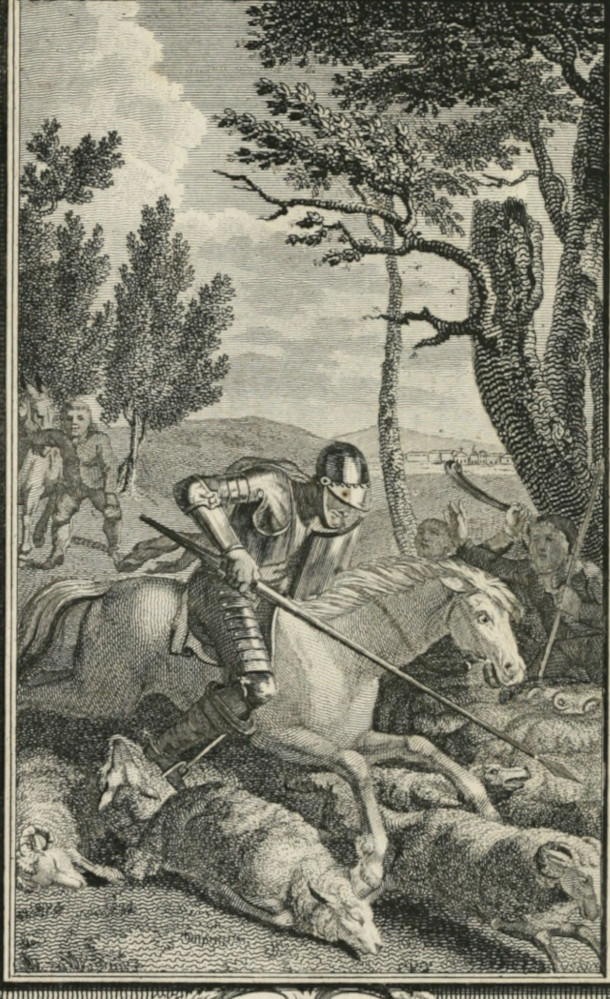
Plate VIII: Don Quixote Valiantly Charging the Herd of Sheep.
The knight, however, did not regard this exclamation: on the contrary, he rode on, bauling aloud, ‘So ho, knights! you that attend and serve under the banners of the valiant Emperor Pentapolin, with the naked arm, follow me in a body, and you shall behold how easily I will avenge him, on his adversary Alifanfaron, of Trapoban.’ Having uttered these words, he rushed into the thickest of the squadron of sheep, and began to lay about him, with as much eagerness and fury, as if he had been actually engaged with his mortal enemies. The herdsmen and shepherds who were driving the flock, called to him to forbear; but finding their admonition had no effect, they ungirded their slings, and began to salute his ears with stones, the least of which was as large as an ordinary fist; but he, far from minding their missiles, rode about the field, crying, ‘Where art thou, proud Alifanfaron? face me if thou darest; I am but a single knight, who want to prove thy prowess hand to hand, and sacrifice thy life for the injury thou hast done to Pentapolin Garamanta.’ Just as he pronounced these words, he received a pebble on his side, that seemed to have buried a couple of his ribs in his belly; and gave him such a rude shock, that he believed himself either dead or desperately wounded; then remembering his specifick, he pulled out the cruse, and setting it to his mouth, began to swallow the balsam; but before he had drank what he thought a sufficient dose, there came another such almond, so plump upon his hand and 94cruse, that after having shivered the pot to pieces, it carried off in its way three or four of his grinders, and shattered two of his fingers in a grievous manner: in short, so irresistible were both the applications, that the poor knight could not help tumbling from his horse. The shepherds immediately came up, and believing him actually dead, gathered together their flock with all imaginable dispatch; and taking their dead, which might be about seven in number, upon their shoulders, made off without any farther inquiry.
All this time Sancho remained upon the hill, beholding, with amazement, the madness of his master, tearing his beard, and cursing the hour and minute on which it was his fate to know him: and now seeing him fallen, and the shepherds gone, he descended to his assistance, when finding him still sensible, though in a miserable situation, ‘Did not I warn you, Signior Don Quixote,’ said he, ‘to turn; and assure you that those you went to attack were no armies, but flocks of innocent sheep?’—‘How strangely can that miscreant inchanter, who is my enemy, transmography things to thwart me? Know, Sancho, that it is a very easy matter for necromancers to make us assume what shapes they please; and the malicious wretch who persecutes me, envying the glory I should have gained in this battle, hath doubtless metamorphosed the squadrons of the foe into flocks of sheep: but thou shalt do one thing, I intreat thee, Sancho, in order to be undeceived and convinced of the truth; mount thy ass, and follow them fair and softly; and when they are at a convenient distance from hence, thou wilt see them return to their former shapes, and ceasing to be sheep, become men again, right and tight as I at first described them; but do not go at present, for I have occasion for thy service and assistance: come hither, and see how many teeth I have lost; methinks there is not one left in my whole jaw.’
Sancho accordingly approached so near as to trust his eyes into his master’s mouth, just at the time when the balsam began to operate in his stomach, which, with the force of a culverin, discharged its contents full in the beard of the compassionate squire. ‘Holy Virgin!’ cried Sancho, ‘what is this that hath befallen me? Without doubt, this poor sinner is mortally wounded, since he vomits blood.’ But considering the case more maturely, he found by the colour, taste, and smell, that it was not blood, but the balsam he had seen him drink: and such was the loathing he conceived at this recognition, that his stomach turned, and he emptied his bowels upon his master; so that both of them remained in a handsome pickle. Sancho ran to his ass, for a towel to clean them, and some application for his master’s hurt; but when he missed his bags, he had well-nigh lost his senses; he cursed his fate again, and determined with himself to leave the knight, and return to his habitation, even though he should lose his wages for the time he had already served, as well as his hopes of governing the Island of Promise.
At this juncture Don Quixote arose, and clapping his left-hand to his cheek, in order to prevent his teeth from falling out, with the right laid hold of the bridle of Rozinante; who, like a faithful and affectionate servant, had never stirred from his master’s side; and went up to the place where his squire stood, leaning upon his ass, with one hand applied to his jaw, in the posture of a person who is exceedingly pensive; the knight perceiving him in this situation, with manifest signs of melancholy in his countenance, ‘Know Sancho,’ said he, ‘that one man is no more than another, unless he can do more than another. All those hurricanes that have happened to us prognosticate that we soon shall have fair weather, and that every thing will succeed to our wish: for it is impossible that either good or bad fortune should be eternal; and therefore it follows, that our adversity having lasted so long, our prosperity must be now at hand. Be not grieved then, at the misfortunes that happen to me, since no part of them falls to thy share.’—‘Not to my share!’ answered Sancho; ‘mayhap, then, he whom they tossed in the blanket yesterday was not the son of my father; and the bags that are lost to-day, with all the goods in them, belonged to some other person.’—‘What, hast thou lost the bags, Sancho!’ cried Don Quixote. ‘Yes, sure,’ said the other. ‘At that rate, then, we have no victuals to eat?’ resumed the knight. ‘That would certainly be the case,’ answered 95the squire, ‘if the meadows did not furnish those herbs you say you know with which unfortunate knights like your worship are wont to make up such losses.’—‘Yes, but for all that,’ replied Don Quixote, ‘I could at present relish a luncheon of brown bread, or a loaf, with a couple of red herrings, better than all the herbs described by Dioscorides, even with the annotations of Doctor Laguna; but, nevertheless, mount thy beast, honest Sancho, and follow me. God, who provides all things, will not be wanting to us; more especially as we are employed in his immediate service: he faileth not to provide for the gnats of the air, the insects of the earth, the spawn of the sea; and is so beneficent, as to cause the sun to shine upon the good and bad, and sendeth rain to the wicked as well as the righteous.’—‘Your worship,’ said Sancho, ‘is more fit to be a preacher than a knight-errant.’—‘Knights-errant,’ replied his master, ‘ever had, and ought to have, some knowledge of every thing; nay, some there have been in times past, who would stop to make a sermon or discourse upon the highway, with as much eloquence as if they had taken their degrees at the university of Paris: from whence it maybe inferred, that the lance was never blunted by the pen, nor the quill impeded by the lance.’—‘What your worship observes may be very true,’ said Sancho; ‘but, in the mean time, let us leave this place, and endeavour to get a night’s lodging in some house or other, where, God grant there may be neither blankets nor blanketeers, nor phantoms, nor inchanted Moors; else, may the devil confound both hook and crook!’
‘Implore the protection of God, my son,’ answered the knight, ‘and lead me where thou wilt: for this once, I leave our lodging to thy care; but reach hither thy hand, and feel with thy finger how many teeth I have lost on this right side of my upper jaw, which is the place that gives me the greatest pain.’ Sancho introduced his fingers, and having carefully examined his gums. ‘How many teeth,’ said he, was your worship wont to have in this place?’—‘Four, besides the dog-tooth,’ answered Don Quixote, ‘all of them sound and whole.’—‘Consider what your worship says,’ replied Sancho. ‘I say, four, if not five,’ resumed the knight; ‘for, in all my life, I never lost tooth or fang, either by worm, rheum, or scurvy.’—‘At present,’ said the squire, ‘in that part of the lower jaw, your worship has but two grinders and a half; and above, neither half nor whole; all is smooth as the palm of my hand.’—‘Cruel fortune!’ cried Don Quixote, hearing this melancholy piece of news; ‘would they had rather demolished a limb, so it had not been the sword-arm: for I would have thee to know, Sancho, that a mouth without grinders, is like a mill without a milstone; and a tooth is worth a treasure[61]; but such mischances always attend us who profess the strict order of chivalry. Get up, friend, and lead the way, and I will follow at thy own pace.’ Sancho complied with his desire, and took the way that seemed most likely to lead to some accommodation, without quitting the high road, which was thereabouts very much frequented. While they jogged on softly, because the pain in Don Quixote’s jaws would not suffer him to be quiet, or exert himself in pushing forward, Sancho being desirous of entertaining and diverting him with his discourse, said, among other things, what will be rehearsed in the following chapter.
CHAP. V. AN ACCOUNT OF THE SAGE DISCOURSE THAT PASSED BETWEEN SANCHO AND HIS MASTER—THE SUCCEEDING ADVENTURE OF THE CORPSE—WITH OTHER REMARKABLE EVENTS.
‘In my opinion, my good master, all the misventures, which have this day happened to us, are designed as a punishment for the sins committed by your worship, in neglecting to fulfil the oath you took, not to eat off a table-cloth, nor solace yourself with the queen; together with all the rest that follows, which your worship 96swore to observe, until such time as you could carry off that helmet of Malandrino, or how d’ye call the Moor? for I don’t remember his right name.’—‘Thou art very much in the right,’ said Don Quixote: ‘to deal ingenuously with thee, Sancho, that affair had actually slipt out of my remembrance; and thou mayest depend upon it, that affair of the blanketing happened to thee, for the fault thou wast guilty of, in omitting to put me in mind of it in time: but I will make an atonement; for there are methods for compounding every thing, in the order of chivalry.’—‘Did I swear any thing?’ replied Sancho. ‘Your not having sworn is of no importance,’ said Don Quixote; ‘it is enough that I know you to be concerned as an accessary; and whether that be the case or not, it will not be amiss to provide a remedy.’—‘Well, then,’ replied the squire, ‘I hope your worship will not forget this, as you did the oath: perhaps the phantoms may take it in their heads again to divert themselves with me, and even with your worship, if they find you obstinate.’
In this and other such discourse, night overtook them in the midst of their journey, before they could light on or discover any house where they could procure lodging; and what was worse, they were almost famished; for in their bags they had lost their whole buttery and provision: nay, to crown their misfortune, an adventure happened to them, that, without any exaggeration, might have actually passed for something preternatural. Though the night shut in very dark, they continued travelling; Sancho believing, that, as they were in the king’s highway, they should probably find an inn at the distance of a league or two.
Jogging on, therefore, under cloud of night, the squire exceeding hungry, and the master very well disposed to eat, they descried upon the road before them a vast number of lights, that seemed like moving stars, approaching them. Sancho was confounded at the sight, the meaning of which even Don Quixote could not comprehend: the one checked his ass, the other pulled in his horse’s bridle, and both halted, in order to gaze attentively at the apparition of the lights, which seemed to increase the nearer they came. This being perceived by the squire, he began to quake like quicksilver; and the hair bristled up on Don Quixote’s head: nevertheless, recollecting himself a little, ‘Without doubt, Sancho,’ said he, ‘this must be a vast and perilous adventure in which I shall be obliged to exert my whole strength and prowess.’—‘Woe is me!’ cried Sancho, ‘if perchance this should be an adventure of phantoms, as I am afraid it is, where shall I find ribs for the occasion?’—‘Phantoms or not phantoms,’ said the knight, ‘I will not suffer them to touch a thread of thy cloaths: if they made merry at thy expence before, it was owing to my incapacity to climb over the yard wall; but at present we are in an open field, where I can manage my sword as I please.’—‘But if they should benumb and bewitch you, as they did in the morning,’ said the squire, ‘what benefit shall I receive from being in the open field?’—‘Be that as it will,’ replied Don Quixote, ‘I beseech thee, Sancho, be of good courage, and thou shalt soon know by experience how much I am master of that virtue.’ Sancho accordingly promised to do his best, with God’s assistance. Then they both stepped to one side of the road, and began to gaze again with great attention. While they were thus endeavouring to discern the meaning of the lights, they perceived a great number of persons in white; which dreadful vision entirely extinguished the courage of Sancho Panza, whose teeth began to chatter, as if he had been in the cold fit of an ague; and this agitation and chattering increased, when they saw them more distinctly; for, first and foremost appeared about twenty persons on horseback, all of them cloathed in white, with each a lighted flambeau in his hand, muttering in a low and plaintive tone. Behind them came a litter covered with black, followed by six mounted cavaliers in deep mourning, that trailed at the very heels of their mules, which were easily distinguished from horses by the slowness of their pace.
This strange vision, at such an hour, and in such a desart place, was surely sufficient to smite the heart of Sancho with fear, and even make an impression upon his master; and this would have been the case, had he been any 97other than Don Quixote; as for the squire, his whole stock of resolution went to wreck. It was not so with his master, whose imagination clearly represented to him, that this was exactly an adventure of the same kind with those he had read in books of chivalry; that the close litter was a bier, in which was carried some dead or wounded knight, the revenge of whose wrongs was reserved for him alone: wherefore, without canvassing the matter any farther, he set his lance in the rest, fixed himself in his seat, and with the most genteel and gallant deportment, placing himself in the middle of the road, through which they were indispensibly obliged to pass, he raised his voice, and called to them as they approached—
‘Halt, knights, whosoever ye are, and give an account of yourselves: whence come ye? whither go ye? and what are you carrying off in that bier? for, in all appearance, you have either done or received an injury; and it is necessary and convenient that I should know it, in order to chastise you for what you are now doing, or revenge the wrong you have already done.’—‘We are at present in a hurry,’ replied one of the phantoms in white; ‘the inn we intend to lodge at is far off, and we cannot stay to give such a tedious account as you desire.’ So saying, he spurred on his mule; while Don Quixote, mightily incensed at this reply, laid hold of his bridle, saying, ‘Stand, and answer the questions I have asked, with more civility; otherwise I will give battle to you all.’
The mule being skittish, was frighted in such a manner, at being seized by the bridle, that rearing on her hind feet, she fell backward upon her rider; and a servant on foot, seeing his master fall, began to revile Don Quixote, whose choler being already provoked, he couched his lance, and without hesitation attacked one of the mourners, who soon fell to the ground, most miserably mauled; then wheeling about upon the rest, it was surprizing to see with what dispatch he assaulted and put them to the rout! while Rozinante acted with such agility and fury, that one would have sworn, at that instant, a pair of wings had sprung from his back. All the squadron arrayed in white, was composed of timorous and unarmed people, who were fain to get out of the fray as soon as possible, and began to fly across the plain, with their lighted torches like so many maskers in carnival time. The mourners being involved and intangled in their long robes, could not stir out of the way; so that Don Quixote, without running any risk, drubbed them all round, and obliged them at length to quit the field, much against their inclination; for they actually believed he was no man, but a devil incarnate, who lay in wait to carry off the dead body that was in the litter.
All this while Sancho stood beholding with admiration the courage and intrepidity of the knight; saying within himself, ‘This master of mine is certainly as strong and valiant as he pretends to be.’
Meanwhile, Don Quixote, by the light of a torch that lay burning on the ground, perceiving the first whom the mule overthrew, rode up to him, and clapping the point of his lance to the poor man’s throat, commanded him to yield, otherwise he would put him to death. To this declaration the other answered, ‘Methinks I am already sufficiently quiet; for one of my legs is broke, so that I cannot stir; I beseech your worship, therefore, if you be a Christian, not to kill me, as in so doing you will commit the horrid sin of sacrilege; for I am a licentiate, and have taken holy orders.’—‘If you are an ecclesiastick, what the devil brought you here?’ cried Don Quixote. ‘The devil, indeed, I think it was,’ answered the overthrown priest. ‘You will have to do with worse than the devil,’ said the knight, ‘if you refuse the satisfaction I at first demanded.’—‘That is easily granted,’ replied the other; ‘and in the first place your worship must know, that though I just now called myself a licentiate, I am no more than a batchelor: my name is Alonzo Lopez; I was born at Alcovendas; and now come from the city of Baeça, in company with eleven other priests, who are those who fled with the torches; we are conveying to Segovia that litter which contains the corpse of a gentleman who died at Baeça, where it was deposited till now, (as I was saying) that we are carrying his bones to be interred at Segovia, which was the place of his nativity.’—‘And who killed him?’ said Don Quixote. ‘God himself,’ replied the batchelor, ‘by 98means of a pestilential calenture that seized him!’—‘At that rate,’ resumed the knight, ‘the Lord hath saved me the trouble of avenging his death, as I would have done, had he been slain by any mortal arm; but, considering how he died, there is nothing to be done, except to shrug up our shoulders in silence, for this is all that could happen, even if I myself should fall by the same hand; and I desire your reverence would take notice, that I am a knight of La Mancha, called Don Quixote, whose office and exercise is to travel through the world, redressing grievances and righting wrongs[62].’—‘I do not know how you can call this behaviour righting wrongs,’ said the batchelor: ‘I am sure you have changed my right into wrong, by breaking my leg, which will never be set to rights again so long as I live; and the grievances you have redressed for me, have been to aggrieve me in such a manner, as that I shall never cease to grieve at my misventure, in meeting with you, while you was in search of adventures.’—‘All things do not equally succeed,’ observed the knight; ‘it was the misfortune of you and your companions, Mr. Batchelor Alonzo Lopez, to travel in the night, with these surplices and lighted flambeaus, singing all the way, before people clad in deep mourning, so that you seemed a company of ghosts broke from the other world, therefore I could not help performing my duty in attacking you; and I would have behaved in the same manner, had I actually known you to be really and truly the inhabitants of hell; for such indeed I thought you were.’—‘Since my hard fate would have it so,’ said the batchelor, ‘I entreat your worship, Sir knight-errant, who have been the cause of an unlucky errand to me, to help me from getting under the mule, which keeps one of my legs fast jammed between the stirrup and the saddle.’—‘I might have talked on till morning,’ said the knight; ‘why did not you inform me of your distress sooner?’
He then called aloud to Sancho, who was in no hurry to hear him, but busy in rummaging a sumpter-mule which those honest priests brought along with them, well furnished with provisions. Having made a bag of his great coat, into which he crammed as much of their victuals as it would hold, he loaded his ass with the bundle, and then running up to his master, helped to free Mr. Batchelor from the oppression of his mule, on which having mounted him, with a torch in his hand, Don Quixote advised him to follow the route of his companions; and desired him to beg their pardon in his name, for the injury he had done them, as it was not in his power to avoid it. Sancho, likewise interposing, said, ‘If in case the gentleman should want to know who the valiant hero is who put them to flight, your worship may tell them, that he is the famous Don Quixote de La Mancha, otherwise surnamed the Knight of the Rueful Countenance.’