Volume 1 — TRAINING OUR FIRE BRIGADE HEROES. DESCRIBED AT THE HEADQUARTERS OF THE LONDON BRIGADE.
Reading edition
By Alfred Arkas.
The most fascinating of the multitudinous institutions with which the Mother City of the Empire abounds is unquestionably that which preserves her millions from the risk of fire. In these days, when we have awakened to a sense of appreciation of the Navy, Army, and other national institutions for our protection and well-being, it is to be feared that we do not sufficiently recognise the vast debt we owe to the Metropolitan Fire Brigade and those who rule its destinies.
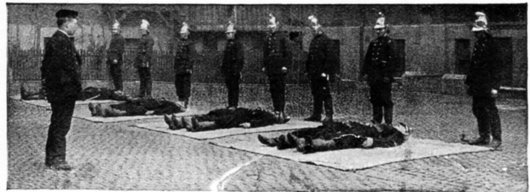
THE LIFTING DRILL
Attention!
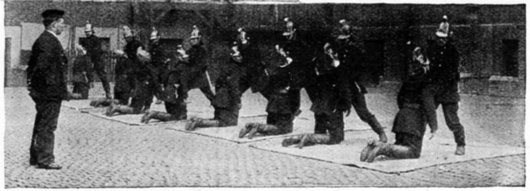
Raising the body to the knees.
London is to all intents and purposes an impregnable city—impregnable, that is to say, as regards an outside foe. The possibility of internal destruction by fire, although by no means so great as in the days of the Great Fire of London, still exists, in spite of fire-proof buildings, stone walls, and wide streets. Although the possibility exists, the risk of such a catastrophe will not be worth consideration so long as the Metropolitan Fire Brigade maintains its present high state of efficiency. It is to London what the Fleet is to the Empire, and the analogy is appropriate in more respects than one. It may be aptly described as the Navy of the Metropolis—the protecting genius of six million people, and the richest city the world has seen. To adequately realise its importance one has only to remember that the destruction of London would be a calamity to the Empire.
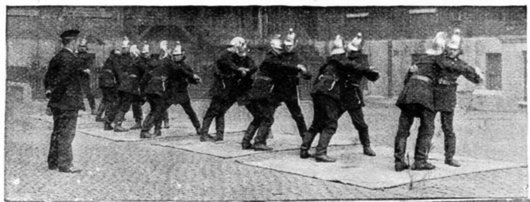
Lifting the body to the feet.
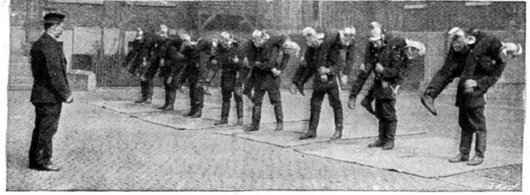
Safely lifted on to the back.
Every night its existence is threatened by the relentless fire demon. Every night the Fire Brigade as certainly combats and disarms it. Surely a strange, weird warfare, scarcely realised, since it is only on occasions when the demon temporarily gets the upper hand that we are reminded of its existence.
Opportunities for the display of heroism and conspicuous devotion to duty are comparatively rare in the Army and Navy. So when they occur we hear of them, and the heroes are received with acclaim. In the Fleet that never goes to sea such matters are common incidents of the day's work.
It is part of the ordinary duty of a London fireman to be a hero, and he never fails when it is expected of him.
It is natural to think of the brigade as a miniature Navy. It smells of the sea in every way. The captain is a naval man. Its crew of 1,009 are seamen, and the work of the brigade is of a nature readily performed by sailors, who are used to danger, and skilled in the art of hanging on to the skyline by their teeth.
Even the apparatus is peculiarly adapted for the use of the horny-handed sons of the sea.
It is therefore easy to understand how it is that these well-disciplined, hard-nerved men are pressed into the service of the brigade.
Many who have read of the marvellous rapidity with which the engines are turned out to a fire, or those who have been fortunate enough to see these splendid fellows at their work, may be interested in learning how a London fireman is made.
By the kindness of Commander Wells, R.N.—one of the most popular officers that ever donned the Queen's uniform—I have been able to observe the whole process, and pick up a good deal of interesting matter respecting the brigade into the bargain.
There is no objectionable formality about entering the brigade. Provided a sailor possesses the initial qualifications—he must be over 21 and under 31 years of age; have been at sea for at least five years; measure 37 inches round the chest; and be able to read and write—he simply walks into the yard of the central station at Southwark and inquires for the chief officer. The Commander examines his "discharges" and testimonials as to character and general intelligence. If he be a likely man, he is passed into the hands of the Brigade Doctor, who certifies his soundness of wind and limb. If he emerges successfully from this ordeal, he has yet a final and more trying one before him—the test of strength.
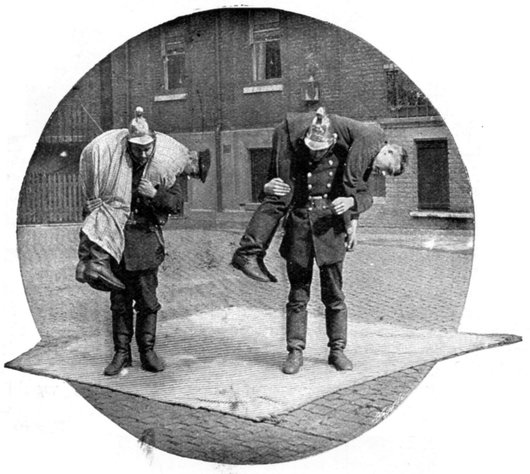
TWO METHODS OF CARRYING—A WOMAN OR A MAN.
Sheer physical strength is a desideratum in all branches of public service, but especially so in the Fire Brigade, where lives and property almost always depend upon nerve and muscle. Accordingly the strength test is necessarily a heavy one. A fire escape is brought into the yard, and is rested lengthwise on the flagstones. To a ring-bolt in the stones a tackle is hooked, the other end being made fast to the foot of the escape. The candidate is then requested to haul the escape bodily from the ground into its normal vertical position. It is an immensely trying pull of 240 lbs. If the candidate manages it, he becomes a probationer at a salary of 24s. per week.
The Southwark instructors reckon that it takes three months' hard work and unceasing drill before a man is competent to leave the yard, even as a fireman of the fourth class. During this period he is not permitted to attend a fire in any capacity.
No other sort of drill equals in fascination that which the embryo M.F.B. man must go through. Unlike a soldier or sailor, he must undertake many of the actual dangers of warfare during ordinary drill on the parade-ground. The instruction, conducted by superintendents who have gone through the mill themselves and know every detail of the work, is divided into two parts—theoretical and practical.
The room in which most of the theory is taught is particularly interesting. It contains a half section of every apparatus or device used by or in connection with the brigade. There is a half section of the boiler of the familiar steamer, a half section of a street lamp, indicating the position of a hydrant, and half sections of hose, nozzles, fire-plugs, flanges, and all the complicated machinery forming parts of the various types of engines in use.
That very important part of instruction, the use of steam, is undertaken in the yard, so that practical demonstration with a steamer under way may accompany the lesson.
Hand in hand with theoretical instruction, a daily grounding goes on in what may be termed emergency drill. To the layman, this is perhaps the most interesting part of the work.
Everything must be rehearsed over and over again. Every movement, every action must be practised again and again till it becomes automatic, before a man can feel sure of doing the right thing at the right time under circumstances of difficulty and danger. Most of us have seen a fireman descend an escape, bearing on his back a human burden, possibly heavier than himself; we wonder how it is done, but it does not occur to us that this same evolution is practised every day at Southwark in all its separate movements.
Our illustrations of this drill show how a fireman is taught to lift and carry a human body. In the first picture, the men under instruction are at "Attention." The second shows the first movement, the body being lifted on to its knees. In the third it is raised to its feet. In the final evolution the prostrate figure is bodily lifted on to the rescuer's back. The whole operation scarcely occupies a moment of time. By this method, the strain of lifting is reduced to a minimum, and the position of the body across the shoulders leaves both hands free.
When the men are thorough masters of this lifting drill, they have to go through the nerve-trying ordeal of performing it as though in actual practice. Escapes are run into the yard. Some of the old hands mount to the roof, and the embryo firemen are ordered to go aloft and save them from an awful death. That this is a very considerable feat, I think our photograph of the operation will amply demonstrate. To an old hand who has performed the operation amid all the exciting surroundings of an actual fire it is simple enough. He skips up the creaking, bending ladder, lightly tosses a twelve-stone colleague on his back, in the most unconcerned manner, and as blithely skips down again.
But although there is an element of very real danger in it to the beginner, yet he generally gets through it satisfactorily, though his progress is necessarily slow. It is in such drills that his sea training stands him in good stead.
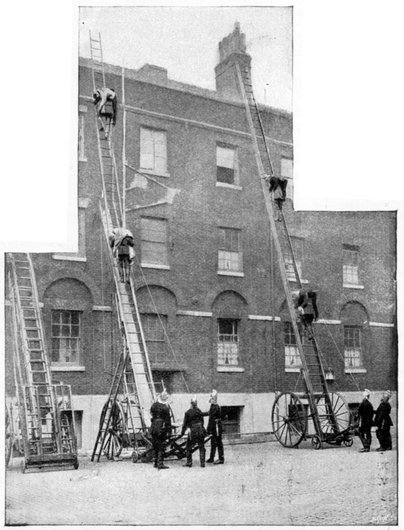
NERVOUS WORK FOR RECRUITS—NEW FIREMEN RESCUING OLD FIREMEN.
However, the most nerve-trying work is the jumping-sheet drill. As our illustration shows, some eighteen or twenty men at a given order man the canvas jumping-sheet.
Beckets, or rope handles, are supplied all round the edge of the sheet. Each man holds one of these in either hand, and as the jumper alights in the centre of the canvas, all simultaneously give a little, and so break the force of the fall. The men are required to jump 20 feet from a parapet into the sheet. It is nervous work, both for the jumpers and those who catch them.
The instructor tells you that there is no danger. In fact a forty-foot jump into the sheet would be very unlikely to result in injury.
It is easy to listen to such statements, but it is another thing to stand on that narrow ledge and gaze contemplatively into the tiny sheet, twenty feet below.
Every possible method of saving life is the subject of a special set of drills, and all are constantly practised by all hands alike. They are designed to meet every possible contingency, and when lives are lost by fire it is generally attributable to delay in summoning the brigade.
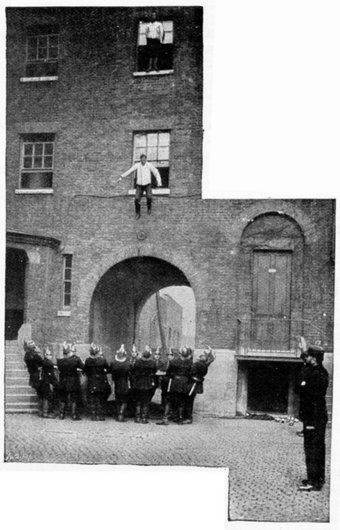
STILL MORE NERVOUS WORK—JUMPING-SHEET DRILL, A 20-FEET DROP.
One of the most interesting systems of rescue is that in which the chair knot is used. It is an extreme method only resorted to when the fierceness of the fire renders the use of the escape impracticable.
This method is shown in actual operation in one of our photographs. You are invited to suppose that the whole face of the building is alight, and that a person is in the top front room calling for assistance. Several men ascend to the roofs of the houses on either side of the doomed building. Each party has a rope, the two ends of which are tied in a knot consisting of two loops. The person in danger is instructed how to fasten the loops about him. He is now suspended in a sort of cradle or chair, and is lowered away, a guy rope to the ground controlling the angle of descent.
In some extreme cases where the chair knot cannot be used another method is resorted to. Several of the brigade ascend to the roof of the opposite house with a line. This has a knot similar to that already described at one end, and is swung or thrown across into the window at which the unfortunate individual stands. If this cannot be managed the brigade use a special rocket apparatus which enables them to shoot a line to any given spot.
The man or woman, as the case may be, gets into the knot and swings off the window-ledge. The rescue party know beforehand by the length of the line exactly where he or she will strike the wall of the opposite house, and a mattress is suspended at this spot to break the impact. At a middle window a long projecting fork catches the rope in the centre as it swings across the street, and plays an important part in lessening the shock to the human burden in the knot below.
Needless to say there must always be an element of risk in this method, and it is only resorted to when every other expedient has failed.
New hands are constantly exercised in the work of turning out, getting apparatus to work, and performing in every detail the duties likely to be met with at an ordinary fire. There is a great deal of esprit de corps among them, and this and natural love of competition soon place them on a footing with the older hands as regards rapidity, stability, and general smartness.
Wednesday is the most interesting day of the week. This is a sort of At Home day at Southwark, and during the afternoon all the drills are gone through for inspection by the Commander. The picturesque incident of this dress rehearsal is the dummy fire. Without the slightest warning the onlooker is startled by a shrill whistle, the mad ringing of bells, and cries of "Fire." From an upper story of one of the buildings volumes of dense black smoke pour forth, and before he has time to realise that the whole thing is nothing more than an elaborate rehearsal, a steamer clatters into the yard, an escape is run up, and the men are aloft with the hose. A moment later two persons are rescued from the burning room, the fire is got under, and the brigade pack up their traps and disappear as quickly as they came. The photograph on the next page illustrates the scene a few seconds after the first alarm.
This very realistic outbreak is produced by means of a little oil and straw, ignited in an alcove in the wall. The two men who attend it have a lively time between fire and water, and if appearance counts for anything they are not rescued a moment too soon.
While one cannot but smile at the humorous side of this mock rescue, there is much of tragedy in the actual work of this kind which most members of the brigade are called upon to perform at one time or another.
I cannot help emphasising my conviction that the brigade is taken too much as a matter of course. At all big fires some member of the brigade is sure to receive injury; this is amply proved by statistics. For example, in 1897 the number of accidents to members of the brigade was 111. That is to say, one man in ten received a more or less serious hurt in the execution of his duty. Fortunately, no fatal case is reported.
In spite of this percentage the men are the happiest of fellows. They love and respect their Commander, at which there is no reason for surprise, and they go to their duty cheerfully, no matter what the danger or inconvenience may be.
The most pathetic record of heroism I know is that contained in a corner cupboard of the Instruction Room. Here are the helmets of men who have died at their posts. In more cases than one their lives have been sacrificed for others.
Bent, battered, twisted, and torn into every conceivable shape, they intimate only too clearly the awful nature and suddenness of such a death.
The appended label describes how every man met his death. It is the story we always hear of the British sailor, whether he be afloat or ashore—blind, unfailing devotion to duty, no matter how hopeless his case.
The remnants of uniform and equipment in the foreground of the picture are all that was found of Jacobs, the poor fellow who was burned like a rat in a hole at the Wandsworth fire in 1889.
I will not enlarge upon this distressing subject. They were grand fellows all of them, worthy of our reverence and respect.
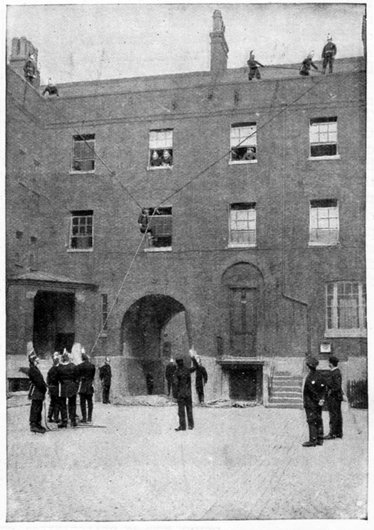
A PROMPT RESCUE—USING THE CHAIR KNOT.
There are many more like them, and if this gruesome illustration reminds our readers that our firemen are every bit as deserving of praise as Thomas Atkins or Jack Tar it will not have been published in vain.
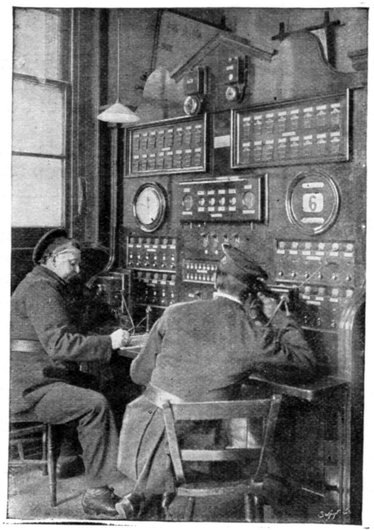
RECEIVING SUPERINTENDENTS' REPORTS.
Improvements are constantly being made in the apparatus of the brigade. There is a tendency to do away with the canvas shute once generally used on fire escapes. Commander Wells believes in ladders. He is striving to horse all escapes, an advantage which must strike the most casual observer of fire brigade work. At the present moment experiments are being made with telephonic street alarms. In the ordinary street alarm you smash the glass, press the button, which rings a bell in the nearest station, and wait till the engine comes. By the new plan it will be possible to speak directly through a telephone to the superintendent of the nearest station—an enormous advantage.
Needless to say the telegraphic and telephonic arrangements of the brigade are the most perfect in the world. One of our illustrations shows the gigantic switchboard, which directly connects the chief officer with the sixty odd stations situated all over London. The men at the tables are engaged in receiving the daily reports sent to the chief officer by the district superintendents.
The canteen van is now taken to every great fire. Formerly, when the men were working drenched to the skin for twelve or thirteen hours on end, they had no means of obtaining much-needed refreshment.
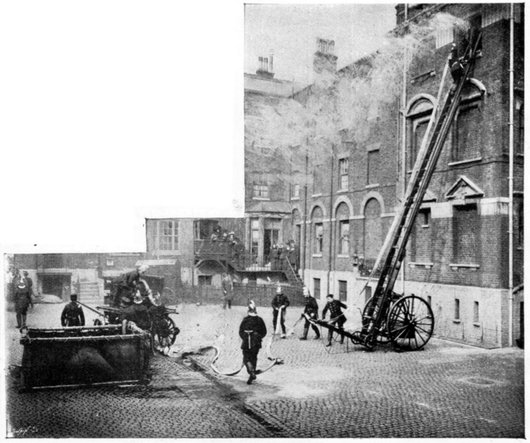
DUMMY FIRE AT HEADQUARTERS, WITH REAL SMOKE.
Commander Wells has altered all that. If the conflagration is one likely to keep the brigade going for some hours, the canteen takes up a convenient position and serves out hot cocoa or hot tea and other light refreshments.
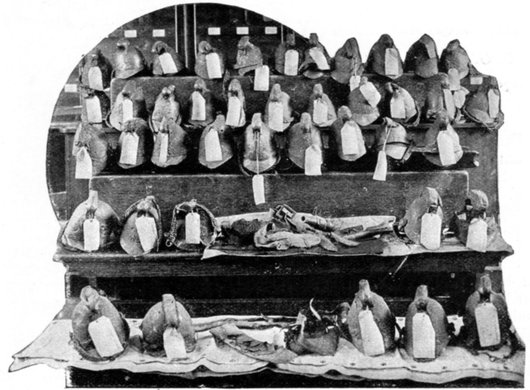
HELMETS OF FIRE BRIGADE HEROES
What a benefit this is only those who have been on fire duty know.
Much more might be said of this, the most interesting of our public services, but my space is limited. I have not even room to deal with the floating fire stations and engines on the River Thames, worthy in themselves of an article.
In conclusion, I may tell those who are fond of figures that there are in the service of the Metropolis 235 escapes, 59 steam fire engines, 70 manuals, 115 hose carts, 36 miles of hose, 8 steam tugs, 12 barges, 5 floating stations, 8 floating engines, 12 skiffs, 5 long fire ladders, 7 ladder vans, 156 watch boxes, 159 horses, 114 telephone lines between stations, 592 fire alarm call points, and a host of other apparatus too numerous to mention.
The two most powerful steamers have a capacity of 580 gallons per minute, the ordinary engines 360 gallons per minute.
The horses are the finest in the world, and, as most people know, they stand on duty ready harnessed. The weight of collar and harness is taken off the animals by means of a mechanical contrivance which swings upward immediately the alarm bell is rung.
In the superintendent's room there is a huge map of London. It is dotted with little spots coloured red, green, and blue. The red marks denote what are called by the brigade "working fires," i.e. where engines have been used. The green spots indicate small fires, and there are left a host of yellow marks—in some districts there are dozens within a few hundred yards of each other.
I regret to say that they represent "malicious false alarms." The punishment for wilfully playing a trick of this kind is a fine of £20 or three months' imprisonment.
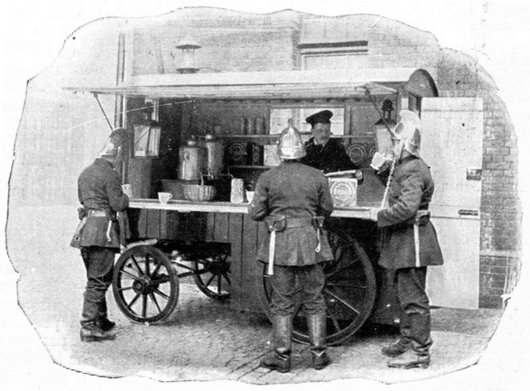
THE FIRE BRIGADE CANTEEN.