Volume 1 — GASCOYNE'S TERRIBLE REVENGE. A STORY OF THE INDIAN MUTINY.
Reading edition
By J. F. Cornish.
Illustrated by Vereker M. Hamilton, R.P.E.
Dinner was preparing in the camp under the toon-trees which covered the foot-hills of the Himalayas.
Here, where the northern edge of the Terai was beginning to become more alpine in its character, the camp was pitched on the fringe of the jungle. Below were magnificent forests of sal, sisoon, and toon-trees; above, pine, spruce, and oak trees proclaimed a more tempered climate.
The spot had been chosen as healthy, well supplied with water, and because the best shooting in the district was fairly accessible from it.
As the Colonel sat in his tent, he saw emerging from the belt of jungle below an extraordinary figure. He called to the Captain and Subaltern, and they watched it as it advanced towards them. The shikaris and native bearers also paused in their various duties, and jabbered among themselves, intent on the approach of the solitary man.
"No Nepaulese, that," asserted the Captain.
"It's a white man," said the Subaltern.
"Wait," said the Colonel.
The figure drew nearer, and at last came into full view. Clad in native dress, weatherbeaten, brown, and lean, with a snow-white beard that swept to his girdle, looking as like a native as a native could look, there was a certain indefinable something about him which told these Englishmen that a compatriot stood before them. Yet, when the Colonel greeted him and bade him welcome to the camp, he stared vacantly and absently at him and made no reply, but squatted gravely on the ground.
The Subaltern quietly mixed a stiff peg and handed it to the stranger, who shook his head; but the Subaltern persisted, and at length he took the glass, looked at it gravely a moment, and then put it to his lips—paused, and then, drinking the whole at a draught, gravely held out the glass to the Subaltern. As he did so, the sleeve of his dress shortened, and his wrist and part of his forearm were bared. The Colonel went to the man, seized the slowly retreating arm, and, pushing the sleeve farther back, showed the others a device tattooed thereon in red and blue. It was two roses intertwined, and underneath the motto, "Aucto splendore resurgo."
In great agitation the Colonel said, "What's your name, sir?"
The newcomer shook his head. But the Colonel, overcoming a passive resistance, dragged him to his feet, looked again at the device, and then closely scanned the face, on a level with his own. He turned pale under his bronze, dropped the hand he held, and turning to the two others, devoured with curiosity, said—
"It's Gascoyne, of the 53rd!"
Then the man, speaking for the first time, said quietly, "Yes, I am Gascoyne," and, so speaking, collapsed on the grass at the Colonel's feet. They took him up and carried him into the largest tent, and after some time, following on the ministrations of the Subaltern, who had been initiated into Red Cross ways, he opened his eyes with a weary sigh, but the dull light in them changed to one of bright recognition, and looking at the Colonel he said—
"Ewan Campbell?"
"That's right, old fellow," said the Colonel, "God bless you, that's right, and you—you're Philip Gascoyne of the 53rd; but don't speak; drink this and then go to sleep, and we'll talk in the morning."
And, like an obedient child, the wanderer did as he was bid, and the drink had been so cunningly medicated by the Subaltern that he slept all that night and through many hours of the next day, the camp being commanded to absolute silence by the Colonel, who meanwhile explained to his wondering companions that this man who had quietly wandered into their midst had, as all thought, perished in the Massacre at Cawnpore.
"But," added the Colonel, "if he wakes in his senses, we shall doubtless hear something strange. He and I were pretty close friends, and he was engaged to one of the sweetest girls.... She was butchered by the order of Nana Sahib."
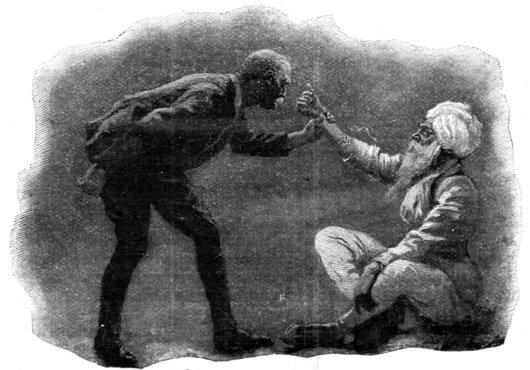
"HE SHOWED A DEVICE TATTOOED ON THE ARM IN RED AND BLUE."
At that moment the servant who had been left in charge of the recovered Gascoyne came up and told them that the Sahib was awake and was asking to see the Colonel. In a moment the three men stood by the side of the wanderer's bed.
"How are you now, Gascoyne?" said the Colonel. "Had a good sleep?"
Gascoyne's eyes turned inquiringly to the other two.
"We're shooting up here, you know," replied the Colonel to his look. "This is Cameron," indicating the Captain, "and Dogan of the 74th—so you're among friends, old fellow."
He smiled, and said quietly, "It is many years since I heard the voice of a friend," and held out his hand, which the Colonel took and pressed.
"I feel very feeble," he resumed.
"We'll doctor you up all right. Dogan knows all the rigs of the medicine man."
Gascoyne protested with a feeble shake of the head.
"No, no," he said, "my mission's ended—but thank God I've met you fellows before going out." He paused, and then went on again, "I have something to tell you; but first tell me, was any attempt made to find the devil who—who——"
"I know whom you mean," said the Colonel, "Nana Sahib, the man who gave orders for the massacre at Cawnpore. Yes, every effort was made, and a very large reward was offered, but I am sorry to say he was never captured, and his fate remains a mystery to this day."
"I can clear that mystery for you," said the sick man, smiling grimly; and then with many pauses he told his three wondering listeners the tale I here set down as the Captain told it me:—
"England need not waste another wish for vengeance," Gascoyne said, "I have taken it. Listen. I was amongst those who, wearied out with famine, fatigue, and wounds, trusted to Nana's oath, and embarked on the boats only to be treacherously fired on and brought back, such of us as survived, to face death, with no chance of showing fight, and after our suffering to die, shot down like dogs. I had been wounded in the neck, and, though the wound was slight, it bled profusely and I was covered with the crimson stain. You, Campbell, knew Miss Lindsay?" His voice broke, and the Colonel nodded with bright eyes, but in silence. "She had been among the unhappy ladies brought back, and all my fears and agony of mind on her account utterly outbalanced any consideration for myself.
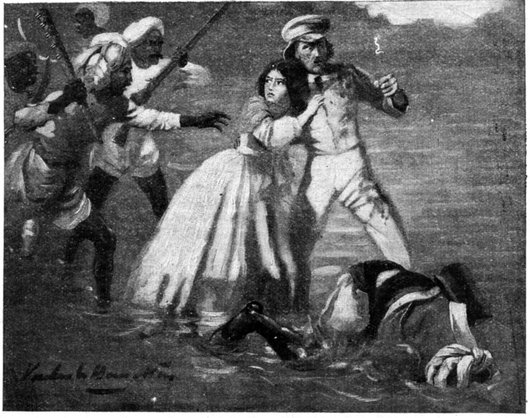
"NERVED WITH HATE AND PASSION, I STRUCK HIM UNDER THE EAR."
"Had all gone well, in a few short weeks we should have been married, but she was basely murdered in my very arms.
"After the fusillade which killed a number of people, our boat was the first to be brought back. As Miss Lindsay was stepping over the side she slipped and fell into the water. I sprang after to help her, when a ruffianly Sepoy seized her by the hair, which had become unfastened, and dragged her to her feet, and with a brutal laugh kissed her on the cheek. The laugh died on his lips, for, maddened by all that had occurred, and by this last outrage, I sprang upon him, and, nerved with hate and passion, struck him with all my force under the ear.
"He fell as if shot, face downward into the shallow water, and lay there dead. Miss Lindsay turned, threw her arms around me, and with a sob buried her face on my shoulder. But though I had avenged her momentarily, my triumph was short, for a fellow named Survur Khan, whose brother it was that I had killed, with a cry of rage struck Miss Lindsay on the head with a club he carried, smashing her skull and covering me with her blood and brains. It was horrible, horrible, and with the horror of it I must have lost consciousness, for I remember no more until I found myself seated on the ground with others. You know what happened. By Nana's orders, after a momentary respite, we were shot by the cowardly miscreants, who would have fled in terror from us, had we been unbound with weapons in our hands. But during that moment's pause I had been thinking, thinking, my heart seemed bursting in my body, my brain throbbed and reeled, my whole being was inflamed with the rage of anger and hatred that consumed me. Oh! if I were but free for a few moments to wreak a vengeance on these cowardly hounds, and die killing, killing.
"I resolved, if I could, to save my life, even at this moment, to live for vengeance. I watched every movement of our destroyers. I knew every dialect of the Indian language, and listened to every syllable they said. You know the story how, there and in cold blood, close to the well they shot us. At the instant the word of command was given, while the finger pressed the trigger, I sprang round and fell on my face unhurt. I feebly beat the ground with my feet, and then lay still.
"I heard groans, a few more shots, and then stillness. They came to me; one fellow turned me over and felt in my pockets. I had nothing; they tore open my shirt and took from my neck a light gold chain, with a locket containing Miss Lindsay's miniature. I would have given worlds to have jumped up, snatched the locket from him, and served him as I had served the butcher's brother; but I wanted a wider vengeance, and I restrained myself. To them I was dead. The fellow who had taken the locket kicked me disdainfully, and made a scurrilous remark about the Mem Sahib whose face he saw in it; but, even under that provocation, I was able to control myself.
"I knew, I felt, I should be able to take vengeance; how, I did not try to think, but I was certain of it; and I lay calm—calm as one who knows that nothing will stand between him and the desire of his heart. At length they went away and left us as we lay.
"That night, when all was still, and I only heard the howlings of the jackals without the walls, I began to think it time to make a move. I had lain for hours in the terrible sun—my limbs were racked by an agonising cramp, a maddening thirst parched my throat and vitals, my lips and tongue were baked and cracked, and my first movement gave me pain unspeakable; then as I moved again I heard a stealthy step, and a voice said very softly—
"'Is any Sahib or Mem Sahib alive?'
"I lay still. I knew the infernal treachery of these demons only too well, and gave no sign. In another moment I felt a hand on my breast. I controlled myself, I held my breath, but I could not still the beating of my heart. A voice whispered, as if of a person talking to himself—
"'This poor Sahib lives.'
"Then my head was raised, and in spite of my clenched teeth a few drops of some stimulant was forced into my mouth—which, cracked and parched, tasted nothing—I only felt the burning sensation of some powerful spirit.
"'Drink, sir,' said the voice; 'I am your friend; it will restore your strength.'
"I ventured to open my eyes. I saw bending over me a venerable form, and the face of a Brahmin I had seen before.
"'Do not fear, sir; I am Nanukchund; I have no part with these murderous men. But let us not talk; I will take you and hide you if it is possible that you can walk, but we must not be seen.'
"The thought of the possibility of living for the vengeance which had kept me alive through the horrors of that day nerved me afresh; the cramping pains that shot agony through my frame were forgotten; I almost stood upright, but Nanukchund pulled me down.
"'In the name of Budda, caution,' he whispered; 'there may be some who look; if I am seen it will be thought (and he shuddered) that I plunder the dead; but if you, then death will come for both. See, I go to the shadow of yonder house; lie still for a moment, and then crawl like the snake until you reach it; but first drink.'
"I drank, and the fire ran through my veins, and renewed my strength. He, looking to the right and to the left and crouching, soon gained the shadow he had indicated. After the lapse of what seemed an age, I began to crawl thither too, with pain and difficulty indescribable. At length I stood beside my rescuer.
"'Not yet are you safe,' said he, and from underneath his garments he produced a bundle. 'Put on this.' I unfolded it, and found a garment similar to his own, with cloth for a turban.
"In a few moments I had become a native. The bronze of my face, with added dust and blood, made my complexion dark as his own. In a few words I told him I was Captain Gascoyne of the 53rd.
"'Then,' said he, quickly, 'you can speak as one of us, and none can know any difference.' From that moment, except on three occasions, I have spoken no English until now.
"Proceeding with infinite caution, once or twice scanned by straggling mutineers, all of whom were more or less under the influence of bhang, we at length reached his house, a secluded one by the river. There for some days I lay in a stupor of sleep, yet with the one idea of vengeance running like a dark thread through my slumbers, in which I saw again my poor girl's fair hair clotted with blood, and felt it clinging round my neck and face.
"When my weary limbs and brain were rested, I was able to talk to Nanukchund, my preserver. He told me much that of course you know—of the outbreak, of the excesses of the mutineers, which he deplored, for he knew how the reckoning would be, and that he was the friend of the Sahibs, and after we had been shot down, came to see if life remained in any of us.
"He was a far-sighted man, and he knew that the yoke these fiends were trying to throw off would be only the more strongly riveted round their necks, and he knew that the English raj was more wise, more just and merciful, than the divided tyrannies of their own Princes. One day he came to the room where I lay, and, with tears running down his face, told me with terror, lest I should rise up and slay him because of his kinship with such demons, of the massacre of the women and children by the order of the bastard Raja of Bithoor, Nana Sahib—how the Sepoys, commanded to shoot them, thrust their guns through the windows, and fired a volley over their heads, and then, sickened of the horror, refused to have anything more to do with it; and no one at first could be found to carry out the brute's orders, until at last Survur Khan, the butcher—the same who had killed my little Madge—volunteered for the murderous job. Then another monster was found, and with swords they went into the slaughter pen, Survur coming out to replace one sword he had broken, by another."
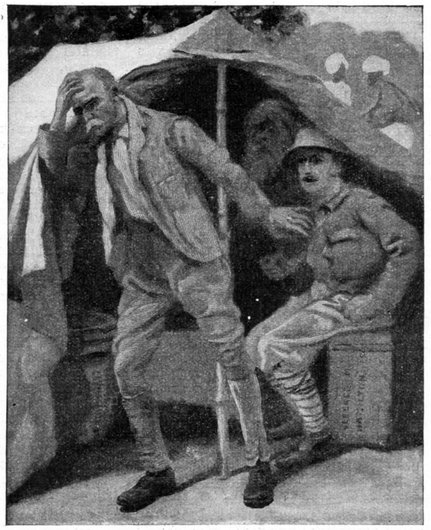
"THE COLONEL CRIED OUT, 'FOR GOD'S SAKE, STOP.'"
At this point of Gascoyne's narrative, so the Captain told me, the Colonel cried out, "For God's sake, stop," and got up and went out of the tent, and Gascoyne said—
"Yes, I remember; he lost a wife and a little girl there."
And then the Captain and the Subaltern understood the Colonel's silence generally, and his fierce anger when he did speak of those days.
It was the next day before Gascoyne resumed his story.
"After Nanukchund's story," he went on, "a dull feeling of hatred, mingled with my purpose of vengeance, took possession of me; and though I loathed the sight of a black face, I found myself under the necessity of assuming one myself. With great care I stained myself all over, and at length both Nanukchund and I were satisfied that my disguise was perfect.
"Some of our men had spent months among the natives undetected; and my own perfect knowledge of the languages spoken in the Gangetic districts, and of the habits and customs of the people, rendered me secure. To Nanukchund I said nothing of my project. So far as he knew, I was only going to join my countrymen where-ever I could find them in force. I said good-bye to him, and promised, when things were settled, he should be gratefully remembered, and I gave him a letter that should have insured his safety in case our people laid hands on him. The next day I was one amongst the ruffians who had butchered my comrades and my countrywomen. That very night I had a chance of killing Survur Khan the butcher. I found him drunk in the doorway of a deserted house. No one was near. I dragged him inside. He laid like a log on the floor. I stood over him, and was about to plunge my knife into his heart, but I reflected.
"He would die insensible to his end; he would not know why he died. So I altered my mind, and on his forehead I made two deep incisions in the form of a cross. The brute moved and groaned, but he was too far under the influence of bhang to be conscious. When I next saw him, although the wound was covered by his turban, I knew by the look in his eyes there was a terror in his heart, which would remain with him until his hour came. The next day Nana retreated on Bithoor, accompanied by the Begum. Then after Futtehpore he retreated with about 3,000 followers into Nepaul, whither I accompanied him."
"From this," said the Colonel, "nothing certain of him was known."
"You shall hear now," said Gascoyne, and continued—
"From the first, dissensions and quarrels arose, which, with desertions, soon reduced their followers to half their number. With the remainder, for nearly two years Nana lived like an outlaw, moving from place to place, his followers slowly diminishing in numbers, from desertion and deaths, disease and hunger, for provisions were terribly scarce and dear. Nana and the Begum were both carried, whenever a move was made, in dhoolies, but now it began to be difficult to find bearers; and here my great opportunity opened for me.
"With the money supplied to me by Nanukchund I paid certain of the ablest-bodied bearers to become my servants. These I humbly placed at the Rajah's disposal. With gratitude he accepted my offer, for he looked with the anticipation of terror toward the time when he might be compelled to walk, for his obesity was now so great, as also was the Begum's, and his Oriental hatred of exertion was so pronounced, that death would almost be preferable. I kept my bearers fed and ready at his will, and I became his favoured slave, but I laughed in my heart, for I was preparing his sacrifice.
"After another year of wandering, the word spread of a great reward offered by the English Government for the Nana, dead or alive, also of pardon for all not actually guilty of murder. Then a conspiracy among the hundred or so followers left was set on foot to earn the reward, but, still determined to feed my unsatisfied vengeance, I betrayed it to the Rajah, and, heading those who were still faithful to him, I fell on the conspirators the night before their projected outbreak, and slaughtered them to a man; and no word can paint the fierce joy I felt as my sword found its sheath in the hearts of the murderous villains. Our numbers now scarcely reached 50, amongst whom was Survur Khan. This man's life had now become a terror to him. I haunted his sleeping and his waking hours. I always made him feel that Nemesis hovered near. He had long ago found that I knew of the scar on his forehead.
"'How comes it, brother,' I had asked him, 'that you have the sign of the Christian on your forehead?'
"At first he eyed me askance, and was surly; then, after, he told me how, waking from his orgie, he had found himself thus marked. I said, 'Then surely some accursed Feringhee has marked you, that he may know you again one day.'
"'Nay,' he answered, 'that cannot be, for none were left alive in Cawnpore at the time.'
"'No, nor any women or children, as you know. See!' I cried, thrusting back his turban, 'See! thy scar is white and livid! It is some god of the Feringhees who has marked thee for his vengeance.'
"Thereafter his life was hell. And so we wandered again—how long I cannot tell—months, years—I don't know—until at last there were left, besides the Nana and the Begum, only three or four more who performed menial offices, and myself. Then a tiger killed two of these, and the other two ran away.
"For me, I had become lean and burnt to almost Indian blackness. They did not suspect me. I had carefully kept my weapons in order, and I was now master of the situation.
"One night, after the last two men had gone, Nana, whose inability to walk had become a real terror, told us we must remain in the clearing by the river bank where we were, and there live.
"That night, while they slept, I waked, and without awakening them I bound them all, so that when they woke they would be unable to move more than a hand. Then I went to the river and cleansed myself as thoroughly as I could, and, secure in my preparations, lay down and slept soundly. Shortly after, I heard Nana's voice calling me. I rose, and my eye fell on Survur Khan. He knew his hour had come; he was livid with fear; he did not know who had bound him—he only knew he was unable to move. He saw me—he saw the expression in my eyes—it was enough. Then I passed to where the Nana and Begum lay. He demanded what this meant.
"'Get up,' I said, 'and you shall know.'
"Shaking with fear, the Begum stood upright. I led them to the opening. When they saw Survur Khan they turned ashen grey.
"'See,' I cried in English, 'you three, I am an English officer. All this time I have followed you, helped you, fed you, shielded you in danger, that I might avenge on you the murder of the woman I loved, and of my countrywomen, with my own hand. Look,' I cried, tearing off Survur Khan's head covering, 'ask him where he got that scar. He does not know, but I can tell you. I found him drunk and could have killed him, but I put my mark on him instead. Directly, you shall see what I have saved him for. I was one of those whom you shot down after you took us from the boats, but I feigned death and escaped.'
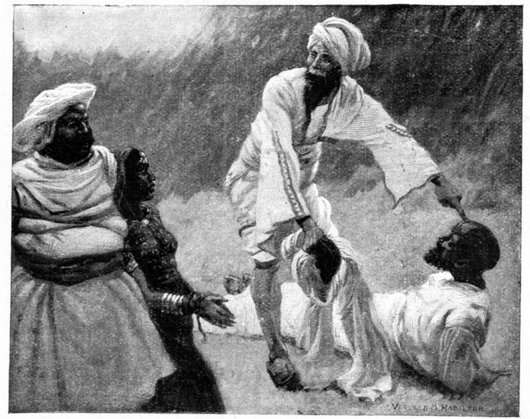
"'LOOK,' I CRIED, TEARING OFF HIS HEAD COVERING, 'ASK HIM WHERE HE GOT THAT SCAR.'"
"The fear of death was on them all. The Begum and Nana grovelled at my feet; they offered me countless gems, they would tell me where they were hidden, if I would but let them live—only spare their lives. I could not mean to kill them in cold blood—I was an Englishman.
"I let them go on until they had exhausted themselves with cries and tears and entreaties, and then I said, 'I do not mean to kill you yet, but that you may feel certain of your end, see this man die. He dashed out the brains of my lover while she lay in my arms. The death he gave her is now meted out to himself.'
"Survur Khan was now a shaking jelly of fear. I went to him, and, with a mace I had always carried, struck him full and fair on the scar. So perished the butcher of our sisters.
"Then commenced the penance of the other two. To walk a hundred yards was pain and misery to them, but for two hours I made them walk; when they would have stayed, a prick from the point of my knife urged them on, and groaning and stumbling they went forward.
"That evening when I drove them back to the little clearing they knew what hunger, thirst, and fatigue were. Their clothes were already in rags, their feet bleeding and sore.
"The corpse of Survur Khan lay there. The crows had been busy on it.
"'Look,' I cried; 'as his fate was, so shall yours be.'
"They groaned, and falling on the ground lay there stunned with the horror of their situation.
"'Henceforth you are my slaves,' I continued. 'Get up and throw that fellow into the river.' They hesitated, but the point of the knife persuaded them, and they in shuddering disgust did as I commanded.
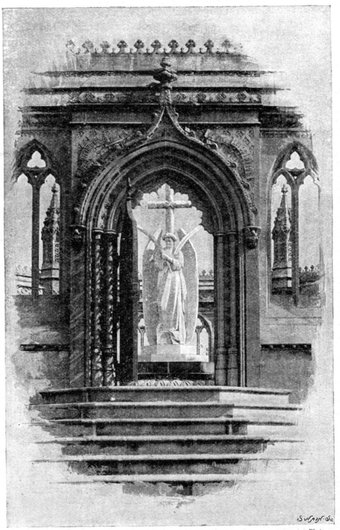
Frith & Co. Photo
THE MONUMENT OVER THE CAWNPORE WELL.
(This was the well into which the bodies of the massacred women and children were thrown.)
"Then I fed them sparingly with rice and water, and the next day they recommenced their pilgrimage. In spite of their cries and groans I drove them like cattle.
"Day after day, month after month, I drove them until they were reduced to the shadows of what they were, and then I began to think it time they died. I was aweary of my own vengeance.
"Long before, I had found a young panther cub. As it grew it evinced a strange love for me. No dog that ever attached itself to a man could have been more absolutely devoted to him than the panther to me. In proportion as it loved me, so it hated my victims. In all our trampings it followed at my heels. At night I had to fasten it up, or it would have forestalled me.
"Now I began to brood what should be their end.
"I hesitated, and for a time almost wavered. After all, the Begum was a woman, and I could not kill a woman, though both she and the other had entreated me to do so a hundred times, for the fatigue and hunger and sleeplessness I subjected them to had made such a horror of their lives, that, curs as they were, death seemed preferable. Moreover I never ceased to remind them of their hellish deeds, and I embittered their every hour by recalling to them how I had waited for those hours, and of their certain deaths.
"While I hesitated, his master the devil put it into the Nana's head to help me. He saw and divined my hesitation.
"One day he stood before me, gaunt and starving.
"'You cannot kill her,' he said.
"'No,' I replied, 'she is a woman.'
"A hideous sneer made his gaunt jaws horrible.
"'I will kill her if you will let me go.'
"There he was, devil to the last. He trembled with the eagerness of anticipated freedom.
"'Go,' I said. He hesitated, but my look was firm, and he went.
"Once or twice since their fat was gone they had attempted to escape, but the last time I lashed the man unmercifully, and said if they tried to escape again I would let the panther deal with them. That cowed them thoroughly, and thenceforward they hung on every glance of my eye.
"But their enforced marchings were no longer such a terror as they had been, and I determined to make an end. But while I thought of it he came before me again.
"'Master,' he said, 'let me kill her; give me my life for hers.'
"I did not reply, neither did my glance forbid him. I could only think of Margaret, with the blood on her fair hair. I turned from him without a word.
"'Master,' he said again, 'will you set me free if I do?'
"He turned and left me. I sat on the river bank and waited. In half an hour he returned and said—
"'Master, come and see.' And I followed him to a small open space in the jungle. What had been the Begum, lay there cold and still. The arch-villain had strangled her.
"I made a sign to the panther. With a bound he was on him; and the head that had conceived the horrors of Cawnpore cracked between the panther's teeth. My vengeance was complete.
"After that, it seems, I must have wandered for years, until you found me. I remember nothing, except that the panther was always with me."
When he had finished his story he lay back and closed his eyes, and then sank into a stupor. From this all the Subaltern's medicinal arts could not rouse him.
The next day at dawn he cried out, and they all ran to him.
"Carry me to the jungle edge," he said, "the end has come."
They carried him, and laid him on a mattress, for he could not stand.
Then he raised his voice in a shrill and piercing cry, that echoed through the jungle.
A dead silence followed.
Then again, as if in an expiring effort, he raised another cry, louder and shriller, and more prolonged than the other.
Then, far off in the gloomy depths of the jungle, a dull muffled roar responded.
They waited, and once again Gascoyne sent up the cry.
Then the leaves of the jungle parted, and a panther, black and mangy, but with the fierce light still alive in the topaz eyes, bounded to the side of the recumbent figure, and began to lick its face, snarling at the three men.
Gascoyne lifted his hand, and the great beast crouched beside him. And so the group remained while a man might have counted twenty. Then Gascoyne raised himself, and stretched out his arms, as if to someone at the foot of his couch, "Madge, Madge," he cried hoarsely, "I am coming," and so fell back and moved no more.
They buried him that evening with the panther, which they had been compelled to shoot.
It was very old, its teeth and claws were worn to stumps; and how they had lived together, and whether the beast had hunted for the man, or the man for the beast, none ever knew.
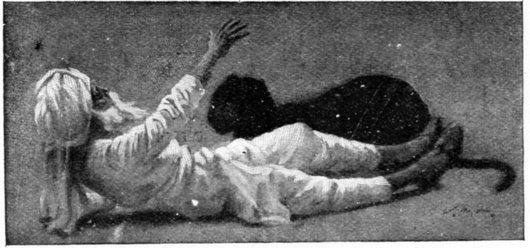
"GASCOYNE LIFTED HIS HAND, AND THE GREAT BEAST CROUCHED BESIDE HIM."