Volume 1 — HOW THE MINISTER'S NOTES WERE RECOVERED. THE STORY OF A BIT OF DIPLOMACY.
Reading edition
By Beatrice Heron-Maxwell.
Illustrated by Fred Pegram.
"It is like this, Frederic," said the United States Minister, button-holing Sir Frederic Rawnsley, and leading him to a deserted cosy-corner, "I am in a nasty hole! It must not be known, of course, but a slip of paper containing some important notes has got lost, and I have a horrible misgiving that it may have slipped inside the despatch we have just sent to Lord Westfaling. It won't do to ask, because it will only ensure their attention being attracted to it if it's there, and will betray our own laxity if it's not. Yet it must be found. What would you do?"
Sir Frederic thought for a moment; under his trivial exterior were some brains, as the Minister knew well.
"I should place the whole matter in the hands of Berend," he said, decisively.
The Minister looked dissatisfied.
"A mere lad, and quite raw," he said; "he has only been with us two days."
"I knew his father," continued Sir Frederic; "one of the cleverest Secretaries who ever handled a Legation. He would have made his mark if he had not died too soon. This boy is exactly like him. I fancy he will do well."
Some guests were entering: a private discussion was no longer possible. The American Minister wandered away, still dissatisfied and irresolute.
Half an hour later he crossed the ballroom, with the young attaché at his heels, and made his way to a girl in white, who was the centre of attraction there.
"You are interested in diplomacy, Lady Anstiss," he said; "may I present to you our latest arrival, Mr. Julius Berend?—Lady Anstiss Carlyon."
The girl raised a pair of lovely, indifferent eyes, and bowed; the Minister moved away as though the introduction were a matter of casual insignificance.
A few steps further on he stopped and glanced back.
Mr. Berend, his face devoid of expression, though he had just been introduced to the most beautiful girl in Brussels, was looking down silently.
Lady Anstiss, her shoulder turned to him, was bestowing her slow, sweet smile, the smile that had already made her famous as a beauty, on someone in the distance.
"What stage of acquaintanceship must one reach," he said, gravely, "before being promoted to the honour of a smile from Lady Anstiss Carlyon?"
She looked a little annoyed.
"Some people never reach it," she answered; "the majority in fact. I reserve it for my personal friends—and they are few."
"I am glad to hear it," said Mr. Berend. "I hate majorities: to escape from them is something worth striving for. To me a barrier of any sort is delightful; it arouses a corresponding amount of energy; and indolence is my detestation and my failing at the same time."
Lady Anstiss made a little gesture of impatience. This sententious boy was going to be a bore, and to give her the trouble of crushing him. Her programme, dangling from her fan, attracted his attention; he raised it and took the pencil, saying, "May I have the pleasure? Which dance?"
There were still two vacant places on the card; Lady Anstiss did not intend them for a chance-comer.
"I am sorry——" she began; but quite courteously he interrupted her.
"I should have preferred a waltz," he said; "but I am fortunate to find you disengaged at all," and wrote his name down.
Lady Anstiss looked at him critically as he did so.
A young man of middle height, with a graceful figure, and a face that might be called blameless, so inoffensive were the features and colouring. Fair, youthful-looking, with an air of mild freshness about it that seemed peculiarly unsuited to his profession. A partner claimed Lady Anstiss before she had made up her mind precisely how to subdue this apparently unconscious offender.
"Lord Westfaling is still away, and can't have had your despatch yet; so if Berend can get round Lady Anstiss," said Sir Frederic Rawnsley, with oracular significance, a little later, "the thing might be worked somehow."
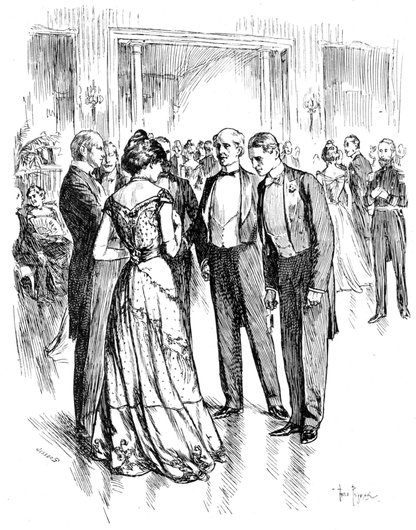
'YOU ARE INTERESTED IN DIPLOMACY, LADY ANSTISS. MAY I PRESENT TO YOU OUR LATEST ARRIVAL?' SAID THE AMERICAN MINISTER.
The American Minister shook his head.
"If!" he repeated. "There is a very wide margin for probability, I am afraid."
"I don't know," replied Sir Frederic. "Women move the levers nowadays, though men make 'em. Westfaling gives in to her in everything. If she so insisted on his retiring from political life to-morrow, he would do it."
Nevertheless, and in spite also of the fact that Lady Anstiss was dancing for the second time that night with Mr. Berend, the Minister still felt as hopeless at the conclusion of the Diplomatic Ball as he had at its commencement.
The day following the ball happened to be the occasion of a weekly reception at Lord Westfaling's, where the part of hostess was played by his only daughter, Lady Anstiss Carlyon. She was at home from four to seven, and it was as the clock struck the former hour that her first visitor was announced—Mr. Julius Berend.
She had parted from him the night before still undecided as to the precise nature and extent of his offence, and the precise measure of punishment. His presumption appeared to be involuntary, as in the case of his calling so early—a privilege he ought to have hesitated to take.
She greeted him with the faintest perceptible effort of memory, as though she hardly recalled who Mr. Julius Berend was; but he was so little disconcerted that the reproof was wasted, and he took the chair nearest to her, which was unnecessary. She felt, in the few moments' conversation that ensued, as though she were a skilled fencer foiling the aimless thrusts of a tyro who did not know he was fencing.
Presently she handed him some tea, and in accepting it he calmly detained her fingers with his left hand.
"Pardon me," he said, "is that a genuine scarabæus in your ring? If so, it is a very perfect specimen."
"My father gave it to me," she said, coldly, "and he believes it to be a real one, but I cannot answer for its genuineness."
She attempted to withdraw her fingers; really, this young man was impossible.
But he still held them with firm gentleness, and having placed his cup of tea on a table, he now ventured to touch the ring with his right forefinger.
"Singular!" he said. "I thought I knew the genus scarabæus fairly well, but I do not remember seeing an intaglio quite like this before. May I——" He was about to draw the ring off.
"I would rather not," Lady Anstiss said, hastily, while his audacity brought the slightest addition of rose-flush to her cheek. "My father placed the ring there himself on my last birthday."
Again she strove to release her hand, and her eyes—grey eyes, with depths of violet in them—darkened with surprised vexation.
This young man seemed incapable of appreciating his own transcendent presumption. He was still replacing the ring, when the door, opening wide and swiftly, disclosed another visitor.
"Lady Lomond!" announced the footman; and a Scotchwoman, of ready eye and potent tongue, entered. The hand of Lady Anstiss was her own again simultaneously; but she rose to greet the newcomer with an uncomfortable sensation of having been caught and compromised.
Her hope that the situation had escaped Lady Lomond's notice was shattered with the first words.
"Palmistry?" inquired that lady, briefly, with a glance at Mr. Berend.
Lady Anstiss smiled with outward composure, but with inward rage.
"Oh, no!" she said; "this is Mr. Berend, who is learned in Egyptian lore, and doubts the quality of my scarabæus."
But even as she said it, she rebelled against all that her words must imply.
It would seem to Mr. Berend that she was acknowledging his right to have held her hand, to have behaved in fact unpardonably; that she was mitigating, explaining, condoning the offence all in one breath, and leaguing herself, as it were, with him against any insinuations that Lady Lomond might make.
Whether Mr. Berend perceived the situation or not it was impossible to tell.
He handed some tea to Lady Lomond, made one of his subtly inane remarks, and took his leave, saying, as he bowed over Lady Anstiss's hand, which he pressed more closely than the farewell warranted—
"I should like to feel quite certain about that scarabæus. Perhaps you will let me examine it again at leisure another day; it is exceedingly interesting to me."
And under the watchful eyes of the most ruthless scandal-promoter in Brussels, Lady Anstiss was obliged to assent, to appear quite friendly and at ease with him, when all the time she felt every word he uttered as a fresh provocation.
"Quite new, is he not?" said Lady Lomond; "that is, out here, I mean. An old friend of yours, no doubt?" Which was embarrassing when Lady Anstiss was secretly making up her mind to cut him dead from that moment.
The door reopened before she answered, and Mr. Berend was back again.
"I forgot," he said, "I am the bearer of a message to Lord Westfaling. Might I give it to him personally?"
"My father is away for three days," replied Lady Anstiss; "I thought General Standish was aware of that."
She intended a reproof, and this time Mr. Berend did not ignore it.
"Quite so," he answered; "my message was not from my chief; it was of a more private nature. Perhaps I might be permitted to have Lord Westfaling's address, or if I might send a note here could it be forwarded?"
"We are not forwarding any letters to him this time; they would only have missed him, perhaps," she answered, "but if you write here he will receive it on arrival."
"Thanks," said Mr. Berend, laconically, and took his final departure.
For thirty-six hours Lady Anstiss did not see him again, and during that period, in the intervals between her social distractions, the thought of him recurred so often that at last she positively wished to see him. She intended to show him plainly that he had transgressed, that she was not to be approached in the easy fashion he had adopted, and that the idea of friendship between them was quite out of the question.
She meant, in fact, to snub him as never had any young rising diplomat been snubbed before.
Armed with these pleasant resolutions, she felt really gratified when, at a dinner to which she had gone under Lady Lomond's chaperonage, she found that Mr. Berend was sitting on her left hand.
She was fully prepared for any advances he might make, and it took her some time to realise that he was evidently not going to make any at all.
He acknowledged her presence with polite gravity, and thereafter devoted himself to the lady on his other side, taking part also in the general conversation at table, and taking it well, but never once addressing a remark to Lady Anstiss.
She found herself listening to his conversation, acknowledging with unwillingness that it was clever, and betrayed no immaturity such as his face suggested; finally she began to feel piqued that he should ignore her, and to think that if Lady Lomond noticed it, that good lady would be sure to weave a new romance from his conduct.
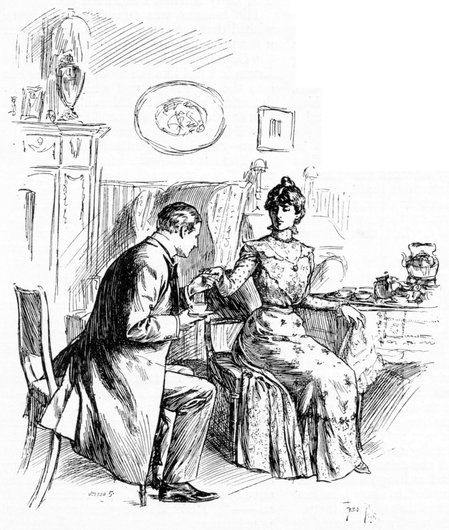
"HE CALMLY DETAINED HER FINGERS WITH HIS LEFT HAND."
After dinner the same thing occurred. Mr. Berend, without seeming to do so in any marked manner, contrived to avoid her, and, strange to say, this chafed her, although she was surrounded all the evening by other men.
It vexed her, too, that Mr. Berend should appear to be concentrating himself on Lady Lomond, and Lady Anstiss wondered that he should be content to listen to such lengthy discourse from a woman who was nothing if she was not gossiping.
She felt a sort of relief when at last the moment for departure came, and, passing Mr. Berend with the slightest bow as he held the door open, swept downstairs in a less equable frame of mind than was her wont. To her surprise, when she followed Lady Lomond down the steps to the carriage, Mr. Berend, running lightly after them, jumped in too.
"I asked Mr. Berend to come with us," said Lady Lomond, "because if you do not mind I should like you to drive me home first, and I thought he could then escort you on to the Rue de la Place." The smile which accompanied this remark conveyed that she thought she had done a very clever and acceptable thing in giving these two an opportunity for a tête-à-tête.
"Thanks," responded Lady Anstiss, stiffly, "but I am afraid that will be taking Mr. Berend quite out of his way; and I am accustomed to drive alone often."
The matter, however, appeared to be settled, and she could only invoke silent anathemas on Lady Lomond's head for her officiousness, and determine that she would match Mr. Berend in behaviour, and would ignore him even when they were left to each other's society. But she reckoned without her host.
For, the moment after Lady Lomond had entered her own house and the carriage had started again, Mr. Berend, calmly taking the vacant place beside Lady Anstiss, said in an earnest tone, quite different from his usual one—
"I have longed for and yet dreaded this moment. Lady Anstiss, I felt to-night that there was only one subject I could speak to you about, and that I did not care to touch on it in the presence of others. It is a matter of indifference to you, but to me it is not only a serious one—it is a very distressing one."
He paused; and she tried to remember some of the chill and cutting remarks with which she had intended to show him how great was the distance that divided them.
But she had been wholly unprepared for this new method of advance, and, as only irrelevant replies occurred to her, she contented herself with silence.
"I am going away," he continued, "to-morrow."
"Going away," she echoed, involuntarily; "you have only just come. How is that?"
"I have pledged myself to fulfil a certain task in a certain space of time; the time ends to-morrow morning, and the task is uncompleted. Therefore I shall leave Brussels in the afternoon. Failure is quite as insupportable to me as to those above me. But I should not mind it so much if it were not for two things."
Again he paused, and again she was silent. They were nearing the Rue de la Place now; he knew that a few moments more only remained to him.
"You do not ask what they are," he said, with reproach, "and you will probably add it to my other iniquities if I tell you. Yet, Lady Anstiss, I must tell you."
His manner was strangely eager; she wished that she could feel more annoyed at it than she did.
"One reason is because when I leave Brussels I feel like the moth who goes out into the dark night and who longs to be fluttering his wings still round the light that dazzled him, that would have scorched him if he could have reached it. And the other—may I tell you the other?"
"You have not waited for my permission so far," she answered, half petulantly, half relentingly.
"There is no time to wait," he said; "the other is that I have added to my failure an unnecessary piece of stupidity which I deplore, and which is all the more aggravating because it is not yet irretrievable."
"What do you mean, Mr. Berend?" Her voice sounded softened even to herself; yet she had not quite intended it.
"I mean that it is in your power to do me an inestimable service; to soften my disgrace, and give me, in fact, another chance with the powers that be. I wrote a note—the note of which I spoke to you—to your father, on a private matter; and at the same time I was copying an important and strictly private paper for my chief. An important and strictly private paper is now missing, and the question is, could it by any carelessness have been placed in the envelope directed to Lord Westfaling. If so——" He made an expressive gesture of hopelessness.
"But what can I do?" She looked at him in real astonishment. This strange young man had the faculty of exciting interest, certainly, as well as displeasure.
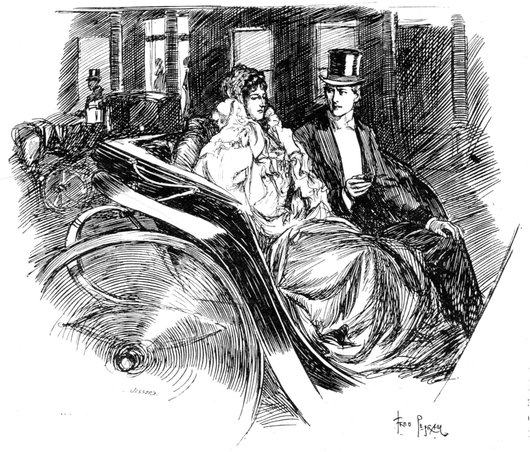
"'IT IS IN YOUR POWER TO SOFTEN MY DISGRACE.'"
"You can allow me to open my own letter—in your presence—to seal it up again, after taking out the accidental enclosure if it is there, and so to retrieve what will otherwise be a very disastrous piece of bad luck."
"I do not see how it would be possible for me to do this," she said, after a moment's thought; "my father returns at ten to-morrow; I should find it difficult to explain it to him, to give him a sufficient reason for having ventured to interfere with his letters."
"If you would allow me to call and say good-bye to you at a quarter to ten," he pleaded, "in any case it would be a favour that I should prize immensely, and it is the last I shall ever ask of you."
It was extraordinary! This was in reality only the third time she had seen him, yet he was speaking to her with all the force and fervour of a long-tried lover.
And the amazement she felt at him was equalled by that which she felt at herself; for, to her own surprise, she was neither indifferent nor resentful. There was a magnetic force about him which carried all before it. They had turned into the Rue de la Place; a moment more and they must part.
"A mere formal visit of farewell," Mr. Berend urged. "Lady Anstiss, you do not know what it means to me, or you would not hesitate. It is not only my career—it is my life!"
The carriage had stopped—the footman had opened the door; before she had time to answer, Mr. Berend had descended and was handing her out.
"Then I will call shortly before ten to-morrow," he said, in a clear voice, "to see if you have any messages for England. Good night, Lady Anstiss."
He was away up the street, and she was in her own boudoir before she realised that she had tacitly granted his request.
And the feeling of annoyance with him that had been hers a few hours before was gone; in its place was one of pity for this daring young man whose essay in diplomacy had come to an untimely end.
He was of course nothing—less than nothing to her, but it would seem too unkind to refuse to see him in the morning.
She went to sleep at last, still undecided as to what she would or would not do.
But Mr. Julius Berend was troubled by no misgivings, and when he presented himself at a quarter to ten the next morning, a flicker of satisfaction tempered the pensive sadness of his gaze.
She was in the garden, and as he stepped out through the French windows towards her he thought—as he had thought on the night of his introduction to her—that for such a face as this, and such a smile, he would go to the end of the world.
And she? A grave sweetness had taken the place of her former manner to him, and she said, after giving him her hand, "Mr. Berend, I have been thinking over what you asked me, and—I think I can make it right with my father. You will promise me, of course, not to take anything out of the letter that ought to remain there?"
"I promise," he answered, quietly.
They went into the library together, and she brought him the tray of letters that were awaiting Lord Westfaling's arrival.
He drew a long envelope from his pocket, an official one, already addressed to Lord Westfaling.
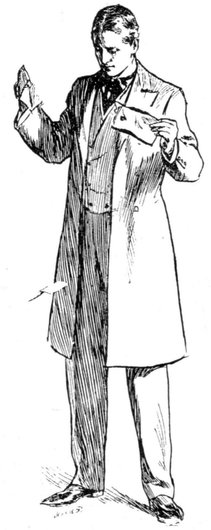
"A LOOSE PAPER FLUTTERED TO THE FLOOR."
"It matches this," he said, "the one I want to open."
There were two similar envelopes amongst the pile of correspondence. He selected one, opened it, and, taking out the contents, shook them, stooped to pick up a loose paper that fluttered from them to the floor, and then placed them in the fresh envelope he had brought.
"May I seal this?" he asked. He had brought an official seal with him.
She brought him sealing wax and taper.
"Thanks," he said, when this was finished. "The paper was there, as I thought. I am glad to have retrieved it."
He folded it up, and put it, with the old envelope, into his pocket.
"Good-bye." He was holding out his hand to her quite coolly.
She felt hurt, disappointed. She would have deprecated his gratitude for the service she had rendered him, but the absence of its expression chilled her.
"Good-bye." She gave him her hand.
He clasped it for an instant, then raised it, saying, "We did not settle the vexed question of the ring. I am inclined, now I see it again, to think it is a genuine old scarabæus."
A sudden access of shyness, strange and new, came to her. The coldness of his voice did not match the warm clasp of his hand, the nearness of his approach.
She felt that the colour was mounting to her cheeks, and turned her face aside to hide it. And the next instant she felt the touch of his lips on her hair just where it swept away from her white neck.
"Mr. Berend!" she said, breathlessly, and would have started away, but he still held her hand.
"You can either never forgive me," he said, quickly, "or you must do so fully and freely. There can be no half measures between us any longer."
She was speechless; a storm of mixed feelings possessed her.
"I set myself to win you from the first moment that I saw you," he continued, impetuously. "The other task was nothing. I determined it should be both or neither with me. The failure that I spoke of to you last night is redeemed, and I am no longer under a cloud. It was a question of my word, and I have kept it. But for you I should not have done so. My fate is in your hands entirely."
Still no answer.
He drew her a little closer. "I have seen you four times," he went on, "and each time I have said to myself, 'There is only one woman in the world for me, and she is so sweet and lovely and perfect, that I dare only say good-bye to her—unless she tells me to stay.' Anstiss, good-bye!"
There was a stir in the house, and steps approaching in the hall. Lord Westfaling had returned, and was coming to the library. Mr. Berend released the hand he held, and Lady Anstiss turned in confusion to greet her father at the door.
"This is Mr. Berend, of the United States Embassy, father," she said. "He has brought a letter for you. It is there amongst your other ones."
She could not look at him; she was still in a tumult of indecision. Mr. Julius Berend had shaken hands with her father, apologising for his early call, and was saying to her—
"I am going to town this afternoon on business. May I call again at a more opportune moment on my return?"
She lifted her eyes to his, and he saw that he had won her.
"Yes," she said, simply; and with a bow he was gone.
"A nice-looking young fellow," commented her father, leisurely turning over his letters. "Son of Max Berend, I suppose. Very clever and smart, I am told."
"I told you you could not do better than pin your faith on Berend," said Sir Frederic Rawnsley to the United States Minister, a few days afterwards. "He managed that little affair for you very cleverly; and seems to be managing another little affair very cleverly, too."
He put up his eyeglass to watch the greeting between Mr. Julius Berend and Lady Anstiss Carlyon.
"Lady Lomond tells me it is almost a settled thing," he remarked. "And, after all, Anstiss might do a good deal worse. Berend will never stop half way; he is bound to reach the top of the tree."
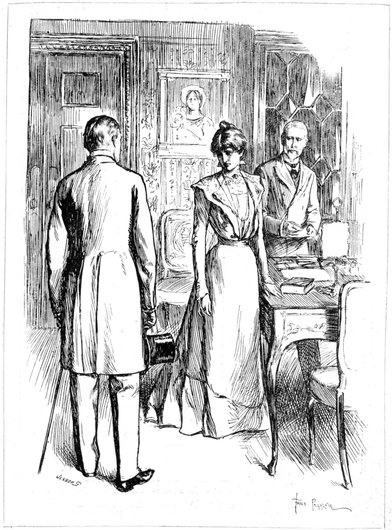
"SHE LIFTED HER EYES TO HIS, AND HE SAW THAT HE HAD WON HER."