Volume 1 — POSTAGE STAMPS WORTH FORTUNES. LATEST MARKET PRICES.
Reading edition
"Good postage stamps" said a leading expert to the writer a few days since, "are one of the soundest investments you can hold." That this is so is amply proved by a glance at the steadily increasing prices quoted for the celebrated blue Mauritius.
With a view to ascertaining some interesting particulars of the present market prices of some of the rarer varieties of stamps, I called upon Mr. Phillips, who is one of our greatest philatelic experts and manager of the great collecting firm of Messrs. Stanley Gibbons, Ltd.
The result was extremely interesting, as a perusal of the facts of this article will demonstrate.
There are two varieties of the 1847 Mauritius, a 1d. red and 2d. blue. The stamp is particularly distinguished, as will be observed in our illustration, by the words "Post Office" on the left-hand side instead of the more usual "Post Paid."
Owing to its rarity and the increased interest evinced by all classes in stamp collecting, the value of this stamp has gone up by leaps and bounds.
THESE TWO STAMPS WERE SOLD FOR £1,000.
There is a good specimen in the British Museum collection. It was purchased fifteen years ago for the modest sum of £70. I say modest, because in 1887, when another specimen came into the market, it realised no less a sum than £200, showing an advance of £130.
SOLD FOR £740.
But this was by no means a top price. The next transaction in blue Mauritius was the sale of a pair which after a spirited competition were knocked down to Messrs. Stanley Gibbons, Ltd., for £680—the price, by the way, of a well-matched pair of thoroughbreds. In 1897 the last transaction took place in this variety, when another pair changed hands for the respectable consideration of £1,921.
So that if by hook or crook you can get hold of an 1847 blue Mauritius, there is a fortune in store for you. However, so far as collectors know, there are only some 23 specimens of the two varieties—11 of the one and 12 of the other—in existence.
Most people imagine the Mauritius to be the rarest and most valuable of stamps. In this they are wrong. Mr. Phillips credits the 1856 British Guiana, black on magenta, with this honour.
By an error, which was quickly rectified, certain of these stamps were lettered "one" instead of "four." If you can obtain a copy in which this error is apparent, it will readily bring £1,000.
At present only one copy is known to be in existence, and that is in Paris. It holds an honoured place in the magnificent collection belonging to Mons. Ferrary, son of the late Duchess Galliera.
The red variety of this stamp without the error is worth only £25. In blue, it may fetch anything from £100 to £300, according to condition.
FETCHES £250.
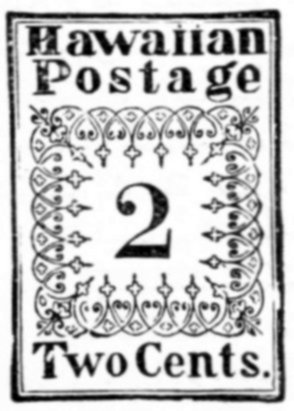
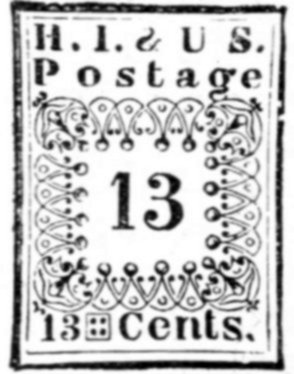
The Hawaiian or Sandwich Islands issued a set of four stamps in 1851. Their face values were 2 cents, 5 cents, and 13 cents, the last mentioned being issued in two varieties. They were local low value stamps marked "Hawaiian—U.S." and were used for the purpose of franking letters to San Francisco.
The 2 cent variety is the most valuable. Messrs. Stanley Gibbons, Ltd., have been dealing in stamps for 40 years, and they have handled only two copies. The last one sold—a used specimen—fetched £740. The British Museum collection includes two copies, and no other specimens exist in Great Britain. There are three or four copies in the United States, and some eight copies in Europe. These are the only specimens in existence.
The 5 cent and 13 cent varieties are not so valuable, though they may be relied upon to fetch a good round sum. A 5 cent copy unused, in average condition, is worth £250; used, from £80 to £100.
A 13 cent specimen in average condition will realise £250 unused, and £75 used.
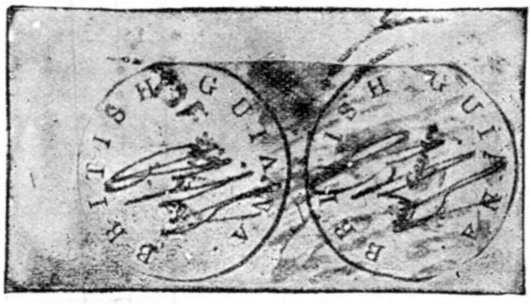
Another British Guiana stamp is extremely valuable—the 2 cent circular variety, issued in 1851, and bearing the postmaster's signature as a guarantee of authenticity.
There are only some ten or eleven copies in existence.
RICE PAPER STAMP.
The pair on the previous page have a history as romantic as anything we have ever heard. Four years ago they were found by an old lady residing in a little village outside Demerara. The vicar of the local church was endeavouring to raise an endowment fund, and the old lady, who understood they were of some value, though she had no idea to what extent, presented them to the clergyman, and asked him to sell them and devote the proceeds to the fund.
He sold them to a member of the Legislative Council of Demerara for £205, who in turn sent them to Messrs. Stanley Gibbons, Ltd. The firm gave him £650 for the pair. He thus realised an immediate profit of £445.
But this was by no means the top price; within three weeks of their receipt Messrs. Stanley Gibbons, Ltd., resold them to a Bavarian dealer in Germany for £780, who immediately parted with them to a well-known Russian collector, who was in want of specimens, for £1,000.
One cannot help sympathising with the original finder. However, it is more than probable she is ignorant of their real value to this day.
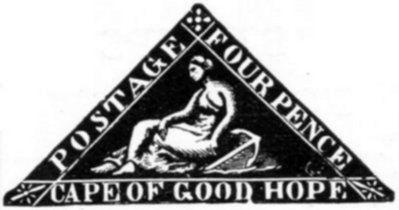
PRICE UNUSED—£500.
Another stamp that has risen prodigiously in value of late years is that known as the Cape of Good Hope issue of 1861. It is known to collectors as one of the errors of 1861, for the following reason.
Just prior to the perpetration of the error, the supply of stamps issued to the colony by the Home authorities ran out, and a local printer was commissioned to produce a temporary supply.
In printing these he made a mistake, the result of which was that the 4d. and 1d. stamps were mixed up. As a consequence many of the 4d. stamps were marked 1d. by mistake, and were the same colour as that used in the former variety.
In 1863 specimens of these errors were sold at 2s. 6d. each. To-day used copies readily fetch from £60 to £70 apiece.
Mr. Phillips says he has only seen one unused copy, and that was sold for £500.
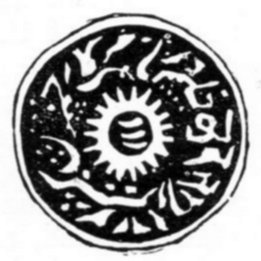
OBSOLETE CASHMERE STAMP.
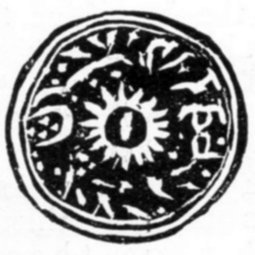
An interesting specimen is the native stamp issued by the Maharajah of Cashmere in 1866. It is the rarest of native varieties, and was made by the natives of Jummoo and printed on rice paper.
It is in three values—½ anna, 1 anna, and 4 annas, all of which are rare, and worth from £30 to £60 apiece. We are able to illustrate only two of these stamps, the ½ and 1 anna values.
This stamp is now obsolete, the Government having made arrangements for the use of British stamps in Cashmere.
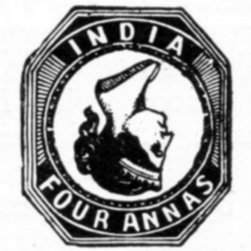
STAMP WITH QUEEN'S HEAD UPSIDE DOWN.
A curious error occurred in the manufacture of a stamp issued by the Indian Government in 1854, all the stamps of one printing appearing with the Queen's head turned upside down. It was a 4 anna stamp, printed in red and blue.
Copies of the correct stamp may be purchased for 5s. But a specimen in which the inverted head appears is worth £150, and not more than twenty copies exist.