Volume 1 — THE BEHAVIOUR OF WARRINGTON, V.C.: (1) ON THE FIELD, AND (2) AT HOME.
Reading edition
By Percy E. Reinganum.
Illustrated by W. B. Wollen, R.I.
(1) On the Field.
A pitch-black night in a rocky valley of Afghanistan: a few stars in the heavy, black, moonless sky only intensifying the almost palpable darkness. A mile or two southwards, where the rocky valley swelled into rocky heights, little flashes of light recurring at intervals, followed by sharp little cracks, showed where the late skirmish and retreat was fighting itself out round about the camp.
Where one of the innumerable broken ridges that seamed the valley made a darker wall across the darkness, two figures were dimly discernible (when you knew where to look for them), the one semi-recumbent, propped against a boulder, the other tall and straight beside him.
"Clear out, Warrington—please go, sir," the voice came faintly from the recumbent figure. "You can get back to camp and send 'em out for me."
"Not likely, young 'un," observed the other. "What says the great R.K.:
"'When you're wounded and left on Afghanistan plains, And the women come out—to cut up what remains— Just——'"
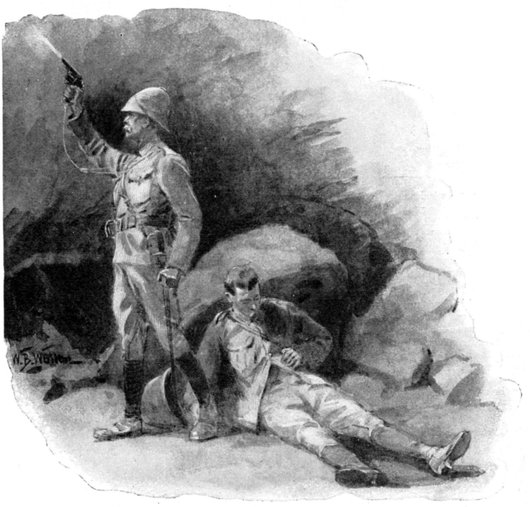
"HE EMPTIED HIS REVOLVER INTO THE SILENCE OF THE NIGHT."
"Don't!" said the wounded man, and almost succeeded in stopping a groan between his clenched teeth.
"Poor old Vicary," said Warrington, bending over him. "Let me undo your belt.... Now grab yourself with both hands."
"Fellows in books," said the weak voice, drowsily, "never get hit in the tummy.... Always—head in a bandage—or—arm in sling.... Those Johnnies that write books—ought to come out with us."
There was silence for a time: the far-off flashes grew more rare. The wounded man shifted himself a little and spoke again.
"You're a brick, Warrington!" he said.
"Slightly different from Piccadilly and the Strand this, eh, Vic?"
"I wish the mater could see us now," said Vicary; "she's going to bye-bye just about now. She'd stick you pretty high up in her prayers if she knew."
"The next time you start talking nonsense," said Warrington, "I shall consider you delirious and past hope; and I shall turn tail and make tracks for camp."
A long silence.
"It's getting beastly cold," said Vicary, with a shiver; "I shall never pull through to-night."
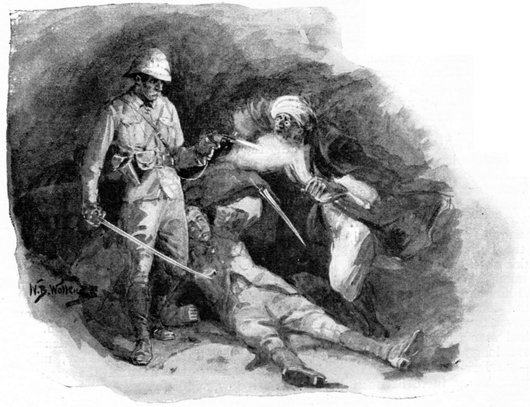
"A HOWLING HILLMAN STUMBLED OVER VICARY'S LEGS."
"Cheer up, lad," said Warrington, and pulled at his moustache and glared at the darkness; "only a few hours till daybreak.... Pity you're six foot four in your boots and solid in proportion. I'm not equal to two miles with you on my back, my dainty midget."
"Can't see how you got me this far.... Why don't you sheer off now and get back, and——Oh, God! No! Warrington!... You're not going?"
"Another word like that, my son, and I leave you for Mr. and Mrs. Pathan and all the little Pathans to play with."
"All right—all right, I won't.... Let me hold your boot—I can hardly see you. Oh, Warry, what a funk I am; all the bit o' pluck I had's run out of the leak in my tunic—and I am beastly cold."
Warrington knelt beside him and cursed beneath his breath, and felt his head and hands. The former was very cold and damp, the latter were very wet and warm.
"I must let them know they're wanted, Vic!" he muttered.
The latter did not hear him.
"It'll be in to-morrow's despatches," he murmured. "'Missing: Lieutenant Beverley Warrington and Second Lieutenant Vicary of the ——' What's up, Warry?"
His companion had touched his forehead lightly with his lips, had risen to his feet, and, with his arm raised above his head, had emptied his revolver into the silence of the night.
"They'll know there's a British officer where that revolver is," he said, cheerily.
"But—but, you fool—you dear old silly fool—so will those brown devils!"
"Can't help that!" said Warrington, with a little laugh, "it's too chilly to stop out late to-night." Then in a lower tone, "For the sake of auld lang syne, Vic, my boy."
He reloaded his revolver. When the echoes had rattled away into deeper silence they heard the distant shots suddenly recommence, and distant shouts and howls came to them like whispers. From the invisible hills facing them came dim and confused scuffling and scraping sounds as of cats scrambling down rocks. A moving white blur appeared somewhere in the thick darkness, then another, and another; and a suggestion of low-toned guttural conversation reached Warrington's straining ears. He shifted his revolver to his left hand and gently drew his sword. Then from over there where he knew the camp lay came six revolver shots in quick succession.
"That's Welby!" he said to himself.
Vicary's hand had been grasping the heel of his foot tightly. Now he felt the grip relax; and in a moment more the wounded subaltern slipped a little with a slight tinkle of steel on rock, and groaned.
In another moment a dozen howling hillmen were blazing away at random towards the spot whence the groan seemed to have come. They aimed low and erratically, and Warrington held his fire for a few interminable seconds.
Then they closed in, and one stumbled over Vicary's outstretched legs before they could realise that two British officers were within a yard of them. Warrington felt the man grab at him as he fell, and fired with the barrel of his revolver touching bare skin. After that he fired and slashed very much at random, and the darkness around him shrieked and howled and spat fire, and long graceful knives suggested themselves to the imagination of the man who had seen them at work before.... For ten long minutes Warrington was busy—wondering all the time what Vicary was doing down there between his legs, and how he liked it, and which of them would die first.
Then suddenly in a lull he heard faintly a sound that sent the blood to his head with a rush—the scraping of many boots over rocks some hundreds of yards away, and the dim echo of a word of command. He shouted, and fired his last cartridge above his head that they might see the flash, and flung the empty weapon at a white eyeball that was too near to be pleasant, and cut and pointed and slashed away with renewed vigour. Down the valley and over the rocks came a hoarse, breathless cheer, and pith helmets gleamed faintly in the near distance. He answered the cheer with a croak, and went on carving and hacking as though his foes still confronted him. But they did not wait to meet his friends. They left. All but five, to whom even British troops were a matter of indifference now, as they stayed behind, huddled into a grim semicircle round Lieut. Warrington and Second Lieut. Vicary. When his men came up to him they found him with Vicary in his arms leaning against the wall of rock, "looking," as Private Billimore said, "as though 'e'd 'ad a nasty messy accident with the red paint."
Vicary opened his eyes as he entered the camp feet foremost.
"Warrington, V.C.," he said, and tried to cheer. But the others did it for him.
(2) At Home.
An afternoon in early November: a cosy room, bright fire, big armchairs, piano, pipes, photographs, and decanters: a male figure extended to enormous length in one armchair, with feet stretched out on the hearthrug: another male figure with back turned towards the room, gazing out of window at the unceasing rain. Thick clouds of tobacco smoke, and silence.
"Of all the brutal, filthy, miserably depressing days!" said the man at the window, suddenly.
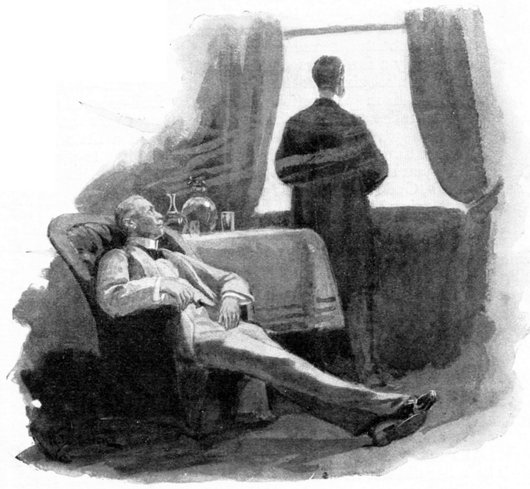
"'I'M IN AN AWFUL FUNK,' SAID WARRINGTON."
"Weather seems to worry you, old man," said the gentleman by the fire, settling down a little deeper into the depths of his armchair. "Third time in twenty minutes you've got up to look at it—and talk about it."
"Sorry, Vic," said the other, and, turning, he came slowly towards the fire. "I must be lively company to-day; but this weather seems to upset one altogether."
"Not me," said Vicary, blowing a cloud. "I'm pretty comfy, thanks. I prefer rain in St. James' to starlight in Chukundra."
The other did not answer, but stood nervously opening and shutting his hands over the cheerful blaze.
"By George!" said Vicary, meditatively, "it seems almost like a dream now—all but the souvenirs we carry—eh, Warry?"
Warrington's hand went up to the livid band that ran across forehead, nose, and cheek, and almost bisected his strong face.
"One comfort," Vicary went on, "mine don't show. Not but what that has its drawbacks," he added, with a chuckle; "no one seems to believe they touched me—think I got my sick-leave on the bounce. And I can't continually strip to prove it."
Still his senior was silent. Vicary edged round a little to look at his face. Then his eyes opened and his voice changed.
"Warrington," he said, "d'you remember that very first dust up we had the second day out from Kir Wallah?"
Warrington nodded.
"That was my first taste of the walk-up-and-down-as-a-target business," said Vicary, solemnly; "and I was in a blue funk. Couldn't help it. Knees all flabby and face all twitchy when those bullets began whispering and pattering."
Warrington laughed nervously.
"I gave you the right sort of a dressing down," he said.
"It pulled me through," said Vicary; then, leaning forward, and still more solemnly, "I say, what did I look like?—all drawn up and ghastly?"
"A bit," admitted Warrington.
"Look in the glass now," said Vicary, in an awestruck voice, for Warrington was senior officer and brother and Ajax and Wellington and Lord Roberts all rolled into one, in the subaltern's estimation.
Warrington started, and looked not at the glass, but at Vicary.
"You're right, young 'un," he said in a moment, and dropped into the other armchair. "I'm in an awful funk at this very moment."
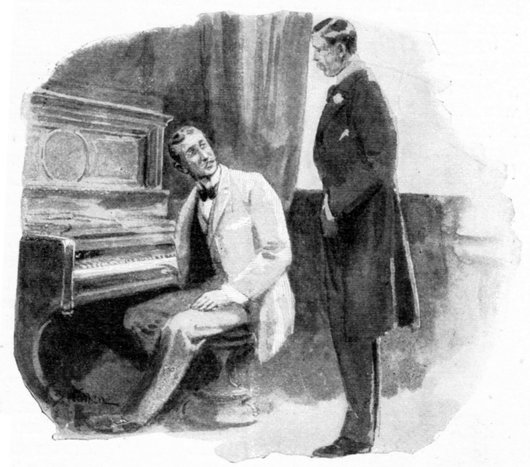
"'I SHOULD ADVISE YOU TO HAVE IT OUT WITH HER.'"
"Oh!" breathed Vicary, and allowed the amazing fact to sink into his consciousness.
"Fact," said Warrington, and dragged at his moustache and gnawed the end.
"In heaven's name," said Ensign Vicary, "what are you frightened of?"
"Of one little girl I could pick up and carry under one arm," said Lieutenant Warrington, V. C.
Vicary drew a long breath.
"You gave me quite a turn," he said.
"It's serious, boy," said the other man, bending his long, gaunt body forward, his grey eyes all alight. "I haven't the pluck to face her."
"Name?" said Vicary, judicially.
"Rivers," said Warrington, with reverence; "Catherine Rivers."
"Pretty Kitty Rivers!" cried Vicary. "Old man, I congratulate you."
"Don't be a fool!" said Warrington, angrily, and walked to the window.
"On your good taste, of course," said Vicary, with a grin. "Is it a bad case?"
"I shall—ask her to be my wife," said Warrington with a rush, "as soon as I dare call—which I haven't done since we've been back—more than a week."
Vicary whistled, rose, and strolled over to the piano.
"Well, I should advise you to go and have it out with her," he said, twisting himself round on the music-stool. "Come back when it's over, and sparkle up a bit."
"Shut up!" growled his senior.
Vicary shrugged his shoulders and struck a few aimless notes. This sort of timidity was strange to him. In matters relating to the opposite sex his senior was a child compared with that good-looking boy at the piano.
Suddenly Vicary grinned, struck a chord, and broke into a music-hall song, accentuating the twang of Cockayne to exaggeration:
"'O-ownly one gurl—in the world fer me; O-ownly one gurl—'as my sympathee; She m'yn't be vairy pritty——'"
"Shakespeare" between the shoulder-blades cut his efforts short. He twisted round, chuckling and rubbing himself.
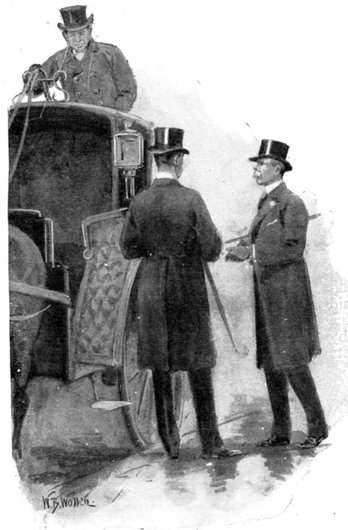
"'HADN'T WE BETTER—ER—WALK?' SAID WARRINGTON, NERVOUSLY."
"Steady on, old chap! What's up?"
"I came here to-day for your help," said Warrington, and stopped short.
"Warry!" said Vicary, nervously. He had never seen him like this before.
"Vic, I'm longing to see her—to say it! I've been longing for months, and now—I simply daren't call."
"Bulldog—heavy father—comic papers," murmured Vicary, quite uncomprehending.
Warrington glared.
"If you're going to be a drivelling young idiot," he said, icily.
"No—no! Drive ahead," said Vicary.
"It's just her I'm frightened of," said Warrington. "I'd rather go through a week of Chukundras than speak; but I'd go through a lifetime of them with her at the far end."
"But, Warrington," said Vicary, puzzled, "she's not such a Tartar."
"She's the best girl in the world," said Warrington, V.C.; "and the only thing in it I'm afraid to face."
"Why, what would she do?" said Vicary.
"Do?" said Warrington, with both hands at his moustache. "Do? Why, she'll drop her eyelashes, or she'll curl the corners of her mouth, or she'll glance at me over her shoulder with her chin up, and then—and then——"
"And then?" said Vicary, twinkling.
"Then I shall sweat like a coolie, and stand gaping like a stuck pig," said Warrington, savagely; "and my knees will go flabby and my face twitchy, as you elegantly put it. Good-bye."
"Eh?"
"I'm going there now. I mean to go there now."
"Yes," said Vicary; "and directly you're outside you'll stand still for a quarter of a hour, and then cut off home and spend the evening practising profanity in solitude."
Warrington stood in front of his junior, and dared not contradict.
"Unless——" said Vicary, and stopped and grinned.
"Unless?" said Warrington, with painful eagerness.
"Unless," said Vicary, coolly, knocking his pipe out into the grate, "unless I come with you."
Warrington drew a long breath.
"Thanks," he said, shortly, and watched Vicary putting on hat and coat, and pulled his moustache violently.
As they left the room he slipped his hand through Vicary's arm.
"This is my Kir Wallah," he said, gravely.
Vicary laughed round at him.
"There's a whacking big balance on the Chukundra side," he said.
"Needn't say good-bye to the mater," he went on, as they descended the stairs; "you'll come back to dine."
"To be cheered up," said Warrington, with pathos.
Vicary did not deign to reply to such an absurd remark. He hailed a hansom.
"Hadn't we better—er—walk?" said Warrington, nervously.
"You jump in," said Vicary; "don't be frightened. I'm coming to hold your hand."
He gave the address, and they bowled away through the grey wetness. Warrington was trying to see the whole of his person at once in a six-inch strip of looking-glass.
"Now, I ask you, Vic," he said, plaintively, "is it likely she'd have an object like me?"
"Fishing!" said the subaltern. "You're not an Adonis, but a V.C. covers a multitude of sins."
"Pooh! what does a girl care about that?" said Warrington; and Vicary laughed aloud at him. To himself he said, "The girl that gets you will get the bravest, cleanest, best gentleman that wears the Queen's uniform; and the girl that will refuse you doesn't exist."
"Why, we're there," said Warrington, flushing and fidgeting; "how that horse has been going!"
"Three doors down the square," said Vicary to the cabman through the trap.
"Tell him to drive once round first," said Warrington, pulling a glove off and then beginning to put it on again. "I—I've got something to say to you——"
"It'll keep," said Vicary. "Out you get."
"No—I say—half a minute. Vicary! Is my tie straight? I ought to have changed my collar. Hang it—all right, I'm coming. Wait for us, cabby—we shan't be five minutes. Vicary, don't ring. I—I don't think I'll call to-day, after all—it's a bit late, don't you think? You have rung? Dash it! I—I—let me ask." The door was opened. "Is Mr. Rivers in? No? Oh, thank you. It don't matter—I'll call again. Good——"
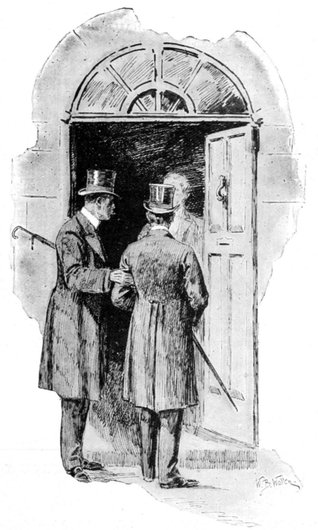
"'SAY LIEUTENANT BEVERLEY WARRINGTON WISHES TO SEE HER ON MOST IMPORTANT BUSINESS.'"
Vicary caught him as he turned and held him fast.
"Is Miss Rivers in?" he asked.
"Yessir," said the man, who knew him well.
"Say Lieutenant Beverley Warrington wishes to see her for a few moments on most important—come here, you old idiot—on most important business."
Inside the house Warrington mopped his face and rehearsed speeches in a low monotone until the man reappeared.
"Will you walk up, sir, please?"
"Walk up," said Vicary, sternly, and marched him out of the room. "Right half face! Quick march! Go on, you conquering hero, and good luck attend you."
Warrington did not answer, but breathed stertorously and fingered the balustrade.
"Up you go!" said Vicary. "There's no retreat. She's waiting for you."
"I—I wish you could come too," said Warrington in a loud, hoarse whisper.
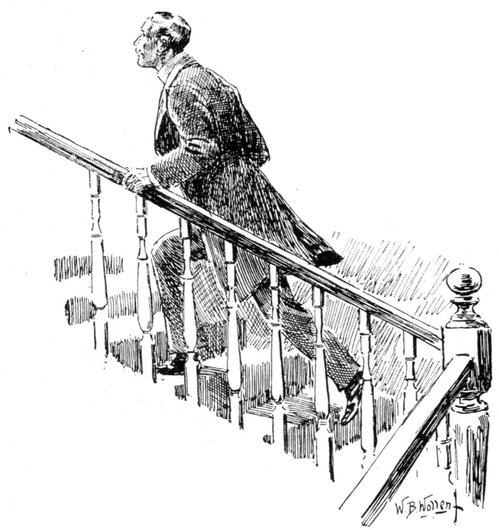
"HE FLEW UPSTAIRS AS FAST AS HIS WOUND WOULD ALLOW HIM."
Vicary grinned, shaking with internal laughter. Warrington glared at him, groaned, and went slowly upstairs, where the man stood patiently waiting to announce him.
Vicary heard him say breathlessly, "Wait a minute"; but the man preferred not to hear him, and opened the door with a most portentous "Lieutenant Beverley Warrington."
Vicary waited in the library. He smoked one cigarette, and another, and another. He tried to read, but gave it up. He tried to laugh at the scene in which he had just taken part, but gave that up too. After all, he was in no laughing mood where Warrington's happiness was concerned.
And at last, when the hands of the clock showed three-quarters of an hour gone, Warrington's voice from upstairs called hoarsely, "Vicary!"
He paused a moment, breathless. Then another voice, far clearer and sweeter, but with just a faint tremor in it, repeated, "Vicary!"
And then he flew upstairs as fast as his wound would allow him.
Lodge, Photo
PARTRIDGE'S NEST WITH THIRTEEN EGGS.