Volume 1 — AMERICAN WIVES OF ENGLISH HUSBANDS. SOME CHARMING LINKS IN THE ANGLO-AMERICAN ALLIANCE.
Reading edition
Those who scout the notion of an Anglo-American Alliance should remember that in a considerable number of cases the question has been solved, and in a very satisfactory manner, by the contracting parties themselves. Every year Anglo-American marriages become more frequent, and there can be no doubt that, on more than one occasion, this fact has told significantly when affairs of moment were in question.
In this matter, at least, the United Kingdom has remained faithful to her "oldest colony," and latterly distinguished Englishmen have sought wives in America, rather than in Greater Britain.
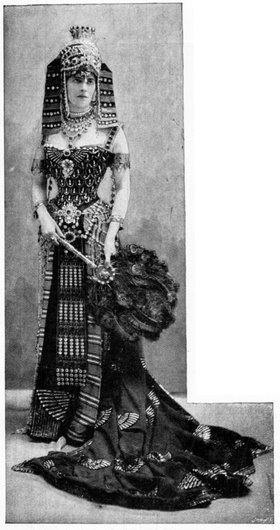
MRS. ARTHUR PAGET.
J. Thomson, Photo
At the present time three of the most prominent personalities in the House of Commons—Mr. Joseph Chamberlain, Sir William Harcourt, and Mr. George Curzon—are each married to an American, and the only difficulty that meets those who would attempt to draw up a list of these informal Anglo-American alliances is to choose from the large number of names that presents itself. To take the peerage only, there are at the present time three American duchesses, and Lady Francis Hope (Miss May Yohe) may one day be Duchess of Newcastle. The only transatlantic marchioness is Lady Anglesey, but there are three American countesses, four baronesses, and many other ladies whose husbands are in possession of courtesy titles.
Of the three American ladies who have worn and are wearing the strawberry leaves, perhaps the most interesting, from several points of view, is the lady who is still known to the world as Lilian, Duchess of Marlborough.
Née Miss Price, the future duchess was married when very young to a wealthy American, Mr. Hammersley. His death occurred comparatively soon after the marriage, and he left his young wife his entire fortune. Some years later, she greatly astonished her friends by marrying the then Duke of Marlborough; but, contrary to general expectation, no part of her immense fortune was squandered, for Her Grace proved herself an excellent woman of business, and though considerable sums were spent on putting and keeping Blenheim in repair, it was arranged that an insurance covering the whole amount should, in each case, be effected on the duke's life. Consequently, at his death, his widow found herself an even wealthier woman than she was before she became his wife.
After the late Duke of Marlborough's death, the duchess lived very quietly; but, as she was still a comparatively young woman, her marriage to Lord William Beresford was considered to be, on her part, a very judicious step. Her stepson, the young Duke of Marlborough, gave her away, and she has remained on very good terms with her second husband's family.
Lord William Beresford was believed, until comparatively lately, to be a confirmed Anglo-Indian, for he managed, as Military Secretary, the households of several Viceroys, and he is known, both among Europeans and Indians all over the Queen's Eastern Empire, as a man possessing not only exceptional business capacity, but remarkable savoir faire. He has taken part in many campaigns, and was the prototype of "Soldier Bill" in one of Whyte Melville's best known novels.
Since his marriage, he and his wife have lived at the Deep Dene, Lord Francis Hope's beautiful place near Dorking, and it was there that their infant son was born last year. The duchess has adapted herself completely to the conditions of English country life. The Deep Dene was described by Aubrey as "an epitome of Paradise," and a "Garden of Eden." Accordingly, the lines of Lord William Beresford and his wife are laid in pleasant places. The latter devotes a good deal of her time to the collection and growth of orchids. Under her supervision a fine orchid-house has been erected, and she is fast becoming a formidable rival to the most noted growers in the kingdom.
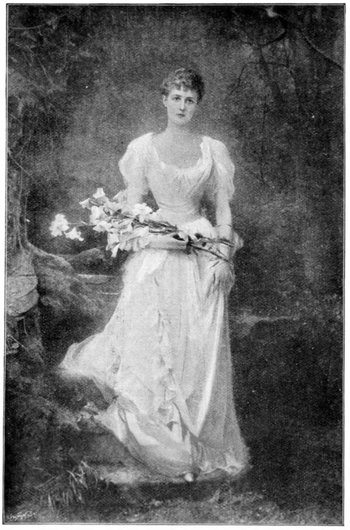
LADY NAYLOR-LEYLAND.
Alice Hughes, Photo
At the present moment the personality of Consuelo, Duchess of Manchester, as she will henceforth be known, is of peculiar interest. Although the engagement of the young duke was lately announced, his mother is still one of the youngest looking women in society, and she has scarcely changed since the day, twenty-two years ago, when she took London by storm as the bride of Viscount Mandeville, the then Duke of Manchester's eldest son and heir.
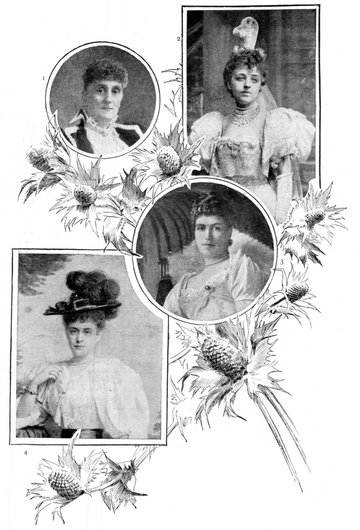
(1) LADY HARCOURT. Elliot and Fry, Photo (2) LADY TERENCE BLACKWOOD. J. Thomson, Photo (3) THE DUCHESS OF MARLBOROUGH. Russell & Sons, Photo (4) LADY ARTHUR BUTLER. Faulkner, Photo
Unlike most Americans who have married Englishmen, Miss Consuelo Yznaga had only once paid a flying visit to London before her marriage. Her mother, who had been a noted belle of New Orleans in the fifties, on her marriage to a distinguished Spaniard went to Cuba, where the future British duchess was born in the little village of Sant Espiritu.
As has been the case with almost every family connected with Cuba, the Yznagas sustained great losses, which led to their settling once more in America, and it was there that Miss Yznaga first met Lord Mandeville, then travelling in the States. When visiting at her father's house he fell ill, and was very kindly nursed and entertained till his recovery. The engagement excited exceptional interest owing to the fact that Lady Mandeville, as she became, was the first Anglo-American peeress.
In spite of the fact that after their marriage Lord and Lady Mandeville had no London house, the latter soon took a very prominent place in society; she became a great favourite both with the Prince and with the Princess of Wales, and she was constantly included in the lists of house parties invited to meet their Royal Highnesses.
Many years of Lady Mandeville's married life were spent in Ireland. She was devoted to her three children, twin daughters and one son, known during his childhood as Lord Kimbolton; and though she often paid flying visits to London, she did not revisit America for a long time.
On the death of the seventh Duke of Manchester, in 1890, Lady Mandeville became at once the reigning Duchess of Manchester, and she was for a time the only American duchess in the peerage; during the two years which elapsed before the duke's death, the duchess gave a series of splendid entertainments both in her London house in Great Cumberland Street, and at Kimbolton Castle, in Huntingdonshire, the splendid place which was, for so many years, the home of poor Catherine of Arragon after her divorce from Henry VIII.
Her mother-in-law, now the Duchess of Devonshire, always proved a firm and loyal friend to her son's beautiful American wife; and on the death of the eighth duke, which occurred in the August of 1892, it was his mother who persuaded the young duchess that she should continue to live in London, and not retire, as she thought of doing, to her son's Irish seat.
The greatest grief of the Duchess of Manchester's life was the death of Lady Mary Montagu, one of her beautiful twin daughters, whose charming portraits by Lady Granby and Mr. Edward Hughes have made their features familiar. Since her death, which occurred very suddenly in Rome, the duchess has lived very quietly until this spring, only emerging from her retirement in order to introduce her young daughter to society.
It is a curious fact that the young Duchess of Marlborough, née Miss Vanderbilt, is the godchild and namesake of Consuelo, Duchess of Manchester, owing to the circumstance that the latter and Mrs. Vanderbilt were intimate friends. The Duke of Marlborough first met Miss Vanderbilt when she was visiting her godmother, but the engagement and marriage took place, as all the world knows, in New York.
The Duchess of Marlborough, like most of her fellow countrywomen, has shown remarkable powers of adaptability. She is very much liked, both round Blenheim and in the more critical London world where her rank gives her a very important place.
Everyone is aware that Lady Randolph Churchill is one of three beautiful sisters who all married Englishmen. The brilliant younger son of a Duke of Marlborough first met Miss Jennie Jerome in Paris. Like so many American women, she was and is a very excellent conversationalist; in fact, during Lord Randolph's lifetime, it used to be said that the only woman who was his match in repartee was his own wife. Although brought up in an intensely republican atmosphere, she developed, after her marriage, into an enthusiastic Tory, and a pillar of the Primrose League.
When her husband decided to enter Parliament, his wife set herself to promoting his interests in every way; and it was openly averred at the time, that he owed his appointment as Chancellor of the Exchequer to her efforts, for in those days Lady Randolph Churchill may be said to have had a salon in the true sense of the word, and her beautiful house in Connaught Place was a rendezvous for her husband's friends and supporters. She showed American thoroughness in everything about the establishment, keeping the best chef in town and being a perfect hostess from every point of view.
Since the premature death of Lord Randolph Churchill, his widow has continued to make her home in London. She is very devoted to her two sons, and is said to be as ambitious for them as she was for their father. It was at one time widely asserted that Lady Randolph was about to become the second wife of her millionaire fellow-countryman, Mr. William Waldorf Astor, but up to the present time the rumour has not been confirmed.
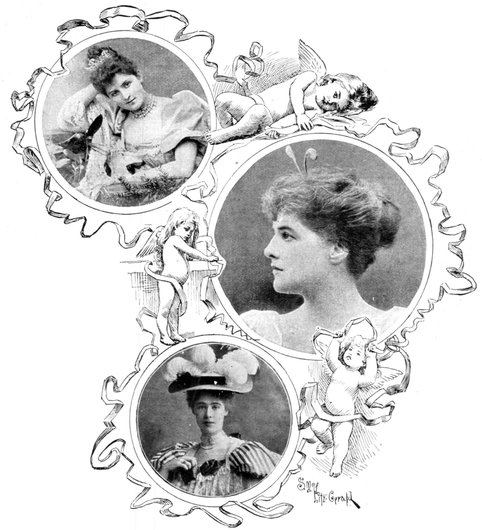
(1) LADY GREY-EGERTON. A. Hughes, Photo (2) LADY RANDOLPH CHURCHILL. A. Hughes, Photo (3) THE COUNTESS OF CRAVEN. Lafayette, Photo
Lady Randolph's great interest in life is music. She is a very fine pianist, and sings almost as well as she talks. She has of late devoted a great deal of her spare time to private theatricals, her first appearance having taken place at Blenheim, during the now historical visit of the Prince and Princess of Wales to the Duke of Marlborough and his young American bride.
Lady Randolph has preserved an extraordinary look of youth, and, though the eldest of the three, she looks younger than either of her sisters, Mrs. Jack Leslie, and Mrs. Morton Frewen.
Among the American women who have been called upon to take an active interest in British political life, Mrs. Joseph Chamberlain certainly deserves the foremost place. She is devoted to her husband, and has made herself thoroughly conversant with all that affects or that may affect his political ambitions. But she is quite content—unlike, it must be admitted, most American women—to take a second place, and she is liked and respected by many people who still retain their prejudice against the Colonial Secretary.
Mrs. Chamberlain, née Miss Mary Endicott, belongs to one of the oldest families in New England, one of her forebears having been the first English governor of Massachusetts. Mr. Chamberlain, then a widower for the second time, first met Miss Endicott in 1887, when he was one of the British delegates on the Fishery Commission; but their engagement did not take place till the following year, and Mr. Chamberlain returned to America to be married, the wedding being celebrated at Salem, Mass., the residence of the bride's father.
At the present moment it is interesting to recall that Mr. W. C. Endicott was Secretary for War in President Cleveland's first administration, and perhaps Mr. Chamberlain's openly expressed sympathies with America during the Hispano-American war are greatly owing to the fact that his wife's family have always been ardently patriotic.
Mrs. Chamberlain has now become quite an Englishwoman. Her husband's people have become her people, and she has even gathered Birmingham to her heart, for although Highbury has become a very "smart" house, its mistress is always ready to welcome there her husband's old supporters and early friends; Mrs. Chamberlain has also ever been on the happiest terms with her step-children, one of whom, Mr. Austen Chamberlain, is older than herself.
What orchids are popularly supposed to be to the Colonial Secretary, roses are to his charming American wife; and the rosery at Highbury is one of the most beautiful in the United Kingdom, and this although Mr. and Mrs. Chamberlain spend a considerable portion of the year in Prince's Gardens, where they are always reminded, however, of their much-loved Warwickshire home, great baskets full of roses being sent them almost daily from Highbury.
Mrs. Chamberlain does not see very much of what may be called the American colony. On all important occasions she is to be seen in the Ladies' Gallery of the House of Commons, and during the famous Home Rule Bill debates she was as faithful in her attendance as was Mrs. Gladstone herself. She is one of the very few American women for whom the Queen has shown a distinct partiality, and she often accompanies her husband when he receives a "dine and sleep" invitation to Windsor.
Lady Harcourt belongs to an altogether older and more serious generation than that from which have been drawn those American women who now leaven English society. She was the daughter of the famous American historian, Motley, and much of her youth was spent in Europe, where her father, who was a diplomat as well as a student, was seeking materials for his great history, "The Rise of the Dutch Republic."
Miss Motley married Mr. Ives when quite a girl, and after becoming a widow continued to live in England; and thus it fell about that Mr. Vernon Harcourt, himself a widower with one little boy, had the good fortune to win as his second wife one of the most charming and kindly of women.
The Liberal ranks are, when compared with their rivals, poor in hostesses; but it is universally admitted that in Lady Harcourt they are exceptionally blessed, and her house parties at Malwood have done much to make Sir William popular with the party, the more so that Lady Harcourt does not confine her interest to politics. She is devoted to literature and art, and accordingly she is very eclectic in her choice of guests. Thus Sir William and Lady Harcourt were on intimate terms with Disraeli, and after the great Tory leader's death, a very valuable and unique miniature of Byron which had been in the possession of the author of "Lothair" was given to the Squire of Malwood by Lord Beaconsfield's executors.
Lady Harcourt also frequently entertained Mr. and Mrs. Gladstone, and in her garden is a walnut tree planted by the Grand Old Man, while close by is an ash which is known as Mrs. Gladstone's tree.
It is an interesting fact that, through the Vernons, Lady Harcourt is the only American who can claim relationship with Royalty. The story goes that on one occasion, to his annoyance rather than to his amusement, a friend of the Liberal Leader once proposed at a Radical gathering the health of "Mr. Vernon Harcourt and the rest of the Royal Family!"
Mrs. George Curzon is the latest addition to the group of American women which is now playing so prominent a part in English political society. The future Lady Scarsdale is the daughter of a great Chicago millionaire, whose home, however, has now been for many years in Washington. It was said at the time of the marriage that Mr. Leiter had settled on his daughter £10,000 a year.
As Miss Leiter, Mrs. Curzon spent several winters in Europe, and she met her future husband first in London, although their engagement and marriage took place at the bride's own home in Washington. Even in America, that land of beautiful women, Miss Leiter was distinguished for her exceptional good looks, and she was also said to be, as a girl, one of the best conversationalists in Washington. Owing to her intimate friendship with Mrs. Cleveland, she was constantly at the White House, and while there became acquainted with all the diplomatic world; indeed, at one time every foreign attaché in Washington was said to aspire to the honour of becoming Miss Leiter's husband. She speaks French and German perfectly, and has always been interested in literary matters; indeed, her interest in Mr. George Curzon's literary work first caused them to become friends. Their engagement lasted some months, and aroused great interest throughout the States.
The marriage took place in Washington four years ago, and ever since Mrs. George Curzon has entirely identified herself with her husband's aims and interests. When he was standing for Southport she was the most energetic of canvassers, and her beautiful London house is becoming quite a rendezvous of the Conservative party.
Of all the American women who have married Englishmen none has a more interesting house than has the Countess of Essex; indeed, Cassiobury Park, which is near Watford, is not only one of the loveliest country houses in the United Kingdom, but is said to date its name and fame from the days of the early Britons. The house itself is of recent construction, having been built by Inigo Jones, while the gardens were laid out by Le Nôtre, who was persuaded to leave Versailles for a brief period in order that he might lend his aid to beautifying the property of the Lord Capel from whom the present Earl of Essex is descended.
Lady Essex, née Miss Adele Grant, has fine taste. Her special hobby is the collecting of miniatures, and in her boudoir at Cassiobury are over a hundred exquisite portraits of the dead and gone beauties and beaux of a former day. Curiously enough, the title of Countess of Essex has been invariably borne by a beautiful woman, and one of the most charming pictures in the house is a portrait of the lovely Kitty Stephens, who became the wife of the fifth earl.
The Countess of Essex, although belonging to a well-known American family, has lived in London from her earliest girlhood, and she was at one time regarded as the prospective bride of the late Lord Cairns. Her marriage, five years ago, to the seventh Earl of Essex was a social sensation of 1893.
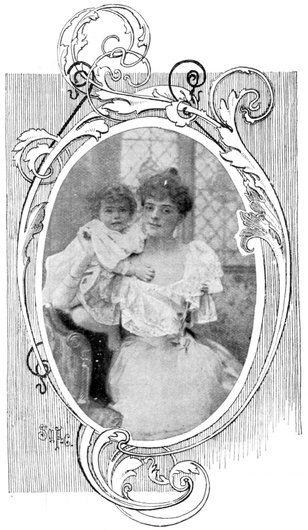
Alice Hughes, Photo
COUNTESS OF ESSEX AND BABY.
Lord and Lady Essex are both keenly interested in sport and in animals. They have no town house, but entertain a great deal in their beautiful Hertfordshire place.
The young Countess of Craven is the daughter of an immensely wealthy American couple, Mr. and Mrs. Bradley Martin; even before their daughter's marriage, they generally spent half the year in Europe, and their entertainments and house parties became notable for almost "Ouidaesque" lavishness. Mrs. Bradley Martin possesses the most valuable collection of jewels belonging to any American woman. Her rubies alone are valued at £40,000, and a fan which she gave her daughter, and which is encrusted with pearls, rubies, emeralds, and diamonds, is intrinsically worth £2,000.
Since the marriage of Miss Cornelia Bradley Martin to the fourth Earl of Craven, the young American countess has taken a prominent place among the country hostesses of the day. She has already entertained Royalty several times.
One of the most attractive American women who have made their home on this side of the Atlantic is Lady Terence Blackwood, the pretty young daughter-in-law of the Marquis of Dufferin. Before her marriage, Miss Flora Davis was for some time a member of the American colony in Paris, and her marriage took place while Lord Dufferin still occupied the British Embassy.
Miss Davis, though the daughter of a very wealthy man, was not, in the ordinary sense of the word, an heiress; and since her marriage she and her husband, who is Lord Dufferin's second son, have lived quite quietly either in a pretty flat in Paris, or more lately in Cadogan Square, where their house is one of the prettiest in London, each room representing a different period, the curious and valuable furniture having been a present from Lady Terence's father.
Lady Naylor-Leyland is the most beautiful American in society. As Miss Jennie Chamberlain her loveliness was the talk of two continents, and her beauty has an exquisite setting in her present London house, for her father-in-law was one of the foremost art collectors in Europe.
Mrs. Arthur Paget takes a very leading place among the American women who have made England their home, for to exceptional loveliness she joins great vivacity and charm of manner. This latter quality is probably owing to the fact that her mother, Mrs. Paran Stevens, was always surrounded in New York by a circle of intellectual and interesting people.
Mrs. Arthur Paget is celebrated for her wonderful collection of jewels, which includes a rope of the largest pearls in the world. She is also very fond of emeralds, and is often seen wearing a tiara of these beautiful stones. Like Lady Naylor-Leyland, she is a very successful London hostess, and she has revived the fashion of poudré and fancy dress balls. Colonel Paget is a cousin of Lord Anglesey.
The same year that witnessed the marriage of the Earl of Essex to Miss Adele Grant witnessed another interesting Anglo-American alliance, that of Miss Mary Caroline Cuyler to Sir Philip Grey-Egerton. Lady Grey-Egerton, who is the proud mother of twin sons, born two years after her marriage, is very fond of society. She is an enthusiastic cyclist.
Ignota.
THE BIRDS OF THE MONTH.