Volume 1 — MY FAIR NEIGHBOUR'S PIANO, AND WHAT CAME OF IT.
Reading edition
By Henry Martley.
Illustrated by F. H. Townsend.
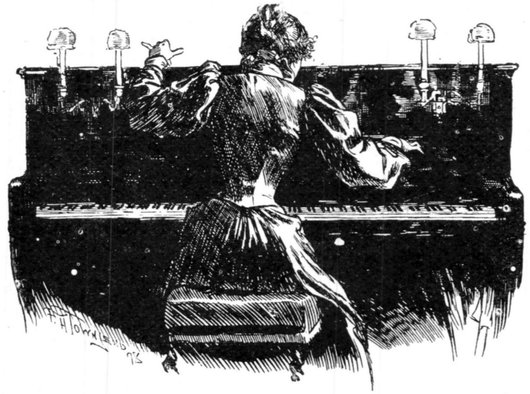
When I heard that a lady had taken the flat over mine, I feared the worst. The worst had come. Dum-dum-dum went the throbbing piano above. The former occupants of that flat has possessed a baby which I used to anathematise, but even its merry crowings or midnight howls were better than this.
The lady—an elderly lady of the spinster persuasion—had passed me several times on the stairs, and I heartily wished that Providence had blessed her with a husband and several children to occupy her spare time. If I ever wanted to go into Parliament, I should have only one item in my programme, and that would be to make a licence as necessary for music in a private as in a public house. There it went—dum-dum-dum—with intervals in which that detestable old maid picked up dropped bars as though she were picking up dropped stitches.
Three times I sat down to tackle the Settled Land Acts, and three times I angrily shut the book without having comprehended a single section.
I was going in for my final at the end of six weeks, and the result of the examination would be of considerable importance to me.
My uncle had paid for most of my education, and held out prospects of a partnership, but as time went on his beneficent intentions had lost their keenness, and a failure would produce considerably less likelihood of those prospects becoming actual facts. He was an old gentleman who judged by results, and the creditable results of my life had hitherto been few. A decent place in the Honours List would mean a probability, a prize would mean a certainty, of a comfortable income for life; and if I was to work, that infernal noise must stop. Legal redress I had none, nor would complaint to the landlord be of any use. There were clauses in the leases against keeping canaries, or even window-boxes, but none forbidding pianos. There was only one course open to me, and that was to appeal to the better feelings of the elderly spinster.
At first I thought of writing a note, and made some attempts at composing one, but they were either too violent or too unconvincing, and I felt that in dealing with a person of her description a personal interview would produce better fruit. On considering the matter, I decided that the interview had better take place at once. It was an unconventional hour to call, but I was not certain that I should have the courage to protest except in the heat of indignation, and I had decided on an effective rôle. I intended to appeal to her as a hard-working young man whom she was depriving of a livelihood, and to a certain extent to be appealingly distressed.
Armed with these intentions, I mounted the stairs, knocked at the door, and asked for Miss Ormerod, which I had gathered was the lady's name. The servant looked at me a little doubtfully, but finally the piano stopped, and she asked me to come in. I put on my most pathetic expression, and entered. I confronted a lady who had just risen from the piano. With some surprise I noticed that it was not the elderly spinster, but a little damsel of prepossessing attributes, and with big merry-hearted eyes.
"I came to see Miss Ormerod," I explained.
"I am Miss Ormerod," she answered.
I am never a very self-possessed young man, and this sudden upsetting of my plans took me aback. The elderly spinster was obviously only a frequent visitor. It is one thing to appeal pathetically to the better feelings of a lady of advanced years, and another to explain matters to a young damsel.
"I live in the flat down below," I continued, "and I came to call to—er——"
"Came to call?" she answered, with an amused air, and a glance at the clock.
"Not to call in the ordinary way," I stammered, "but I couldn't help it. You see, you were playing the piano, and—and——"
"Wasn't it sufficiently audible down below?" she inquired, chillingly.
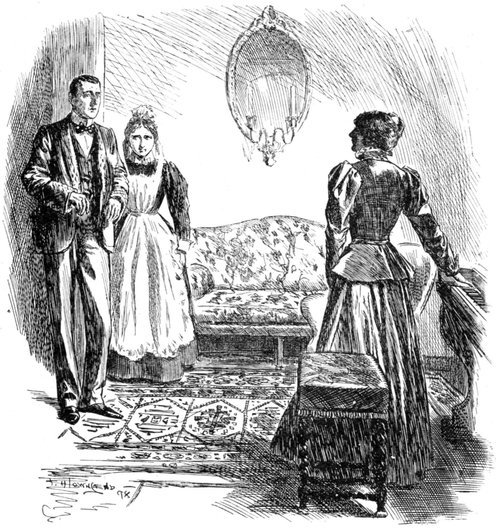
"I PUT ON MY MOST PATHETIC EXPRESSION, AND ENTERED."
"Quite audible," I answered, catching eagerly at the chance of explanation. "In fact it was too audible—that was just it. It's rather disturbing in my flat."
"And may I ask why I am not to play the piano?" she replied. "There was a noise in your flat the night before last considerably less melodious than a piano."
"I suppose there was. Ellis and some other men came to a farewell dinner with me before his departure to India. It shan't occur again," I said; "and you see, I'm reading for my final, and if you could——"
She looked at me somewhat doubtfully.
"The Solicitor's final," I added—it was a fragment of my intended appeal to the elderly spinster—"is a very difficult examination, and requires concentrated attention."
"You're reading for the Solicitor's final?" she exclaimed, with a sudden change of expression. "Oh, then you must know a lot of law."
"That scarcely follows," I began to protest, in some surprise.
"And you can explain to me what a negotiable instrument really is," she went on, delightedly.
I began to think she must be mad.
"I've been trying to make it out since tea time," she said, "and I can't. That's why I was strumming."
"Has something gone wrong with a cheque?" I asked.
"Oh, no," she laughed, "you don't understand. I'm reading law too. I'm going in for an exam at the London University. You won't mind explaining about negotiable instruments, will you, if I promise not to play the piano? Please sit down."
I sat down and explained the matter as lucidly as I could. The explanation took some little time, but though it was nearly eleven when I left, the proceeding seemed to strike her as perfectly natural, and I did not complain, particularly as it meant deliverance from the piano.
The next night, however, I had scarcely settled down when the strumming began once more. After the trouble that I had taken the night before it was ungrateful of the damsel, and she had distinctly promised that the noise should not occur again. I stood it for half an hour, and then went up to make another protest.
"I thought you were never coming," the damsel said, in an aggrieved way; "I want you to tell me the difference between a cheque and a bill of exchange payable at a banker's. Have some tea, won't you?"
I had some tea, and furnished her with further information. We discussed the Bills of Exchange Act at some length. It was a much pleasanter way of imbibing the law than by one's self, and her vivâ voce examination was not without its uses. However, the situation was unconventional, and I had my doubts on its advisability.
The next afternoon, when I came back from the office, I was informed that a lady was waiting to see me. In my room, sitting perpendicularly on the edge of an armchair, was the elderly spinster.
"Is your name Arbuthnot?" she inquired, abruptly and severely.
I admitted the accusation.
"Then, Mr. Arbuthnot," she said, grimly, "I wish to have a word with you. I hear you have been forcing yourself on my niece."
"I beg your pardon?" I said, in astonishment.
"Forcing yourself on that poor misguided child," she continued, "and taking advantage of her folly in the most ungentlemanly way."
"If you mean Miss Ormerod," I answered, "perhaps I might explain."
"Perhaps you might," she replied, acidly.
I told her what had happened, and how the mistake had occurred. I was never very remarkably tactful; and, even if I had been, any other explanation than the truth would have been difficult.
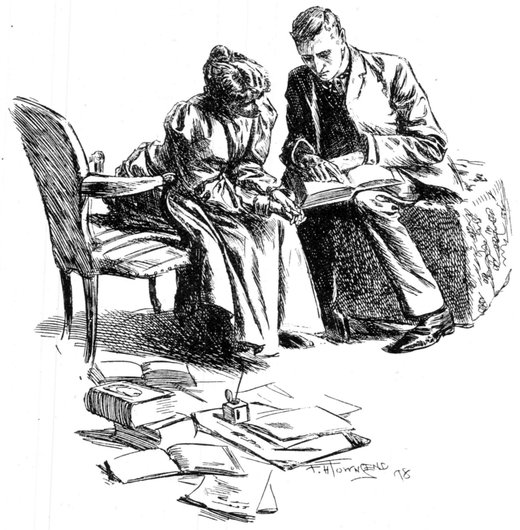
"THE EXPLANATION TOOK SOME LITTLE TIME."
"So you supposed," she answered, "that I should have allowed young men to call on me at a late hour?"
That was rather a poser, and I made no answer.
"Your excuse," she went on, "only confirms my previous opinion of you. You have deliberately forced yourself on a crazy, motherless child, who does not understand the ways of the world, nor, I regret to say, what is due to herself."
"I have done nothing of the kind," I said, indignantly.
"I might have known that it was degrading myself to talk to an attorney's clerk," she said, with an awful emphasis on the last two words. Then she strode away.
That evening the piano began again, but I sat stolidly and endured it. After all, there was something in what the old lady said. The strumming continued for an hour, and then stopped. In a few minutes the servant brought me a note.
"Dear Mr. Arbuthnot,
"I cannot understand when a banker is liable for a forged cheque.
"Yours sincerely,
"Marjorie Ormerod."
I wrote back to say that I had had an interview with her aunt, and appended the law on the subject of forged cheques. My note had not been dispatched more than five minutes when a knock came at the door, and Miss Ormerod walked in.
"Mr. Arbuthnot," she said, "will you kindly tell me the meaning of this note?"
"I thought I had made my meaning clear," I answered. "A banker——"
"I was not referring to bankers," she replied, "but to what you say about my aunt."
"I supposed she would have told you," I said. "She did me the honour of visiting me this afternoon, and—well—she suggested that there were conventionalities."
"She's been gossiping with my servant," she exclaimed; "but why do you pay any attention to what she says?"
"You see," I ventured to protest, "there are conventionalities."
"Conventionalities," she replied, firmly, "are some of the things that I do not intend to have in my life. If I were a man, and I wished to—to ask you a polite question about forged cheques, wouldn't you answer it?"
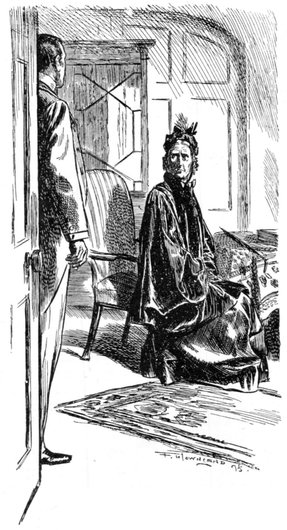
"'I HEAR YOU HAVE BEEN FORCING YOUR ATTENTIONS ON MY NIECE.'"
As a matter of fact, if a man had asked for instruction under pain of playing the piano, I think I should have refused; but to say no would have resulted in embarrassing explanations of my previous readiness to enlighten her. So I replied diplomatically—
"Perhaps so."
"Then," she said, "I insist on your coming upstairs at once. You will insult me, Mr. Arbuthnot, if you refuse."
Since she put it in that way, I was compelled to give in, however much I agreed with the old lady. When I had finished my exposition of the law, Miss Ormerod expounded some of her theories of life, with autobiographical illustrations. The fundamental theory seemed to be that a girl ought to be allowed to do anything without taking the consequences. As a deduction from this great truth, she had decided to live alone and become a London University Portia. At one time she had intended to pursue her ambitions at an Oxford college, but inquiry had revealed the fact that the girls there were still in swaddling clothes. It was only in London, and in a flat, that the true woman—she disclaimed the term new woman—could possibly realise herself. Most of her life she had spent in the country, a fact which I might have guessed. One of the main fallacies which the true woman was going to expose, and which had been intruded on her that night, was the notion that no girl could associate with a man without some foolish idea of love-making. This fallacy she denounced vigorously, and, as I thought, with a purpose. It was naturally not a conversation in which I could take much part, and I listened mostly in silence.
The situation was more unpleasant than the piano. It was hard to avoid further interviews, and at the same time I knew that I ought to do so. The little girl had contracted some diseased modern notions, and I had no business to aid and abet her. However, if she persisted in regarding it as an insult for me to do my duty, I saw no alternative but to acquiesce. I could only hope that in future she might find fewer difficulties in the law. In this hope I was disappointed. Regularly for the next fortnight the piano demanded instruction every evening, and with more and more misgiving I obeyed it. The fact was that I felt myself beginning to take a disquieting interest in her, and at the end of the fortnight I acknowledged frankly to myself that, as far as concerned me at least, her favourite fallacy had been proved true.
Matters were in this condition, and were already sufficiently complicated, when a further complication was added to them. Shortly after my arrival home one evening, a person of Hebraic appearance was shown in, who announced himself as Mr. Hart.
"Good evening," he began, greasily; "I have been consulted by Miss Prentice in regard to a rather delicate matter. Miss Prentice has, I believe, already spoken to you on the subject."
"Has she?" I inquired. "Who is Miss Prentice?"
"She is the aunt of Miss Ormerod, the young lady who lives above you," he went on. "She informs me that at her interview with you she found you—shall we say?—unreasonable."
"Well?" I said curtly, for I disliked the man.
"Now," he continued, "of course we know that Miss Ormerod, though holding these peculiar views, is a young lady possessed of a considerable fortune—not very large, but considerable."
"Do we?" I answered. "I know nothing of the kind."
"Come, come," he said, "let us talk as men of the world—in a friendly way—but as men of the world."
"If you'd kindly tell me the object of your visit, I should be obliged," I replied.
"Oh, I can quite see your point of view," he said, with an oily leer. "Miss Ormerod, being, as I say, possessed of some fortune—not so large as some people might suppose, but some fortune—her relations are naturally anxious that she should not marry without seeing a little more of the world than—shall we say?—can be seen in these flats."
"Are you incapable of saying what you mean, sir?" I inquired, with gathering suspicion.
"As a brother professional, you must know that things cannot always be put crudely," he said. "Of course, Miss Prentice is not a lady to be parsimonious where her niece is in question. At the same time, she is not a lady of unlimited means. I may, however, remind you, Mr. Arbuthnot, that a bird in the hand——"
"Do you mean," I burst out angrily, "that I am supposed to be attempting to inveigle Miss Ormerod into a marriage, and that you've come here to offer me a bribe?"
"Gently, Mr. Arbuthnot, gently," he protested.
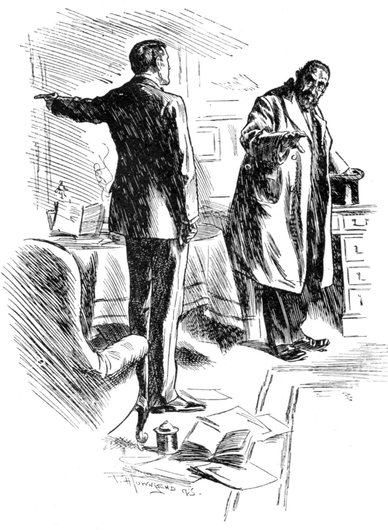
"'WILL YOU KINDLY LEAVE THE ROOM AT ONCE?' I ROARED."
"Will you kindly leave the room at once?" I roared.
"I was afraid this might happen," he answered, "so we made a few inquiries and took precautions. There are such things, Mr. Arbuthnot, as unpaid Oxford debts, eh? And tradesmen are sometimes so distrustful as to sell those debts. Now, here's a tailor's bill—dear me, where's the schedule? Yes, a tailor's bill for £57 odd."
"What on earth do you mean?" I said.
"And you can have all these bills and a little ready money," he went on, "if you'd only be reasonable."
"Get out!" I exclaimed again.
"Do be reasonable, Mr. Arbuthnot," he purred on, "or otherwise I may be compelled to follow my instructions and sue, and—I regret to say it—sell you up, and prevent your inhabiting this delightful little flat any longer."
"I give you just one minute," I said, taking out my watch.
"Oh, very well, very well," he answered; "a gold watch—I must remember that."
I sat down and cursed that elderly spinster. The position was quite delightful. Those bills, as far as I remembered them, amounted to something over £300; and, if my uncle discovered their existence, my prospects of a partnership, and probably even my allowance, would be at an end. Never having been at a university himself, he held strong views on the subject of getting into debt. That evening the piano played again, and I went up to explain Miss Ormerod's difficulties as usual. With dramatic irony, they concerned the sale of goods.
Borrowing the money was out of the question, and I resolved desperately to allow the law to take its course, and to spend the few remaining days in Miss Ormerod's company as far as I could. Our legal discussions, and sometimes our discussions on other things, became more protracted, but the time went swiftly, and in the course of a fortnight or so there was a man in possession. Probably if that elderly spinster had been gifted with any capacity for sitting tight, I should now be in South Africa, but as I sat burning my letters preparatory to the sale, Miss Ormerod burst in.
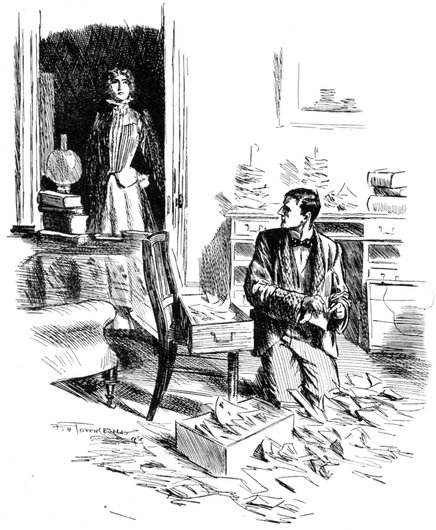
"'I'M VERY ANGRY,' SHE SAID."
"Mr. Arbuthnot," she said, "I should like to have a few words with you. I'm very angry."
I followed her meekly.
"My aunt has been here this afternoon," she began, when we had reached her flat, "and I hear that you are in debt, and that your furniture is going to be sold."
"It is quite true," I said, wearily. "You see, I got into debt at Oxford——"
"Do you think I'm a fool?" she asked, indignantly. "What has my aunt got to do with it?"
"Your aunt?" I answered. "What should she have to do with it? I suppose someone informed her——"
"You suppose nothing of the kind," she answered, hotly. "I know why; she told me. It was because she disapproved of—of your tuition, and I'm sure she had something to do with this, or she wouldn't have been so pleased with herself. I know my aunt only too well. On your word of honour, isn't she concerned in this, Mr. Arbuthnot?"
"What in the world," I replied, attempting to parry the question, "should a respectable elderly lady like your aunt have to do with debt-collecting?"
"There are very few things," she answered, "with which my aunt has not to do if she gets within measurable distance of them. Now, will you please explain?"
"How can I," I said, "if there's nothing to explain?"
"I think you told me the other night," she answered, "that suppressio veri sometimes amounts to suggestio falsi."
"Miss Ormerod," I said, "I've got a lot of letters to burn to-night, and I am rather busy——"
"Oh, very well," she observed, "then I must find out for myself."
She hurried down to my flat along the passage, and burst open the kitchen door. The sheriff's man had already drained the beer-cask, and was sitting smoking with his feet on the kitchen range.
"Now," Miss Ormerod remarked, "please tell me why you're here."
"If you open your mouth," I broke in, "I'll throttle you."
"You're a witness, young lady," the man said, "he's threatened to assault an officer of the law in the execution of his duty."
"Perhaps this might soothe your feelings," Miss Ormerod said, slipping something into his hand.
"I'll give you a sovereign to hold your tongue," I exclaimed, desperately.
"Very well, sir," he said, "hand it over."
"I'll give it you to-morrow," I replied. As a matter of fact my cash in hand amounted to some fifteen shillings.
"Oh, I daresay," he replied, with a grin. "Make it five shillings more, young lady."
He got the five shillings, and then began as though he were unfolding a portentous secret.
"I'm in for a matter of £300 recovered in the action of Prentice versus Arbuthnot."
There was no false delicacy about Miss Prentice; she had gleefully sued as assignee in her own name.
"Miss Ellen Prentice?" Miss Ormerod asked, quickly.
"I fancy that's the name," he said, searching among some greasy papers.
"Oh, that will do," Miss Ormerod replied, with a flushed face. "Mr. Arbuthnot, I want to speak to you."
She swept upstairs again, and I accompanied her in silence.
"Now, perhaps," she remarked, "you'll be good enough to tell me the truth."
I told her a part of it, including the visit of my Hebraic friend, but I omitted his suggestions of the matrimonial objects of my visits. Miss Prentice's proceedings, I suggested, were all due to her regard for the conventionalities and her niece's welfare.
"Of course," she began, sitting down and taking a chequebook from a drawer, "you'll let me lend you this money."
"Thank you very much," I said, "but it's quite out of the question."
"How preposterous!" she exclaimed, in astonishment. "If a man were to offer you the money——"
"Very likely," I said; "you are not a man."
"But what difference in the world can that make?" she inquired, indignantly.
"In the world," I said, "it makes a considerable difference."
"But we've been friends, Mr. Arbuthnot," she said, appealingly, "and this is my fault. Won't you take this wretched money to please me?"
"I'd do most things to please you," I answered, "but I can't do this."
"I—I don't understand," she said, in a half-broken voice, and looked at me dolorously for a moment or two.
"Will you be able to be a solicitor after this?" she asked.
"Oh, I haven't thought about things yet," I answered.
"Surely you might tell me," she said, tearfully; "I think I've ruined your life."
"Miss Ormerod," I remarked, getting up, "what's happened was my own fault, and you're not to blame in the least; but I think it would be better if I went down to my place and finished looking things over."
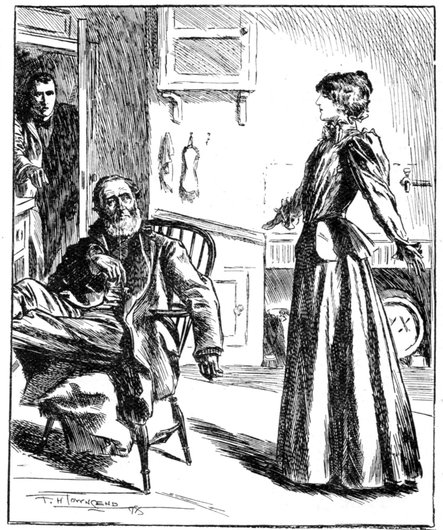
"'PLEASE TELL ME WHY YOU'RE HERE,' SAID MISS ORMEROD TO THE SHERIFF'S MAN."
"Oh, but I can't let you go like this," she pleaded, tearfully; "it's so silly of you. I've got such a lot of money, and surely you'll do me a favour and let me lend you a little of it."
"It's out of the question," I said.
"And," she pursued, a little timorously, "how am I to get through my examination if you won't help me? You've helped me so much, Mr. Arbuthnot, you really have."
"Good-bye," I said, holding out my hand.
"It's cruel of you, very cruel," she went on, without noticing it; "and—and you don't seem to mind in the least."
"What's done is done. Good-bye," I said again.
"And I suppose you'll go somewhere—quite away from this?" she continued, "quite far away?"
"Probably," I said.
"But don't you mind—at all?" she asked.
"It's not particularly pleasant," I admitted.
"We've been good friends, haven't we?" she said, with a little quiver of her lips.
"The best of friends," I agreed.
"Good-bye," she said, holding out her hand.
As I took it our eyes met, and she drew her hand back. It was hard, under the circumstances, not to look something more than the best of friends.
"I suppose," she said, "that you refused to take that money because—because it would have hurt your self-respect."
"I think so," I answered.
"Well," she went on, slowly, and half turning away, "girls have their self-respect too."
"What manner of man must you think I am?" I asked, understanding a little what she meant, but refusing to take advantage of what I thought the little girl's mistaken chivalry.
"And what manner of girl must you think me?" she replied, and burst out crying.
"Don't think I don't understand and don't appreciate," I said, lamely.
"Go away, go away," she sobbed.
"I can't go," I said, "till I have explained. I don't quite know how to, but our friendship began with bills of exchange, and don't you think a debtor would sometimes prefer not to have an acceptance for honour when he cannot pay his debts?"
"It depends," she said, softly, and with a lamentable disregard of the law, "whether it's supra protest."
"Don't tempt me too far," I urged.
"I am not tempting you," she said, getting up and turning on me angrily.
"If you only knew," I protested, bitterly, and her face changed.
"How am I to know," she asked, "if you refuse to tell me?"
"What right have I?" I burst out.
"A right," she murmured, "implies an obligation, and of course——"
Well, well, the rest of the conversation was commonplace except to ourselves. The man in possession exhausted most of my capital in getting extremely drunk that night, my uncle insisted for the first time in his life in regarding me as a clever fellow after all, and Miss Prentice has been confirmed in her opinion that I am a scheming scoundrel.
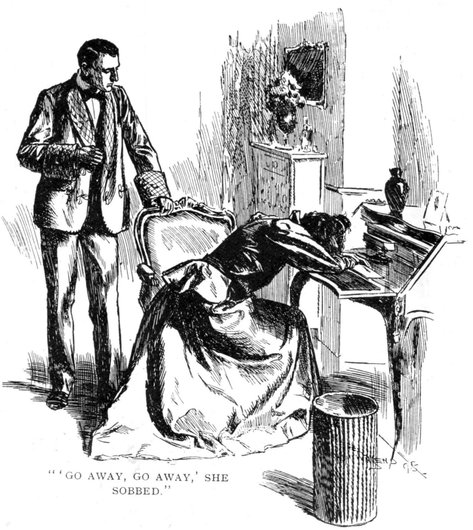
"'GO AWAY, GO AWAY,' SHE SOBBED."