Volume 1 — A VERY QUEER CRICKET MATCH. MR. DAN LENO'S ELEVEN v. CAMBERWELL UNITED C.C.
Reading edition
By Gavin Macdonald.
Everybody has seen Mr. Dan Leno—King Humorist of the variety stage. Or if they haven't seen him, they have heard of him.
As a singer, comedian, and grotesque actor he is incomparable. As a cricketer he dwarfs the reputation of the mighty W. G. to mere nothingness.
Mr. Dan Leno is a modest, retiring man. In a general way he practises in his back yard, and confines his matches to the prescribed area of the lawn-tennis plot at the rear of his house. He says he has done well in one sphere, and he spurns the suggestion that he should enter another.
There is only one thing that will wean him from his resolution, and in this the members of his profession resemble him to a man. In the cause of charity they may be relied upon to throw all objections aside.
It was at a charity match played recently at Dulwich, in aid of a local pension fund, that I had the pleasure of witnessing the most remarkable exhibition of cricket it has ever been my lot to witness.
It was advertised as a one-day match between an eleven of local players captained by Colonel Dalbiac, M.P., and an eleven of eccentric cricketers, known as Danites, under the captaincy of Mr. Dan Leno.
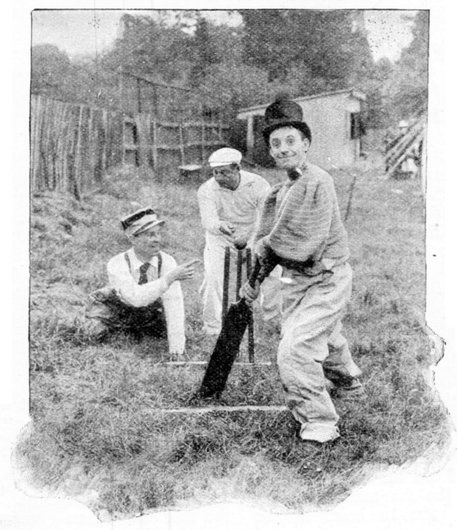
MR. LENO AT THE WICKET.
The latter team was composed of the following gentlemen, all more or less well known to fame—Messrs. Dan Leno, Eugene Stratton, Harry Randall, the Brothers MacNaughton, Pastor, Glennister, Cobbett, Joe Elvin, Griffiths, and Tressider.
The various preliminaries differed somewhat from those usually in evidence on the cricket field, but the 3,000 spectators enjoyed them so much that it might be advisable for the county clubs to follow suit and ensure a big gate.
Punctually at the appointed time the two elevens emerged from their tents and showed themselves to the expectant crowd. The Dulwich XI. were conventionally clad in white flannels and club caps. Not so the Danites. As they marched in single file from their tent, a great silence came over the multitude. They were stricken with an astonishment too deep for words. Where was the idol of the hour? There was no Dan Leno apparent among those grotesquely-clad creatures.
The little man in the van of the procession, with the tall silk cricketing hat of a bygone age, loose holland bags falling like anæmic concertinas over his shoes, the striped wool blouse with puffed sleeves and the huge black beard and side whiskers. Surely that was not he. The crowd looked hard. As they did so the little man's features relaxed into an elastic smile, so elastic that none could mistake it. Then they cried, "Why, it's Dan," and sat down and cheered till they ached. One by one the other members of this strange eleven were identified through their disguises, and the fun began.
The team marched in comic single file round the field at quick time. Every few steps Capt. W.G. Daniel Leno stopped to bow his acknowledgments, and as he did so the remaining ten ran forcibly into each other's backs and rolled heavily over each other on the grass from the force of impact. Wigs, false moustaches, and other stage impedimenta dropped in the mêlée, and the spectators stood up on end and swayed with laughter.
At the wicket Dr. W. G. D. Leno met the opponent captain. There was a sporting handshake, and the former skied the fateful coin. The crowd wanted the Eccentrics to win the toss. But there was little enough cause for anxiety. Dan Leno had a double-headed coin, and he called to it himself, which conclusively settled the matter. He elected to go in first.
Rightly or wrongly, he was of opinion that the ordinary entry of the opening side was a tame sort of affair. Dan Leno has something of the old Roman in him. He likes a state entry and the plaudits of the populace. He and his team once more processed off the field to a distant corner where a dozen chargers brayed in melancholy inactivity. Here all were mounted satisfactorily but the fat man, whom it took half-a-dozen men to hoist in the saddle. Then to the music of a thousand throats the team flew round the ground and charged on to the wicket.
Never was entry so triumphal. The splendidly-trained chargers swished their tails majestically, and brayed in lieu of trumpets. Then, without so much as a command, they planted their fore feet firmly on the green sward, dropped their riders over their heads, and departed from whence they came.
Dan Leno and T. MacNaughton took their places at the wicket; the remaining Danites, contrary to custom, squatted about the field, and the match began.
The first ball hit the middle stump on the top and downed the wickets like ninepins. "How's that?" called the Dulwich team. "Out," said the umpire.
Dan Leno was more than surprised, he was disgusted and hurt. "Out? What do you mean?" he said, with a glance of contemptuous pity at the umpire. He called a couple of his team to assist him in his protest against such a palpable piece of jobbery on the part of the opposition team.
The two gentlemen appealed to were unanimous in their opinion that he could not possibly be out. The thing was absurd. The Dulwich team, umpire and all, laughed so much that they were physically incapable of doing or saying anything. When you glance at the snapshot we obtained of this tableau, you will not be surprised at this.
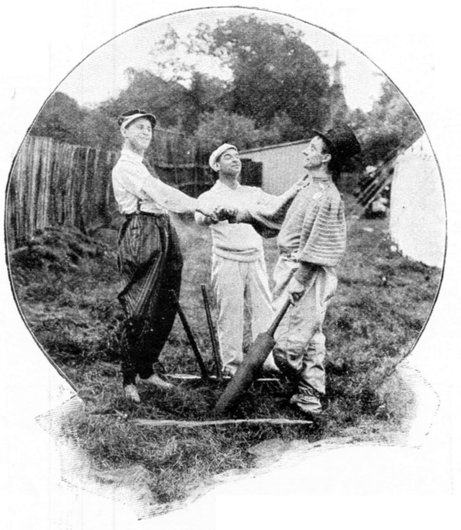
MR. LENO'S SATISFACTORY APPEAL AGAINST THE UMPIRE.
At the precise moment when their captain was engaged in an attempt to prove that the bowling of the middle stump did not necessarily imply being out, some member of his team cried, "Trial ball." It was a happy thought. In a moment the field was in an uproar. "Yes, yes—trial ball!" came from all sides. The plea was allowed, and Dan went in again to the tune of frantic laughter and applause. As the next ball came up he dropped his bat, caught it in his hat, and ran. He scored ten runs, and then quietly handed the ball over to the bowler again. Nobody objected to this novel method of scoring. Everybody enjoyed it too much to dream of protesting.
The Danites had opened the match with a useful ten, but there was more to follow. T. MacNaughton was now at the batting end, and he drove the ball out to boundary over the heads of some of the Danites sitting on the grass.
Before any of the field reached it, one of these gentlemen slipped quietly to the edge of the crowd, picked up the ball, and disappeared.
When he had chatted to a few friends and visited the refreshment booth, he returned and laid it quietly on the field again. Messrs. Leno and MacNaughton were standing at the wickets utterly blown, with another twenty runs to their names, and the field were playing hide and seek among the spectators searching for the lost leather.
The captain's wicket went down a score of times. They were all trial balls. He was stumped over and over again, but he maintained that, as he had never been stumped before, he couldn't be now, and stuck doggedly to the wicket.
He looked like carrying his bat out, and MacNaughton was scoring steadily the whole time, tens and twelves being common incidents of the play, especially when an enthusiastic Danite succeeded in getting hold of the ball and threw it to the opposite side of the field, from whence it had to be fielded all over again.
However, there is an end to all things. A good curling ball sent the valiant W. G. D. L.'s stumps to the four corners of the heavens, and the umpire gave him out.
In vain he protested "Trial ball," his own side were in agreement, and he was invited to leave the crease. Little Dan said he was there, and there he meant to be.
Unfortunately at that moment a Danite, rigged out as an inspector of police, pulled out a whistle and blew it shrilly. The whole field followed him, and, kicking, blowing, and raving against umpires and their decisions, the hero of the hour was borne forcibly from the field.
A wave of deep distress came over the spectators as Dan Leno was carried out. All felt that, in view of his unexampled performance, he ought to have carried out his bat.
Nobody can say the Danite XI. were not good sportsmen. They all stuck to the wickets till they were carried off.
Harry Randall made a brave show of sticking, but the odds were overwhelming.
Mr. Eugene Stratton's left-handed batting elicited the warmest approval by reason of its novelty. This may be accounted for by the fact that he is an American, and prior to this occasion had never played any game but baseball.
Bowling is Mr. Harry Randall's strong point. His delivery is unique, and the sight of him should be of practical value to aspiring trundlers.
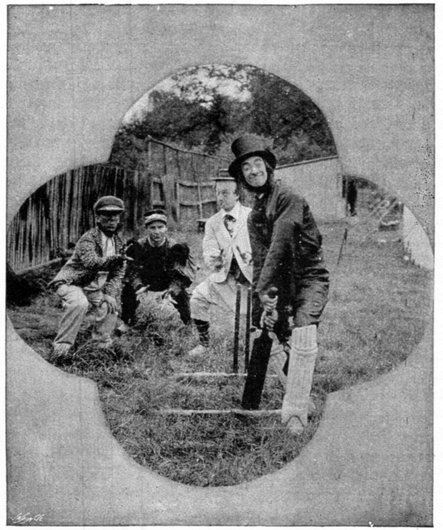
ONE OF THE BROTHERS MACNAUGHTON BATTING. MESSRS HARRY RANDALL AND EUGENE STRATTON IN THE SLIPS.
At lunch time all the Danites were out. Then came the rub. Owing to various eccentricities on the part of the players, a detailed score had not been kept. Captain Leno was appealed to. He said he didn't actually know how many they had made. The runs were so numerous he couldn't keep up with them. However, he observed that his side "felt" as though it had made at least 275 runs. They had probably made twice as many. Accordingly the first innings was closed at that, to the entire satisfaction of everybody, including the spectators, who cried with laughter at this new method of settling off old scores.
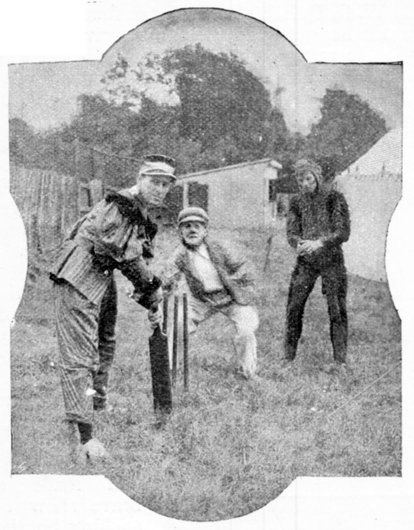
MR. EUGENE STRATTON AS A BATSMAN.
After lunch the Eccentrics took the field, and the Dulwich men went to the wickets.
Hereafter it was cricket extraordinary, and no funnier burlesque was ever seen upon the stage. The bowlers were not bowlers, but they were excellent mimics. They knew it was the correct thing to stroll away from the wicket and back again before a delivery. They walked a quarter of a mile or so to the boundary each time, and returned at 20 miles an hour in the most approved style, launching the ball at a terrific pace. The very first ball was at least ten yards wide, but somebody called, "How's that?" "Out!" said the umpire, and "Out" it had to be. The batsman looked blankly from one to the other. He was too stupefied to protest. Had he done so it would not have helped matters. He had been given "out," and out he had to go. The Danites threw the ball madly skyward. They careered against each, rolled in one indistinguishable mass on the grass, and yelled till they were hoarse. The crack player of the opposition eleven gone—out without a run! The next ball missed the wickets, but it clean bowled the fat man, and he rolled along the grass like a wind-driven hat.
When twenty or thirty balls had been sent up by the boundary-walking trundlers somebody called "Over," and the Danites quadrilled gracefully over the pitch. This little manœuvre occurred at every over.
The next Dulwich man was knocked out in a peculiar and novel way. He did not touch the ball at all, but the fat wicket-keeper ran in and caught it from the bowler's hands. Then he threw it in the air. "How's that?" he cried. "Out!" cried Dan Leno, neatly catching it in his top hat. The batsman laughed, and the spectators joined him. "How's that?" asked Captain Leno of the umpire. "Out," responded the latter. The batsman walked sadly from the wickets. He thought he must have been standing without the crease, and had been stumped without noticing it.
So brilliant was the play of the Danites that the other team by one means or another were got out for an "estimated" total of 25 runs.
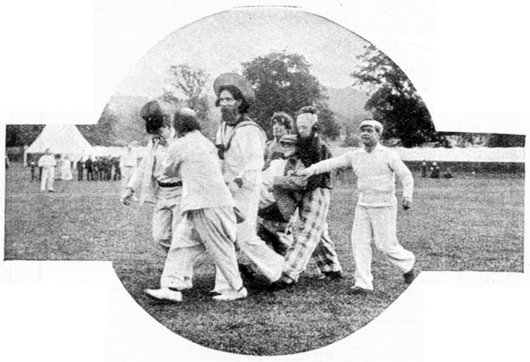
HOW MR. LENO WENT "OUT."
It was admirable fooling all the time, and it says much for the "stars" of the music hall that they are willing to give their services so freely in the cause of charity.

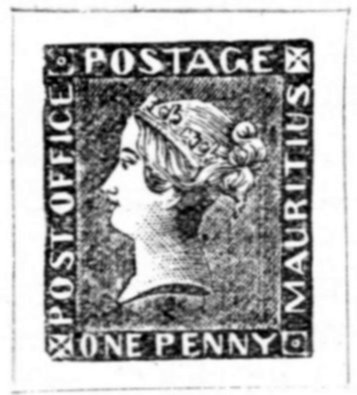
WORTH £960.
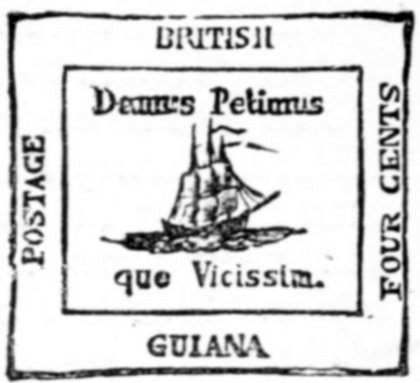
PRICE £300.