Volume 1 — PHOTOGRAPHIC LIES. PROVING THE USELESSNESS OF THE CAMERA AS A WITNESS.
Reading edition
There is a popular notion abroad that the art of photography is a first cousin to George Washington, and cannot tell a lie. The wider knowledge of the art, due to its adoption by hundreds of thousands of amateurs as a hobby, has largely shown the fallaciousness of this belief. Yet photographic fakes of a most absurdly simple nature still continue to impose upon the credulity of thousands of people, among the number being many who have gone so far as to accept such inventions as irrefutable evidence, in their ignorance of the possibilities of this, perhaps, the most elastic of all arts.
A striking instance of this is seen in the so-called "spirit" photographs, published some years ago by Mr. W. T. Stead. The brilliant editor of the Review of Reviews, a deep believer in spirit manifestations, argued that these photographs afforded the most conclusive proofs of the playful habit spooks have of returning to the scenes of their earthly labours.
He said that they were on the photographic plate, and, that being so, they must have been there "in the flesh," or "in the fog," as Mark Twain has it.
Unfortunately, this apparently conclusive argument was completely upset by Mr. Labouchere, who possessed a greater knowledge of the ways of photographs and photographers than his colleague, and explained how it was done.
As a matter of fact, the photographic ghost is an easily explained phenomenon, and any amateur can turn out creepy spooks by the thousand at the expense of a little time and patience.
A photograph is absolutely inadmissible as evidence of anything, unless it is proved conclusively that it was in nowise faked after being taken.
The faking can be carried on almost to any extent. In fact, nothing is impossible to the clever knight of the camera.
If a photographer wished to show that you were in a particular street at a certain time, he could do it with the greatest ease, notwithstanding that you were a thousand miles away at the moment in question.
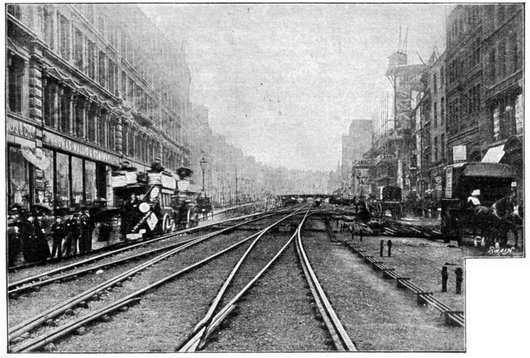
A RAILWAY IN HOLBORN, LONDON!
If he wished to prove that your dog or pony had trespassed on his flowerbeds, it would be a simple matter to do so, and if cleverly done I doubt if the "fake" could be detected.
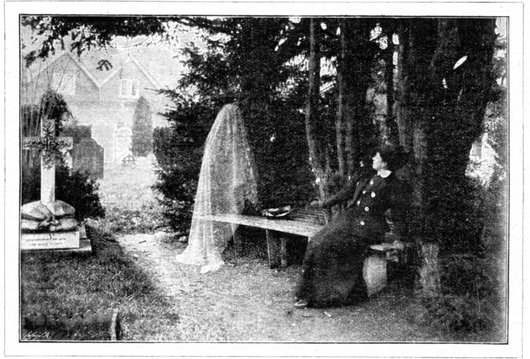
A GHOST WHICH WAS NOT A GHOST.
Anyway, I have seen many faked photographs that experienced photographers themselves were at a loss to explain.
In this article I propose to give some examples of extraordinary faked photographs, and explain to some extent how they are done. In each case they have been specially prepared for the illustration of this article, and amateur photographers who read this might do worse than copy them.
Many of these required considerable technical skill and inventive resource.
These qualities are exhibited to a high degree in the illustration of the railway in Holborn, for while we are glad that an electric train is to run under Holborn, no living or dead man has ever seen a train in Holborn itself. Such fakes occupy a considerable time in manufacture.
While the explanation is simple, the carrying out of this fake was a matter of some difficulty.
First a picture of a railway junction was taken. Then it was necessary to take a photograph of Holborn. This in itself is a simple enough matter, but in this case it was necessary to obtain a picture of exactly the same scale, in order that the railway lines might be fitted to appear as a natural part of the picture.
This was only managed after several ineffectual shots. Then the latter negative was placed in the printing frame with the roadway masked. When sufficiently printed the railway negative was placed in the frame on the same paper. That part of Holborn already printed was masked, and thus the rails were printed in the space where the roadway should have been. The result will make Londoners rub their eyes.
The two ghost photographs are specially calculated to puzzle not a few who are unacquainted with the tricks of the art. Like most puzzling things, they are simplicity itself when explained. There is not a suspicion of mystery about them. By the same method any amateur may manufacture a whole gallery of family ghosts for his delectation.
The invocation of our ghosts was on this wise.
A nice, quiet, suitable sort of churchyard not a dozen miles from London was chosen, and, with a couple of assistants, I hied myself to it one bright and anything but ethereal morning.
First, the lady was posed till we were satisfied that she looked scared enough for a ghost to be turned on. A second later my other assistant, with the best dining-room tablecloth thrown over his head, came on the scene, glided with healthy earthly steps to a pre-arranged spot, and took up his position.
Snap went the pneumatic shutter. The photographic plate, one of an extremely rapid variety, was exposed for the space of a second, and the ghost hid himself behind the camera and took off his tablecloth. The lady meanwhile remained in the same position, and directly the ghost disappeared, snap went the shutter again on her. So in the interval of nine seconds this wonder was perpetrated.
Those who have not dabbled in photography will require a further explanation of the need of two exposures of the same plate. In the first place, then, I assume that everybody knows that a photograph is the result of light acting on a glass plate coated with a sensitive preparation. When the photographer says, "Now then, a smile, please. Thank you. Steady," you may have noticed that he touches an indiarubber ball. This is a pneumatic release, which momentarily exposes the plate to the light. In that brief period the light eats or rots the sensitive material, at the same time faithfully imprinting upon it an exact image of whatever may be before it.
Now the whole secret of successful photography may be said to depend on this exposure being of the right length. If it is too short, the light has insufficient time to clearly impress the plate with the picture. If it is too long, the image will be too dense.
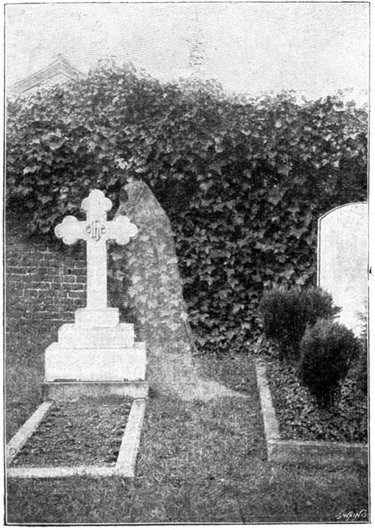
PROVING A MAN TO BE TRANSPARENT.
So much technique is necessary to a proper explanation of ghost pictures. Now the one second exposure given to our friend the ghost was much too short a time in which to obtain a good portrait of him, but quite long enough to obtain a faint shadowy image, which was just the thing desired.
On obtaining this he quietly walks out of the picture, and we then open the plate for another eight seconds, which is just long enough to obtain a clear and normal photograph of the rest of the picture, including the startled sitter, who has not moved in the meantime. And what is of still greater importance, it gives sufficient time for the foliage and end of the seat to impress themselves through the first picture, and so produce that shadowy transparent texture beloved of all aristocratic varieties of the ghost species.
The tombstone spirit was produced in the same way, a second exposure being given to the tomb, the grass, and the ivy-covered wall behind.
It will be seen that the ghost picture is a particularly simple example of the "fake" photograph.
In the beginning of this article I spoke of the futility of admitting the photograph as evidence.
To prove my assertion, I have been at some pains to prepare a faked photograph that will show how a subject might be "doctored" and put in as conclusive proof.
I have assumed, for the purpose of this example, that a prisoner charged with an offence, say in the North of England, has sought to set up an alibi by producing a portrait of a street in which he himself is seen. For the sake of argument, we will say that the photograph was taken by a friend who is prepared to swear that the picture was made on the day of the crime. Supposing this to be the case, if the photograph were accepted as evidence it would undoubtedly be instrumental in getting the accused off.
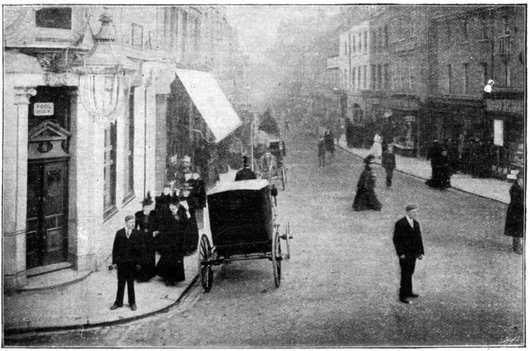
SHOWING HOW A MAN CAN BE IN TWO PLACES AT ONCE.
Now such a picture might readily be faked so as to deceive the most experienced. In order to realise this, you have only to glance at the photograph on this page.
The scene is a street at Richmond, and in the foreground two men are standing. If you look at them for a moment you will observe that they are in reality one and the same person. As we have not yet discovered a method of creating a double, it is perfectly clear that one at least of these figures has been "faked" or printed into the original photograph, and I don't know that it is very clear which.
As a matter of fact the one on the left-hand side was taken in the original picture, and the other is faked. Two figures of the same individual are shown, because, had we published one, and stated that the other was "printed in," it is possible some people might question the statement.
As it is, the duplicate clinches the matter, and the obvious deduction is that if one photograph can be faked in this manner, so can another.
However, we doubt if photographers, amateur or otherwise, were ever guilty of using their knowledge of fakes for any purpose other than that of amusement, and that indeed was our idea in shedding light on this comparatively unknown subject.
By the simple expedient of faking in the printing operation you may do what you will with friend or foe.
Cecil Rhodes may shake hands with Oom Paul, and the nation may be persuaded that they have forgotten their little amenities. It is only necessary to obtain suitable photographs of the two, the rest is comparatively simple.
The figure in the bottle would in the middle ages have burned its creator at the stake, but there is no witchcraft in it in reality. Indeed, it is one of the simplest photographic freaks to produce. In this case the figure is printed somewhat deeply on paper in the usual way, except that a mask of paper is cut to fit all round it to keep the remaining portion of the sensitive paper from contact with the light. When the print is deep enough it is taken out of the printing-frame, then placed behind a negative of the bottle, and a light print is made, with the result that the effect shown in the illustration is produced.
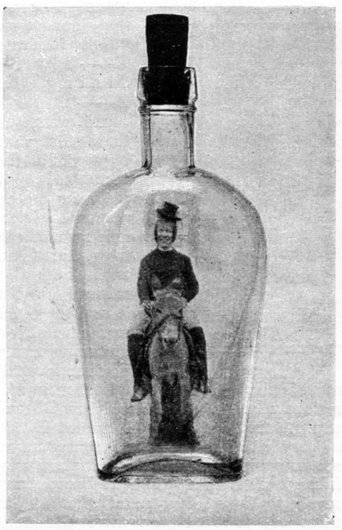
AN EXTRAORDINARY MIXTURE.
Few, save those who have had practice in instantaneous photography, realise the enormous rapidity necessary to the successful portraying of rapid movement by means of the camera.
One of the most interesting experiments in trick photography is that devoted to the evolving of composite portraits. The production of a successful composite practically means the creation of a new face. The method is similar to that employed in the making of ghost pictures. It is necessary to obtain, say, four portraits—the more used the greater the difficulty. These are all photographed one over the other on the same plate. The difficulty consists in regulating the exposures, that photographed first requiring a longer exposure than the next, and so on through the series. The example we give is a composite of photographs of well-known actors, and the face contains portraits of Sir Henry Irving and Mr. Forbes Robertson.
The composite photograph has been of great scientific value in determining the characteristic predominant features of different types of physiognomy. Our illustration is an excellent example of the typical actor's face.
A well-known professor recently composed a series of these types. One was a face containing the portraits of twelve eminent mathematicians; another contained portraits of sixteen notable naturalists.
Very extraordinary photographic freaks often result from mere accident. On the next page is given a picture of Hastings pier in a storm. A very good negative was obtained in the first instance, but unfortunately when developed it was placed on the oven to dry. The heat contracted the sensitive film of the negative, and when printed it presented the curious appearance seen in the illustration.
As a picture of a storm it is splendid, surpassing in exaggeration anything ever invented by the resourceful Munchausen.
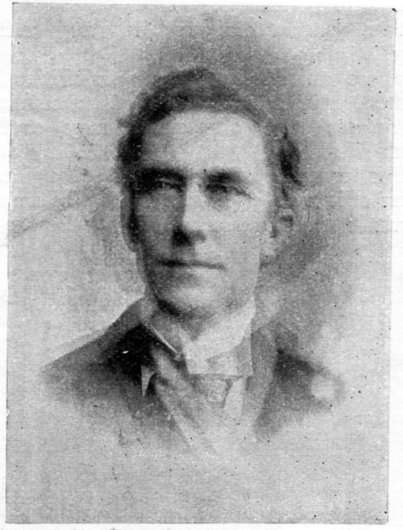
COMPOSITE PORTRAIT OF WELL-KNOWN ACTORS.
"A Study in Boots" is an excellent example of one of the most effective methods of photographic faking. Like many things which border on the marvellous, it is as simple as A B C. The explanation is that when taking the photograph the operator used a short focus lens and made a point of specially focussing the boots instead of the picture as a whole. The result was that the rest of the figure was thrown out of focus, and consequently out of proportion.
This effect is only too well known to most beginners in the art, for it often appears unbidden in their early efforts, to the utter ruin of an otherwise good picture. Amateurs frequently spoil portraits of their friends in this way, the feet or hands appearing treble their proper size in the picture. The defect is usually the result of working with a lens of too short a focus. This explanation is somewhat technical for those who have not embraced the fascinating art, but it cannot be put in any other way.
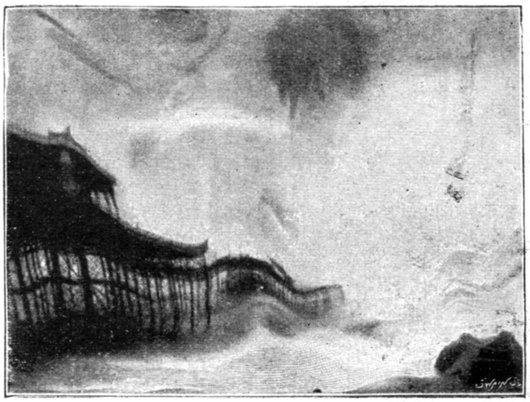
HASTINGS PIER WHEN SUFFERING FROM HEAT.
There are many other possibilities in photographic faking. In fact, an amateur of an inventive disposition may evolve them ad libitum.
For example, there is the "long and short of it" style of fake, that will surely result in much amusement. By the use of concave and convex mirrors the face of a friend may be abnormally lengthened or widened in the portrait until it reminds one of the pictures displayed outside eating-houses, bearing the inscriptions, "Before dining at Z——'s," "After dining at Z——'s."
However, all these things are by way of amusement. I have never come across any deliberate case of photographic faking with intent to mislead or bear false witness; but, as I have already stated, what may be done for recreation is also possible of application in more serious affairs, and therefore it is a fallacy to suppose that a photograph cannot lie.
Very little has been done, comparatively speaking, in the direction of photograph faking. It is an amusement I can recommend to every devotee of the art; for there are few pastimes more completely fascinating.
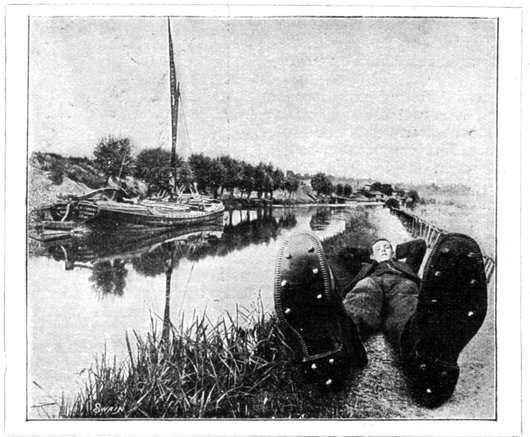
A STUDY IN BOOTS.
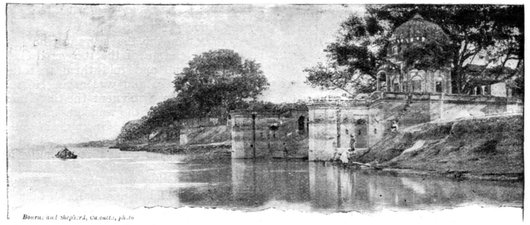
Bourne and Shepherd, Calcutta, Photo
SUTTEE CHOWRA GHAT, CAWNPORE, WHERE THE MASSACRE TOOK PLACE.