IX
Reading edition
THE CHINESE CITY
MANY visitors to this busy port hurry on to richer fields of conquest with never a glimpse of the Chinese City, and some doubtless do not even know there is such a place. Yet not the International Settlement, nor the French Concession, but the Chinese City is the real Shanghai. The city is the nucleus north and south of whose storm-beaten walls the foreign settlements sprang up and without which they would not have been. The coming of the foreigner is of recent date, for few men from the West saw the spot, and certainly not one resided there till after Shanghai was opened as a treaty port in 1842. The city itself, though in the heyday of youth, compared with many other cities in China, still counts its age by centuries that creep close on to a millennium. The walls were not built until 1555, a year after the city had been sacked, burned to the ground, and left a howling wilderness by Japanese raiders. Gone now are the old walls, since the revolution, and the creaking gates that swung back and forth night and morning so many years on their rusty hinges, or if a vestige is left it is fast disappearing under the blows of pick-ax and hammer. But no, that is a mistake, for a halt has just been called in the work of demolition. The Chinese Town Council it is reported, is a house divided against itself, and some of its members strongly advocate the rebuilding of the walls for the sake of protection. A compromise has been effected by voting to allow the walls to remain down but letting the gates stand, or what is left of them, to serve as triumphal arches.
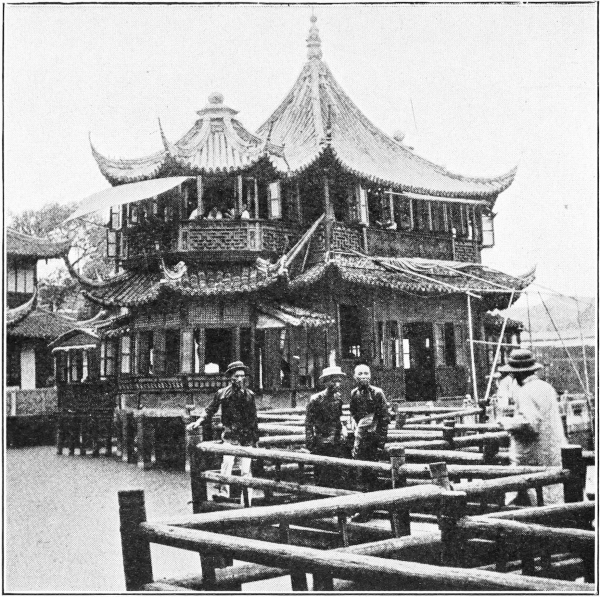
THE ORIGINAL WILLOW PATTERN TEA HOUSE
Of course it is better that the old walls should go, more sanitary and more modern. The ill-smelling moat has been covered on the north and west by a splendid boulevard ninety feet wide. Trolley lines will by and by encircle the whole city, as they now run along two sides. Many of the streets in the outer circumference of the city are being widened, while those in the heart of it are receiving some attention, though improvement is difficult on account of property interests. Ramshackle rat-infested hovels, here, there, and yonder, have vanished from sight, and new tea-houses, and shops, glistening with fresh paint, are taking their places. Public nuisances are being attacked. A well-to-do family reports that since the pestilential creek back of their house has been filled in, their property has advanced in value hundreds of dollars. Street refuse is swept up and carried away each day. Meat is inspected. Pipes have been laid and running water introduced, so that one no longer hears the monotonous cry of the water carriers trotting along with a pole across their shoulders from which were suspended the overflowing buckets spilling water at every step. Electric lights have largely superseded little smoky kerosene lamps, or still more primitive pottery or tin lamps with a tiny wick swimming in vegetable oil.
All this is just as it should be. The improvements are highly commended by every one, and yet, inconsistent beings that we are, why is it that with our rejoicing over the changes, our hearts likewise experience a pang of regret? What is there about things old and quaint, albeit noisome and repulsive, that things brand new somehow do not possess for us? So with the passing of the old walls and a modicum of the old dirt, a certain indefinable charm has slipped away too, never to return. Nevertheless the Chinese City continues to exist, although since the walls are down its boundaries are not so clearly defined, and enough of the ancient landmarks remain in the way of foul-smelling alleys, streets of gay shops, beggars and crowds, to satisfy most lovers of the haunting allurements of the Orient.
The city is approximately three miles in circumference. There is no map of it beyond the merest outline, and neither a Murray nor a Baedeker to facilitate a tramp through its labyrinthian byways. But the stranger crossing its boundaries is not left coldly to his own devices, for the instant he appears in sight he is met by a chattering company of self-constituted guides. If perchance their services are declined, they still manage unobtrusively to shadow the Innocent Abroad and entice him to shops that are almost certain to loosen his purse-strings and where they propose to secure a fat commission on the purchases made.
The shops in the Chinese City are the originals of the replicas in the Settlement, only that being the originals they are more bizarre and delightful. Like birds of a feather, shops doing the same kind of work, or selling the same kind of articles, are apt to flock together. For example, most of the furniture shops handling the beautiful red and black wood from the southern province of Kwangtung are found near the north gate, also the shops selling exquisitely carved ivory. Elsewhere are grouped the silversmiths, the jewelers with tempting displays of jade, amber, pearls, and precious stones, cloth and silk merchants, shoe and cap makers, dealers whose specialty is all kinds of fans; brass, pewter, and china shops, makers of coffins from the costly red and teak woods to the less expensive pine and ash—but the amazing variety of the shops is fairly bewildering and defies enumeration!
There are no department stores in the city. Each tradesman confines himself strictly to his own line of goods. Not for his life would he dare encroach on the rights and privileges of another, for every trade has its guild which sees to it that the interests of its members are protected. Many of the guilds are wealthy and powerful, politically as well as commercially, like the silk merchants’ and silversmiths’ guilds. They have their guild houses, all more or less elaborately fitted up with rooms for conferences and feasts, and attached to them are rows of long low buildings divided into small chambers, where, upon the payment of a rental, the coffins of deceased members may be deposited until a convenient time for burial.
Certain shops sell nothing but funeral trappings, but instead of presenting a sombre appearance they are among the gayest in the city. Hung aloft to show off to the best advantage are elaborately embroidered crimson satin coverings for the coffin, and around on the shelves or under glass cases is apparel for the dead, very richly embroidered robes, slippers, and headgear, this latter in the shape of mitres and helmets, of remarkable design and ornamentation. There are also priests’ robes and white cotton raiment and sackcloth for the mourners. Other shops carry only the paper furnishings that are an essential part of a funeral ceremony. When the spirit of the deceased leaves the body and passes to the spirit world, according to Chinese superstition he requires for his comfort the same conveniences to which he was accustomed in life. Hence the dutiful elder son, in proportion to his financial ability, and often far beyond it, for Chinese funerals are fearfully costly, sees that his honoured parent is provided with them. The articles are made of coloured paper, the larger ones over a light framework of bamboo, and include every conceivable object, from a sedan chair to a teacup. These images are borne in the funeral procession through the streets and burned at the grave, the smoke being supposed to waft them through ether to the waiting spirit. They are such exact facsimiles of the real thing, especially in the case of small articles like vases, jewelry boxes, braziers, lamps, clocks, basins, that it is hard to believe they are false. One of the best imitations ever produced in a Shanghai city shop was that of a fur-lined Mandarin coat, so perfect in every detail as almost to deceive the Chinese themselves.
A shopkeeper who always attracts custom is the portrait painter. He is an important personage and does business behind closed doors—that is, his shop is not open to the street as most are; but has a front partition with a door and show window. On the window is pasted a collection of small pictures of human heads cut from newspapers and magazines. Inside the shop quantities more are stored away. When a widow, it may be, wishes a likeness of her consort who left no pictured memorial behind him, or a youth perhaps craves a reminder of the grand-uncle he never saw, they find their way to one of these portrait shops. The shopkeeper spreads out before them an array of pictures, and after careful study a selection is made of a particular portrait which either bears some imaginary resemblance to the dear departed, or is what the sorrowing relatives would choose to have him look like. The shopkeeper then paints the head in life size and adds a body clothed in whatever style of garments may be mutually decided on. The finished portrait is finally hung on the wall of the family dwelling and pointed to with pride and affection as the face of the deceased ancestor.
Drug shops are many and are invested with an air of quiet exclusiveness and semi-professionalism, which suffers but a slight declension when in hot weather the clerks, after the manner of most shopkeepers, divest themselves of their non-essential upper garments and pass the day stripped to the waist. Upon the shelves of the shop stand rows and rows of large pewter cannisters and blue and white china jars, innocent enough to look at and yet designed to arouse the curiosity of the beholder as to the nature and character of their contents. Below are quantities of drawers containing dried roots, herbs, bones, seaweed, chalk, things indescribable and inscrutable, drawn from the air above, the earth beneath, and the waters under the earth. In addition to drugs the shop frequently keeps on exhibition some special attractions, such as glass jars with snakes preserved in alcohol, dried alligator skins, corals and geological specimens. In filling prescriptions china bottles, coloured pasteboard boxes and squares of white paper are used. Sometimes a score or more of the paper squares are placed on the counter at once, and from the different drawers an interesting assortment of medicines is laid on them. Here is dried orange peel, said to be an unfailing remedy for loss of appetite, a yellow berry that removes phlegm, a dried beetle that in a solution of water makes the best kind of eyewash. The silkworm taken from the cocoon when eaten with rice greatly assists digestion, and so does a flat bug that from its appearance might be great-grandfather to the bedbug. The ladybug, or what resembles one, is a sure cure for liver complaint, and another insect if rubbed on wounds quickly heals them. Also in certain troubles it has been found that a little of the alcohol in which a serpent is preserved, if taken internally, proves particularly efficacious. On the wall at the back of the shop is painted a picture of the god of medicine, at whose shrine tapers are kept burning. Chinese shops carrying foreign drugs, some of them excellent shops, too, are not uncommon in the Settlement but are seldom to be seen in the Chinese City.
The dentist, like his confreres in other countries, is ever in demand. Occasionally an aspiring, prosperous fellow is discovered doing business in a shop where the patient may balance himself on a stool, though still in full view of the curious street crowd, and tilting his head back, have the offending molar extracted without further ado. But ordinarily the professional outfit is limited to a small wooden table and what it will hold, set out in the street. Back of the weather-worn stand lounges the dentist, soiled and uncouth, keeping guard over his stock in trade, bottles of ointments, salves, a pair of forceps and other nondescript instruments, a few sets of teeth under a dust-covered glass case, and last but not least, piles of decayed teeth successfully extracted from tortured victims and kept as decoys to attract patronage. There are travelling dentists whose shop is a wheelbarrow which carries the dental equipment, with the inevitable pile of teeth conspicuous in the centre. They move from point to point, in inclement weather under cover of a mammoth coloured umbrella, and sound a gong to draw the ever-ready crowd.
More common still are the peripatetic restaurants. The outfit of the manager of the Liliputian establishment is a model of convenience and compactness. A simple bamboo frame, easily borne by one man even with all the appurtenances, is divided into two sections. On one side in a pocket rests a clay stove, with a place underneath for holding the wood. On the other is a series of drawers of various sizes, in which the dough, sugar, and spices are kept. A little kneading board pulls out from a slit between the drawers, and on it the baker deftly fashions his cakes and meat pies, frying them in vegetable oil in a shallow iron basin, or if they are to be baked, plastering them against the inner sides of the clay stove above the fire. Despite the dirt, dust, and flies, even the ultra fastidious can not deny that the finished product is decidedly appetizing.
Not a foot of valuable land in the Chinese City is wasted on sidewalks. Hence everybody and everything is right on the street, and the very narrow passages are badly congested. Rickety jinricshas, a few sedan chairs which are fast disappearing from Shanghai, burden-bearers and pedestrians hurry continually to and fro, shouting in shrill falsetto tones to one another to clear the way and running in imminent danger of colliding with the unwary and trampling on children. Yet not all the streets are mere alleyways. A few, but it must be admitted a very few, are wide enough to allow a carriage to pass through with comparative ease, and they seem in comparison like boulevards. Then there are others along which a carriage can manage to creep providing the driver is skillful and the people hug the sides of the roads or retire precipitately into the shops out of harm’s way, but this is too risky a venture to be indulged in often and is seldom permitted by the police. Once in a while it happens that a carriage gets wedged into a tight place where it can neither move forward, back out nor even find room to turn at right angles into a cross street. The only thing then is to unhitch the horse, lead him out, pull the carriage back, and finally lifting it up bodily, turn it around and harness the horse to it again.
Not all the city is laid out in streets, for there are some open places and even flourishing vegetable gardens which quite suggest the country. That this is possible in so densely populated an area seems a marvel, and where and how the people are all hidden away is a puzzle. In the poorer sections, with the closing down of night they vanish as if by magic, except in hot weather when many camp on the streets, and in the morning the crowds swarm forth as mysteriously, like rats from their holes.
The best known and most popular breathing spot in the city is that about the lake or pond, in whose centre on a small island rises the far-famed Willow Ware Tea-House, for the identical tea-house pictured on the much sought for willow-ware porcelain is located in the Chinese City. This to the average globe-trotter is the city’s chief attraction, but alas, never was the saying “Distance lends enchantment” more truly applicable, for while the pictures of the old tea-house are undeniably charming, with its graceful upturned gables and the zigzag bridges leading to it, made zigzag to ward off evil spirits who are said to travel in straight lines, yet seen near at hand how quickly the enchantment is dispelled! Filth, rottenness, and roistering are the main present-day characteristics of this tea-house of fair renown. Instead of reflecting the blue sky above, the water is covered with a thick vegetable scum, green and unwholesome. The shores around are made lively with a colony of small vendors whose wares are set on tables or spread out over the ground. They evidently reap a paying harvest from the sale of scrolls, pottery, towels, sheepskin coats, toys, and all manner of cheap foreign knickknacks which are much sought after by the people. Switches of long, jet black hair, especially plentiful since queues went out of fashion, are given places of prominence. Many doubtless are sent abroad to add beauty to the coiffures of dames of high degree.
The business of the man who deals in rags must flourish like the green bay tree judging from the number engaged in it. What a sight is a rag-man’s shop, rags, rags everywhere, stuffed in baskets and bags, hanging from the walls, covering the floor in huge piebald bundles and mounds, germ-infected, poisonous, alive with vermin, gathered up and brought in from heaven knows where! Yet every day women and children spend long hours industriously picking them over and making them up into mops and the soles of Chinese shoes, for which they find a ready sale.
Shanghai once boasted a supremely great citizen. He lived back in the sixteenth century, a veritable Chinese Maecenas. Besides being a man of letters and encouraging Western learning, he rose to the highest position in the empire, as Premier and Chancellor of the Privy Council. His name will be of little consequence to the outside world, but it is Siu Kuang-ki, should any one care to know it. He was converted to Christianity under the Jesuit Fathers, and lived a pure, consistent, devoted life, dying so poor in spite of large emoluments that his funeral expenses had to be paid from the public treasury. He built in the Chinese City the first Christian church ever seen in these parts. During the exigencies of later years it was converted into a temple sacred to the god of war, but was afterward redeemed and restored to its original use. This church is still standing, a striking edifice back a little from the noisy street, with a typical Chinese roof, and below it on the front outside wall, a beautiful gilded cross.
The present war god’s temple is near the temple of Confucius, with its grass-grown court and deserted halls. Once a year, in the early dawn, the military governor of Shanghai and the city officials enter the sanctuary dedicated to the god of war and conduct a weird pageant-like ceremony in honour of two local military heroes. The tutelary deities of the Chinese City, black and repelling, occupy a large centrally located temple more frequented by worshippers than any other. The roomy outer court, like the temple court in Jerusalem, is given up to buying and selling, also to eating and drinking, gambling and fortune-telling, and there is no busier, noisier mart in all the city.
The local official in the Chinese City is called the “Chih-hsien,” or District Magistrate, and is appointed from Peking. His official residence styled the Yamen, is a common, ordinary building, approached through several untidy courts lined with the low one-story quarters of the Yamen retainers and petty officials. Every day, in three small, bare rooms of the Yamen, court is held, the Chinese judges in their professional gowns looking distinctly out of keeping with their surroundings. To the left and back of the Yamen is the City Prison and adjoining it a much smaller one for women. Stories are afloat regarding the unsanitary condition of the prison and the treatment of prisoners that cause one to cringe and dread an investigation, but whatever may have been the state of affairs under the old régime, and the prison manager is frank to confess that things were very different ten years ago, there is now little to criticise and a great deal to commend. The grey brick buildings are in thoroughly good repair, the cells of the four hundred men and the fifty women prisoners, clean and fairly well lighted and ventilated, though, as the manager himself will hasten to tell the visitor, too crowded for health. A few carefully tended plants are growing in the centre of each of the courts, a praiseworthy effort to introduce a touch of the æsthetic. Industrial work on a considerable scale is carried on in the men’s prison, though the grant of money from the government is too small to keep all at work. Wooden and rattan furniture, towels, mats, shoes, and clothing are made. A very little industrial work is given the women in the way of cutting out and making garments, but from lack of funds to supply workrooms and material, most of the poor creatures are forced to pass their days in idleness. The wardens of the women’s prison are women. The discipline is excellent, yet not severe, the prisoners look well fed and well cared for, and the men especially, happy and contented. Provision is made to send sick prisoners to a Chinese hospital, where they receive the best of care.
The Yamen, disappointing as it is in appearance, yet witnesses some stirring scenes, as when, not long ago, a quantity of opium and opium-smoking utensils were burned on the open ground in front of it in the presence of an interested throng of spectators. Not an opium den or shop exists in the Chinese City. Long ago they were effectually closed by order of the government.
The city is well policed. There has been a wonderful shaking up of the dry bones in that department in recent years, particularly since the revolution. The Chief of Police is chosen on the recommendation of the local military governor by the provincial governor at Nanking, but the Chief of the Fire Department is the choice of the people, and affairs of the department are wholly under their control. All the seven hundred members of the Fire Brigade are volunteers and serve without pay. Of late the brigade has attained a high grade of efficiency, and in the engine stations scattered over the city may be seen a very creditable equipment of modern machinery including some small motor cars. They must of necessity be small in order to get through the narrow streets. At the central station between the east and south gates stands a splendid tower supporting a bell weighing 6,000 lbs. which sounds the fire alarm not only in the city itself, but in the surrounding territory included in the Chinese municipality. This tower is the work of Shanghai’s engineering genius Nicholas Tzu, who patterned it after a small model of the Eiffel tower, but with changes that adapted it more perfectly to its present use. At a recent large fire in the city, the chiefs of the International and French Fire Brigades were present and looked on, but their assistance was not asked for nor was it needed, though the Chinese firemen were obliged to fight valiantly for three hours before they got control of the flames.
That the Chinese City is taking on thoroughly up-to-date airs will be generally conceded when it is known that strikes are becoming rather general. The latest one to break out was in the Dyers’ Union. The masses of the people in China dress in blue cotton. Indeed, so universally is it worn, that it might almost be called the national dress, consequently the business of dyeing is one of the most common and the Dyers’ Union is very strong. Since a Presidential mandate had gone forth that every labor union must be approved by the police, and as in this case the police interfered to put down the strike, it failed of its object. But a strike last winter was more successful. The women working in a silk filature mill within the Chinese precincts, though outside the Chinese City, were roused to fury by a reduction in their wages. Early one morning ninety or a hundred of them gathered at the mill gate and made such a clamour, pounding and shouting as only enraged Chinese women can, that the authorities, realizing that after all right was on the side of the strikers, were glad to effect a speedy and satisfactory compromise.