XII
Reading edition
FOREIGN PHILANTHROPIES
A BISHOP visiting in Shanghai said he should sometime like to write a book on the “cries” of China. It would make interesting reading. The cries are many and diverse. Most coolies, for example, whether on land or water, work to the accompaniment of a rhythmical chant, and though the poor fellows, carrying heavy burdens, fairly gasp in their effort to continue the vocal exercise while under the strain of physical exertion, they seem unable to proceed without it.
In the early days, when foreigners first settled in Shanghai, it is related that house servants, as they carried food to and from the table, indulged in the usual monotonous sing-song till the distracted diners peremptorily put a stop to the habit.
But of all the cries known to China, the most pitiful is the cry of the children, the sharp insistent wail of suffering childhood that ascends night and day all over this great land. Had Mrs. Browning visited the Far East she would surely have been impelled to pen another noble poem on the “Cry of the Children” whose pathos would have pierced the heart of the world. Many people believe slavery in China is a thing of the past, as a multitude imagine foot-binding is no longer practised. It is true that edicts from time to time have gone forth abolishing slavery, but they have not been enforced and old customs die hard. The most that can be said is that this hydra-headed monster no longer stalks abroad as openly and unchallenged as formerly, though that the evil exists no one who knows conditions can for a moment deny.
Out from the centre of the noisy city, where the fields are green and the air pure and fresh, stands a substantial red brick building. The presiding genius is a sweet-faced, motherly woman in the garb of a Protestant Episcopal deaconess. “Is this the Slave Girls’ Refuge?” asks the visitor. “It is the Children’s Refuge.” Then, with a deprecatory smile, “We are leaving the word ‘slave’ out now because we want to do all we can to help the children forget their sad past.” The house is plain, not a dollar wasted on ornamentation, and filled to overflowing. Built to accommodate seventy-five, last year a hundred and fifty-six were crowded into it. Little cots line the upper verandas, and the superintendent’s bedroom is turned into a day nursery for the smallest tots. “You surely ought to have one spot you could call your very own,” exclaims the half indignant visitor. “I should find it restful and pleasant, but with my big family I can’t manage it,” and the ever ready smile again illumines the kind face.
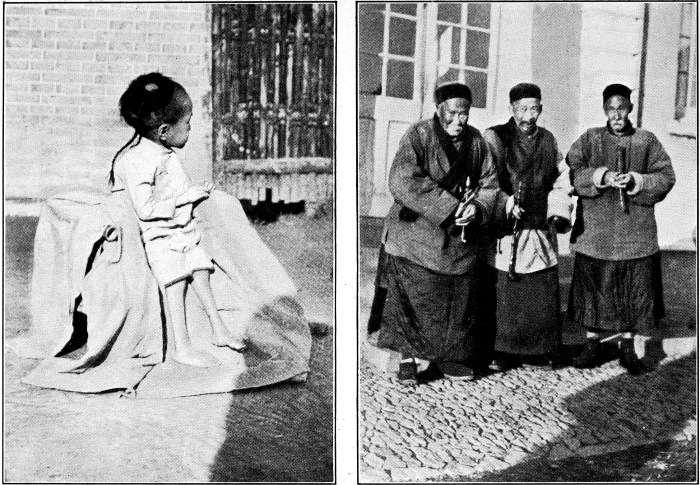
RESCUED CHILD JUST BROUGHT TO THE CHILDREN’S REFUGE
OLD MEN AT THE HOME OF THE LITTLE SISTERS OF THE POOR
This work, which is undenominational, was started by a band of Christian women after the upheaval of 1900, although the present building was not occupied till ten years later. Now, in so short a time, it has been outgrown, and the need for an addition is imperative. The children range in age from three to twenty, for some have been in the Home a long time and developed into useful assistants. Most of the little ones are rescued by the police, who take them to the Municipal Mixed Court, and from there they are turned over to the Refuge. And what eventually becomes of these waifs? A few are returned to parents from whom they have been stolen, others are adopted by families or mission schools, while a large number die, too weakened because of ill treatment to resist disease. Occasionally there is a simple wedding at the Refuge and a girl goes out from it to a home of her own. Shanghai is a great slave market. Children are sent and brought here from all over China, kidnappers having a large hand in the shameful trade. Parents frequently sell their own offspring, for there are many mouths to feed and rice is often very, very scarce. Only girls are slaves. They become the property, body, mind, and soul, of their owners, who may do with them as they like. Their pitiful little life stories are almost too harrowing to repeat. A baby of five had its flesh pinched with red-hot irons, another of six was tied to a post for days without food, having had hot needles run under her nails. One was three times buried alive. A mite three years old, nearly dead from neglect and starvation, weighed only ten pounds when brought to the Refuge. A doctor counted on the body of a bleeding child two hundred and forty cuts, burns, and bruises. One was brought in with an arm twisted out of shape and an eyelid nearly torn away. A little slave, after repeated beatings that almost crushed the life out of her, was thrown by her mistress on an ash-heap to die. When rescued and sent to the Refuge her mind seemed clouded. She took scarcely any notice of her surroundings, but if any one approached her the poor child shrieked in terror. “You are going to kill me! I know you are going to kill me!” “A few weeks later,” said the superintendent, tears filling her eyes as she told the story, “the little thing was following me around everywhere, repeating softly to herself, ‘Jesus loves me, Jesus loves me.’” How the superintendent with her great warm heart mothers her flock! The more marred, feeble, and wretched they are the more her love surrounds them. And it is most wonderful how these little bruised, neglected plants, blossom out under her tender care. Until recently she was the only foreigner in charge of the work. While so many others flit away in the fierce heat of summer for a breath of cool air, this faithful worker remains, season after season, at her post. “I can not leave the children,” she will urge. But she asks no one’s commiseration, for a happier heart is not to be found in China.
There is a shelter called “The Home for Waifs and Strays” at quite the opposite side of Shanghai. It gathers in a somewhat different class of children, not many slaves, but outcasts, down to new-born infants picked up on the street by the police. Many of the children are mentally deficient and some suffer from incurable diseases. A devoted Christian woman is at the head of the Home, which receives its support from the Municipal Council, by whom the work was inaugurated several years ago.
A new building has just been completed close to the Children’s Refuge, which so long stood entirely alone in the midst of cultivated fields. It is the home of the School for Blind Boys. No charity is more appealing in a country where diseased eyes, leading to partial or total blindness, are so fearfully common. The school opened its doors only three years ago in a rented house, yet the mental development of the boys has been most remarkable. There is certain to arise soon an insistent demand for blind teachers for the blind, and the purpose of the school is to give their boys a general education which will qualify them for that work. It also has a growing industrial department, and the Blind School, like the Children’s Refuge, is in part supported by the sale of its products. The plan is later to establish on the same site a similar school for girls.
One of the best known institutions in Shanghai is the Door of Hope. As the name implies it is intended to succor girls bound by a slavery the most cruel of all. No other city in the country contains as many brothels as Shanghai. It is often called the Sodom of China, and is known to many of the native Christians away from the coast only as the Far Country of the Prodigal Son. Sadly enough, the presence of degenerate foreigners is largely responsible for the sin laid at the gates of the gay metropolis.
It is safe to say that the majority of Chinese girls found in houses of ill-fame are there through no fault of their own. Kidnappers dispose in this way of many of the children they have stolen. Often parents, particularly in famine times, sell their little daughters, choosing in their ignorance such a fate for them rather than to see them die of starvation.
The “Receiving Home” is in an alley-way just off Nanking Road, which is the Piccadilly of Shanghai. Several years ago a few philanthropic and influential Chinese gentlemen succeeded in securing from the International Municipality the passage of a law whereby a notice was placed in each brothel telling of the Receiving Home and how to reach it. Another law was passed at the same time prohibiting brothels from accepting girls under fourteen. Both of these statutes have gradually been allowed to become dead letters, and little or no attention is now paid to them. A rescued girl stays in the Receiving Home only over night, or until her case is brought up in the Mixed Court and she is committed to the Door of Hope. This building is in the outskirts of the city, far removed from the crowded, dangerous district with which the girls have grown too familiar. For obvious reasons, although all are under the same roof, it has been found wise to separate the first-year girls from those of the second year. This charity is supported by grants from the Municipal Council together with voluntary gifts and the sale of industrial work. The Door of Hope dolls are famed far and wide. The little wooden heads, beautifully carved, are the only parts of the dolls not made by the girls. Shanghai firms gladly donate in abundance bright-coloured scraps of silk, satin, and cotton cloth. The dolls are dressed to represent all grades and classes of society, and a set, consisting of sixteen, is of real value educationally.
The first-year girls spend the morning in study and the afternoon in work. They begin by learning to make their own clothes, cloth shoes and all, then when the tailor’s trade has been thoroughly mastered, they are set to dressing dolls. For this work a slight compensation is given which acts as a spur and encouragement. The second-year girls are busy all day at their embroidery frames with a little schooling in the evening. They receive regular pay and are expected in the main to clothe themselves. The embroidery is exquisitely fine and dainty and there is a constant call for it, both in and out of Shanghai, especially from prospective brides and mothers. In the long, cheerful work-room, lined on both sides with windows, the sixty or more girls of the second year gather each morning at eight o’clock for prayers. Half an hour later, the embroidery frames are laid out on small tables, and materials unrolled to the accompaniment of happy chatter. When all is in readiness to begin, a sudden hush falls on the room, as some one points to the text for the day on a Scripture calendar hanging on the wall. This is repeated in concert, followed by a brief prayer from one of the girls. It is a sweet custom and seems to give just the right start to the day. The calendar is compiled annually by a Chinese woman living in Shanghai.
It is not necessary to ask if the girls are happy. Their bright, contented faces show that. Few are inherently bad. Only once in a long while some one tires of the quiet routine and revolts or runs away. But it is natural that they should crave change and the sight of a face from the outside world is eagerly welcomed. Noticing this, a foreign lady living in the neighbourhood once asked the girls in relays to her home for afternoon tea. The day the first-year girls were present, one of them, pointing to the piano, turned to the missionary in charge with the question, “What is that black box?” It was explained to her that it was a musical instrument, and when later it was played upon, the delight of the girls was unbounded. An American visitor was so touched by the incident that she secured for the Door of Hope the gift of a splendid victrola which, being a thing of beauty, is likewise sure to prove a joy forever.
Most of those who enter the Door of Hope, after a few months or a year, become earnest Christians, and sooner or later are married to Christian men. In China it is considered no disgrace to marry a fallen girl, provided she has changed her way of living. One girl who was recently married to a minister made such a favourable impression on her husband’s friend that he went to the Home begging that he be given a wife just like her. “But how are these poor girls for whom often a very large sum of money has been paid, rescued from their owners?” asks the puzzled caller. Ah, it is here that a ray of light streams through the darkness. There is a law in China, yes, and a very old law too, that no woman can be made to lead a life of shame against her will. If she has a chance to express herself in court, she may choose the better way, and no one is allowed to oppose her. The difficulty is to escape from bondage and secure the chance to voice a protest. Besides, many are too young to speak for themselves, like the baby of three, who the other day was carried to a brothel in the arms of her own father and offered for sale. The keepers prefer to buy very young children, as they cost little and can be used as singing girls during their early years.
Five miles out from Shanghai, in a pleasant farming district, is the children’s branch of the Door of Hope. In this beautiful protected spot, a hundred and sixty little ones, snatched from the horrible pit in which they had been thrown, live happily together. With the blessed forgetfulness of childhood, the past soon fades into indistinctness, till it is well-nigh effaced from their memory. The cottage system is in vogue, and the big family is divided up into groups of about twenty. Each cottage has its house-mother, one of the older, trusted girls from the City Home, and all are under the care of two devoted foreigners. The hours are filled with house-work, studies, simple industries, gardening, play. If a girl shows special aptitude, she is sent in time to a mission school, where the curriculum is broader and better adapted to her largest development. As soon as the children are old enough, they are trained in evangelistic work, such as teaching in Ragged Sunday-Schools and holding village prayer meetings. Practically every one ripens into a genuine little Christian.
Two of the most striking philanthropies in Shanghai are conducted by the Roman Catholics. If there is a class of society that draws on one’s sympathies even more than friendless children, it is friendless old people, since their capacity for conscious suffering is greater. A most admirable characteristic of the Chinese is their usually kind treatment of the aged. Filial piety shines its brightest in poverty stricken homes, where real sacrifice is required to provide for the parents, who are often much better able to care for themselves than their children are for them. But very many are left alone in the world without food or shelter, or money to buy a coffin in which they would so gladly lie down and die.
The Catholic Home for indigent old people is popularly known by the name given to the Sisters of Charity in charge of it, “The Little Sisters of the Poor.” The capacious three-story building shelters a hundred and fifty old men and as many old women, which is all it will hold. But as fast as any die others are ready to take their places, for there is always a long waiting list. The only conditions of admission to the Home are that the applicant must be over sixty and wholly without means of support. Most of those taken in are seventy or more. One might easily imagine that a place like this, which gathers under its roof so many old people, whose lives for the most part have been spent in the midst of poverty and filth, and with never an idea of cleanly habits, would be anything but inviting. Yet it is a sort of Eden, not a speck of dirt on the well-scrubbed floors, not a bad or even a close smell in the big airy rooms, not a spot on the white bed curtains and pretty patch-work coverlids made by the old people from the scraps sent in from the shops. And as for the inmates enjoying themselves, why the faces of the dear old souls fairly radiate happiness! They are allowed tobacco and plenty of tea and chatter like magpies over their pipes and cups. In order not to make life under the new conditions terrifying for them, a weekly bath is not insisted on, but clean, neatly mended garments are donned every Sunday morning. When sick, the simple-minded folk are attended by old-fashioned Chinese medicine men, instead of foreign trained doctors whose new-fangled ways the patients would spurn. All who are able to work have regular duties, spinning, laundering, tailoring, nursing. The women’s quarters are on one side of the building, and the men’s on the other, with the chapel between them. “Yes,” says the Sister Superior, stopping a moment as she passes in front of the altar to kneel and make the sign of the Cross, “the chapel is in the centre, so you see it is God who divides and God who unites us.” Several of the Sisters are Chinese, and one round-faced novitiate works in the kitchen, where the shining brass and copper vessels call to mind “Father Lawrence” and his immaculate domain. No Chinese girl can enter as an “aspirant” to the privileges of sisterhood, unless she belongs to the third generation of Christians.
Shanghai’s great show-place is the Catholic institution at Siccawei, a suburban village named after the Jesuit missionaries’ patron saint. No one coming to the city willingly leaves without seeing it, certainly not if the visitor is a woman. For the laces and embroideries made under the direction of the French Sisters are the very quintessence of artistic loveliness, and the salesroom is seldom empty.
More than fifty years ago, at the close of the T’aiping Rebellion, the Jesuits, after many persecutions and vicissitudes, returned to Shanghai, from whence they had fled, and settled at Siccawei. There they began a small work, which has steadily grown till it has reached almost gigantic proportions. Clustered about the Cathedral, glaringly modern and capacious, whose tall spires are a landmark in all the country round, are the old church, a men’s college and theological seminary, observatory, museum, orphanages, schools, and industrial plants. The women’s and girls’ buildings are on one side of a tidal creek, and those of the men and boys on the other. Asked some question by a stranger about the boys’ work, the Sister addressed replied in a tone of finality, “I can’t tell you. I know no more about what is going on over there than you do.” Each Sister is assigned her own duties for which she is responsible, and gives herself to them exclusively. There are fifty Sisters, more than two-thirds of whom are Chinese. The spirituelle expression seen sometimes on the faces of these Chinese recluses, is most remarkable. The foreign Sisters are all French. No one can doubt their devotion. They take no vacation; they never go home on furlough. Several have been at their posts over forty years.
It is a large household the Sisters have under their care, averaging in number seventeen hundred, but the work is so divided and runs with such systematic regularity that there is no suggestion of friction or confusion. First in order come the foundlings. Each day, tiny, new-born babes are brought into the Home, or often left at the gate in the darkness of the night. None are turned away. They are washed, dressed, laid in clean little cribs, and as soon as possible baptised with a Christian name in the chapel on the premises. Many are so frail when they enter, that a few brief hours or days end their troubled existence. Next are the day-schools of various grades for Catholic children, the large orphanage, and the boarding-school for non-Christian or pagan children, as the Sisters call them, with playground, dormitories, dining and school rooms entirely separate from the others. In a secluded corner of the grounds live the sixty unfortunates, who are either blind, crippled, or mentally deficient. Their chief occupation is spinning cotton by the aid of crude spinning wheels, something the dullest are found capable of learning to do.
But it is through its industrial department that Siccawei is best known to the general public. Hundreds of women are employed in making lace and embroidery, most of them having been reared in the Home, and married from it to Catholic husbands whose earning capacity is insufficient for the family needs. A day nursery and school is maintained for the babies and young children of the employees. The work rooms are of enormous size and well lighted. In the centre of each one, on a raised platform, sits a Sister, overlooking the women. The proceeds from the sale of work are very large.
The industrial plant for the men and boys, on the other side of the creek, is even more elaborate. It includes many departments, wood-carving, carpentry, shoemaking, work in iron and brass, glass-blowing, painting in oils and water colours, and a printing establishment. The genial Father in charge of the wood-carving and carpentering, is in his line a genius. Some of the work turned out under his supervision is wonderfully beautiful, and ranks among the finest specimens of Chinese art sent to the Panama Exposition. The youngest apprentices, lads of ten or twelve, begin their industrial training by making little coffins for the foundlings across the way. “Yes,” Father B. is in the habit of remarking, pointing to the boys with a smile, “they start in life where others leave off.” The Siccawei Mission is self-perpetuating within the limits of its own constituency. Growth comes through the ever inflowing stream of helpless humanity. But no effort is put forth, either by the missionaries or Chinese communicants, to reach the unevangelized masses. Formerly this work was subsidized from France, but it now depends for support wholly on the sale of its industries and voluntary contributions.
All Shanghai philanthropies from time to time receive liberal donations from the Chinese themselves, many of whom understand and genuinely appreciate what is being done for their people. The recent founding of the Society of Organized Charities (Protestant) has aided greatly in carrying on systematic work in behalf of the deserving poor.