II
Reading edition
CIVIC FEATURES
“THE quaintest little republic in the world” is what Shanghai is often called. Certainly there is no city like it in China. Within its present limits are peoples from many countries, eighteen having consular representation, and all living, in the main, amicably together under a polyglot governing body whose members are elected by popular vote. The working out of the present system of autonomy was a difficult task. The city fathers long ago fought their way through more than one bitter controversy, for there were many minds as well as many nationalities. The Land and Municipal Regulations now in use are practically the same as those adopted back in 1869. Ten years after Shanghai became a treaty port the French withdrew from the union and set up a government of their own. The others formed themselves into the “International Settlement,” latterly known as the “Model Settlement.” Truth compels the admission, however, that it is not in all respects as worthy a “model” as its wellwishers would like to see it. Still it has admirable features, and as self-respecting a metropolis as Hongkong was urged by one of her citizens in a recent appeal to wake up and emulate the example of stirring, progressive Shanghai.
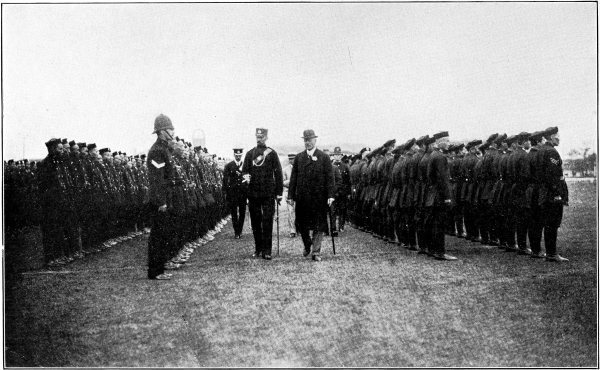
CHINESE POLICEMEN DRAWN UP FOR INSPECTION
The centre around which everything political revolves is the Municipal Council. The consuls of the International Settlement each spring call a meeting of the rate-payers or electors. Any foreigner who owns or rents property of a fixed value possesses the right of franchise. The rate-payers elect the members of the Municipal Council, and that done they retire from the public gaze till the following year, unless convened for special business. The Council holds weekly sessions. Its nine members are unsalaried business men. Chinese are not eligible to membership, but Japanese are, though as a matter of fact there never had been a Japanese member, greatly to this people’s displeasure, until a year ago, when one succeeded in getting elected. Judicial authority is vested in the consuls. Each consul arbitrates for his own nationals except in the cases of the three countries having fully organized law courts with resident judges. These are England, America, and Germany. The English court was established years ago; the American held its first session in 1907. The Chinese are extremely sore on the subject of extraterritoriality. That it does not exist in Japan only adds to their grief and mortification. Since the New Law Codes have been framed the nation is more insistent than ever that this thorn in its flesh shall be removed and foreign courts abolished. But the new laws are not widely operative, and until the old methods of bribery and torture are forever relegated to the past the Treaty Powers will continue to claim exclusive rights over their subjects, and the subjects to demand protection.
A unique institution peculiar to Shanghai, indeed, as some one has called it, “the most unique institution ever dedicated to justice,” is the Mixed Court. In the early days, when Chinese were made prisoners in the International Settlement, they were turned over to the Chinese City officials for trial and punishment, but justice was rare, and cruel or unduly lenient treatment the rule. To protect the Chinese, and insure fair dealing in those cases in which foreigners were involved, as well as to try the cases of foreigners having no consular representation, the Mixed Court was established in 1865. It has not proved a wholly satisfactory solution of the difficulty, for the law in force is the Chinese law, and the foreign assessor, an Englishman, American, or German, according to the day of the week, who occupies a seat on the judicial bench beside the Chinese judge, ranks as little more than a figurehead, acting merely in an advisory capacity. Practically though, it must be said, and this is particularly true since 1911, he is coming to be the real power behind the throne, and to exercise pretty much of a controlling influence. At the time of the revolution the management of the Mixed Court passed from the hands of the Chinese to the control of the Municipal Council. The change was effected quietly, so that while the Chinese were well aware of what was going on they could appear not to know, and thus save their “face.” If only “face” can be preserved facts are of small moment.
A morning spent in visiting the Mixed Court is to most people an experience of absorbing interest, as it throws innumerable side-lights on Chinese life and character. At half-past nine each morning, the hour of opening court, the foreign assessor and the Chinese judge walk in and take their seats, each flanked by his interpreters and clerks of solemn mein. The witnesses, Chinese and foreign, assemble on opposite sides of the room, the prisoners, most of them poor forlorn specimens of humanity, file into the docket closely guarded by Sikh and Chinese policemen, with an English sergeant-at-arms on duty near by, while in the hall, around the door and pressing as far inside as they dare, gathers the curious, motley crowd of onlookers, many of them relatives and friends of the prisoners, but stolidly immobile during all the proceedings. Is there another place in the world where such a variety of cases is heard as at the Shanghai Mixed Court, cases civil and criminal, tragic, pathetic and comic? Some are intricate enough to tax the wisdom of a Solomon, and some are simple as a child’s play. An old couple appeared one morning to petition for a divorce. Their faces wore such a kindly expression, they seemed so at peace with mankind in general and each other in particular, that the judge was puzzled. “Have you quarreled?” he asked. “Oh, no.” “Don’t you live happily together?” “We are most happy and that is why we are here,” hastily explained the old woman. Then the whole story was poured out. An evil omen had convinced them that in the future they would quarrel frightfully, separate, and die apart of broken hearts, so in order to avert such a calamity they had determined to take time by the forelock and part company while they were still good friends. A few words of advice and assurance set matters all right, and it was not long before the aged lovers, for that is what they really were, passed smilingly out of the courtroom, hand in hand, to return to their humble home. No executions take place in the Settlement. Prisoners sentenced to capital punishment are handed over to the Chinese authorities, and here again “face” is considered, for while the death sentence has actually been passed the court in the Chinese City is allowed to assume that it has not, and proceed as if the prisoner was condemned on its own initiative.
The building occupied by the Mixed Court is bounded on the right by the Woman’s Prison and on the left by the Debtor’s Prison. Under the Chinese regime discipline was practically nil and affairs were left largely to run themselves. Inmates of the Debtor’s Prison might smoke opium and gamble to their heart’s content, provided they could get the money, while dancing-girls furnished them entertainment. In the woman’s prison conditions were even worse. The top floor was set apart as a rendezvous for the young children of the prisoners, wretched, neglected little ones, exposed to every kind of evil influence. Their mothers in the cells below did pretty much as they liked. One of their tricks was to thrust their hands between the iron rods at the windows, and tear away by main force the corrugated iron screen so that they could chatter noisily with the people in the street below, and by letting down a string draw up food or anything else their friends were minded to tie on the end. The wardresses (the only man about the place is the gatekeeper) were deceitful, faithless, open to bribes, in fact little better than the women behind the bars.
But marked changes have taken place during the past few years. As soon as the foreign municipality assumed control, a prerogative by the way likely any time to revert to the Chinese, who are considerably nettled over their loss of authority, the young children were removed from their pernicious environment and placed in a Home under the care of a Christian woman. The Municipal Council supports this Home. The whole staff of wardresses was dismissed and their places filled by others who were strictly watched till their faithfulness was proved. The filthy building underwent a thorough cleaning, repainting, and calcimining. Baths, laundries, and doctors’ examining rooms were added to the plant and the prisoners required to exercise an hour daily in the sunny, cement-paved court, which has resulted in a marked improvement in the health record. The chief lack now is industrial work for the women, who have absolutely no employment except scrubbing the corridors and washing their own clothes. The sole break in the dull monotony of their lives comes when the gentle, sweet-faced missionary from the Door of Hope visits the prison with her Chinese Bible woman, going from cell to cell to sing, read, and pray. Four women are confined in a cell, which is fairly well lighted and sufficiently large. The Chinese beds are entirely devoid of bedding even in the coldest weather, the padded garments of the prisoners being expected to suffice. Nursing babies up to four or five months old are allowed to stay with their mothers. Most of the women are convicted for kidnapping, and the sentences do not extend at the longest beyond eight or ten years.
The Debtor’s Prison is officially known as the “House of Detention.” Its prisoners are not chained, may walk about freely, smoke, play games provided they are not games of chance, and at certain hours each day are allowed to see their friends in a small room at one side. On a winter’s day, when the windows and door of this room are shut, the contracted space packed with people, and the air heavy enough with tobacco smoke to cut with a knife, it is almost as much as a foreigner’s life is worth to take even a hasty peep inside. The prisoners provide their own bedding and food, with the exception of rice, and on the whole appear to enjoy themselves and to be in no hurry for their release, though some have hidden away quite enough money to pay their debt if they cared to, and others have relatives or friends who could easily pay it for them. Recently two men were set at liberty by the court on the presumption that they were really unable to meet their obligation, one after seven years’ imprisonment and the other five. The Municipal jail for men is several miles away, in a more open part of the city. Its massive, gray brick walls shut in between eleven and twelve hundred prisoners, all of them Chinese, for foreign prisoners are lodged temporarily in small prisons connected with their consulates, or, when the consulate has no prison, in the British jail. The discipline and upkeep of the jail are about perfect. The superintendent is a Christian who arranges for regular Sunday services for the prisoners, the Young Men’s Christian Association having general charge.
Industrial work of various kinds, including tailoring, mat weaving, and carpentering, is carried forward on a large scale, and a considerable amount of the city’s road-paving and repairing is done by the prisoners. Short terms in jail are rather welcomed than otherwise by many of the men, for they mean to them shelter, good food, warm blankets, and a chance to learn a trade under the most favourable conditions. Indeed, it has come to pass that many habitual offenders are in the habit of flocking to Shanghai as soon as the cold weather sets in with the express purpose of putting up at the jail for the winter. A specific instance occurred a while ago when a Chinese walked into one of the police stations and cheerfully announced that he wanted to be arrested. “My belong velly bad man,” he said, “velly bad man.” Not being able to give any special reason why he should be arrested at that particular time, he was told to go about his business. But he insisted. He was “velly bad,” and wanted to be arrested, and it was with a look of pained surprise that he made his way out of the station. As he walked down the street, thinking with dismay of the cold weather ahead, a happy inspiration struck him. He went in search of a policeman, and having found one, proceeded to beat him. He did his work thoroughly, was quickly arrested by another policeman, and taken to the nearest police station, beaming with satisfaction. The problem of his winter’s lodging had been solved. A moot question for some time past has been the advisability of reviving the practice of flogging with the bamboo. Many officials, Chinese as well as foreign, contend that this punishment as formerly administered by the Mixed Court, was thoroughly humane, and that as it has real terror for the Chinese nothing begins to be so effective in preventing crime, which has of late been greatly on the increase.
Formerly there was no Reformatory, and young boys convicted of no worse crime than petty stealing were often confined in the same cell with hardened criminals. It was the present superintendent who agitated the need of a separate building for the boys under sixteen, and finally a great three-story warehouse was purchased and fitted up for this purpose by the Municipal Council. Some of the lads are as young as nine. “The longer I live in China and the more I see of its poverty-stricken multitudes the less I blame any one for stealing,” exclaimed a Y.M.C.A. visitor at the Reformatory. The boys do industrial work in the morning and in the afternoon study, drill, and play. The fire drill is fine, but the military drill is the boys’ delight. Those best trained take turns in acting as drill-master. They give the orders in English and the company responds with a vim. Insubordination is punished by obliging the offender to scrub the wooden floors with sand, sometimes for a whole day. They are kept beautifully white. “You should see the kitchen!” said a frequent caller to a new comer. “It is so clean you could eat off the floor!” Several Christian Chinese business men in Shanghai have an understanding with the superintendent that they will receive a limited number of boys sent out from the reformatory, give them employment and a chance to begin life anew.
One of the first things that impressed itself on the early foreign settlers in Shanghai was the need of an adequate police force. In the beginning it was limited to a handful of Chinese watchmen under the joint jurisdiction of the Chinese and foreigners. An amusing story of those days is that the police were in the habit of lining up for inspection in their own nondescript garments, but wearing foreign military caps and carrying in place of rifles closed Chinese umbrellas of oiled paper! Now the city is well guarded by 230 English policemen, 450 Sikh Indians, and over a thousand Chinese. The picturesque red turbans of the Sikhs are conspicuous everywhere. These men are harsh but efficient preservers of the peace. The Chinese are afraid of them. There is one especially tall Sikh of whom his foreign superior says, “He is the only man that I am absolutely certain will carry out my orders in my absence as if I were present.” One of his duties is to punish Chinese police delinquents by putting them through a severe physical drill half an hour long in summer and an hour in winter. “It looks easy enough,” a foreign lady remarked, as she watched the men, “Why, I exercise harder than that when I play tennis.” “Oh no, you don’t bring into action every muscle in this way,” smiled the head officer. “These men are glad enough to lie down and rest after their stunt is finished. I had one man that fainted, but he was abnormal.” What makes this punishment especially objectionable to the Chinese is that it is administered by a Sikh. If an English officer were over them it would not hurt half so much. The work of a policeman attracts the Chinese and there is never any lack of recruits. The course of training lasts three months. Scientific wrestling appeals to the novice strongly and he soon acquires real skill. The officers have a unique method of putting a stop to fighting among the men. The combatants are given boxing gloves, forbidden to bite or kick, two favorite forms of attack with them, and then made to fight until they are thoroughly tired out. One such experience usually works a cure for all time.
Chinese barracks are clean and severely plain. “We carry on a constant warfare against bedbugs,” says the foreign sergeant. “I do not allow a hook or nail in the walls, except the bracket back of each bed for holding the rifle, and that I wouldn’t permit up again, for vermin hide in the corners.” Every Saturday the planks on which the men sleep are scrubbed with sand and water. The sand soon works into the pores of the wood where bugs are apt to lodge, so it acts both as a cleanser and an insect preventive. When a man goes home to spend a day, as he is sometimes allowed to do, the barracks on his return must undergo a special cleaning, for he is sure to bring back a fresh relay of bugs. The past year an innovation has been introduced in furnishing the Chinese police with rifles, a convincing proof of their general faithfulness and the trust reposed in them. They are not permitted to take the rifles to their homes, but when going off duty leave them at the police stations.
The Sikh recruiting station is on the same grounds with the Chinese but in a separate yard. The chief embarrassment in connection with the Sikhs is their food. They are East Indians and can not eat what the Chinese do. Caste rules are inflexible and time must be given them to prepare food in their own way no matter how greatly the staff is inconvenienced. The Sikhs are stern disciplinarians, but in character no more dependable than most of the Chinese, nor in some cases as much so. A Sikh watchman patrolling an outlying district rang one evening the doorbell of a foreigner’s house. “It is raining,” he remarked blandly. “Can I have a chair and sit on your veranda?” It was observed afterward that he frequently camped on the veranda when it was not raining. The Sikhs are not required to learn Chinese, but they are encouraged to do so by being promoted and given higher salaries when they can speak it. Chinese is demanded of European policemen. They of course constitute the backbone of the staff. The Municipal Department supports a hospital, one of the cleanest and best in the city, for Chinese policemen; it is also used for prisoners from the Municipal Jail. Women prisoners when sick are sent to a woman’s mission hospital.
In case of riot or other emergency Shanghai would not need to rely wholly on the police force, for it has a dependable Volunteer Corps, at present 1,300 strong. As long ago as 1853 the Volunteer Corps was organized, and ever since the T’aiping Rebellion, when the members rendered such valiant service, there has been occasion time and again to turn to them for help. Their most recent laurels were won during the Rebellion in the summer of 1913, when Shanghai was the centre of the war zone. To watch the Corps at drill or on parade, so many sturdy young men among the older ones in the ranks, gives foreign residents an exhilarating sense of security, and warms their hearts with a glow of honest pride in their defenders. Among the many nationalities represented in the Volunteer Corps is a strong Chinese contingent, and it causes a still further quickening of the pulse to learn from the commanding officer that whenever the Chinese Volunteers have been called into action their efficiency and loyalty have been in the highest degree commendable. During the past year a Volunteer Motor Car Company was added to the force. It started with eighteen private cars and men to run them, but in case of need practically all the private as well as public cars in the city would be placed at the disposal of the Volunteers.
The Shanghai Fire Department dates back to 1866. The three chief officers are employees of the Municipal Council, but all the members of the four companies are volunteers. There are three fire stations and three watch towers, besides a one-thousand-gallon fire float moored at one of the jetties on the Bund. Three motor vehicles are in use and the purpose is to abolish horses as rapidly as possible. In a cosmopolitan city like Shanghai, where all sorts of buildings crowd upon one another in the densely populated districts, fires are constantly breaking out, but the Fire Brigade handles them so well that destructive ones are rare.
“Why is it your letters always come to me with a two-cent United States stamp on them?” wrote a bright American club woman to a friend in Shanghai. Her perplexity is not surprising, since even certain government departments in Washington have been known to send to Shanghai franked envelopes bearing five-cent stamps. The independence of the “Little Republic,” albeit on Chinese soil, is emphasized by its having six foreign postoffices—British, American, German, French, Russian, and Japanese. Three countries—Great Britain, America, and Germany—have legalized the domestic rate of postage to and from Shanghai. But home letters forwarded from Shanghai to interior points require the usual foreign postage of five cents, and parcels from abroad sent inland must be rewrapped, restamped, and go through the Chinese postoffice.[1]
It is a pity that China failed to improve her flood-tide of opportunity in 1878, when she was formally invited to join the International Postal Union, in the hope that it would encourage her to establish a national postoffice. But with a short-sighted policy she declined to do so, and it was not till September 1st, 1914, that this privilege was finally embraced. Though for years a national postoffice was urged upon the people and often seemed about to materialize through the efforts of progressive statesmen like Li Hung Chang, yet it did not really make its appearance till 1896. Up to that time mail was distributed from local stations under local control, and as means of rapid transit were very few, much of it was delivered by couriers. There are still many courier routes in the interior where railroads and steamers do not penetrate, but the couriers, often on foot, sometimes on mule or horseback, waste no time in getting over the ground, not infrequently travelling between eighty and ninety miles a day, and this in spite of unspeakably bad roads, to say nothing of brigands, floods, and a few other minor difficulties! Shanghai is the largest distributing centre in China, and in the substantial red brick Chinese postoffice, just across the road from the British postoffice, an enormous business is carried on. All heads of departments are foreigners. Periodically the Chinese voice a protest, declaring that as the Chinese staff has now received sufficient training, it is prepared to fill unaided the most responsible positions. But sagacious Chinese politicians are loth to release the foreigners, realizing that a change at the present time would inevitably entail a grave risk. It is rather interesting that the newest and handsomest postoffice building in Shanghai is the Japanese. There are no foreign postmen except Japanese. Chinese postmen in neat green livery cover their route on bicycles. There are six deliveries a day in the business districts and three and four in the residential. One family was so disturbed by the postman bringing mail at ten o’clock or later at night, and insistently ringing the door-bell until it was answered, that they requested him to defer delivering the late mail until morning, but he continued to call whenever he had letters, evidently impressed that the postoffice rules were inflexible and must no more be broken than the laws of the Medes and Persians.
Probably the most interesting of any branch of the foreign Municipal government is the Health Department. Eighteen years ago when the doctor in charge settled in Shanghai and started a campaign against disease, he was not building on another man’s foundation, for nothing like it had ever been attempted. A member of the staff has aptly called the Municipal laboratory “the brain of the department.” It is certainly kept busy in a thousand ways. People from all over China, for one thing, turn to it for the Pasteur treatment. But its chief work centres about plague prevention. Plague is the bane of the Orient, and plague, it was discovered in 1908, is transmitted to human beings through fleas that carry the poison from infected rats. Then to prevent plague, rats must be exterminated, no easy matter in a city like Shanghai. The campaign began in this way. The city was divided into districts, the districts into sub-districts and sub-districts into blocks, and a map made of the whole. A raid on rats followed. Every one caught, dead or alive, was taken to the laboratory and an examination made. A black-headed pin was stuck in the map over the spot where each plague-infected rat was found. A red headed pin on the map indicated a human death from plague. In this way it was soon learned what parts of the city were specially invaded by the pests. To kill the rats, however, amounted to little, for others soon appeared to take their places. Something more radical needed to be done. After the Municipal Council had passed rules calling for the rat-proofing of houses, a more difficult task confronted the officers of the Health Department in getting the rules enforced. They were needed badly enough for foreign houses, but were drawn up especially for Chinese dwellings where often four and five families are crowded like sardines into one small building. At first the Chinese strenuously opposed and ridiculed the rules but later came to regard them more favorably. The people are terrorized at the outbreak of plague, and when a few years ago Shanghai was threatened with a bad epidemic, they were ready for the time being to submit to anything that promised to stamp it out and prevent another visitation. The rules demand that there shall be no open space underneath the ground floor, and by laying three inches of tar chips on six inches of concrete, it is impossible for rats to enter the house from below. The health officers also urge upon householders, although not included in the rules, that walls be made solid and the upper story left without a ceiling, showing simply the bare rafters. Many old houses as well as new ones are treated in this way. Sometimes a whole block of old houses is rat-proofed at one time. While the work goes on the people turn out of their homes and camp in the street in front of them, cooking their meals over little charcoal fires, and squatting patiently about till they can go back. But education is a slow process and opposition still continues. The ideal worked toward is the one already reached in Manila and held up as an example, “No hollow spaces whatever accessible to rats.” With the most careful economy it costs the Health Department two cents to catch each rat, yet whenever notified by a foreign or Chinese tenant it is prepared to send its employees with traps to rid the premises. Stationary garbage receptacles of concrete, with spring lids, that are fire and rat proof, have been placed in large numbers all over the city. Several times a day they are emptied through an opening below and the contents carried off in municipal carts. The receptacles are liked by the Chinese, who seldom now throw their garbage on the ground.
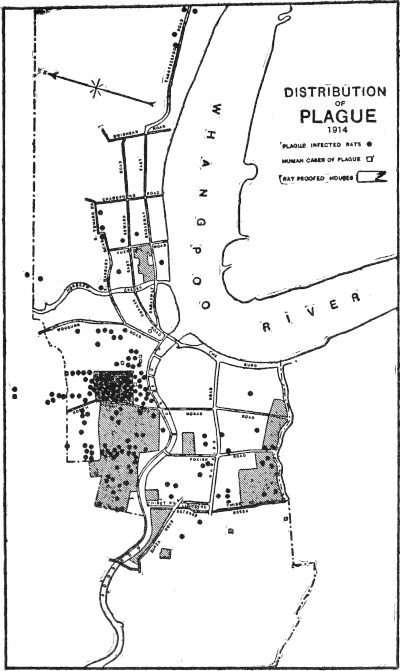
DISTRIBUTION OF PLAGUE 1914
The danger from contagious diseases is not so easily controlled. There is no law requiring small-pox, cholera, or even plague patients to go to the Chinese Isolation Hospital. Moral suasion is the only influence that can be brought to bear on them, and it is not always sufficiently powerful. But a vigorous campaign in the interest of the prevention of disease is continually in progress. Every month, and every day of the month, printed circulars are scattered broadcast. They are written in both English and Chinese, and relate to sanitation, hygiene, the danger of promiscuous spitting, of flies and mosquitoes, the need of removing stagnant water and rat-proofing houses. In the autumn and winter notices are posted on electric light and telephone poles calling the attention of passers-by to free vaccination for Chinese at any one of the sixteen branch offices of the health department. Health lectures are given weekly at the health offices, and not only that but heed is paid to the old proverb: “If the hill will not come to Mahomet, Mahomet will go to the hill.” Although the lectures, which are of a popular character, usually draw a large, attentive crowd, trained Chinese employees lecture in schools, tea-shops, and other places where the people are wont to gather. They carry around a dinner bell which they ring to attract an audience, and they soon have it. When the lectures first began the people did not understand their intent, and they aroused almost fierce opposition. But the Chief of the Department, a physician of great tact and urbanity, sent invitations to some of the leading business men and officials to meet him at a specified time and place when he addressed them in person explaining the character of his campaign. After that there was no further trouble. A large force of coolies is employed to fight mosquitoes. They work in pairs in districts assigned to them. Their duty is to gather up old tins, bottles, and broken crockery, warn residents against leaving about their premises tubs, empty flower-pots, and other vessels capable of holding rain-water, obliterating shallow pools and slushy places by means of scratch drains or filling them up with house ashes, and sprinkling kerosene oil on stagnant water that can not be drawn off. The coolies are inspired to faithfulness by frequent and unannounced inspection of their work.
Among the many business houses regularly inspected by the Health Department are dairies, laundries, tea, fruit, and meat shops, restaurants and bakeries. Licenses prohibit in tea-shops the hawking of fresh food stuffs on the premises; dairies, bakeries, and laundries must be calcimined twice a year, no one shall sleep or eat in them, nor may they be attached to a dwelling-house. In bakeries the spraying of fluid from the mouth on the products of the bakery is prohibited, and in laundries the same rule applies to the sprinkling of clothes. In dairies workers are required to keep their clothes clean and wash their hands before milking. Always and everywhere spitting is forbidden and also the employment of persons with communicable diseases. To suppose that these rules are carried out to the letter, would be altogether too much to expect of human nature. That they act as a powerful deterrent is certainly true. The foreign dairies are the best, but one Chinese dairy enjoys the enviable reputation of never having been either fined or cautioned. The Municipal Slaughter House is kept strictly sanitary and cattle and carcasses are examined daily. Good meat is stamped with the words “Killed Municipal Slaughter House.” Inferior meat but free from disease is marked “2nd Quality.” No meat for foreign consumption is allowed to be brought into the Settlement unless it bears the Municipal stamp.
Tuberculosis is the Chinaman’s Nemesis, and too often pursues him from the cradle to the grave. It is also frightfully common among the poor Eurasians who herd together under lamentable conditions. The only remedy for this prevailing malady seems to be to educate, educate, educate, and that is being done as thoroughly and effectively as possible. The Society of King’s Daughters recently did a fine thing. They planned a Tuberculosis Exhibit, which was held for a week or more in an empty down town store. Much of the exhibit was loaned and set up by the Young Men’s Christian Association that is itself carrying on a telling campaign against China’s “White Scourge.” Maps, charts, pictures, devices of all kinds for arresting the attention and teaching a lesson, were arranged attractively, but two things in particular produced a profound impression. One was a bell that every thirty-seven seconds clanged ominously. Over it hung a placard announcing in Chinese and English that every time the bell tolled some poor victim in China died of tuberculosis. The other design was more conspicuously placed in one of the large show windows and always attracted a crowd of absorbed, silent Chinese. The sight that held them spell-bound was a perfect model of a Chinese house, out of which stepped a Chinaman, who, after walking a few steps, fell into a Chinese coffin that instantly disappeared in the earth. This happened every eight seconds and each drop of the coffin represented a death from tuberculosis somewhere in the world.
Before 1898 there was practically no Health Department and no health campaign. If progress at times seems slow, one has only to look back to realize what a marvellous change for the better has been wrought in a decade and a half. Perhaps more to the Health Department than to any other branch of the Municipal Government Shanghai owes its right to be called “The Model Settlement.” The group of Central Municipal Buildings covering an entire square in the heart of the city forms one of the finest plants of the kind to be found in the Far East.