VI
Reading edition
SOMETHING ABOUT VEHICLES
LET them be named decently and in order. First and foremost is the wheelbarrow. It does not take this rank because of its superior size, elegance, or even usefulness, but on account of its antiquity. To be sure, it can not lay claim to antedating the sedan-chair, but the dignified and exclusive sedan-chair has practically dropped out of Shanghai street life and hence will not be considered. The wheelbarrow on the contrary, instead of being relegated to the interior or less modern towns, creakily holds its own, and is not to be downed. Nor does any one want it to be, useful vehicle that it is, unless perchance some nervous invalids, or weary sleepers, whose morning rest is disturbed by the rising crescendo of the rasping, tormenting, unconquerable nuisance. The creak could be stopped with a few drops of oil—the easiest matter in the world, but the coolie loves that creak—he would not part with it for anything. It means business. It is the evidence of work being accomplished. Without it he would feel lost. Every wheelbarrow, the Chinese say, has its individual creak. People too far off to be recognized are identified in this way. “Friend Wong is coming,” says a man to his neighbor, “I hear his creak.” A Chinese wheelbarrow has this advantage over its foreign compeers, that instead of a small wheel at the end, it has a large one in the center. To be sure, the wheel rising up divides the wheelbarrow into halves, but makes it much easier to carry the weight. A stout woven rope band fastened to the handle-bars and passing back across the coolie’s shoulders helps greatly to steady the load.
The Shanghai wheelbarrow is mostly used for freight, but because of its cheapness it is a favourite passenger vehicle with a certain class of Chinese, especially the women and children going to and from the mills. Often eight or ten crowd on, sitting sideways with their feet hanging down. Once eleven women and girls were seen on one, pushed along by a single coolie. A coolie ordinarily is able to manage anywhere from six hundred to a thousand pounds. He carries everything, from building-stone to goose feathers. When the cargo is heavy the poor fellow staggers like a drunken man, moving from side to side to balance his load. His veins stand out like whipcords and the perspiration pours off from him in streams. To keep from being blinded by it in summer he frequently has to wear a band forming artificial eyebrows across his forehead to catch and hold the water. All the time, breathless as he is, he usually keeps up his singing cry, partly from force of habit and partly to warn people that he is coming and to clear the road. But street-cars can’t turn out of the way, and some other vehicles won’t, so occasionally the coolie gets caught in a trap, the wheelbarrow loses its balance, and over it goes. With certain kinds of cargo no damage is done and the only inconvenience is the delay and extra lifting, but if the load is rice bags which burst open, or breakable merchandise, the coolie faces a bad situation. He earns, as a rule, a fair living wage for a poor man, but there is no surplus to cover the cost of accidents.
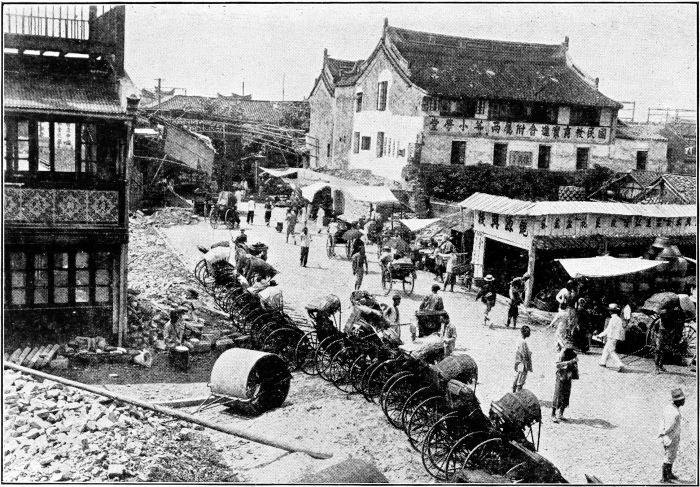
HIGH, BLACK RICKSHAS OUTSIDE THE FOREIGN SETTLEMENT
Wheelbarrow coolies, though, are said to live longer and fare better than most ricsha coolies. This latter class is very shortlived as a rule. Their working years do not ordinarily extend beyond three, five, or at the most ten. One Shanghai ricsha coolie declared he had pulled a ricsha for twenty-four years, but this, if true, was most exceptional. At the present time there are between nine and ten thousand public ricshas in Shanghai, but probably a shifting population during the year of many times that number of coolies. Some one who has studied the subject estimates that the entire coolie population of Shanghai, including all classes, reaches as high as four hundred thousand. The average earnings of a ricsha coolie are seven coppers, about three or four cents, a day, and from this pittance he must support a family, and that too in a city noted over China for high cost of living. No wonder a doctor in charge of a mission hospital where many sick coolies are sent recently reported, “A large number of the cases brought in are in a state of collapse due to malnutrition and the bad hygienic conditions of their life superadded to the strenuous spasmodic strain they undergo.” Heart trouble and China’s inveterate foe, tuberculosis, carry off the majority. Perspiring freely, even in winter, after a hard run, then waiting, it may be an hour, for another “fare,” in the penetrating wind or chilling rain, with no extra covering for their thinly clad bodies, the coolies are in a condition to succumb readily to disease. Married men live in colonies in the outskirts of the city, in little straw or bamboo huts, for which they pay a rental of from fifteen to twenty cents a month. In cold weather the whole family crawls inside to keep warm, where the air is heavy with tobacco smoke and the fumes from the little charcoal fire over which the rice is cooking. Many a baby contracts eye disease that later leads to blindness. Unmarried ricsha coolies sleep wherever they can find shelter, ordinarily in the cheap tea-houses, often as many as fifty herding together in one small room. The conditions in these places beggar description.
The coolies do not own their ricshas. They are the property of companies, some foreign, others Chinese, each owning anywhere from fifty to seven or eight hundred, while two large companies have in stock a thousand and twelve hundred, respectively. One of these companies manufactures its own ricshas, turning out a hundred a month. Women are employed to make the cushions for the back and seat. Several of the companies provide the men with uniforms. Generally it is only a coat, while the wearer’s ragged trousers show more ragged in contrast. In a single instance the clothes are washed every twenty-four hours in the company’s laundry and returned clean to the coolies. The Municipal Council has decreed that in the International Settlement ricsha coolies must be decently clad, but the rule is not strictly enforced. On the back of ricshas belonging to Chinese companies is written in Chinese the company’s name, which is generally rather poetic not to say moral in tone, such as “Able to Fly Co.,” “Everlasting Remembrance,” “Steadfast Righteousness.” One company’s ricshas exhibit above the license plate a small metal locomotive, highly suggestive of incomparable speed. A rubber-tired ricsha costs, when new, fifty or sixty dollars, and its rental per day is from thirty-five to forty cents. A coolie hiring a ricsha, after using it a few hours, or half a day, sublets it, and that man in turn often rents it to another, so that in the course of twenty-four hours, it is likely to pass through two, three, or perhaps four hands, consequently the number of ricsha coolies is naturally far in excess of the ricshas. Passengers pay either according to the time the ricsha is used, the regular tariff being twenty cents an hour (but if the poor fellow gets eight or ten cents he does well), or by the trip, say five cents for a run of a mile or a mile and a half. At night the coolie expects a trifle more, as he has to spend a cent to buy the candle that lights his paper lantern or tiny lamp. These are the prices for foreigners. Chinese as a rule give less. Ricshas are of two kinds, the high black ones and the low brown style. All the latter are furnished with rubber tires. Most of the high ones formerly were without them, and as they could be rented more cheaply in consequence, were much used by the poorer Chinese, but of late the Municipal Council has succeeded in banishing all such ricshas from the Settlement. Most of the worn-out ricshas are apparently bought up for use in the Chinese district, as it abounds in a multitude of rickety, ramshackle vehicles, probably purchased for a mere song. Many of them are pulled by young boys, scarcely more than children.
Ricsha coolies running in the International Settlement must have a license from the Municipal Council. If they are to travel beyond the limits of the Settlement they require in addition a French and a Chinese license. The license, in the form of a tin plate, is slipped into a groove at the back of the ricsha. It is furnished to the coolies by the companies owning the ricshas who pay into the city treasury a dollar a month for each one. The coolie loses his license if he commits a misdemeanor. Often for a very slight one, like blocking the road, generally in his eagerness to secure a passenger, he has his license taken from him by a Sikh policeman. Then the poor fellow is sorely troubled, for he can do no business without his license, and it is sometimes several days, or weeks, before it is restored, on the payment of a fine of forty cents. Once a month the ricshas in the Settlement must have their licenses renewed and be officially inspected.
At the examining station opposite the Honkew Market, between three and four hundred gather every day. An English policeman is in charge. One by one the ricshas are brought before him, while he and a Chinese assistant shake, pull, and pound them to see if they are in good condition. If any part shows signs of weakness it is wrenched off, the license withheld, and the ricsha sent back to the company that owns it for repairs. The companies are represented on these occasions by Chinese foremen. Occasionally the foreman is a forewoman. A regular habitué is an old wizened creature, with bound feet and half blind, but as the foreign officer aptly describes her, “Keen as a razor when it comes to looking after the fifty ricshas placed in her care.” Accidents to ricshas are not infrequent on the crowded streets of Shanghai. The marvel is that they do not occur oftener. Nearly all coolies run with their heads down and their minds,—well, who can tell where a coolie’s mind may be wandering? It is doubtless dormant most of the time. Nearly all coolies come from the lowest stratum of society, and having nothing else to give in exchange for bread, or rather rice, sell their strength. The literal interpretation of the word “coolie” is “The man who sells his strength.”
The ricsha coolie’s movements are erratic and impulsive. He seldom reasons. There are foreigners who will not risk their life in a ricsha and hair-breadth escapes occur nearly every day. An American lady was riding on one of the narrow, congested streets, when suddenly her coolie attempted to dash across the road between two electric cars approaching from opposite directions. He succeeded in clearing the track himself but the cars closed on the ricsha, crushing it to splinters. The woman with great presence of mind saved herself by grasping the front railing of one of the cars and holding to it until she could be drawn up. Another remarkable escape was that of a mother who, with her young baby, was riding on one of the quiet streets supposed to be perfectly safe. The coolie saw a man approaching on a bicycle, zigzaged several times in front of him, then utterly losing his nerve and wits, he dropped the shafts and ran away. The sudden stop and downward movement of the ricsha threw the baby out of its mother’s arms. The little thing fell, face down, on the hard macadamized road, and lay so still the mother feared the child was dead, but it proved to be only stunned, and except for some bad bruises, the next day seemed none the worse for its fall.
The ordinary wear and tear of ricshas is made good by the owners, but damages due to accidents are often charged to the coolie, at least in part. The amount for which he is responsible depends on the company. One large firm exacts two and three dollars for a tire. These prices are ruinous for the coolie, who is obliged to borrow the money to pay the fine, and money lenders demand exorbitant rates of interest. The coolie who is unable to pay his debt has no recourse but to run away, commit suicide, or go to the Debtor’s Prison. In the latter case, unless he has more fortunate friends or relatives who come to his rescue he is likely to remain a prisoner indefinitely.
It is interesting to see how quickly a fresh arrival from the West accustoms himself to ricsha riding. At first he is apt to inveigh against man-drawn vehicles, or if he gets into a ricsha, to sit lightly on the seat, with perhaps one foot hanging out at the side, with the idea of helping the coolie along, but presently he abandons himself to the enjoyment of the little, easy-running carriage, or as one enthusiastic woman described it “a grown-up’s perambulator,” and almost ceases to think of the puller as a human being. But let him stand on the Bund some day in the late afternoon and watch the stream of ricshas hurrying by. There is scarcely a coolie whose face is not drawn as if with pain, and many are actually contorted. Although a ricsha coolie’s life is far from a bed of roses, in his own happy-go-lucky way he does manage to get some pleasure out of it. One of the ricsha companies, with benevolent intentions, undertook to furnish free hot tea to its men at the company’s headquarters, but the plan didn’t work, for the reason that the coolies preferred to buy their own tea at a tea-house. Wretched as is the low-class tea-house, it is the coolies’ favorite gathering place, where, surrounded by their cronies, they can gossip, smoke, and gamble till necessity drives them forth to work again.
The coolies who come to the city in winter from farms and return to them in the spring, may be called gentlemen of means compared with the others. A very few, the number is almost negligible, are able to make ricsha pulling a paying business, as in the case of the man who gave up the position of “boy” at six dollars a month in a private family to become a ricsha coolie, because he said he could make more money.
Many articles are lost in the ricshas. A passenger gets out and hurries away, forgetting his bundle or umbrella, and unless he has thought to look at the number on the ricsha, that is the last he ever sees of it. Not always though. The narrow margin on which the poor coolie exists from day to day makes the exceptionally honest one stand out in all the brighter light. An elderly gentleman, carrying a very valuable package, left his ricsha with the package in it and went into a store. His business detained him some time and he finally returned home in a street car, entirely forgetting he had a ricsha waiting for him. After a considerable time the coolie, who had not observed the gentleman go away, went into the shop to look for him. A clerk said he had gone. Then was the coolie’s opportunity to run off with his prize. But no, in a moment he had brought in the package and laid it on the counter, asking anxiously how he could get it to the owner. As the gentleman was a regular customer at the shop, the clerk agreed to send it to his residence. That coolie not only received no reward for his honesty, since he slipped back into the crowd and it was impossible to identify him, but he lost time and fare as well. Another case was that of a lady who, in stepping from her ricsha, dropped a five dollar bill, which was discovered by the coolie after she had gone. Not being sure which house the lady had entered the coolie went from one to another until he found the owner of the money, to whom he restored it. It sometimes happens that dishonesty crops up where it is not looked for, and an unprincipled passenger, sad to relate, sometimes a foreigner, after using a ricsha for several hours, eludes his coolie and escapes the payment of fare by going into a shop or house and disappearing out another door.
The ricsha is not indigenous to China. It was introduced from Japan as many as fifty years ago and promises to be seen on the streets of Shanghai for some time to come in spite of the increasing popularity of more modern conveyances.
There is a Christian mission for the ricsha coolies. It was started four years ago by a Scotch business man on whose heart had been laid the spiritual needs of this neglected class. At two centres in thickly-populated coolie districts week-day and Sunday meetings are held in rented Chinese houses, besides Sunday-schools and day-schools for the children of the ricsha coolies and a weekly religious meeting for women. A native evangelist visits the men in their homes and in the tea-shops they are wont to frequent, a Bible woman goes among the women, hot rice and beds are given to the really destitute in cold weather, and the sick are sent to the hospital. At the special Christmas services held one year each coolie was presented with a cheap towel, to his great delight. But let it not be imagined that the coolie’s satisfaction was due to the fact that he could now remove a few layers of dirt from his hands and face. That consideration, if it entered his mind at all, was wholly secondary. The chief use of the towel was to wipe the sweat from his brow when running, so that he could see more clearly. The coolies’ incredulous amazement that any one should care for them was most touching. At first when they flocked to the Hall they would say to the evangelist, “Is this for us?” and at the close of the meeting, “We never heard anything like it!” There have been a number of very bright conversions among them. The work is supported by voluntary contributions, the coolies themselves, out of their extreme poverty, giving generously. The ambition of some is to raise enough money to build a church! It is a noble purpose but leagues beyond the possibilities of their meagre resources.
Tramcars began running in the International Settlement in Shanghai in 1907. Six years later they were introduced on Chinese territory. No street in the Chinese city being wide enough for a car to pass through it, the intention is to surround the city with a track in place of the old moat, and it will not be long before the circle is complete. The cars are divided into two unequal sections, the larger one for third-class passengers and the smaller for first-class. Some foreigners travel third-class and many Chinese first-class. On one line in the Settlement, owing to the rude treatment accorded them in the third-class compartment by Chinese men, Chinese women are allowed to travel first-class for a third-class fare. Two notices stand out conspicuously in third-class cars. One prohibits spitting and is put up by the Municipal Health Department to guard against tuberculosis. The other warns passengers not to enter or leave while the cars are in motion. The warning is emphasized by a coloured picture of a man who has fallen in jumping off a car and is lying on the ground with the blood flowing from his wounds. Still, every year some Chinese are killed and many more injured in attempting, in their ignorance of physical laws, to imitate what they see foreigners do. Yet accidents do not deter them from using the cars, and during the busy hours of the day they fairly swarm into them. Nearly all the cars carry a trailer, and except for a few seats in front reserved for first-class passengers, that too is crowded with Chinese. Fares are rated according to the distance traveled. Both motorman and conductor are Chinese, and the latter understands just enough English to collect fares. But if a stranger in the city asks in English for general information he will rarely succeed in making himself understood. Railless cars, brought over from England, were introduced on one road in the autumn of 1914, but proved too heavy for the paving and were prohibited after a week or two. The following spring, the road foundation having been strengthened, a second trial of the cars was made, and this time with pronounced success. They soon became very popular. Underground and elevated cars have not yet made their appearance in Shanghai, but the son of one of its most prominent Chinese citizens has been spending some time in Paris learning to fly, so on his return in the near future almost anything may be expected to develop in this progressive corner of the Orient.
Shanghai being one of the greatest shipping ports in the Far East, quantities of merchandise are handled daily. Besides wheelbarrows, and coolies who carry loads suspended by ropes from poles resting on their shoulders, men-drawn carts are constantly in requisition. Coolies take the place of horses and mules as beasts of burden. It is true that the foreign hotels and many foreign firms have their wagons and vans, nowadays they are oftener motor cars, but these vehicles of Western manufacture are far outnumbered by native hand-pulled carts. The carts are of the simplest design, several oblong planks nailed together and set on two wheels. Most of the loads have to be tied on with ropes, and no account is taken of weight. The coolies’ muscle is not spared. Three, four, or more coolies are stationed in front of the cart to pull, with often several at the back to push. Stout ropes fifteen or twenty feet long are fastened by one end to the cart and knotted at the other. Each coolie takes a rope, passes it over his shoulder, changing occasionally for relief from one to the other, and grasps the knot with both hands. If the load is extremely heavy, such as iron rods or building stone, the pullers even on level ground are obliged to stop frequently to rest and recover breath. But it is when crossing the arched bridges over Soochow Creek that the tug of war comes. The forward coolies bend almost double, while those at the rear push with might and main till their faces are congested and it seems as if they must burst every blood-vessel in their bodies. But perhaps the cart does not yield an inch. After a moment’s rest another effort is made. This time the coolies at the back grasp the wheels and at last succeed in turning them ever so little, while slowly, very, very slowly the cart is drawn up the incline. When the highest point of the bridge is reached, unless the road in front is clear, there is another pause. Then the coolies who have been pushing, pull back, assisted by some of the others, while the forward coolies rush ahead in the liveliest manner to keep from being hit by the cart. It impresses foreigners as a cruel way of getting work done and draws painfully on their sympathies, but if a sudden change were made to horse power, the carters would doubtless be the first ones to raise a hue and cry against it.