XIII
Reading edition
CHINESE SUCCESSES IN SOCIAL SERVICE
SEVERAL years ago a company of lepers numbering about forty, living in one of the southern provinces of China, were driven from their miserable shacks and burned alive. When the official by whose order the atrocious deed was committed was called to account for it, he excused himself by saying that since the lepers were public nuisances, mere cumberers of the ground, he decided that the sooner they were out of the way the better. Such was his idea of social service and he represents a class in China who regard calamities like famine, flood, and pestilence as heaven-sent blessings to relieve the land of its superfluous population. But to the educated youth, touched by the spirit of a common brotherhood, and to the better elements of an earlier generation the incident just related is as abhorrent as it can possibly be to a Westerner.
Philanthropy of a certain kind is not new in China. Almsgiving for the sake of winning and storing up merit is centuries old. But galling poverty, the fierce struggle for existence, strange customs and superstitions, have all contributed to deaden the sensibilities and quench the naturally kind impulses of the heart. For example, to care for a man lying sick by the roadside means to the rank and file that the Good Samaritan brings down on his own head the ill-luck that followed the poor unfortunate, and to carry him into his house to die involves not only the obligation of paying for his coffin and burial, no small matter in China, but of answering to his relatives, if he has any, for his decease. Not long ago in the Chinese City a humble dwelling-house took fire and quickly burned to the ground. The family barely escaped with their lives, a mother with a new-born baby, and a troop of older children, one of them sick. The father was away, presumably at work. A missionary passing through the narrow street saw the poor things huddled together in a forlorn little group and her heart was stirred with pity. “Why don’t some of you take them home?” she asked of the crowd looking on. “Her husband is coming, we must wait for him,” they answered. An hour or two later, on returning, the lady found the family in the same spot, the woman weak and weary, pressing her infant to her breast. A cold rain was falling. “If you don’t give these people shelter I shall take them home with me,” she exclaimed indignantly to a bystander. “The husband will be here soon, we dare not interfere,” he said in tones of sharp decision. The next morning, unbelievable as it seems, the woman and her children were still on the street, unsheltered and uncared for. At once they were hurried to the mission hospital and tenderly nursed. Then, and not till then, did the real truth in the case come out. Had any one befriended these outcasts, the evil spirit that caused the destruction of their house, would in anger have entered the home of their benefactor and wrought disaster. Hence the only safe course, since they had incurred the displeasure of the gods, was to let them severely alone. Yet to offset this circumstance is the sweet story, and by no means an isolated case, of the old Chinese grandmother, who when a little foreign babe was rescued from drowning, but chilled to the marrow and ready to die, quickly opened her padded coat, and pressed it to her warm bosom, till it revived, thus saving its life.
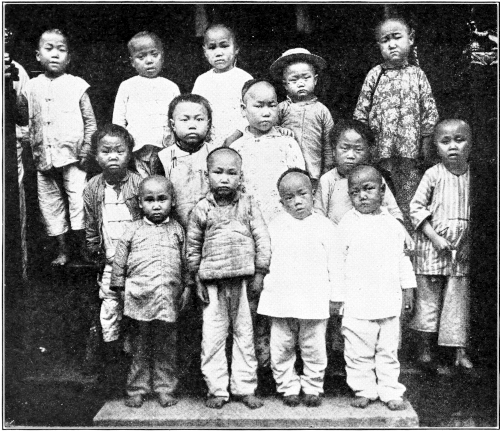
RESCUED KIDNAPPED CHILDREN AS THEY WERE PHOTOGRAPHED FOR ADVERTISEMENT IN THE CHINESE DAILY NEWSPAPERS
The recent revolution ushered in many innovations, but nothing that is destined to result in larger good to China than the practice of social service as understood in the West. The idea has met with a quick and enthusiastic response by the Chinese, Christians, and non-Christians alike, and is already yielding notable results in many places. “Why should we not do for ourselves what foreigners have so long been doing for us?” the leaders are asking one another, and hospitals, orphanages, model prisons, refuges, industrial plants, are rising up here, there, and yonder, till it is scarcely possible to open a newspaper without reading of some new project afloat. In progressive Shanghai social service is fast becoming a slogan. An unusual opportunity is afforded here of contrasting the old style of philanthropy with the new, and the study is valuable as well as interesting.
The local Charitable Society that antedates all others has its headquarters, known as The Hall of United Benevolence, in the Chinese City. Its exact age is difficult to determine as no one seems to know. Some say it has as many as three hundred years to its credit. A managing board of ten men, with offices in a Chinese house of spacious dimensions, does the business of the Society, which is very wealthy, owning large tracts of public land. Its chief work is to donate lots to philanthropic institutions, furnish coffins to paupers, subsidize various existing charities, and dispense free of charge Chinese medicines. This Association is held in the highest regard by all classes of Chinese, and may be called the fountain-head from which most of the existing charities have sprung.
One of the older philanthropies, started more than fifty years ago, is the Home for Widows in the Chinese City. It receives widows without money or relatives to support them, who have determined not to re-marry, a most praiseworthy resolve according to Chinese standards. The house-mother, an old woman of seventy, delights to tell that she has been an inmate of the Home for forty years, and certainly the bright-eyed, rosy-cheeked dame is as good an advertisement as the place could have. Widows with young children are allowed to keep their little ones with them till the girls are betrothed and the boys able to go out to work. In the meantime they are sent to day-schools in the city. A family of three hundred is crowded into the rambling old house, the gift of a former governor, which consists of a series of small courts shut in by low two-story buildings. Each woman has her own little room, or perhaps more than one if her family is large. The premises are fairly neat, but what troops of children swarm around, noisy and undisciplined, and as a Chinese caller once pointedly remarked, “How the women must quarrel!” Their salvation evidently lies in their industrial work, for while food and shelter are given them, the able-bodied are expected to provide their own and their children’s clothes. So they spend their days making articles which are sold and yield a slight revenue, chiefly Chinese shoes, idol money, and clothing.
The Widows’ Home, despite its limitations, commands a degree of genuine respect, but not so the two Foundlings’ Homes that awaken only pity and almost fierce resentment. They are meant to do good, yet alas, what a travesty on the real thing! The institution inside of the Chinese City is the oldest philanthropy in Shanghai and dates back to 1710. From the Hall of United Benevolence that fosters it an occasional report goes forth telling about this work. The reports are written in the usual florid Chinese style, and after describing at length the virtuous motives of the founders and supporters, give the rules governing the organization. For instance the age of each child is registered, a note made of its appearance and condition, also “of the lines and fashion of its fingers, five senses and four limbs.” Wet nurses are made to draw lots for the babies in order to avoid partiality. Close to the street entrance is a perforated drawer in which the foundling is to be left. The one who brings the baby must rap on the door with a stick that hangs beside the drawer to announce its arrival. These and many more minute directions are recorded with painstaking elaboration.
They read well, but what are the facts? It requires considerable tact and insistence for a visitor to gain access to the inner rooms of the Home, where the real life of the babies is dragged out. Two or three of the well-favoured will be brought in the arms of nurses to an outer court, but when permission is asked to go inside there is evident reluctance and many excuses are offered. Sometimes the only sure open sesame is the official card of the City Magistrate. Apparently no cruelty is practiced, but it is the gross ignorance and negligence of the caretakers that makes so pitiable the brief life of the babies, for most of them die after a few weeks or months. Each wet nurse is given the charge of two foundlings. The nurses may remain at the Home or if they prefer take the little ones to their own home, in which case they receive somewhat larger pay. If a sufficient number of wet nurses can not be secured, the foundlings, irrespective of age, whether a few days or several months old, are fed on rice water sweetened with coarse brown sugar. Scarcely any reach the Home in a normal condition. Diseased, weak, bruised, one coming with a terrible gash in its neck given with intent to kill, the death-knell of the puny things is generally sounded before birth. The rooms where they are kept are small, and as a rule almost devoid of light and air. In one of the Homes even through the heat of a Shanghai summer the babies not only sleep in stifling rooms but on beds surrounded by closely-woven cloth curtains. In the other Home they lie the long day through in bamboo cribs, their little bodies eaten with flies and poisoned with mosquitoes. The chorus of feeble wails that constantly arises pierces the visitor’s heart, as does the sight of the tiny skeleton-like limbs. With scarcely an exception the fifty babies in each of the Homes, and the far larger number that are put out to nurse, are girls. Just one thought comes as a slight comfort, that wretched as is the condition of the children they are certainly quite as well, or even perhaps better off, than they would be in their own homes. No wonder physicians in China say the mortality among children reaches as high as seventy or eighty per cent.
In happy contrast to these Homes, is the Hospice of St. Joseph, which has gathered into its safe shelter nearly eleven hundred of Shanghai’s sick and poverty-stricken Chinese. But the story is too good not to be told from the beginning. Four years ago two Christian men, members of the Catholic Church, determined to found a philanthropic institution. One holds several highly responsible offices in the Chinese Municipality. The other is a successful business man. Many of the tramcars in the International Settlement, and all of those under Chinese control, were turned out from his foundry. His snug steamers ply the waters of the upper Yangtse as far as Chungking, conquerors at last, after many futile efforts, over the difficulties presented by the dangerous rapids. He subscribes for American journals on mechanics which he studies diligently through an interpreter, and after absorbing ideas gleaned from them, invents and adapts machinery for use in China. It is his desire to see Chinese farmers follow improved methods of agriculture, and to encourage them he occasionally presents a village with a modern threshing machine made in his foundry. His Sundays are frequently spent in evangelistic work in the country, and busy man that he is, he makes it a practice as often as possible to leave his work and go to the Arsenal to pray with condemned prisoners before they die. Recently the President honoured him with a medal rarely bestowed, and all who know him, Protestant and Catholic alike, pronounce him a “rare character.”
The land for the Hospice was donated by the Charitable Society of the Hall of United Benevolences, and the Chinese Municipality gave bricks (those bricks seem to multiply miraculously!) from the old city wall for building material. The colony includes a men’s hospital, a women’s hospital, a home for boys, a refuge for girls, an asylum for the blind, a chapel, dispensaries, kitchens, quarters for the insane, for opium patients, and prisoners from the jail in the Chinese City. These buildings are already completed and others are projected. While the two founders direct the business affairs of the institution, they have given the care of it to twelve Sisters of Charity, four of whom are Europeans and the rest Chinese.
The upkeep of such a great establishment, under the conditions that exist in China, is no small matter, but the next to impossible has been achieved and the management is well-nigh beyond criticism. The long, light airy wards, with every cot filled, are visited each morning by a foreign-trained Chinese physician, who donates his services. On the second floor of the men’s hospital is a beautiful white-tiled operating room, with all the latest equipment. There are industries, indoors or out, for those able to work. Children study half a day. Incurables and old people without support are kept on for life, but the strong and middle-aged are sent away from the institution as soon as they are well to make room for others. It is a joy in this land, where the insane have been so long neglected and maltreated, to find a retreat prepared for them where they receive the kindest consideration. The consequence is that many after a few months go home cured. Every cement-lined cell is protected in front by iron bars, so that the door can be left wide open, admitting light and air. A door at the back of each cell opens into a narrow corridor which leads to bathrooms with large earthen tubs and running water. Several of the cells are neatly padded to accommodate violent patients. This place and the prisoners’ wards next to it, as clean and wholesome as heart could wish, are in charge of a Christian young man of tried character.
In addition to the Hospice, its two large-hearted founders have built, on a much frequented street, a three-story Evangelistic Hall. Said the elder one, “We want it to be a place where any passerby and especially strangers in the city, can stop a while and discuss the Christian doctrine.” There is a day school for boys in connection with it.
Out in the neighbourhood of the old pagoda, set in the midst of blooming peach orchards, is a large orphanage for both boys and girls. This also is a Christian institution, but Protestant, and was started eleven years ago by a group of men, several of whom had studied in mission schools. The boys and girls are in separate though connecting compounds, and a happier, merrier lot of young folks it would be hard to find. Much is made of Bible Study, and industrial work among the boys is strongly emphasized. The sale of their rattan furniture, painted scrolls, cloth and hot-house flowers, especially at the time of their annual chrysanthemum show, goes a long way toward meeting the current expenses of the work.
On the same road as the orphanage, but nearer town, is “The Shanghai Home for Poor Children.” This is not Christian, but it is one of the most interesting and best conducted institutions in the city. A few influential business men are its promoters, Chinese with high ideals and broad vision. There are in the Home about twenty girls and a hundred boys, many of them waifs picked up on the streets by the directors themselves. A peculiarity of this institution is that the children do not use beds but sleep on the floor in great breezy dormitories where there can be no question of well-inflated lungs. The school has a famous orchestra, and a picture that catches the eye at once, on the wall of the reception room, represents the band members, girls as well as boys, sitting with their instruments in their hands on the platform in the main hall. This Home is characterized by two unique features, one, that the old-time Chinese boxing and fencing are taught in the fine out-of-doors gymnasium, and the other, the prominence given to agriculture and horticulture as school branches. Indeed this seems to be the only school in Shanghai where agriculture is a study, with opportunity for practical work in the ample grounds around the institution. In connection with this charity it is worth recording that of the ten members on the Board of Directors five are women. However, they have not advanced quite far enough to join with the men in committee meetings but hold separate sessions. Or possibly it is the men, poor benighted creatures, who are to blame!
It is impossible to lay too much emphasis on the value of industrial schools, and social service can be turned into no more beneficent channels than in starting and maintaining such schools. Until very recently industrial training was wholly neglected in China. Even now, if a Chinese educator is asked, “Are there any industrial schools in Shanghai?” he will answer, “None,” and yet there are at least two and one more soon to be opened. But these, it seems, are not classed as schools, since they admit only poor boys unable to pay tuition, and because the study of books is made secondary. The best industrial school was opened four years ago. Work is carried on in a single large building that is not divided into rooms, but from whose centre apartments branch off in different directions like the spokes of a wheel, all well supplied with windows, thus insuring plenty of fresh air and good ventilation even in the hottest weather. “How many boys have you?” was asked of the head teacher. “One hundred, and I wish I had room for five hundred!” came the reply with surprising earnestness. The boys range in age from very little fellows to lads of sixteen and eighteen. There are industries enough to suit the bent of each one. They include carpet-weaving, wicker work, soap-making, pottery, portrait painting, the manufacture of kindergarten toys, clothing made on sewing machines, and stockings on knitting machines. The boys work during the day and study in the evening. Their pride is in their brass band and they earn quite a bit of money for the school by playing at weddings and funerals. The third of an acre covered by the school plant was originally a cemetery, and how characteristic it is of China, that in order to secure the land one hundred and thirty-nine graves had to be removed!
One of the commonest crimes in Shanghai is kidnapping. Chinese children, if they are healthy and attractive, need to be carefully guarded. Most of the kidnappers are women, and the nefarious business is so lucrative that a large number are engaged in it. Kidnappers grow bold as well as wily, picking up children at play on the street, or off on errands, and even beguiling or snatching them away from their very doors. Both boys and girls are stolen, though boys are greater prizes, being always in demand as apprentices and adopted sons in families that have not been blessed with an heir, for the master of a house who has no son to burn incense before his ancestral tablet after his death, and to worship at his grave, is of all men most miserable. Still, pretty little girls are always easily disposed of, either in brothels or in private homes as slaves or future daughters-in-law.
Several years ago about thirty public-spirited Chinese gentlemen in Shanghai formed themselves into an Anti-Kidnapping Society and set to work in earnest to combat this evil. They hired skilled Chinese detectives to meet out-going and in-coming coast and river steamers and arrest all suspicious characters. Cunning as the kidnappers are, again and again they prove no match for the quickwitted detectives, who succeed in rescuing many children. The poor little victims are frequently concealed in baskets of clothing, or hidden away in boxes that ostensibly contain fruit or merchandise. Sometimes two or three will be found crouching together in a single box with only the tiniest holes for admitting air. The very young children are usually drugged, and older ones frightened into silence by the most terrible threats. Five miles out from Shanghai, convenient to the railroad yet in the midst of open country, has stood for years a large Buddhist temple. At the time of the revolution, when so many of the temples in China were abandoned, and put to other uses, this one was leased by the Anti-Kidnapping Society as a Home for rescued children. Stripped of its idols and incense burners, the smoke-blackened walls white-washed, the priests ejected, the old place that so long echoed the mumbled prayers of heathen devotees now resounds with the happy voices of between two and three hundred children. The girls, who are considerably in the minority, occupy the courts in the rear, large and pleasant however, and the boys those in front. The Worship Hall of the temple has been converted into a school and assembly room for the boys. Every day in the Chinese newspapers of Shanghai the Home is advertised, with a description and photographs of the children most recently rescued. In this way hundreds have been identified by their parents and returned to them. Unclaimed children are kept in the Home, being taught some kind of industrial work until they are able to go out and care for themselves. Ethics is a branch of the school curriculum, but the children are at liberty to accept whatever religious belief they will.
The Chinese gentry in Shanghai maintain several free dispensaries. The largest of these, fronting on a crowded street, has in Chinese characters over one door the motto, “Loving to Save,” and above another “Heaven Bestows Perfect Happiness.” This charity is said to be half a century old and the building itself bears evidence of having endured that long. Every second day the dispensary is open, when patients by the hundred visit it. The dozen or so Chinese trained doctors in attendance are divided into two classes, those treating internal diseases and the others dealing with external troubles. They are separated like sheep from goats, sitting each at his own table, under covered corridors on opposite sides of a court. In the rear of the dispensary is a large workshop where coffins are made and given to the poor.
Seven years ago, when plague raged, an isolation hospital was opened by a well-known Chinese philanthropist in the outskirts of the city. He succeeded in buying the house of a wealthy Chinaman, whose several wives and numerous offspring actually performed the unprecedented feat, for Chinese, of vacating the premises in two days. Wards have since been added to the main building, so that the hospital will now accommodate about a hundred. Through the efforts of this same philanthropist, aided by a distinguished foreigner, Dr. Timothy Richard, the China Branch of the Red Cross Society was established in 1904 with headquarters in Shanghai. Three Red Cross hospitals are operated in widely separated districts of the city, two of them intended to be used exclusively for cholera patients during the cholera season. One of these had its opening some months ago when the hospital was visited by many influential Chinese and a few foreign guests. Nothing could have illustrated more clearly the progress the people are making in the science of social service. The building is a thoroughly renovated old-fashioned Chinese mansion, with courts and rooms innumerable and the usual lovely carved woodwork, mural decorations and tiny squares of translucent glass set in quaint wooden screens, though most of these had been replaced by good-sized modern windows. The most fastidious Westerner could not have asked for cleaner wards, arranged for the various classes of patients, whiter examining and operating rooms for both men and women, or a more complete equipment, though the whole was on a somewhat diminutive scale. The question, it is true, would occasionally intrude itself, “How will this place look a month from now?” but it was followed by the reflection “What began best, can’t end worst,” and that a committee capable of initiating such a work could be trusted to supervise its upkeep. The corps of young men nurses wore a neat uniform of white with blue trimmings. The women nurses,—well, to be frank, there were none. “It is so difficult to find women nurses,” explained one of the doctors. “We must have them of course or we can’t open the women’s department.” The keen interest of the Chinese themselves in the hospital, evidenced by the numbers present and their painstaking inspection, was one of the most hopeful signs. An elderly gentleman, of a singularly refined and benevolent countenance, had come all the way from Nanking, half a day’s journey, to study the plant with a view to starting something similar in his own city.
Time fails to tell of the fine modern hospital of the little Chinese woman doctor who received her training at a mission medical school in Canton, and about whom a whole chapter could be written. Unselfish to a fault, serving devotedly under the Red Cross Society during the revolution, pouring her money and her life out in kindred charities, no personal sacrifice is too great for the betterment of her people whose spiritual as well as physical needs lie as a burden on her heart.
A minor charity but one by no means to be despised is that of furnishing on the street in summer free drinks, not of intoxicants, but of tea. The tea is poured hot into earthen jars which stand inside small booths. Beside the jar is a bamboo dipper, and any passerby may stop and quench his thirst. The tea stations are scattered at frequent intervals throughout the foreign settlements as well as the Chinese City, and are an inestimable boon, particularly to the hard-working coolies.
Another charity that well illustrates the poverty of China is the conservation of waste rice. Rice is China’s staff of life. The servant calls his master to eat not by saying “Dinner is ready,” but “Rice is ready.” To waste rice is a sin; to save it, meritorious. As junks laden with rice from the country around are poled down the river and creeks to Shanghai, a few handfuls of the precious grain inevitably sift out from the bags onto the bank. This is picked up by benevolently minded persons, along with the mud in which it has fallen, and afterward laboriously separated and washed. Some hundreds of pounds in the course of a year are collected in this way and distributed to the poor. A number of local Chinese guilds during the coldest winter weather, are in the habit of feeding daily large numbers of the suffering poor, who line up at specified hours for their allotted portion; also generous sums of money are contributed annually by the Chinese and sent to the districts devastated by flood and famine to relieve the destitute.
Perhaps the most significant event of the last year in Shanghai was the organization by young Chinese women of a Social Service League. The leaders are Christians, who in a tactful but persistent way, are sure to make their influence felt. Already as a beginning five free day-schools for the poor, with a total attendance of several hundred, have been started and others are expected to open soon. A Sunday School taught by volunteer workers is held in connection with each day-school. It is the plan to dot the city with these charity schools, which divide the day between the study of the Chinese language and manual training. The whole financial burden is met by the League members and their interested friends, while a few, ladies of high position, who heretofore have led self-centred lives, are giving several hours a week to teaching. The movement is attracting wide attention.