X
Reading edition
CUSTOMS OLD AND NEW
A STUDENT in a mission school for girls received an invitation from a young gentleman of her acquaintance to accompany him on a certain evening to a place of amusement. The note fell into the hands of the missionary in charge who sought an interview with the man. “It is against the rules of the school for our girls to go out unchaperoned,” she told him, “besides why do you make such a request? You know it is not Chinese custom.” “Ha, ha,” laughed the youth derisively, “perhaps it was not formerly, but now that we have a Republic we can do anything.”
Great changes and grave dangers accompanied the birth of the republic, and nowhere are they as apparent as in Shanghai. Old things are passing away and the new order is not yet firmly established. Young women are particularly sensitive to the changed conditions. In their eagerness to imitate the ways of the West, the real meaning of which many do not fully understand, liberty and license are often confused. But the girls must not be judged too harshly, for while some are unblushingly bold, others are like imprisoned birds who, suddenly finding the cage door ajar, pant to try their wings in the open. It is scarcely to be wondered at if sometimes they fly too far afield and drop back weary and bruised. The better class of students who have studied abroad are helping to set matters right. They show how it is possible for friends of both sexes to meet on the tramcars, on the street, or in one another’s homes and chat together naturally and yet modestly. It was with great gusto that a young matron who had never been out of China but associated freely with those who had, told of a picnic enjoyed by the mixed choir of the Chinese church to which she belonged. “We went down the river in a launch, taking our supper with us.” “Wasn’t it hard to carry Chinese food in baskets?” “Oh, we had foreign food—cake and sandwiches. I made some peanut sandwiches and every one seemed to like them.” “Were the picnickers all married people?” “No, some were not,” was the laughing reply. A Wellesley graduate who had been absent eight years from her Shanghai home was asked on her return what impressed her most. “The way my sister-in-law goes about the streets alone and even shops in the big stores.” “Wouldn’t she have done that before you went to America?” “I should say not! But now she doesn’t seem to think anything of it.” “How about your mother, does she go out too?” “No, mother prefers to follow the old customs, but she makes no objection to what we do.”
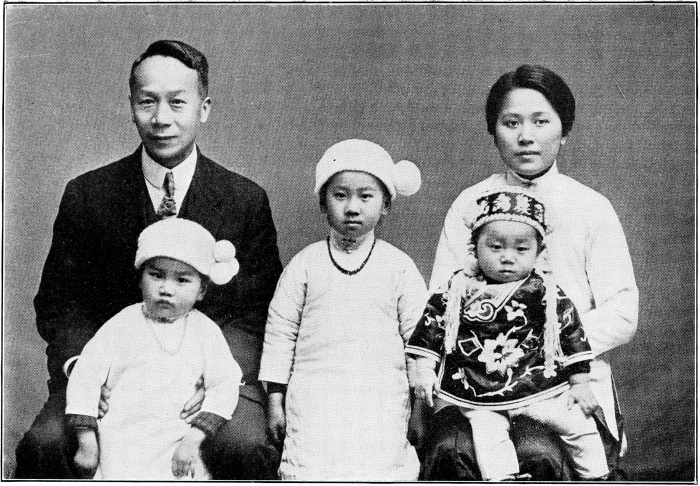
A MODERN CHEVALIER AND HIS HAPPY FAMILY
It is easy enough to view the social changes with fear and trembling and many of them are bad enough in their trend to justify any amount of anxiety, but there is a bright side and perhaps in deprecating the evil it has been too often overlooked. Nothing is more commendable than the loving comradeship that is growing up between husband and wife. This might be expected among students who have lived abroad and are used to foreign ways, but it is by no means confined to that class. “You have a pretty home,” commented a foreign friend to a bride of a year. Her husband was the editor of a popular Chinese daily and neither of them had ever been away from their native land. The bride beamed with pleasure. “Your lace curtains are hung so tastefully,” continued the caller. “Wasn’t it hard to show your servant how to do it?” “My husband and I hung them. We worked evenings after he came home from the office,” replied the blushing little wife. A few months later, when an expectant mother, she displayed with shy satisfaction, an exquisitely dainty layette, each tiny garment made with her own hands after a foreign pattern. “What a fine baby!” exclaimed another friend to the jubilant parents of their firstborn. “It is a boy, isn’t it?” “No, a girl,” corrected the father, gazing with fond pride into the tiny face of the rosy mite, “but she cries a good deal. I was up with her for three or four hours last night and had to walk with her most of the time to keep her from disturbing my wife.” “I was very glad to see your wife at my party on Friday,” remarked an American lady to a busy Chinese secretary. “Yes, I got off early from the office and went home to take care of the children so she could go. I wouldn’t have had her miss that pleasure for anything. My Margaret is such a good wife.”
When charming little Mrs. F. sailed for America to see a brother graduate at the University of California her husband was at the jetty looking after the baggage, and went with her on the launch down the river to where the ocean liner was anchored. Dr. Wu Ting Fang, ex-Minister to the United States and one of Shanghai’s best known citizens, meeting Dr. F. soon afterward, twitted him facetiously: “Oho, it used to be the custom in China for the husband to go away and the wife to stay at home with the family, and now it seems to be just the other way and the wife goes while the husband stays at home.” Dr. F., who, with the help of his mother and sister, was caring for his three little ones in Mrs. F.’s absence, laughed goodnaturedly and explained that it was he who had urged this trip on his wife. Once when this same husband was presiding at a formal banquet, it was noticed by those near him that in the midst of the festivities he quietly left his place and passed down to the other end of the long table. Mrs. F., detained it may be by putting the children to bed, had just come in, and Dr. F., not too engrossed in conversation to be watching for his wife, rose to draw out her chair and seat her in it with all the gallantry of a chevalier. The afternoon Mr. and Mrs. C. gave their “tea,” the young husband greeted the incoming guests at the door, while his wife, clad in soft white Chinese silk with a wreath of tiny pink rosebuds nestling against her black hair, presided over the tea-table with all the ease and grace of a society belle, and withal a sweet modesty which every society belle does not possess.
Perhaps these incidents, trifling in themselves, will possess small significance for the reader who has never lived in China, but to those who have they are encouraging signs that the leaven is working which of a certainty will by and by raise women all over the land from the position of mere chattels whose chief business is the bearing of children to be the equals and companions of their husbands. Dr. Arthur H. Smith, an authority in things Chinese, said recently in conversation, “I believe that the reorganization of the life of women in China is the most important sociological and educational event of modern times.”
Bound feet are becoming less and less the fashion in Shanghai. The increasing spread of physical training in all the schools is a great aid in favour of anti-footbinding, for the popular exercises can not well be taken on tiny feet. A medium course at present much in vogue is neither to let the feet alone nor bind them tightly, but by the use of comparatively loose bandages to prevent their growing too large. The little bound feet of old, common enough still in the interior, are in Shanghai generally looked upon with shame by the younger generation, who if they are so unfortunate as to own them, try to conceal their crippled members underneath long skirts or by wearing large shoes. It is not the women alone who frown upon bound feet. In many instances their husbands are equally opposed to them, men who a few years ago would have spurned a woman not swaying uncertainly on her much admired “Chinese Lilies.” A native teacher, supposed to be of the “old school,” was telling his foreign pupil of the recent death of his wife. “She fell down when crossing our courtyard and never regained consciousness.” “That was remarkable,” was the surprised answer. “How did she happen to fall?” “It was her small feet that did it. She lost her balance. But her feet were bound before I married her, or they never would have been bound.” “Then you disapprove of the custom and probably do not intend to bind the feet of your little daughters?” The man’s voice rose to an indignant pitch and with a vehemence quite unusual for a Chinese he ejaculated, “I shall not!”
Young men back from years of study in America or Europe, and there are many such in Shanghai, wear foreign clothes and look well in them. Some indeed are quite dudish in their attire. Many older men of the upper class on state occasions array themselves in dress suits and high hats, but in private life they ordinarily lay aside the torturing starched shirt and choking collar and resume their loose, comfortable Chinese garments. Women students on returning to China usually drop back at once into native dress, wherein they show their good sense, for besides the comfort of this style, nothing becomes them quite so well. Some years ago two girls from the interior arrived in Shanghai on their way to study medicine in America. They were told that in order to attract less attention on shipboard it would be well at once to adopt foreign dress, so they did, corsets and all. The older one’s description of her sensations is most amusing. “I couldn’t breathe. I couldn’t eat. The food had no room to go down. I never felt so miserable.” “What did you do?” “I took the corsets off.” “How long had you worn them?” Mary held up a little forefinger, as she announced solemnly, “Just one awful day.”
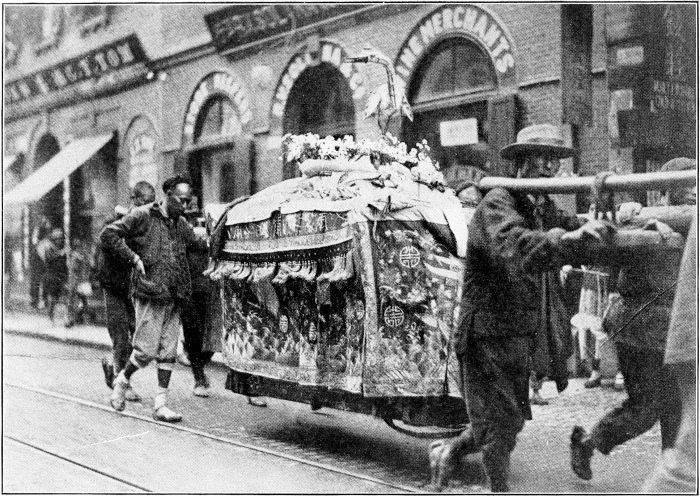
THE COFFIN IN A FUNERAL PROCESSION
The ultra-stylish dress of the “fast set” among young women in Shanghai is tight trousers, short tight jacket with short tight sleeves, and very high collars. To Western eyes this is neither pretty nor modest, and Chinese from the interior look upon it askance. Instead of bare heads, girls in winter are coming to wear, not hats, except those who have adopted foreign dress, but worsted caps, usually trimmed with coloured ribbon or artificial flowers. There is a shop on a busy street, called “Love Your Country Shop,” which deals largely in these fancy articles. Foreign shoes are also gradually taking the place of the cloth-soled, satin-topped Chinese shoes, and it is a wise change if women are to go much abroad in this city of heavy and frequent rains.
The old-time wedding procession is no longer an every day sight in the International Settlement, though happily for lovers of the antique, still common about the Chinese City. Carriages have to a large extent superseded the gorgeous sedan chairs, draped with embroidered crimson satin, and pale pink silk the orthodox crimson satin wedding gown. Veils are much worn too, and occasionally a very up-to-date bride is decked out in a gown of white silk or satin made in the most extreme Western fashion. More often, however, there is a painfully inartistic combination of Chinese and foreign styles. Little Miss Y. invited her foreign friends to inspect her trousseau shortly before her marriage. Garment after garment, evolved from heavy brocaded satin, sheeny silks, and gauzy web-like stuffs, was unfolded before admiring eyes. Finally the grand climax was reached when the wedding gown was brought in. The marvelous embroidery on the delicate pink silk evoked “Ohs” and “Ahs” of rapture, accompanied by exclamations such as “A perfect dream,” “I never saw anything so beautiful!” But when a common pink net veil, cheap white imitation flowers and coarse white cotton gloves bought at a foreign department store and plainly regarded as the crowning touches to the outfit were laid beside the exquisite Chinese gown, there were inward groans from the disappointed visitors. Miss Y. wore on the third finger of her left hand a heavy ring set with diamonds and pearls. On her wedding day she would have her band of gold like a Western bride. “You are very fond of the gentleman, of course,” some one asked her. The bright eyes dropped quickly as the low answer came back, “I have seen him only once.” “Were you alone?” “No, my aunt was in the room.” Plainly then, notwithstanding her foreign finery, this was not one of the so-called present day “liberty girls.”
The case of Miss W. was quite different. She and her fiancé had met and fallen in love in the good old-fashioned way. They were married by the bride’s father, an Episcopal clergyman, who, being tall and well-favoured, made a rather imposing figure in his priestly robe. After he had walked in and taken his place inside the chancel, a church warden to the strains of Lohengrin’s Wedding March ushered up the aisle with due ceremony the groom and best man. That done, they were left standing for fully ten minutes. The wedding march was played and re-played, the party at the altar shifted and turned while the audience craned their necks till they were sore in an effort to catch a glimpse of the incoming bride. What was the matter? Was she sick? Was she panic-stricken? Had an accident befallen the wedding dress? None of these calamities had overtaken the girl, who was dressed and ready to follow her fiancé into the church. But ancient marriage customs in China prescribe that a bride must be sent for again and again by the groom before, with tears and great reluctance, she is at last persuaded to leave her home. Although this was a modern wedding, it would not do to disregard wholly the time-honoured practice, hence a proper interval was allowed to elapse before the bride made her appearance. During the ceremony outbursts of laughter several times proceeded from the Chinese guests, many of whom had evidently never witnessed a Christian wedding and to whom the plighting of the troth and other passages were highly amusing. The bridal couple was not in the least disturbed by these demonstrations any more than when the warden from time to time stepped forward and taking one or the other by the arm, turned them around, or jerked them into proper position. Soon after the conclusion of the ceremony the bride retired and removed her veil, which was doubtless an uncomfortable if stylish appurtenance of which she was very glad to be rid.
Sometimes embarrassing situations are created because the young people are attracted to modern ways while their forbears much prefer the old. This happened recently when a law student just back from America married the girl to whom he had been betrothed before he left home. The bride wore a white satin gown with slit hobble skirt and fish-tail train, veil, kid gloves, slippers, and carried a shower bouquet. All was as modern as it was possible to have it, but at the last moment the groom was thrown into a state of great perturbation because of the refusal of his parents and their old-fashioned friends to attend the wedding. In his desire to have every arrangement conform to Western ideas he had omitted to send conveyances for his relatives, according to immemorial Chinese custom, and they were so incensed by the omission they refused to stir from their homes, although abundantly able to hire carriages or sedan-chairs as they might prefer. At the last moment, with the greatest difficulty, a sufficient number of vehicles was found and hurried off to bring the families to the wedding, but so offended were they that it required the utmost persuasion to induce them to come.
A Shanghai bride not long ago was taken to task by her friends for daring to show a glad countenance. “Don’t you know it is a bride’s duty to be sad and cry? Instead of that you look really happy,” they cried. “I am happy, and why shouldn’t I look so?” she replied with fervour. But the high-water mark of self-assertion was reached when a Shanghai maid, the daughter of wealthy parents, declared that her acceptance of her suitor depended on whether he was willing to shave off his beard, to which demand he promptly and meekly acceded. Truly the order of things changeth in old China!
Shanghai has something of which no other city in China can boast, and that is a Nuptial Hall. Contracting parties who wish a modern wedding but have not homes suited for it may rent this building. It contains a guest hall, banquet room, and bed chambers, all nicely furnished. Here the newly wedded pair can remain if they choose, for a few days of their honeymoon or arrange for automobile or carriage to take them away at once.
Occasionally a clash occurs between customs past and present which results in tragedy. A while ago a youth and maiden, both teaching in a government school in Shanghai, fell deeply in love. The girl’s father heard of it but objected to his daughter’s marrying because she was the mainstay of the family, and he argued that filial duty required her to continue their support although perfectly competent to shoulder the burden himself. Taking her one day in a small boat to the middle of a deep stream near their home, he demanded of the girl that she give up her lover. When she loyally clung to him her inhuman parent threw her overboard and let her drown before his eyes. A few years ago a deed like this would have attracted little attention. “The girl belonged to her father and it is nobody’s business what he did to her,” would have been the popular verdict. But it is not so in Shanghai to-day. The papers were full of the awful crime, the broken-hearted lover carried the case to the Chinese Court, and so great a stir was made that no one will dare to repeat such an act, at least openly.
It can not be said that Shanghai has progressed beyond the stage of polygamy. Under the old régime, for a man to take one or many “secondary wives,” as they were called, was a well-nigh universal practice, but it has died out among the younger, educated classes and before long will be forever relegated to the past in the treaty ports. The women themselves are rising up in defence of one another. An interesting instance is that of a man who left a young wife of six months in Shanghai and disappeared for several years. When he came back, bringing a new wife with him, he repudiated the first. Her condition was very pitiful. Being at last turned out on the street by her husband’s relatives after the death of her child, she went to learn tailoring in a Singer Sewing Machine shop. It was at this juncture that the Chinese Woman’s Co-operative Association, composed of some of the leading women in Shanghai, espoused her cause. They distributed broadcast a circular which read: “The legitimate wife of —— is too poor to engage a lawyer. We therefore ask those who sympathize with her to come to her assistance and see that she has justice, otherwise our two hundred million sisters will ever remain under the yoke of the other sex.” This resulted in the case being carried into the court and a fine imposed on the offender of eighty days’ imprisonment, pitifully inadequate yet a move in the right direction, and a victory for the band of progressive women.
Funeral ceremonies are undergoing a radical change in Shanghai though not so rapidly as marriage customs. Ancient observances are still held sacred by the majority, and through the streets trail the old-time funeral processions. Some are pathetic in their simplicity, a cheap unadorned coffin swinging from bamboo poles resting on the shoulders of coolies striding rapidly forward followed by a few mourners on wheelbarrows or in ricshas. Others are the long processions of the well-to-do, grotesquely spectacular. First come coolies in a straggling irregular line holding aloft tawdry banners and lanterns, after them priests, bands (often two, a Chinese and a foreign string band), paper images to be burned at the vault and trays of cooked food to be left there, the sedan-chair of the deceased and the carriage he may or may not have owned, quite empty save for a crayon portrait of him standing upright on the seat in the midst of wreaths of flowers and palm leaves, and finally the catafalque concealed under a crimson satin cover and surmounted by an imitation crane which is believed to carry heavenward the released spirit. Behind the coffin, borne by perspiring, hired coolies, the very lowest down in the social scale, for only such can be induced to act as pall-bearers, walk the adult sons as chief mourners. They are robed in white cotton with a strip of sackcloth as a head band or a sackcloth helmet. A sheet, spread out to form the three sides of a square and carried by coolies, furnishes a screen inside of which the men march. Following them in carriages are the widow, the daughters, and other relatives and friends. Even this is a strange mixture of old and present day usages, for formerly there were no carriages, no brass band, and above all no palm leaves, which in a non-Christian funeral are of course devoid of religious significance. Between the wholly modern funeral and one of this description there are varying degrees of transition. Often a hearse is used whose blackness is hidden under a wealth of bright blossoms covering sides as well as top, so that it has more the appearance of a gala trap than a conveyance for the dead. The Chinese have an inherent objection to sombre effects at a funeral, the mourners wearing white and the draperies being of the brightest colours.
A curious incident occurred recently which is a striking illustration of the way in which old and new customs may be said to elbow one another in their struggle for supremacy. A tired foreigner trying to sleep was disturbed by a persistent clatter of metal instruments and medley of voices close by. Finally in desperation he got up and looked out on the street, determined to locate the noise and if possible put a stop to it. It was summer weather and through the open windows of a neighbouring Chinese house he found himself the half unconscious observer of a strange scene. On the bed lay an old woman, evidently very sick, while a Chinese doctor and several assistants were running about the room with Chinese rattles and whistles, frightening away the evil spirit that had caused the malady. At last he was chased to the court below, where a pause was made, and the impudent intruder politely asked what his wishes might be. Replying that he desired to visit a neighbouring village he was told he could go, whereupon the relieved family shut and bolted the outer door after paying the doctor a fat fee for his services. This all took place under the very shadow of a group of the most up-to-date Municipal hospitals in Shanghai.
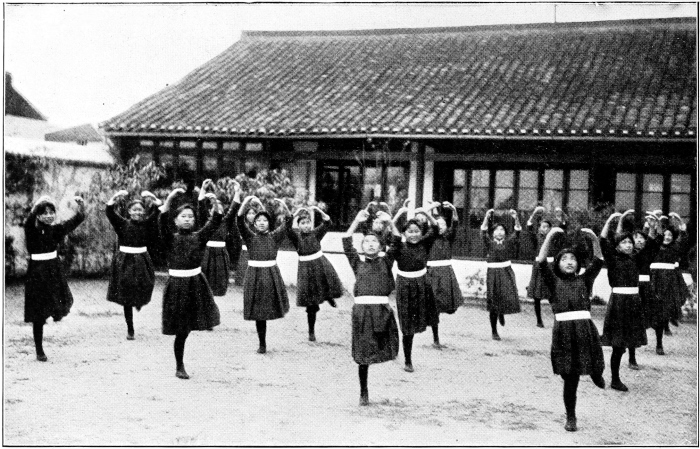
SCHOOL GIRLS IN GYMNASIUM DRILL
One of the hopeful signs of these later days in China is the changing attitude of the people toward physical exercise, for it means better health and better morals for the nation. Not long ago, really only a very few years, round shoulders were by every one highly commended, in the women as indicating modesty and in the men scholarly habits. A girl who held herself erect, with well developed chest, would have been set down at once as bold and forward, and not only that, but any kind of physical exertion was regarded by the upper classes, young and old alike, as coolie’s work and quite beneath their dignity. Some Chinese girls were watching a game of tennis for the first time, when one turned to her companion with a puzzled expression and the remark, “Can’t they get coolies to do that work for them?” Several Englishmen living in the western part of the city were in the habit of rising early every morning for a tramp in the country. The Chinese in the neighbourhood who saw them start out day after day were told the men walked for the pleasure of it, but they shook their heads incredulously, “We know they mean to worship at some secret shrine, for no one in his senses would work so hard if he didn’t have to” A couple of foreigners were crossing Garden Bridge when a troop of Chinese youths went rushing past with foot-balls tucked under their arms. Said the gentleman laughingly to his companion, “You wouldn’t have seen that a short time ago in Shanghai.” “Why? Because the boys were not playing ball?” “Yes, and neither would they have done such an unmannerly thing as to run. Just now they were so interested in the coming ball game they forgot all about appearances.”
In the spring of 1915 Shanghai witnessed a unique spectacle, something that will go down in history, and deservedly, as one of the great events in the life of the city. It was the Second Far Eastern Olympiad, the first having been held the year before in Manila. The Municipal Council turned over Shanghai’s finest park for the games, and the Young Men’s Christian Association fitted it up with the necessary accessories. No one who was there will ever forget that week. Many foreigners were present, but they were almost lost among the crowds of Chinese, for this was a distinctly Chinese celebration, just as it was meant to be. The élite Chinese turned out as well as the common people, men and women, young and old. Wide-eyed and tense, they watched their countrymen contest with crack players from Japan and the Philippines, and cheered tremendously when again and again the Chinese “won out.” It was good to look upon these lusty youths, who instead of cultivating long finger nails and cramping their chests after the manner of the old-time Chinese scholars, were clad in gymnasium tights, vaulting, running, swimming, batting, while their sires and grandsires forgot themselves and their traditions so far as to urge them on with shouts of approval.
Shortly afterward, under the auspices of the Young Women’s Christian Association, several hundred girls from mission and private schools gave a physical exhibition of their own. This was not open to the public, guests being admitted by ticket and only a few gentlemen invited. Some of the girls wore modified gymnasium suits, but most appeared in their ordinary school clothes. It was all-important that the conservatives should not be shocked, who were none too friendly to the idea of physical training for their daughters. Mothers, grandmothers, and aunts, their prejudice partly overcome by their curiosity, sat around in crowds on the borders of the grassy campus viewing the exercises, first with indifference, then interest, and at last, genuine enthusiasm. The leader was a young Chinese woman who received her training in Boston. These two events marked a new era in the physical development of Young China and the ravages of tuberculosis have received a check, while good, hard, honest work is understood, by athletes at least, as something not to be shunned as a disgrace.