VII
Reading edition
A PEEP INTO THE SCHOOLROOM
“HOW many schools for the Chinese, not counting missionary schools, are there in Shanghai?” The question was asked of a Y.M.C.A. secretary, who with others had just completed a canvass of the city with reference to its educational facilities. “It is not possible to tell exactly,” he replied, puckering his brow. “As nearly as we could find out, there are at least five hundred, probably more. Of course that list does not include the schools for girls. Miss Blank can tell you about them.” The Chairman of the Committee on the Investigation of Girls’ Schools was interviewed. She brought out her maps, charts, and reports, and spread them on the table. “It was such a difficult search,” she explained. “We discovered between thirty and forty boarding schools alone, but it is almost certain that does not include all. Some of them were hidden away in the queerest places.” “What a difference in the number of schools for girls compared with those for boys!” exclaimed her visitor. “Oh, well, you must remember we made no effort to tabulate the little day-schools. They seemed to be legion and met us at every turn.” The large majority of the schools enumerated were established after 1900, and very many sprang up at the time of the revolution in 1911, or quickly following it.
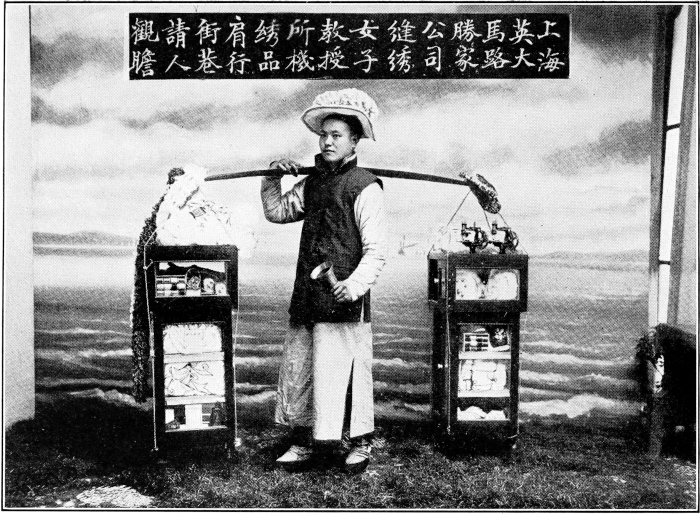
ADVERTISING SINGER SEWING MACHINE PRODUCTS
From these statistics it might appear that the education of the children of Shanghai was fairly well provided for, but with no compulsory system, thousands that are employed in mills and factories, bound out as apprentices, thrust forth to beg or allowed to loaf, never cross the threshold of a schoolroom.
The Municipality of the International Settlement supports four large public schools for Chinese boys (there are none for girls), the ground in each instance having been donated by philanthropic Chinese, and the native residents in the Settlement, who form the bulk of the population, paying their share of the taxes on the buildings.
One of the handsomest buildings in the French Concession is a public school for Chinese boys.
Private schools, or as they are termed “Gentry Schools,” are very popular with the Chinese. In Shanghai this class far outnumbers all others, and it is moreover an interesting fact that of the schools under government control very many were started by an individual or group of individuals as private enterprises. China is a nation that reverences learning above all else. Not a scrap of paper that has written or printed on it even a single “character” is willingly allowed to be blown about carelessly or trampled under foot. These precious bits, soiled and torn though they may be, are laboriously picked up by men or boys armed with tongs or pin-pointed sticks, who travel to and fro through the streets in search of them. The well-to-do hire proxies to perform this meritorious work. The paper is carried to the public ovens, where it is burned, and the ashes afterward thrown out in the river. The belief is millenniums old that heaven vouchsafes special blessings to those who show due regard for the sacred symbols of knowledge. It follows then quite naturally that to open and maintain a school ranks with the Chinese among the highest forms of service one can render to mankind.
Since Western education has been introduced, many of China’s best young men have dedicated their lives and fortunes to popularizing it. Among the numerous examples that could be cited in Shanghai alone, the Akademio Utopia is one. Four years ago a group of ten zealous young men started a school in a small rented building. They had little capital, but each one agreed to devote twenty per cent of his income to meeting the running expenses. Several who had studied abroad gave also of their time and taught one or more classes. The principal was a graduate of Cornell University and the first Chinese student from that institution to be elected to Phi Beta Kappa. The current expenses were soon met, or nearly so, by the fees of the students, whose number quickly ran up to over a hundred, but when it became necessary to build, the young promoters again put their hands in their pockets, and out of their modest earnings gave most liberally. The principal’s father offered him financial help but in a spirit of manly independence he refused it, preferring to depend on his own and the school’s resources. The fine new building is finished and in use, though plain benches take the place of desks which will be added later, together with other needed furnishings, as the debt is gradually paid off.
In the plebeian district of the Settlement, on a street little frequented by foreigners, is a boarding and day-school attended by five hundred and fifty boys. Unlike the former school, this one started full-fledged the year of the Boxer Rebellion, which witnessed the birth of so many new enterprises. The plant consists of three brick buildings, the middle one surmounted by a stately clock tower, and all connected by covered passageways. The main building is divided from front to back into parallel sections, with open courts between, though joined on the upper story by bridges. In this way good light and air are secured for each of the forty-six rooms. There is a laboratory, a science class-room with seats in amphitheatre style, a library containing both Chinese and English books, a hall dedicated to Confucius whose walls are hung with scrolls inscribed with quotations from the writings of the Sage and where the students gather semi-annually for worship, and finally a reception-room, having as its chief ornament a portrait of the founder of the school. The founder began life as a poor boatman. By careful saving of his earnings he was by and by able to open a small metal-ware shop. Possessed of great business sagacity, he rose step by step, gradually amassing wealth, until he became a millionaire. Though he never learned to read and write, this self-made man had ideals and gave liberally for the free education of the poor. When he was past sixty he conceived the idea of founding a school as the best and most lasting memorial of himself he could leave to the city. The plans were made and the building begun, though the philanthropist did not live to see it completed. A statue is soon to be erected in his honour by a company of Shanghai merchants. The founder’s sons built a beautiful little memorial temple to their father on the school area between the playground and the out-of-doors gymnasium, and thither they resort at stated intervals to prostrate themselves before the ancestral tablets, as the students do in front of the philanthropist’s portrait in the reception hall. But they have no love for learning and take no interest whatever in the school, which goes to prove that not all the conservatives lived in the past century nor that all of the progressives are confined to the new. The fees are kept low, board and tuition for the entire school year of ten months and a half costing less than twenty-four dollars. Fifty of the boys are charity pupils. English and French are taught, the latter by a graduate of the school, and there is a small industrial department. The course of study extends through eleven years and carries the student up to about the third year in a home High School.
Close to the South Gate of the Chinese City, or where the South Gate formerly stood, is a plain red brick building called in English “The Shanghai High School.” The interior arrangement could not be simpler, a hall running through the middle, which is also a dining-room for the boarders, and class-rooms opening off from it on either side. Above are dormitories. In this building and three smaller ones on the grounds, five hundred boys, half of them boarders, whose ages average sixteen, are receiving a thorough education. A foreign educator remarked when visiting the school, “This shows what excellent work the Chinese can do with a very modest equipment, which, after all, answers in every way to their actual needs.” The story of this school is worth repeating. Thirteen years ago four progressive brothers banded together to help educate the youth of Shanghai. Not having sufficient money to purchase a suitable site and erect a building, they fitted up the family residence for a school, supporting it largely with their own funds. Three of the brothers are successful business men, and the fourth became the principal. He is a graduate of St. John’s University of the Protestant Episcopal Mission in Shanghai, a man in his early prime, of scholarly tastes and habits. Hardly had the doors of the school been opened when ninety boys flocked to it, and the number increased so rapidly that within a year or two it became necessary to look for more commodious quarters. The school in the meantime had received recognition from the local government and was given an annual grant-in-aid. The Chinese Municipality donated some of the public land for a site for the new plant, and in 1909 the present edifice was completed. Thirty teachers are employed, three of them being foreigners, and women. Speaking one day of the qualifications of his foreign teachers, reference was made by a friend to the fact that one of them had graduated with honour from the University of Edinburgh. “Yes,” said the principal smilingly, “I consider myself fortunate in securing her, but I always seek the very best for my school, for it is my purpose to maintain the highest standard.” And that he does maintain it was proved when several of his students on examination entered St. John’s University unconditioned, the first time a school under Chinese management had attained such distinction.
Four years after the brothers started their venture, their three sisters launched a school for girls. This school, like the other, had a small beginning, but from the first was a pronounced success. Later, its promotors were also given public land on which to build, and what is more, bricks from the city wall, at that time in process of being torn down, were donated for building material. Can the imagination conjure up anything more strange and romantic than a part of the old storied walls metamorphosed into a school for Chinese girls? How the city fathers who planned those walls, to say nothing of Confucius himself, whose prophetic eye caught no vision of a liberally educated womanhood, would have shrunk in horror from such unseemly desecration! The sisters are all married, one being a widow, and with their families live in neat apartments in the rear of the school. They are well-to-do, and teach for love’s sake rather than for the money there is in it. Indeed, the school has not yet become self-supporting. One teacher is principal, another supervises the classes in embroidery, and the third manages the business. The one hundred and thirty bright-faced pupils, besides the common branches, are taught music, drawing, painting, and plain sewing. They receive regular instruction in physical training from a young Chinese woman who had her own education in Boston. The school has been honoured with medals from several expositions to which specimens of beautiful embroidery and drawings have been sent.
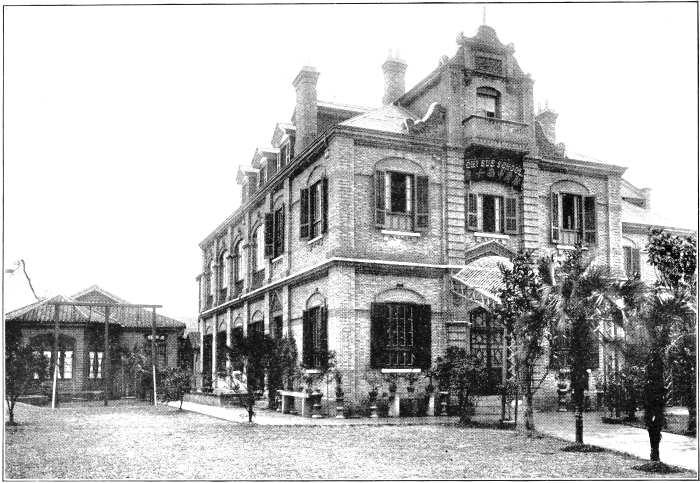
Fifty years ago a baby girl destined for an unusual career was born in one of the patrician Chinese homes in Shanghai. She was reared in luxury and given the meagre education at home usually accorded by indulgent parents to girls in her position. Allowed by choice to remain unmarried, she eventually allied herself with a society of austere Buddhist religionists known as “vegetarians.” Years rolled by, till the girl, grown to womanhood, had passed her thirty-ninth birthday. She had long observed that her father was a liberal-minded man, and that his benefactions were frequently in aid of schools for girls, which were gradually becoming common. “If my father is interested in the education of girls,” she reasoned within herself, “why should I not open a school and he help me?” But when she mentioned the plan to her father he frowned upon it harshly, and her stepmother was even more violent in her opposition. Education might be condoned in others, but no daughter of theirs needed more than she had, and much less should she aspire to be a medium for encouraging it. Moreover, the father realized the young woman’s marked ability, and had plans of his own respecting the help she would by and by render him in the management of his estate. The more she was opposed, however, the stronger grew her purpose, until finally the controversy led to her being practically disinherited and driven from the parental roof. She had a little money with which she managed to open a small school, and then sold her jewels to keep it running. That was twelve years ago. Twice she has moved, the last time, in the spring of 1914, to a handsome new building she erected herself largely with the portion of her inheritance she was able to secure when her father died. There was a notable “opening” to which many Chinese guests and a few favored foreigners were invited. On the wall of the Assembly Room hung a large portrait of the principal’s father, for the flower of filial piety rarely dies in China, no matter how rough the winds that blow upon it. Chinese flags were draped over the platform and fluttered from pillar to post. In the side rooms the industrial work of the girls was on exhibition and a fine collation set forth.
The building and grounds of this school are always kept neat and attractive, and no matter what hour of the day the unexpected visitor arrives, he is sure to find dormitories and hall, and even dining-room, kitchen, and laundry worthy of the closest inspection. The kindergarten building is slightly separated from the main one, and it would be hard to find anywhere a more perfect model of its kind. Mothers’ Meetings are held from time to time when practicable. Matters relating to the child’s moral, mental, and physical well-being are frankly discussed.
“Commencement Day” is observed with great éclat. Last year, four “sweet girl graduates” sat on the platform, all dressed alike, in white Chinese silk made in Chinese style, white slippers with foreign heels, and tiny blue ribbon bows at the neck, and bands of narrow blue ribbon around their hair. The class colours were blue and white, and behind the girls hung their class banner, bearing on a white ground their motto “Excelsior” in blue letters. Each graduate had prepared an essay in English, but only one was read, “The Influence and Responsibility of the Young Women of China.” In thought and language it would have done credit to a school-girl in any land. The others wrote on, “The Need of Compulsory Education,” “The Evils of the Cigarette Habit,” and “The Advantages of an Education in China Over That Received Abroad.” Songs, piano solos, duets, and eight-handed pieces, recitations in French and English, and an eloquent address on “The Value of Education for Women,” by the Chinese Commissioner of Foreign Affairs, completed the programme, which throughout was of an exceptionally high order. Then came the closing scene as a delightful climax. Dr. Wu Ting Fang, former Minister to the United States, presented to each graduate a diploma tied with ribbon in approved Western style, which he received from the hand of the principal. It was hard to realize that the little woman standing beside Dr. Wu, so modest and retiring, in simple, dark Chinese dress, her hair combed straight back from her face in old-time Chinese fashion, was the promoter and controlling spirit of this most successful up-to-date school. She speaks no English and prefers to keep in the background as much as possible, yet hers is an unusual personality. Though not a professing Christian she is a believer in heart and is quite a regular attendant at a Protestant Episcopal Mission Church.
Another popular school for girls is known generally as the “Suffragette School.” Like so many others, its existence began at the close of the recent revolution, and grew out of it. The exigencies of the revolution brought women into the public arena as they had never thought of figuring before. A few who had studied medicine went to the front as doctors and many more as Red Cross nurses. A large number acted as spies, secreted refugees, carried ammunition to the soldiers, and sacrificed property and life itself for their country. From various quarters there gathered in Shanghai a hundred or so school-girls, most of them runaways, fired with an all-consuming if misguided desire to aid their country, who donned uniforms, shouldered arms, drilled, and begged to be allowed to march at once to the firing-line, which fortunately for them they were not permitted to do. They were known as the “Amazons.” All these events, however, so stirred the patriotism of the women of Shanghai that a numerous company banded together to raise money for the revolution, which they did very successfully. When the fighting ceased, instead of disbanding they formed themselves into a permanent organization under the name of “The Chinese Woman’s Co-operative Association.” Its purpose was to protect the interests of women in general, and in particular to gain for them the right of suffrage.
The society is still in existence, though greatly modified in tone and reduced in numbers by the elimination of the most rabid and troublesome spirits. Occasional meetings are held and men are frequently invited to address them, a woman occupying the chair. The principal work done by this Association since the revolution has been the founding and fostering of the Suffragette School, with the idea of inculcating advanced ideas in the minds of the young. At first the teachers, all of them women, worked without salary, and turned with disdain from men and marriage. While the curriculum includes Western studies, particular emphasis is laid on Chinese subjects, especially the writing of Chinese characters, which the pupils do exceedingly well. They are encouraged to make their clothes of Chinese cloth, use Chinese furnishings in their homes and preserve the old-time customs and the old-time beliefs; in short, to be Chinese to the backbone and independent of the foreigners’ supplies and the foreigners’ religion.
The school has prospered better numerically than financially. An interested missionary was talking one day about the school to Miss C., a recent graduate of Wellesley College and a relative of the principal. “You say the school is poor?” “Not poor in the quality of work done, but, O yes, very poor in money.” “What is the reason of that?” “Well, it hasn’t financial supporters. You see, right after the revolution so many women were enthusiastic about suffrage. But they are not now in the same way, and they don’t take as much interest in keeping up the school.” “What do you think makes them less interested in the question of suffrage?” “They don’t believe the time has come in China to push it. Other things they feel are at present more important and necessary.” “What is your personal opinion?” The bright eyes of the young woman rested an instant thoughtfully on her questioner, then came the decided reply, “I am sure we are not ready to vote yet, and it is a mistake to divert our thoughts from greater needs by thinking of it and working for it.”
More and more as the New Learning is crowding out the old-time impractical methods, the desire grows to relate the work of the schools to the life of the people. Hitherto industrial training has received little attention in China, but the Republic has been gradually awakening to its importance, so that to-day schools of this kind are the ones that appeal most strongly to the popular mind and receive the readiest support from governmental and private sources. In Shanghai, commercial and industrial schools, or schools that have added these departments to their curricula, are constantly on the increase.
The World’s Chinese Students’ Federation, with headquarters at Shanghai, is carrying on both day and evening schools which are largely attended. The teachers give their services free and are young men of independent means, or those who are able and willing to devote a portion of their time to this work. The principal is only twenty-one, a graduate of the Young Men’s Christian Association school and unusually gifted.
The leading institution in Shanghai under Chinese auspices is the Government Institute of Technology. As in the case of so many other educational enterprises, this one received its initial impulse from an individual, a man high in government employ. It began in 1897 as a Normal School, then added Preparatory and Grammar School departments, and finally, under the skillful leadership of Dr. John C. Ferguson, developed into Nanyang College, still later adding courses in civil and electrical engineering, and changing its name to “The Government School of Technology.” The handsome buildings in the midst of spacious well-kept grounds, the complete equipment, fine corps of teachers, eight of whom are Americans, the standard of work maintained, and the character of the large student body, all combine to make this a school Shanghai may well be proud of. A few of the best students are sent each year to Europe and America for a period of practical training.
The Mining and Railway College is not so large nor so old an institution, but in its way quite as remarkable. Its founder, who is also its president, is a young man in his early thirties, with a finely chiselled, scholarly face and gracious manner. When travelling abroad after finishing his education at Queen’s College in Hongkong, he became convinced that what China required more than almost anything else was trained engineers. So four years ago (many things happened in Shanghai four years ago), unaided, he started this school, giving himself and his money without reserve to the work. Already the students number two hundred and sixty, as promising a body of young men as one would wish to see. They come from nearly every province in the country and a few from Java. Five of the fifteen teachers have studied abroad, but only one is a foreigner, a Belgian who teaches mining and mineralogy. The entering students are put at once into English classes and it is remarkable what they accomplish in a single year. A specialty is made of chirography, “for,” says the president, “unless the boys learn to form their letters carefully, they will not draw well, and as engineers they must do that.”
The School of Medicine and of Engineering, carried on by the Germans for Chinese students, is unique in its way. An eminent physicist in Shanghai has said that in his opinion it is the greatest institution in China. The school, its two departments being entirely distinct, is not missionary nor even philanthropic in character. This is simply a business enterprise fostered by the German government for business purposes. They give the best training in return for what, to the Chinese, are heavy fees, in order that these men may be prepared later to work in their employ. The teaching force is of the highest grade and the scientific equipment as perfect as the means provided can make it.
MISS ZEE’S NEW SCHOOL BUILDING. KINDERGARTEN IN THE REAR
Perhaps of all the schools in Shanghai, the little day-schools appeal to one most because of their unfailing human interest and the possibilities stored up in them. They are of every kind and degree of excellence, or badness, according to the way they are looked at. On the whole, most of them seem to be doing good and even the poorest keep the children off the street. Often there are amusing features. In the Chinese city, on a signboard over a doorway appears the rather unusual announcement, “English taught from A. to L.” Just what is done with the remaining letters of the alphabet is not explained. On a side street the passerby reads again in large English letters, “Daily Progressive School.” In two poorly lighted, none too clean rooms of an old Chinese house, thirty or forty children bend over their roughly made desks, studying aloud in vociferous tones. The head teacher quiets them while he greets the chance visitor and points with pride to his foreign textbooks in geography and English. He too has ideals, and when reference is made to the name of the school, answers, “Yes, that is what I want to make it, ‘Daily Progressive.’” He adds that he has started two branches of his “Daily Progressive School” in other parts of Shanghai. Then comes the unexpected question, “Are you a Christian?” “I am a Christian,” naming the mission school where he received his education.
Sometimes a little day-school is hidden away in the back room of a rambling old house, or in an inner apartment of a Buddhist temple, where the unsophisticated easily loses himself amid its labyrinthine windings. During the stormy iconoclastic days of the revolution, temples and ancestral halls were turned over wholesale by the provisional government to be used as schools, and though many have reverted to their original purposes, others, like Li Hung Chang’s Temple in Shanghai, are still kept as seats of learning. This memorial to the great statesman, built by public funds, was taken possession of five years ago by the trustees of Fuh-tan College, and now the bronze statue of the famous Li from its pedestal in the garden looks down each day on three hundred and fifty students hurrying to and fro through the numberless courts and passageways. Commencement exercises are held in the Hall of Ancestral Worship, where, on a raised platform against an ornate background, sits the Chinese President, an alumnus of Yale, surrounded by his faculty, all in collegiate cap and gown, making one of the curious anomalies common in these days of transition.
From the Provincial Normal School, located in the Chinese city, thirty young men graduated last year and more than five hundred have gone out from its doors during the eleven years since it was opened. Such is the demand for teachers that long before the school-year closes every member of the graduating class has been spoken for. The alumni are scattered far and wide over the country. Near the Normal School is a large practice school of four hundred pupils. The students of the Normal School are taught music, clay-modelling, wood-carving, painting, drawing. They are ardent patriots and keenly resent any real or supposed indignity offered to their native land. Sometimes they express their patriotism in original ways, as they did not long ago, when feeling ran high because of the unreasonable demands made on China by Japan. The boys’ sleeping and study rooms open onto courts in the rambling structure, or rather a series of Chinese buildings which constitute the school plant. These rooms were cleared out and each one made the scene of some pictorial or material representation of the current political issue. Many of the exhibits were exceedingly clever, a few were most amusing, but all were strikingly illustrative of the animus of the student body and showed the kind of teachers that are being sent forth over China to instill their principles into the minds of the rising generation.
It is significant of the spirit of the times that a young man in Shanghai a few months ago went to his father and begged to be given his portion of the family gambling money. With it he opened a school which has now one hundred and fifty pupils. The secretary of the Provincial Educational Association, recently back from an extended tour in America, requested a resident missionary to give him lessons in English. He was so impressed with the excellence of the American system that he decided to introduce the same methods into his own schools as rapidly as possible, and wanted a better knowledge of English that he might be qualified to select text-books and arrange courses of study.
Last summer for the first time the Shanghai prefect fixed a uniform vacation period for the elementary schools extending through five weeks, from July 22d to August 25th. In sending out the notice the prefect added a clause to the effect that during two weeks of the vacation three hours a day must be spent by the pupils in reviewing their lessons.
There are two flourishing Japanese schools in Shanghai. One is a large public school that is growing so rapidly a new building has been added to the group which suffices for six or seven hundred pupils. Boys and girls of all ages are accommodated under the same roof, but with the exception of the very little children in the kindergarten, they occupy separate rooms and have their recess at different hours. They make a pretty sight in their gay coloured garments flitting about in the sunshine like radiant butterflies during play hours, or pouring joyously out on the street at the close of school, some going off in ricshas accompanied by nurses, more on foot, while a lot of youngsters scramble onto the street cars, clutching their coppers in dirty little paws, each one carrying a school bag or books tied up in a square of cloth, and a little lunch box, while on every urchin’s head rests a smart military cap.
The other school is a Japanese College with nearly three hundred students, strong of body, alert in mind, picked men all of them. They are sent from Japan by their respective prefectures to study in Shanghai for three years, every expense being met. The course includes commerce, engineering, and agriculture. During the fourteen years since the school opened, eight hundred have graduated, seventy receiving certificates last June. At the end of the second year’s work, seventy or eighty of the most promising students at the expense of the school, are sent far and wide over China to study the country and its condition, agricultural, mining, social, political. “When the men graduate from the college they return to Japan, do they not?” was asked of the president. “Oh, no,” came the emphatic reply, “they are expected to stay in China and help the Chinese develop their resources.”
A group of schools in Shanghai which are not for the study of books, but, in their line, of great value, the public generally knows little about. These are the six Singer Sewing-Machine Schools for women and girls. The Singer Sewing-Machine made its advent in China a decade ago, and thus far it is without a rival. It “took” almost at once with the Chinese and is now found everywhere, even in the most unlooked for and absurdly out-of-the-way places. In 1910 Singer Sewing-Machine schools were started in Shanghai. At first they met with small success. Those for men were a signal failure and soon closed their doors. The few who ventured to enter the schools for women and girls had to be paid for coming, but the old conservatism seemed to die out with the revolution. The leading school now numbers fifty pupils. The period of training covers three, six, or twelve months according to the kind of work taken up, whether plain tailoring or fancy embroidery. The pupils come from widely scattered districts and it is the intention when they return to their village or town that they shall open a school of their own, and in this way introduce the machines throughout the country. There are already more than four hundred selling stations in China, each in charge of a Chinese agent. The machines are sold on the installment plan. “We consider ourselves missionaries in our way,” said the foreign representative of the company in Shanghai, “for is it not a charity to lighten the labour of these poor hard-working people by selling them our sewing-machines on easy terms?” The Singer Company subscribes liberally to all benevolences, and during the revolution, and the rebellion the following year, it loaned its machines free of charge to organizations engaged in making garments for the destitute. One effective way it has of advertising is to send men about the streets of Shanghai dressed fantastically in clothes made in its shops, while offering for sale small articles carried in portable show-cases.