VIII
Reading edition
A WIZARD PUBLISHING HOUSE
“THE pen is mightier than the sword” has through the centuries been a working axiom in China, for soldiers stood at the foot of the social ladder, while scholars sat proudly on the top rung. Recent experiences, it is true, have somewhat altered the views of the people, though not reversed them. But the accompanying adage, “The printed page is mightier than the sword,” has not seemed to acquire popularity, despite the fact that printing from movable type was discovered in old China long before Gutenberg saw the light of day. Indeed, the “Peking Gazette,” whose lineal descendant still flourishes in the Capital, claims the honour of being the first newspaper ever published. It was printed from wooden blocks, some of which are still in existence, no one knows just how long ago, though tradition makes it as many as a thousand years. But for centuries the art was little used and even as late as the Chino-Japanese war in 1894 news travelled so slowly that people living only seventy-five miles from the coast had not even heard there was a war. Now, Shanghai alone, which is far in advance of other cities in this respect, publishes more than thirty newspapers and periodicals, twelve of them being dailies. Many of the sheets are illustrated, and as a proof that they are thoroughly abreast of the times, advertisements of well known patent medicines are given a prominent place!
With the dawn of China’s “New Day,” and the increasing thirst for Western learning, an insistent cry was heard, not alone for newspapers, but for books, books, and plenty of them. Then to meet the need arose the Commercial Press. The story of the rapid growth and development of this great publishing house reads like a tale from the Arabian Nights. The idea was born in the minds of three young, wide-awake Chinese, all practical printers, and all of them Christians, the product of a Presbyterian Mission School in Shanghai. Work began in 1897 in a modest way with two small printing presses. The shop was a Chinese house in an alley off one of the main roads. These quarters were speedily outgrown, and after two moves the plant was finally lodged permanently in a group of fine brick buildings covering eight acres in the northern end of the city. To-day sixty modern presses, the very best to be had, are annually, in round figures, using up twenty-five thousand reams of foreign paper and thirty-four hundred reams of Chinese paper, the bulk of which is turned into school books and scattered far and wide over the land, from Manchuria to Thibet. The year after the revolution, although new machinery was bought, additional workmen taken on as fast as they could be found, and the presses kept running night and day, the enormous demand for books could not be met.
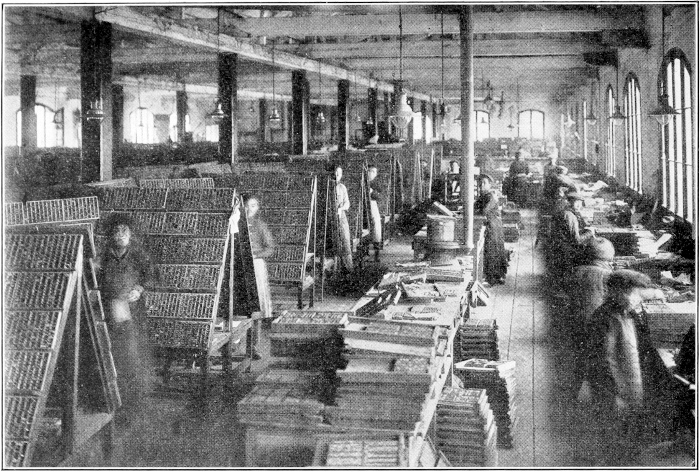
CHINESE COMPOSING ROOM
From the first, the policy of the Commercial Press has been never to print any books that are antagonistic to the Christian religion, and to this purpose it has faithfully adhered. Indeed, the twenty or more heads of departments are either Christians or in sympathy with Christianity.
The rules of this house governing the treatment of employees may not sound unusual to Western ears, but studied in comparison with conditions as they have been in China, and still are for the most part, their true worth is keenly realized. The Commercial Press employs about fourteen hundred men and four hundred women. Several of the boys are deaf mutes from a missionary institution in the north, and a number are from the Shanghai Reformatory, taken on by the company to give them a fresh start in life, with a hostel built especially for their accommodation. Most of the women work in the bindery, though they are found here and there throughout the establishment and some of the lighter machinery is operated by them. One is a forewoman and a few bright girls are studying to be bookkeepers. None are admitted under fourteen years of age, while the majority are much older. An innovation has lately been introduced, permitting women to work in the same room with men, although at different tables. It has proved a perfect success. All hands attend strictly to business and the new arrangement has distinct advantages over the old, as, in giving employees better light and air, since the rooms can be kept larger. The hours of labour are from 7:30 to 12 and from 1 to 5:30 o’clock. The bell rings for the women to leave five minutes before the men. “Ladies first, you see,” a member of the staff laughingly remarked to a visitor. When a woman expects to become a mother she is given two months off with full pay and five dollars in addition to meet extra expenses. Sundays are holidays. About one-eighth of the force are Christians and two Protestant churches are located in the neighborhood of the Works, which many of them attend. Wages are excellent with the addition of a bonus for special merit. There is a reserve fund for the benefit of the families of the deceased, and old, retired employees. Profit sharing is a part of the system and the head men in each department are shareholders in the company.
A small hospital with accommodation for a score of patients, and with an immaculate dispensary and operating room, is another feature of this remarkable establishment. An attendant is always present, and a Chinese foreign-trained doctor visits the hospital every morning. The clinic is open to outsiders as well as employees and their families. All pay a fee of three Chinese coppers, about one cent, as it has been found necessary to charge something to keep the place from being overrun. Near the Commercial Press the management has built a number of small but comfortable houses, and these are rented, at a nominal rate, to employees who care to occupy them. A school is maintained for the children of employees, and a night-school and reading-room for apprentices. A kindergarten, for which the Commercial Press furnishes the premises and the Presbyterian Mission Press the teachers, is also close by. None of these schools are free, as parents are able to pay a little tuition and feel more self-respecting to do so. A tea garden, made attractive with shrubs, flowers, and seats scattered about on the well-kept lawn, furnishes a delightful resting-place for the clerks when off duty. The fire brigade is a most important factor in the concern. It is composed of twenty-six men, all employees, and is kept at a high grade of efficiency by frequent drills. A stone’s throw from the main building is the fire station, fitted up with bright hose wagons, ladders, buckets, torches for carrying safety oil lamps of brass, besides complete uniforms for the men, the burnished brass helmets being their special pride. The brigade stands ready to respond to a limited number of outside calls.
Visitors to the press works are always cordially welcomed, and courteously shown over the establishment by a competent guide, whenever possible a member of the staff. So extensive is the plant it usually requires several hours for even a cursory tour of inspection. Two of the buildings are used for the printing plant and foundry, one for the Chinese bindery, another is reserved for the editorial department, Chinese and English, two are warehouses, one is a carpentry shop, and one, a long low building somewhat apart from the others, is devoted to photography and its various branches. The rooms are airy, clean, and cheerful, in marked contrast to most of the workshops in China. Each is connected by telephone with the main office, and light tracks are laid for carrying merchandise to and fro. Electric motors supply the motive power, while both gas and electricity are used for lighting purposes.
Most of the printing presses are from England and America. Those for finer work, including the immense wonder-working machines in the colour printing department, are of German manufacture. The Commercial Press was the first firm to introduce three-colour printing into China. One is tempted to linger long beside these marvellous presses. As the blue, yellow, red, each in its turn, is added so quickly and easily to the maps, charts, pictures, and kindergarten scrolls, the visitor is almost persuaded that he is viewing an exhibition of the cunning art of a magician, rather than the automatic movements of an insensate piece of machinery. Here is laid before the eyes a gay picture of the landing of Columbus for a history of America in Chinese, and yonder an equally charming one of the child Raleigh for a history of England. Much is made of illustrations in the school books published by the Commercial Press. Their ethical readers for little folks are fascinating productions. Each page is a coloured picture, which teaches its own lesson. Children are represented on their way to school, saluting the teacher, reciting their lessons, giving alms to the poor, caring for the aged, the young, sick, and blind, dusting and sweeping the rooms, washing, brushing, mending, and folding clothes, brushing their teeth, eating, playing. Houses are pictured as clean and sanitary, living as wholesome and pure. Especial emphasis is placed on proper manners and morals, teaching sadly needed to-day in China, when there is such an alarming tendency to abandon all that was really admirable under the old régime, and adopt in an exaggerated form all that is bad from the West. In the First Year Primary books practically no reading matter is introduced, only a few Chinese characters to explain the text. The little ones scan them attentively, absorbing knowledge without being conscious of the fact. How different is this from the old way, when children were shut all day long in dark, close rooms, shouting aloud unmeaning phrases from the Chinese classics, while the teacher dozed in his chair!
The newest addition to the plant is the installation of three “off-set” presses, the first in the Far East. An expert came out from America with them to set them up and instruct the Chinese workmen in their use. They are often kept busy through the twenty-four hours in turning out bonds and bank-notes by the millions for the Government.
Too much praise can not be given to the work of the editorial department. The entire second floor and part of the third of a quiet, three-story building is devoted to it. At long, unpainted wooden tables, littered with books and papers, sit the hundred and fifty scholars, bending over their work. Above four thousand original books have already gone out from their busy workshop, besides countless others that have been translated and edited. Eight monthly magazines are published by the editorial staff, a general one, an educational, a political, student’s, child’s, short story, a woman’s magazine, and one entitled “The English Student,” of which twenty thousand copies are issued monthly. The newest publication is a magazine called “The English Weekly.” The aim of the last two is to help Chinese students in the study of English. The Woman’s Magazine is one of the most popular. A bright girl who has studied in America was speaking about it one day to a group of foreign friends. “Just think,” she said, “the last number contains recipes for cooking eggs in twelve different ways.” “Is that so unusual?” asked an interested listener. “Why, they were not for making foreign dishes, but cooking Chinese food! I never before heard of a printed Chinese food recipe. If Chinese women begin to learn about food values it will mean everything in their lives.” The Woman’s Magazine started its life two years ago with a man as editor-in-chief. This fall a young woman will take over that position. She is a recent graduate of Wellesley College and married to a Harvard alumnus. Modest and lovable, she graciously answered the questions of her foreign callers. “Yes,” she admitted, with a little apologetic laugh, “I am going to try to edit the magazine.” “There will be assistant editors of course?” “Oh, yes.” “Women?” “No, I believe they are all men.” This young wife is a beautiful housekeeper, and it is safe to assume her home and family will not be neglected on account of the outside work she is about to take up. Indeed, it is worthy of comment that no one is more pleased about it than the young husband himself.
An interesting fact in connection with the editorial department of the Commercial Press is that most Western books are translated through the medium of the Japanese language, instead of directly from the English. This is because the present system of education in China is based on that of Japan, and scientific terms are more easily adapted from the Japanese. But Chinese students returning from abroad are strong in their feeling that this second-hand method of acquiring knowledge must soon give way to the more direct.
Glancing about the editorial room with its scores of hard-working men, pouring out the best that is in them for the uplift and enlightenment of their country, it is impossible not to feel a strange stirring of the heart, and one is also thrilled when looking through the warehouses where room after room is filled with books stacked to the ceiling or packed in boxes to be shipped away. Some of the largest orders come from the most distant provinces. The aim of the publishing house is not to issue many handsome, expensive books, but to flood the land with cheap editions that shall be within the reach of all.
Tiptoeing out of the editorial department, the visitor passes on to the English and Chinese composing rooms, which present a very different scene. There is a sort of mystery about Chinese type. That a “character” made up of a score or more of tiny individual strokes can be reproduced perfectly in a clean-cut piece of lead, seems nothing short of marvellous. Chinese type-setting is exceedingly complex. The cases are set on slanting frames, placed to form a triangle, within which stands the compositor. About six thousand characters are in ordinary use and a font of type weighs fifteen hundred pounds. An American woman is chief proof-reader for English text, assisted by a Portuguese and many Chinese. Behind the printing department is the foundry. Type-casting is a specialty and is done on a large scale. Indeed the market for a long time was so generally supplied from the Commercial Press that their sizes became the standard for all China. The matrices, kept in a fire-proof safe, are among the Company’s most valuable assets. A few modern automatic type-casters from Chicago are used, but they are far outnumbered by the old-style, hand-worked machines. The type cast from the old-style machines must be assorted, trimmed, and polished, all of which is done by women. “We are not always keen in making use of the latest machines,” explains the staff, “since labour is so cheap in China, and it is a blessing to the poor people to give work to as many as possible.”
Nearly all of the smaller machinery used in the Commercial Press Works is made in their own foundry and carpentry shop, besides physical, physiological, and chemical apparatus for schools, tools for industrial work, and small reed organs. The job-printing department is strictly up to date and large returns are realized from it. Recently one of the heads of the company made a trip around the world in order to study the best and latest processes of printing. The two hundred copies of the English edition of “China’s Young Men,” the organ of the Young Men’s Christian Association, are sent out monthly from this press.
No expense has been spared to make the equipment of the photo-engraving department as perfect as possible. It is provided with arc lamps and an acid-blasting etching machine, so that orders can be quickly filled irrespective of the weather. A fine photographic gallery is annexed whose chief furnishing is a new camera bought in London and making the fifth in use. The lens is able to produce pictures 32 × 43 inches, and with a single exception is the largest in the world. The camera rests upon a handcar, which runs back and forth over a small track. For some years, one-fourth of the company’s stock was held by Japanese, but at the beginning of 1914 this was bought back, so that now the concern is wholly Chinese. This consummation of a long-anticipated hope was celebrated with great rejoicing.
Several miles away from the works, on one of the busiest streets in a Chinese section of the International Settlement, stands the business house of the Commercial Press. The four-story building of reinforced concrete, ornamented with iron pillars, is quite new, having been built only six years ago at a cost of twenty thousand dollars. The fine show windows at once attract attention. Those on the right of the entrance are reserved for Chinese books and the ones on the left for English. Among the latter, besides standard works in literature, fiction, biography, and travel, are seen titles like the following: “Ready Made Speeches,” “Cooking,” “How the People Rule,” “Our Sick and How to Take Care of Them,” “Poultry and Profit,” “All about Railways,” “Railway Conquest of the World,” and a series under the general head, “Common Commodities of Commerce,” including tea, coffee, sugar, iron, oil, rubber. The sales rooms are on the ground floor. But many things are found there besides books and the usual appurtenances of a bookstore. In the apartments at the rear, in glass cases, are displayed samples of the many kinds of school apparatus manufactured at the works, also a large collection of stuffed birds from different countries, various forms of insect and animal life preserved in alcohol, besides what is of exceeding value to Chinese students, studies in rice, cotton, the silkworm, and other products, showing the progressive changes and best methods of their development and the uses to which they are and may be put. For the accommodation of customers who wish to look over the books at their leisure, numerous benches are scattered conveniently about, and the pleasant little reading room is always well patronized.
The second and third stories are mainly devoted to offices, while a good part of the fourth is reserved for the dining-hall. According to the usual custom in China, the two hundred employees have their board furnished them as a part of their pay, and all who receive under ten dollars a month are given lodging as well, though not in the same building. A roof garden, where the clerks may gather for the noon rest, or enjoy the cool evening breezes in hot weather, is one of the attractions of the place. Perhaps the two most useful adjuncts are the elevator, which carries both freight and passengers, and the electric cash register and delivery system, the only one in China. The Commercial Press has over forty branch offices in China, the large branch in Peking being employed chiefly with work for the government. It has besides more than a thousand selling agencies in other countries where the Chinese have settled, and is the largest publishing house in the Orient.