Volume 1 — CHAPTER XIII.
Reading edition
York—Place’s Ware—Hirstwood’s China—Layerthorpe—Osmotherley—Hull—Belle Vue Pottery—Stepney Lane Pottery—Leeds—Hartley, Greens, & Co.—Britton and Sons—Leathley Lane Pottery—Castleford Pottery—Eagle Pottery—Pontefract—Ferrybridge—Knottingley—Ralph Wedgwood—Swinton Pottery—Rockingham Ware—Cadogan Pots—Rockingham China—Brameld & Co.—Dale’s Patent—Baguley’s Productions—Mexborough—Rock Pottery—Mexborough Pottery—Mexborough Old Pottery—Rawmarsh—Rotherham—North Field Pottery—Holmes’s Pottery—Don Pottery—Denaby—Kilnhurst—Wath-upon-Dearne—Newhill Pottery—Wakefield—Potovens—Yearsley—Wortley—Healey—Colsterdale.
York.
“Place’s Ware.”—Francis Place, who may be looked upon as one of the pioneers of modern pottery, commenced the manufacture of what, at the time, was considered “equal to true china ware,” about 1665. But little, however, is known either of the manufactory, or of the ware he produced. Francis Place was, according to Walpole, a younger son of Mr. Rowland Place, of Dimsdale, in the county of Durham, and was placed as clerk to an attorney in London until 1665. Walpole’s notice of him runs thus:
“Mr. Francis Place, a gentleman of Yorkshire, had a turn to most of the beautiful arts. He painted, designed, and etched. Mr. Scots of Crown Court, Westminster, had a picture of gooseberries painted in oil on a black ground (a common method with him, as Mr. Scots was told by Mrs. Wyndham, Place’s daughter, who was living in 1764), and a jug of his Earthenware. Mr. Place was placed as clerk to an attorney in London, where he continued till 1665, in which year going into a shop the officers came to shut up the house, on its having the Plague in it. This occasioned his leaving London, and gave him an opportunity of quitting a profession that was contrary to his inclination, and of following the roving life he loved and the arts for which he had talents. Ralph Thoresby often mentions Mr. Place with great encomiums and specifies various presents that he made to his Museum. He tells us too that Mr. Place discovered an earth for, and a method of making Porcelain, which he put in practice at the Manor house at York, of which manufacture he gave Thoresby a fine Mug. His pottery cost him much money; he attempted it solely from a turn for experiments, but one Clifton took the hint from him, and made a fortune by it.”
Thoresby, in his “Ducatus Leodiensis” (1714), mentions Place and his wares several times. The principal notice, when speaking of the vein of white clay in the hundred of Wortley, is as follows:—
“Here is a good vein of fine clay that will retain its whiteness after it is burnt (when others turn red), and therefore used for the making of tobacco pipes, a manufacture but lately begun at Leeds. Of the several sorts of clay, their nature and colours, and how to manage such as are stubborn, my honoured friend, John Evelyn, Esq., has writ incomparably in his Sylva and Pomona; and there is a very curious table of clay exhibited by another celebrated naturalist of this age. As to the sort and manner of making Pipes, I can add nothing to what my late friend, Mr Houghton, has writ in his useful collections, where he tells us also that the finest mugs, and even China ware, are made of this sort of Earth, of which, saith he, we may make as good in England as any in the world, and this I am fully convinced of, having a specimen in this Museum made of English materials in the Manor house at York by the very ingenious Mr Francis Place, who presented it to me with one of the outer covers purposely made to secure them from the violence of the fire in baking.”
From the examples at present in existence—and there are only two or three known—it appears that the ware was simply a tolerably fine kind of earthenware, of a greyish colour streaked with black and brown; and this is the way in which Horace Walpole describes his specimen: “I have a coffee cup of his ware; it is of grey earth, with streaks of black, and not superior to common earthenware.” This example was sold at the Strawberry Hill sale, and passed into the hands of Mr. Franks, who generously presented it to the Museum of Practical Geology. It is a cup about 2½ inches in height, and 2⅛ inches in diameter at the top. It is of thin glazed greyish ware, streaked with black and brown, and has a narrow rib, or raised band, running round it at about two-thirds of its height from the top. An old pasteboard label attached to the handle of this cup bears the words “Mr. Francis Place’s china,” probably in the handwriting of Horace Walpole.
Examples are also in the hands of some of the descendants of Mr. Place. They are of precisely the same character as the one just described. In the same hands is “a small portrait of Place, by himself, in which he has introduced one of his cups, the original of which his descendant possesses, and which is traditionally said to be one which he considered to be his masterpiece.” Mr. Place, in 1712, visited Thoresby, and in 1728 he died, leaving a widow and an only child, a daughter, married to Wadham Wyndham, Esq.
York China Manufactory.—In 1838 Mr. Haigh Hirstwood, formerly of the Rockingham china works, established a china manufactory in York, and by the succeeding spring had so far progressed that the following paragraph appeared in one of the York papers:—
“York China Manufactory.—Mr. Hirstwood, of Stonegate, is erecting a kiln, extensive warehouses, &c., in the Groves, for manufacturing, gilding, and burnishing china, which has not previously been attempted in this city.”
The works were established in Lowther Street, Groves, and were continued until about 1850, when the concern was wound up. Mr. Haigh Hirstwood was born at Royd’s Hall, near Huddersfield, in 1778; and learnt the art of china making and decorating under the Bramelds at the Rockingham works, as did also afterwards his sons and son-in-law. He continued at the Rockingham works upwards of forty years, leaving them only towards their close, when he removed to York and commenced business as a china dealer. In 1839, as I have stated, he erected kilns, &c., at York, and commenced business in the decorating and finishing departments, buying his china in the white from Sampson Bridgwood & Co. of Longton, and from others. In this business he was assisted by his son-in-law, Mr. William Leyland also from the Rockingham works, who became his managing partner. Disagreements having arisen, however, the business was broken up, Mr. Hirstwood remaining in York, where he died in 1854, and Mr. Leyland removing to London, when he took to painting and decorating lamps, where he died in 1853, leaving a widow (who soon afterwards died) and a family of two sons and four daughters, who are now of Lawrence, near Boston, Massachusetts, North America. Mr. Leyland was a clever painter, gilder, and enameller, and understood well all the practical details of the potter’s art. Mr. Hirstwood was a clever painter of flowers, &c., and was considered the best fly painter at the Rockingham works. In 1826 he copied, for use in the decoration of the Rockingham china, upwards of five hundred insects at Wentworth House, which had been arranged by Lady Milton, the daughter-in-law of Earl Fitzwilliam. He and his sons Joseph and William (who were brought up at the Rockingham works) were engaged upon the chef-d’œuvres of that manufactory, the services for King William IV. and for the Duchess of Cumberland. He was succeeded in his business in Coney Street by his son, Mr. William Hirstwood, father of the present proprietor, but the manufactory has been entirely discontinued since 1850. No mark was used.
The goods principally produced were dinner, tea, dessert, and other services, vases, figures, &c. The style of decoration was, as is natural to expect, closely assimilated to that of Rockingham china; indeed, so closely as in some instances scarcely to be distinguished from them. Some of the flowers are beautifully painted, as are also the butterflies and other natural objects, and the gilding is remarkably good. The figures are usually of good character.
Layerthorpe Pottery.
This manufactory of coarse ware—flower-pots, chimney pipes, bowls, socket pipes, &c.—was established in 1846 by its present proprietor, Mr. John Webster, who produces considerable quantities of ware.
Osmotherley.
A pottery, discontinued many years back, existed at this place. Its productions were the ordinary brown ware, in which jugs, mugs, pitchers, tobacco-boxes, &c., were produced.
Hull.
There can be no doubt but that common earthenware was made at Hull, if not earlier, at all events in the middle of the seventeenth century; but no record of such works has at present been brought to light. In June, 1875, however, some property at Sculcoates, formerly an outskirt of Hull, was brought to the hammer by Mr. Charles Johnson. It was in extent about one-third of an acre, and has always been known by the name “Pot House Yard.” Inquiries have resulted in ascertaining that this pottery at Sculcoates had not been worked in the memory of those living, but that there were pottery works there. There are still remaining three cottages fronting into the ground, of a date certainly a hundred and fifty years back, but more probably two hundred years. Part of the site has been occupied in recent years by Messrs. Stewart and Gregson, oil refiners, who have now become the purchasers of the whole of the property. Very early in the eighteenth century pipe-making was carried on here; and Gent, in his curious history, published in 1735, records, among the epitaphs in the churchyard, one to “Thomas Cook, Pipe-maker, who died the 7th of February, 1720, aged 64.” The first distinct information I have been able to gather regarding pot works at this place is that in 1802 (eighteen years earlier than the first date given by Chaffers), by a deed, dated August 10 in that year, Thomas English, of Hull, merchant, sold a plot of land on what is called the Humber Bank, in a part of what was then the outskirts of the town, and known as “Myton.” The piece of land consisted of 3,718 square yards, and was conveyed to James Smith and Jeremiah Smith, both of Hull, potters; Job Ridgway, of Shelton, Staffordshire, potter; and Josiah Hipwood, of Hull, blockmaker. That part of the town has for fifty years, to the writer’s knowledge, been known as the “Pottery,” a name doubtless derived from these works. The deed of partnership between these parties was dated 23rd November, 1802.
From the fact of two of the parties, James Smith and Jeremiah Smith, being described as “of Hull, potters,” while Job Ridgway was of “Shelton, Staffordshire, potter,” the probability is that the Smiths were already in business there as pot-makers, and that Ridgway joined them for the purpose of increasing and improving their manufacture. The partnership, however, was but of short duration, for in 1804 Mr. Ridgway, being desirous of retiring, agreed to sell to the remaining partners all his fourth part of the lands, works, stock-in-trade, debts, &c., for the sum of £1,000. Hipwood left the concern in the same year, when a Mr. James Rose became a partner with the Smiths. In 1806 the proprietors assigned all their interest in the works to Messrs. Job and George Ridgway, who carried them on for some years. In 1826 they were succeeded by Mr. William Bell, who became the proprietor in that year, by deed of conveyance from the brothers Ridgway. By Mr. Bell the manufactory was very much extended, and the operations were carried on on a large scale, chiefly for export, the principal part of the trade being with Hamburg, where his brother, Mr. Edward Bell, was in business, and a large German and Dutch trade was done through his means. The works were closed in 1841, when the plant and stock were disposed of by auction, as here shown:—
“To Potters, &c. To be Sold by Auction, by Mr. Stamp, at the Belle Vue Pottery, Humber Bank, Hull, on Thursday, July 29th, 1841, at Eleven o’Clock, without Reserve, the Remainder of the Utensils and Stock, consisting of four Printing Presses, 60 large Copper Plates, large Iron Mortar and Pestle, large Scale Beam, Boards, and Weights; several small Lots of Tincal, Borax, Colours, &c.; sundry Boards, Planks, Tubs, Shovels, Whirlers, Rakes, Lumber, &c. A Kiln of Unfinished Pots; a great Quantity of Moulds, Saggars, &c.; three good Counting-house Desks, Writing Table, Nest of Drawers, Shelves, and other Office Furniture. The above may be seen one Day previous to the Sale, on application to the Auctioneer.”
At this sale Mr. Charles Johnson, of Hull, to whom I am indebted for much of this information, acted as auctioneer for Mr. Stamp, and I am informed by him that the copper-plates, the stock of which weighed about three hundredweight, and amongst which were some of the “Willow pattern,” “were sold to a pottery works at or near Rotherham,” which I presume to be either the Swinton or the Don works.
The wares produced were cream-coloured ware, green-glazed ware, the ordinary white ware, and blue printed wares; and in them the usual classes of useful goods, consisting of services of various kinds and miscellaneous articles, were made. One notable dinner-service was made to commemorate an exploit in connection with the noted pirate Paul Jones, and was, it would appear, made for the owner, or family of the owner of the “Crow Isle.” Only one plate of this service is now known to be in existence, and this is preserved at the Hull Museum, to which it was presented by the late Mr. Charles Hassell, grandson to the late Francis Hall, Esq., of Hull, who was owner of the “Crow Isle,” Baltic trader. In the centre is represented the “Crow Isle” successfully beating off Paul Jones on its homeward voyage when off the Yorkshire coast in 1779. Another example of the Belle Vue pottery is a butter-pot in form of a cow, with movable lid, in yellow ware. Mr. Johnson has also in his possession a portion of a remarkably fine green-glazed dessert service, of very artistic design, in embossed leaves, with basket-work centres to the plates, which was bought at the Hull works from Mr. Bell in 1838. It is marked with the impressed mark (Fig. 845).
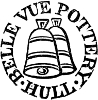
Fig. 847.
The mark is the one here engraved. It is two bells, surrounded by the words “Belle Vue Pottery, Hull;” but sometimes the bells alone appear, without the lettering. In the possession of the late Mr. Bagshawe were some of the later accounts of these works, from which a good idea of the extent to which the operations were carried on may be gleaned. For instance, in 1837, four years before the close of the works, the expenses were as under:—
Slip Men £96 19 0
Flat Men 144 4 9
Pressers 47 1 10
Throwers and Turners 376 5 6
Saggar Making 33 15 11
Cock Spurs 26 18 10
Modelling 21 0 0
Printing 164 0 11
Biscuit Firemen 59 16 11
Biscuit Painting 89 18 8
Gloss Firemen 113 9 4
Packing, &c. 104 19 8
Engineer 79 10 5
Enamel Painting 76 17 9
£1,434 19 6
The works have been entirely discontinued since 1841, and the site included in the extensive engineering works of Messrs. C. D. Holmes & Co.
In 1804, Mr. William Clowes (also from the Staffordshire pottery district), one of the founders of Primitive Methodism, worked at the Hull pottery. Mr. Clowes was born at Burslem in 1780; he “came from Nottingham to Hull to establish a missionary centre, on the 15th of January, 1819;” the day after his arrival “he informs us that he visited the Pottery by the Humber Bankside, where he had worked as a potter fifteen years before, but he found the working of the pottery had been discontinued;” i.e., I presume it was then in a transition state before being transferred to Mr. Bell by the brothers Ridgway.
Stepney Lane.—At the present time a small pottery for the manufacture of the common brown ware pancheons, flower-pots, &c., is still carried on by the successors of Mr. Mayfield, of the Stepney Paper Mills, Hull.
Leeds.
There is no doubt that pottery has been made at Leeds, or in its immediate neighbourhood, from the earliest times of our British history. Celtic and Romano-British relics have, from time to time, been found in the neighbourhood, which were, without doubt, made at the place; and the village of Potters Newton evidently takes its name from a colony of potters having settled there in early times. That it was so in days of yore is evidenced by the fact of the name appearing in deeds of the thirteenth century. In later times coarse brown earthenware was made in Leeds, as were also tobacco-pipes in the reign of Charles II. These were made from clays found at Wortley—the same bed of clay which was worked for the old Leeds pottery, and is still used for making yellow ware and saggars at the present day. The manufacture of tobacco-pipes at Leeds was established in the latter part of the seventeenth century, and was carried on somewhat extensively for several years. Ralph Thoresby, in his “Ducatus Leodiensis,” published in 1714, in his account of Wortley Hundred says: “Here is a good vein of fine clay, that will retain its whiteness after it is burnt (when others turn red), and therefore used for the making of tobacco-pipes, a manufacture but lately begun at Leeds.” Probably to the existence of this bed of fine clay is to be attributed the establishment of the pot works at Leeds, to which I am now about to direct attention.
Of the date of the first establishment of the Leeds pot works nothing definite is known. It is, however, certain that they were in existence about the middle of last century, and that they were then producing wares of no ordinary degree of excellence. Before this time a kind of delft-ware was made, and I have seen some very creditable copies of Oriental patterns, with salt glaze, also produced at these works. Delft-ware, however, was only made to a small extent, and was soon succeeded by the manufacture of that fine cream-coloured earthenware which made the works so famous, and enabled them in that particular branch to compete successfully with Wedgwood and other makers. As early as 1770 considerable progress had been made in the ornamental productions, and I have seen dated examples of open and embossed basket-work ware of a few years later (1777 and 1779), which are as fine as anything produced at the time.
The first proprietors of whom there appears to be any record were two brothers named Green, in 1760; and it is believed their earliest productions were in black ware, in which the firm afterwards excelled. It was then carried on by Humble, Green, & Co. “Mr. Wilson has found the draft of an agreement, dated November 11, 1775, whereby ‘Joshua Green, of Middleton, gent., John Green, of Hunslet, potter, with divers others, under the firm of Humble, Green & Co.,’ agree with Messrs. Hutchinson and Evers to erect and maintain in repair at their mill a water-wheel, with all necessary machinery for grinding flints. For thirteen years the wheel was to be used exclusively by the Greens, who were to supply burnt flints and to pay 10s. for every 100 pecks of well ground and levigated flints, the workmen’s wages being first deducted.” In 1783 the firm was Hartley, Greens, & Company, and they had so far advanced in their work, and were so firmly established and well known by that year as to justify them in issuing a book of “designs” of some of the articles they were then producing. A copy of this rare volume, in my own possession, contains all three of the lists—English, French, and German. The English title is “Designs of sundry Articles of Queen’s, or Cream-colour’d Earthen-Ware, manufactured by Hartley, Greens, & Co., at Leeds-Pottery: with A Great Variety of other Articles. The same Enamel’d, Printed or Ornamented with Gold to any Pattern; also with Coats of Arms, Cyphers, Landscapes, &c., &c. Leeds, 1783.” The list and title-page occupy eight pages, as do also each of the two others—translated into German and French—which accompany it, and which bear the following titles:—“Abrisse von verschiedenen Artickeln vom Königinnen oder gelben Stein-Gute, welches Hartley, Greens, & Comp. In ihrer Fabrick in Leeds verfertigen; Nebst vielen andern Artickeln; Auch dieselben gemahlt, gedruckt oder mit Gold gezieret zu jedem Muster, ebenfalls mit Wapen, eingegrabene Namen, Landschaften, &c., &c., &c. Leeds, 1783.” “Desseins de divers Articles de Poteries de la Reine en Couleur de Creme, Fabriqués à la Poterie de Hartley, Greens, & Co. à Leeds: Avec une Quantité d’autres Articles; Les mêmes émaillés, imprimés ou ornés d’Or à chaque Patron, aussi avec des Armes, des Chiffres, des Paisages, &c. &c. Leeds, 1783.”[107] This catalogue, with some variations, continued to be issued till a much later period. A copy presented by myself in 1865 to the Jermyn Street Museum supplies the plates missing in the former copy. It has no title-page, but is printed on paper bearing a water-mark of 1814. The words “Leeds Pottery” are engraved on each plate of the book. The plates, forty-four in number, are very effectively engraved on copper, and exhibit a wonderful, and certainly exquisite, variety of designs for almost all articles in use, both plain, ornamented, perforated, and basket-work, including services, vases, candlesticks, flower-stands, inkstands, baskets, spoons, &c., &c.[108]
The partners at this time (1783–4) composing the firm of Hartley, Greens, & Co. were William Hartley, Joshua Green, John Green, Henry Ackroyd,[109] John Barwick, Samuel Wainwright, Thomas Wainwright, George Hanson, and Saville Green. The business was, it appears, divided into six shares, of which William Hartley, Joshua and John Green, and Henry Ackroyd, had each one; John Barwick and the two Wainwrights half of one each; and George Hanson and Saville Green a quarter share each, the latter acting as “bookkeeper” to the firm. The proprietors were extremely systematic and particular in their mode of keeping accounts and in their dealings with each other. They held regular meetings, and appointed independent and disinterested persons as valuers in each department; for instance, one to value the stock of finished goods in the ware rooms, another the unfinished ware, another the copper plates, another the buildings, others the moulds and models, the windmill, the horses, the waggons and carts, the raw materials, the woodwork, and every imaginable thing. The reports of these various valuers, whose names and awards for many years I have carefully examined, were submitted to a meeting of the partners, when a balance was struck, to which the names of each one were attached.
In 1785, and again in 1786, fresh editions of the catalogue and book of plates were issued, without change either in the number of articles enumerated or in their variety or form. The works at this time had been considerably increased in size, and the wares made were exported in large quantities to Germany, Holland, France, Spain, and Russia. So great had the concern become five years later (1791), that the yearly balance then struck amounted to over £51,500; and it is worth recording that in that year the value of the copper-plates from which the transfer printing was effected was £204, while at the present time they represent about £1,000. These copper-plates consisted of teapot borders, landscapes, Nankin borders, and others. The general stock in this year (1791) was valued at about £6,000, and the windmill at about £1,200. The house of the partners, entered as “Hartley, Green, & Co.’s House,” was at Thorpe Arch, near Tadcaster and Wetherby.[110] At Thorpe Arch, too, were the grinding mills. These mills were ten miles from the works at Leeds, and a team of four horses was kept constantly at work carrying the ground flint and stone. They, with the men who worked them, stayed six days, going and coming, between the two places, and then six at Thorpe Arch, alternately. The raw material was taken from Leeds to the mills at Thorpe Arch, when the horses who had brought it worked the mill to grind it, and returned with it, when prepared, to Leeds for use. This continued until 1814, when the windmill on the Leeds premises, which had been used as a corn mill, was converted into a flint mill, and an engine, made by the builders of the first successful locomotive, Fenton, Murray, & Co., put up. This mill is still used for the same purpose.
In 1794 another edition of the catalogue and pattern-book was issued. It was precisely the same in contents as the previous editions, both in the plates and letter-press; and contained the catalogue, or list, in English, French, and German. Fresh designs appear to have been continually added, and, the connections of the company increasing, a translation of the catalogue into the Spanish language was in a few years issued. This interesting work, of which a copy is in the possession of Mr. E. Hailstone, F.S.A., and which also contains the English catalogue, without date, bears the following title:—“Dibuxos de varios Renglones de Loza Inglesa de Regna, de Color de Crema, Fabricados en la Manufactura y Lozeria Hartley, Greens, y Compa. en Leeds: en este mismo ramo fabriam de dicha loza, hay piezas esmaltadas, impresas y adornadas con oro; como tambien hermoseadas con escudos, armas, cifras, payses, &c. &c. Leeds.” Instead of 152 general articles, as enumerated in the previous editions, 221 appear in this; and instead of 32 in tea-ware, 48 appear. In 1814, too, another edition was issued, a copy of which is in my own possession; it contains 71 plates of patterns, exhibiting 221 general articles, and 48 patterns of tea, coffee, and chocolate services. In this edition the whole of the plates, both those from the other copies and those newly engraved, have the words “Leeds Pottery” engraved upon them.
In the middle of the last century an important event in connection with the Leeds pottery took place. This was the establishment of the tramway from the collieries of Mr. Charles Brandling, at Middleton, to the town of Leeds. This tramway passed through the Leeds pot works, to the proprietors of which a nominal rental of £7 a year was paid, and to whom, as a further consideration for the right of passage, an advantage in the price of coals was allowed.[111] While speaking of the formation of this early line, it is interesting to note that upon it was set to work the first locomotive commercially successful on any railway. Mr. John Blenkinsop, who was manager of the Middleton Collieries, took out a patent, in 1811, for a locomotive steam engine, and placed his designs for execution in the hands of Messrs. Fenton, Murray & Co., at that time eminent engineers of Leeds. This was the first locomotive engine in which two cylinders were employed, and in that respect was a great improvement upon those of Trevithick and others. The cylinders were placed vertically, and were immersed for more than half their length in the steam space of the boiler. The progress was effected by a cog wheel working into a rack on the side of one of the rails. Mr. Blenkinsop’s engine began running on the railway extending from the Middleton Collieries to the town of Leeds, a distance of about three miles and a half, on the 12th of August, 1812, two years before George Stephenson started his first locomotive. Mr. Blenkinsop was for many years principal agent to the Brandling family, and his invention was, as is seen, first brought to bear in bringing coals from those pits to Leeds—a matter of immense importance to the town and its manufactures.
In 1796, as named in Hutchins’ “History of Dorset,” much of the Poole clay in that county was sent “to Selby for the use of the Leeds potteries.”
In the year 1800 two fresh partners, Ebenezer Green and E. Parsons, had joined the concern, the firm at this time consisting of William Hartley, Joshua Green, John Green, Ebenezer Green, E. Parsons, Mrs. Ackroyd and her daughter Mary (widow and daughter of Henry Ackroyd, deceased), John Barwick, Thomas Wainwright, George Hanson, Saville Green, and Samuel Wainwright. On the death of Mr. Hartley the business was carried on—still under the title of Hartley, Greens & Co.—by the remaining partners; and a Mr. Ruperti, a Russian, became, I believe, a partner in the firm. The trade at this time was, as I have already stated, principally with Russia, and with Norway, Spain and Portugal, and hence, I presume, Mr. Ruperti’s connection with it. The agent in Russia at one time was Mr. Barwick, and afterwards his nephew, Mr. Jubb. Other changes in the proprietary followed in succession, one of which was that a minister, the Rev. W. Parsons, married Miss Ackroyd, and thus became a partner; and for a time the style of the firm was changed from “Hartley, Greens, & Co.,” to “Greens, Hartley, & Co.” These repeated changes, and the unpleasantness and disputes that arose in consequence appear to have been detrimental to the concern, which was ultimately thrown into Chancery, and a large portion of the stock sold off. Some idea of the extent of the business done about this time may be formed from the fact, which I have gathered from a personal reference to the accounts, that the annual sales amounted, in round numbers, to about £30,000; that about £8,000 was paid in wages, and more than £2,000 for coals, even with the decided advantage of reduction in price by the arrangement spoken of.
In 1825, by an advantageous arrangement effected through the good offices of his friend Mr. Hardy, the then Recorder of Leeds, I am informed, the affair was got out of Chancery, and passed, by purchase, into the hands of Mr. Samuel Wainwright, one of the partners. The concern was at this time, I believe, carried on in the name of “Samuel Wainwright and Company,” and was conducted with great spirit. Mr. Wainwright engaged as his confidential cashier Stephen Chappell, who up to that time was employed as a bookkeeper in one of the Leeds cloth manufactories.[112] At Wainwright’s death (of cholera) in 1832, the trustees carried on the business under the style of the “Leeds Pottery Company,” and employed Stephen Chappell as their sole manager. This arrangement continued until the year 1840, when the trustees transferred the whole concern to Chappell, who took it at his own valuation. Shortly after this time his brother James became a partner in the concern, the firm then consisting simply of “Stephen and James Chappell,” who continued the works until 1847, when they became bankrupt. The pottery was then carried on for about three years, for the benefit of the creditors, by the assignees, under the management of Mr. Richard Britton, who had for some time held a confidential position with Mr. Chappell. In 1850 the concern passed, by purchase, into the hands of Mr. Samuel Warburton and this same Mr. Richard Britton, and was by them carried on under the style of “Warburton and Britton,” until 1863, when, on the death of Mr. Warburton, Mr. Richard Britton became sole proprietor of the works. On July 1st, 1872, he was joined in partnership by his two eldest sons, John Broadbent Britton and Alfred Britton, the firm at the present time being “Richard Britton & Sons.”
The Leeds Pot Works are situated in Jack Lane, and occupy an area of considerably more than seven acres of ground, and at the present time give employment to about two hundred and fifty persons. The premises are intersected for a considerable portion of their length by the Brandling’s Railway, and are also crossed in a cutting by the main line of the Midland Railway. The works are very extensive, and, with but some trifling alterations, now stand as they did in the time of Hartley, Greens, & Co. Closely adjoining them is the Leathley Lane Pottery.
The wares manufactured at different periods at these interesting works consist of the coarse brown earthenwares, made on its first establishment; delft-ware, produced only in small quantities, and for a short period; hard and highly vitrified stone ware, with a strong salt glaze; cream-coloured, or Queen’s ware; Egyptian black ware; Rockingham ware; white earthenware; yellow ware, &c., &c. The great speciality of the works was the perforated “Queen’s or cream-coloured earthenware,” for which they became universally famed, and successfully competed with Wedgwood. It is this kind of ware which among collectors has acquired the name of “Leeds Ware.” To this it will be necessary to direct careful attention, and to point out both the peculiarities of pattern and of ornamentation which they exhibit.
Figs. 848 and 849.
In colour the old Leeds ware—i.e., the cream-coloured earthenware—is of a particularly clear rich tint, usually rather deeper in tone than Wedgwood’s Queen’s ware, and of a slightly yellowish cast. The body is particularly fine and hard, and the glaze of extremely good quality. This glaze was produced with arsenic, and its use was so deleterious to the workmen, that they usually became hopelessly crippled after four or five years’ exposure to its effects. It is not now used.
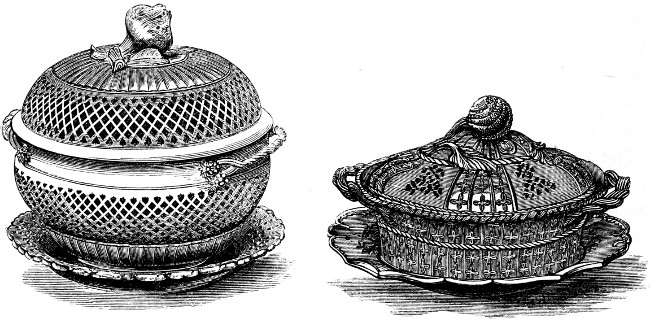
The perforated pieces, as well as those of open basket-work, exhibit an unusual degree of skill and an elaborateness of design that is quite unequalled. The example (Fig. 848), is a chestnut basket and stand, of the finest and most elaborate description. In form it is faultless, as it is also in moulding, and there is considerable elegance in the general outline. The upper part of the cover, and the lower portion of the bowl are fluted, and the handles, which are double twisted, terminate in flowers and foliage. Both bowl and cover are elaborately perforated; and here it may be well to note, for the information of collectors, that the perforations of this description were produced by punches, by which the soft clay was pierced by hand. I name this more particularly because I have heard an opinion expressed, by those not conversant with the matter, that this description of open-work was produced in the mould. The fact of each of the perforations being produced separately by the hands of the workman, adds materially to the interest attached to the piece, and to its value. It may also be remarked that the wholesale price of this piece (eleven inches in diameter), the pattern for which was probably produced about 1782–83, was, in 1794, 8s. 6d.—a price which collectors at the present time would gladly triple and even quadruple.
Figs. 850 to 852.
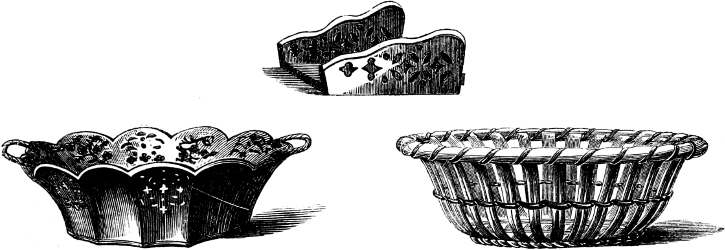
Fig. 849 is an oval butter-tub and stand, of peculiarly elegant design, belonging to Mr. Manning. It is well covered with embossed work, and has both cover and stand very nicely perforated, the perforations being produced in the same manner as the one just described, by punches. The handles are ribbed and double twisted, with foliated terminations. The next illustration shows one of the “pierced fruit baskets” for which these works were very famous, and I have chosen it because it shows the combination of the pierced work with painting. These, and the asparagus shell (Fig. 850), engraved to show how the peculiar art of these works was applied to the simplest things, will be sufficient to illustrate this variety of pottery.
The next variety is that of twig baskets, of which Fig. 852 is a good and characteristic example. In these pieces, which were produced in different varieties of wicker-work, the “twigs,” or “withies,” are really composed of clay in long or short “strips,” as occasion required, and then twisted and formed into shape. The process was one which required considerable care and nicety in manipulation, and was well calculated to exhibit the skill of the workman. Baskets of this kind were made by various makers, as well as at Leeds, and all on much the same model, so that without an intimate knowledge of the body and glaze of the Leeds ware, it is difficult to distinguish them from others. One of these baskets on its oval stand or dish (the wholesale price in 1794 ranging from 1s. 4d. to 3s. 6d., according to size) is engraved in the book of patterns of which I have spoken, and those who are fortunate enough to possess, or to be able to refer to that extremely scarce work, “Wedgwood’s Engraved Pattern Book” (18 plates, 4to.), will there find one engraved on Plate 13, Fig. 851. The same baskets were produced at Castleford and Don, and by Staffordshire houses.
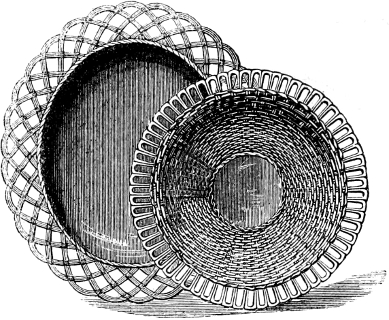
Fig. 853.
Another characteristic variety of Leeds work was the combination in basket-work, &c., of embossed patterns with perforations. Of these I give an excellent example on the accompanying engraving, in which the rim of the dish is embossed and pierced in basket-work. The way in which this was produced was this. The plate, dish, basket, or other piece, was formed in the mould so that the pattern stood out in relief above the parts intended to be incised. These were then cut out by hand, with a penknife, leaving the pattern entirely in open-work. The dish here engraved is one of the simplest kind, but is an extremely early specimen, having probably been made about 1779, and is therefore a good illustration of this class of work. It is marked in small capital letters LEEDS POTTERY.
In this same ware—the Queen’s or cream-coloured earthenware—the Leeds works produced services of various kinds, as well as the usual vessels for domestic use, and works of Art in the shape of vases, candelabra, centres, &c. &c. Of the services, which, as a rule, were of remarkably elegant forms, and produced with extreme skill in workmanship, it will not be necessary to give illustrations. Of the more decorative pieces, however, I give Figs. 854 to 856, engravings, because it is well to show collectors to what degree of perfection in design these almost forgotten works had arrived. The first example which I engrave is a magnificent centre, or “grand platt menage,” of four tiers. It is composed of five separate pieces. The base is rock, and each tier is composed of shells after the fashion of the Plymouth designs. The shells are supported on elegant brackets, and the whole piece is surmounted by a well-modelled female figure.
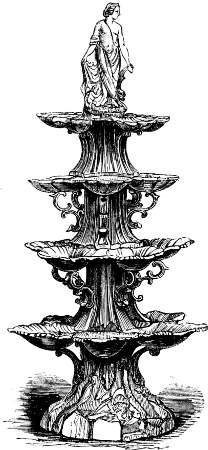
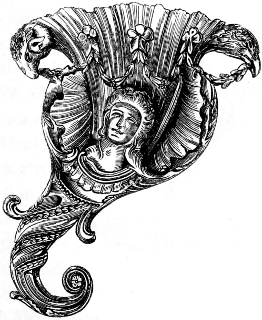
Figs. 854 and 855.
Fig. 855 shows a jardinière of very elegant and effective design, of cornucopia form, with a head of Flora, crowned with flowers, in front, and festoons above held by a ram’s and an eagle’s head; and Fig. 856 exhibits a “grand platt menage,” similar to that engraved on Plate 26 (Fig. 106) of the “Book of Patterns.”
In the plate to which I have referred this elegant piece has a base for cruets added, and is somewhat different in some of its details, but it is much the same in general design. Around the centre of the base, it will be noticed, is a series of rams’ heads with large bent horns, hooked at the end, and the foliage beneath the pine-apple at the top is also deeply bent downwards, and the point of each leaf hooked up at the end. On these—the horns and leaves—it was intended to hang small earthenware wicker-work baskets, and on the engraving to which I have alluded, these are all shown in situ. It is interesting to note that in Mr. Hailstone’s collection is a precisely similar piece, but with the addition of a circular base, which is of Wedgwood’s Queen’s ware, and is marked WEDGWOOD in the usual manner. This circumstance shows that the design was common to both manufactories, and the natural inference to be drawn is that Messrs. Hartley, Greens, & Co., in this instance, as in others, copied and reproduced Wedgwood’s designs; while in other instances it is equally possible Wedgwood copied from them. It is curious in going through the pattern-books of Hartley, Greens, & Co. of 1783, and downwards to 1814, Wedgwood’s of 1815, and the “Don,” to note the similarity of designs exhibited, some of which are so nearly identical, as to appear almost to have been produced from the same moulds.
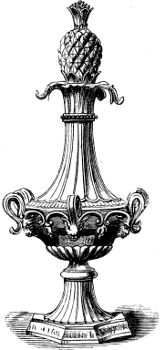
Fig. 856.
A teapot, dated 1777, has been ascribed to the Leeds works; but I am doubtful as to the correctness of the appropriation. It bears on one side the words:—
“May all loving Friends Be happy and free In drinking a Cup Of harmless tea.”
And on the other side:—
“Mary Green in the Parish of Souze 1777.”
The vases, scent jars, cockle pots, and potpourri produced at Leeds, were many of them of very elaborate and elegant designs, and of large size, and were decorated with raised figures, medallions, flowers, festoons, shells, &c., and with perforated work. They were also frequently painted, or enamelled, in various colours, blue, green, and red being the prevailing ones. One “cockle pot,” 22 inches in height, has a square stand, highly decorated with shells, &c., in relief, and with perforations, standing on four feet. At each corner is a raised seated figure. From the centre rises the stem, supporting a solid globe, on which rests the bowl, supported by mermaids. The bowl is decorated with festoons of shells, flowers, and sea-weeds in high relief. The cover is also ornamented with raised groups of shells and seaweed, and is perforated in an elaborate and somewhat intricate pattern. It is surmounted by a spirited figure of Neptune with his trident and horses.
Candlesticks were made in great variety, and were highly decorated. Some were in the form of vases, and in this variety vases were produced in the same manner as Wedgwood’s jasper ware, with reversible tops, so as to serve either as ornaments only, or as candlesticks. Others have dolphins; others again Corinthian and other pillars; others have massive bases perforated and embossed, while the candlestick itself rose from griffins; and others again are vases with branches for two or more candles springing out from their tops. These are now of great rarity, as, indeed, are many of the productions of the Leeds works.
Single figures, and groups of figures, were also produced, principally in the plain cream-coloured ware, but sometimes painted. It is also said that some minute works of Art, small cameos, were made at Leeds. A pair of these, said to be authenticated as Leeds manufacture, are in the possession of Mr. Ferns, who is also the owner of many excellent specimens of perforated ware.
In Mr. Hailstone’s possession is a remarkably fine fountain of large size. It has a dolphin spout, shell terminations, mermaids and shells for handles, and has figures and ornaments in relief in front.
In tea, coffee, and chocolate services, a large variety of patterns were produced; both plain, engined, fluted, pierced, and otherwise decorated. Many of these are of similar form to Wedgwood’s, to whom their manipulation would, indeed, have been no discredit. The great peculiarity of the tea and coffee pots, &c., is their double twisted handles, with flowers and leaves for terminations. Many of these are extremely beautiful, both in design and in execution. These services were made either in plain cream-colour, or painted with borders and sprigs of flowers in various colours. The chocolate cups are usually two-handled, or without handles. The stands are, in many instances, highly ornamented with perforations, or take the form of melon or other leaves, and have ornamental sockets for the cups attached. Several patterns appear in the engravings of which I have spoken. Tea-kettles and milk-pails with covers were also made, and in the possession of the late Mr. Lucas was a fine example of a tea-kettle with double twisted handle, with foliated terminations.
In the early part of the present century, white earthenware was made at these works. It was a fine, hard, compact body, and had, like the cream-coloured, a remarkably good glaze. In this ware services, especially dinner and tea, were produced, and were decorated with transfer printing, painting, lustre, and tinsel. “Tinselling,” it must be understood, is the peculiar process by which a part of the pattern is made to assume a metallic appearance by being washed here and there over the transfer or drawing. Examples of these, consisting of plates, and a cup and saucer, belonging to Mr. Manning and Mr. Davis, are marked with the curved mark to be hereafter described.
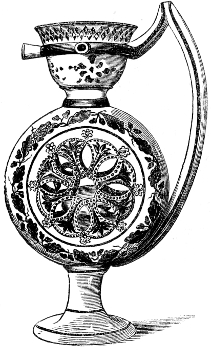
Fig. 857.
The plates also bear a small blue-pencilled letter C, and impressed flower of seven lobes, and kind of cross pattée; these are, of course, workmen’s marks. The cup and saucer in Mr. Davis’s possession have flowers and rude landscape in colours and copper-coloured “tinsel.”
An excellent example of the white earthenware of Leeds is the puzzle jug in the possession of Mr. Alfred Britton, here engraved (Fig. 857). This is one of the most elaborate in design, and careful in execution, which has come under my notice. The upper part is ornamented with “punched” perforations, and the centre of the jug is open throughout, having an open flower on either side, between which is a swan standing clear in the inside. The jug is painted with borders and sprigs of flowers, and is marked with the usual impressed mark of LEEDS POTTERY. A curious example of the white earthenware is in the possession of Mr. Hailstone. It is a large jug, having on one side a spirited engraving of “the Vicar and Moses” in black transfer printing, and coloured, and on the other side the old ballad of “the Vicar and Moses,” engraved in two columns, and surrounded by a border. In front of the jug, pendent from the spout, is painted the arms of the borough of Leeds, the golden fleece, commonly called the “tup in trouble.” On each side of this are the initials J. B. and S. B., and beneath are the words—“Success to Leeds Manufactory.”
Transfer printing was introduced at Leeds, probably, about 1780, but this is very uncertain. In the title-page of the “Book of Patterns in 1783,” it is said, “the same enamel’d, Printed or Ornamented with Gold to any pattern; also with Coats of Arms, Cyphers, Landscapes, &c.;” and in 1791, the copper-plates then in use were valued at £204. The patterns were principally willow pattern, Nankin pattern, borders, groups of flowers, landscapes, and ruins. I may mention that several of the original pattern-books of drawings of the articles themselves, and of borders and other decorations, of the early Leeds productions are in my own possession.
Lustre, both gold and silver, was used occasionally in the decorations at Leeds, and excellent examples of “lustre ware” were also produced. These, like the other early productions of the works, are scarce.
About the year 1800, black ware was introduced at Leeds. This was of the same character as the Egyptian black, then so largely made in Staffordshire by Wedgwood, by Mayer, by Neale, and others. The body is extremely compact, firm, and hard, but had a more decided bluish cast than is usual in other makes. In this ware, tea and coffee pots, the latter both with spouts and with snips, cream ewers, and other articles were made. I believe there are but few collectors cognizant of the fact that this Egyptian black ware was made at Leeds at all; but I have been fortunate enough, by careful examination, to ascertain that up to 1812–13, probably from ninety to a hundred distinct patterns and sizes of teapots alone were produced in black at these works. This is an interesting fact to note, and is one which will call attention for the first time to this particular branch of Leeds manufacture. The patterns of the teapots were very varied, both in form, in style of ornamentation, and in size. In form were round, oval, octagonal, and other shapes, including some of twelve sides. In ornamentation some were engine-turned in a variety of patterns, while others were chequered or fluted. Others again were formed in moulds elaborately ornamented in relief with flowers, fruits, borders, festoons, &c., &c.; while others still had groups of figures, trophies, and medallions in relief on their sides. The “knobs” of the lids were seated figures, lions, swans, flowers, &c., &c. The lids were made of every variety, both inward and outward fitting, sliding, and attached with hinges. In speaking of engine-turning, it may be well to note that “engined” mugs, jugs, &c., were made at these works as early as 1782, if not at an earlier date. And here, in connection with the black ware, let me note too, that pot-works were established at Swinton, by some of the family of the Greens, of Leeds (see Swinton); and that here, too, black ware teapots were made, which were known as “Swinton pattern.” Of these I shall have more to say in my account of the Swinton works.
The marks used at Leeds are not numerous, and are easily distinguished. Collectors, however, need to be told that very few indeed of the productions of this manufactory were marked. The great bulk of the pottery, whether in Queen’s ware or otherwise, was made for foreign markets—Russia, Holland, Spain, Germany, Portugal, France, &c.—and as a rule the goods were sent off unmarked. It is worthy of note, too, that the finest examples of Leeds make, both in the perforated and other varieties, now known, have been recovered from the Continent. To illustrate this remark, it will be only necessary to point to the chestnut basket just described and engraved, which was purchased and brought from Holland a few years ago. The marks, so far as I have been able to ascertain, which were used at the Leeds works, and of each of which examples are in my own collection, are the following—
LEEDS · POTTERY*
in large capitals, with a terminal asterisk impressed. This mark occurs on a large-sized “Melon Terine” same as the one engraved in the pattern-book of 1783, figure 68, plate 16. On the same piece are a large capital letter S impressed, and the number 12 incised. These are of course workmen’s or pattern marks.
LEEDS * POTTERY
in small capital letters.
HARTLEY GREENS & CO LEEDS * POTTERY Fig. 858.
in small capital letters.

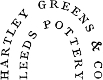
Fig. 859.
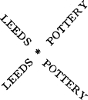
Fig. 860.
in small capital letters, in two curved or horse-shoe lines.
Many good examples of Leeds wares are preserved in the Museum of Practical Geology. Among these one is marked with the impressed Leeds mark twice in form of a saltire (Fig. 860).
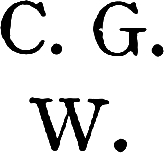
The marks usually ascribed to Leeds are the following:—but there is no proof that any of these were ever used at the works. In my own possession is a dessert service with the “sponged” border (which was used at Leeds), and a series of extremely fine and thoroughly artistic figures, cupids, &c., engraved in stipple, and printed in a warm pinkish brown colour, which bears the first of these three marks; but although it is ascribed to Leeds, I have grave doubts as to the correctness of the appropriation.

Mr. Chaffers, in his first edition, says: “The mark of C. G. has been attributed to Charles Green, of Leeds; that in the margin is on a cup and saucer of white English china, with paintings of landscapes and the raised wicker border, common to this manufactory.” I quote this for the purpose of showing how little reliance can be placed on the information hitherto given with respect to these works. So far as my researches go, I do not find there was a Charles Green connected with the Leeds works; and that china was never made there I am fully convinced. This mark of does occur upon a china cup and saucer which has come under my notice: but it has not any connection with the Leeds works.
The Leeds Pottery at the present time produces the ordinary descriptions of earthenware for domestic use, consisting of dinner ware in great variety, tea and coffee, toilet, and other services, jugs and mugs, screw jugs, bowls and basins, and, indeed, all articles in general use. In dinner ware upwards of ten standard patterns are made for the London market, which market takes nearly one-half of the whole productions of the works in general goods. The white earthenware is of the same quality as the ordinary run of Staffordshire ware, and has a good glaze. It is produced in the usual styles of blue printing, painting and edging. Pearl white of good quality, both plain and decorated, is also manufactured. This pearl body is got up in toilet ware, varying in patterns, printed lines, and fancy stamped; jugs embossed and plain; tea and breakfast services, &c. It is also being introduced for washing-machines, substituting earthenware bottoms for wood; also for patented machines for cloth manufacturers. These were first shown at the Leeds Exhibition of 1875. Scent-jars, leech-jars, &c., &c., are also largely made.
In Rockingham ware, tea and coffee pots and other articles are still made in considerable quantities; as are also Egyptian black glazed wares and yellow earthenware, which is made from native clays procured from Wortley. Thus it will be seen that the Leeds potteries of the present day—of the very existence of which but few persons are aware—are of considerable size and importance, and are doing a large business—a business which, unlike that of the olden times, is principally confined to the supplying of the home markets, where, not being marked, the ware usually passes for that of Staffordshire.
The marks used at the present day are, an old English letter L within a gothic quatrefoil in a circle, impressed in the body of the ware; or the name of the pattern within an ornamental circle, and, below it, the initials of the firm, R. B. & S., printed on the surface.

Leathley Lane Pottery.
Closely adjoining the works I have been noticing is another small pottery, of whose history a few words may be said. They were established in the early part of the present century, by, I believe, a Mr. North, for the manufacture of black ware, but were afterwards used by the same person for the making of the ordinary white earthenware. From Mr. North the works passed into the hands of a Mr. Hepworth, who made the ordinary brown salt-glazed ware. It was next worked by Mr. Dawson, one of the trustees of the Leeds pottery, who took into partnership Mr. Chappell, of whom I have spoken as, for a period, proprietor of the Leeds pottery; and it was for some time carried on by Dawson and Chappell, afterwards by Chappell alone, and then by Shackleton, Taylor and Co. This partnership was dissolved in 1851, and the works were then continued by two of the former proprietors, Messrs. Taylor and Gibson. Since 1859, the factory has been continued to the present time by Messrs. Gibson & Co. The premises are small, and produce only the commoner and inferior kinds of earthenware for domestic purposes. These are white ware of the commonest kind, yellow ware made from the Wortley clays, and Rockingham ware.
Castleford.
Castleford, which has its stations on the “North-Eastern” and on the “Lancashire and Yorkshire,” and is in direct communication with the Midland and Great Northern Railways, lies about twelve miles from Leeds. It is, in great measure, supported by its glasshouses, its chemical works, and its potteries, which are still in full operation. Common brown ware had, I believe, been made for a considerable period, on the spot, the goods produced, of course, being pancheons and the ordinary classes of coarse vessels. The Castleford Pottery was established, towards the close of the last century, by David Dunderdale, for the manufacture of the finer kinds of earthenware, more especially Queen’s or cream-coloured ware, which was then being made so largely at Leeds and other places, as well as in Staffordshire. Mr. Dunderdale took into partnership a Mr. Plowes, and in 1803, the firm of D. Dunderdale & Co., which appears stamped on the goods, consisted of these two persons. The partnership was not of long duration, and after considerable dissension, was dissolved, Mr. Plowes removing to Ferrybridge, where he joined the proprietors of the pot-works there, his son removing to London, and Mr. Dunderdale continuing the Castleford Works alone. The next partner was Mr. Thomas Edward Upton, a relative of Mr. Dunderdale’s, and these two shortly afterwards took into partnership John Bramley (or Bramler) and Thomas Russell, who was not a practical potter, but was an hotel proprietor at Harrogate. At this time the proprietary was thus divided:—Dunderdale one half of the concern, Russell a fourth, and Upton and Bramley an eighth each. Considerable additions were made to the works at this time, and the change in the proprietary was commemorated by a grand feast, and by bonfires, and all kinds of extravagant rejoicings.
In 1820 the manufactory was closed, and in 1821 a part of the works was taken by some of the workmen—George Asquith, William and Daniel Byford, Richard Gill, James Sharp, and David Hingham. They were succeeded by Taylor, Harrison, & Co., Harrison having been an apprentice of David Dunderdale’s; and the place was for several years carried on by the latter and the son of the former, under the style of Taylor and Harrison. It is now closed as an earthenware manufactory (Messrs. Taylor and Harrison having given up the trade), and is carried on for stoneware alone. At these works, an offshoot, as I have shown, of the old pottery, the commoner descriptions of goods only are made.
At the close of the year 1825, I believe, the old works were taken by Asquith, Wood, & Co. They were joined in partnership by Thomas Nicholson, who had served his apprenticeship with Hartley, Greens, & Co., of the Leeds Pottery, and carried on the business as Asquith, Wood, and Nicholson, and afterwards as Wood and Nicholson alone. In 1854 another change took place, by which Mr. Nicholson, one of the old firm, retained the works, and took into partnership Thomas Hartley, the style of the firm being Thomas Nicholson & Co. A few years ago Mr. Nicholson retired from the concern, and it was then carried on by Thomas Hartley alone, and afterwards with partners, under the old name of Nicholson & Co. In December, 1871, Mr. Hartley died, and the Castleford Pottery was then, and still is, carried on by his co-partners, Hugh McDowall Clokie, and John Masterman, under the style of “Clokie and Masterman.”
The Castleford Works, under David Dunderdale & Co., did a large trade with Spain, the Baltic, and other “foreign parts,” principally in cream-coloured ware, and it is said that during the war the losses were so great, both in earthenware and in specie, as to cripple the works, and lead to their being closed. So great was the export trade of the firm, that they owned vessels of heavy burthen, which were kept trading with the Spanish and other ports. It is related that just before the peace of Amiens, one of Dunderdale’s ships was closely and hotly chased, but succeeded in outstripping her would-be captors. This was celebrated at Castleford, and the circumstance was remembered as “Dunkirk Races,” and is still talked of with pride by one or two of the old people with whom I have conversed.
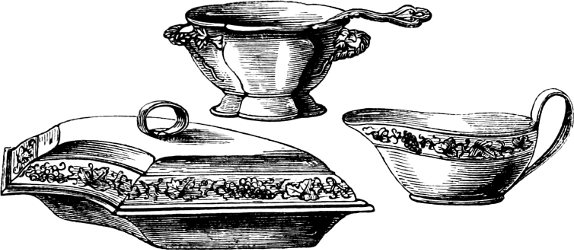
Figs. 861 to 863.
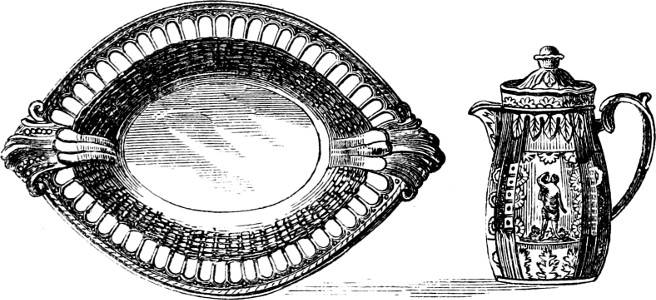
Figs. 864 and 865.
As I have said, the staple production of the Castleford Pottery in Dunderdale’s time was the “Queen’s” or “cream-coloured ware,” which was made of an excellent quality, and of a good colour. In appearance it assimilated pretty closely to the cream ware made at the Herculaneum Works, and was not so fine or so perfect in glaze as that made at Leeds. In this ware dinner, dessert, and other services, as well as open-work baskets, vases, candlesticks, and a large variety of other articles, were made, both plain and painted, or enamelled, and decorated with transfer printing. In the accompanying engraving are shown some examples. Fig. 862 is one of a set of four central covered dishes painted in sepia with a border of vine leaves, grapes, and tendrils, of precisely the same design as appears on examples of Wedgwood’s make, and of Herculaneum, and other places. This set of dishes, when placed together for use, forms a circle of twenty-two inches in diameter. The sauce-boat (Fig. 863) is a part of the same service. The small oval sauce tureen (Fig. 861) and ladle show that double-twisted handles were made at Castleford as well as at Leeds, at Swinton, and other places. Open-work baskets, stands, plates, dishes, &c., were produced in great variety, and of designs in many instances closely resembling those of Leeds and other places. The accompanying engraving (Fig. 864) exhibits one of these. In what would now be called Parian, the Castleford Works in their early days produced some remarkably good and effective pieces. One of these, a hot-milk jug with its cover, shown on Fig. 865 is beautifully decorated with foliated and other borders, and with groups of figures in relief. Mugs, and other articles of the same material, were also produced. Examples of this kind of ware may be seen in the Museum of Practical Geology, Jermyn Street, and in many private collections.
Black or Egyptian ware of fine quality was made at Castleford in its palmy days, and is now of some degree of rarity. In my friend C. Roach Smith’s possession is a part of a service of this material, in which the hot-milk jug is of precisely the same pattern as the one engraved above. In fine white earthenware a large variety of goods was made by Dunderdale & Co., who produced a remarkably hard and compact body, and a glaze of considerable merit. In the late Mr. Pulleine’s possession, among other examples, was an oval fruit-dish, painted inside with a broad, bold, but not elegant border in red, and in the centre, in an oval, a landscape, with water, buildings, trees, figures, &c., in the same colour on a red tinted ground.
The marks used at these works appear to have been very few, and are easily recognised. They are—
D D & Co* CASTLEFORD
or
D·D & Co CASTLEFORD POTTERY
impressed in the ware. The mark of the later proprietors when trading as “T. Nicholson & Co.,” was a circular garter, surmounted by a crown, and on the ribbon the initials of the firm—“T. N. & Co.”; in the centre the name of the pattern. The mark of the present firm is their initials within a border.
At the present day the Castleford Pottery, as carried on by Clokie and Masterman, manufactures all the ordinary kinds of earthenware, including white, printed, sponged, and the very commonest kinds of painted varieties; the principal patterns of services being “Willow,” “Wild Rose,” “Albion,” “Gem,” “Eton College,” “Verona,” etc., which are produced in blue, green, brown, and other colours. The body is firm and good, and the glaze of the usual quality. The old glory of the works has, however, long departed, and nothing artistic or beautiful is now to be seen in the place where once so many choice articles might be found. There is in connection with the pottery a flint mill, where flint, stone, glaze and colour are ground, and the clay is prepared by hydraulic pressure.
The Eagle Pottery was established in 1854 by a company of workmen, under the style of “John Roberts & Co.,” and afterwards taken by Messrs. Pratt & Co., who sold the concern to Mr. H. McDowall, who continued to trade under the original style. Since the death of Mr. McDowall the buildings have been converted into a glass bottle manufactory. Only the most common classes of earthenware were produced.
Pontefract.
Thoresby records that Francis Place, of the Manor House at York, spent much money upon his manufacture of “fine muggs,” and that he attempted it solely from a turn for experiments; but one Clifton, of Pontefract, took the hint from him, and made a fortune by it. The works of Mr. Clifton would probably be the forerunners of those of Ferrybridge, near the “town of liquorice.”
The Ferrybridge Pottery is situated at Ferrybridge, by Knottingley, and only a short distance from that famous seat of the growth of liquorice, Pontefract, whose “Pomfret cakes” are so well and, indeed, universally known. The pot-works at Ferrybridge are among the largest, if they are not the very largest, in Yorkshire, and have the reputation of being well arranged and convenient. They were established in 1792, by Mr. William Tomlinson, who had for partners Mr. Seaton, an eminent banker of Pontefract; Mr. Foster, a wealthy shipowner, of Selby; Mr. Timothy Smith, a coal proprietor; and Mr. Thompson, an independent gentleman, residing at Selby. The firm was styled “William Tomlinson & Co.,” until about the year 1796, when the proprietors took into partnership Ralph Wedgwood, of Burslem, when the style was changed to that of “Tomlinson, Foster, Wedgwood, & Co.”
Ralph Wedgwood was the eldest son of Thomas Wedgwood, of Etruria (the cousin and partner of Josiah Wedgwood), and was brought up at that place under his uncle and father. He was brother to John Taylor Wedgwood, the eminent line engraver, whose works are so justly in repute.
In my “Life of Josiah Wedgwood,” I gave, for the first time, as the result of considerable research, a notice of this remarkable man, Ralph Wedgwood, and of his inventions, and his family[113] and connections.
Ralph Wedgwood, who was a man of extraordinary and varied ability, the originator of many important scientific inventions, and the author of the “Book of Remembrance,” published in 1814, in which the invention of the electric telegraph, under the name of the “fulguripolygraph,” is made known, and its benefits—precisely such as are now reaped by the public—are described, was born in 1766, and was brought up with his father at Etruria, where he received much valuable aid in chemistry, &c., from Josiah Wedgwood. He afterwards carried on business as a potter, under the style of “Wedgwood & Co.,” at the Hill Works, Burslem; but was ruined through losses during the war. While at the Hill, he prepared and presented to Queen Charlotte some fine examples of his manufacture, on the occasion of the restoration of health to the king, which were graciously accepted through the hands of Lord Cremorne. He then removed into Yorkshire, where, as I have stated, he entered into partnership with Messrs. Tomlinson & Co., of Ferrybridge, and thus again commenced business. This engagement, however, was not of long duration, his partners being dissatisfied at the large amount of breakage caused by his experiments and peculiar mode of firing, and the partnership being dissolved he retired from the concern, having succeeded in getting a thousand pounds awarded to him as his share of the business. He next removed to Bransford, near Worcester, where he issued prospectuses for teaching chemistry at schools, and thence to London, in 1803, travelling in a carriage of his own constructing, which he describes as “a long coach to get out behind, and on grasshopper springs, now used by all the mails.” This carriage was so extraordinary in its appearance as to be taken for a travelling show. While at Bransford he had been perfecting his inventions, among which was his celebrated manifold writer, which still maintains its high repute “against all comers.” One of his copying schemes, which he called a “Penna-polygraph,” that of writing with a number of pens attached to one handle, he found, on his arrival in London, had already been made by another person. His other plan, proving to be new, he called the “Pocket Secretary,” and afterwards the “Manifold Writer;” and on the 7th of October, 1806, after much discouragement and opposition, he took out a patent for this as “an apparatus for producing duplicates of writing.” In 1808 he took out a second patent for “an apparatus for producing several original writings or drawings one and at the same time, which I shall call a Pennæpolygraph, or pen and stylographic manifold writer.” An “ærial zone” was also proposed by him, and his invention was laid before the Admiralty, but judging from the following extract from a letter now lying before me, the invention was not considered to be a very feasible one. “The ærial zone is in proper hands if it is laid before the Admiralty, for there does not seem to be any greater likelihood of its becoming an article of general use than there is of the ladies leaving off muslin because some lose their lives every year by its use.”[114]
In 1806, Ralph Wedgwood established himself at Charing Cross, and soon afterwards his whole attention began to be engrossed with his scheme of the electric telegraph, first invented by his father, Thomas Wedgwood, which, in the then unsettled state of the kingdom—in midst of war, it must be remembered—he considered would be of the utmost importance to the government. In 1814, having perfected his scheme, he submitted his proposal to Lord Castlereagh, and most anxiously awaited the result. His son Ralph having waited on his lordship for a decision as to whether government would accept the plan or not, was informed that “the war being at an end, the old system was sufficient for the country!” The plan, therefore, fell to the ground, until Professor Wheatstone, in happier and more enlightened times, again brought the subject forward with such eminent success. The plan, thus brought forward by Ralph Wedgwood in 1814 (and, as I have stated, he received the first idea from his father), was thus described by him in a pamphlet entitled, “An Address to the Public, on the advantages of a proposed introduction of the Stylographic Principle of writing into general use; and also of an improved species of Telegraphy, calculated for the use of the Public as well as for the Government.” The pamphlet is dated May 29, 1815.
Ralph Wedgwood from Charing Cross removed successively to Piccadilly, and Southampton Street, Strand, where he continued producing his “Pocket Secretary” in large numbers, and did a profitable business. The advantages he gained were, however, lost by his researches concerning the electric telegraph, and in the end his business gradually decayed. He was a man of too eccentric and visionary nature for the ordinary pursuits of life, and was thus led into the speculative ideas rather than the substantialities of worldly existence. Among his schemes was one for the founding of an universal language, over which he held a lengthy and elaborate correspondence with Percy Bysshe Shelley and other men of the day. He died at Chelsea in 1837. He was three times married—first to Mary Yeomans, of Worcester, by whom he had issue Ralph Wedgwood, of Barnes and Cornhill; secondly, to Sarah Taylor; and thirdly, to Anne Copeland, by each of whom also he had issue.
After the dissolution of the partnership at Ferrybridge, which took place, I believe, about 1800 or 1801, when Wedgwood ceased to have any connection with the concern, the firm of “Tomlinson & Co.” was resumed, and so continued until 1834, when it changed to “Tomlinson, Plowes, & Co.;” Mr. Plowes, of the Castleford Works, having joined the proprietary.
In 1804, the name of the manufactory, which, up to that period, had been called the Knottingley Pottery, was changed to that of the Ferrybridge Pottery. This change was made for the convenience of foreign correspondence—a large foreign trade being carried on—Ferrybridge being at that time a post-town of some note, and the works being situated nearer to it than to Knottingley.
Mr. Tomlinson was succeeded by his son Mr. Edward Tomlinson, who continued the works under the firm of Edward Tomlinson & Co., until the year 1826, when he finally retired from the concern. A part of the premises were then worked for a short time by Messrs. Wigglesworth and Ingham; when the whole place was taken by Messrs. Reed, Taylor, and Kelsall, who continued the manufactory until the retirement of Mr. Kelsall, after which the works were continued by the surviving partners, Messrs. James Reed and Benjamin Taylor. Mr. Reed, who was father of Mr. John Reed, of the “Mexborough Pottery,” was a man of enlarged experience, of matured judgment, and of great practical skill; and in his time many improvements in the ware were made, and the manufacture of china introduced. He, in conjunction with his partner, took the Mexborough Pottery, and for some time carried on the two establishments conjointly. Ultimately Mr. Reed gave up the Ferrybridge works, and confined himself to those at Mexborough, while Mr. Taylor carried on the Ferrybridge works alone.
After Mr. Taylor gave up the works Mr. Lewis Woolf entered upon them as tenant for a few years, and in 1856 became the purchaser, and commenced manufacturing in his own name, and has continued from that time until the present day. In the following year, 1857, a large additional pottery was built closely adjoining, and, indeed, connected with the “Ferrybridge Pottery,” by the sons of Mr. Lewis Woolf. This new manufactory was called the “Australian Pottery,” and is still in full work. The proprietors of the joint works, “The Ferrybridge and Australian Potteries,” as they are named, now are Lewis, Sidney, and Henry Woolf, who trade under the style of “Lewis Woolf and Sons.”
These works, besides a very large local and coasting trade, had extensive transactions with several foreign ports. From their first establishment to the time of the issuing of the famous Berlin decree by Napoleon, Messrs. Tomlinson & Co. had done a very extensive and lucrative trade with Russia, for which country the finer and more expensive kinds of earthenware, including cream-colour, Egyptian black, and other kinds of fancy bodies, were made, both pressed, printed, enamelled, and gilt. The decree cut short the trade with the Continent; but shortly after this commercial blow, which was severely felt by the Yorkshire potters, the River Plate was opened by Sir Home Popham, a circumstance which was taken immediate advantage of by the Ferrybridge firm. “One of the partners immediately proceeded there, and succeeded in establishing a good market until the royal family emigrated to Brazil, when the same partner moved up to Rio de Janeiro, to which port a large business was for many years carried on.”
The wares principally made were the following:—cream and cane-coloured ware, in which services and most articles in general use were manufactured, either plain, pressed (i.e., with raised patterns), painted, or printed. Green glazed ware, in which dessert services and other articles were made, and which were of a lighter colour than what Wedgwood produced. Egyptian black ware, of the usual quality made at the period. Fine white earthenware, in which was produced all the usual kinds of goods in enamelling, blue printing, painting, &c. Artists of considerable ability were employed at the works, and I have seen examples which are of thoroughly good character, and will vie with some of the best contemporary productions of the Staffordshire potteries.
In the time of Messrs. Reed and Taylor china of a very fine quality was made, but the manufacture was not of long duration. Tea and coffee services, dessert services, scent bottles, and a variety of articles, were made of this body, and were remarkably good in form and in style of decoration. Examples of Ferrybridge china are now of extreme rarity.
Cameos, medallions, and other ornamental articles in the time of Ralph Wedgwood’s connection with the works, were made in imitation of those of Josiah Wedgwood, to which they were, however, very inferior both in body and finish.
The combined works at the present time (by which of course I mean the joint manufactory of the “Ferrybridge and Australian Potteries”) give employment to about five hundred hands, and do a large trade with Australia and other foreign markets. In white earthenware, which is the staple trade of the works, the ornamentation consists of a large variety of patterns in transfer printing, in common painting, in lustre or “tinsel,” and in sponged patterns. Enamelled and gilt goods, too, are made, and of qualities to suit the different markets for which they are intended. For the Egyptian markets, to which large quantities of goods are sent, lustred or tinselled patterns are adapted very extensively. In “jet ware,” dessert services, candlesticks, toilet trays, and other articles are made. In this ware, I believe I am right in saying that a large number of services have been made especially for the Chinese market. In Egyptian black the ordinary varieties of articles are made, as they are also in Rockingham ware. In “blue jasper” ware, i.e., a blue glazed ware, absurdly so called, many useful and ornamental articles are made, as they are also in a variety of other bodies.
The marks used at the Ferrybridge Pottery have been but few. So far as my knowledge goes, those which will be of interest to the collector are the following—
TOMLINSON & CO.
impressed in the bottom of the ware,
WEDGWOOD & CO.
impressed on cameos, made during the time of Ralph Wedgwood’s connection with the works.
FERRYBRIDGE.
also impressed, and one variety of which mark is peculiar from having the letter D reversed thus—
FERRYBRIᗡGE P
A shield, with the words—OPAQUE GRANITE CHINA in three lines, supported by a lion and unicorn, and surmounted by a crown. This mark is also impressed, and occurs on green-glazed ware, as does the one just spoken of.
The mark at the present time is that of the lion and unicorn with the shield and crown, and the words, “Ferrybridge and Australian Potteries,” sometimes impressed, and at others printed on the goods, with the names of the bodies, as “granite,” “stone china,” &c., added.
Swinton-Rockingham China.
When pot-making was first practised in Swinton and its district, it is, of course, impossible to say, but I believe that as early, at all events (if not at a much earlier period), as quite the beginning of last century, a hard brown ware, of much the same quality as that made at Nottingham and Chesterfield, was produced on Swinton Common, where clays useful for various purposes were abundantly found. In 1745, it appears that a Mr. Edward Butler, seeing the advantage offered by the locality through its clays, which consisted of a “common yellow clay used for the purposes of making bricks, tiles, and coarse earthenware; a finer white clay for making pottery of a better quality; an excellent clay for making fire-bricks; and also a white clay usually called pipeclay;” established a tile-yard and pot-works for common earthenware, on a part of the estate of Charles, Marquis of Rockingham, which lay closely contiguous to Swinton Common, where these clays existed. The memory of this old potter, the founder of the works which afterwards became so famous as the “Royal Rockingham China Works,” is, it is pleasant to record, at the present day preserved in the name of a field near the now ruined factory, called “Butler’s Park.” Butler at these works produced the ordinary classes of goods then in use, but principally the hard brown ware to which I have just alluded. An interesting example of this period was in the possession of the late Dr. Brameld, and is engraved on Fig. 866. It is a “posset-pot” of the usual form of those which, at that period, were in such general use in Derbyshire and Yorkshire; it bears the date of 1759. This interesting example has a fragment of a label, written at “Swinton Pottery,” which authenticates it as having been made by, or for, John Brameld.
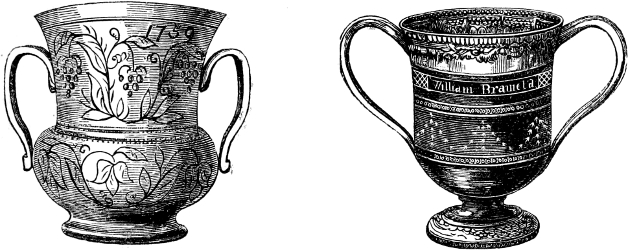
Figs. 866 and 867.
In 1765 the works were taken by William Malpass, who held another small pot-work at Kilnhurst, in the same neighbourhood, and he continued them for some years. With him were associated in partnership, I believe, John Brameld, and subsequently his son, William Brameld, of whom I shall have more to say presently. Mr. Malpass continued to manufacture the same varieties of ware as his predecessor, and held the works, or rather was a partner in them, at all events as late as 1786.
In 1778 Mr. Thomas Bingley became a principal proprietor of the Swinton works, and had for partners, among others, John and William Brameld, and a person named Sharpe. Mr. Bingley was a member of a family of that name which had been resident at Swinton for more than four hundred years, and is now worthily represented in the person of Mr. Thomas Bingley, who still resides there. The firm at this time was carried on under the style of Thomas Bingley & Co., and, being thriving, indeed opulent, people, the works were greatly enlarged, and conducted with much spirit. An extensive trade was at this time carried on, and besides the ordinary brown and yellow wares, blue and white dinner, tea, coffee, and other services were made, as also a white earthenware of remarkably fine and compact body, and other wares of good quality.
A highly interesting example of this period, 1788, is shown on the accompanying engraving (Fig. 867), which exhibits a two-handled drinking-cup, with the name of one of the proprietors, “William Brameld,” on one side, and the date “1788” on the other. This curious cup, which is five and a quarter inches in height, is of fine white earthenware with a bluish coloured glaze. The upper part, both inside and out, two narrow borders round the centre, the handles, and the base, are ornamented with blue transfer-printing. The rest of the vessel is black, the name, date, and ornaments upon it being gilt. The borders of blue printing are much the same as those around “willow pattern” plates, and from this it may be inferred that the “willow pattern” was at that period produced in Swinton.
From about the year 1787 down to 1800, the firm traded under the style of “Greens, Bingley, & Co.” This was consequent on some of the Greens of the “Leeds Pottery,” (which see)—having become partners, and taken an active part in the Swinton manufactory, with Mr. Bingley, Mr. Brameld, and those who were connected with them in those works. Mr. John Green became acting manager of the Swinton works, and afterwards, as I am informed, founded the “Don Pottery.”
I possess some original letters from John Green, dated “Leeds Pottery,” of April and June, 1788, addressed to “Mr. John Brameld, Swinton, near Rotherham,” giving directions not only concerning the works themselves, but relating to the partnership:—
“Should be glad you and Mr. Bingley will look over the partnership-deeds, and if there be anything that do not meet your ideas, please point it out. When you have done this you may send them in a small box directed for me; they never was in my mind when at Swinton, or should have done the needful then. I have writt Charles with some sponges and ... informing him I expect 4 Cm kills per week exclusive of china, which I hope he will be able to manage without increasing the wages.” ... “Hope your buisket kill turns out well. You have room now if you will but make neat goods and be observing to get money; but it will require a strict attention to keep every weelband in the nick.”
In the same letter he speaks of consignments of flint by Mr. Brearey to Selby and Tadcaster. He also offers Brameld from himself and partners a commission of 5 per cent. on all “wearing apparell sould to your works.”
The partnership with John Green was carried on in the style of “Greens, Bingley, & Co., Swinton Pottery;” and the same price-lists which were printed at Leeds with the Leeds pottery heading, had that heading cut off, and that of “Greens, Bingley, & Co., Swinton Pottery,” written in its place. Later on large fresh price-lists were printed. They were headed “Greens, Hartley, & Co., Swinton Pottery, make, sell, and export wholesale all sorts of Earthenware, Cream Coloured or Queens, Nankeen Blue, Tortoise Shell, Fine Egyptian Black, Brown China, &c., &c. All the above sorts enameled, printed, or ornamented with gold or silver.” On the fly-leaf was a printed circular, dated “Swinton Pottery, 1st February, 1796,” announcing an advance in prices and a revised system of counting.
The patterns used at Leeds were evidently, to some extent, adopted at Swinton; and I possess some original drawings and designs on which the numbers for each of those works are given. For instance, in teapots, Leeds No. 149 was Swinton No. 68; Leeds 133 was Swinton 69; 218 was 70; and 252 was 71, and so on.
Late in the last century, about the time of which I am now writing, a peculiar kind of ware was first made at these works, and took the name of “Brown China,” and afterwards that which it has ever since maintained where attempted to be made, of “Rockingham Ware.” This ware, which is of a fine reddish-brown, or chocolate colour, is one of the smoothest and most beautiful wares that has ever been produced at any place. The body is of fine hard and compact white earthenware, and the brown glaze, by which the peculiar shaded and streaky effect of this class of goods was produced is as fine as it is possible to conceive, and required to be “dipped” and passed through the firing no fewer than three times before it could be considered perfect. In this exquisite ware tea, coffee, and chocolate services, jugs, drinking-cups, &c., were produced, and continued to be made to the close of the works in 1842. Since that time “Rockingham ware”—in every instance falling far short of the original in beauty and in excellence—has been made by almost every manufacturer in the kingdom, and has always, especially for tea and coffee pots, met a ready and extensive sale. One special article produced in this ware was the curious coffee pot, formed on purely scientific principles, which is usually known to collectors as the “Cadogan pot.” This curious piece was formed on the model of an example of green Indian ware, said to have been brought from abroad[115] by the Marquis and Marchioness of Rockingham, or the Hon. Mrs. Cadogan, and preserved fifty or sixty years at Wentworth before it was thought of being copied. It has a small opening in the bottom to admit the coffee, but none at the top and no lid. From the hole in the bottom a tube, slightly spiral, was made to pass up inside the vessel to within half an inch of the top, so that after filling, on the “pot” being turned over into its proper position for table use, the coffee was kept in without chance of spilling or escape.
It is worthy of remark that tea and “Cadogan” coffee pots of genuine Rockingham ware, the first of which was made for the Marchioness of Rockingham, have the reputation of being by far the best of any, and are said, I know not upon what principle, to produce a better and purer flavour than any others.[116] I have been told it as a fact, that George IV., who was as great a connoisseur in tea as he was in many far less harmless matters, invariably, for a long time, used one of the then fashionable Rockingham ware pots. I have it from undeniable authority that the royal penchant for this kind of ware thus arose. When he, while Prince Regent, visited Wentworth House, the seat of Earl Fitzwilliam, these teapots were in use, and were much admired. On the return of the prince and suite to London, inquiries were made for them at John Mortlock’s, in Oxford Street, who supplied the palace. He at once saw that they would come into considerable repute, ordered largely, contracted to have his own name stamped upon them, and enjoyed the questionable reputation of being their inventor. Mr. Mortlock, I believe, ordered as much as £900 worth of this ware in one season alone.
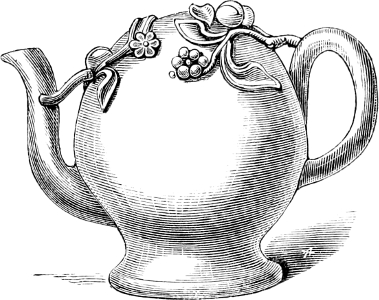
Fig. 868.—Cadogan Pot.
In 1796, the firm was, as before, “Greens, Bingley, & Co.;” and from a list of prices and goods now in my possession, it appears that a large variety of articles were produced. The list is thus headed:—
“Greens, Bingley, & Co. Swinton Pottery, make, sell, and export wholesale, all sorts of Earthen Ware, viz., Cream-coloured, or Queen’s, Nankeen Blue, Tortoise Shell, Fine Egyptian Black, Brown China, &c. Also the above sorts enameled, printed or ornamented with gold or silver.”
Among the articles in cream ware, enumerated in this list, are all the separate items for services in Paris, Bath, concave, royal, queen’s, feather, and shell-edge patterns, which were produced “printed or enamelled with coats of arms, crests, cyphers, landscapes, &c.; also blue printed Nankeen patterns;” dishes, covers, compotiers, tureens, plates, butter-tubs, baking-dishes, nappies, glass trays, fruit plates, fruit baskets pierced and plain, tea-trays, garden-pots and stands, shaving-basins, salts, castors, cruets, egg-cups, spoons plain and pierced, ice-cellars, candlesticks, inkstands, wafer and sand boxes, fountain inkstands, bidets, &c., furnished castors, tureen ladles, chocolate stands, quintal flower horns, radish dishes, crosses with holy-water cup, ice pails, broad mugs, bowls, ewers, basins, &c., milk ewers, tea and coffee pots, tea canisters, chocolate cups and saucers, &c., &c.
In 1806, the firm of “Greens, Bingley, & Co.” was dissolved. At this time, as appears from a memorandum of resolutions, passed at a meeting held on January 22nd, 1806, preparatory to the dissolution, that the partners (present) were—“William Hartley for himself and others (this was William Hartley, principal proprietor in the Leeds Pottery), Ebenezer Green for himself and others (this was another of the partners in the Leeds Pottery), George Hanson, Thomas Bingley, John Brameld, and William Brameld.” These resolutions are as follows:—
“At a meeting held at Swinton Pottery, on Wednesday, the 22nd day of January, 1806.
Present
William Hartley for himself and others.
Ebenezer Green for himself and others.
George Hanson.
Thomas Bingley.
John Brameld.
William Brameld.
1st. That no more Coals be got at Wath Wood Colliery.
2nd. That on the 1st of February next the Engine, Gins, and every thing that is valuable belonging to us, be removed from the Colliery to the Pottery premises, and that the Pits be rail’d round.
3rd. That no more stone be got from the Quarry on Wath Wood.
4th. That the Willows be immediately cut and brought to the Pottery.
5th. That the Manure on hand be sold.
6th. That the Crop or Crops on the Farm be immediately valued.
7th. That the Coals on hand be disposed of in the best manner possible.
8th. That as many Men be immediately discharged from the Manufactory as can be conveniently done; retaining for the present only as many as may be necessary to compleat the orders already taken, and make a few things that may be needful to assort the Stock on hand.
9th. That a Schedule of every thing belonging to the Colliery and Quarry be immediately taken.
10th. That these Resolutions be carried into Execution by C. Prince.”
At the dissolution of partnership, the whole concern fell into the hands of two of the partners, Messrs. John and William Brameld, who, with other partners, continued the works with considerable spirit under the style of “Brameld & Co.” until their death. The old price-lists, which I have already named, continued to be used, but had the words “Greens, Bingley” erased with the pen, and “Brameld” substituted, so that the heading commenced “Brameld & Co., Swinton Pottery.” They were later on joined in partnership by the younger branches of the family, who eventually, as I shall show, became proprietors of the manufactory. By Messrs. John and William Brameld additional buildings were erected, and great improvements made in the ware. About this time cream-coloured ware was made very extensively, and a remarkably fine white earthenware—the “chalk-body,” as it was technically called—was successfully produced, but, owing to its costliness through loss in firing, was made only to a small extent, and is now of great rarity.
About the year 1813, the sons of the old proprietors, on the death of Mr. William Brameld, succeeded to the concern. These were Thomas Brameld, George Frederick Brameld, and John Wager Brameld, and to them the great after-success of the works was due. These gentlemen considerably enlarged the manufactory, made many improvements in the wares produced, and erected a flint mill on the premises, which after the close of the china works continued to be worked by their descendants.
Mr. Thomas Brameld, the eldest of the partners, was a man of the most exquisite taste, and he laboured hard to raise the character of the productions of the Swinton Works to a high standard of excellence. In this he succeeded to an eminent degree. In 1820 he turned his attention to the production of china ware, and made many experiments in bodies and glazes. Having expended large sums of money in the production of this, his favourite project, and in making Art-advances in his manufactory, the firm became, as is too frequently the case with those who study the beautiful instead of the strictly commercial in the management of their works, slightly embarrassed. This was considerably increased by the great loss, both in earthenware and money, which the firm sustained consequent on the war. In 1825, which it will be remembered was a year of great commercial difficulties, Messrs. Brameld succumbed to the embarrassments that had for some time affected them, and a meeting of themselves, their creditors, &c., was held at Rotherham. At this meeting, Mr. Thomas Brameld produced some remarkable examples of his china ware, the result of long and patient labour on his part, and these being highly approved by all who were present, and appearing likely to succeed, Earl Fitzwilliam, the owner of the property at Swinton, in the most laudable and kindly manner, agreed to assist in the prosecution of the work by the advance of capital, and by taking an active part in the scheme.
This being done, Mr. Brameld set himself to his task with renewed spirit, and with a determination to make his porcelain at least equal to any which could then be produced, and in this he certainly succeeded. The works were altered and enlarged; modellers and painters, the most skilful that could be procured, were employed; and every means taken to insure that success, artistically and manipulatively, which quickly followed. In this ware, dinner, dessert, breakfast, and tea services, vases, groups of figures and flowers, and numberless articles, both of utility and ornament, were produced, and were all characterised by pure taste, and an excellence of design and workmanship which told much for the skill and judgment of the mind that governed the whole of the manufactory.
Mr. George Frederick Brameld, the second of the partners, devoted himself to the strictly commercial part of the business on the Continent. He for some time resided at St. Petersburg, a large trade with Russia being carried on by the firm.
Mr. John Wager Brameld, like his brother, was a man of pure taste. He was an excellent artist, and some truly exquisite paintings on porcelain by him have come under my notice. He was a clever painter of flowers and of figures, and landscapes. In flowers Mr. Brameld went to Nature herself, collecting specimens wherever he went, and reproducing their beauties on the choice wares of the works. At Lowestoft I remember seeing a set of three vases painted in flowers, which, it is said, Mr. Brameld gathered on the Dene, at that place, on one of his visits, and which vases he presented to the father of their present owner.[117] In the same hands is an elegant snuff-box, bearing an exquisite painting of “The Politician,” with groups of flowers, and bearing the words, “Brameld, Rockingham Works, near Rotherham,” “The Politician, J. W. Brameld.” This being a signed piece of John Wager Brameld’s, is particularly interesting. Mr. Brameld’s time was chiefly devoted, however, to travelling for the firm in the United Kingdom, and to the management of the London house, so that his artistic productions did not make a feature in the goods generally made at the works.