Volume 1 — CHAPTER VII. (continued 2)
Reading edition
Mr. Duesbury, who not only held the Derby China Works, but had purchased those of Chelsea, Giles’s, and one at Vauxhall, thus became proprietor of the Bow works as well, and was therefore the largest holder either in those or later days. Mr. Duesbury, as he did with those of Chelsea, removed the moulds, models, implements, &c., to Derby, and the Bow manufactory was brought to a close. The next year, 1777, John Crowther became an inmate of Morden College, Blackheath, being elected on the foundation on the 17th of March, and here he was still residing in 1790, “and,” says Thomas Craft, “I am the only person of all those employed there (at Bow) who annually visit him.” On the site of the works some small tenements and a turpentine manufactory soon sprang up, and their exact site was forgotten, having been later on converted into chemical works by Mr. Macmurdo, the calico printer. Afterwards a portion of the place was used as emery mills by Mr. Marshall, and, since then, as a manufactory of lucifer matches, vesta lights, &c., by Messrs. Bell and Black. In 1867, during some sewering operations at these works, a considerable number of fragments of Bow china—probably on the site of one of the old kilns—was discovered. Of this discovery the following interesting account appeared in the Art Journal for 1869:—
“In trenching a drain from the manufactory into the sewer, the workmen, at about eight or ten feet from the surface, came upon the débris of the old Bow China Works.
“Mr. Higgins, jun., who is attached to the match-manufactory, received his first intimation of the trouvaille from perceiving fragments of delicate biscuit china in the hands of some children, who had picked them up as playthings. This led him to keep strict watch over the excavation, and, by permission of the proprietors, the ground remained open for a few months, and, as leisure permitted, he examined the earth for some distance immediately round the spot. Limited as the space was, he found a great quantity of specimens, which he and his sister, Miss Higgins, have taken the pains to arrange carefully in trays, and through their kindness we are enabled to describe some of the more interesting examples.
“Although fragmentary, they are particularly interesting, as showing us the various descriptions of ware made at Bow, verifying its products, and enabling us to identify not only the paste and glaze, but the methods of ornamentation.
“The spot where the excavations were made is supposed to have been where one of the kilns formerly stood; this is borne out to a certain extent by the presence of a quantity of bricks cemented together, the inner surface having become vitrified by the heat of the kiln; and also by a vast number of broken saggers, or cases of baked earthenware, used to contain the china, and protect it from the flame and ashes in the kiln. One of these saggers, of cylindrical form, measures 10 inches in diameter by 8½ inches in height; it had three rows of holes pierced through the sides, at equal distances from top to bottom, into which clay pegs (like large clout nails) were inserted, to support the circular platforms within, at convenient distances, on which the china articles rested while baking. The cockspur, or point, used to separate the china is a simple cone of baked clay, not the usual form, which is like the caltrop, having always three points below and one only uppermost. Large pieces of china clay were found, some in a soft, soapy state, others hardened; bones of animals, which entered into the composition of the paste, as well as calcined flints and pieces of quartz, used in making the frit or glaze; a number of circular medallions of baked clay, from two to six inches in diameter—one was marked on each side with H and M cut into the clay. All the fragments of vessels discovered are of porcelain biscuit: not a piece of Delft or common earthenware was found among them: some few are glazed, but these form the exceptions.
“The first we shall notice, and probably the earliest manufacture, are the pieces decorated with blue painting: the designs are painted, in mineral colour, on the biscuit, and have not been glazed or burnt in. These designs are principally of Chinese landscapes, flowers, figures, and birds. A few examples are given on the next page, to show their general character.
“A very frequent pattern of simple character in the blue ware is three hanging branches of willow leaves. Among the rest is a mottled ground plate with white angular medallions of light blue scenery. The only variations in colour are a cup with green leaves and lake flowers, and a fragment painted in lake camaïeu, with a castellated mansion, of high finish: these two are glazed. Not a single specimen of blue-printed china was discovered: all are painted with a brush. This is not at all surprising, for it must be remembered they are all unfinished pieces, which have never been out of the factory; and, when this decoration was required, they were sent to Liverpool to be printed.
“The next division consists of biscuit china, fragments of services ornamented in relief, the favourite pattern being the Mayflower. The hawthorn is represented quite after nature, with its thorny branches and blossom. About a dozen of the moulds for stamping these flowers were also found quite perfect; they are of biscuit, three inches by two and a half in diameter. Fig. 408 is interesting, being the original mould of a biscuit cup which has its exact counterpart glazed. These pieces form a history in themselves.
“Another mould is of two roses and leaves on a stalk (Fig. 409). The raised figures on the biscuit are remarkably sharp; but the application of the glaze fills up the spaces.
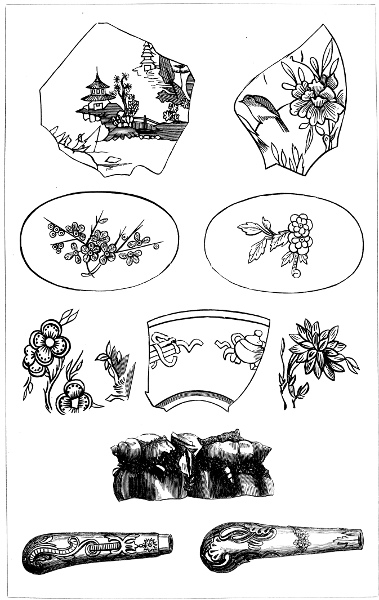
Figs. 406 to 415.
“The other decorations in relief are the basket pattern, overlapping leaves, vertical bands overlaid with scrolls, ribbed cups and basins, a biscuit candlestick in form of a vine-leaf, another of different pattern painted blue. In this extensive collection we find milk-pots, cups, cans, and saucers, open-work baskets, octagon plates, cup-handles, lion’s-paw feet, small pots for colour or rouge; but not a single piece has any mark which can be assigned to the fabrique. One of the cups has the name of ‘Norman’ written on it in pencil—perhaps the name of one of the painters. Among other relics are pieces which have been injured in the kiln by falling into ugly and distorted shapes, plates and saucers that have inadvertently gone in contact with each other and could not be separated.
“There is a great variety of china biscuit knife-handles, some plain, others with rococo scrolls in relief, heightened with blue; two specimens are here given (Figs. 414 and 415).
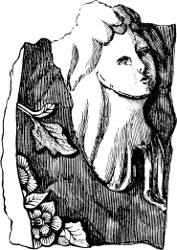
Fig. 416.
“Some few pieces of an ornamental character are among the débris. The foot of a salt-cellar beautifully modelled in biscuit, formed of three shells, with smaller shells and seaweed between; the upper shell, to hold the salt, is wanting. A sketch of it is here given (Fig. 413). To these may be added the foot of a large centre ornament of the same character as the last, to hold sweetmeats, also modelled by hand in shells of all sorts, rock-work, coral, seaweed, &c., with three escalop shells: this has had one or more tiers above, but broken off at stem. Some natural shells were found which served as copies. There are two pug-dogs nearly perfect, with collars, on which are roses. Two handles, in form of female heads, in high relief, for tureens and other large bowls (Fig. 416); and a man’s head, with a high cap and feather, nicely modelled (Fig. 417); also the body of a female figure in biscuit, with laced bodice.
“The Bow paste is exceedingly hard, and the fracture very close and compact; consequently the pieces, as a rule, are very heavy for their size, but many of the cups and saucers are almost of egg-shell thickness. The colour is a milky white.”
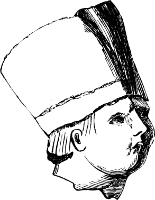
Fig. 417.
In the Art-Journal for 1869 a notice of the account-books of the Bow works, now belonging to Lady Charlotte Schrieber, is given; and this I here quote, as it contains some highly interesting matter:—
“The first contains the accounts from January, 1750.—1. O.S., in which year the partnership of Messrs. Crowther and Weatherby commenced, up to December, 1755. From these it appears that a branch establishment was opened in London in 1753, which, no doubt, was that of St. Catherine’s, near the Tower,[69] although the place is not mentioned. An account is given in separate columns of the value of the bisket and glazed-ware taken into the warehouse at Bow, and sold out of the warehouses at London and Bow, in each year.
“A statement for the year 1754 is here given, to show the extent of the business transacted.
A Weekly Account of Trade, &c., at London and Bow.
1754. Jan. 5. Goods Credited with Discount. Credit without Discount. Retail Cash, London. Cash, per Journal. Cash Recd. at Bow. Goods Returned.
5 134 15 5 1 1 0 20 4 3 11 1 6 28 17 9½ 9 15 0
12 174 6 1 25 5 6 29 4 8 138 9 3 16 14 8 4 13 0
19 192 13 6 24 16 10 50 16 0 153 18 9 28 15 10½ 15 5 0
26 115 14 4 1 0 0 59 6 2 94 13 0 20 8 9 16 16 3
Feby. 2 50 16 11 15 19 3 26 2 6 86 15 0 30 9 6½ 1 6 6
9 69 8 7 9 14 7 42 3 9 40 5 4 21 6 1 62 1 5
16 51 16 8 3 7 6 32 17 5 71 18 5 24 14 7½ 7 16 6
23 48 9 11 71 1 8 38 12 8 58 17 7 22 10 7½ 2 19 3
Mar. 2 67 1 3 13 9 6 56 4 3 83 2 5 26 3 10 17 14 6
9 89 12 7½ 8 9 4 44 11 9 145 14 2 35 5 1½
16 136 17 0½ 9 5 6 27 11 5 70 12 6 33 16 4 2 0 6
23 41 7 5 13 6 0 36 8 10 55 9 6 14 7 0 1 9 0
30 104 11 0 14 10 6 41 18 3 90 16 2 21 9 9
1277 10 9 211 7 2 506 1 11 1101 13 7 325 0 0 141 16 11
Annual Account of the Porcelain Company’s Trade for the Year 1754.
Sold with Discount. Sold without Discount. Cash received, London. Cash received, Bow. Debts come in.
1st Quarter 1277 10 9 211 7 2 506 1 11 325 0 0 1101 13 7
2nd Quarter 2222 11 8 200 0 3 569 3 11 299 10 4 1434 10 1
3rd Quarter 2647 18 1 385 2 2 381 18 11 150 4 0 2184 6 11
4th Quarter 1982 3 8 189 0 0 353 5 8 77 8 11 2429 10 9
Total 8130 4 2 985 9 7 1810 10 5 852 3 3 7150 1 4
Disct. 10% 813 0 0 Cash received Bow 852 3 3
7317 4 2 „ „ London 1810 10 5
Sold without Discount 985 9 7
Sold with Discount 7317 4 2
Total 18,115 8 9
“The following extract will show the actual cash receipts at Bow and London, 1751 to 1755, exclusive of the book debts received during the year, which, as will be seen in the preceding account for 1754, amounted to upwards of £7,000.
“This statement gives us an idea of the steady increase of the business, which had nearly doubled itself in five years.
O.S. 1750–1 £6,573 0 8
N.S. 1752 7,747 4 8
„ 1753 10,114 11 6
„ 1754 10,965 6 3
„ 1755 11,229 15 2
“The next entry gives us the weekly account of biscuit china made at Bow in 1754, and is interesting, as it distinctly informs us that the name of the Bow factory was New Canton; the China works being, as Thomas Craft says, on the same plan as that of Canton.”
A Weekly Account of Bisket ware made at New Canton.
1754.
Jan. 5 No Kilns
12 Do.
19 Do.
29 Do.
Feb. 2 Do.
9 Do.
16 Do.
23 2 Kilns 128 15 2
Mar. 2 2 Do. 126 8 11
9 2 Do. 134 9 10
16 2 Do. 147 18 6
23 2 Do. 129 0 6
30 2 Do. 132 14 10
799 7 9
1754.
Apr. 6 2 Kilns 109 4 3
13 2 Do. 140 13 3
20 2 Do. 128 8 6
27 2 Do. 115 3 6
May 4 2 Do. 121 13 3
11 2 Do. 115 16 6
18 2 Do. 128 5 0
25 3 Do. 184 13 8
June 1 3 Do. 177 0 8
8 3 Do. 177 17 6
15 3 Do. 181 14 5
22 3 Do. 177 3 0
29 3 Do. 169 9 1
1,927 2 7
799 7 9
Amount one week with another for 19 weeks is £143 10 0 each week £2,726 10 4
“There is a cash-account book for 1757 and 1758, of receipts and payments of a London branch of the Bow factory, either at St. Catherine’s or in Cornhill: it is balanced weekly. The moneys received are principally from customers, whose names are given, and ready money taken daily, cash received from St. James Street, &c., averaging about £120 per week. The bulk of the money was paid to Mr. Crowther every week, occasionally to Mr. Weatherby.
“Mr. Frye frequently received sums varying from £15 to £30, possibly for expenses at Bow; Mr. Heylin’s name occurs once or twice only for small sums. Other payments are for powder gold and for grain gold for Bow; freight of clay; weekly wages—to Mr. Brown, 18s.; Mr. Sandys, 12s.; Hugh Williams, 12s.; Stephenson, 12s.; Burnett, 10s.,—which average about 60s. per week.
“The book we now refer to contains memoranda made by John Bowcocke, in 1756; he was one of the managers, or perhaps traveller, for the Bow works. In it we find orders from customers, and many interesting notes relating to the business. We shall have occasion to quote largely from this manuscript, as the items throw considerable light upon the various descriptions of ware made there, among which many will be identified by the curious reader.
“‘1756. Insure £450 on board the Antilope: John Cowling.
Mr. Crowther paid Thos. Osborne for an anchor for the ship Antilope £12 1s. 0d.
2 doz. crimson buttons for Mr. Frye.
Jany. 29. Mr. Fogg: a sprig’d sallad vessel, 12s.; 1 pair sprig’d boats, 6s.; 16 cooks, 2s. each, abated; a swan; two harlequins (returned), 7s.
March. Mr. Fahy: 9 gentlemen and ladies, at 9s., £4 1s. 0d.
Mr. White: 1 small fluter white: 3 pair boys and girls; 1 pair small fidler and companion; 1 pair tamberines; 1 cook.
Mr. Fogg: 2 doz. odd cups and 2 doz. imag’d small; 2 pair image ewers; 6 swans; 6 white boars; 6 sprig’d handled cups and 6 cans; 1 pair sauce boats, Mr. Vere’s pattern, 4s.; 1 pair large ribbed boats, 4s.; 1 large dragon milk-pot; 12 dragon breakfast cups and saucers with good deep colour; 1 sprig’d upright teapot, 3s.; 1 sprig’d cream ewer; 24 octagon nappy plates, partridge pattern; 1 vine-leaf milk-pot.
March 27. Mrs. Ann Howard, the Lamb, in Broad Mead, Bristol. 10 round dishes; 2 of each size from the smallest to the largest, both included; 1 largest octogon dish; 1 next less size dish; 36 table plates; 12 soup plates; 2 pair rib’d boats; 3 pair flatt salts, without feet; they must all be the bordered image, blue and pale, as you please.
She has it greatly in her power to serve the factory. I hope they will be very neat and charged reasonable; I have not told her any price. Add 1 soup dish, 13, or not above 14 inches over; 12 table plates. Imaged pale blue.
Quy. What’s to be done with white bud sprigs; what quy. of Cupids and B is wanted white; white floras, &c.
March 30. Lent Mr. Frye, cash £8.
April 22. Colol. Griffin, Brook Street; 4 small upright pint mugs to be painted to the very fine landskip pattern, as soon as possible.
April 22. 4 doz. blue plates, Newark pattern; 8 doz. mosaic do.
April 28. Lord Southwell: Mr. Heylin has promised him to make an oval tureen, the image pattern, and to be done in 6 weeks without fail. Think of the Chinese head for Mr. Weatherby.
May 4. Mr. Vanderkist: an enamelled partridge coffee-pot, 9s. Mr. White: 1 imag’d cup and 7 sprig’d chocolates. What is meant by 36 white men with salt-boxes? Mr. Hunter desires to have some mustard ladles as the cream ladles, only small boles and long handles; 6 enamelled roses; 2 pr. green leaf candlesticks; 4 white leaf candlesticks.
Mr. Kentish: mandrill coffee-pot.
Mr. Fogg: 2 swans, wings open.
Mrs. Whitfield to have 1 pr. white branch candlesticks. Mr. Williams, 1 pr. sporters; 1 enamelled pero, 6s. 1 shepherd, imperial, 7s.; 1 shepherdess, 9s.
May 7. Quy. whether any Windsor bricks were received at the glass house, which is charged to the porcelain compy.
Paid Mr. Heylin, Minshull’s draft, £10 10s. 0d. J. B. paid Sir Joseph Hankey for Messrs. Weatherby and Crowther, £348 18s. 0d.
Mr. Fahy: 1 pr. of the new shepherd and compn.; 1 pr. Dutch dancers, 9s.; 1 gentleman and lady, 18s.; 1 cook, 7s.; 1 boy and girl, 12s.; 1 Paris cries, 6s.; 1 woman with chicken, 7s.
Whether any bucks is wanted? There was 5 pair sent down, and only 1 pair came back.
Send down what does there is in town, and send down the Bow books.
May 28. Patterns received from Lady Cavendish: a Japan octogon cup and saucer, lady pattern; a rib’d and scollop’d cup and saucer, image pattern; a basket bordered dysart plate; a Japan bread and butter plate.
Mr. Williams: 12 setts blue teas, at 2s. 10d.; a sett compleat of the second printed teas.
May 15. Recd. a pair of birds on pedestals, to be painted for Mr. Legg, corner of Birchen lane.
Lady Stairs: a compleat sett Dresden sprig, the canister top; parteridge octogon plates.
Mrs. Whitfield to have 1 pr. white biscuit candlesticks.
May 20. Duchess of Leeds: 2 square enamd. and sprig’d desst. 15s.; 1 blue dolphin-pickle stand, 5s.; 1 white basin and cover, 3s.; the Duke of Argyle’s acct., £20 5s. 0d.
The Duchess of Portland’s acct. to be made out, and wait on the steward, Mr. Guidon, in Privy Gardens, Whitehall, and will be paid when her ladyship returns.
June 18. Mr. Fogg: 1 pint printed mug, 5s.; 1 half-pint do., 3s. 6d.; 1 fine plate, 4s.; 1 partridge handd. cup and saucer, 3s. 6d. Allowed Mr. Fogg. In a Pero’s broken hat, 1s. (Pierrot); in two Turks 3s.; octogon dysart partridge plate, 3s. 6d. Mr. Fogg to know the price of the best cock plates; 4 pair rib’d boats, at 4s., good; 2 pr. small imaged boats and plates; 6 squirrels; butter tubs; 2 small dragon milk-pots; 2 do., a little larger; 1 dragon sugar dish.
Mr. Morgan lent me a leaf for the roses; 4 vauses; 1 pair Minervas of each size.
2 double dozn. of lase and 2 double doz. dysart rose pattern knife handles; to be mounted and sent in Baxter’s parcel.
July 24. Mr. Fogg to have 1 pair of coloured squirrels.
The knife-handles; how many sold of Dresden flowers; and to have a double dozn. mounted.
Has Mrs. Bernardeau had what she ordered of the wheatsheaf?
To buy a partridge either alive or dead.
To bring down the Chelsea cabbage leaves and bason.
Recd. and gave Mr. Beswick receipt for £107 12s. 0d. in full to Sept. 1755, for Weatherby and Crowther. J. B.
Mr. Coleman: harliquin, columbine, and Pero (Pierrot). 1 small sprig’d round teapot.
Goats, swans, and every other sorts of toys to be sent in Baxter’s order, flatt drawers to be made on purpose, and each kept separate.
A plate of the Princess Wales’ pattern, good.
Aug. 30. Paid Mr. Heylin’s draft on Mr. Crowther for £13, and charged Mr. Crowther’s cash acct. with it: quy. how is Mr. Heylin made Dr. and J. C. Creditor?
Nov. 29. J. Bowcocke borrowed of Mr. Crowther for Bow £30.
Mr. Fogg: caudle-cups, white sprig’d and saucers; 3 pr. image cream ewers, full blue; 4 white leaf candlesticks, 2s. 3d.; 1 set large sprig’d teas, handled; 2 pr. rib’d boats, at 4s. 6d.; 1 sprig’d tea pot, 4s., good.
Patterns received from Lady Cavendish; a Japan octogon cup and saucer, lady pattern; a rib’d and scollop’d cup and saucer; a basket bordered dysart plate; a Japan bread and butter plate. To be returned in a month, May 28th, 1756.’
“On analyzing these memoranda, although they are but imperfect and necessarily curt, being written only for the writer’s guidance, we are made acquainted with many facts not before disclosed; for example—it has never been suggested that printed china was produced at Bow, yet it is evident that china was decorated with transfer engravings as early as the year 1756, as appears from the following entries:—
“‘One pint printed mug, One half-pint, do., A sett compleat of the second printed teas.’
“The patent which Messrs. Sadler and Green, of Liverpool, proposed taking out as inventors of the process is dated 1756, but they had brought the art to perfection several years before, and had kept it a profound secret. Transfer printing on enamel was in vogue at Battersea before 1755, and the process would be the same on china as enamel. Horace Walpole, writing to Richard Bentley in Sept. 1755, says, ‘I send you a trifling snuff-box, only as a sample of the new manufacture at Battersea, which is done with copper-plates.’ Mr. Binns, of Worcester, has a Battersea enamel watch-case with the tea-party from the same plate as the impressions on china. The Liverpool Guide of 1799 says ‘copper-plate printing upon china and earthenware originated here in 1752, and remained some time a secret with the inventors, Messrs. Sadler and Green. The manner in which this continues to be done here, remains still unrivalled in perfection. As late as 1783, Wedgwood constantly sent his ware to Liverpool to be printed.’
“The proprietors of the Bow works availed themselves of assistance by occasionally sending their china to Liverpool to be printed.[70] All the pieces decorated with transfer engravings, have, without discrimination, been erroneously assigned to Worcester, owing to the want of a thorough investigation of the quality of the body.
“Lady Charlotte Schreiber has a teapot with a transfer portrait of the ‘Prussian Hero,’ the handle and spout ornamented in relief with the enamelled flowers peculiar to Bow; a bowl with prints of the well-known tea-party, and garden-scenes; and two plates, part of ‘a sett of the second printed teas,’ before alluded to, with poultry and leaves. All these are undoubtedly of Bow body, probably decorated at Liverpool.
“Large quantities of blue-painted ware issued from the Bow works, and there are frequent allusions to them in the order-book, for cheap services. On examining the blue pieces, which can be safely assigned to Bow from the nature of the body, there is a peculiarity in the glaze which arises in this way: blue being at that time the only colour that would bear the intense heat of the kiln (au grand feu), it is always painted on the biscuit before being dipped in the glaze; consequently portions, however slight, are apt, while the glaze is in a fluid state, to spread over the surface, giving it a blue tinge, especially on large surfaces; the other colours, as well as the gold, are painted over the glaze, and set in a kiln of lower temperature, called the reverberatory or muffle kiln. Hence the blue, being under the glaze, is imperishable, but the other colours, from frequent use, get rubbed off.
“We find in the order-book the blue Newark pattern; blue dolphin pickle-stand; ‘setts of blue teas.’ A dinner-service was ordered to be ‘blue and pale as you please,’ &c.
“Among the patterns noticed in the same book are white bud sprigs, sprigged tea sets, and Dresden sprigs; partridge services, imaged services, and dragon services, were in great demand; Chelsea cabbage leaf, the lady pattern, and the Princess of Wales’s pattern, white men with salt boxes, mugs painted to the fine landscape pattern, &c.
“Of the figures and groups, only a few are mentioned, such as Minerva of two sizes, Flora, imperial shepherd and shepherdess, the new shepherd and its companion, Cupid, gentleman and lady, boy and girl, fluter, fiddler, harlequin, columbine, and pierrot or clown, tambourine-player, sportsman, cook, Dutch dancer, woman with chicken, Turk and companion, female figure, birds on pedestals, swans, boars, squirrels, buck and doe, goat, and toys of all sorts.
“These short notices of Bow figures, although far from being important examples, will remind many of our readers of similar pieces which have been classed as Chelsea.
“We may also refer to the pair of white china figures of Woodward the actor, and Mrs. Clive, in the costumes as given in Bell’s ‘Collection of Plays.’ A pair of these in the white Bow china, exquisitely modelled and finished, bear the date 1758 stamped in the clay: they are in the possession of a lady whose family has retained them ever since they came from the factory.
“Memorandum-book of John Bowcocke for 1758.
“There is very little to interest us in this book. Bowcocke was at Dublin for the first eight months, receiving consignments of glass and china from the works, which were sold principally by auction. The money taken was remitted weekly to the company.
“‘Feb. 9, 1758. Dublin. I went to see Sheridan, in Hamlet.
April 19. Lady Freik shew’d me two tureens she brought from France, moulded from a full-grown cabbage. (A sketch is given.)
Aug. 22. At Nottingham. Called on Mr. Rigley; he says he was used ill about some figure Thorpe sent, not to order, and has done.
Sept. 24. At Bow. Went to hear Mr. John Crowther preach his first sermon.
Oct. 16. Bought a china figure for Mrs. McNally, 4s.
Painting do., 1s. 3d.
Treating Mrs. McNally, wine, 1s.
Went to see her home from the play, 1s.; purl, 2d.
(This lady was a good customer of the firm: on referring to the cash-book, we find she paid, on Oct. 16th, £18 13s. 9d.)
Nov. 27. At Bow. Observed in the burning of the bisquit ware that dishes and plates should be burnt in new cases, and only one in each case, as when two are burnt in one another it is certain that one is always bad.
All handled chocolates and coffees and handled teas to be burnt with covers.
Dec. 26. Dined with Mr. H. Frye and family at Stratford.’
“In the front of this book is a note in pencil, written in 1866, stating that—
“‘One hundred years since, John Bowcocke died, Tuesday, Feb. 26th, 1765, at 6 o’clock in the evening, of lockjaw. He was brother to William Bowcocke, of Chester, painter, my mother’s father.—Thos. Bailey.’
“In the same collection are two books of pencil sketches by a French artist named De la Cour, of plants, trees, festoons of flowers, rococo scrolls, cane handles, frames, chimney-pieces, landscapes (among which is a view of London), figures, single figures for statuettes, &c. Another book contains coloured engravings by Martin Engelbrecht, of Nuremberg, of a great variety of subjects suitable for painting on china: costumes of various nations, ladies and gentlemen splendidly attired, shepherds and shepherdesses, garden scenes and summer-houses, palaces, birds, animals and insects, hunting scenes, musicians, Chinese figures and scenery, interlaced ornaments, &c. A fourth book, published by Edwards and Darley, 1754, consists of engraved subjects,—Chinese interiors, vases, figures, pagodas, bridges, animals, exotic birds, insects, &c. The Chinese designs are mixed up with rococo scrolls and other ornamental work.”
Enough will have been gleaned from the foregoing regarding the various productions of the Bow Works. One or two noted examples, however, require to be specially named, as being usually associated in the minds of collectors with this manufactory. One of these is a well-known small goat milk-jug which was formerly always attributed to Bow. It bears a bee in relief under the spout which was supposed to be allegorical of the initial B of Bow. Some examples, however, are without the bee. They are occasionally marked with a simple triangle, which, however, has been shown to have been occasionally used at Chelsea; and that the goat jugs were also there made.[71]
The marks attributed to the Bow factory are numerous and varied; and some which are so ascribed have not, I believe, the slightest connection with those works. The following are among the marks, said by one writer or other to belong to Bow, but some of them are very doubtful. Indeed, there is almost an absolute certainty that some of those ascribed to Bow, in reality belong to Chelsea and other places. Some of these marks are incised.
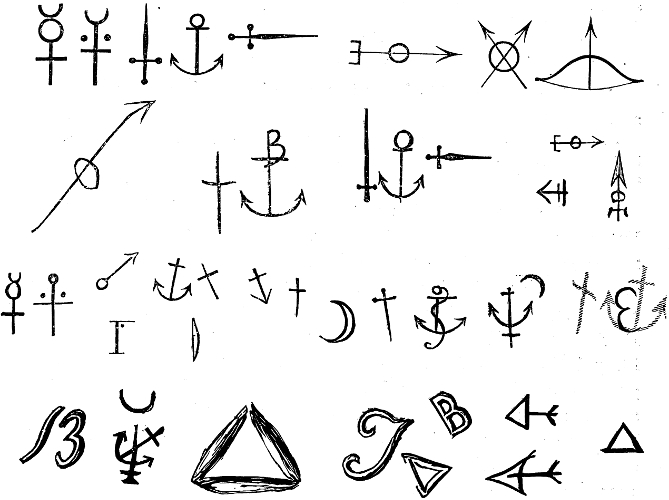
Figs. 418 to 450.
Stratford.
The London Chronicle of 1755 contains the following paragraph: “Yesterday four persons, well skilled in the making of British china, were engaged for Scotland, where a new porcelain manufacture is going to be established in the manner of that now carried on at Chelsea, Stratford, and Bow.” From this it is evident that in 1755 a china manufactory, distinct from that at Bow, was carried on at this place. Nothing, however, is at present known as to its history.
Kentish Town.
In the middle of last century John Giles had a small establishment and kiln at Kentish Town, where he finished and burned china, &c., procured in the white from other manufactories. He advertised “to procure and paint, for any person, Worcester porcelain to any or in any pattern;” and here vases and other articles, decorated by himself and by other artists and amateurs, were burned. An interesting reference to this kiln will be found in my account of the Bow china works on another page, where Thomas Craft, speaking of a bowl he had made, writing from memory in 1790, says “about the year 1760:” “I took it in a box to Kentish Town, and had it burned there in Mr. Gyles’s kiln, cost me 3s.” In 1771 Giles took premises in Cockspur Street, as a sale-room, &c. On the 9th of July in that year the lease of these premises was granted from “George Stubbs, of the parish of St. Margaret, Westmr., in the county of Middx., Esq.,“ to James Giles, of the parish of St. James, within the liberty of Westmr., in the said county of Middlx., china-man,” of “all that messuage or tenement and premises, lately called or known by the name of the Gun Tavern, in the parish of St. Martin-in-the-Fields, in the said county of Middx., situate and being on the north side of a street called Cockspur Street, leading from Pall Mall to Charing Cross, and lately in the tenure or occupation of Susannah Cannon, deceased, together with all ways,” &c., &c., for a term of 21 years, at an annual rental of £110. These premises were held from the Crown, on a longer lease, by Stubbs, so that this was a sub-letting to Giles, who had power to enter upon them on the above date, but to be free from rent until September 29th in consideration of any sums he might lay out in repairs, he covenanting to lay out in improvements and repairs £300, if requisite. The deed, in my own possession, bears the signature and seal of “Geo. Stubbs,” and the attesting signatures of “G. Stubbs. Jos. Mead, his Clerk.”
Giles appears to have become involved soon after this, and was assisted with loans and money and in other ways, by Duesbury, of the Derby china works. This is proved by papers in my own possession, amongst which are several notes of hand, as “Borrowed of Mr. Duesbury five guineas, which I promise to repay on demand. James Giles.” “Paid Mr. Heath a Bill on Mr. Giles, dated Feb. 20, at two months, value £120.” “April 1, James Giles’s note due 4th June, 1777, £50.” “May 29, Jas. Giles’s note due July 12, £50,” etc., etc. Ultimately Mr. Duesbury, on the failure of Giles, took to his stock and entire concern, and the original accounts, &c., connected with this are in my own possession. One of these, the balance-sheet of the estate for 1776–77, is very curious as showing some of the fashionable people with whom he did business:—
Jas. GILES’S ESTATE, Cr.
1776. £ s. d.
May 4. By Miss Clarkson’s Bill received 3 8 6
„ Lord Palmerstone’s do. 0 14 6
13. „ Coll. Twisleton’s do. 0 10 6
15. „ Lady Nuneham do. 2 14 6
„ „ Lady Ailesford do. 0 15 0
„ 28. „ Mrs. Nesbitt do. 0 10 6
June 14. „ Duke of Bolton do. 3 4 0
„ 17. „ Mr. Robt. Child do. 2 15 0
„ 10. „ Mr. Duesbury borrow’d 5 5 0
July 23. „ Ditto do. 5 5 0
Aug. 17. „ Ditto do. 3 13 0
1777.
May 17. „ Mr. Buller his Bill 8 19 0
„ 30. „ Dutchess of Ancaster do. 10 1 0
June 14. „ Mrs. Stevens do. 0 11 6
„ „ Mr. Cooper do. 0 9 0
„ „ Mr. Kent do. 2 10 6
July 12. „ Mr. Sheridan, on Acct. 20 0 0
Sept. 8. „ Ditto, in full 3 12 6
£74 19 0
Jas. GILES’S ESTATE, Dr.
1776. £ s. d.
May 11. Jas. Steventon, assisting before, at and after the Auction at Squibs, 17 days at 3s. 2 11 0
„ Saml. Sanders do., 10 days at 3s. 1 10 0
„ Paid Cartage from Berwick Street 0 4 0
„ Hay, paper, nails, &c. 0 3 7
13. Pd. ½ year’s rent to Mrs. Becket 15 0 0
June 5. Steventon and Sanders, 14 days each at Sale King’s Head, Butcher Row, at 3s. each 4 4 0
„ Paid Porterage 0 2 0
July 5. Paid Mrs. Becket ½ year’s Rent in full 15 0 0
Aug. 28. Bill for enamelling sundries to compleat Stock 25 2 10
1778.
April 30. Paid Debt to Flight & Co. 12 6 2
„ Cost of arrest to do. 2 2 0
„ Paid Debt to Mr. Maiden 0 7 6
£78 13 1
The £25 2s. 10d. “for enamelling sundries to complete stock” was thus expended:—
Acct. of Goods Enamel’d to compleat the Stock, and Deld. to Mr. Duesbury, Augt. 28th, 1776, by Js. Giles.
£ s. d.
48 Shank’d Tea Cups and Saucers, blue edge, at 8d. 1 12 0
2 Teapots 4s.; 2 Milkpots, 3s.; 2 Slop Basons, 3s.; do. 0 10 0
2 Sugar Boxes, 4s.; 2 large Plates, 4s.; 2 less do., 3s. 0 11 0
2 Teapot Stands, 2 Spoon Trays do. at 1s. 0 4 0
12 Plain Handle Teas, 12 Saucers do. at 8d. 0 16 0
6 Coffee Cups, 4s.; 2 Slop Basons, 4s.; 2 Sugar Boxes, 4s.; do. 0 12 0
2 Bread and Butter Plates, 3s.; 2 Teapots, 4s. 0 7 0
12 Handle Teas, 12 Saucers, 6 Coffee Cups, green edge, at 8d. 1 0 0
1 Slop Bason and 1 Sugar Box, do., at 2s. 0 4 0
17 Fluted Teas, 1 Coffee Cup, 1 Slop Bason, 1 Sugar Box, 1 Milk Pot, blue wreath 1 11 6
24 Handle Cups and Saucers, 6 Coffee Cups, and 1 Sugar Box, fruit and flowers and pea-green ground 4 16 0
7 Twig Handle Teas, 6 Coffee Cups, gold Dontell, at 1s. 0 13 0
1 Teapot, 1 Milkpot, do. 0 5 0
12 Plain Handle Cups and Saucers, for Breakfast, do. 0 15 0
1 Slop Bason, 1 Sugar Box, do. 0 5 0
2 Saucers, 1s.; and 1 Coffee Can, do. 0 2 6
24 New Ribb’d Handle Teas and Saucers, do., at 1s. 1 4 0
1 Teapot, 3s.; 1 Milkpot, 2s.; 1 Slop Bason, 2s. 6d.; 1 Sugar Box, 2s. 6d. 0 10 0
1 Stand, 1 Boat, 2s. 6d.; 1 large Plate, 2s. 6d.; 1 less, 2s. 0 7 0
24 Shank’d Handle Teas and Saucers, 1 Sugar Box, 1 Milkpot, green flower, &c. 1 10 0
2 Chocolates, 2 Saucers, flowers and brown edge 0 4 0
1 Coffee Cup, pink sprigs 0 0 10
1 Table Plate, French blue ring 0 3 0
12 Handle Teas, 12 Saucers, sky-blue and gold 3 0 0
2 Slop Basons, 9s.; 1 Teapot, 6s.; 1 Butter Tub and Cover do., 5s. 1 0 0
18 Desert Plates in large birds 3 0 0
£25 2 10
The “Debt to Flight & Co.,” and “Cost of Arrest to do.,” as entered under the date of April 30th, is thus explained:—
Thomas Flight and Robert Tabor Against James Giles.
In the Common Pleas.
Hilary Vacation, 1778.
To Debt as pr. Warrant £12 6 2
To Cost of Suit, &c. 2 2 0
£14 8 2
Received 30th April, 1778, of Mr. James Giles, the above-named Defendant, Fourteen Pounds, eight Shillings and 2d., for the purposes above mentioned.
Pr. Thomas Vere,
£14 8s. 2d. No. 15, Southampton Buildings.
One of the assignees of James Giles was Mr. Wm. Randall, who died before Dec. 23, 1779. In the balance-sheet of his accounts, from May 7, 1776 (the date of assignment), to that date, are frequent entries of postage of letters from Worcester; and among the receipts are accounts from Lady Melbourne, Lady Warren, Paul Orchard, Esq., Mrs. Powis, — Kent, Esq., Lady Jersey, Dutchess Dowager of Leinster, etc. The account is as follows:—
The Account of the late Mr. William Randall, as one of the Assignees of the Effects of the late Mr. Giles, from May ye 7th, 1776, to December ye 23rd, 1779.
Willm. Randall, Credr.
1776. £ s. d.
May 7. For a year’s rent of Mr. Giles’ House, due at Xmas 1775, & paid to Mr. Stubbs 110 0 0
„ For a Bill to Mr. Stubbs, Attorney 5 13 9
„ 31. For a Quarter’s Rent paid to Do., due at Ladyday 27 10 0
June 26. For a Letter from Worcester 0 0 4
„ 29. For an half-year’s Interest of £200, due April ye 4th, upon Bond, to Mrs. Twiss 5 0 0
Aug. 21. For a Bill to Mr. Sheppard, Attorney 21 18 6
For a Letter fm Worcester 0 0 4
„ 23. For a Quarter’s Rent, due at Midsummer, paid to Mr. Stubbs 27 10 0
Nov. 16. For Do. „ due at Michaelmas 27 10 0
1777.
Jan. 15. For an half-year’s Interest, due Oct. 4th, 1776, to Mrs. Twiss 5 0 0
„ 29. For a Letter fm Worcester 0 0 4
Dec. 13. For a Year’s Rent, due at Michaelmas, and paid to Mr. Stubbs 110 0 0
1778.
Dec. 28. For Do. „ due at Do. 110 0 0
1779.
For a Letter from Worcester 0 0 4
Dec. 23. For a Year’s Rent, due at Michaelmas, to Mr. Stubbs 110 0 0
Per Con: Dr.
1776. £ s. d.
May 7. For cash recd. of Messrs. Stubbs—Shop Account 42 6 6
„ 8. For Do. „ of Lady Warren Do. 11 7 0
„ 9. For Do. „ of Paul Orchard, Esq. Do. 10 10 0
Deducted for China broken 0 10 6
9 19 6
„ 20. For Do. „ of Mrs. Powis Do. 15 4 0
„ 23. For Do. „ of — Kent, Esq. Do. 2 10 0
— For Do. „ of Lady Melbourne Do. 15 1 0
„ 31. For Do. „ of Mr. Harris, for a Quarter’s Rent of the House late Mr. Giles’, due at Ladyday 35 0 0
June 11. For Do. „ of Lady Jersey—Shop Account 2 14 0
Nov. 16. For Do. „ of Mr. Harris, for an half-year’s Rent due at Michaelmas 70 0
Dec. 7. For Do. „ of the Dutchess Dowager of Leinster, Shop Account 32 13 6
1777.
June 17. For Do. „ of Mr. Tho: Jones Do. 0 8 6
Dec. 13. For Do. „ of Mr. Harris, for a Year’s Rent, due at Michaelmas 140 0 0
1778.
Dec. 28. For Do. „ of Do. „ „ due at Do. 140 0 0
1779.
Dec. 23. For Do. „ of Do. „ „ due at Do. 140 0 0
Euston Road.
In 1860 Messrs. W. and T. Wills, sculptors, having turned their attention to the production of works of art in terra-cotta, commenced the manufacture at this place. The works produced consist of vases, figures and groups of figures, busts, &c., of a size and character for drawing-room use. The subjects are principally mythological, and are admirably modelled—each piece sent out receiving its finishing touches from the artist’s own hands. In colour, Messrs. Wills’ terra-cottas are a delicate pink and deep rich red. Their names are marked on each piece.
Oxford Street.
Among London establishments who, from a long and intimate connection with some of the more eminent of our porcelain works, may almost be considered to be manufacturers, are the following. To these firms the world owes many of the most striking and beautiful of ceramic productions. These have been designed by the firms themselves, and made specially for them; they thus become literally their own productions.
Mortlocks; Oxford Street.—This house was established in 1746, by John Mortlock, and has been uninterruptedly continued since that date through five generations, in direct line, of the same family; its head at the present time being, as it was more than one hundred and fifty years ago, a John Mortlock. In the palmy days of the old Rockingham works, John Mortlock was London agent for the goods made there. One speciality of these works, the “Cadogan” teapot, formed on the model of an example of Indian green ware brought from abroad by the Marquess and Marchioness of Rockingham, or the Hon. Mrs. Cadogan, was the means of adding largely to his connection with these works. The first of these was made for the Marchioness of Rockingham; and when the Prince Regent, afterwards George IV., visited Wentworth House, the seat of Earl Fitzwilliam, these teapots were then in use, and were much admired; the prince, who was a great connoisseur in tea, I believe, bringing one of them away with him. On the return of the prince and his suite to town, inquiries were made for them of John Mortlock, who supplied the palace with china, &c. He at once saw that they would come into great repute, and ordered a large quantity, stipulating that his name, MORTLOCK, should be stamped upon them. This was done in place of the word ROCKINGHAM, and they thus passed as Mortlock’s own make; he ordered at one time as much as £900 worth for one season’s consumption. (See “Rockingham Works.”)
When the Nantgarw works were first started, Mr. Mortlock became a large purchaser as well as agent. He regularly took a large quantity of the ware in the white; this he had painted in London, by Webster, Randall, and various other artists, and fired at the enamel kiln of Messrs. Robins and Randall, in Spa Fields. At this time Mortlock was also agent to the Coalport and Swansea works; and Mr. Nore, of Coalport, feeling a jealousy, and finding that the sale of the Swansea and Nantgarw productions interfered with his own, bought up those two concerns, removed their models, &c., to Coalport, and closed them. The firm still retain an agency for Coalport, and also for Messrs. Minton & Co. Mr. Mortlock has special marks for some of the Coalport productions prepared from his designs.
Hoxton.
In 1693 there was “a famous brick-moulder at Hoxton.” Some very interesting particulars are given by Houghton, in his “Husbandry and Trade Improved,” 1693.
Hammersmith.
Houghton, in 1693, thus alludes to the brick works at this place: “Some can make fourteen or 15,000 in a day, some 18,000; but Nicholas Gooding, of Hammersmith, for a wager of 10l., made in one day 22,000 bricks, upon which Sir Nicholas Crisp assisted him to set up, and he is now living at Hammersmith, and worth several thousand pounds. His master’s name was Gosling, who had three men whom he often encouraged to wagers.”