Volume 1 — CHAPTER X.
Reading edition
Plymouth—William Cookworthy—The Divining Rod—Discovery of Petuntse and Kaolin—Productions of the Plymouth Works—Patent—Specification—Marks—Sale to Champion—Transference to Bristol—Death of Cookworthy—Plymouth Earthenware Works—Watcombe—Terra-Cotta Works—Honiton—Exeter—Bovey Tracey Pottery—Indiho Pottery—Bovey Pottery—Folley Pottery—Bideford Pottery—Framington Pottery—Aller Pottery.
One of the names most intimately connected with the early history of the porcelain manufactures of this kingdom is that of William Cookworthy, to whom that art is indebted for the discovery of the two most important of its ingredients, the native kaolin and the petuntse, and to whose successful experiments and labours its excellence was and is in a great measure to be attributed. At the time when he first made his experiments—although Dwight had patented his invention for making transparent porcelain, although Van Hamme and others had also secured their rights for similar purposes, although Chelsea and other places made their china (it is said) of Chinese materials, and although many experiments had been made on the nature and properties of the earths supposed to be employed for its manufacture—the art of china-making from native materials was unknown; and Cookworthy pursued his course of study unaided by the experience of others, and, though beset with difficulties at every turn, brought it to a perfectly successful and satisfactory issue. The history of these experiments, and the life of this man, are the history of the Plymouth works. The one is inseparable from the other. The history of the works is the story of the life of Cookworthy, and the story of that life is the origin, the success, and the close of those works. The narrative of William Cookworthy, then, must be the thread of my present history.
William Cookworthy was born at Kingsbridge, not many miles from Plymouth, on the 12th of April, 1705, his parents being William and Edith Cookworthy, who were Quakers. His father was a weaver, and died, leaving his family but ill provided for, in 1718. Thus young Cookworthy, at the age of thirteen, and with six younger brothers and sisters—for he was the eldest of the family of seven—was left fatherless. His mother entered upon her heavy task of providing for and maintaining her large family with true courage, and appears to have succeeded in working out a good position for them all. She betook herself to dressmaking, and as her little daughters grew old enough to handle the needle, they were taught to aid her, and thus she maintained them in comparative comfort. In the following spring, at the age of fourteen, young Cookworthy was apprenticed to a chemist in London, named Bevans; but his mother’s means being too scanty to admit of his being sent to the metropolis in any other way, he was compelled to walk there on foot. This task, no light one in those days, a hundred and fifty years ago, or now, for a boy of fourteen, he successfully accomplished.
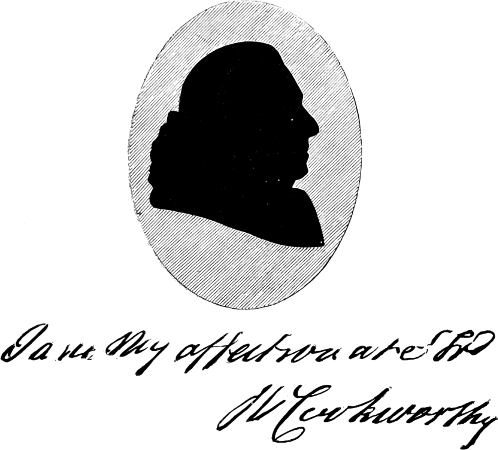
Fig. 705.—Portrait and Autograph of William Cookworthy.
His apprenticeship he appears to have passed with extreme credit, and on its termination returned into Devonshire, not only with the good opinion, but with the co-operation of his late master, and commenced business in Nutt Street, Plymouth, as wholesale chemist and druggist, under the name of Bevans and Cookworthy. Here he gradually worked his way forward, and became one of the little knot of intelligent men who in those days met regularly together at each other’s houses, of whom Cookworthy, Dr. Huxham, Dr. Mudge, and the elder Northcote, were among the most celebrated. Here he brought his mother to live under his roof, and she became by her excellent and charitable character a general favourite among the leading people of the place, and was looked up to with great respect by the lower classes whom she benefited. In 1735 Cookworthy married a young Quaker lady of Somersetshire, named Berry. This lady, to whom he seems to have been most deeply attached, lived only ten years after their marriage, and left him with five little daughters; and Cookworthy remained a widower for the remaining thirty-five years of his life.
In 1745 his attention seems first to have been seriously directed to experimenting in the manufacture of porcelain—at all events, in this year the first allusion to the matter which is made in his letters and papers occurs, and this only casually. In the following letter, written to his friend and customer, “Richard Hingston, Surgeon, in Penryn,” and dated May 5th, 1745, this allusion will be found.
“Plymouth, 30th, 5th mo., 1745.
“Dear Richard,
“My Eastern and South-Ham journeys have kept me of late so much abroad that I have not had opportunities of writing to thee equal to my inclination.
“Thy last order went a few days since by Wm. Johns’ barge for Falmouth, which is the first opportunity that hath offered since we received it. I am sorry for the damage which happened to the pill-boxes and party-gold, but am apt to believe it was taken in the passage, as we always keep the pill-boxes in a garrett where no moisture can affect them.
“Amos hath, I understand, answered thy question about the beds, which I believe he was very capable of doing effectually, having been formerly concerned in filling them at brother Fox’s. I hope his answer is fully satisfactory.
“We have of late been very barren in news. But, a few days since, we had certain advice that Admiral Martin’s squadron had taken a very rich ship from the Havannah, though the captain from whom Chas. de Voigne hath received a letter says she came from St. Domingo. ’Tis allowed, however, that she hath a good deal of money on board, and so ’tis likely she may have been at both places.
“Chas. de Voigne tells me that Cape Breton is of such consequence to the French that they cannot do without it, and we may depend on their exerting their utmost endeavour to retake it; and if they should be unsuccessful, would never make peace without its reddition. We had lately a very considerable sale here for the cargoes of the prizes taken by Martin’s squadron some time since, and that of the Elephant. J. Colsworthy was at it, and bought a very large quantity of sugars on commission, as well as another Friend from London, whose name is Jonathan Gurnell. We must not be at all surprised at this, it being by what I can find grown a settled maxim that Friends may deal in prize goods. For on my attacking F. Jewel for being concerned in the purchase of the Mentor, which he bought in partnership with Dr. Dicker and Lancelot Robinson, he pleaded in his justification that Friends at London were clearly of opinion there is no harm in it; and that Jno. Hayward, a preacher, had given him a commission to buy prize Havannah snuffs. And brother Fox, who has done something in this way too for the good of his family, acquaints me that Friend Wilson, when here, seemed to be quite ignorant of anything wrong in the practice, and only advised in general that Friends should not act against their convictions. I am not at present disposed to make reflections, and therefore shall only say that I hope I shall be kept clear of it, as I believe it would bring a cloud over my mind.
“I purpose next second day to set out for the west, and hope to be with thee about the 22nd proximo. But I shall not be able to stay as usual, as I must hasten to Looe, to ‘squire Sally to Redruth yearly meeting, from whence she purposes to go to Wadebridge, to pay a visit to her cousins. She talks as if she should not be able to spare time to see you at Penryn. But I believe she will be mistaken.
“I had lately with me the person who hath discovered the china-earth. He had several samples of the chinaware of their making with him, which were, I think, equal to the Asiatic. ’Twas found in the back of Virginia, where he was in quest of mines; and having read Du Halde, discovered both the petunse and kaulin. ’Tis the latter earth, he says, is the essential thing towards the success of the manufacture. He is gone for a cargo of it, having bought the whole country of the Indians where it rises. They can import it for £13 per ton, and by that means afford their china as cheap as common stone ware. But they intend only to go about 30 per cent. under the company. The man is a Quaker by profession, but seems to be as thorough a Deist as I ever met with. He knows a good deal of mineral affairs, but not funditùs.
“I have at last hearkened to thy advice, and begun to commit to black and white what I know in chemistry—I mean so far as I have not been obliged to other folks. Having finished my observations on furnaces, I intend to continue it as I have leisure, as it may be of use after my death.
“Farewell, dear Richard, and if I am to have an answer, let it be by next post, or it will not come to hand before my leaving home.
“Thine affectionately,
“W. C.
“Maunds[88] are excessively dear, and I have none worse than what is sent that is fit for use.”
The letter is addressed “For Richard Hingston, Surgeon, in Penryn,” and is followed by an invoice of goods sent by “Bevans and Cookworthy.”
At this time the business was still carried on under the style of “Bevans and Cookworthy.” The death of his wife, which took place within a few months of the writing of this letter, entirely took away his attention from business, and his researches into china clays were thrown aside. He retired into seclusion at Looe, in Cornwall, where he remained for several months, and, on his return to business, took his brother Philip, who, it appears, had lately returned from abroad, into partnership, and carried it on, with him under the style of “William Cookworthy & Co.” This arrangement enabled Cookworthy to devote his time to the scientific part of the business, and to the prosecution of his researches, while his brother took the commercial management of the concern. Left thus more to the bent of his scientific inclinations, he pursued his inquiries relative to the manufacture of porcelain, and lost no opportunity of searching into and experimenting upon the properties of the different natural productions of Cornwall; and it is related of him that, in his journeys into that county, he has passed many nights sitting up with the managers of mines, obtaining information on matters connected with mines and their products. In the course of these visits he first became acquainted with the supposed wonderful properties of the “Divining Rod,” or “Dowsing Rod,” as it was called by the Cornish miners, in the discovery of ore of various kinds.
In the magic properties of this rod he was an ardent believer, and he wrote an elaborate dissertation upon its uses, which has been published. It is entitled “Observations on the Properties of the Virgula Divina,” and contains, from beginning to end, such a series of statements as would do well to go side by side with the tales of spririt-rapping in our day, and which make one wonder at the amount of credulity that a clever man may occasionally exhibit. So ardent a believer was he in the value of this rod, that he did not hesitate to uphold it in the presence of men of high scientific attainments, and to carry on experiments occasionally to prove to them its correctness. As might be expected, on most occasions these experiments failed, but the operator had always some good reason ready to be assigned for the mishap. On one occasion, after having warmly descanted on its properties to Dr. Mudge and Dr. Johnson, he agreed to try in his own garden the experiment as to whether any metal was to be found beneath its surface, affirming that if metal, whether large or small in quantity, and at whatever depth, existed, the rod would immediately indicate its whereabouts. The doctors having previously taken the precaution to have one of Cookworthy’s large iron mortars, used in his laboratory, buried in one corner of the garden, unknown to him, the examination with the rod was gravely made, and resulted in Cookworthy triumphantly affirming that no metal existed on the spot. The learned doctors then, in his presence, dug out the mortar to prove that he was wrong, and had signally failed in his trial. Cookworthy, nothing disconcerted, however, immediately exclaimed, “Ah, that’s an amalgam! my rod has no sympathy with amalgams,” and thus spoiled their joke, and kept his own position at the same time.
His journeys into Cornwall, however, were productive of much more important results than the fabulous properties of the divining rod, for it was in these journeys that he succeeded in discovering, after much anxious inquiry and research, the materials for the manufacture of genuine porcelain. The information given him by the “Quaker” in 1745 had never been lost sight of, and he prosecuted inquiries wherever he went. After many searchings and experiments, he at length discovered the two materials, first in Tregonnin Hill, in Germo parish; next in the parish of St. Stephen’s; and again at Boconnoc, the family seat of Thomas Pitt, Lord Camelford. There is a kind of traditionary belief that he first found the stone he was anxious to discover in the tower of St. Columb Church, which is built of stone from St. Stephen’s, and which thus led him to the spot where it was to be procured. At this time he lodged at Carlogges, in St. Stephen’s parish, with a Mr. Yelland, and was in the habit of going about the neighbourhood with his “dowsing rod,” in search of mineral treasures. This discovery would probably be about 1754 or 1755.
Having made this important discovery, Cookworthy appears to have determined at once to carry out his intention of making porcelain, and to secure the material to himself. To this end he went to London to see the proprietors of the land, and to arrange for the royalty of the materials. In this he succeeded; and ultimately Lord Camelford joined him in the manufacture of china, and, as appears from a letter of that nobleman to Polwhele, the historian of Cornwall, the two expended about three thousand pounds in prosecuting the work. The letter of Lord Camelford, which is dated “Boconnoc, Nov. 30, 1790,” is as follows:—
“With regard to the Porcelain Manufactory that was attempted to be established some years ago, and which was afterwards transferred to Bristol, where it failed, it was undertaken by Mr. Cookworthy, upon a friend of his having discovered on an estate of mine, in the parish of St. Stephen’s, a certain white saponaceous clay, and close by it a species of granite, or moor-stone, white, with greenish spots, which he immediately perceived to be the two materials described by the missionary Père D’Entrecolles, as the constituent parts of Chinese porcelain, the one giving whiteness and body to the paste, the other vitrification and transparency. The difficulties found in proportioning properly these materials, so as to give exactly the necessary degree of vitrification and no more, and other niceties with regard to the manipulation, discouraged us from proceeding in this concern, after we had procured a patent for the use of our materials, and expended on it between two and three thousand pounds. We then sold our interest to Mr. Champion, of Bristol.”
It will be seen that Lord Camelford in this letter says that the discovery was made by a friend of Cookworthy’s. Whether this were so or not is matter of little consequence, but it is due to Cookworthy, who was strictly conscientious and scrupulously honest and straightforward in all his transactions, to say that he has left it on record that he himself made the discovery, as will be seen by the following highly interesting paper written by him, but unfortunately without date:—
“It is now near twenty years since I discovered that the ingredients used by the Chinese in the composition of their porcelain, were to be got, in immense quantities, in the county of Cornwall; and as I have since that time, by abundance of experiments, clearly proved this to the entire satisfaction of many ingenious men, I was willing this discovery might be preserved to posterity, if I should not live to carry it into a manufacture; and, with this view, I have thought proper to put in writing, in a summary way, all I have discovered about this matter.
“The account of the materials used by the Chinese is very justly given by the Jesuit missionaries, as well as their manner of preparing and mixing them into the China-ware paste. They observe, the Chinese have two sorts of bodies for porcelain; one prepared with Petunse and Caulin, the other with Petunse and Wha She or Soapy Rock. The Petunse they describe to be prepared from a quarry stone of a particular kind, by beating it in stamping-mills, and washing off and settling the parts which are beaten fine. This ingredient gives the ware transparency and mellowness, and is used for glazing it. The stone of this Petunse is a species of the granite, or, as we in the west call it, the moor-stone.
“I first discovered it in the parish of Germo, in a hill called Tregonnin Hill; the whole country in depth is of this stone. It reaches, east and west, from Breag to Germo, and north and south, from Tregonnin Hill to the sea. From the cliffs some of this stone hath been brought to Plymouth, where it was used in the casemates of the garrison; but I think the best quarries are in Tregonnin Hill. The stone is compounded of small pellucid gravel, and a whitish matter, which, indeed, is Caulin petrified; and as the Caulin of Tregonnin Hill hath abundance of mica in it, this stone hath them also. If the stone is taken a fathom or two from the surface, where the rock is quite solid, it is stained with abundance of greenish spots, which are very apparent when it is wetted. This is a circumstance noted by the Jesuits, who observe that the stones which have the most of this quality are the most proper for the preparation of the glaze; and I believe this remark is just, as I know that they are the most easily vitrifiable, and that a vein of this kind in Tregonnin Hill is so much so that it makes an excellent glaze without the addition of vitrescent ingredients. If a small crucible is filled up with this stone, or a piece of it put in it, and exposed to the most violent fire of a good wind furnace for an hour, the stone will be melted into a beautiful mass; all its impurities will be discharged, one part of it will be almost of a limpid transparency, and the other appear in spots as white as snow. The former is the gravel, the other the Caulin, reduced by fire to purity. If the fire is not continued long enough to effect this, the upper part and middle of the mass will be of a dirty colour, and the bottom and parts of the sides fine.
“CAULIN.
“This material, in the Chinese way of speaking, constitutes the bones, as the Petunse does the flesh, of china ware. It is a white talcy earth, found in our granite countries, both in the counties of Devon and Cornwall. It lies in different depths beneath the surface. Sometimes there shall be a fathom or more of earth above it, and at other times two or three feet. It is found on the sides of hills, and in valleys; in the sides, where, following the course of the hills, the surface sinks, or is concave, and seldom, I believe, or never where it swells, or is convex. By what I have observed, it is by no means a regular stratum, but is rather in bunches or heaps, the regular continuance of which is frequently interrupted by gravel and other matters. At times there are veins of it among the solid rocks, when it is constantly very pure from gravel. I have a piece by me of this kind, very fine.
“There are inexhaustible stores of this Caulin in the two western counties. The use it’s commonly put to is in mending the tin furnaces and the fire-places of the fire-engines, for which ’tis very proper. The sort I have chiefly tried is what is got from the side of Tregonnin Hill, where there are several pits of it. As the stone hath a pretty large quantity of Caulin in it, so the Caulin hath a large mixture of the same sort of gravel as enters into the composition of the stone. It contains, besides, mica in abundance.
“In order to prepare the Caulin for porcelain, nothing more is necessary but pouring a large quantity of water on it, so that it may not, when dissolved, be of so thick a consistence as to suspend the mica. Let it settle about ten minutes, and pour off the dissolved clay into another vessel. Let it settle, pour off the water, and dry it. I will observe here, that care ought to be taken about the water used in washing off both the Petunse and Caulin. It ought to be pure, without any metallic or calcareous mixture. Our rivers in the west afford excellent water for this purpose, as they arise, the most of them, and run through a granite country. The Caulin of Tregonnin Hill is very unvitrifiable, and exceedingly apt to take stains from the fire. I know no way to burn it clean but the following:—Form it into cakes of the thickness of two or three crown pieces, and beat some of the stone to a very coarse powder; cover the bottom of the crucible with this powder; then put in a cake of the Caulin; cover this the thickness of one-third of an inch with the powder of stone; fill the crucible in this way, ending with a layer of the stone; cover the crucible, and treat it as in the process for melting the stone before described. If the stone is burned to purity, the Caulin will be as white as snow; if but partially calcined, so far as the stone is pure, the Caulin will be so; and when that is of a dirty colour, the Caulin will be of the same hue.
“I have lately discovered that, in the neighbourhood of the parish of St. Stephen’s, in Cornwall, there are immense quantities both of the Petunse stone and the Caulin, and which, I believe, may be more commodiously and advantageously wrought than those of Tregonnin Hill, as, by the experiments I have made on them, they produce a much whiter body, and do not shrink so much, by far, in baking, nor take stains so readily from the fire. Tregonnin Hill is about a mile from Godolphin House, between Helston and Penzance. St. Stephen’s lies between Truro, St. Austel, and St. Columb; and the parish of Dennis, the next to St. Stephen’s, I believe, hath both the ingredients in plenty in it. I know of two quarries of the stone—one is just above St. Stephen’s, the other is called Caluggus, somewhat more than a mile from it, and appears to be the finer stone.
“Having given this sketch of the natural history of the materials, ’tis needless to say much about the composition. Pottery being at present in great perfection in England, our potters’-mills prepare the Petunse much better than stamping mills, and excuse one from the trouble of washing it off, it being fit to be used as it comes from the mill. I would further observe that the mills should be made of the Petunse granite, it being obvious that, in grinding, some of the mill-stones must wear off and mix with the Petunse. If those stones should be of a nature disagreeable to the body, this mixture must, in some degree, be hurtful to it; whereas, whatever wears off from mill-stones of the same stone, cannot be so in the least degree. I have generally mixed about equal parts of the washed Caulin and Petunse for the composition of the body, which, when burnt, is very white, and sufficiently transparent. The Caulin of St. Stephen’s burns to a degree of transparency without the addition of Petunse. The materials from this place make a body much whiter than the Asiatic, and, I think, full as white as the ancient chinaware, or that of Dresden.
“The stones I have hitherto used for glazing are those with the green spots of Tregonnin Hill. These, barely ground fine, make a good glaze. If ’tis wanted softer, vitrescent materials must be added. The best I have tried are those said to be used by the Chinese, viz., lime and fern-ashes, prepared as follows:—The lime is to be slacked by water, and sifted. One part of this, by measure, is to be mixed with twice its quantity of fern-ashes, and calcined together in an iron pot, the fire to be raised till the matter is red hot. It should not melt, and for that reason should be kept continually stirred. When it sinks in the pot, and grows of a light ash colour, ’tis done. It then must be levigated in the potter’s mill to perfect smoothness. It may be used in proportion of one part to ten, and so on to fifteen or twenty of the stone, as shall be found necessary. We found one to fifteen of the stone a very suitable proportion. Our manner of mixing was to dilute both the stones and the ashes to a proper degree for dipping, and then to mix them as above. On mixing, the whole grows thicker. If ’tis too thick for dipping, more water must be added. Our method of dipping was just the same as is used by the delft-ware people. We first baked our ware to a soft biscuit, which would suck, then painted it with blue, and dipped them with the same ease; and the glazing grows hard and dry, as soon as it does in the delft-ware. Large vessels may be dipped raw, as the Chinese are said to do it. But the proper thickness of the glaze is not so easily distinguished this way, as when the ware is biscuited; for, the raw body being of the same colour and consistence with the glaze, when the latter is dry, ’tis hardly possible to determine the limits of either; a thing very easy to be done when the body is hardened by biscuiting. Our chinaware makers in general deny it to be possible to glaze on a raw body or soft biscuit. And so it is with their glaze; which, abounding in lead and other fluxing materials, melts soon and runs thin, and, melting before the body closes, penetrates it, and is lost in the body, whereas our stone is almost as hard to melt as the body is to close; and, not melting thin, neither runs nor penetrates the body. I insist on the truth of this observation, and ’tis necessary to be insisted on, as scarcely any of our potters, misled by too slavish dependence on their own too partial experience, will allow it. I have said above that the Jesuits observe that the Chinese paint and glaze their ware on the raw body. I know this can be done, for I have done it; and so may anyone else who pleases to try it. I have now by me the bottom of a Chinese punch-bowl, which was plainly glazed, when it was raw, or a soft biscuit; for the ware wants a great deal of being burnt, it being of the colour of coarse whited-brown paper. But the same body, when exposed to a proper degree of fire, turns to a chinaware of a very good colour—a demonstration that it had not, as our ware in England hath, the great fire before the glaze was laid on. I don’t point out the advantages of painting and glazing on a soft biscuit, as they are very obvious to anyone, ever so little used to pottery.
“In regard to burning, I have to remark, that by all the experiments we have made, the north of England kilns, where the fire is applied in mouths on the outside of the kilns, and the fuel is coal, will not do for our body, at least when it is composed of the materials of Tregonnin Hill.
“In those kilns especially, when bags are used, there is no passage of air through the middle of the kiln; and a vapour, in spite of all the care that can be taken, will either transpire through the bags, or be reflected from the crown, which will smoke and spoil our ware, though it doth not appear to affect other compositions. How true this remark may be, with regard to the St. Stephen’s materials I cannot determine, as they have not yet been tried in a kiln. The only furnace or kiln which we have tried with any degree of success, is the kiln used by the potters who make brown stone. It is called the 36-hole kiln. Wood is the fuel used in it. They burn billets before and under it, where there is an oven or arch pierced by 36-holes, through which the flame ascends into the chamber which contains the ware, and goes out at as many holes of the same dimensions in the crown of the furnace. The safeguards at bottom stand on knobs of clay, which won’t melt, about two inches square, and two inches and a half or three inches high; by which means more of the holes are stopped by the bottoms of the safeguard, but the air and flame freely ascend, and play round every safeguard; by which means those tingeing vapours, which have given us so much trouble, are kept in continual motion upward, and hindered from penetrating and staining the ware.
“Experience must determine the best form and way of using this kiln. ’Tis the only desideratum wanting to the bringing of the manufacture of porcelain, equal to any in the world, to perfection in England.
“Caulin pipeclay and a coarse unvitrifiable sand make excellent safeguards.”
The experiments on the Cornish materials having been perfectly successful, Cookworthy established himself as a china manufacturer at Plymouth. The works were at Coxside, at the extreme angle which juts into the water at Sutton Pool. Some parts of the buildings still exist, and are used as a shipwright’s yard. They are still known by the name of the “China House,” and it is really pleasant to find that a memory of these once celebrated works is yet retained on the spot where they were carried on. It is strange, however, to think that the same building which was used for the fabricating of the finest and most delicate and fragile articles, should now be used for the constructing of huge seaworthy vessels, which can withstand the force of the waves, and bear heavy burthens in safety across the seas, whether in calm or storm.
In these works Cookworthy prosecuted his new art with great success, and was soon enabled to enter the market with Englishmade hard-paste china, composed of native materials alone. The early examples are, as is natural to expect, very coarse, rough, and inferior, but they evidence, nevertheless, considerable skill in mixing, though not so much, perhaps, in firing. And they are also remarkable for their clumsiness, as well as for their bad colour, their uneven glazing, and their being almost invariably disfigured by fire cracks—if nowhere else, almost invariably at the bottom. On many of the pieces the colour (blue) on which the pattern was drawn, has “run” in the glazing, and thus disfigured the pieces. As examples of the early make of Plymouth, an inkstand belonging to Mrs. Lydia Prideaux, of Plymouth, is an excellent specimen. It was for many years the office inkstand of her father, who died in 1796, and was got by him from the son of a workman in the china factory. It is very clumsy in make, of coarse body, rough in the glaze, uneven in colour, and is, perhaps, one of the best and most characteristic existing specimens of the early make of Plymouth. It is circular, nearly five and a half inches in diameter; around the top is a border in blue, and round the hollowed sides are octagonal spaces with Chinese figures and landscapes, connected together by a diapered band, all in blue. The inkstand bears the usual Plymouth mark on the bottom, in blue.
Another early example worthy of note is a pounce-pot, formerly in the possession of the late Mr. James, of Bristol. Like the inkstand and other early examples, it is coarse in texture, rough on the surface, and imperfect in the glaze. It is painted with flowers in blue, and has the mark also in blue on the bottom.
As on the earliest productions of all the old china works, the decorations on the Plymouth examples are invariably blue; the blue at first being of a heavy, dull, blackish shade, but gradually improving, until, on some specimens which I have seen, it had attained a clear brilliance. Cookworthy, being a good chemist, paid considerable attention to the producing of a good blue, and was the first who succeeded in this country in manufacturing cobalt blue direct from the ore. Before this time the colour was prepared by grinding foreign imported zaffres with slab and muller; but after a series of experiments he succeeded in producing a fine and excellent blue from the cobalt ore, and prepared it by a better process. It is said that Cookworthy himself painted some of the earlier blue and white productions of his manufactory, and this is not at all improbable.
Examples of the finer and more advanced class of blue and white are, like the earlier and more primitive attempts, scarce.
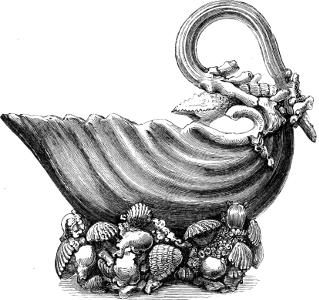
Fig. 706.
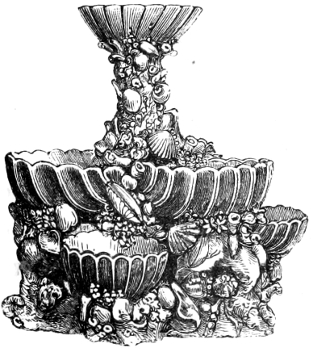
Fig. 707.
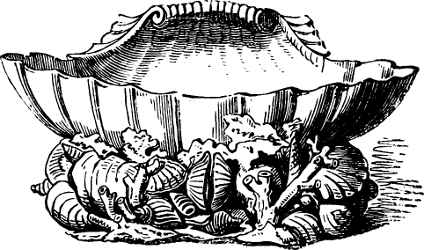
Fig. 708.
The white porcelain of Plymouth is one of its notable features, for in it some remarkably fine works exist in different collections. These mostly consist of salt-cellars, pickle-cups, and toilet-pieces, formed of shells and corals, beautifully, indeed exquisitely, modelled from nature. The shells and corals, and other marine objects which compose these pieces, are remarkably true to nature, and their arrangement in groups is very artistic and good. As a rule these pieces are not marked. Some of the forms of these shell groups are shown in the accompanying engravings. The accidental arrangement of the small shells, sea-weeds, and coral, are very characteristic of Plymouth manufacture, and evince a high degree of artistic excellence. The salt-cellars of this description, in the Museum of Practical Geology, are good examples, and useful for reference. In white, too, Cookworthy produced figures, birds, and animals, both singly and in groups, which bore no mark. Amongst the most successful and important productions of the Plymouth works, in white, are busts, of which one or two excellent examples are in existence. The finest of these is a bust, of large size, of King George II., in possession of the late Dr. Cookworthy, of Plymouth, the great-nephew of William Cookworthy, the founder of the works, from whom it has passed in succession to its present owner, who is now the sole representative of the family. The bust, which is remarkably fine, and exquisitely modelled, evidences a very advanced state of Art, and shows great skill, both in modelling, in body, and in firing. Its height is seventeen inches, and its extreme width thirteen inches. Dr. Cookworthy also possessed some remarkably fine allegorical figures, groups for candlesticks, &c., all, although unmarked, said to be authenticated as Plymouth manufacture. An elephant said to be probably of Plymouth manufacture is in the Museum of Practical Geology, as are also Figs. 708 and 713.
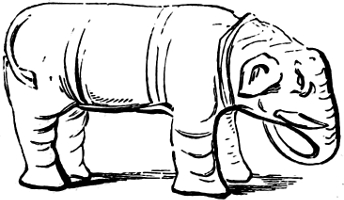
Fig. 709.
The prosecution of the new works having progressed satisfactorily, Cookworthy in 1768 took out a patent for the manufacture of “a kind of porcelain newly invented by me, composed of moor-stone or growan, and growan clay.” The patent was dated the 17th of March, 1768, and contained the usual proviso that full specification should be lodged and enrolled within four months of that date. This specification was duly enrolled, and I am happy to be able to give it in extenso to my readers. It is a most interesting document, and contains a great deal of valuable information; it is as follows:—
“To all people to whom these presents shall come, I, William Cookworthy, of Plymouth, in the County of Devon, Chemist, send greeting.
“Whereas His Most Gracious Majesty King George the Third, by Letters Patent bearing date at Westminster the Seventeenth day of March now last past, did give and grant unto me, the said William Cookworthy, my executors, administrators, and assigns, his especial license, full power, sole privilege and authority, that I, the said William Cookworthy, my executors, administrators, and assigns, and every of us, by myself and themselves, and by mine and their deputy or deputys, servants or agents, or such others as I, the said William Cookworthy, my executors, administrators, or assigns, should at any time agree with, and no others, from time to time, and at all times thereafter during the term of years therein expressed, should and lawfully might make, use, exercise, and vend ‘a kind of Porcellain newly invented by me, compos’d of Moor-stone or Growan, and Growan Clay,’ within that part of His Majesty’s kingdom of Great Britain called England, his dominion of Wales, and town of Berwick-upon-Tweed, in such manner as to me, the said William Cookworthy, my executors, administrators, and assigns, or any of us, should in our discretion seem meet, and that I, the said William Cookworthy, my executors, administrators, and assigns, should and lawfully might have and enjoy the whole profit, benefit, commodity, and advantage from time to time coming, growing, accruing, and arising by reason of the said invention, for and during the term of years therein mentioned, to have, hold, exercise, and enjoy the said license, powers, privileges, and advantages thereinbefore granted unto me, the said William Cookworthy, my executors, administrators, and assigns, for and during and unto the full end and term of fourteen years from the date of the said Letters Patent, next and immediately ensuing, and fully to be compleat and ended according to the statute in such case made and provided; in which said Letters Patent there is contained a provisoe as or to the effect following (viz.), that if I, the said William Cookworthy, should not particularly describe and ascertain the nature of my said invention, and in what manner the same was to be performed, by an instrument in writing under my hand and seal, and cause the same to be inrolled in His Majesty’s High Court of Chancery within four calendar months next and immediately after the date of the said Letters Patent; that then the said Letters Patent and all libertys and advantages whatsoever thereby granted should utterly cease, determine, and become void, as in and by the said Letters Patent (relation being thereunto had) more fully and at large it doth and may appear.
“Now know ye that I, the said William Cookworthy, in pursuance of the said recited provisoe, do, by this my Deed in writing, declare and make known the nature of my said invention, and the quality of the materials, and manner in which the same is performed, which is as followeth (that is to say):—
“The materials of which the body of the said porcellain is composed are a stone and earth, or clay. The stone is known in the countys of Devon and Cornwall by the names of Moor-stone and Growan, which stones are generally composed of grains of stone or gravel of a white or whitish colour, with a mixture of talky shining particles. This gravel and these talky particles are cemented together by a petrified clay into very solid rocks, and immense quantities of them are found in both the above-mentioned countys. All these stones, exposed to a violent fire, melt without the addition of fluxes into a semi-transparent glass, differing in clearness and beauty according to the purity of the stone. The earth, or clay, for the most part lies in the valleys where the stone forms the hills. This earth is very frequently very white, tho’ sometimes of a yellowish or cream colour. It generally arises with a large mixture of talky micæ, or spangles, and a semi-transparent or whitish gravel. Some sorts have little of the micæ, or spangles, but the best clay for making porcellain always abounds in micæ, or spangles. The stone is prepared by levigation in a potter’s mill, in water in the usual manner, to a very fine powder. The clay is prepared by diluting it with water untill the mixture is rendered sufficiently thin for the gravell and micæ to subside; the white water containing the clay is then poured, or left to run off from the subsided micæ and gravell into proper vessells or reservoirs; and after it has settled a day or two, the clear water above it is to be then poured or drawn off, and the clay, or earth, reduced to a proper consistence by the common methods of exposing it to the sun and air, or laying it on chalk. This earth, or clay, gives the ware its whiteness and infusibility, as the stone doth its transparency and mellowness: they are therefore to be mix’d in different proportions, as the ware is intended to be more or less transparent; and the mixture is to be performed in the method used by potters, and well known (viz., by diluting the materials in water, passing the mixture through a fine sieve, and reducing it to a paste of a proper consistence for working in the way directed for the preparation of the clay). This paste is to be form’d into vessells, and these vessells, when biscuited, are to be dipp’d in the glaze, which is prepared of the levigated stone, with the addition of lime and fern-ashes, or an earth called magnesia alba, in such quantity as may make it properly fusible and transparent when it has received a due degree of fire in the second baking.
“In witness whereof I, the said William Cookworthy, have hereunto sett my hand and seal this Eleventh day of July, in the Eighth year of the reign of our Sovereign Lord George the Third, by the grace of God of Great Britain, France, and Ireland, King, Defender of the Faith, and so forth, and in the year of our Lord One Thousand Seven Hundred and Sixty-eight.
“William (l. s.) Cookworthy.
“Signed, sealed, and delivered by the within-named William Cookworthy, in the presence of
“George Leach,
“J. Stove.
“And be it remembered that on aforesaid Eleventh day of July, in the year above-mentioned, the aforesaid William Cookworthy came before our said Lord the King in his Chancery, and acknowledged the Specification aforesaid, and all and everything therein contained and specified in form above written. And also the Specification aforesaid was stampt according to the tenor of the statute made in the sixth year of the reign of the late King and Queen William and Mary of England, and so forth.
“Inrolled the Fourteenth day of July, in the year above written.
“Samuel Champion, a Master Extraordinary.”
It is natural to suppose that the finest and best goods of the Plymouth Works were produced in the six years which intervened between the enrolling of this specification and the removal of the Works to Bristol, previous to their sale to Champion. The progress of the manufactory had hitherto been great and satisfactory, but continuing at the same rate of improvement, the perfection to which the best productions arrived could only have been attained a very short time before its close.
Cookworthy determined to make his porcelain equal to that of Sèvres and Dresden, both in body, which he himself mixed, and in ornamentation, for which he procured the services of such artists as were available. To this end he engaged a Mon. Saqui, or Soqui, from Sèvres, who was a man of rare talent as a painter and enameller, and to whose hands, and those of Henry Bone, a native of Plymouth, who there is reason to suppose was apprenticed to Cookworthy, and afterwards became very celebrated, the best painted specimens may be ascribed. Besides these several other artists were employed, but they were principally engaged in painting in blue, while Saqui and Bone painted the high-class birds and flowers.
In a town like Plymouth, where Art has always found a home, and whose sons have so greatly distinguished themselves, it is not to be wondered that the paintings and decorations on china should assume a high character for design and treatment. In a neighbourhood which has the honour of having given birth to Sir Joshua Reynolds, to James Northcote, to Haydon, to Sir Charles Eastlake, to Opie, to William Cooke, and to a score others, it would be strange indeed if the Art part of the manufacture had not been prominently good, and had not produced artists, like Henry Bone, of more than local excellence.
The ware made at Plymouth consisted of dinner services, tea and coffee services, mugs and jugs; vases, trinket and toilet stands, busts, single figures and groups, animals, “Madonnas,” and other figures after foreign models, candlesticks with birds, flowers, &c., &c. The large mug (Fig. 712) is an excellent example of the higher, and, of course, later, productions of Cookworthy’s manufactory. It is a quart mug, remarkably well potted, clear in its colour and glaze, and exquisitely painted by Saqui on the one side with peacock and pheasant and landscapes, and on the other with a group of flowers. Mugs of this form, and different sizes, painted with birds and flowers, are to be found in different collections, and are usually marked in red or blue. The peculiarity of the specimen here engraved is, that besides being remarkably good in its painting, it is marked with the usual sign, but instead of being in colour, is incised before glazing. The bottom is also disfigured, as so frequently occurs, with a fire crack. The incised mark on this mug is engraved (Fig. 710). Some very good mugs of the form and style of this one were shown in the Exhibition of 1851, in Mr. Phillips’s case, illustrating the raw material and productions of the clay district. They were marked in red, and belonged to Mr. George Pridham, of Plymouth. On the same engraving with the mug I have given a representation of a teapot, which is beautifully painted with groups of flowers in pink. That Cookworthy endeavoured to procure good artists is evident by the following advertisement in 1770:—

Fig. 710.
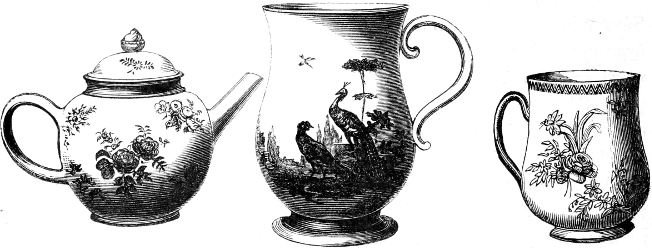
Figs. 711 to 713.
“China painters wanted, for the Plymouth new invented Patent Porcelain Manufactory.—A number of sober, ingenious artists, capable of painting in enamel or blue, may hear of constant employ by sending their proposals to Thomas Frank, in Castle Street, Bristol.”
Among the busts and statuettes are an admirable bust of George II., after the statue by Ruysbranch, in Queen’s Square, Bristol; Woodward, the actor; Mrs. Clive; a shepherd; and shepherdess, &c., which show that excellent modellers must have been employed.
One of the finest productions of the Plymouth Works, and evidently of the latest, is a pair of splendid vases and covers, sixteen inches high, in the possession of Mr. Francis Fry, of Bristol. One of these is here engraved (Fig. 714). It is hexagonal, and is enriched with festoons of beautifully-modelled raised flowers, and with painted butterflies, leaves, borders, &c. These vases are of precisely the same general form as some unique examples of Bristol make, which I shall have to describe when writing on those works, from which, however, they differ in ornament and detail, and they are evidently the production of the same artists. They are marked with the usual sign in red.
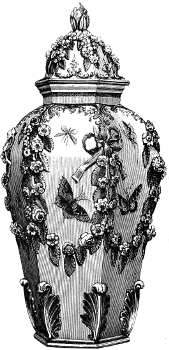
Fig. 714.
In Lord Mount Edgcumbe’s possession, too, is a pair of vases of very similar character (but more nearly resembling Mr. Fry’s specimens of Bristol), on which the Plymouth mark has, at a later period, been added. Many good examples of Plymouth still remain in the hands of families resident in Plymouth and its neighbourhood, and in the cabinets of most collectors.
In the Museum of Practical Geology some characteristic examples of Plymouth ware may be seen. Among these are a pair of shell-salts (Fig. 708); a pair of figures, “Europe” and “Asia,” and some other figures; some remarkably good mugs, jugs, and sauce boats; one or two cups and saucers; and other pieces. There are also two plates (one of which is shown on Fig. 715), described as “in earthenware, with thick white enamel, painted,” the one with flowers, and the other “in green, with flowers on the border and crest of the Parker family in the centre. Unmarked.”
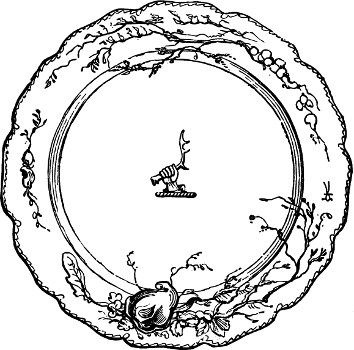
Fig. 715.
The mark of the Plymouth china is usually painted in red or blue on the bottom of the pieces. No mark has yet, however, come under my notice on the white examples. On the early blue and white the mark appears invariably to be in blue, and somewhat thick and clumsy in its drawing. On the later and more advanced goods it is more neatly drawn in red or blue. It varies a little in form, according to the different “hand” by which it was affixed. The mark is the chemical sign for tin or mercury, ꝝ, and was doubtless chosen by Cookworthy, the chemist, to denote that the materials from which it was made, and which he had discovered, were procured from the stanniferous district of Cornwall. The following are varieties of the mark selected from different specimens:—

Figs. 716 to 724.
On some other examples the sign with the addition of the Bristol mark of the cross beneath it occurs; and on others a number, as if to denote the number of the pattern (or possibly of the workman), occurs. These two marks, the simple sign and the sign with the number, occur on pieces belonging to the same set.
Mr Wm Cookworthy’s Factory Plymo 1770
In Mr. Skardon’s possession is a pair of small sauce boats, embossed and painted with birds and flowers in colours; they each bear the name, painted on the bottom, as here shown. In Dr. Ashford’s possession is an example bearing a very similar mark, but in writing letters, thus:—
Mr W. Cookworthy’s Factory Plymouth 1770
Another curious example, formerly in the possession of Mr. C. W. Reynolds, bears the word “Plymouth,” the arms of the borough, some illegible letters, and the date “March 14 1768 C F.”
However beautiful and satisfactory the productions of the Plymouth works might be as china, they were not, it would appear, remunerative commercially. The clay and the stone Cookworthy had within easy distance, but his material was difficult and expensive to make, his experiments produced frequent failures and losses, and therefore he was unable to keep pace with other manufactories, and to compete with them. Add to this that he was far from being a young man—being then in his seventieth year—it is not surprising that he should determine on giving up the works, especially when Lord Camelford, who was one of his partners, says between two and three thousand pounds had been sunk in their prosecution.
On the 6th of May, 1774, therefore, William Cookworthy (who, it would appear probable, had already removed the manufacture to Bristol), for considerations set forth in the deed of assignment, sold the business and patent-right to Richard Champion, merchant, of Bristol, who had been connected pecuniarily with the works at Plymouth, and who had previously, “under license from the patentee” (William Cookworthy), commenced the manufacture of china in Bristol, under the style of “W. Cookworthy & Co.,” and they were transferred to that city.[89] Champion appears to have been a connection of Cookworthy’s—a cousin of the latter, Phillip Debell Tuckett, marrying, in August, 1774, a sister of the former (Esther Champion), about the time when the affairs for the transfer of the works were finally completed; and the arrangements appear to have been completed entirely to Cookworthy’s satisfaction. The following letter, highly characteristic of Cookworthy’s style, relates to the settlement of the transfer. Though without date, it evidently was written only a short time prior to the 6th of May, 1774. It is addressed to his cousin, Anna Cookworthy, of Plymouth:—
“Bristol, 4th day, 10 o’clock.
“My Dear Cousin,
“When I wrote my last to thy father, I hoped to have left this city, last second day; but such hath been the nature of the affair which detains me here, that though I have endeavoured, to the utmost of my power, to get it completed, I cannot yet succeed. The attorney assures me that we shall have everything ready by next fifth day; and, if he is as good as his word, we shall finish our matters that evening, or the next day at farthest. And then, if health permits, I shall set out in the machine second day morning, and reach Plymouth on fourth day.[90]
“I am heartily disposed to show every mark of respect to a niece so sincerely and justly esteemed by me; and it hath been one source of anxiety and vexation to me that I have been so long detained here; but there is really a necessity for my closing our affair before I leave this city. When this is done, I shall set my face towards Plymouth with great pleasure. Not that I have any reason to complain of Bristol; for, though I have had the load of important and difficult affairs on my mind, and have gone through a real fit of the gout besides, I have been helped through all in the enjoyment of calm spirits and inward satisfaction.
“I have a budget full of interesting matter for your entertainment at my return. I have not had the least reason to complain of R. Champion’s behaviour; and all my acquaintance at Bristol have shown me much kindness and respect; and, on the whole, my time hath been spent agreeably amongst them, all things considered. For, considering my attention to china-wares, the closing of my business with R. Champion, the settling the lovers’ matters, which were in a much worse situation than we imagined; all this, and the attending meetings, have made the last month the busiest one to me that I have known for many years. But quiet dependence is sufficient to carry us, safely and well, through all those things in which Providence engages us. Let this be an encouragement to my dear niece through every difficulty she may meet with. Let us but determine in all things to do our duty, depending only on Him who is mighty to help, and nothing that can befall us can be hurtful to us. Let us learn to despise the superficial judgment of a world that looks only at things that are seen; which renders all its spacious wisdom foolishness in reality. Let the attainment and possession of a conscience void of offence, regulate us in all our views and pursuits; and let us implore the help of the Great Father, and steadily wait for it, through the whole course of our conduct; and we shall know that blessing which maketh rich, and addeth no sorrow with it to rest on our hearts and houses.
“Farewell, my dear cousin; and, farewell, all my dear friends. I am hastening to meeting.
“W. Cookworthy.”
The works having been transferred to Bristol, were carried on by Richard Champion, who having incurred considerable expense without a proportionate return, petitioned in the same year for a further term of fourteen years patent-right to be extended to him, which was accordingly done by Act of Parliament passed in the session which commenced the 29th of November in the same year (1774). This Act and others will be found noticed in my account of the Bristol china works.
Thus ended, after the brief period of nineteen or twenty years from the first discovery of the material to its close, the manufacture of porcelain in Plymouth—a manufacture which was an honour to the locality, a credit to all concerned in it, and which has given it, and Cookworthy its founder, an imperishable name in the ceramic annals of this country.
Having passed through the history of the works, so far as scantiness of material will allow, it only remains to turn back for a few minutes to the thread of the life of Cookworthy with which I started, and to follow it, so far as may be necessary, to its close.
During the time he was engaged on the manufacture of chinaware, his ever-active mind seems to have been busied with other things as well, and he appears to have been sought, and much esteemed, by the savans of the day. Smeaton, the builder of the Eddystone Lighthouse, was an inmate of his house while the lighthouse was in progress, and they were constant companions in examining the dove-tailed blocks of stone as they were prepared on the Hoe for shipping; Wolcot—“Peter Pindar”—was a frequent visitor for days together at his house; Sir Joseph Banks, Captain Cook, and Dr. Solander, were his guests just before the famous “Voyage Round the World” and on their return, when their protégé, Omai the Otaheitan, was also his guest; Earl St. Vincent, then Captain Jervis, was his attached friend, and he was looked up to by all as a man of such large understanding, such varied and extensive knowledge, and such powers of intellectual conversation, that, as Lord St. Vincent is said often to have remarked, “whoever was in Mr. Cookworthy’s company was always wiser and better for having been in it.” He carried on considerable experiments to discover a method by which sea-water might be distilled for use on board ship. He was a disciple of Swedenborg, some of whose works he translated, and was also an accomplished astronomer, and an ardent disciple of “good old Izaac Walton.” As a preacher among the Society of Friends he seems to have been most highly esteemed, and to have been a man looked up to by the whole of that body.
In 1780, Cookworthy, then seventy-five, died in the same house in Nutt Street, Plymouth, which he had occupied from the time of his first starting in life, and a touching “testimony” to his character was given by the “monthly meeting.” He was interred with every mark of respect at Plymouth, and his memory is still warmly cherished in the locality.
Plymouth Earthenware.—The manufacture of chinaware having ceased in Plymouth in 1774 this useful and elegant art was lost to the town. Some years later rough common brown and yellow earthenware was made here. In addition to these, manufactories of fine “Queen’s Ware,” and painted, printed, and enamelled ware, were established in 1810.
In 1815 there were three separate manufactories in Plymouth. The proprietors of these various potteries were Mr. Fillis, Mr. Algar, and Mr. Hellyer.
Plymouth Pottery Company.—Mr. Wm. Alsop (who made coarse ware near the Gas Works) built a manufactory for fine earthenware of the ordinary commoner quality, but afterwards removed to Swansea, his works passing into the hands of Messrs. Bryant, Burnell, and James. Subsequently Mr. Alsop returned from Swansea and formed a Limited Liability Company for the carrying on of this concern, and produced large quantities of the common classes of pottery and printed goods. On the death of Mr. Alsop a Mr. Bishop, from the Staffordshire pottery district, took the management of the works, but the manufacture gradually died out, and about 1863 the plant was sold off and the place disposed of to the Gas Company. The mark used by this company was the Queen’s Arms, with the words “P.P. COY. L. (Plymouth Pottery Company Limited.) Stone China.” The quality of the ware was of the commonest description of white earthenware, blue printed in various patterns. There is at the present time a manufactory of common brown ware, carried on by Mr. Hellyer.
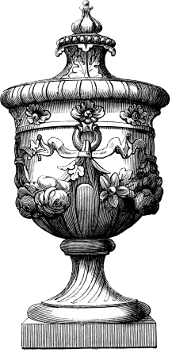
Fig. 725.
Watcombe.
Watcombe Pottery.—The works at Watcombe, St. Mary Church, about two miles from Torquay, in Devonshire, were established in 1869, and have made more rapid progress in the time than any other manufactory on record. Their establishment owes its origin to the discovery a few years ago, by G. T. Allen, Esq., of Watcombe House, of a bed of the finest plastic clay, of considerable extent and depth.
This discovery was made while excavating behind his residence, and Mr. Allen, who is a gentleman of great learning and of refined taste, and who is son of Dr. Allen, Bishop of Ely, and was the last Master of Dulwich College before the late changes made in that institution, took immediate steps to have its qualities for ceramic purposes tested. A company was immediately afterwards formed for the getting and sale of the terra-cotta clay to various potters; but, after experiments had been made, and its unique beauty, when worked, discovered, it was wisely resolved to erect a pottery on the spot, and to convert the clay immediately from the pits into Art-manufactures and architectural enrichments. Shortly afterwards, the company were fortunate enough to secure the services of Mr. Charles Brock, of Hanley, in Staffordshire—a gentleman of the most enlightened taste, and of the most extensive practical knowledge—to become the manager and Art-director of the concern. Mr. Brock at once turned his attention to the development of the resources of the clay thus fortunately discovered; and having brought together a number of skilled workmen and workwomen from the Staffordshire potteries, and procured the best possible models and modellers, soon produced Art-works which are quite unequalled in this country, in works of this character and material. At the present time about one hundred persons are employed at the Watcombe works, and there can be but little doubt that, as they are yet quite in their infancy, that number will be considerably increased as their resources become more developed. The Watcombe clay is remarkably fine, clean, and pure; and, with skilful manipulation, and the requisite degree of heat in firing, has a warmth, delicacy, and pureness of colour, and an evenness of tint, that is very gratifying to the eye; while the surface in the “turned” specimens is fine, smooth, and almost velvety to the touch. It is capable of being modelled into raised flowers and other ornaments, and is eminently adapted for most decorative purposes. Many of the borders and pressed ornaments have almost the sharpness, as they have quite the general effect, of those made of jasper body; indeed, many of the productions bear a very strong and marked general resemblance, in appearance, to those of jasper ware; and they are superior in many respects to the much-vaunted terra cotta of France and Germany.
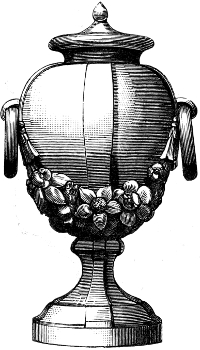
Fig. 726.
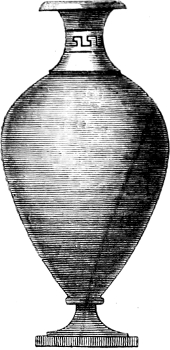
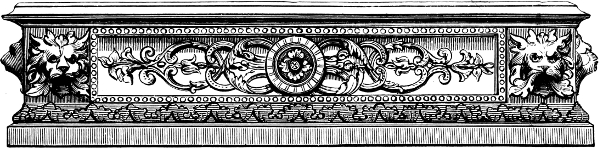

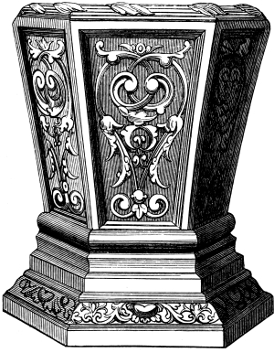
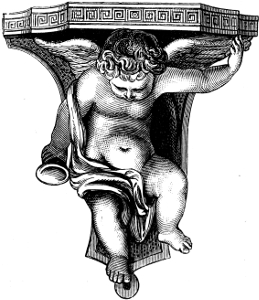
Figs. 727 to 733.—Watcombe Terra Cotta.
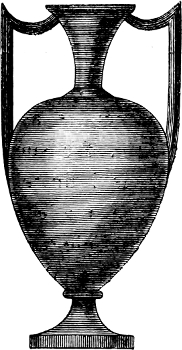
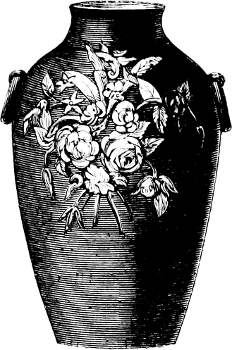
The Art-productions of the Watcombe pottery are extremely varied, and show how capable this local clay is of being turned to good account in a variety of ways. Among the more notable productions are statuettes and busts, for which the clay is peculiarly suitable. Of these, the difficult figure of “The Disc Thrower” is one of the most successful, both in modelling, in firing, and in all the other manipulative processes. Another artistic statuette is a sweetly pretty figure of a country girl, bare-footed and reclining. Her right hand holds up her apron filled with flowers, while in her left she holds an open book, which she is intently reading. The conception of the figure, simple and graceful in the highest degree, is remarkably good, and the execution is free and artistic. In others, a charming effect is produced by leaving the figure itself of the natural red of the body, and introducing a lighter tinted clay for the drapery in which they are partly enveloped; this, again, being lighted up and relieved here and there with a slight touch of colour. Among the busts are a pair of Byron and Scott—two of the most popular subjects that could be produced—and of full life-size, being about two feet six inches in height, and two feet in width. In modelling, these busts are among the most easy, graceful, and life-like we have ever seen, either in marble, in parian, or in any other material, while as productions in warm-tinted terra-cotta they surpass anything yet produced. They are not only life-like portraits of these two great and widely-different types of men, as regards features and figure and pose, but they convey an actual reflex of the mind of each in the expression which the modeller has caught and perpetuated. The tint of the Watcombe terra-cotta is a delicate rich warm red, with what may be truly called a “bloom” overspreading its surface. It is, therefore, on that account, as well as for its matchless fineness and purity, eminently adapted for busts and statuary; and, for such large size busts as the pair we are writing about, it is infinitely superior to any other material. The vases, which are made in endless variety, are characterized by extreme chasteness and elegance of outline, and by excellent taste in decoration, whether that decoration consists in festoons of hand-modelled flowers, in pressed work, in milling, in printing, or in painting. Many of them in form and in ornamentation, although of so different a body, bear comparison with the better specimens of Wedgewood-ware, and exhibit a purity of taste which is quite refreshing. For tea or déjeuné services, the insides of the teapots and cream-ewers are simply, but judiciously glazed; while the cups are, as in some old oriental examples, lined with celeste, which colour is also occasionally introduced with good taste, on the handles and mouldings. Brackets, of charming design, candlesticks, jugs, medallions, tobacco-jars, spill-cases, flower-stands—and, indeed, all the articles produced—bear the same stamp of care and elegance. The turning is done with admirable precision; the moulding with a refreshing delicacy of finish; and the gilding and enamelling—only sparsely introduced, by the way, and then only as an accessory to the general design—executed with a pure taste and by a master mind. Besides these, it is necessary to mention that architectural decorations and enrichments, statues, garden and flower-vases, pedestals, and garden edgings, besides other articles, are made; the commoner strata of clay being remarkably well adapted, from its hardness and durability, for these purposes. Our engravings convey but a very poor idea of the beauty and elegance of form of the vases, &c., here produced; the purest taste characterizes the various articles. The works are carried on by a company, under the style of “The Watcombe Terra Cotta Clay Company,” consisting of seven proprietors. They are situate about two miles from Torquay, on the Teignmouth Road, near to the picturesque rocks and downs of Watcombe. Large show-rooms have been erected, and everything done to make the Watcombe works attractive and useful. They have been visited by, and received the patronage of, many distinguished persons. The marks used by the company are simply impressed in the body of the ware, or printed on its surface. The usual mark is simply the words “Watcombe, Torquay,” or “Watcombe;” but another, and very picturesque mark has also been adopted—it is a woodpecker on a branch of a tree, with a distant landscape and ship on the sea, within a garter, on which are the words, WATCOMBE TORQUAY.
WATCOMBE, TORQUAY.
Honiton.
A manufactory of common brown and red ware existed here in the early part of the present century, but has long been discontinued. Its productions were for ordinary domestic use—the common “cloam” of the country—and consisted of pans, pitchers, pancheons, porringers, &c.
Exeter.
In Felix Farley’s Bristol Journal of December 29th, 1764, is the following:—“We hear that a few gentlemen of fortune have undertaken to set up a new manufactory of china at Exeter.” Probably rumour was all, for as yet I have found nothing to lead to the inference that the works were ever established.
Bovey Tracey.
The great source of Devonshire clay used in most of the potteries of the kingdom is the district near the estuary of the river Teign. This clay is known by various names—“Black clay,” “Ball clay,” “Devonshire clay,” “Kingsteignton clay,” or “Potter’s clay;” and is sent off in immense quantities to the various seats of earthenware manufacture. Yet in the whole of this district where the clay is raised, and one would expect to find earthenware extensively made, only one pottery exists, and that one not on a large scale. Coal, which is such an important item in the manufacture of earthenware, is wanting in the district; and it is found more economical and advantageous to take the clay to the coal, than to bring the coal to the clay. Although no true coal is found in this district (that is, coal of the Carboniferous formation), a lignite is found on Bovey Heath field. The beds of this lignite crop out in a line running east and west for about the length of half a mile in the vicinity of the present Bovey Tracey Pottery Works. In the middle of the last century these beds had been but little worked, and lignite could easily be obtained by open pits. In consequence of the sandy and soft nature of the beds which alternate with the lignite, it has been found impossible to work underground on the plan adopted in ordinary coal-mines. The raising of Bovey lignite has, therefore, been almost given up—all the coal near the surface having been worked out. The existence of a cheap fuel in the proximity of the potters’ clay no doubt led to the establishment of potteries at Bovey Tracey. This lignite is a light bituminous coal which occurs in the Miocene formation, being the same geological formation in which the potters’ clay is found. This lignite is highly gaseous, but only possesses about a third of the heat-giving power of average English coal. It is the same as the Norwegian “Surturbrand,” and emits a disagreeable odour in burning. Large pieces of fir-trees are occasionally found perfect in it.
Indiho Pottery.—About 1772 a pottery was established at Indiho, or Indio, or Indeo, in the parish of Bovey Tracey, and continued to be worked until 1841, when it was superseded by the Bovey Pottery, which had been established a few years previously to that time. The Indiho Pottery was a small manufactory, and is supposed to have been commenced by one George Tufnell, and was afterwards in the hands of proprietors of the names of Inglett and Steer. About the beginning of the present century a really good earthenware was made at Indio; the printed ware was of a superior class, and some tea and coffee cups of a brown body with an interior enamelled with white slip and painted outside with small sprigs are characteristic and pretty. Nothing remains of the buildings of the manufactory at Indio—a modern house, the seat of Charles Aldenburgh Bentinck, Esq., standing on its site.
Bovey Pottery.—The first pottery at Bovey Tracey was not on the site of the present pottery known under this name, but was carried on in some houses, which are parish property, near the modern railway station. The house is at present a carpenter’s shop, and is at a corner just where the road turns off to the Bovey Heathfield. Tradition states that this pottery had mills to grind materials close to Bovey Bridge, and the remains of a mill and water-wheel existed on the left bank of the stream up to 1844. These works were carried on by a family of the name of Ellis; they were probably commenced in the earlier half of the eighteenth century and certainly were in work in 1755, and lasted for thirty years after that period. Nothing certain is known of the character of the ware of this first attempt at Bovey Tracey. Clay pipes are said to have been made, and jugs of a yellow body which are attributed to this period are to be found in houses in the neighbourhood.
In 1842 the Bovey Pottery was purchased by two Devonshire gentlemen, Captain Buller and Mr. J. Divett, who enlarged the works, and obtained the lignite from underground workings. The supply of this substance, however, proving insufficient for the increased requirements of the manufacture, ordinary coal was substituted in its stead; and, after the opening of a railway to the works, Somersetshire coal has been used to the entire exclusion of the lignite. The works are still carried on by Messrs. Buller and Divett, under the style of the “Bovey Tracey Pottery Company.” In general character they are similar to those of the pottery district, and on the average five glost-ovens are fired each week. The quality of the ware is about equal to the ordinary and commoner classes of Staffordshire goods. It consists of all the ordinary services and articles in white, printed, and coloured wares, and is principally supplied to the home markets in the West of England, and to Mediterranean ports.
The Folly Pottery.—Another pottery in Bovey Tracey parish was the “Folly Pottery.” This pottery may be looked upon as the origin of the present Bovey Tracey Pottery. No doubt the site was chosen for its proximity to the main outcrop of the lignite. Considerable uncertainty exists as to the date of this manufacture. It was probably commenced in the last years of the eighteenth or the first years of the nineteenth century by a man of the name of Mead. It was then for a considerable period contemporaneous with the Indio Pottery. The earthenware, however, seems hardly, at any time, to have equalled in quality that of the last-named pottery. In 1835 the works were carried on by Messrs. John and Thomas Honeychurch. It is thus described in an advertisement of sale:—“To be sold by public auction, as directed by the assignees of John and Thomas Honeychurch, bankrupts, at the Union Inn, Bovey Tracey, on the 2nd May, 1836, the Folly Pottery, situate in the parish of Bovey Tracey, in the county of Devon. This may be designated one of the largest and most complete potteries in the West of England, 14 miles from Exeter and 28 from Plymouth; its situation being in the land of clay, from which nearly all the potteries in Staffordshire draw their supply, with coal-mine and railroad, &c.” The advertisement, after giving particulars regarding the processes, &c., speaks of a glost-kiln, and a biscuit-kiln, capable of containing 1,600 saggers of ware; flint kilns; a quantity of Cornish clay and flints, copper-plates, moulds, &c. No purchaser was found until 1842, when the concern was bought by Captain Buller and Mr. J. Divett, and converted into the “Bovey Tracey Pottery Company,” as last described.
Bideford.
Pot works appear to have existed at Bideford ever since the fourteenth century, but nothing beyond the ordinary coarse earthenware has been produced. Nothing is known as to the early history of these works, but fragments of ware of mediæval character have not unfrequently been dug up. An interesting relic, a chimney-pot, is in the possession of Mr. Crocker. It is of square form, and bears the name “Bideford,” and the date “1668.”
The Bideford Old Pottery, belonging to Mr. W. H. Crocker, has been in the possession of himself and his ancestors for more than a century, but of late years its productions, under the present proprietor, have received a marked improvement. The works were almost entirely rebuilt, and much extended, in 1870.
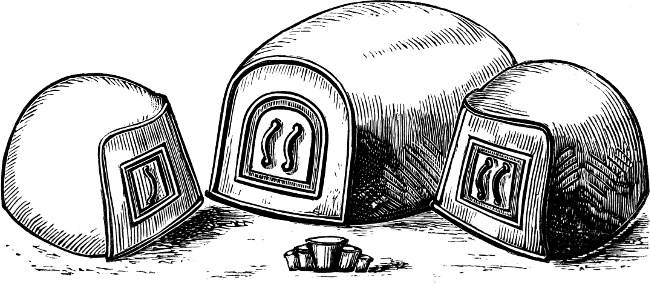
Fig. 734.—Earthenware Ovens.
Ornamental goods are to some extent made, and consist of garden vases, edgings, jugs, and other articles. Flower-pots, sea-kale and rhubarb pots, chimney tops, &c., are also largely made.
The great specialty, however, of the productions are the fire-clay ovens, which are made in considerable numbers and of various sizes. They are of peculiar shape, and so constructed as to retain the heat for a considerable time. Their form may be said, in some measure, to approximate to the old couvre-feu, as will be seen by the engraving (Fig. 734). The bottom is flat, and the walls, which are of great strength and thickness, are arched, so that the heat is thrown upon the bread in every direction. In front is a loose fire-clay door made to fit with exactness; or, occasionally, a cast-iron door is fixed. These ovens are heated with gorse, or wood, and one bundle of either is said to be sufficient to thoroughly bake three pecks of dough. The ovens are, and for generations have been, in much repute in Devonshire and Cornwall, and in the Welsh districts, and the bread baked in them is said to have a sweeter and more wholesome flavour than when baked in ordinary ovens. They are ornamented in a primitive manner with impressed and incised lines, and the mark used is the proprietor’s name
W. H. CROCKER BIDEFORD
North Devon Pottery.—This pottery was established in 1848 by a company formed for the purpose. The productions are confined to stoneware pipes, and sanitary appliances of various kinds. The goods are made from the strong clay deposits of the northern side of Dartmoor—a clay of peculiar hardness and tenacity—and the articles are therefore what may be called “real vitrified stone ware,” as distinguished from the pipes and sanitary goods made in other districts from fire-clay. The works are under the management of Mr. Henry Jones.
Fremington.
The manufacture of coarse brown ware has evidently been carried on for many generations at Fremington, near Barnstaple, for fragments of mediæval and later wares are constantly being turned up. About fifty years ago the remains of five old potteries, which could not have been worked for, at least, a century, existed near the present manufactory.
The Pottery, at Fremington, was established in the early part of the present century by Mr. George Fishley, who, in 1839, was succeeded by his son Edmund Fishley, who continued it until his death in 1861, when it passed into the hands of his son, Mr. Edwin B. Fishley, the present proprietor.
The goods produced are of the ordinary glazed red ware, and consist principally of pitchers and jars; scalding-pans for milk, for producing the world-famed “Devonshire cream”; flower-pots and pans; washing pots, cauldrons, and ewe pans; baking dishes and bread pans; salting vessels and chimney pots, and many other articles. Some of the water pitchers bear the peculiar names of “Long Toms,” “Thirty Tales,” “Gullymouths,” &c. Yellow-ware jugs and other domestic vessels are also made.
In ornamental wares some good designs in jars, beer jugs, and vases are produced. These are formed of a body of red clay, with figures and flowers in white clay. They are sometimes coloured, with good effect. The beer jugs, which are a speciality of the works, are generally white with drawings in red, of the same colour as the body.
The great speciality of the Fremington Pottery, like that of Bideford, is the manufacture of fire-clay ovens. These are made of various sizes for baking from one peck up to twelve. Their general form will be best understood from Fig. 734. The material of which they are composed is remarkably firm, hard, and compact, and retains the heat for a considerable time. These ovens, which are a peculiarity of the West of England and of some of the Welsh districts, are simply enclosed in raised brickwork, leaving the mouth open to the front. They are heated in the inside with wood or gorse, and are remarkable for the small quantity of fuel that is required—two pennyworth of wood being said to be amply sufficient to bake seven or eight shillings’ worth of flour. The bread is stated to be of a peculiarly wholesome and sweet character. The mark used on the ovens, &c., is simply the proprietor’s name impressed in the clay while moist. On the ornamental ware the name is written on the bottom of the ware.
E. B. FISHLEY, FREMINGTON.
Aller.
The Aller Pottery.—These works, near Newton Abbot, were commenced for the manufacture of common brown ware in 1865, and three years later came into the hands of Messrs. John Phillips & Co., by whom they are still carried on, for the production of architectural pottery. The goods manufactured consist of flooring and roofing tiles, sanitary and sewage ware, garden edgings, ornamental chimney pots, decorative bricks, flower vases, &c., and various other kinds of fire-clay goods. The markets principally supplied are those of Devonshire, Somersetshire, and Cornwall.
The mark is a horse’s head, couped, with the Greek words ΦIΛΕΩ ΙΠΠΟΝ, being a playful allusion to the name of the proprietor, “Phillips.”
Pednandrea, Redruth.
Crucible Works.—These works at Pednandrea and at Fore Street, Redruth, were established about 1760 by John Juleff, and carried on by him until his decease, when he was succeeded by his son, John Juleff, by whom they were continued until 1875. In that year he died and the works passed into the hands of his two sons, by whom they are still carried on under the style of “John and David Juleff.” The firm are the only manufacturers of the original Cornish crucibles, which have always had, and still maintain, the reputation of being the best articles made for dry assaying and for standing intense heat. They are made to a large extent and sent to most parts of the world. The firm also make mufflers, scorifiers, special bricks and covers for assay furnaces, plumbago crucibles for tin assaying, plumbago brass melting pots, &c., of various shapes and sizes. Mr. Juleff received honourable mention for his goods at the 1861 Exhibition: there being no competition in these specialities, no medal could be awarded. The goods are usually marked with the name of the firm.