Volume 1 — CHAPTER VI.
Reading edition
The Fulham Works—Dwight’s Inventions and Patents—First China made in England—Dwight’s Books of Recipes, &c.—Present Productions—Lambeth—Exchequer Trial—High Street—Coade’s Works—London Pottery—Lambeth Pottery—Fore Street—Waters’ Patent—Imperial Pottery—Crispe’s China—Blackfriars Road—Bas-reliefs for Wedgwood Institute—Vauxhall—Aldgate—Mill Wall—Mortlake—Southwark; Gravel Lane—Isleworth—Stepney—Greenwich—Deptford—Merton—Hounslow—Wandsworth—Ewell—Cheam—Chiselhurst.
Fulham.
In 1671, as I have already shown,[39] John Dwight took out a patent for “the mistery of transparent earthenware, comonly knowne by the names of Porcelaine or China, and Persian Ware,” &c. The patent runs as follows:—
“CHARLES THE SECOND, &c., to all to whome theise presents shall come, greeting.
“WHEREAS wee have bene informed by the humble peticon of John Dwight, Gentl, that he had discovered “The Mistery of Transparent Earthenware, comonly knowne by the Names of Porcelaine or China, and Persian Ware, as alsoe the Misterie of the Stone Ware vulgarly called Cologne Ware; and that he designed to introduce a Manufacture of the said Wares into our Kingdome of England, where they have not hitherto bene wrought or made.” And thereupon the said John Dwight hath humbly besought vs to grant him the sole benefitt of the manufacture of the said wares for fourteene yeares, according to the statute in that behalfe made and provided.
“KNOW YEE, that wee, being willing to cherish and encourage all laudable endeavours and designes of such our subiects as shall find out vsefull and profitable arts, misteries, and invencons, by granting and appropriating vnto them for some terme of yeares the fruite and benefitt of their industry, whereby their labours and expences in the attainmt thereof may be recompensed and rewarded vnto them, of our especiall grace, certaine knowledge, and meere mocon, have given and granted, and by theise presents, for vs, our heires and successors, doe give and grant vnto the said John Dwight, his executors, administrators, and assignes, speciall lycense and full and free libertie, priviledge, power, and authoritie, that he, the said John Dwight, his executors, administrators, and assignes, by him and themselves, or by his or their deputies, servants, workemen, or assignes, and none other, shall and may, from time to time, and att all and everie time and times hereafter, dureing the tearme of fourteene yeares next ensueing the date of these presents, att his and their owne proper costs and charges, vse, exercise, practise, and enioy the said misterie and Invencon of makeing transparent earthen ware, comonly knowne by the names of porcelaine or China, and Persian ware; and also the mistery and Invencon or makeing the stone ware vulgarly called Collogne ware, within any convenient place or places within our Realme of England, Dominion of Wales, or Towne of Berwick-vpon-Tweed, in such manner as to him or them in their discrecons shall seeme meete; and shall and may have and enioy the sole benefitt and advantage from, by, or vnder the said misteries and invencons or manufactures of the said wares, or either of them by him the said John Dwight found out and discovered, as aforesaid, ariseing or groweing from time to time dureing the terme hereby granted, to have, hold, and enioy the said lycenses, priviledges, powers, and authorities, benefitt, advantages, & other the premisses in and by these presents granted or menconed to be granted, and everie of them, vnto the said John Dwight, his executors, administrators, and assignes, from and dureing the tearme of fourteene yeares from henceforth next ensueing, and fully to be compleate and ended, yeilding and paying therefore yearely and every yeare dureing the said tearme into the receipt of our Exchequer att Westminster, to the vse of vs, our heires and successors, the yearely rent or sume of twentie shillings of lawfull money of England, att the two most vsuall feasts or tearmes in the yeare, (that is to say) att the Feast of Saint Michaell the Archangell, and the Annunciation of the Blessed Virgin Mary, by even and equall porcons. And to the end the said John Dwight, his executors, administrators, and assignes, and everie of them, may the better enioy the full and whole benefitt and sole vse and exercise of the said misteries, invencons, and manufacture of the said wares, as well within liberties as without, wee doe by theise presents, for vs, our heires and successors, require and streightly charge and comand all and everie person & persons, bodies pollitique and corporate, of whatsoever qualitie, degree, name, or condicon they be, that neither they nor any of them, dureing the tearme hereby granted, either directly or indirectly, doe or shall vse or putt in practise the said misteries and invencons or manufacture of the said wares, or either of them, soe by the said John Dwight found out or discovered as aforesaid; nor doe or shall counterfeit, imitate, or resemble the same; nor doe or shall make any addicon therevnto, or substraccon from the same, whereby to pretend themselves the inventors or devisors thereof, without the lycense, consent, and agreement of the said John Dwight, his executors, administrators, or assignes, in writeing under his or their hands and seals first had and obteyned in that behalfe, vpon such paines and penalties as can or may be inflicted on such offendors for the contempt of this our comand in that behalfe, and further to be answearable to the said John Dwight, his executors, administrators, and assignes, according to law and justice, for his and their damages thereby susteined. And further, we doe by theise presents, for vs, our heires and successors, give and grant vnto the said John Dwight, his executors, administrators, and assignes, full power and authoritie that he, they, and everie of them, his, theire, & everie of theire deputies, servants, and agents, or any of them, haveing first obteyned a warrant in this behalfe from the Lord Chiefe Justice of the Court of King’s Bench for the time being, may, with the assistance of a constable or any other lawfull officer, as well within liberties as without, vpon request, att convenient times in the day, dureing the time aforesaid, and in lawfull manner, to enter and make search in any houses or other places where there shall be iust causes of suspition, for discovering and finding out of all such persons as shall within the tearme of fourteene yeares aforesaid imitate or cause to bee imitated or vse or putt in practise the said misteries and invencons, or manufacture of the said wares, or either of them, soe by the said John Dwight found out and discovered as aforesaid, that soe such offendors may be proceeded against and punished according to their demeritts. And further, wee doe by theise presents, for vs, our heires and successors, will, authorise, and require all and singuler justices of the peace, mayors, sheriffes, bayliffes, constables, head-boroughs, and all other officers and ministers whatsoever, of vs, our heires and successors, for the time being, that they and every of them respectively be from time to time dureing the said tearme hereby granted in their respective places, favouring, ayding, helping, and assisting vnto the said John Dwight, his executors, adminrs, and assignes, and to be his and their deputie and deputies, servants, and agents, in and by all things in and aboute the accomplishment of our will and pleasure herein declared, and in the exercise and execucon of the powers and priviledges herein and hereby granted or menconed to be granted as aforesaid; and, moreover, wee will and comand by theise presents, for us, our heires and successors, that our said officers, or any of them, doe not molest, trouble, or interrupt the said John Dwight, his executors, administrators, or assignes, or his or their deputie or deputies, servants, or workemen, or any of them, in or about the vse or exercise of the said misteries and invencons or manufacture of the said wares, or either of them, or any matter or thing concerning the same, or either of them: Provided alwaies, that if att any time dureing the said tearme of fourteene yeares it shall be made appeare vnto vs, our heires or successors, or any six or more of our or their Privy Councell, that this our grant is contrary to law or preiudiciall or inconvenient or not of public vse or benefitt, then, vpon significacon & declaracon to be made by vs, our heires or successors, vnder our or their signett or privie seale, or by the Lords and others of our Privy Councell, or any six of them for the time being, in writeing vnder their hands, of such preiudice or inconvenience, these our Letters Patents, and all things therein conteyned, shall forthwith cease, determine, and be vtterly void to all intents and purposes, anything hereinbefore conteyned to the contrary notwithstanding. And our will and pleasure is, that the said John Dwight, his executors, administrators, or assignes, shall enroll these presents, or cause the same to be enrolled, before the Clerke of the Pipe within six moneths next after the date hereof. And lastly, wee doe by theise presents, for vs, our heires and successors, grant vnto the said John Dwight, his executors, administrators, and assignes, that these our Letters Patents, and the inrollment thereof, shall bee in and by all things good, valid, sufficient, and effectuall in the law, according to the true intent and meaning of theise presents, and shall be taken, adiudged, and construed most favourably and beneficially for the best benefitt and advantage of the said John Dwight, his executors, administrators, and assignes, as well in all our Courts of Record as elsewhere, notwithstanding the not specifying the various sorts of the said Collogne wares, and the not full and certaine describing the manner and qualitie of the said misteries and invencons, or any of them, or of the materialls, way and manner of workeing the same, or of the true and certaine vse and benefitt thereof, and notwithstanding any other defects, incertainties, or imperfeccons in theise presents conteyned, or any act, statute, ordinance, provision, proclamacon, or restraint to the contrary thereof in anywise notwithstanding.
“In witnes, &c. Witnes our selfe att Westminster, the Three and twentieth day of Aprill P bre de privatoe sigillo.”
This was the commencement of the Fulham Pottery, whose history I am about to attempt to trace, and which has continued uninterruptedly in work for more than two centuries.
Dwight appears to have been a man of considerable learning and ability. He graduated as M.A. at Christ Church, Oxford, and successively held the appointments of secretary to more than one Bishop of Chester. He seems to have long experimented upon clays and mineral products in the search after the body of which the oriental china was made, and at length to have brought those researches to a successful issue. Six years after the date of the first of his patents, Dr. Plot, the eminent antiquary and keeper of the Ashmolean Museum at Oxford, thus wrote of his discoveries in his “History of Oxfordshire”:—
“§ 84. Amongst arts that concern formation of earths, I shall not mention the making of pots at Marsh Balden and Nuneham Courtney, nor of tobacco-pipes of the white earth of Shotover, since those places are now deserted. Nor indeed was there, as I ever heard of, anything extraordinary performed during the working these earths, nor is there now of a very good tobacco-pipe clay found in the parish of Horspath, since the first printing of the third chapter of this history.... Let it suffice for things of this nature, that the ingenious John Dwight, formerly M.A. of Christ Church College, Oxon, hath discovered the mystery of the stone or Cologne wares (such as d’Alva bottles, jugs, noggins), heretofore made only in Germany, and by the Dutch brought over into England in great quantities; and hath set up a manufacture of the same, which (by methods and contrivances of his own, altogether unlike those used by the Germans), in three or four years’ time, he hath brought it to greater perfection than it has attained where it hath been used for many ages, insomuch that the Company of Glass-sellers of London, who are the dealers for that commodity, have contracted with the inventor to buy only of his English manufacture, and refuse the foreign.
Ҥ 85. He hath discovered also the mystery of the Hessian wares, and vessels for reteining the penetrating salts and spirits of the chymists, more serviceable than were ever made in England, or imported from Germany itself.
Ҥ 86. And hath found ways to make an earth white and transparent as porcellane, and not distinguishable frome it by the eye, or by experiments that have been purposely made to try wherein they disagree. To this earth he hath added the colours that are usual in the coloured china ware, and divers others not seen before. The skill that hath been wanting to set up a manufacture of this transparent earthenware in England, like that of China, is the glazing of the white earth, which hath much puzzled the projector, but now that difficulty also is in great measure overcome.
“§ 87. He hath also caused to be modelled statues or figures of the said transparent earth (a thing not done elsewhere, for China affords us only imperfect mouldings), which he hath diversified with great variety of colours, making them of the colour of iron, copper, brass, and party-colour’d as some Achat-stones. The considerations that induced him to this attempt were the duration of this hard-burnt earth, much above brass or marble, against all air and weather, and the softness of the matter to be modelled, which makes it capable of more curious work than stones that are wrought with chisels, or metals that are cast. In short, he has so advanced the Art Plastic that ’tis dubious whether any man since Prometheus have excelled him, not excepting the famous Damophilus and Gorgasus of Pliny (Nat. Hist., lib. xxxv. c. 12).
“§ 88. And these arts he employs about meterials of English growth, and not much applyed to other uses; for instance, he makes the stone bottles of a clay in appearance like to tobacco-pipe clay, which will not make tobacco-pipes, although the tobacco-pipe clay will make bottles; so that that which hath lain buried and useless to the owners may become beneficial to them by reason of this manufacture, and many working hands get good livelihoods, not to speak of the very considerable sums of English coyn annually kept at home by it.”
Dwight having patented his discovery of “the mistery of transparent earthenware, commonly known by the names of Porcelaine or China, or Persia ware,” in April, 1671, it is perfectly clear that the discovery must have been made before that time, and that it must have been the result of a long series of patient trials and experiments. Thus, I think, we may safely say that the actual discovery was made some time prior to 1671. In 1684 the patent expired, and a new one granted, in June, for another term of fourteen years—this time the wares and articles being more specifically named. It is as follows:—
“CHARLES THE SECOND, by the grace of God, &c., to all to whom these presents shall come, greeting.
“WHEREAS John Dwight, Gentl, hath represented vnto vs that by his owne industry and at his owne proper costs and charges, hee hath invented and sett vp at Fulham, in our County of Middx, ‘Severall New Manufactures of Earthenwares, called by the Names of White Gorges, Marbled Porcellane Vessells, Statues, and Figures, and Fine Stone Gorges and Vessells, never before made in England or elsewhere; and alsoe discovered the Mistery of Transparent Porcellane, and Opacous, Redd, and Darke-coloured Porcellane or China and Persian Wares, and the Mistery of the Cologne or Stone Wares,’ and is endeavouring to settle manufactures of all the said wares within this our kingdome of England; and hee having humbly besought vs, to grant vnto him our Letters Patents for the sole vse and exercise of the same for the terme of fowrteene years, according to the Statute in that case provided, wee are gratiously pleased to condescend to that his request.
“KNOW YEE THEREFORE, that wee being willing that the said John Dwight may reap some reasonable recompence and compensacon for his great charge and paines in and about the premisses, and to incourage the inventers of such arts as may be of publick vse and benefitt, of our especiall grace, certeine knowledge, and meere mocon, have given and granted, and by these presents, for vs, our heires and successors, doe give and grant, vnto the said John Dwight, his executors, administrators, and assignes, speciall licence, full power, sole privilege and authority, that hee, the said John Dwight, his executors, administrators, and assignes, and every of them, by themselves, or their deputy or deputys, servants or agents, or such others as the said John Dwight, his executors, administrators, or assignes, shall at any time agree with, and noe others, from time to time and at all times dureing the terme of yeares hereafter in these presents expressed, shall and lawfully may vse, exercise, and enioy the said Invencons of new manufactures within any part or parts, place or places whatsoever, of, in, or belonging to our kingdome of England, dominion of Wales, and all and every or any of our kingdomes and dominions whatsoever, in such manner, and according to such reasonable and lawfull rates and limitacons, as to him, the said John Dwight, his executors, administrators, and assignes, or any of them, shall in their discrecons seeme meet, and that hee, the said John Dwight, his executors, administrators, and assignes, shall and may have and enioy the sole benefitt, profitt, comodity, and advantage from time to time coming, growing, and arising by reason of the said Invencons of new manufactures, for and dureing the full terme of yeares hereafter menconed; to have, hold, exercise, and enioy the said licence, powers, privileges, and advantages hereinbefore granted or menconed to be granted vnto the said John Dwight, his executors, administrators, and assignes, for and dureing and vnto the full end and terme of fourteene yeares from the day of the date of these presents next and imediately ensueing and fully to be compleate and ended according to the Statute in this case made and provided; and to the end that the said John Dwight, his executors, administrators, and assignes, and every of them, may enioy the full benefitt and the sole vse and exercise of the said Invencons of new manufactures according to our gratious intencons hereinbefore declared, wee doe by these presents, for vs, our heires and successors, require and strictly comand all and every person and persons, bodys politique and corporate, and all other our subiects whatsoever, of what estate, quality, or degree, name, or condicon soever they be, within all and every our kingdomes & dominions, that neither they nor any of them, at any time dureinge the continuance of the said terme of fowrteene yeares hereby granted, either directly or indirectly doe, vse, or put in practise the said Invencons of new manufactures, or any of them, or any part of the same soe atteined vnto by the said John Dwight as aforesaid, nor shall in anywise counterfeite or resemble the said Invencons of manufacture, or any of them, nor shall make or cause to be made any addicon thereto or substraccon from the same, whereby to pretend themselves the inventers or devisers thereof, without the licence, consent, or agreement of the said John Dwight, his executors, administrators, or assignes, in writing vnder his, their, or some of their hands and seales, first had and obteyned in that behalfe, vpon such paines and penaltys as can or may be iustly inflicted on such offenders for their contempt of this our Royall comand; and further to be answerable to the said John Dwight, his executors, administrators, and assignes, according to law for his and their damages thereby to be susteined. And wee doe, of our further especiall grace, certeine knowledge, and meere mocon, for vs, our heires and successors, grant vnto the said John Dwight, his executors, administrators, and assignes, by these presents, that hee, they, and every of them, and his, their, and every of their deputys, agents, and servants, haveing first obteined a lawfull warrant from the Lord Chiefe Justice of our Court of King’s Bench at Westm for the time being, and with the assistance of a constable or any other lawful officer, at convenient times in the day dureing the terme hereby granted, and in lawfull manner, may enter into and make search in any place or places whatsoever within any of our kingdomes and dominions where there shall be iust cause of suspicon for the discovery and finding out of all and every person and persons as shall imitate or cause to be imitated, or shall vse or put in practise the said Invencons of new manufactures, or any of them, or shall make or counterfeite any instruments or materialls to the same belonging, that soe such offender or offenders may be proceeded against and punished according to law. And further, wee doe by these presents, for vs, our heires and successors, will, authorise, and comand all and singular justices of the peace, mayors, sheriffs, bayliffes, constables, head-boroughs, and all other officers and ministers whatsoever of vs, our heires and successors, for the time being, as well within our kingdome of England and dominion of Wales, as within all and every other our kingdomes and dominions, that they and every of them respectively be from time to time dureing the terme hereby granted, in their respective offices, favouring, aiding, helping, and assisting vnto the said John Dwight, his executors, administrators, and assignes, and to his and theire deputy and deputys, servants and agents, in and by all things in and about the accomplishment of our Royall will and pleasure hereinbefore declared, and in the exercise and execucon of the powers and privileges hereby granted as aforesaid. And moreover wee doe by these presents, for vs, our heires and successors, will and comand that our said respective officers and ministers before menconed, or any of them, doe not, nor shall att any time hereafter dureing the said terme hereby granted, in anywise, molest, trouble, or hinder the said John Dwight, his executors, administrators, or assignes, or any his or their deputys, servants, or agents, in or about the due and lawfull vse or exercise of the aforesaid Invencons, or any of them, or anything relateing therevnto: Provided always, and these our Letters Patents are and shalbe vpon this condicon, that if at any tyme dureing the said terme hereby granted it shalbe made appeare to vs, our heires or successors, or any six or more of our or their Privy Councell, that this our present grant is contrary to law or preiudiciall or inconvenient to our subiects in generall, or that the said Invencons and every of them are not new invencons as to the publick vse and exercise thereof within this our kingdome, and not invented and found out by the said John Dwight as aforesaid, then vpon significacon and declaracon thereof to be made by us, our heires or successors, vnder our or their signett or privy seale, or by the lords and others of our or their Privy Councell, or any six or more of them vnder their hands, these our Letters Patents shall forthwith cease, determine, and be vtterly void to all intents and purposes, any thing before herein conteined to the contrary in anywise notwithstanding: Provided alsoe, that these our Letters Patents or any thing therein conteined shall not extend or be construed to extend to give privilege vnto the said John Dwight, his executors, administrators, or assignes, or any of them, to vse or imitate any invencon or worke whatsoever which hath been heretofore found out or invented by any other of our subiects whatsoever, and publicly vsed or exercised within our said realme and dominions, or any of them, vnto whom we have already granted our like Letters Patents of Privilege for the sole vse, exercise, and benefitt thereof, it being our will and pleasure that the said John Dwight, his executors, administrators, and assignes, and all and singular other person and persons to whom we have already granted our like Letters Patents or privileges, as aforesaid, shall distinctly vse and practise their severall invencons by them invented and found out according to the true intent and meaning of the said Letters Patents and of these presents. And lastly wee doe by these presents, for vs, our heires and successors, grant vnto the said John Dwight, his executors, administrators, and assignes, that these our Letters Patents or the inrollment thereof shalbe in and by all things firme, valid, sufficient, and effectuall in the law according to the true intent and meaneing thereof, and shalbe taken, construed, and adiudged in the most favourable and beneficiall sense for the best advantage of the said John Dwight, his executors, administrators, and assignes, aswell in all Courts of Record as elsewhere, and by all and singular the officers and ministers whatsoever of vs, our heires and successors in all and singular our realmes and dominions whatsoever, and amongst all and every the subiects of us, our heires and successors, whatsoever and wheresoever, notwithstanding the not full and certaine describing the nature or quality of the said Invencons, or any of them, or of the materialls thereto conduceing or belonging, or any other defects or incertaintys in these presents contained, or any act, statute, ordinance, provision, proclamacon, or restriccon, or other matter, cause, or thing whatsoever to the contrary in any wise notwithstanding.
In witnesse, &c. Witnesse Ourselfe at Westm, the Twelfth day of June. By Writt of Privy Seale.
In 1694[40] Houghton thus, in his “Letters on Husbandry and Trade,” wrote[41] while speaking of the tobacco-pipe clays, “gotten at or nigh Pool, a post-town in Dorsetshire, and there dug in square pieces, of the bigness of about half a hundredweight each; from thence ’tis brought to London, and sold in peaceable times at about eighteen shillings a ton, but now in this time of war is worth about three and twenty shillings,” And again he says: “This sort of clay, as I hinted formerly, is used to clay sugar; and the best sort of mugs are made with it, and the ingenious Mr. Daught of Fulham tells me that ’tis the same earth China-ware is made of, and ’tis made, not by lying long in the earth, but in the fire; and if it were worth while, we may make as good China here as any is in the world. And so for this time, farewel Clay.” Again, on “March 13, 1695,” he thus writes: “Of China-ware I see but little imported in the year 1694, I presume by reason of the war and our bad luck at sea. There came only from Spain certain, and from India certain twice. ’Tis a curious manufacture, and deserves to be encourag’d here, which without doubt money would do; and Mr. Dowoit at Fulham has done it, and can again in any thing that is flat: but the difficulty is that if a hollow dish be made, it must be burnt so much that the heat of the fire will make the sides fall. He tells me that our clay will very well do it; the main skill is in managing the fire. By my consent, the man that would bring it to perfection should have for his encouragement one thousand pound from the publick, though I help’d to pay a tax towards it.”
Although no specifications are preserved with Dwight’s patents,[42] I am enabled, through the extreme kindness and courtesy of the present owner of the works, C. I. C. Bailey, Esq., to give recipes for the manufacture of porcelain, &c., in Dwight’s own words, and copied from his own private pocket-books. These two extremely curious books were recently discovered among some old account books and their discovery throws considerable light on the history of the plastic art at this period. One of these books, which is bound in vellum, contains on its outside front cover the words:—
“All that is in this book was enterd since 9 ber 15 1695;”
but the other contains many earlier entries, from 1691. Both the books are in Dwight’s own handwriting. Among the number of curious recipes are the following, which possess more than ordinary interest.
“To make transparent Porcelane or China Cley.—Take fine white thirty pounds. Best cley sifted twenty pounds. Mingle & tread. This works strong and may be wrought thin vpon ye wheel.
“To make another transparent porcelane or China Cley.—Take fine white thirty pounds. Best Cley fifteen pounds. Mingle and tread. This works weaker and thicker but burns very clear with low fire.
“To make red porcelane Cley.—Take Cley sifted twenty pounds. Ffine dark Earth fifteen pounds. White ꝑ. Cyprus five pounds. Mingle & tread.
“To make a bright red Cley wth Staffordshire red Cley.—Take sifted Staffordshire Cley thirty pounds. ffine dark twenty pounds. Mingle & tread.
“The fine Stone Cley.—Take sifted cley sixty pounds ffine white fourteen pounds. ffine white sand sifted ten pounds. Mingle and tread. The best way of weighing and mingling this Cley is, 1, To weigh thirty pounds of Cley & put that into ye mingling box, 2, To weigh thirty pounds of Cley and put that also into ye mingling box. Spreading all the Cley till it lye Leuell. 3, Then weigh fourteen pounds of fine white, & ten pounds of fine white sand, and pour ym together upon the Cley, and spread them to lye leuell, yn mingle all ye grate Shouell.
“The fine white Cley for Gorges & Cans.—Take Cley sifted three and thirty pound, ffine white thirty pounds. Mingle & tread. The readiest way of weighing and mingling this Cley is 1st, Weigh three and thirty pounds of Cley and put it into ye mingling box, spreading it abroad till it lye leuell, 2, Weigh thirty pounds of fine white, put it into the mingling box vpon the Cley, spreading it to the leuell, then mingle them with ye grate Shouell.
“The like fine white Cley in smaller quantity if occasion require.—Take Cley sifted two & twenty pounds, ffine white twenty pounds. Weigh the white first, and lay the Cley a top, mingling ym in the scale.
“The fine white Cley for dishes or Teapots to endure boiling water.—Take Cley sifted two & twenty pounds ffine white twenty pounds. White ꝑ. Cyprus six pounds. Weigh these one vpon another and mingle them in ye Scale.
“‘9ber[43] 1695. An Essay towards a China Glasse.—Take calcin’d sand six ounces, ffine white sand two ounces. Mingle and melt them vnder the ffurnace into a white hard glasse. Take of the set white hard glasse beated & sifted half a pound. White Lead two ounces. Mingle & melt them into a glasse to be ground for a china glasse.’ ‘Not (note) yt in burning China you must set pots near the wideness of ye Arches and set them 6 inches distant from one another and from the wall. The little furnace where the last Red Teapots were burnt I take to be a convenient one for this vse.’
“1691 March 14. To make a gray Porcellane by Salt.—Take eighteen pound of fine white Earth, two pound of fine pale Earth, twenty pound of Cley, six pound of vnground White Earth sifted through Cyprus sieve; mingle & tread. This is a strong hardy Cley, fit for Garden pots, teapots, dishes &c.
“1691 March 15. To make a blew porcellane Cley to be turn’d into vessells or to spot and inlay pots of any other Porcellane.—Take fiue pounds of Cley, fiue pound of ye fine White Earth, one pound of zaffer fine ground-dryd and done through a midling hair Sieve, mingle & tread. If it be wetted with the white water ’twill be the brighter.
“To make another blew porc: Cley more bright.—Take six pound of fine White Earth, four pound of Cley, one pound of zaffer ground fine dry’d & sifted through ye midling hair sieve, mingle, and tread them wth the white water.
“1692 July 12. To make a blew porcell: Cley of inlaying or to turn into vessells.—Take fine white two ounces. White ꝑ. Cyp’s sieve one ounce. Best Smalt one ounce. Cley three ounces.
“1693 9ber 14. To make transparent porcellane or China Cley.—Take fine white Earth thirty pounds. Cley sifted twenty pounds. Mingle & tread.
“To make another transparent porcellane or China Cley.—Take fine white Earth thirty pounds, Cley sifted fifteen pounds. Mingle and tread.”
Other recipes are:
“Light grey Cley to endure boiling water;” “ffiner light grey Cley for ye like vses;” “Mouse coloured cley to endure boiling water;” “ffiner mouse coloured Cley for ye same vse;” “1698 Apr: 6. To make Number Sixteen;” “The best White Cley to make Gor: Cans, or dishes to endure boiling water;” “To make ye White Earth;” “To make the White Earth in larger quantity at one time;” “To make the Dark Earth;” “To make fine White;” “To make fine Dark;” “To make calcin’d Sand;” “To make white ꝑ. Cyprus;” “To make ye Black Earth;” “A fine brown colour wth out Grinding;” “To make a fine bright and strong brown;” “To make ye brightest brown colour;” “Cley to burn brown;” “for marbling stone-pots;” “White to marble ston pots;” “Another grey for marbl: stone pots;” “To make a fine white porcellane Cley to be burnt wth Salt fitt only for things of ornament;” “Grey Cley for ye like vse;” “A darker Cley for ye same vse;” “A Mouse colour’d Porcellane wth white specks;” “A bright Mouse colourd Cley to endure boiling water;” “A fine porcellane Cley fit for deep dishes wth out handles to be burnt wth out glasse in the strongest fire that may serve to perfect ye China ware. ℞ Cley twenty pounds. ffine White twenty pounds. fine Black Earth two pounds. White ꝑ Cyprus sieve six pounds. Mingle & tread;” “The best Dark Earth;” “The fine grinding of the Dark Earth;” “The best browne glasse for white browne pots;” “To make the Dark Earth;” “A dark colour’d Cley for marbled dishes and teapots to endure boiling water;” “The Mouse colour’d Cley to endure boiling water;” “Another lesse red Cley;” “To make a grey porcellane Clay hardy & fit for Garden Potts, Teapots &c.;” “Another lighter Grey Cley;” “To make a deep red Cley of the Staffordshire red Cley;” “Another good red of ye same Cley;” “Another Red Cley;” “To make a Cley to burn brown strong & hardy fit for teapots to be sprig’d white;” “To make ye best fine ston Clay;” “Wh: br: & wh: gor: to be excisd[44] Cley sixty pounds, White sand 12 pounds, ffine White 24 pounds.”
These extracts will be amply sufficient to show the interest and importance of these curious old books which have so kindly been placed at my disposal for this work by their owner, Mr. Bailey, but I cannot refrain from giving some extracts of a totally different character. These relate to the way Mr. Dwight had of being his own banker by hiding his money in all sorts of out-of-the-way corners of his pot-works until wanted. Probably there may still be some of this “treasure-trove,” as well as his moulds and models, &c., to be turned on by some fortunate possessor of the place.
“In ye old Labouratory at the old house, in two holes vnder the fire-place on both sides ye ffurnace in 2 half pint Gor: Couered 460.
“Behind the door of the Old Labouratory, & within ye end of ye bench, in a pot couered 200.
“In ye second presse in ye said Laboura: vnder some papers at ye bottome in a bag some mill’d money.[47]
“Behind ye doore of the little parlor old house in a corner some mill’d money.[47]
“In ye same little parlour behind some boxes just going into ye kitchen some mill’d money.[47]
“In ye second side hole at the bottome of ye first ffurnace in ye kitchen on ye right hand going to ye chimney, pott of Gui:[46][47]
“between a little ffurnace & great one that joynes to ye oven behind Shouels & forks some Gui:[47] “Close by those Shouells wth in a hole into ye vent of ye same large furnace, Gui:[47]
“In two holes of that great furnace running in almost to the Ouen, 2 boxes full of mill’d money. May be drawn out wth a long crooked Iron standing behind ye kitchen door.[47]
“1698 Vnder ye lower shelfe in ye kitchen near ye Oven, 2 cans couer’d.
“In severall holes of ye ffurnace in ye middle of the kitchin opening at ye top where the sands lyes is a purse of 100 gui: & seuerall Cans couer’d.
“At ye further End of the bottome hole of my furnace in the little parlour a box of 200l.”
There are also many other matters of interest in these books; among them the names of
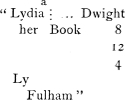
evidently in her own handwriting, and which I take to mean “Lydia Dwight, her book, Fulham, 15”—the 15 being her age, which is arrived at by adding the figures together as they occur in form of a cross, 1, 2, 8, and 4.
“Ly D. Lewin,” “Lydia Dwigh,” “Mrs. Deb Nel,” “Mrs. Deb N,” “Mary,” “Deb Nel,” “Miss Betty Osgood,” “Miss Lucy,” “Miss Betty Osgood,” and “Miss Molly Osgood,” are also scribbled in different parts of the book.
Dwight is stated to have buried, in like manner as he did his money, all his models, tools, moulds, &c., in some still-unknown secret hiding-place of his manufactory that his descendants might not continue that branch of the trade which he had been the first to invent; and very securely he has, evidently, done this; for, whatever may be found in future alterations and excavations, it is certain that these have never yet been brought to light. A few years ago, however, after taking down some of the old buildings, which had become much dilapidated, the workmen, while digging foundations for the new workshops, &c., discovered a vaulted chamber or cellar which had been firmly walled up, and which, on being broken into, was found to contain a number of stoneware grey-beards or bellarmines and ale-pots, &c., undoubtedly of Dwight’s manufacture. These were of the same form, precisely, as the old Cologne ones which they were intended to, and did, supersede in this country—and were those “fine stone gorges never before made in England”—and for which his patent was granted. One of these, presented to me by the present proprietor of the works, Mr. Bailey, I here engrave (Fig. 338).
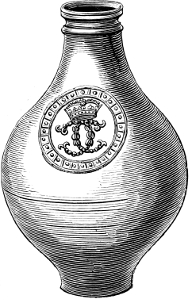
Fig. 338.
Nothing, at present, is known as to when the death of John Dwight took place, or who succeeded him. A Dr. Dwight died at Fulham in 1737, who, according to the Gentleman’s Magazine of that year, was “author of several curious treatises on physic. He was the first that found out the secret to colour earthenware like china;” but this was not John Dwight, as supposed by some writers, but Samuel Dwight, who, in 1722, published “De Vomitione, et Purgatione, eorumque excessu curando, necnon de emiticis Medicamentis, de Catharticis, et Variolis, et Morbillis;” in 1725, “De Hydropibus;” and in 1731, “De Febribus, Symptomaticis.” As the death of this Samuel Dwight took place in 1737, or sixty-six years after the date of John Dwight’s patent, the probability is that he was the son of John Dwight, and that his finding out the secret of colouring earthenware like china took place while engaged in his father’s business. About this time it would appear (probably after the death of Samuel Dwight) the business was carried on by a Margaret Dwight, in partnership with Thomas Warland, and these two—Margaret Dwight and Thomas Warland of Fulham, potters—became bankrupt in 1746. This lady is said afterwards to have married a Mr. White, or Wight, who continued the works. In 1762 “William White, of Fulham, in the county of Middlesex, potter,” took out a patent for the manufacture of “white crucibles or melting potts made of British materials, and never before made in England or elsewhere, and which I have lately sett up at Fulham aforesaid,” and which were composed of “Stourbridge clay and Dorsetshire clay, calcined; mix them with Woolwich sand and water, to be trodden with the feet, and then burned.” For these he had, in the previous year, obtained a premium from the Society of Arts. In 1795 the works were, according to Lysons, “carried on by Mr. White, a descendant in the female line of the first proprietor,” and they were so continued until 1862, when, on the death of the then Mr. White, they passed into the hands of Messrs. Makintosh and Clements. Two years later, however, on the death of Mr. Makintosh, the works were sold to the present proprietor, Mr. C. I. C. Bailey, who shortly afterwards considerably enlarged and improved them; he having built a new factory and introduced the newest and most improved machinery.
The articles and the wares made by the Dwights will have been pretty well understood from the foregoing notice; but, in addition, it is essential to speak of some few well-authenticated examples which still exist. About the time of the sale in 1862, Mr. Baylis, of Priors Bank, obtained from the Fulham works a number—about twenty-five—of extremely curious and historically valuable specimens of the ware produced there by the Dwights, and kept in the family. Of these he sent a brief account to the Art-Journal,[48] a part of which I here transcribe:—
“The first is a dish, said, and with more than mere probability, to be one of a dinner set manufactured for the especial service of Charles II. It is of a round form and large size, being 64½ inches in circumference. The groundwork is a rich blue, approaching to the ultramarine; it is surrounded by a broad rim nearly four inches wide, formed by a graceful border of foliage and birds in white, and shaded with pale blue. The whole of the centre is occupied by the royal arms, surmounted by its kingly helmet, crown and lion crest. The arms themselves are encircled with the garter, on which is inscribed the well-known motto, ‘Honi soit qui mal y pense.’ The arms and supporters rest upon a groundwork of foliage, in the middle of which is the motto, ‘Dieu et mon Droit.’ The workmanship of this piece of crockery is of very superior character, and a dinner set of similar ware would make many a modern one look poor. The solitary specimen left of this once-magnificent royal dinner service is believed to be by far the finest extant of this early English manufacture, and includes five classical figures of brown ware, of admirable execution, testifying to the skill and taste of the Italian workmen: they consist of Saturn—at least we presume it is meant for him, as he is represented with a child in his arms, which he seems to be on the point of devouring, according to his agreement with his brother Titan. He has already got the child’s hand in his mouth, and the bite of his teeth is by no means agreeable to his offspring, as is evident by the expression of pain on his countenance. The next figure is Jupiter, the third is Neptune, the fourth Mars, and the fifth either Adonis or Meleager, the emblem of the boar’s head applying to either—the former being killed by a boar; the latter having killed the boar; and as the head is cut off, and lying at his feet, it is most probably Meleager, as he cut off the head of the beast and presented it to Atalanta. The grey ware consists of a bust of Charles II.; a bust of his queen, Catherine of Braganza; another of James II., and a companion one of his queen, Mary d’Este—all four of meritorious execution and excellent likenesses; a statuette of Flora; a likeness of one of the Dwight family, thirteen inches high; another of Adonis, same height; and a likeness of a lady; a portrait of one of the Dwights; a smaller pair of statuettes of a gentleman and lady of the court of Charles II., probably intended as likenesses; a curious figure, or rather bust, of one sleeping, or rather lying on a pillow, for it was a death likeness, and is inscribed ‘Lydia Dwight, dyd March the 3rd, 1762;’ a drinking cup, called Hogarth’s cup—it is lettered ‘Midnight Conversation,’ and and has on it a representation of Hogarth’s picture in raised figures, and also four arms of the City companies. There are also four brown liqueur bottles, with white figures in relief, temp. Charles II., with his initial letter; and one or two specimens, such as a butter-boat and a couple of pickle saucers of fine grey ware; but these appear of a somewhat different kind of manufacture, and may have been brought from Delft.”[49]
Other productions were flip-cans, gorges, grey beards, ale pots, bottles, mugs, single figures and groups, busts, statuettes, flasks, leaf-dishes, &c. In the Jermyn Street Museum are some examples of this ware, and others may be found in various private collections. Among the latter may be named an historically interesting flip-can, belonging to “Robinson Crusoe,” and carefully preserved by his family. It bears the incised inscription—
“Alexander Selkirke. This is my one When you take me on bord of ship Pray fill me full with punch or flipp Fulham,”
and is said to have been made for him in or about 1703.
The goods now made at these works, by Mr. Bailey, are glazed and unglazed stoneware, porous ware, terra-cotta, and china. In stoneware, or “Bristol ware,” all the usual domestic vessels—in bottles, pitchers, jars, pans, drinking-mugs, tobacco-pots, feet, carriage, and chest warmers, funnels, bird fountains, barrels, filters, &c.—are made very extensively, as also are drain and sanitary pipes, traps, &c., of every description. The stoneware is of the hardest, finest, and most durable character, and the glaze is remarkably good. To this excellent quality is to be attributed the success of these works, Mr. Bailey supplying, I believe, the large house of Crosse & Blackwell, as well as many distillers, chemists, and shippers, with their stoneware, both for home and export trade, and constantly increasing his business and premises. Works of art of a high order, in his stoneware, terra cotta, china, and other productions, are now executed. For the stoneware department, M. Cazin, late Director of the School of Art at Tours, in France, has been engaged chiefly to design figured and other fancy jugs, mugs, cannettes, &c. Some of these, with armorial bearings and other decorations in incised lines, or impressed, are remarkably good adaptations of the antique. A cannette, in my own possession, bearing the artist’s name, “CAZIN, 1872, STUDY,” is remarkably good, and gives evidence of great things to follow. Another example, also in my own possession, and made expressly for me, is of excellent form and remarkably pure and simple design. It bears an admirably modelled armorial medallion, with arms, crests, helmet, mantling, &c., and is likewise decorated with incised and relief ornaments. On the bottom is the date, incised, “1873,” and on the handle the artist’s name, C. CAZIN, also incised. In 1872 Mr. Bailey received a medal at the Dublin Exhibition for his stoneware and terra cotta.
Mr. Bailey has introduced a marked improvement in the construction of filters—the water passing downwards at the back, and then rising in zig-zag direction by its own force to the tap at the top in front—thus the water has to travel a much further distance through the filtering matter (as shown by the arrows in the section) than the old method, and having to be taken a far more circuitous course, it is brought more thoroughly in contact with the purifying medium. The usual method is for the water to pass perpendicularly down or up, but in these filters the water is kept a considerable time in contact with the charcoal and other ingredients, and any sediment is left at the bottom, instead of forming a compact mass of filth for the water to pass through each time it is filled.
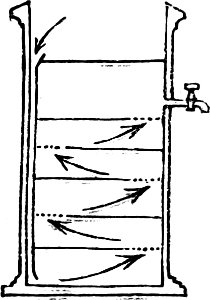
Fig. 339.
Terra-cotta stoves, of simple and effective construction, are also extensively made at these works. In “Sunderland Ware”—i.e. brown ware, white inside—cream pots, starch pans, milk bowls, dishes, trays, and basins are largely manufactured.
Chemical apparatus—receivers, retorts, evaporating dishes, condensing worms, filtering and other funnels, still heads, &c.,—are a speciality in these works, and are of high repute.
These various goods were thus spoken of in the Official Report of the International Exhibition, 1871:—
“Mr. Bailey exhibits some samples of well-made chemical ware of a highly vitreous and durable body, consisting of acid tanks, retorts, receivers, condensing worms, and other vessels. He sends one or two specimens of sewer pipes, well burnt, and of dense body. His contribution of Bristol ware, for excellence of make, glaze, and colour, is equal to any exhibited, and comprises, among many other things, an ingenious ascension filter, in which, by a certain arrangement of stoneware discs in the interior, the water is more exposed to the filtering material than in ordinary filters. A churn, entirely constructed of stoneware, by this exhibitor, is also well worth notice; it is stated to be exceedingly rapid in its action.”
In terra-cotta, the Fulham Works now produce vases, statues, architectural enrichments, chimney shafts, stoves, &c., of very good quality and of admirable design; Mr. R. W. Martin, sculptor, student of the Royal Academy and Government Schools of Art, having been engaged as modeller and designer. The productions in this department are of a very high order of merit, and will take rank with those of any other manufactory. The brackets and jardinières are of great beauty, and are characterised by a pure artistic feeling and a touch such as is seldom attained; the pieces bear evidence of being not only modelled by a clever artist, but of receiving finishing-touches by the master-hand itself. In colour the Fulham terra cotta is a light pink and a rich red, and, when these are combined, a peculiar delicacy and finished effect is produced. The mark R. W. Martin fecit occurs on the productions of this artist.
The manufacture of china ware was, during the year 1873, very wisely and successfully added to this establishment, and, with the aid of the good workmen and artists who have been engaged, has already done much to establish a fresh fame for Fulham. The art direction of this branch was placed by Mr. Bailey in the hands of Mr. E. Bennet, a well-known sculptor, while the china body flowers, &c., were undertaken by Mr. Hopkinson. I am the more particular in stating these arrangements as, being the beginning of a new manufacture, I am desirous of putting on record the circumstances of its commencement. The “body,” it may be well to note, is made from Dwight’s original recipe—the very body of which the first china ware made in England was produced—and therefore the “Fulham china” of to-day has an historical interest attached to it which is possessed by no other. It was a wise thought that induced Mr. Bailey to restore to Fulham the special manufacture which has rendered its name famous in the ceramic annals of this country; and it is to be hoped that the spirit he has shown will be amply compensated by a liberal patronage of his productions.
The marks used by Mr. Bailey are:—

At the 1871 Exhibition (at which no medals were given) Mr. Bailey’s productions were highly spoken of in the Official Report; and at the Dublin Exhibition of 1872 he was awarded a medal for his terra cotta and stoneware.
Lambeth.
Lambeth has been a seat of pottery manufacture from an early period. In mediæval times the characteristic brown-ware pitchers, pans, tygs, &c., were made; and, later on, at this place was quite a colony of makers of Delft ware, who in turn gave place to stoneware manufacturers. China, too, appears to have been made at Lambeth from perhaps 1760, or thereabouts. It is recorded that in the middle of the seventeenth century the Delft ware manufacture commenced; but it is not unlikely that Rous and Cullyn, some years earlier, here established themselves in the making of “stone potts, stone jugs, and stone bottels,” for which they received a patent in 1626.[50] It is conjectured, and with some probability, that one of the Delft ware makers at this place was John Ariens Van Hamme, a Dutchman, who had come over from the Hague under the encouragement of our ambassador, who, as has already been shown,[51] took out a patent in 1676 for the “art of makeinge tiles and porcelane and other earthen wares, after the way practiced in Holland,” and who, with his staff of workmen, probably formed the nucleus of what was afterwards a nest of potters, comprising, according to the “History of Lambeth,” no less than twenty manufactories. In 1693 a trial took place in the Court of Exchequer concerning some parcels of potter’s clay which had been seized by the Custom House officers, under pretence that it was fuller’s earth. In this trial five London potters, William Knight, Thomas Harper, Henry De Wilde, John Robins, and Moses Johnson, gave evidence in favour of the clay being potter’s clay. There is nothing in the record of this trial to identify any of the five potters therein named with Lambeth; but the probability is that some of them belonged to that place. One of them, William Knight, was undoubtedly the “William Knight of the parish of St. Buttolph Without, Aldgate, London, Pottmaker,” concerning whom I give, from the original deed in my possession, some particulars under the head of “Aldgate;” some of the others were, I believe, of Lambeth. The account of the trial has been printed by my friend, Mr. Reeks, in the “Catalogue of the Museum of Practical Geology,” and is so interesting that I here reproduce it entire.
A Brief Account of the Evidence given on behalf of Edmund Warner, at a Tryal had at the Bar the 24th of November, 1693, before the Four Barons of the Exchequer, relating to a Parcel of Potters Clay, seized by the Custom-House Officers, under the pretence of it’s being Fullers Earth.
William Riddal swore that he was Steward and Tenant to the said Warner for above 20 Years, in all which time the said Warner constantly sold to the Potters in London considerable quantities of the same sort of clay now in dispute, for the making of White and Painted Earthen-Ware: That he never knew or heard that the least Parcel of it was ever sold as Fullers-Earth, or put to any other Use than making Earthen-Ware, excepting some small quantities yearly in the Neighbourhood for daubing of Houses, which may be alledged as a good Argument that the said Clay is not of the nature of Fullers-Earth; for, whereas this makes the best Clay Wall in England, if it were of the nature of Fullers-Earth, upon the first wet Weather it would all fall to the Ground: He likewise further deposed, That the first time the said Warner shipt the said Clay for Holland, it was seized by the Custom-house Officers as Fullers-Earth; but upon Tryal of it, they were convinced of their Error, and cleared the same.
William Knight, Thomas Harper, Henry de Wilde, John Robins, Moses Johnson are all Potters in London, and swore that they had all seen the said Warner’s Clay, which was seized, that it was really Potter’s Clay, and of the same sort which they had constantly bought of him, some for above 25 Years, others ever since they were Traders, that it is of a quite different nature from Fullers Earth; for the said Warner’s Clay tho’ never so often dissolved in Water, may be brought into a Body again, and will work, like Wax, into any shape, whereas Fullers Earth being once dissolved is never to be got into any Body, but when it is dry crumbles like Sand, and all the art of Man can never make a Pot of it.
Hen. de Wilde, one of the said Potters, farther deposed, That about five Years since he shipt some of the said Warner’s Clay for Pensilvania, where his Son had set up a Pot-House, that the Custom-House Officers did then likewise seize it as Fullers-Earth, but upon Trial of it found they were mistaken, and cleared the same.
Benjamin Furly, Merchant in Rotterdam, to whom the said Warner consigned his Clay, John Sonman, Servant to the said Furly, were, by virtue of a Commission from the Court of Exchequer, examined upon Oath (by Commissioners appointed for that purpose), to several Interrogatories, and their Depositions being read in Court, did plainly prove that all the said Warner’s Clay which was sent for Holland was really sold to Potters for making of Earthen-Ware; That they never heard, nor do believe that any part of it was ever used for the Fulling Trade, or is any way proper for it; that they sold the said Warner’s Clay from 25 to 30 Guilders a Last, when they could buy Fullers-Earth at 7 Guilders a Last.
Adrian Van Arde, sworn Measurer of all the Earth and Clay imported to Rotterdam, was examined by vertue of the said Commission, and Deposed, That for many Years which he had been in that Office, he never knew or heard of any English Fullers-Earth imported into Holland, that they were so plentifully supplied with that sort of Earth from Flanders; that it is commonly bought and sold at Seven Guilders a Last, and had an Hundred Last by him to sell at the same Rate.
Ten or Twelve Potters in Holland were likewise examined by virtue of the said Commission, and deposed severally, That they had bought considerable quantities of the said Warner’s clay of Mr. Benj. Furly, and paid for the same from 25 to 30 Guilders a Last; that they used the same in making Earthen-Ware, but do not believe it any way useful for the Fulling Trade, nor never heard that any of it was ever sold for that use.
Colonel Holt, a Member of Parliament, swore, That he (being very lately in Holland) made the strictest inquiries into the Truth of this Business, that he could, First amongst the Potters, who all declared to the same Effect, as in their Depositions before mentioned, that he likewise took some of the said Warner’s Clay, and got a Fuller to try it, whether it were any way useful for their Trade, who answered it was not? nor could he use it if he might have it for Nothing; after which the Colonel ask’d him, From whence they were supplied with Fullers-Earth, and at what Rates? The Fullers answered, generally from Flanders at 6½, and 7 Guilders per Last; and sometimes from Rosendale, in the States Dominions, at 10 Guilders per Last; that being much dryer, and wasted less by lying; all which the Colonel (being unwilling to believe upon the Fuller’s bare word) caused to be drawn up in the Form of an Affidavit, and the Fuller before a Magistrate, swore to the Truth of it, which Affidavit the Colonel hath to produce.
Mr. Edward Paget, a Divine, swore, That he being in Holland at the same time, made the like Enquiry amongst the Fullers at Layden, the chief cloathing Town in Holland, who all gave him the same Information, that the Fuller at Rotterdam had done the Colonel above; and for his better satisfaction, Three of the Chiefest went with him before a Magistrate, and swore to the Truth of what they Affirmed; after which he went to Delft amongst the Potters, who all affirmed the same thing, that the Ten or Twelve had sworn in their aforementioned Depositions, the Truth of which they attested by a Certificate, under the Hands of above Twenty, which Affidavits, and Certificate, the said Paget hath to produce.
Rich. Cutler, Matthew Hanson, Ship-brokers, swore, They had hired many Ships for the said Warner, to load Clay for Rotterdam; and the general Price of the Fraight, and Primage paid for the same, was 15 Guilders, 8 Stivers per Last; and sometimes 17 Guilders, 12 Stivers per Last.
Will. Read, Tho. Wood, John Saliby, Mariners, swore, They had the same Prices above mentioned, for several Fraights which they carried, and saw delivered to the Potters in Holland.
Hump. Bellomy, Richard Hopkins, Timothy Fowler, —— Shepherd, Worcester, are all Buyers, and Sellers of Fullers-Earth, and swore they could well judge of the same, having dealt therein from Ten to above Twenty-five Years, that they all took Samples of the said Warner’s Clay, out of the King’s Celler, and tryed all the Experiments to judge of it, that they were capable of; and possitively affirmed that it was no Fullers-Earth; neither could they find anything of the Nature of Fullers-Earth in it, that for their Use they would not give a Shilling for 100 Last, for they should never be able to sell it.
Alderman Bearcraft, Tho. Cooksey, John Wynn, Rowl. Hancock, Gloucestershire; Rich. Osborne, Tho. Woorrel, John Chilton, Sam. Beadle, Essex; Simon Meazy, John Lawson, John Backer, John Peartree, Suffolk; John Clarke, Senior, John Clarke, Junior, Will. Baines, Tho. Baines, Dan. Baines, John Smith, John Carter, Dan. Wenden, Sam. Wrinch, London; Dan. Barrs, John St. Berry, are all Clothiers, Fullers, and Cloth-Workers; being the most eminent in their several Places; as well for Honesty, as great Traders, and good Estates; they all swore they had made the most impartial Experiments they could of the said Warner’s Clay, now in dispute, being the same taken out of the King’s Celler, that they tried it upon several sorts of Goods, as several sorts of Cloth, Bays, Cloth-Serges, and Perpetuanæs, and every one possitively affirmed that it was no Fuller’s-Earth, but on the contrary was an absolute Enemy to the Woollen Manufacture; for instead of scouring, it fix’d the Grease in the Grownd of all the Goods, that were done with it, and instead of makeing them White, it absolutely stained them Yellow, all which was apparent to the most common Eye, in all the above-said several sorts of Goods, produced in Court: They likewise declared upon Oath, that they were all Strangers to the said Warner; and that it was as prejudicial to their interest, to have Fullers-Earth Transported, as any men’s, and therefore could have no Inducement to favour the said Warner, beyond the Merits of his cause, to the Violation of their Consciences.
This is so just a Recital of the Evidence given on behalf of the said Warner, that he challenges the greatest of his Enemies to detect him of the least Falsehood therein; and if his Adversaries had been as fair in representing theirs, there would have been no need of this; for whereas in their printed Papers they make their Witnesses to affirm the said Warner’s clay was tried in all Experiments, without any mixture, there was not above One or Two, but upon cross-Examination at the Tryal, owned they used either Segg and Hogs dung, or Soap and Gauls with it, which would have scowered any Cloath better without the said Clay than with it.
It may not be amiss likewise to observe that for a whole Year in which the Custom-House Officers have been so very diligent in spreading the Fame of the said Warner’s Clay to be the best Fullers-Earth in England, he hath not been able to sell the least quantity of it as such, tho’ he has proffered it to all Men for a very little more than one-Third of what Fullers-Earth is generally sold for.
The Delft ware here made was of the ordinary kind, same as imported from Holland, and as that made in various English localities, and, being without mark, is not to be distinguished from others. Besides tiles, plates, jugs, mugs, dishes, &c., sack and other wine bottles, apothecaries’ pill-slabs, wine-bin labels, &c., were made. Some of these pill-slabs are preserved in the Jermyn Street Museum, as are also some of the “sack-pots,” both of which may most probably, as well as the apothecaries’ jars, be ascribed to Lambeth. They are all of Delft ware, painted with blue, in the same manner as the tiles and other articles of this ware.
In 1820 there “were six or seven potters in Lambeth,” says Mr. Goddard, “working some sixteen small kilns, of seven or eight feet in diameter, the produce of each kiln being under £20 worth of ware, the principal articles made being blacking bottles, ginger-beer bottles (very extensively made still), porter and cider bottles (not so largely made now), spruce-beer bottles (gone, with the beer, quite out of fashion), ink bottles (more used now than ever), oil bottles, pickle jars, hunting jugs, &c. A few chemical vessels were also turned out well from one kiln belonging to an eccentric individual, whose chief boast was to drink a gallon of beer a day, and do without rest on Sundays.” In 1860: “In place of some sixteen kilns, turning out each under £20 per kiln, we have now about seventy, turning out each, perhaps, on an average £50. They consume upwards of 20,000 tons of coal, paying a corporation tax of say £2,100 per annum. The law requires this quantity to be burnt without smoke, and, after immense cost and labour, this difficulty may be called surmounted. Twenty-three thousand tons of clay are annually changed into useful articles, giving employment to more than eight hundred persons. The returns of the Lambeth potters cannot be estimated at less than £140,000.”
High Street.—From about 1750 to 1770 the Delft ware works were carried on by a Mr. Griffiths, who had, for those days, a large establishment. A curious reference to this manufactory occurs in the following extract from the Monthly Magazine for 1797. A man, at that time unknown, but who turned out to be James Doe, a potter, committed suicide by drowning, on the 14th of September in that year, at Sea Mill Docks, two and a half miles from Bristol, having remained “fasting and praying,” without food or bedding in the ruined building there from the 11th, waiting opportunity and determination to commit the rash act; and having, during the whole of that time, written a kind of diary of his feelings and intentions, his hopes and fears, on the walls of the old room he remained in. Mr. Joseph James interested himself much in the matter, and wrote an account for the Monthly Magazine; and this, and the inquest, and other means he took, resulted in the discovery of the name and some particulars of the life of the suicide. Two of the letters forwarded in October, 1797, are highly interesting as showing at what works he had been employed. The first letter is from London, from “a respectable proprietor of a pottery there,” and thus runs:—
“To the Editor of the Monthly Magazine.
“Sir,
“The extraordinary and affecting manuscript writing of the unfortunate stranger found drowned in Sea-Mill Dock, which I transmitted to you last month, having very probably excited the attention and sympathy of many of your numerous readers, I feel it a duty incumbent upon me to lay before them (through the channel of your useful publication) some information which I have since been enabled to procure of this unhappy and extraordinary person.
“A few days previous to the publication of your magazine, I caused a paragraph to be again inserted in the Bristol newspapers, requesting the attention of the readers to the personal description of the stranger found drowned at Sea-Mill Dock, and inviting the two women who had made inquiries after a stranger that was missing, and answering the same description, to come forward with their information, as the only probable means left of tracing out the name and connections of this unfortunate stranger. I was soon after waited on by two gentlemen of Bristol of the name of Ring, the proprietors of a large pottery, whose information and description of a person lately come to Bristol, and who worked in their manufactory, in the art of painting china, so exactly corresponded with the clothing and person of the man found drowned at Sea-Mills, that there remained not a doubt of his being the person, the subject of their inquiry. Through their polite assistance I obtained the name of the deceased, which is James Doe, and I also got an interview with the K—f—m acquaintance, who, having visited the tenement, and viewed the manuscript writing there upon the wall, recognised the handwriting of his friend; he gave me likewise a description of his person and dress, which corresponded with that already published. For particulars of the deceased’s family and friends, I was referred to several persons in London, one of whom, a respectable proprietor of a pottery there, writes thus:—
“‘Sir,—I received yours, and was much affected at its contents. I should have written sooner, but I wished first to see his uncle, who has informed me of the following particulars:—
“‘James Doe was born at Lambeth, in Surrey, of very respectable parents, and was educated in the same place. He served an apprenticeship at Lambeth to a painter in the china and earthenware line, and he painted in the biscuit before it was glazed. In this line he was esteemed a good workman; and, to my own knowledge, he worked some years at Mr. Wedgwood’s manufactory in Staffordshire. He was there very much respected by his employer, his fellow-workmen, and by all who knew him. He was fond of company, but I do not remember him to neglect business when urgent. Having a tolerably good education, he was fond of reading. He was particularly generous, and always first to relieve any of the trade out of employ or in sickness. He worked at Mr. Baddely’s, in Staffordshire, for six or seven years, and was, at that place, very much respected. In fact, I believe him to be generally beloved and respected wheresoever he worked. About three years ago he came to London, and finding little or no employment in the line in which he was brought up, he was obliged to leave town, and, being assisted by his friends, he embarked on board a ship for Newcastle, and from thence went on to Glasgow in Scotland, where he was a fellow-workman with one of my present journeymen, and supported an excellent character there. From this time, I believe, he met with many disappointments. He then went to Ireland, and, after stopping there a short time, he embarked on board a vessel bound for Swansea, in South Wales, where he worked some time, and then went on to the Worcestershire China Manufactory, which was, I believe, the last place he worked at.’”
The following is an extract from the letter alluded to:—
“‘London, Nov. 20, 1797.
“‘Sir,—
“‘You seem to be very anxious concerning the life of the unfortunate stranger found drowned in Sea-Mill Dock. You have a right to know it, for the kindness you have shown to his unfortunate remains. James Doe was born at Lambeth, about two miles from London, of honest parents, who brought him up in as creditable a manner as their circumstances would admit. At the age of fourteen years, or thereabouts, he was put as an apprentice to Mr. Griffiths, at the delft pottery, High Street, Lambeth. When he was out of his time, he continued working at his business until he became slack; and the queen’s ware meeting with great encouragement, he went into Staffordshire for employment, where he remained upwards of twenty years, working for different masters, and then came up to London, in want of employ, and got work at China-gilding for a few months. He was then invited into Staffordshire again, where he remained but a short time: and from that time he has been considered the wanderer of the trade. He was the most charitable man I ever knew; and he was often known to neglect himself when misfortunes came on his friends and acquaintances, to whose relief he contributed both time and money, as much as lay in his power. Believe me, Sir, you have bestowed your trouble on the remains of a very good-hearted man. The acquaintance he alluded to in his diary, and another person, were going to France, about thirteen years ago, with a view of carrying over and establishing there the queen’s-ware manufactory; some of the master potters heard of it, and had them confined in prison. As soon as James Doe heard of it, he went through the trade to gather money to support his friend, and to preserve him from want; and he, poor soul, contributed all he had, for that purpose. To be denied assistance by that man whom he had relieved in distress, was too great for his tender heart to bear. Sir, I do not pretend to hold my friend up to perfection, the last action of his life is against him; but, I believe, the denial of relief by that man whom he had served and relieved in distress was the sole cause of his committing the rash act of suicide. The language of the manuscript writing is nearly the same as his last conversation with me, as far as this friend is mentioned. I perfectly agree with you, that he was in his senses as much as he ever was in his life, when he committed the act of suicide. He was acquainted with a Mr. Greenwood in Staffordshire for some years, a man remarkable for fine knowledge; to that man the unfortunate Doe owed a great deal of his knowledge; and although Mr. Greenwood was a very sensible man, yet he held it just for a man to destroy himself, and, like my friend, in his perfect senses, actually made away with himself the day before he was to have been married to a person of credit and property. They are two of the strangest suicides I ever heard; and had James Doe written to his friends in London, he would have had money sent him; for his friends in London would have thought it a happiness to relieve him. He was a very useful man in the Staffordshire ware manufactory, as he had studied the chemical secrets of that business. He was fond of reading. I shall be happy to communicate any further particulars you may require; and am, Sir,
“‘Yours,’ &c. &c.”
In the possession of Mr. R. C. Ring is a mug painted by Doe—said to be his last work. It is signed “J. Doe, Sept., 1797;” and as he committed suicide on the 14th of that month, it would certainly be one of his last productions. Mr. Owen’s assertion that he committed suicide through a fear that that painting would injure the enameller’s trade is, from the above letters, &c., amply shown to be without foundation.
Coades.—Coade’s Artificial Stone Works, at Pedlar’s Acre, King’s Arms Stairs, Narrow Wall, Lambeth, opposite Whitehall Stairs or Ferry, were established about 1760 by Mrs. or the Misses Coade, under the name of “Coade’s Lithodipyra, Terra Cotta, or Artificial Stone Manufactory.” This material was intended to take the place of carved stone for vases, statues, and architectural enrichments. In 1769 the two Misses Coade took into partnership their cousin, a Mr. Sealy (the nephew of Mr. Coade), and by these the works were carried on. In 1811 the firm was still “Coades & Sealy.” At the death of Mr. Sealy, who survived the Misses Coade, a Mr. Croggan, who had for a long time been a clerk or manager attached to the business, became the proprietor of the works, which he continued for many years. He then disposed of the business to Messrs. Routledge, Greenwood, & Keene, who were succeeded by Messrs. Routledge & Lucas. These gentlemen, about 1840, dissolved partnership and sold off all their moulds, models, plant, &c., by auction, by Messrs. Rushworth & Jarvis, of Saville Row. Many of these moulds and models were bought by Mr. Blashfield[52] and by other manufacturers, among whom was Mr. H. M. Blanchard of Blackfriars Road[53] (which see), and who, being an apprentice with the Coades, and possessing many of their models, &c., claims to be their successor.
The Coades are said to have come from Lyme Regis, in Dorsetshire, and probably it was for the purpose of turning their native clay to good account in London that induced them to establish this manufactory. Bacon, Flaxman, Banks, Rossi, and Panzetta, the sculptors, were employed to model for these works, and many of the old mansions and public buildings in London and in the country, as well as abroad—including the bas-relief in the pediment over the western portico of Greenwich Hospital, representing the death of Nelson, designed by Benjamin West, and modelled by Bacon and Panzetta; and the rood-screen of St. George’s Chapel, Windsor; the statue of Britannia on the Nelson monument at Yarmouth, &c.—were executed at these works. The works principally produced at Coades were capitals of columns, statues, vases, bassi-relievi, monuments, coats of arms, keystones, angle rusticated blocks, balustrades, &c. They were of durable quality and excellent manufacture.
Another person employed at Coades was William John Coffee, who afterwards attained some celebrity as a modeller at the Derby China Works, and as a terra cotta maker, for a short time, at Derby. I believe he was employed as a fire-man at Coades, and here, no doubt, being a clever fellow, picked up his knowledge of modelling and of mixing bodies. The following curious letter and “information,” from the originals in my own possession, give some highly interesting particulars regarding Coades’ and Sealy’s manufactory in 1790:—
“The information got from the fire-man that worked at the Artificial Stone Manufactory, Lambeth:—There is three kilns, the largest is 9 feet diameter and about 10 feet high, the other two are sizes under; they have only three fire-holes to each, and they are about 14 inches in the clear. They make use of no saggers, but their kilns are all muffled about two inches thick, which was always done by this fire-man. They always was four days and four nights of fireing a kilns, and the moment the goods are fire’d up he always took and stop’d the kilns intirely close from any air whatever without lowering the fires at all. He has been use to fire intirely with coal (which are call’d Hartley coals—they are not much unlike yours at Derby). He never made use of any thermometer, but depended intirely on his own knowledge. The composition shrinks about half an inch in a foot in the drying, and about the same in the firing. A great deal of the ornaments are 4 inches thick when fired, and he has fired figures 9 feet high. This man has had the intire management of building the kilns, setting and firing them for many years; his wages was one guinea per week, and for every night when he fired he had 2s. 6d. for the small kiln, 3s. for the next size, and 3s. 6d. for the largest.
“Sir,—Quite unexpected, the fire-man from Lambeth that I have been after so long, call’d on me on Monday, to say that he was out of imploy; therefore I engaged him to meet me at Field’s in the evening, which he did; and inclosed is all the information I cou’d get from him. I informed him that when I wrote to him in the country I was imploy’d to look out for a person in his way, but did not know wether there was now the same person wanted or not, but wou’d write. At the same time I ask’d him if he shou’d like to go down into the country to make a trial for a short time, and see how he was likely to succeed; but this he seem’d to decline for some time, unless he went upon a certainty for constant imployment. After drinking a bowl of punch, he said he wou’d go down to make trial, in case his expences was all paid up and down, and paid for the time he was away. He seems to think, before he cou’d attempt doing any thing, there must be some alteration made to the kiln; but of this you will be the best judge, if you agree to have him down. He seems pretty confident they will be glad to have him back to Lambeth again very soon: in short, he thinks they cannot do without him. He says they had better a made him a present of £500 than a parted with him. I have been inform’d thro’ another hand that had use to work at the manufactory they have had very great losses in the kilns since he left, and that they have lost everything in the large kiln. He seems very confident in succeeding in firing China figures to any size; but of this he cannot be a judge till a trial is made. After I first see this man, I went and inform’d Mr. Vulliamy of it, and his advise is to for you to have him down, tho’ he says he is a drunken bad chap, but clever in his business. If you shou’d so determine to have him down, I think sooner the better, as he expects soon to be call’d to Gen. Conway’s[54] again, and likewise to fire some figures, &c., for a Mrs. Dimer,[54] in town. He has promis’d to call again in a few days, therefore you will please to give your answer. Mr. Vulliamy very much wants two boys of the last mould sent: begs you will forward them immediately. Mr. V. inform’d me a few days since that he would write to you the first opportunity, and am,
“Sir, your very obedient servant,
“J. Lygo.”
“March 23rd, ’90.”
In 1792 the following letter, also in my own possession, was addressed to Coffee by Miss E. Coade, and shows what a clear-headed, right-minded, and well-disposed employer she was:—
“Lyme, 25 July, 1792.
“Mr. Coffee.—I received your third letter, but have had so many engagements that I cou’d not answer it sooner; besides that at this distance I can’t speak upon it as if I were present. I supposed, as you now say, that Mr. Pritchard’s information against you was in consequence of some quarrell you had had with him; but I do not justify his manner of taking revenge, and you are now returning it upon him by acquainting me of his making tools in my time and selling them, which, as you say, is a greater crime than what he has charged you with, and if Mr. Sealy knew it, I can’t suppose he wou’d keep such a man. But it is always a rule with me to let every man speak for himself if he can; and, therefore, as I am at such a distance I must put it by for ye present, or else refer it to Mr. Sealy, who is ye only judge whether ye hurry of business will allow of parting with a man or not. You shou’d put yourself in ye place of a master, and then consider how many things they have to try them, and how impossible to attend to ye private quarrells of ye workmen: however, I know Mr. Sealy is disposed to do justice. You say he behaved very well to you in ye beginning of this affair, and if he changed his conduct, it must be in consequence of your improper behaviour to him. But as it is too late to recall what is past, my advice to you is to do as you say—return to your work; and if you are conscious that in your passion you have behaved disrespectfully to Mr. Sealy, make such acknowledgments to him as will show your good sense, as well as a sense of duty. I have no doubt but he would have lent you money if you had asked it in a becoming spirit. I hope your hand is better and that you are at work. And wishing you may improve this accident to your own good, I remain
“Your sincere friend,
“E. Coade.
“My best wishes to Patty. I did not know but I shou’d have been up by this time, but I hope it will not be long.”
The London Pottery is in High Street, Lambeth. It was established on a small scale in 1751, on a portion of old “Hereford House,” the palace of one of the former bishops of Hereford, and has been carried on without intermission, from that time to the present. In 1840 the manufactory came into the hands of Mr. James Stiff, the head of the present firm of “Messrs. James Stiff & Sons.” At that time the works consisted only of two kilns (the larger one being only about ten feet in diameter), and covered an area of probably less than a quarter of an acre of ground. Since 1840 it has been gradually developed, until at the present time it comprises fourteen kilns (some of them more than twenty feet in diameter) and covers an area of about two acres of ground. It has a very extensive frontage on the Albert Embankment, overlooking the river Thames, and by means of a private dock, with entrance under the Embankment, is enabled directly to carry on a very extensive export trade, and also to import most economically the coals, clay, and other raw material used in the production of brown and white stoneware, terra-cotta, &c. Until 1860, when fresh buildings were erected, a Delft-ware sign-board existed in the front of this pottery.
The four principal kinds of pottery manufactured by Messrs. Stiff and Sons are: 1. Brown salt-glazed stoneware, in which the tubular socket drain-pipes so extensively made here are produced; water-filters, jugs, bottles, jars, and all kinds of chemical apparatus are also made in this class of ware. 2. White stoneware or “double-glazed” ware, or “Bristol ware,” in which salt is not used, but the glazing is obtained by the application of a liquid glaze to the interior and exterior of each article before it is placed in the kiln. This ware, which is generally made with a rich yellow ochre on the upper parts of goods, while the lower part is of a creamy-white colour, has only been introduced into Lambeth about twenty years. It has, however, to a considerable extent superseded the old brown stoneware, on account of its superior appearance and cleanliness. 3. Buff terra-cotta, in which is made garden vases, pedestals, chimney-tops, window arches, string-courses, &c. This terra-cotta, being thoroughly vitrified, is valuable for the manufacture of keystones, springers, string-courses, &c., for buildings where durability is of the very highest importance; one great advantage (for architectural purposes) lying in the fact that, in it, the choicest and most elaborate patterns, either raised or countersunk, can be obtained at little more than the cost of perfectly plain stone. 4. Porous ware, in which round and square porous cells, plates, &c., are extensively made, and have been used by some of the first telegraphic engineers, philosophical instrument makers, &c., of the day, and have given much satisfaction, securing, as they do, the greatest amount of porosity, together with a degree of hardness and fineness of texture which render them insusceptible of disintegration.
The quality of the stoneware or “Bristol ware” produced at the “London Pottery” is remarkably good, being extremely hard, and covered with an excellent, clear, and firm glaze, not surpassed by any other house. The same remark will apply to the porous ware, which is fine in composition, and possesses to an eminent degree the porous quality so essential in vessels of this description. The terra-cotta goods are of very fine, hard, and durable quality, and of a peculiarly pleasing tone of colour. Their artistic execution is of a high order, and some of the designs—as notably the draped bowl and flower-pots which are engraved on Figs. 340 to 342, and 345, 346.
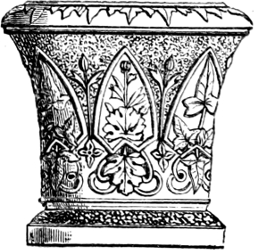
Fig. 340.
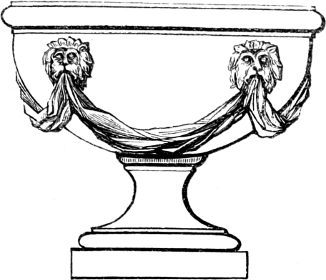
Fig. 341.
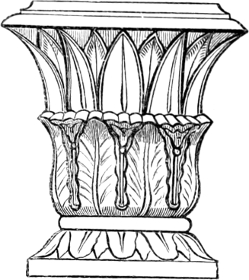
Fig. 342.
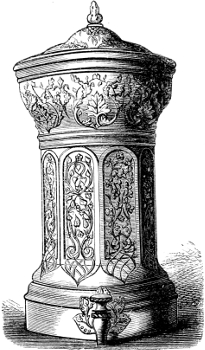
Fig. 343.
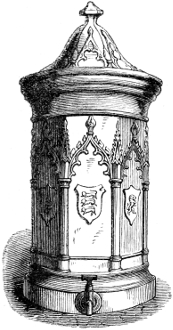
Fig. 344.
Fig. 345.
Fig. 346.
Messrs. Stiff & Sons produce a large number of filters of excellent construction and of artistic design. Some of these have Gothic arches, with figures or armorial decorations, and others are decorated with elegant foliage; two of these effective designs are shown on Figs. 343 and 344. These filters have been more than thirty years before the public. The filtering medium consists of alternate layers of charcoal, silica, and another purifying substance, all carefully cleansed, and so arranged as to retain full efficiency for eight or ten years without further cost or trouble. The “Popular” filter—intended for common use among all classes—purifies eight gallons of water per day, and is sold complete and fitted for a mere trifle.
The potteries of Messrs. Stiff & Son are among the largest in London. They employ about two hundred hands, and their annual import of raw material, clay, coals, &c., is about 15,000 tons. They have business relations in almost all parts of the world, and their manufactures have been admitted to the principal International Exhibitions; their terra-cotta vases combine excellence of finish with correctness of design, and are sold at very moderate prices. Their stoneware chemical apparatus has a very wide reputation, and their drain-pipes and other sanitary appliances, comprising nearly two-thirds of their business, have an immense sale.
It is well to add that at this pottery antique jugs and water-jugs, of excellent design and clever manipulation, are made. The forms are chaste and good, and they have, partly owing to the care in making, and partly to the fineness of the glaze, a pleasanter feel to the hand than others. The carriage and foot warmers, &c., made here are also extremely good in quality and design.
The Lambeth Pottery.—In 1818 Mr. John Doulton established stoneware works at Vauxhall, and soon afterwards was joined in partnership by Mr. John Watts, the business being carried on under the style of Doulton & Watts. Some years after, the works were removed to High Street, Lambeth, to premises near those which had formerly been occupied by Mr. Griffiths, already spoken of. In 1858 Mr. Watts died, and from that time to the present the manufactory has been carried on by Mr. John Doulton in co-partnership with his sons, under the style of Doulton & Watts, and Henry Doulton & Co. In 1854 Mr. Henry Doulton took out a patent for “improvements in kilns used in the manufacture of stoneware, earthenware, and china.” In 1859 he took out another patent for “improvements in earthenware jars and bottles,” and in 1861 the same gentleman also patented his “improvements in the construction of vats and similar vessels for containing liquids.” At the Exhibitions of 1851 and 1862, medals were awarded to this firm, as they were also at the Exhibitions at Paris, Hamburg, Oporto, New Zealand, Auxerre, Caen, and Amsterdam. At the International Exhibitions of 1871 and 1872 they also received the highest commendation.
The goods manufactured by Messrs. Doulton & Co. include chemical vessels of large size (up to 500 gallons) and all kinds of stoneware suitable for the laboratory and works of the manufacturing chemist—jars, bottles, jugs, water-filters, and other articles of domestic use; terra-cotta for architectural and gardening purposes; drainage pipes, irrigation conduits, sinks, and all kinds of sanitary ware; plumbago and other crucibles, muffles, furnaces, &c.: and, in addition to their manufactory at Lambeth, they have works for the manufacture of sewer pipes, fire goods, blue bricks, &c., at Rowley-Regis, Staffordshire; Smethwick, Staffordshire; and St. Helen’s, Lancashire. The various kinds of stoneware and terra-cotta produced by Messrs. Doulton at their Lambeth works give employment to about six hundred men; and their consumption of coals at Lambeth alone (exclusive of the quantity used in their Staffordshire and Lancashire factories) is over 10,000 tons per annum.
Fig. 347.—Doulton Ware.
Figs. 348 to 353.—Doulton’s Vases, Filters, &c.
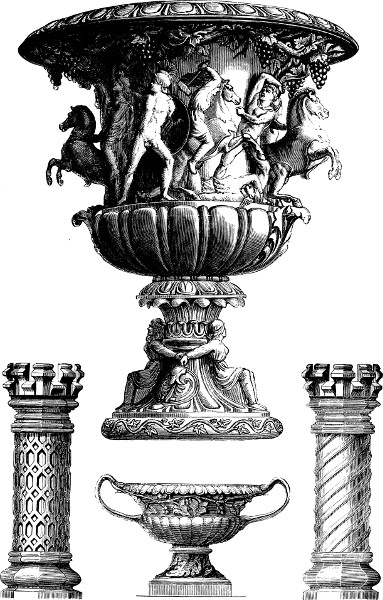
Figs. 354 to 357.—Doulton’s Terra Cotta.
In stoneware—which, like every other branch of the ceramic art, has made great progress during the last twenty or thirty years, and has been made applicable to scores of purposes never dreamed of by the potters of old—Messrs. Doulton produce, to a very large extent, bottles, jars, pitchers, and jugs; troughs and pans; feet, carriage, bed, and other warmers; barrels and taps; filters, filter-stands, and drip-pans, and every possible variety of household vessels. Besides these, force-pumps, retorts, receivers, condensing-worms, still-heads, evaporating dishes and pans, filtering-funnels, percolators, and every other conceivable kind of chemical and manufacturing vessels and apparatus, as well as drain-pipes, gullies, sinks, and sanitary goods, are largely made.
Many of the productions in this stoneware are of extremely artistic character, and evince a purity of taste which is highly meritorious. Some of the jugs and tankards, from antique examples, and which are produced both in brown, blue, claret, and fine white stoneware, are remarkably chaste and elegant, and remind one of the best periods of German and Flemish art. The forms are admirable, and the decorations, whether foliage or animal, incised or in relief, are always thoroughly well considered, and especially adapted to the material, the mode of production, and the use of the object. “There are no affected imitations of antique types. The spirit of true design is caught with admirable perception and insight, and when colour is introduced, it is done sparingly, and with a view to enhance the form of the object and the natural beauty of the material, rather than to conceal either the one or the other.”
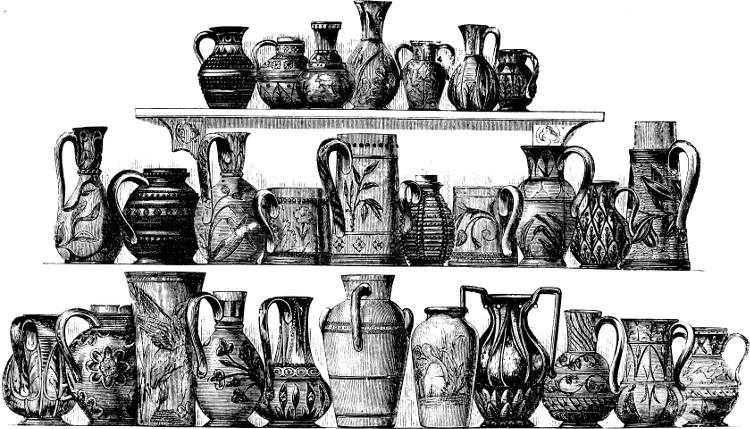
Fig. 358.—Group of Doulton Ware.
In terra-cotta, Messrs. Doulton’s works rank high, both for the beauty of their productions, the variety of designs they have introduced, and the durability and excellence of their material. In vases for gardens, &c.—the finest of which is their Amazon vase (Fig. 354) sent to the Exhibition of 1871—Messrs. Doulton produce a large number of exquisite patterns, as they do also of pedestals, fountains, garden-seats, flower-boxes, and vases, fern-cases, flower-pendants, mignionette-boxes, brackets, terminals, &c., which are all characterized by extreme excellence of design and workmanship. In statuary and architectural decorations the productions consist of figures, busts, and medallions; keystones, arches, trusses, and string-courses; capitals, bases, and finials; window and door heads and jambs; rain-water heads, of marvellously bold and effective design; parapets and balustrades; panels of coloured stoneware and terra-cotta, modelled in very high relief, and mostly of scriptural subjects, for out-door decoration; tiles and bosses of endless design—some ornamented in the sgraffito style, and others richly coloured; and everything requisite for the architect or the builder. Of terra-cotta flower-pots and fern-cases a large variety are made, all elegant in shape—some ornamented with masks and medallions, and others with vegetable composition; and of brackets and pendants the specimens are very graceful. Painting on pottery has also of late been introduced into this manufactory with very good results.
One class of objects to which attention should be called, presents, in ordinary clays, adaptations in which is conspicuous all the play of the chastest Greek contours, with all the forms dear to successive generations of housewives before the revival set in. Prominent are claret cups, loving cups, hot and cold water jugs, flower vases, candlesticks, hunting jugs, pitchers, and inkstands, with a great variety of other vessels. “What particularly arrests the eye in this branch of the manufacture is, that each object has a style which now takes us back to the flowery periods of Doric and Etruscan forms, now to the days of mediæval hospitalities, or to modern instances, by vessels of form and capacity which would delight even the hearts of the notoriously beer-loving Burschenschaft of Jena. And it is necessary to explain that, as these works are not the results of the common course of earthenware production, it has cost much thought and the exercise of much knowledge and ingenuity to appoint a confederacy of labour so particularly qualified as shall work successfully to this special end.” The ornament is principally the sgraffimento, or incised outline, which is effected sometimes as soon as the vessel leaves the wheel, or more generally after it has been allowed partially to dry to a consistency which will allow of its being handled, though yet sufficiently soft to admit of being easily worked upon. To the designs thus engraved in outline, especially to the leafage, colour is applied with an ordinary water-colour brush, and burnt in. This ware is called “Doulton ware,” or “Sgraffito ware,” and no two pieces are formed alike. With regard to the body it will be sufficient to say that the great strength of stoneware in comparison with that of earthenware, and also its perfect cleanliness, have secured its adoption, whether produced by this or any of the other eminent firms who manufacture it, in all kinds of appliances in connection with drainage and sanitary engineering; and the perfect resistance it offers to the strongest acids, proves the material to be admirably fitted for the manufacture of every kind of vessel and apparatus employed in trades depending in any degree on chemical operations.