Volume 1 — CHAPTER XII.
Reading edition
Nottingham Ware—List of Potters—Nottingham Mugs—Bears—Lowesby—Coalville—Ibstock—Tamworth—Wilnecote—Coventry—Nuneaton—Broxburne—Stamford—Roman Kiln—Blasfield’s Terra-Cotta—Bolingbroke—Wisbech—Lowestoft and Gunton—Delft Ware—Lowestoft China—Stowmarket—Ipswich—Ebbisham—Wrotham—Yarmouth—Cossey—Cadborough—Rye—Gestingthorpe—Holkham—Nuneham Courtney—Marsh Balden—Horspath—Shotover.
Nottingham.
That pottery and encaustic paving-tiles were made at Nottingham during mediæval times is abundantly proved by the discovery, in April, 1874 (when digging the foundations for the Methodist New Connection chapel), of kilns and examples of tiles and domestic vessels. Of this discovery Mr. A. J. Sully gives me the following account:—
“As the men were excavating on the site of the old Parliament Street Chapel at the lower corner of George Street, they came on an old kiln, in and near which they found jars, jugs, and flat-bottomed pots of mediæval manufacture, varying from six to sixteen inches in height and from two to nine inches in diameter; they are all of a red clay body, with the upper portion of the outside covered with green salt glaze. They afterwards found three other kilns and more pieces of the same description, and a number of fragments of encaustic tiles with coats of arms on, and one or two with inscriptions. In the same place, they also found a number of silver pennies of Edward I., II., and III., a few Irish types of Edward I., and pennies of Alexander of Scotland. But what proves most conclusively that there was a pottery there, is the fact that nearly all the pieces found are faulty, having been either broken, or fallen in shape in the oven, and therefore thrown aside; and the coins, tiles, and pottery being all of the same period, prove that the works must have been in existence as early as the latter part of the fourteenth century. One of the vessels is probably unique; it is of the shape of an inverted water-bottle, and has a face in relief on each side—though for what use it was intended I am unable to conjecture, as it has an opening at the bottom as well as at the top. They were all found within four feet of the surface, the walls of the chapel having been built all round the place; but there being no internal walls of any kind, the enclosed land had not been disturbed before. Some kilns and fragments of a similar kind were discovered about fifty years ago, when excavations were being made on the site of St. Paul’s church, which is also situated in Broad Street, but at a distance of about three hundred yards from where this last find took place; so that the works would seem to have been of a very extensive character, and to have covered a large space of ground.”
The vessels seem to be of very much the same general character and period as those found at Burley Hill, described on pages 78 and 79. They consist principally of pitchers of almost identical form with those engraved on Figs. 266 to 269 and 272 and 274. The most remarkable is the one described by Mr. Sully as bearing a mask on either side.
In 1641 there appears, from a list of trades compiled in that year and given by Dering, to have been only one master-potter at Nottingham. In 1693 “glass-pots”—i.e. crucibles for glass makers—were made of Derbyshire crouch clay. This is thus alluded to by Houghton in that year, “clay with flat or thin sand glittering with mica. Crouch white clay, Derbyshire, of which the glass pots are made at Nottingham.”
In the beginning of last century Mr. Charles Morley was a manufacturer of brown glazed earthenware in Nottingham. His works were in the lower part of Beck Street, on the way to St. Ann’s Well. Mr. Morley, who amassed a very considerable fortune by his pottery, built for himself the large house in Beck Lane, which was afterwards occupied by his son, the late Mr. Charles Lomas Morley, and still later used as the Government School of Design. In 1737 Mr. Charles Morley, the potter, was one of the Sheriffs of Nottingham. One of his principal branches of manufacture was in brown ware ale-mugs, for the ale-houses of the district, and in pitchers, and other domestic utensils. In 1739, according to a list of trades in that year, there were two master-potters in Nottingham.
Dering, who wrote his “Nottingamia vetus et nova” in 1751, says that at that time Nottingham sends down the river Trent “coals, lead, timber, corn, wool, and potter’s ware.”
In 1772–4 it is stated, in a curious and scarce little work, “A Short Tour in the Midland Counties of England,” that at Nottingham “the making of glass wares is laid aside, and that of pots become very trifling; but here are some small silk mills and also a few on the same principle for cotton, lately erected.”
In 1774 the names of thirteen “pot-makers,” one “mug maker,” and four “pipe makers” occur in “An exact List of the Burgesses and Freeholders of the town and county of Nottingham,” who voted at the election of Members of Parliament in that year, but of course these would mainly be journeymen. The names, which I here extract from a copy of this scarce book in my own possession, are as follows:—
John Ash, pot maker, Bottle Lane.
William Barns, pot maker, Barkergate.
John Clayton, pipe maker, Bridge Foot.
Moses Colclough, pot maker, Beck Barn.
John Coppock, pot maker, Marsdens Court.
Thomas Ellnor, pot maker, St. James’s Lane.
Thomas Glover, pot maker, Warser Gate.
John Handley, mug maker, Coalpit Lane.
John Hazeley, pot maker, Bridlesmith Gate.
Thomas Hough, pot maker, Beck Lane.
William Lockett, pot maker, New Buildings.
Benjamin Marshall, pipe maker, Parliament Street.
James Sefton, pipe maker, Mary Gate.
George Sefton, pipe maker, Mary Gate.
Isaac Selby, pot maker, New Buildings.
Leonard Twells, pot maker, Beck Lane.
Samuel Wyer, pot maker, Boot Lane.
John Wyer, sen., pot maker, Boot Lane.
In 1780, in “An exact list of the Burgesses of the town and county of the town of Nottingham, who polled in the election of two Burgesses to represent the said town in the Council Chamber,” the following fourteen pot and mug-makers and one pipe-maker occur:—
John Coppock, pot maker, Narrow Marsh.
Isaac Dance, pot maker, Coalpit Lane.
John Clayton, pipe maker, Water Lane.
Thomas Hough, pot maker, New Buildings.
John Handley, mug maker, Coalpit Lane.
Isaac Selby, pot maker, York Road.
Thomas Wyer, pot maker, Boot Lane.
Richard Reeves, pot maker, New Buildings.
William Barnes, pot maker, Barker Gate.
Moses Coleclough, pot maker, Beckbarn Yard.
Leonard Twells, pot maker, Beck Lane.
Richard Wyer, pot-maker, Boot Lane.
Thomas Glover, pot maker, Warsergate.
William Lockett, pot maker, St. Ann’s Street.
Thomas Ellnor, pot maker, St. James’s Lane.
In 1802, in a List of the Burgesses in the Free Library[102] the following four names occur;—
Moses Colclough, potter, Beck Court.
John Key, pot maker, Coalpit Lane.
John Reynolds, potter, Barker Gate.
Samuel Woodhouse, pot maker, Sandy Lane.
In the list of those who voted at the contested election of 1803, only one pot-maker appears. In the same list the “Old Pottery” is mentioned as a place of residence of several persons, thus showing that the manufacture had then ceased at that place.
In 1815, Blackner in his history of Nottingham says, “there were likewise two potteries within the last thirty years,” “but the clay was principally brought from a considerable distance, which added so much to the cost of the pots as to prevent the proprietors maintaining a competition with the Staffordshire dealers.”
The names of “Mug-House Yard” and “Mug-House Lane” in Beck Street, take their origin from the old pot works of Mr. Morley, and show, incontestably, that those works, where “mugs” were the staple production, were known as the “Mug-house.”
The greater part of the clay was brought from out of Derbyshire, but some is said also to have been procured from Hucknall Torkard.
The earliest known dated example of Nottingham ware is the remarkably fine posset-pot (Fig. 812), in the possession of my friend, the Rev. J. S. Doxey, by whom it was thus described for my “Reliquary”:—[103]
“It is a Posset-pot of the general form (Jewitt’s “Life of Wedgwood,” pp. 64–65), fashioned with more than ordinary care and lightness. It is made of very hard and durable ware, and has, as usual, a light brown lustrous glaze. It stands 10½ inches, and at the top is 9½ inches in diameter. It is of a very unusual mode of construction, the ‘belly’ part having double sides, the outer of which is ornamented with foliage and flowers, the stalks being incised and the flowers and leaves being perforations. There is, moreover, the following remarkable peculiarity, which may be partially seen in the engraving. A tube commencing about an inch from the top, is passed down the exterior side as far as the top of the ‘belly,’ where it passes through and is continued to the bottom of the interior. This tube, I imagine, had originally a mouth-piece, which is unfortunately broken off, and was so constructed that a draught of the posset liquor could by suction be taken apart from the bread, spices, &c. Between the handles, on the upper part, on the tube side, is inscribed in cursive characters the following:—

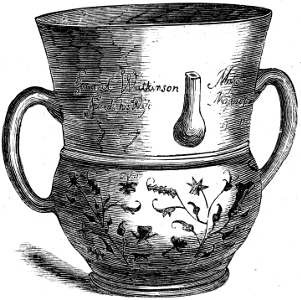
Fig. 812.
“Occupying a space 5 inches broad and 5½ in height, on the other side, in a similar position are to be seen the Royal arms of the period (William III.) with crest, supporters, and garter, with motto. Though this cup is of the same general form as the Posset-pot, and may have been used as such, it may also have been used on occasions of mayoral and other hospitality as a ‘loving-cup,’ or as some would prefer to call it, from its having only two handles, a ‘parting-cup.’ Samuel Watkinson, the owner of the Posset-pot, or in whose honour it was made, was no mean person. From Throsby’s Thoroton’s ‘History of Nottingham,’ I learn he was elected on three several occasions (1700, 1708, 1715) Mayor, or as it is more correctly put on the Posset-pot, Major of Nottingham.”
In Mr. Briscoe’s possession is a good specimen of the brown mugs so characteristic of Nottingham ware. It is 5½ inches in height, 2⅞ inches in diameter at the bottom, and wider at the top, and will hold about half a pint. It was discovered during excavations in Victoria Street, Nottingham, close to the site of the Old Ship inn, of “Gideon Giles” notoriety.
Figs. 813 and 814.
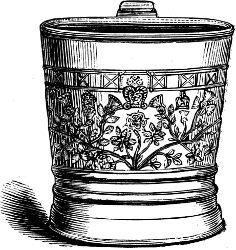
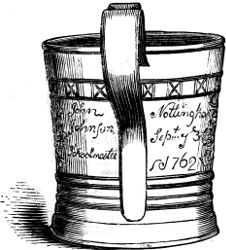
One of the finest mugs which has come under my notice—and indeed, I believe, the finest known example—is in the possession of Mr. E. M. Kidd, of Nottingham, who is also the fortunate possessor of a fine collection of English china. It is engraved on Figs. 813 and 814. In front is a full-blown rose on a stem, surmounted by a crown, and there are two other crowns, one on either side, a little lower down, between what are evidently intended for thistles; there is also a terminal rose at each end, and the remainder of the body is ornamented with their stems and foliage. At the back, by the handle, are the words
John Nottingham
Johnson Sept. ye 3
Schoolmaster 1762
This inscription is, as usual, in ordinary writing letters, incised, or scratched, into the soft clay. On the bottom, in the same kind of incised writing letters, is the maker’s name, Wm Lockett. This is highly interesting, as he, William Lockett, is one of the makers included in the foregoing lists of voters in 1774 and 1780. The name stands thus in the 1774 list:—“Lockett William, pot-maker, New buildings” (in 1780 he was of St. Ann’s Street), and he appears to have given a plumper for the Hon. William Howe, of Epperstone. In the same list is a Henry Lockett, saddler, Smithy row, who voted in the same manner. In the same list the name of the school-master, for whom this special mug was made also occurs, but he voted for Lord Edward Bentinck, and Sir Charles Sedley, of Nutthall, Bart. The name stands thus:—“Johnson John, school-master, St. Mary’s Church side.”
Thus a record occurs both of the maker and the owner of this curious mug, of which Mr. Kidd is the fortunate possessor.
A jug formerly belonging to Mr. Norman has the inscription, incised in writing letters, as follows:—
“John Smith junr of Bassford near Nottingham 1712”
In the Museum of Practical Geology is a “christening bowl,” thirteen inches in diameter bearing the incised words, in writing letters, “Nouember 20 1726;” a punch-bowl, twenty-two inches in diameter, with the words “Old England for Ever, 1750;” and a highly interesting mug “in brown earthenware with glaze of metallic lustre, ornamented with stamped flowers laid on in relief, and incised inscription in cursive characters, round the rim, ‘Made at Nottingham ye 17th Day of August A.D. 1771.’”
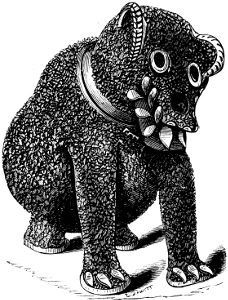
Fig. 815.
Another good, dated example, brought under my notice by Mr. Briscoe, bears the names of “Thos. and Mary Brammer, May ye 21 1753.” In the collection formerly belonging to Mr. Hawkins was “a neatly formed puzzle jug, of lustrous glaze, ornamented with a vase of pinks [these flowers being most generally used in the ornamentation of the Nottingham Pottery] and scrolls around the lower part, the flowers being a dark red colour; on the front is the date 1755, underneath the bottom, the initials, ‘G. B.’” In the same collection was “a tobacco jar, in form of a bear, of bright lustrous glaze, his head being the cover, a collar round his neck, and a chain, to which is attached a large hollow ball, containing stones and holes, used as a rattle; on the ball is impressed the name “Elizabeth Clark, Decr ye 25th 1769.”
One of the favourite productions of the Nottingham “Mug-house” and its predecessors, was drinking jugs in form of a bear, which were also made at Brampton in the same kind of ware, and at Fulham and other places in other wares. A strikingly good example (Fig. 815) is in my own possession. It is 9½ inches in height, and formed of the usual hard brown glazed ware of this pottery. The whole, with the exception of the neck, is powdered with small fragments of dry clay (not “potsherds” as usually, but erroneously, stated) which have been sprinkled over its surface before firing and burnt in with it. This, it may be remarked, is the usual characteristic of these vessels whenever made. The one under notice has the eyes, outlines of the ears, teeth, and claws, laid on in white “slip.” It, like many other “bears,” is made to rest as in the engraving, or to stand upright when placed on its hams; the body contains the liquor, and the head lifts off to be used as a drinking-cup, holding it by the muzzle.
Lowesby.
In 1835 Sir Frederick Gustavus Fowke, Bart., commenced some Terra Cotta Works at Lowesby, in Leicestershire, and produced vases of very good character and of remarkably hard and fine body from the clays of the neighbourhood. He had previously, about 1833, made some garden-pots for his own use, and finding the clay remarkably good and tenacious, determined upon utilising it. In colour the terra cotta was a full rich red, and in some cases the articles were decorated with Etruscan figures and ornaments in black enamel. Vases, ornamented flower-pots, butter-pots, and other articles of domestic use, were produced, and these were mostly decorated with patterns in black, or occasionally in colours, and gilt.
A shop for the sale of the Lowesby ware was opened in King William Street, London, under the management of a Mr. Purden. The ornamental vases, made of different sizes, were sent up to London as they came from the kiln, and many of the antique shapes were beautifully painted and enamelled in London under Mr. Purden’s superintendence. The manufacture was only continued for a few years and then, not being found to answer, died out. The place is now used as a brick and tile works, and flower-pots are also made.
The mark is impressed on the bottom of the ware. It is a fleur-de-lis, beneath the name “LOWESBY” in a curved line (Fig. 816). Occasionally the name LOWESBY without the fleur-de-lis occurs. The arms of Sir Frederick G. Fowke, Bart., the founder of the works, are, vert, a fleur-de-lis, argent, and the seat is Lowesby Hall, so that the mark represented time armorial bearing of the family, and the name of the estate.
Fig. 816.
Coalville.
In 1859 the attention of Mr. George Smith (who has made himself a name, and earned the thanks of his country for his philanthropic exertions in improving the condition of the brick-yard children and those of the canal population) was accidentally drawn to the clays of the neighbourhood of Coalville and Whitwick, and he procured some for the purpose of experiments. These trials proving eminently satisfactory, Mr. Smith entered into an arrangement with Mr. Joseph Whetstone and others by which he undertook to establish the manufacture of terra cotta on the spot and to develop the clay resources of the place. The works were therefore established in connection with the Whitwick Colliery Company, at Coalville and Ibstock; they are now worked by the Midland Brick and Terra Cotta Company. Three kinds of terra cotta are here produced, viz., red, white or light buff, and yellow or cream colour. These varieties, each distinct from the other, are thus described for me by Mr. Smith:—
“First, the red. This is made out of the surface clay, of a greyish tint, and varies in thickness from four to thirty feet, and does not shrink much in burning; it burns a beautiful bright red colour and will stand the severest weather and keep its colour. Occasionally a little white scum may be seen on the surface: this is the result of making, drying, and burning too quickly; but this will disappear after it has been in use a winter or so. Second, the light buff or glypto terra cotta. The clay out of which this is made underlies the red terra cotta clay and varies in thickness from six to twenty feet; it is very hard and difficult to be ground to a proper fineness. This terra cotta when burnt resembles very much Bath stone in colour, and may, if it be kept dry from the time it is burnt to the time it is used, be cut and carved with much ease, and it is very suitable for head-stones, &c. But this peculiar speciality disappears after it has been exposed to the weather for a little time, when it gets hard, and turns the edge of the tools. Third, the yellow or cream-coloured terra cotta. The clay for this kind of terra cotta is got out of the coal-pits in the neighbourhood, and lies at a depth of about a hundred and twenty yards from the surface. It averages about five feet in thickness, and is a kind of clay between a pot-clay and a fire-clay. It is very fine, strong, free from iron, and will stand a great heat, but shrinks a deal in burning—about one-eighth. The kind of goods this clay is most suitable for are the following:—Sewage-pipes, chimney-pots, vases, flower-boxes, tiles, and pottery. The goods produced in architectural enrichments are bases and capitals; cornices, corbels, and brackets; arch moulds, vaulting-ribs, and balustrades; diapers, finials, and ridge-tiles, and other articles. Garden and conservatory, as well as table vases—some of which, especially a tripod vase, are of excellent design—are also made of various sizes.”
Ibstock.
The history of these works is that of Coalville; which see.
Polesworth.
Terra Cotta Works.—One of the manufactures of terra cotta carried on by the “Midland Brick and Terra Cotta Company” is situated at Polesworth. It was established in 1875, and the directorship placed in the hands of Mr. J. Joiner, for many years principal manager at the Stamford Terra Cotta Works. The productions consist of fountains; garden, conservatory, and other vases of various designs; architectural details and enrichments; chimney tops, chimney pieces, capitals and columns, crestings and finials, and other articles, including an admirable feature, that of tomb-stones, monuments, memorial tablets, urns, &c. Blue and brown bricks, both moulded and plain; coping, arch, and stable bricks; roofing tiles, garden edgings, drain pipes, and other useful goods are also extensively made. The terra cotta is both red and buff, and is of fine hard and durable quality, and, with a clean, good surface, unites a pleasant shade of colour.
Market Bosworth.
Terra Cotta Works, belonging to the “Midland” Company, before spoken of, have been established for the production of bricks, tiles, fire-clay, and the more ordinary terra cotta goods.
Tamworth.
The Terra Cotta Works at Tamworth were established in 1847, by the present owners, Messrs. Gibbs and Canning, and are now very extensive and important, and produce a large variety of goods of the highest class and character. The principal productions are terra-cotta for architectural, horticultural, and other useful and ornamental purposes; Della Robbia ware; sanitary and other goods; tiles, and bricks, &c. In terra cotta, for architectural purposes, trusses and cornices, bosses and pateræ, brackets and corbels, capitals and bases, balustrades and parapets, keystones and quoins, strings and mouldings, window and door heads, terminals and finials, friezes, diaper work, ashlar, and every other detail, are produced, and of a quality for sharpness, hardness, and durability scarcely to be surpassed. Among the buildings where this Tamworth terra cotta has been well introduced are the Roman Catholic church of the Holy Name at Manchester; the Royal Albert Hall, South Kensington; the Royal Horticultural Gardens; the Colston Hall, Bristol; the Natural History Museum, South Kensington; and the corridor of the New Town Hall, Manchester, &c. For ornamental purposes this firm produces fountains, vases, tazzas, pedestals, garden-seats, brackets, suspenders, figures and groups, garden-edging, and every variety of articles for the lawn, the garden, or the conservatory. Many of these are of excellent design, and the material being durable they are well suited for out-door purposes. The “Della Robbia ware”—a fine terra cotta beautifully and effectively enamelled in brilliant and flat colours on the surface—is produced in endless variety in plaques, &c., for ceilings and walls, where it takes the place of plaster or other surface-covering. Its great beauty is, however, especially apparent in the garden and flower-vases, jardinières, mignonette-boxes, tree-pots, and an endless variety of other useful articles which the firm produce. The designs are chaste and elegant, especially those in which the convolvulus is introduced, and the colouring rich and effective in the extreme. They are among the best productions of this class of goods. Another excellent production of the firm is a grey terra-cotta, which has a pleasing effect for architectural enrichments.
Wilnecote.
The Wilnecote Works, near Tamworth, which rank among the more important in the kingdom, were established in 1860, when Mr. George Skey purchased the coal mines at this place, with the intention of working them. On sinking shafts for the purpose he fortunately discovered several important and valuable beds of fire-clay, and other clays well adapted for pottery purposes, and he wisely determined to at once erect suitable kilns and buildings for their full development. At great cost and under considerable disadvantages suitable workrooms were erected and fitted up with suitable machinery, steam presses, lathes, &c. Competent workmen were engaged, and the manufactory was opened in 1862. The goods produced were so well received and their quality so good, both as regard material and workmanship, as well as design, that the works had very shortly to be considerably enlarged and fresh workrooms, kilns, &c., erected. This was done, and at the present time the entire produce of the coal and clay pits (about 300 tons of coal and 300 tons of clay per week) is used up at the works, which give employment to several hundred persons. In 1864 Mr. Skey having found the concern grown to more than his own personal care could, single handed, control, formed it into a limited liability company, with a capital of £60,000, under the style of the “Wilnecote Company, Limited,” afterwards altered to the “George Skey and Company, Limited,” Mr. Skey being the managing director, and Mr. Thos. Creswell, secretary.
The goods produced are:—in terra-cotta, which is of fine and durable quality, and of excellent workmanship, fountains, vases, tazzas, brackets, pedestals, suspenders, terminals, flower-vases, mignonette-boxes, fern-stands, garden-seats, balustrades, cornices, chimney tops, and every description of architectural enrichment. Game-pie dishes, of admirable design and of perfect modelling, and other articles, are also produced in this material. The colour is a beautiful light cream colour, and the body being very fine the relief patterns “come out” very sharply and effectively. In “Rustic ware,” vases, garden-seats, flower-pots, brackets, fern-stands, and an infinite variety of beautiful articles are made. This “Rustic ware” is a fine buff coloured terra-cotta, glazed with a rich brown glaze, and sometimes heightened with a green tinge, just sufficient to give it a remarkably pleasing effect. The modelling of some of these goods is highly artistic. In stoneware, or Bristol ware, all the usual articles as made at Lambeth, at Bristol, and other places, are produced. In sanitary ware, all the usual and many additional articles are made; these are of remarkably fine and good quality and excellent both in body and glaze, and in firing. In ridging and roofing-tiles, sewerage-pipes, and garden-edgings, and in moulded bricks for cornices, string courses, &c., an endless variety; and in paving-tiles, and facing-bricks of various colours, as well as fire-bricks, all the usual kinds.
Terra-cotta gas-stoves are extensively made in various designs, some of which are registered. They are chaste and even elegant in design, and admirable in construction. Some of the patterns are in high relief, and others, in addition to the relief, are perforated, and have a striking and pleasing effect. Two of the designs are shown on Figs. 817 and 818.
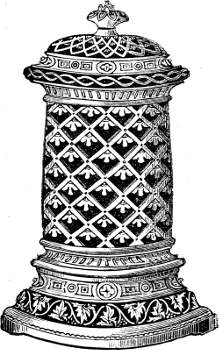
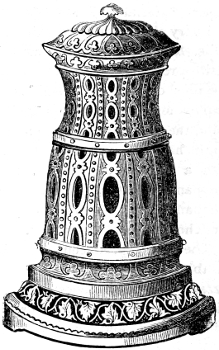
Figs. 817 and 818.
The following is an analysis of Mr. George Skey’s Fire Clay, made by Mr. A. Winkler Willis’ of Wolverhampton:—Silica, hydrated, 71·41; detrydrated, 75·99. Alumina, hydrated, 21·17; detrydrated, 22·53. Protoxide of Iron, hydrated, ·91; detrydrated, ·97. Lime, hydrated, ·04; detrydrated, ·05. Magnesia, hydrated, a trace. Alkalies, hydrated, ·82; detrydrated, ·87. Manganese, Organic Matter, Sulphuric Acid, Chlorine, traces. Water, hydrated, 2·57. Water combined, hydrated, 3·49. Total, hydrated, 100·41; detrydrated, 100·41. Total Impurities, 1·89.
The mark used is the words GEORGE SKEY WILNECOTE WORKS NR TAMWORTH, in an oval, impressed in the ware.
Coventry.
At Stoke, near Coventry, and other places in the district, are old established coarse brown ware works. Mr. Robt. Wakefield is a maker of flower-pots, seakale-pots, &c., of good quality.
Nuneaton.
The works were established about 1830, by Mr. Peter Wager Williams, upon the site of what evidently had been very old pot works, but of which no record appears to exist. At first there were during Mr. P. W. Williams’s lifetime two distinct manufactories. One of these was next worked by his eldest son, Mr. John Williams, who sold it to his three brothers, Peter, Charles, and James, by whom it was carried on under the style of “Caroline Williams.” It passed by purchase into the hands of Mr. J. Rawlins, and was taken by “Messrs. Broadbent and Stanley Brothers,” by whom it was considerably extended. The other manufactory was carried on by Mr. Walter Handley, at whose death it passed to his son-in-law, Mr. David Wheway, at whose decease it was incorporated with the former one, and carried on jointly with it, by Messrs. Broadbent and Stanley Brothers. In 1871 Mr. Broadbent retired from the concern, and it is now carried on by Messrs. Stanley Brothers. The goods produced are terra-cotta vases, chimney-tops, &c.; coloured paving-tiles for geometric designs; garden-edging, ornamental ridging and all kinds of plain building and ornamental bricks; glazed sanitary and other pipes, &c. The firm has recently patented a process for the manufacture of malt kiln tiles, for which they have invented new machinery. They are made of the finest fire-clay, and are of very superior character to any others. The marls in this neighbourhood, from which these various goods are made, are varied, and on the ground worked by this firm alone about twenty different measures occur, and these are of divers colours and qualities. The works occupy nearly ten acres of ground.
Broxbourne.
In 1843, when terra-cotta was but little known, Mr. Pulham turned his attention to it, made numerous experiments in order to bring about its revival, and succeeded in making it both of a good hard stone colour and of a rich pale red. Having done this, he began to produce various small objects for architectural purposes—bosses, angle quoins, brackets, balustrades, small flower-pots, and vases—which remain at the present day as sharp and good as when they left the kiln. He also, about this time, introduced what is termed granulated terra-cotta, having the appearance of stone. Latterly this imitation has fallen into disrepute, and wisely so, for although where terra-cotta is now used it is adopted instead of stone, yet it is not used to imitate stone, but passes for what it is,—bona fide terra-cotta. For architectural purposes, it is still, in some instances, granulated.
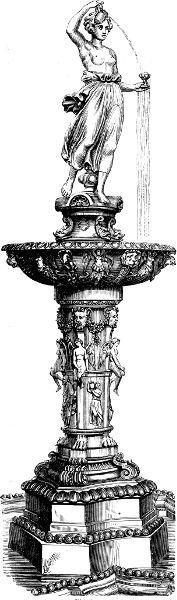
Fig. 819.
Mr. Pulham exhibited specimens of his work at the Exhibition of 1851. Notably amongst them was a handsome Gothic vase in rich pale red, highly enriched; this was placed upon a suitable pedestal of cream-colour terra-cotta. From that time down to the next Exhibition, in 1862, improvements were constantly being made, both in the manipulation, production, and style of the manufacture. Mr. Pulham aimed more at the quality than quantity made; and it is said that he still carries out the rule he laid down, not to extend his business, but to keep it so that it is not too large to be under his own personal supervision. Mr. Pulham exhibited in 1862, among other things, a large Fountain for a gentleman’s grounds near Tunbridge Wells, many features of which, particularly the life-size figure of Hebe which surmounts it, and which is a perfection in burning, were very successful.
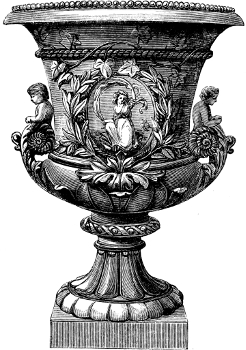
Fig. 820.
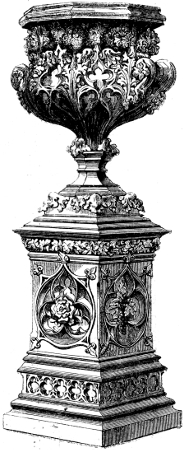
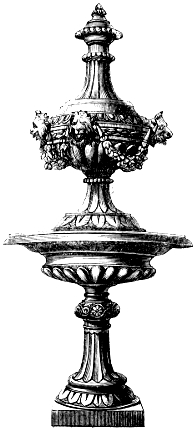
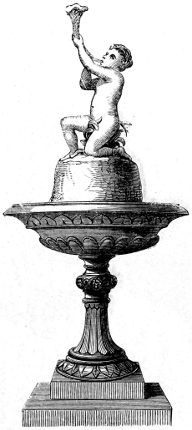
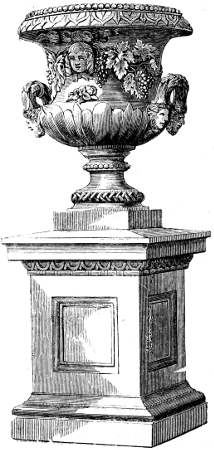
Figs. 821 to 824.—Broxbourne Terra Cotta.
In 1871, besides other of his productions, Mr. Pulham exhibited a small fountain, which was at play during the whole time of the Exhibition; and also several new vases. The fountains (for which a prize medal was awarded) and principal exhibits were very favourably noticed. Some of these I give on Figs. 819 to 824. At the Paris Exhibition in 1867 fountains, vases, and architectural embellishments, amongst which may be named the Preston vase (a number of which were made for the People’s Park, Preston), with medallions representing the staple commerce of the place; some rich columns, novel window jambs and dressings; and notably amongst the rest was the Mulready Monument, erected for the Science and Art Department, South Kensington, and at whose instigation it was sent to Paris. The design of this is a pedestal 15 ft. by 10 ft., round the sides of which are sketched in outline some of Mulready’s principal pictures. This pedestal supports a large-size effigy, 7 ft. long, on a raised bier, the whole of this bier and effigy being fired successfully, just as it left the sculptor’s and modeller’s hands, and which was highly commended and spoken of as quite a chef d’œuvre in the terra-cotta art, and obtained the silver medal. It is now in Kensal Green cemetery, where it was fixed on its return from Paris. Mr. Pulham also executed a portion of ornamental terra-cotta used in the New Science Schools at South Kensington. The quality of the terra-cotta produced at Broxbourne is very high; it is hard, firm, compact, and durable, and of a soft and pleasing colour. Besides the articles already named, Mr. Pulham produces a goodly variety of vases, tazzas, pedestals, flower-baskets, and architectural enrichments of every kind.
Stamford.
That pottery was in mediæval times made in Stamford was incontestably proved in the latter end of 1874 by the discovery of a kiln during the course of excavations in the rear of a house occupied by the Rev. E. F. Gretton, formerly Master of the Grammar School there. The kiln was thus described in “The Reliquary,”[104] by Mr. G. H. Burton:—
“On visiting the spot after a clearance had been effected, I found an opening sunk in the ground, 7 feet wide, and as far as excavated, 8 feet 6 inches long. The end that was bared (north) was semicircular; the form of the other could not be seen, though from certain indications I think it would correspond. The bottom was floored with clay, and the lining or ‘bratticing’ of the sides was composed of stones, of irregular shapes and sizes, set in and entirely faced with clay. The layer forming the floor was about three inches thick, and had been burnt to a rather deep red; the coating of the sides was not so highly burnt, indeed; the clay at one part, only a few inches from the face, became perfectly plastic by exposure during a few days’ rain. In this opening, in the direction of its length, was a row of four piers of an extreme height of 3 ft. 8 inches, and about 12 inches or 14 inches thick; their section was something like a square or oblong, slightly rounded at the angles—in some parts resembling a rough circle. These columns were at somewhat irregular distances. That at the north end supported a short, thick lintel, which was connected with the enclosure, and was in a line with the series of piers. The three other columns carried at their heads a slighter lintel. These piers supported four horizontal beams 1 foot wide and 9 inches thick, of an extreme length of 4 feet 6 inches, which spanned the space between the piers and the east side of the opening. Thus the internal arrangement, to use a homely illustration, was pretty much that of a gridiron bent in the middle to the shape of the letter L inverted. The part enclosed by the piers and beams was of the clear width of 3 feet 6 inches; the space from the piers to the other side was 2 feet 6 inches. This latter is believed to represent the ‘stoke-hole,’ and the unbarred opening, between the two northernmost piers, was perhaps a ‘man-hole.’ I have been told that the four transverse beams had been continued right across the opening, and that on one side they had been accidentally destroyed; but one who was very early on the spot assures me that the piers did not then present the appearance of anything having been broken from them. The columns, the beams, and the lintels were all of clay, burnt in some portions to a light brick red. Their construction seems to have been a rude and simple affair. Sticks or branches of no great thickness were placed in position, and then soft clay was clapped round them until the required massiveness was obtained, when drying and baking would finish the operation, if indeed drying and baking were necessary. Of what the superstructure was composed, and what form it took, I could find nothing to indicate. The floor of the kiln was seven or eight feet from the present surface, and the sides at the highest remaining part rose to a level with the horizontal beams. I should state that in two parallel cuttings, made for the foundations of new buildings, I observed a very thin layer of burnt earth of a light colour, extending nearly to the south end of the excavated remains of the kiln, and at about the same level as the horizontal beams. This would seem to show that when the kiln was in operation the tops of the pillars were on a level with the then surrounding surface. One remarkable circumstance ought, perhaps, to be mentioned. It was found necessary to make a cutting through this kiln, and the excavation revealed the fact, that for at least ten feet beneath the kiln floor there was nothing but ‘made ground,’ as the workmen called it. Other cuttings near disclosed a similar substructure, the loose ground being 20 feet deep.”

The very large and important works of this place owed their origin to Mr. J. M. Blashfield, by whom they were established in 1858. Previous to that time, Mr. Blashfield had been, until 1851, engaged, in Southwark Bridge Road, Albion Place, Blackfriars, and Mill Wall, in the Italian marble trade, and the manufacture of cements and scagliola, and the making and laying down of tessellated pavements, &c. In that year he commenced the manufacture of terra-cotta at Mill Wall, London, having a few years previously purchased a number of the moulds, models, &c., from Coades when that manufactory was closed. In 1858 Mr. Blashfield removed his moulds, models, plant, &c., to Stamford, where a splendid clay for his purpose exists, and where he soon became as successful as such enterprise and ability as his deserved, and where he did more for the development and improvement of the beautiful in art than could otherwise have been accomplished. In 1874 the works merged into a limited liability company, under the style of the “Stamford Terra-Cotta Company,” which failed and was wound up in 1875, when the plant and stock were sold by auction.
Mr. Blashfield’s name is very intimately connected with the subject of encaustic paving-tiles, having been associated with the late Mr. Herbert Minton in their revival. In reference to this the following extract from a paper read by him is interesting:—
“One of the greatest revivals in pottery, connected with architecture, took place about 1833. Mr. Wright, of Shelton, obtained a patent for making inlaid tiles. This patent was bought by the late Mr. Herbert Minton, who improved upon it, and produced the tiles now so commonly used in churches.
“In 1840, Richard Prosser, of Birmingham, took a patent for making buttons in china. In 1841, buttons made from the body of which porcelain is constituted were very largely manufactured by the late Mr. Herbert Minton, under this patent of Prosser’s; and having, myself, for several years, made inlaid pavements and imitations of old mosaic and tesselated work, I conceived that Prosser’s invention would make tesseræ and tiles, and I suggested to Minton and Prosser the enlargement of the patent for this purpose. I then made arrangements to carry out this invention, and laid the first designs and specimens I made before the then President of the Royal Society (the Marquis of Northampton), who kindly permitted me to exhibit them at one of his soirées, at his house in Piccadilly, about the commencement of the year 1843. He then introduced the subject to a great number of noblemen, and especially to his Royal Highness the Prince Consort, who requested an especial account of the process to be written for him, and which was done, and forms now the appendix to the second edition of a work I first published in 1842, through Mr. Owen Jones, on Tesselated Pavements. In 1843, I published a work upon Encaustic Tiles, with ninety-six copies of ancient tiles drawn half the full size, and also designs of pavements. The drawings were arranged and copied on stone by Mr. Owen Jones. I also employed Mr. Lewis, Mr. Kendall, and other architects on the same subject, and especially Mr. Digby Wyatt, who copied for me in Italy the remains of the mosaic works of the Middle Ages, from San Lorenzo, St. Mark’s, and other places; and which has since been drawn on stone, and published by him, under the title of ‘The Geometrical Mosaics of the Middle Ages.’ The Society of Arts, London, also kindly permitted me to lecture on the subject, and constantly to bring it forward—so that, by the end of the year 1845, the trade in tesselated pavements, inlaid tiles, and Venetian floors, had gained a firm footing; but, from various circumstances, and after spending many thousand pounds in bringing the subject fully into notice, I was obliged to surrender all interest in it to the manufacturer, Herbert Minton. Since this date, Minton and Hollins have revived the art of majolica and Palissy ware, and produced the most magnificent specimens, both in point of size and color, ever attained in this description of pottery.”
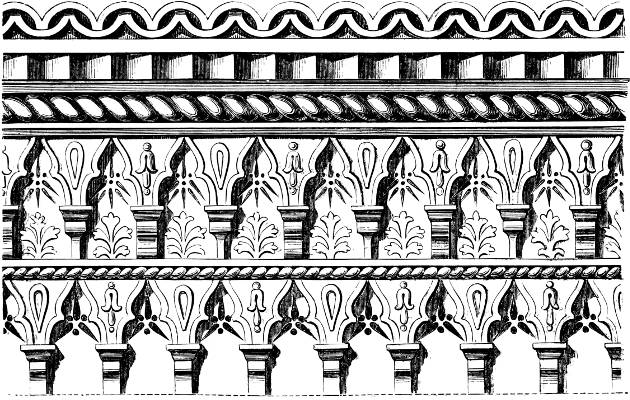
Fig. 825.
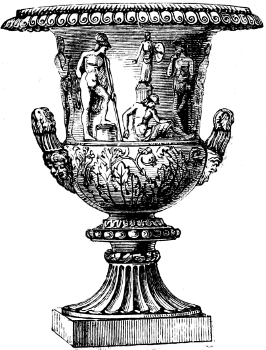
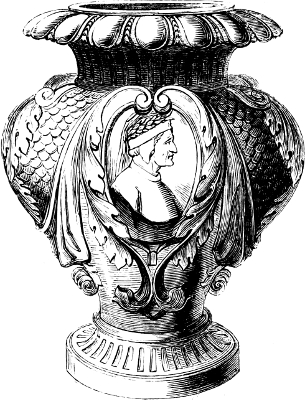
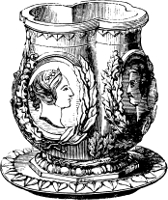
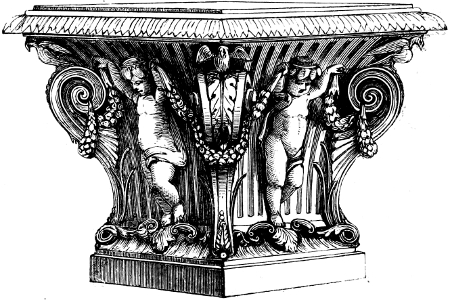
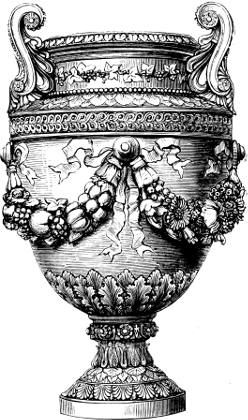
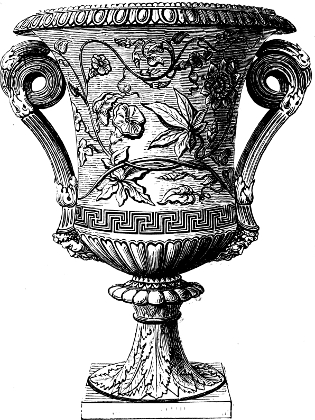
Figs. 826 to 831.—Blashfield’s Stamford Terra Cotta.
Mr. Blashfield further wrote to me:—
“I suggested to Herbert Minton the making of mosaic pavements, and found some of the money and designs for the early development of the pavement business. It was the connection with the pavement business that led me to a knowledge of pottery; and made me turn the moulds and models which I had used for plastic scagliola and cement castings into use for terra-cotta in 1851. I began to form my collection of models in 1831 in the Southwark Bridge Road.”
The productions of this manufactory were terra-cotta as applied to every purpose, glazed or enamelled tiles and bricks for wall-facings, hard ordinary paving tiles, enamelled architectural enrichments for internal use, and red and buff moulded bricks.
In this material, statues, both single figures and groups, busts, vases, tazzas, fountains, pedestals, suspenders, chimney shafts, cornices, consoles, string courses, pateræ, medallions, panels, friezes, capitals and bases, tracery, window and door heads and jambs, balustrades, and every species of architectural decoration were produced in almost endless—and, certainly, as to design, matchless—variety. The vases and tazzæ were most carefully modelled from ancient examples taken from the British and other Museums, and from the standard works of Montfaucon, Winckelmann, Millengen, Raoul Rochette, Dubois-Maisonneuve, Baptista Passerio, D’Hancarville, Piranesi, Tatham, Moses, Sir William Hamilton, Englefield, and others; and many original designs by Mr. Blashfield and other artists were added. These were produced of various sizes, but all of equal excellence. The statues and busts, &c., are clever reproductions of ancient examples, and special works modelled for the purpose by or from Bell, Woodington, Roubilliac, Weigall, Chantrey, and other renowned modern artists.
Among the public buildings which have been enriched by the art works of Mr. Blashfield’s manufactory are the urns, antifixa, and pavements in the Royal Mausoleums, Windsor; vases and terminals, &c., at Buckingham Palace; vases, tazzas, borders, &c., at Kew and Hampton Court Gardens and Dairy Farm, Windsor; colossal statues, fountains, vases, &c., and roofs and other decorations, at the Crystal Palace; chimney shafts, &c., Sandringham; vases and pedestals, Marlborough House; the entire red, buff, grey, and black terra-cotta details and enrichments for Dulwich College; Lady Alford’s mansion, and many other places; and, indeed, for most of the public buildings and private mansions of this country and abroad. Of these, perhaps one of the most important, and which will ever remain a lasting monument of Stamford ceramic art, is the new Dulwich College, erected from designs by Mr. Charles Barry, and entirely composed of terra-cotta. It is the most complete specimen of terra-cotta building in England—no stone whatever being used; the value of the material alone being, in the gross, calculated at £28,000. The whole of this was made at these works.
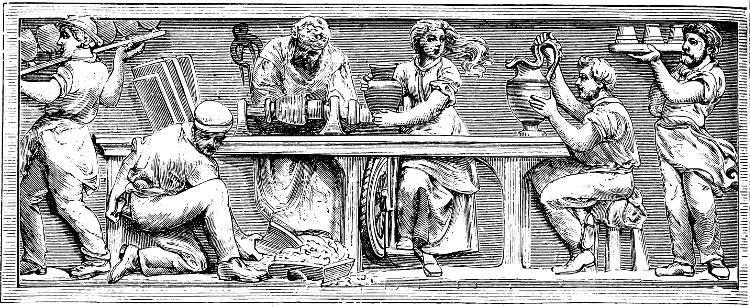
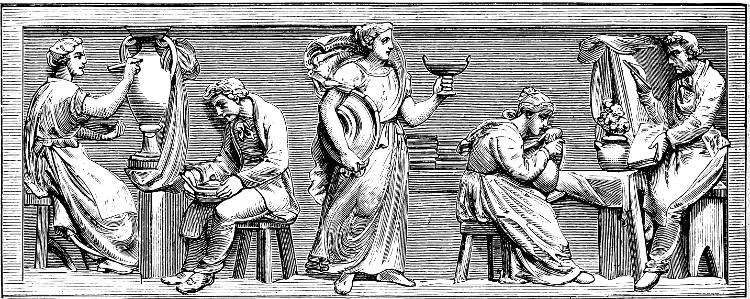
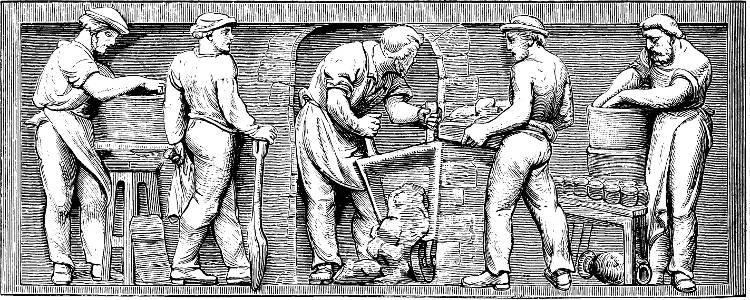
Figs. 832 to 834.—Blashfield’s Terra Cotta.
In colour and quality the Stamford terra-cotta is of faultless excellence. The details are sharp, and in many cases exquisitely moulded; and, the body being much finer and harder than usual, they have a finish and a “touch” about them that cannot easily be surpassed.
One of the most striking series of subjects produced in terra-cotta was the manufacturing “process panels” on the exterior of the Wedgwood Memorial Institute at Burslem. Three of these are engraved on Figs. 832 to 834. The whole series, modelled by Mr. Walter J. Morris, illustrate the various processes of the plastic art; those selected for engraving represent “Turning,” “Painting,” and “Firing.” The history of these panels is a somewhat interesting feature as connected with Stamford terra-cotta works, and is worth briefly recording. The whole of the clay for these large panels was prepared at the Stamford works by Mr. Blashfield. A large case, lined with plaster of Paris, was made for each panel; the clay was firmly and evenly pressed into it, and thus each of the twelve was transmitted to South Kensington. Mr. Morris wrought his modelling on the faces of these cases of clay, and they were returned to Stamford when ready for the later process to be accomplished. At Stamford they were cut up in suitable pieces for “firing;” made true (for they had got considerably twisted and warped during the time they were in the modeller’s hands), carefully dried, and burned; the whole series coming out from the kiln in the admirable and perfect state in which they now stand, as monuments of Mr. Blashfield’s ceramic skill, in the Wedgwood Institute. The whole of the operations in producing these panels occupied about twelve months in time, and their cost, of course, was something considerable. They were marked with Mr. Blashfield’s name.
Among the most successful vases was the “Shakspeare vase.” It is of the Medici form, but the general allegorical design and details are Mr. Blashfield’s own. The figures of the allegory, which run round the body of the vase, were modelled by the late Mr. Nixon, who executed the statue of William IV. for the City of London, in conjunction with his father, also a sculptor of eminence. It represents a masque scene from Shakspeare’s Tempest—Prospero, Ferdinand and Miranda, with Juno and Ceres, in front of the vase; Iris at the back, with the reapers, dancers, &c. Caliban forms the part of one handle and Sycorax the other. The whole are moulded in a masterly manner, and the rest of the details of the vase are eminently in keeping with them.
Engravings of some of Mr. Blashfield’s vases are given on Figs. 826 to 835. Of these, Fig. 827, of novel design, bears powerful medallions of Dante and Petrarch; and Fig. 828 (a flower-pot), those of the Queen and the Prince Consort, and the Emperor and Empress of the French.
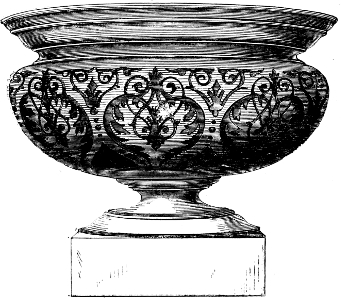
Fig. 835.
The marks used were the name, impressed, “J. M. BLASHFIELD,” or “BLASHFIELD, STAMFORD,” or “STAMFORD TERRA COTTA CO. LIMITED.”
Bolingbroke.
In the seventeenth century a pottery existed at Bolingbroke, in Lincolnshire. Houghton, writing in 1693, speaks of “the blue clay of Bolingbroke pottery, in Lincolnshire.” Nothing, however, is now known as to this manufactory.
Wisbech.
Terra-cotta of a remarkably good character, made from the clay of the district, was made here in 1859; but the works were not of long continuance.
Lowestoft and Gunton.
Lowestoft, on the very easternmost point of England, on the coast of Suffolk, is a pleasant town, with delightful sea views, a fine coast, and a picturesque neighbourhood. It is an ancient borough; is divided into three parts, respectively known as the “Old Town,” the “New Town,” and the “Lower Town;” and its principal street, from which branch off other streets to the left, and numberless “scores,” or narrow ways, leading to the Dene and the sea, is about a mile in length, and contains the principal residences, shops, and public buildings. Its chief trade, like that of Yarmouth, is the herring fishery; and many curious traditions of conflicts between the men of the two rival “bloater towns” are still extant among the inhabitants. The principal interest of the place, however, centres in the fact, that here, on one of the easternmost points of the East Angles, a manufactory of fine porcelain existed in the latter half of last century, and that genuine productions of those works are now much sought for by collectors. In 1863 I visited Lowestoft for the special purpose of seeking information regarding the works, about which at that time literally nothing was known, and after a vast deal of research, both in the town and out of it, I succeeded in obtaining the information which is embodied in this chapter, and which, with the exception of its being now revised and here and there amended, I contributed to the Art-Journal of July in that year.
It seems somewhat strange that the absolute “land’s end” on the eastern coast of England should have been chosen as the spot on which porcelain should be made, when the clay for the purpose had to be procured from the western “Land’s End,” Cornwall, and the coal from the extreme northern coast of Northumberland and Durham. It is not improbable, however, that the same cause which conduced to the establishment of the Chelsea works had much to do with the formation of those at Lowestoft. Certain it is that an extensive trade was in the early and middle part of last century carried on, as it is at the present day, with Holland; and certain it is, that at that time, as now, the town was the constant resort of Dutch fishermen and others; and as the first productions of the Ceramic Art in this neighbourhood appear, so far as I have been able to ascertain, to have been delft-ware, it is not too much to suppose that the first potters were from Holland, and made the ware from clay found in the neighbourhood. Specimens of this fine delft-ware, inscribed with names of people in the neighbourhood, and with dates, still exist, and attest pretty strongly to the correctness of this opinion.
Gillingwater, in his “History of Lowestoft,” written in 1790, says at p. 112:—
“The only manufactory carried on at Lowestoft is that of making porcelain, or china ware; where the proprietors have brought this ingenious art to a great degree of perfection; and, from the prospect it affords, promises to be attended with much success. The origin of this manufactory is as follows:—In the year 1756, Hewlin Luson, Esq., of Gunton Hall, near Lowestoft, having discovered some fine clay, or earth, on his estate in that parish, sent a small quantity of it to one of the china manufactories near London, in view of discovering what kind of ware it was capable of producing, which, upon trial, proved to be somewhat finer than that called the delft-ware. Mr. Luson was so far encouraged by this success as to resolve upon making another experiment of the goodness of its quality upon his own premises; accordingly he immediately procured some workmen from London, and erected upon his estate at Gunton a temporary kiln and furnace, and all the other apparatus necessary for the undertaking; but the manufacturers in London being apprised of his intentions, and of the excellent quality of the earth, and apprehending also that if Mr. Luson succeeded he might rival them in their manufacture, it induced them to exercise every art in their power to render his scheme abortive; and so far tampered with the workmen he had procured, that they spoiled the ware, and thereby frustrated Mr. Luson’s design. But notwithstanding this unhandsome treatment, the resolution of establishing a china manufactory at Lowestoft was not relinquished, but was revived again in the succeeding year (1757), by Messrs. Walker, Brown, Aldred, and Rickman. This second attempt experienced the same misfortune as the former one, and very nearly ruined their designs; but the proprietors happening to discover these practices of the workmen before it was too late, they took such precautions as to render every future attempt of this nature wholly ineffectual, and have now established the factory upon such a permanent foundation as promises great success. They have now enlarged their original plan, and by purchasing several adjoining houses, and erecting additional buildings, have made every necessary alteration requisite for the various purposes of the manufactory. They employ a considerable number of workmen, and supply with ware many of the principal towns in the adjacent counties, and keep a warehouse in London to execute the orders they receive both from the city and the adjoining towns, and have brought the manufactory to such a degree of perfection as promises to be a credit to the town, useful to the inhabitants, and beneficial to themselves.”
It appears from this account that the first pottery was established at Gunton, near Lowestoft, in 1756; but I am inclined to think that pot making had been carried on some years before this date. Marryat describes two plates in his possession, of coarse paste, with blue borders, which bear, respectively, the words—
QUINTON QUINTON
BENJAMIN MARY
YARMOUTH YARMOUTH
1752. 1752.
which he considers may have been ante-dated; but the probability is that they are not, but that they were painted at Gunton or Lowestoft at the period whose date they bear. A remarkably fine blue and white delft plate, or dish, which belonged to the late Mr. James Mills, of Norwich, and traditionally said to be painted at Lowestoft, has a bold border of blue colour round the rim, and the centre bears a heart-shaped tablet (Fig. 836) with a Cupid at either side bearing a pendent bunch of flowers. Above the tablet is a coronet, and below it a knot and tassel. The tablet bears the words—Robart & Ann Parrish in Norwich 1756. Other examples of this kind of ware, bearing names of individuals and places in the neighbourhood, have also come under my notice, and tend to strengthen my opinion that they must have been made somewhat prior to the year 1756.
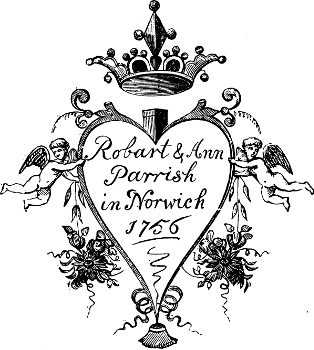
Fig. 836.
It is a matter of extreme importance, and very noteworthy, that of the dated examples of wares known or recorded, those of 1752, 1756, 1759, and 1760, are not china but delft ware; and that those from 1762 forward to 1789 are china. The inference is that the manufacture of delft ware at Gunton or Lowestoft continued till about 1760, and that about that time the manufacture of porcelain was gradually making its way.
The proprietors of the porcelain works in 1757 are stated by Gillingwater to be Messrs. Walker, Brown, Aldred, and Rickman. Of some of these proprietors particulars will be found interwoven in my present article, but of the others very little is known. By 1770 the manufacture had advanced very considerably, so much so that in that year, as appears by the following advertisement, a warehouse for its sale was established in London:—“Clark Durnford, Lowestoft China Warehouse, No. 4, Great St. Thomas the Apostle, Queen Street, Cheapside, London, where merchants and shopkeepers may be supplied with any quantity of the said ware at the usual prices. N.B. Allowance of Twenty per cent. for Ready Money.”
The firm was carried on (as is proved by the address furnished to Mr. Duesbury, of the Derby China factory) under the style of “Robert Browne & Co.”; the address is “Mr. Robt. Browne & Co., China Manufactory, Lowestoff, Suffolk.”
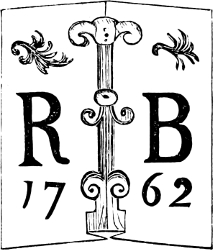
Fig. 837.
One of the partners of the early firm, and the manager of the works, was Robert Browne, who died in 1771, when the management fell to his son, also Robert Browne, who, being an excellent practical chemist, made great improvements in the ware. He was constantly experimenting on “bodies,” and succeeded in bringing the art of making porcelain nearer to the Oriental original than had been at that time attained by any other individual. Of the first of these Robert Brownes an interesting relic remains in the possession of his great-grandson at the present day. It is a small inkstand, white, with blue ornaments. It is of nine-sided form, and has Chinese figures on seven of its sides, the other two being taken up with the pattern here engraved, the initials “R. B., 1762,” being those of Robert Browne just alluded to.
The manufacture of porcelain under the management of the second Robert Browne must have attained some great degree of excellence in 1775, for in that year I find that a man named David Rhodes, who was apparently employed by his master, Josiah Wedgwood, to collect together for him examples of the productions of the different manufactories of this country, enters in his account of expenses the purchase of a Lowestoft slop basin, for which he gave ninepence. The account, which is in the possession of Mr. Mayer, of Liverpool, is curious, as the following items will show:—
1775. s. d.
May 10. A Flawed Chelsea Leaf, a Plymouth Teapot, and 2 Liverpool Coffee Cups 0 6
May 12. A set of Bristol China 6 0
„ A ½-pint Worcester Basin and broken ware 0 6
„ 2 Slop Basins, Derby and Leastoff 1 6
„ 1 Quart Bristol Mug and Teapot Stand 2 6
„ A Broken Quart Mug, Bristol 0 6
Prices at which collectors nowadays would be only too glad to purchase specimens. Fancy a quart Bristol mug, and a teapot-stand of the same, for half-a-crown! and a Chelsea leaf, a Plymouth teapot, and two Liverpool coffee-cups for sixpence!
The works must at this time have become noted, or they would not have attracted the attention of Josiah Wedgwood, and made him desirous of examining the “body,” and comparing it with other wares made in this country. That the china produced at and before this time was good there can be no doubt, and the purchase of a “slop-basin” shows that tea-services must, prior to that time, have been made. It would be interesting to find that this identical slop-basin was still preserved at Etruria, as, possibly, it may be, although I have failed to recognise it.
A curious circumstance connected with the first Robert Browne, the memory of which has been preserved in his family, is worth relating, as showing the schemes and the underhand practices which were resorted to by manufacturers in those days (as, alas! now), to worm out and steal the secrets of others. The workmen who had been engaged from London having been, as alluded to by Gillingwater, shamefully tampered with, and bribed to injure the work at Lowestoft, probably induced Mr. Browne to retaliate in the manner I am about to describe. Being desirous, soon after the commencement of the works, to ascertain how the glaze was prepared, some of the colours mixed, and other particulars concerning the ingredients used, he went to London, and under the disguise of a workman, engaged himself at one of the china manufactories—of course either Chelsea or Bow. Here, after a short time, he bribed the warehouseman to assist him in his design, and soon accomplished his purpose. The warehouseman locked him up secretly in that part of the factory where the principal was in the habit of mixing the ingredients after the workmen had left the premises. Browne was placed under an empty hogshead close to the counter or table on which the principal operated, and could thus see through an opening all that was going on. From his hiding-place he watched all the processes, saw the proportions of the different ingredients used, and gained the secret he had so long coveted. Having thus remained a willing prisoner for some hours, he was at last released when the principal left the place, and shortly afterwards returned to Lowestoft, after an absence of only two or three weeks, in full possession of the, till then, secret information possessed by the famed works of Chelsea or Bow.
It may be well to note that the Brownes, I am informed, were engaged in the staple trade of the place—that of the herring fishery as well as in that of the manufacture of porcelain. The firm also were shipowners, and kept vessels constantly running “to the Isle of Wight for a peculiar sand, which, with pulverised glass and pipeclay, formed principally the ingredients of the groundwork of the ware,” and to Newcastle for coals.
Lowestoft is, fortunately, particularly rich in dated examples of its productions; but it is worthy of remark, that the whole of these examples, with names and dates, which have come under my notice, are white and blue; showing that, during the period through which these dates run, that was the character of the china made at these works, and that the finer body and the elaborate colouring which distinguish so much of the Lowestoft porcelain, were of later date. But of this presently.
The earliest dated example of Lowestoft china ware I have yet seen is the inkstand just described, which bears the initials “R. B.,” and the date “1762.” In Mr. Norman’s collection was a bowl with the name “Abrm. Moore, 1765,” and a basin, said to have been made for Sarah Crisp, has her initials “S. C., 1765.” The next is a fine bowl, with a large group of Chinese figures—emperor, mandarins, &c.—painted in blue, and inscribed on the bottom with the name of an eccentric old maid, well known in the town, and whose gravestone lies in the churchyard:—
ELIZATH BUCKLE 1768.
This bowl and other pieces of a service (notably a basin and cream jug, painted with shepherd and shepherdess) made for her, were painted by her nephew, a man named Robert Allen, who, as a boy, was one of the first employed when the manufactory was established and remained there until its close. The bowl is in the possession of his aged daughter, Mrs. Johnson. This Robert Allen may well be classed amongst the “worthies” of Lowestoft. Working at the china manufactory from the first, he became foreman, and was entrusted with the mixing of the colours and the ingredients of the material itself, and remained so till the close of the factory in 1803. As a painter he appears to have been chiefly employed on blue; at all events the only authenticated specimens of his work which I have seen are of that colour. He also employed himself in staining glass, and numerous pieces of his work are still preserved by families in the town. His principal work was the painting in the east window of the parish church, which he completed in the year 1819, being then in his seventy-fourth year, and presented it to the town. In acknowledgment of this service a silver cup, now in possession of his daughter, and bearing the following inscription, was presented to him:—“A token of respect to Mr. Robert Allen, from his fellow-townsmen at Lowestoft, for having, at the advanced age of Seventy-four, gratuitously and elegantly ornamented the East Window of their Parish Church Anno. Dom. 1819.”
After the closing of the Lowestoft works, Allen, who dealt in china, &c., put up a small kiln at his own house, where he carried on operations on a limited scale, buying the unfinished ware from the Rockingham works and painting and finishing it himself for sale. Mr. Brameld, of the Rockingham works, who was an excellent painter on china, occasionally visited Lowestoft, and became attached to Allen, to whom he presented a set of five vases, beautifully painted from nature with flowers copied from specimens he had gathered on the Dene. He also presented him with a snuff-box, painted by himself.
Of the same year as the bowl above described (1768) a dated example in the possession of Mr. Seago, the town clerk of Lowestoft, is a bowl, with the words—
EDWARD MORLEY 1768
Another bears the date—
RICD. MASON JANY. 1TH 1771
Of this latter year another dated example is shown on the engraving (Fig. 838); it has the words—“James & Mary Curtis, Lowestoft, 1771.” This mug was painted by Thomas Curtis, son of the pair named in the inscription. He was for some time, it is said, employed at Dresden, and became a “silent partner” in the Lowestoft works, and in his will is described as a “porcelain painter.” Part of a set of china, painted by this same Thomas Curtis on Oriental body, in 1775, and intended as a wedding present for his son James, is still preserved in the family.
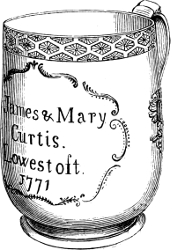
Fig. 838.
The next dated example of blue and white was in the museum of the late Mr. Mills, of Norwich. It is a mug, and bears the inscription—“ROBT. HAWARD 1781.” The same gentleman had also other initialed specimens, made originally for members of his family. In Mr. Seago’s collection is an inkstand marked S. A. Sept. 26 1782, being the initials of Samuel Aldred; and Mr. Norman possessed a similar inkstand inscribed “A present from Lowestoft,” but not dated. In Norwich a later example, with the initials and date—
W J S 1784
is also preserved. A beautiful example, the latest known dated specimen of Lowestoft china, is in the possession of Mr. J. Williams, of Islington. It is a mug, three and a half inches high, painted in blue with borders and flowers, and has on the front the initials and name[105]
G C LOWESTOFT 1789
These will be sufficient to show the range of years over which the Lowestoft blue and white porcelain was manufactured. That it was made to the close of the works there is every probability; but that it gradually gave way to a finer and higher class of goods is certain. Earthenware, too, of a fine kind, appears to have been made at Lowestoft, of which I have seen some interesting examples, so called, in various collections.
In the possession of Mr. Andreas A. Cockayne is a pair of remarkably good salt-cellars of undoubted Lowestoft make. The inside is painted with roses and other flowers, and the outside has festoons of roses and foliage, and on either side of each is a shield bearing gules, on a bend, argent, three leopards’ heads, caboshed, of the field; over all an escutcheon of pretence with the arms of Cockayne, argent, three cocks, gules. Crest, a leopard’s head, caboshed, gules.
Before speaking of the later and higher class of goods made, or painted, at Lowestoft, it is quite necessary to put collectors on their guard against giving implicit credence to all they hear in the locality as to the kinds of ware made at these works. I have seen undoubted specimens of early Worcester, of Caughley, of Bristol, and of several other localities, gravely asserted to be Lowestoft, and even attempted to be proved to be such by the very marks they bear. As a proof of this I may just mention that it is said the company did a large trade with Turkey, and the ware prepared for that market “had on it no representation of man or beast (so as not to offend Mahometan law), and at the bottom of each piece the Crescent was painted!” It is perhaps unnecessary to say that the pieces marked with the “Turkish Crescent” are the ordinary blue and white with the Worcester and Caughley marks, and that some of the pieces are the well-known “cabbage-leaf” and other forms of those makes.

Figs. 839, 840.
The great characteristic of the latter and more advanced porcelain made at Lowestoft, is its extreme minuteness and intricacy of pattern and beauty of finish. Indeed the decorations on many of the specimens which I have examined, are of a character far superior, both in design and in the exquisite and almost microscopic nicety of the pencilling and finish, to those mostly produced at other English manufactories. The borders are frequently very minute and elaborate, and the wreaths, festoons, or groups of flowers, are equally delicate in their proportions.
Some of the productions of the Lowestoft works are apparently painted on Oriental body, but there are many good examples in existence where the body is of Lowestoft make which are of very fine quality. The collector will be able to distinguish immediately between the examples painted at Lowestoft on Oriental body and those which were potted and painted there. Punch-bowls and tea and coffee services appear to have been the staple productions of these works, and, fortunately, many of the former, and several almost complete sets of the latter, are remaining in the hands of families in the neighbourhood, and in those of local collectors, who seem imbued with a truly laudable desire to keep alive the memory of what has been done for the Ceramic Art in their town. The bowls are usually of remarkably good form, and highly ornamented. They are mostly painted at Lowestoft, on Oriental body. Some of these, though not dated, nevertheless give collateral evidence of the period at which they were made, and become, therefore, historically valuable; as do also, indeed, some of the services bearing the initials, heraldic bearings, and monograms of families in the neighbourhood. A punch-bowl in the possession of the town clerk of Lowestoft, which is elaborately ornamented inside and out, bears inside a well-painted representation of a fishing lugger at full sail, within a circle, beneath which is the name of the vessel, The Judas. This bowl was made for the boat Judas, and was filled with punch and drank to its success before each fishing voyage, and at carousals at their end. In the same collection is another beautiful bowl, bearing on either side, within ovals, and surrounded by ornamental ovals, &c., portraits of the notorious John Wilkes, and another, with the words “Wilkes and Liberty.” The painting of these, as of all the higher class of wares, is very beautiful and, indeed, in some parts exquisite.
When writing in 1863 upon these works (and it must be borne in mind that I was the first to write upon them) I expressed myself as above. My opinion that some of the Lowestoft productions were painted there on Oriental body,—an opinion based upon thoroughly good foundation—has been taken exception to by a later writer (who has been indebted for nearly every scrap of information he has embodied in his work to what I then wrote), in no measured terms. I was fortified in that opinion by the judgment of the late Mr. Rose, of Coalport, than whom no man living had a more thorough practical knowledge of bodies and of all the different processes and phases of Ceramic Art, and whose opinion in all technical matters was sought and relied upon by all scientific men of real intelligence; and I am far from feeling disposed to give up that opinion at the mere dictum of a dealer. I have hesitation in saying that if a tithe of the pieces exhibited as Lowestoft were painted there (which I very much doubt), they assuredly were painted on Oriental body, for much of the ware now vaunted as Lowestoft is certainly not English.[106]
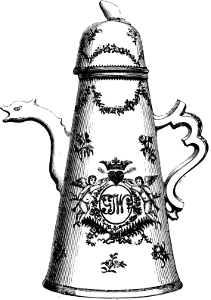
Fig. 841.
The coffee-pot (Fig. 841) formerly belonging to Mr. Norman is a good specimen of Lowestoft painting. It forms part of a service, evidently a marriage-service, originally made for Captain Walsh. The initials it bears are probably those of himself and his bride. They are enclosed in an oval within a wreath of roses and palm branches, tied with a true lover’s knot. On either side is a Cupid, who supports a human heart pierced with two arrows, and this is surmounted by a coronet. On reference to the delft plate just described and engraved (Robert and Ann Parrish), it will be seen how strongly the design of that early example of Lowestoft earthenware accords with this, perhaps one of the most highly finished of its productions in porcelain.
It is unnecessary to describe other services, although many of them are of the highest beauty. One tea service, with the crest (an owl) and the monogram of W. W. conjoined, is especially deserving of notice, however, as being one of the choicest examples of porcelain painting of its kind which have come under my notice. This service, until lately intact, has unfortunately been dispersed, and portions of it passed into the collections of Sir Henry Tyrwhit, Mr. Norman, Mr. Seago, and others.
It is worthy of remark that on much of the Lowestoft china the rose is plentifully introduced. The reason for this is probably two-fold: first, the arms of the borough is the Tudor (or full-blown) rose, crowned with an open arched crown; and this may probably have been the principal incentive in giving the rose so constant and so prominent a place in the ornamentation of the china. Second, during the period of the great Revolution, a French refugee of the name of Rose, one of the cleverest of the French porcelain painters, found his way to Lowestoft, and was engaged by the company. He became the principal, and by far the best, of the artists employed, and probably introduced the rose more generally, in allusion to his name, than would otherwise have been done. To him may probably be ascribed the finest and most minutely finished specimens of painting which the works produced, and it was his taste which gave that French character to the general style of ornamentation which is so discoverable on many of the services. It is well to remark that on some of the pieces painted by him he is said to have introduced a small rose under the handle as a special mark of his work. Like that of many another man of genius, the lot of this clever refugee artist was a sad one. He was an aged man when he came to Lowestoft, and he remained at the works till his eyesight failed him, and he became very poor. A subscription was entered into, and a couple of donkeys to help him to carry water in the town purchased, and thus he passed his last few years.
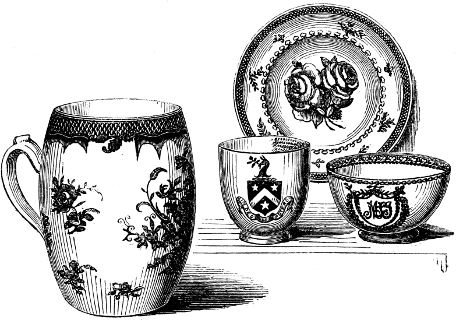
Fig. 842.
In the group (Fig. 842), I have shown some very characteristic examples of the higher class make of the Lowestoft works. The saucer is an excellent specimen of floral decoration, and shows better than many the rose which was so plentifully introduced in decoration. The painting, however, of these bolder groups of flowers is not so good as in the more minute ones—the artists, as I have before said, excelling in minute, careful, and elaborate pencilling rather than in breadth of style and colour. The coffee-cup is a simple but very good specimen of heraldic decoration. It is part of a set made for the celebrated writer, the Rev. Robert Potter, Prebendary of Norwich and Vicar of Lowestoft, one of the most distinguished classical scholars of his time, and chiefly known for his excellent translations of Æschylus, Euripides, and Sophocles, and for other equally learned works. The cup bears the arms or, a chevron, sable, between three mullets, gules, pierced of the first; with crest, and motto, “In Deo Potero.” The tea-cup in the same group is a good example of the not unusual French style of ornamentation, in wreaths, monograms, and initials. The shield bears the initials “M.S.J.,” and is surrounded by a remarkably elegant wreath of flowers, and surmounted by a crest. The engraving (Fig. 843) is a simple sketch from the saucer belonging to the cup just described, and is therefore not filled in with the elaborate detail of the original. The mug engraved in the group is of a form very usual in Lowestoft specimens. It is well decorated with groups and sprays of flowers, among which the rose is predominant. The borders on all these pieces are of elaborate and minutely pencilled character.
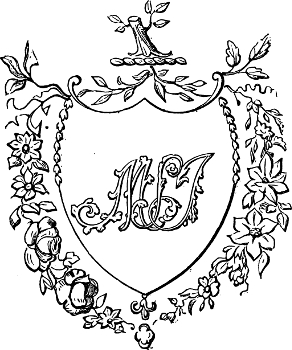
Fig. 843.
Transfer printing on china does not seem to have been practised to any extent at Lowestoft. One jug, however, which has been handed down from father to son in the family of the most active proprietor, is preserved, with a memorandum that the copper-plate from which it was printed was given to Mr. Browne by a Mr. Gamble, of Bungay, who, with his family, was in the habit of visiting Lowestoft. Probably the plate was given that the family might be supplied with ware printed from it. The design is a sportsman with dog and gun, and on the spout of the jug are the letters ‘S. A.’ the initials of Samuel Aldred. I have also seen a set of beakers, &c., printed in blue, which are said to have been bought at the factory, and to be attested as Lowestoft make.
The Lowestoft works did not excel in figures, which were usually simple in design, and of small size. They are usually single rustic figures, and possess no notable features; four examples, purchased at the factory just before its close, are in the possession of Lady Smith, and are highly interesting as being well authenticated. Among the principal artists employed at the works were Rose, the refugee of whom I have just spoken, whose beautiful floral patterns decorate most of the best specimens of the ware of these works; Powles, a very clever artist, whose name is well known as the draughtsman of the plates illustrating Gillingwater’s “History of Lowestoft;” Allen, of whom I have spoken, who painted the east window of the parish church, and was the mixer of the colours at the factory; Redgate, who also was a good flower-painter; Curtis, of whose productions I have already spoken; Abel, John, and Joseph Bly; James, John, and Margaret Redgrave; and others named Stevenson, Balls, Mottershed, and Simpson. Besides these, several women were employed in painting and gilding.
The works were brought to a close in the year 1803 or 1804, and the materials and finished goods were sold by auction. The causes which led to their discontinuance were many, but principally the losses sustained by the company, and the successful competition of the Staffordshire manufacturers. One great loss was caused by the failure of their London agents; another and more serious one by the destruction of a very large quantity of Lowestoft china in Holland, with which country an extensive trade was carried on, as thus stated:—“When Napoleon crossed the river during a hard frost and captured Holland, amongst the British property destroyed was a quantity of Lowestoft china at Rotterdam, in value several thousand pounds.” The trade with Rotterdam was very large, and the ware was sent weekly in hogsheads by way of Yarmouth. These two losses, coming closely together, crippled the company; and the cost of manufacture, through having no coal nor any other requisite material in the neighbourhood, preventing them from producing ware so cheaply as could be done in Staffordshire and at Derby and Worcester, the works were closed, after the proprietors had realised considerable sums; and the town thus lost a branch of manufacture which was an honour to it, and which has given it a name in the annals of the Ceramic Art of this country.
And here, before proceeding further, let me again utter a word or two of caution to collectors, against placing too implicit a reliance upon what has been written concerning Lowestoft china, and against taking for granted that all which is nowadays called Lowestoft china is really the production of that manufactory. If all that is ascribed to Lowestoft was ever made there, the works must have been about the most extensive, and—if all the varieties of wares that are now said to have been there produced were made, as is asserted, simultaneously—the most extraordinary on record. The great bulk of the specimens now unblushingly ascribed to Lowestoft I believe never were in that town, much less were ever made there. Mr. Owen, in his excellent work on Bristol china, says truly:—
“The fashion has become general to attribute all such (Oriental) china to Lowestoft, in spite of the evidence afforded by its make, texture, and glaze. It is painful to see, in public and private collections, examples of Oriental ware so labelled, simply because, though hard porcelain, they bear English armorial coats and initials. Mrs. Wilton, of Twigworth Villa, Gloucester, has a set of Oriental china mugs—with the initials of her grandfather and grandmother—which were made for her ancestor in China, and brought thence by himself. According to the new fashion, these relics would be attributed to Lowestoft. Many porcelain punch-bowls are to be found in seaport towns with names and portraits of ships and very early dates; these bowls are often attributed to the works at Liverpool and Lowestoft. The officers of the East India Co.’s ships were accustomed to take out English delft bowls, and get them reproduced in common porcelain in China for their merchant friends; and many a relic now prized as of home manufacture was procured in this manner.”
And again:—
“If one hundredth portion only of the Oriental porcelain which, on the slight evidence of having a certain red trellis-work in the borders, or coarsely-painted roses, or English armorial bearings, is erroneously attributed to Lowestoft, had really been made there, that factory must have been the most prolific and wonderful in the kingdom. A higher critical appreciation of the peculiarities of Oriental ware would prevent such an error.”
The mill for grinding the materials for the manufactory “was in a ravine by the Warren House on Gunton Denes, where a fine stream of water constantly flows. This was dammed up, and when it had arrived at a certain height, was set to flow over a very large wheel (the largest of the kind at that time in the kingdom), for the purpose of grinding the materials for the china.” This water wheel is, I am informed, still in existence. The factory was situated in the town, and the premises are now occupied as a brewery. The street is still called Factory Lane. It is worthy of note that no mark was used upon Lowestoft china. Marryat mentions a mark of three parallel straight blue lines; but this is evidently an error, as no such examples appear to be known.
Stowmarket.
The Tile Works at this place are of old establishment, and have always been noted for the production of celebrated “white bricks,” spoken of in the seventeenth century. They are worked by Mr. C. O. Fison, who, in addition, manufactures an improved malt-kiln tile, both square-cluster and round-cluster, for which honourable mention was made at the 1862 Exhibition. They are largely exported to various foreign countries, as well as being extensively used in this kingdom.
Ipswich.
Ransome’s Patent Stone.—The first manufacture of this important material was commenced at Ipswich in 1844; the inventor being Mr. Frederick Ransome, of the firm of Ransomes and Sims of this town. The works were removed in 1866 to East Greenwich, which see (page 162) for a farther account.
Ebbisham.
A large brick manufactory existed at Ebbisham, in Surrey, in the seventeenth century, and a long and most interesting account of it, and of the clays, as well as all the processes of manufacture, will be found in Houghton’s “Husbandry and Trade Improved,” 1693.
Wrotham.
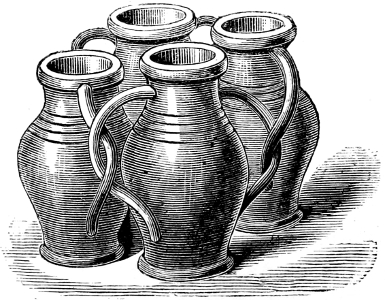
Fig. 844.
A pottery was in existence here, in Kent, in the middle of the seventeenth century, but nothing is known as to its history. The ware was the usual coarse brown ware, of much the same character as the Toft dishes. An example, formerly belonging to Mr. C. W. Reynolds, decorated with an incised pattern and bearing the date 1668, and the initials H. I. and I. A., is traditionally said to be of this make. In the British Museum is a large brown dish with the words E. W. E., WROTHAM, 1669, and in the Museum of Practical Geology is a two-handled posset-pot with raised ornaments and inscription laid on, in yellow slip, before glazing, T. E., WROTHAM, 1703. Another good example, belonging to Mr. Baldwin, is a four-handled tyg ornamented with fleur-de-lis, &c., and bearing the words

An interesting example, considered by Marryat to belong to Wrotham, is given on Fig. 844.
Yarmouth.
Although the name “Absolon, Yarmouth,” may occur on various pieces of ware in different collections, it must not, for one moment, be taken for granted that the pottery was produced there. The Absolons were china and glass dealers in Yarmouth, and one of the family appears to have erected a kiln, called the Ovens, and there to have burnt in the flowers and other designs which he employed himself in painting upon ware produced from other places. His plan appears to have been to procure the ordinary cream-coloured ware in plates, &c., and paint upon them flowers in the manner of those of Swinton, Don, &c.; and in the same manner to write their names on the back; and then to burn them in in his own “oven.” Mr. Norman possessed some plates of Absolon’s painting, which bore on the back the usual mark of his name, pencilled on and burnt in, and the name “TURNER” impressed in the ware. These pieces, there can be no reasonable doubt, were made by John Turner, of Lane End. Mr. Chaffers says that having the name of “Turner” stamped upon them, “proves that they were actually made at Caughley, and decorated at Yarmouth;” but this carries its own condemnation on the face of it, for Turner of Caughley is not known to have stamped his name on his ware, and beyond this he did not produce cream ware at his works. There is reason to believe that Absolon bought his ware from Staffordshire and Leeds. He put his name in colour on the bottom of the pieces he decorated.
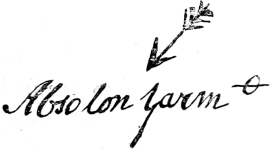
Fig. 845.
Cossey.
The works at Cossey, near Norwich, which now produce many art-works of merit in the form of decorated bricks and other architectural enrichments, were established about 1800, as a brick-yard, and so continued of small size, until about 1827, when Cossey, or Costessy Hall, the seat of its noble owner, Lord Stafford, was rebuilt, when they were enlarged, so as to enable a full supply for the purpose to be made. The foreman of these works was Mr. Gunton, and under his care the manufacture of ornamental bricks, for the new hall, was tried, and with marked success. On this hall,—one of the best of brick buildings, and one which may be looked upon as a gigantic example of Cossey ceramic art—are some remarkably fine Tudoresque chimney shafts, as well as excellently designed and well-executed cusped window-heads, transoms, mullions, &c.; and finials, door-jambs, cornices, panelling, and string-courses, all of equal excellence. These are all formed of moulded brick made at Cossey from native clays, and are still in remarkably good preservation. After the completion of the building of the Hall the brickworks were closed for about four years, when Mr. Gunton succeeded in renting them in the hope of fully carrying out his idea of manufacturing decorated brickwork. Unfortunately, however, he was not permitted to have the use of the moulds from which the Hall bricks had been made; but, nevertheless, he from time to time prepared new moulds for chimney shafts, window-heads, mouldings, &c., and gradually got them into notice, and architects and builders soon began to see their advantage. The works are now carried on by his son, Mr. George Gunton, whose productions are of the highest possible class of merit. Among the architectural enrichments produced at these works,—the designs being entirely supplied by architects, and of the purest style and finish—are chimney shafts, many of which are of the most elaborate style of ornamentation; window-heads, &c.; balustrades; cornices; medallions; crest-ridging; string-courses; plinths; arches and keys; pateræ; architraves; finials; capitals, bases, and shafts; and many other matters. These are produced of remarkable sharpness and of great beauty of finish—the tooth, nail-head, and other ornaments, being very pure in character. They are produced in two colours—a fine, rich, deep red, and a stone; the latter being the nearest approach of any to artificial stone, and both being extremely hard and durable.
Cadborough.
The Cadborough Pottery, near Rye, in Sussex, was first built about 1807, and carried on by Mr. James Smith, and afterwards by his son, Mr. Jeremiah Smith. In 1840, the business passed into the hands of the late Mr. William Mitchell (who had had the management of it, under Mr. Smith, since 1827), who carried it on in his own name until 1859, when he took one of his sons, Mr. Frederick Mitchell, into partnership, and the firm became “Wm. Mitchell & Son,” and so continued until 1869, when the partnership was dissolved, under mutual arrangement, Mr. Mitchell, sen., continuing the Cadborough business for common earthenware, and his son, Mr. Frederick Mitchell, taking the fancy department, which was his own creation, to new premises, the Bellevue Pottery (which see). In 1870, Mr. Mitchell, sen., died, and the business at Cadborough was then taken by Mr. Henry Mitchell, who still carries it on. The goods produced are the ordinary common brown wares, glazed and unglazed, and consist of flower-pots; chimney-pots; pitchers and crocks of various kinds; tongue, ham, beef, biscuit, milk, and other pans; bottles, jugs, bowls, and other domestic vessels; sewer and drain pipes; butter-pots; and all the other usual articles made in this ware. The clay is dug on the farm of Cadborough, as is also the loam with which it is mixed, and it is of peculiarly hard and durable texture, and capable of taking a good glaze. Many of the domestic vessels are mottled or “splashed” under the glaze.
Rye.
The “Bellevue Pottery” in the Ferry Road, Rye, Sussex, was established in 1869, by its present proprietor, Mr. Frederick Mitchell, son and partner of the late Mr. William Mitchell of the Cadborough Pottery (which see). It was established entirely for the manufacture of “Sussex Rustic Ware”—an ornamental branch of the brown-ware goods invented by Mr. Frederick Mitchell while at those works. This ware is of peculiar, but highly pleasing character, and in it a large variety of fancy articles, flower-baskets, candlesticks, jugs, vases, pilgrims’ bottles, &c., are made. The clay is peculiarly light, and of tolerably close texture, and it is capable of working into any form. The glaze, which is of equal richness with that of “Rockingham” ware, is of exceedingly good quality, and it has a rich effect over the mottling or “splashing” which characterizes this ware. Many of the productions are very artistic, and evince much taste and skill in manipulation. Some of the vessels are decorated with the leaf and head of the staple product of the county —the hop—or with other excellent copies of leaves and flowers, &c. The peculiarity of this “Sussex Rustic Ware” is its extreme lightness, and the richness of its mottling and glaze.
One article, worthy of especial notice, as made at these works (and formerly at Cadborough), is the “Sussex Pig” here engraved. This is a drinking vessel of the same general character as the “Bears,” which will be found described under the heads of Brampton, Nottingham, &c. The body, when filled with ale, stands on end, on its tail, and the head lifts off to be used as a drinking cup, precisely in the same manner as with the “bears.” In Sussex these “pigs” are used at weddings, when each guest is invited to “drink a hogshead of beer to the health of the bride;” and at other social and convivial meetings. On these occasions each person is expected to drink this cup—or “hog’s head”—full of liquor.
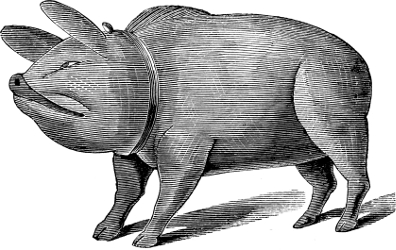
Fig. 846.
Gestingthorpe.
Pavement tiles and other articles were made at Gestingthorpe, in Essex, in the seventeenth century. Houghton, writing in 1693, says:—
“From my ingenious good friend, Mr. Samuel Dale, of Braintree, in Essex, I am informed, that at Gestingthorpe, in that county, are made a sort of hard yellowish bricks and pavements, called white brick, and Walpet brick, from a town in Suffolk of that name, where they were first made; they are harder and more durable than common red brick, and therefore much used for pavement of floors in lower rooms, and also for fire-hearths, except just where they make their fires.”
Holkham.
In 1849, the Earl of Leicester, anxious to turn the clays of his estate in Norfolk to good account, commenced the manufacture of red terra-cotta at Holkham, and produced some good Tudor chimney-tops and moulded bricks.
Nuneham Courtney.
Potworks existed here in the beginning of the seventeenth century, and are spoken of by Plot, in 1677 as being “now deserted; nor, indeed, was there, as I ever heard of, anything extraordinary performed during the working these earths.”
Marsh Balden.
The pottery at this place, existing in the beginning of the seventeenth century, is included in the above remark by Dr. Plot.
Horspath.
Tobacco pipes were made here in the latter end of the seventeenth century.
Shotover.
At Shotover, in the parish of Headington, tobacco-pipes were made prior to 1677, at which time the “place was deserted.”