Volume 1 — CHAPTER XI.
Reading edition
Bristol—Delft Ware—Redcliffe Backs—Richard Frank—Ring—Flower—Bristol China—William Cookworthy—Richard Champion—Transference of Plymouth Works—Extension of Patent—Wedgwood’s Opposition—“Case” of the Manufacturers—Champion’s Specification—Champion’s Productions—Edmund Burke—Bristol Vases—Figures—Marks—Bristol Earthenware—Temple Backs—Potters’ Songs—Temple and St. Thomas’s Street Works—Temple Gate—Wilder Street—Bristol Glass—William Edkins—Salt Glaze—Brislington—Crews Hole—Westbury—Easton—Weston-super-Mare—Matthews’s Royal Pottery—Poole—Architectural Pottery Company—Bourne Valley—Branksea—Kinson.
Bristol.
The first record of pot-making in Bristol appears to have been in the reign of Edward I., but it seems certain that vessels were made in the neighbourhood in Saxon and Norman times, as well as in the earlier Celtic and Romano-British periods. Mediæval earthenware vessels of different periods, and probably made in the locality, have now and then been found at Bristol, and during the reign of Elizabeth, there is no doubt, a manufactory of fictile vessels was in operation.
“Six hundred years ago,” says Mr. Owen, “the art of pottery was practised in Bristol, but in what form is beyond our speculation. The record, though authentic, is too terse to give more than the bare fact, and the imagination must be fertile indeed that can supply the details. The Governor of Bristol Castle, under Edward I., in his accounts, preserved in the Pipe Roll for the twelfth year of that reign (1284), has an item—‘pro terra fodienda ad vasa fictilia facienda’—which shows that this claim for high antiquity is well founded.” Fragments of some curious pitchers and other mediæval domestic vessels are engraved by Mr. Owen, and appear to be of about the period alluded to.
The Delft Works.—At the close of the seventeenth century, Delft ware was made here, and continued to be produced until about the time when porcelain began to be produced in the city. Many specimens of Bristol Delft ware have come under my notice, some of which are, fortunately, dated. The earliest dated example I have seen is a plate marked on the rim with the initials S · M · B, and the date 1703, thus— . The ware is of a very nice quality, with a good glaze, and the blue of good colour. The next dated specimen, in chronological order, which has come under my notice is a Delft high-heeled shoe, or choppine, which is dated on the sole 1722, along with the initials M S—thus This very good example, which is said to be of Bristol make, was in possession of the late Mr. James, of that city. It is beautifully formed, has a buckle in front, and is flowered and bordered in blue. Two of these Delft stands in the form of high-heeled shoes, formerly belonging to Queen Charlotte, were sold at the Bernal sale. They were of an earlier date, and marked M I 1705. Another example in the same possession is a plate of the year 1740, bearing on its rim the initials R · S · P, thus—
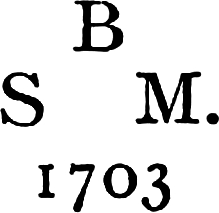
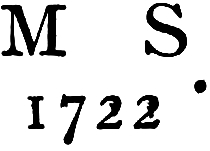
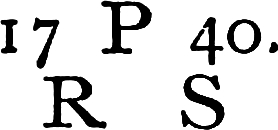
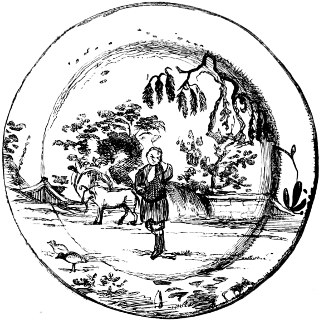
Fig. 735.—Edkins’ Plate, belonging to Mr. Owen.
One of the latest dated examples I have seen is the plate engraved on Fig. 735, which forms part of a set belonging to a descendant of the artist who painted it, and has remained in the family from the time of its manufacture until it came into my hands. It is a plate painted in a somewhat peculiar style, in blue, with a Chinese figure, trees, cattle, and birds, and having on its under side the date 1760, and the initials M · B · E, as shown on Fig. 736. These are the initials of Michael and Betty Edkins, of Bristol, of whom I shall have more to say presently.
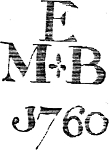
Fig. 736.
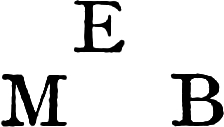
It may be well to remark, en passant, that this mode of placing initials, which is so usual on traders’ tokens, was the favourite way of arranging the initials of husband and wife, and they were so understood without using the short &. The upper letter was the initial of the surname, and those below of the Christian names of the husband and wife. Thus would read M & B E, and stand for Michael and Betty Edkins.
The Delft ware works were situated on “Redcliffe Backs,” near to the glass works of Messrs. Little and Longman. The names of the first potters are, as usual, lost, but in the early part of last century the works belonged to a Mr. Richard Frank, who seems to have been a man of standing in the place, and who employed, along with other workmen, a Mr. Thomas Patience, and a family of the name of Hope. Richard Frank, who had also works at Brislington, was the son of Thomas Frank, “gallipot maker,” of Bristol, who was married in 1697; he, the “gallipot maker,” is therefore the earliest recorded potter of this place. The goods produced at Richard Frank’s manufactory—who, as well as his father, is described as a “gallipot maker” in 1734–9 and 1754—were principally plates, dishes, and “Dutch tiles” for fire-places, dairies, &c. In the Museum of Practical Geology is a slab composed of twenty-four tiles, on which is painted in blue a view of St. Mary Redcliffe Church, Bristol. These were made by Richard Frank, about 1738–50, and the arms of Bishop Butler appear upon one of them. The tiles were all, of course, painted by hand, and we have it on the authority of Michael Edkins, himself the actual painter of the plate, Fig. 735, that the brushes which he and the other workmen used were made by themselves from the hairs pulled from the nostrils and eyelids of cattle. Michael Edkins, the painter of Delft ware, was, it appears, from Birmingham, where he was apprenticed to a house painter. His master dying before his term expired, he was of course left to shift for himself, and made his way to Bristol, where, becoming acquainted with Patience and Hope, he got employed at Frank’s pottery, where he became a “pot painter,” and continued in that employment till the Delft pottery declined, “when (in 1761) he became a coach and general painter and decorator, and quickly rose to eminence, was employed about most public works in the city, assisted in painting the bas-reliefs to the altar-piece of St. Mary Redcliffe, and also assisted Hogarth in fixing his celebrated pictures in that altar-piece.” He was also a successful actor at the theatre. One branch of his business that he now followed was “enamelling glass ware,” which he did for Little and Longmans, and their successors, Vigor and Stevens, whose glass house adjoined the Delft pottery on Redcliffe Backs. The works stood on what is now, at the time I write, Redcliffe Wharf, occupied by Mr. Cripps, general wharfinger, on the river Avon.
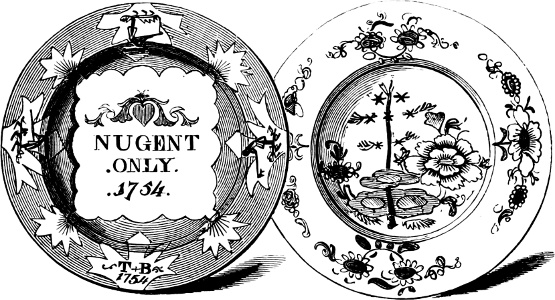
Fig. 737.—Election Plate, 1754.
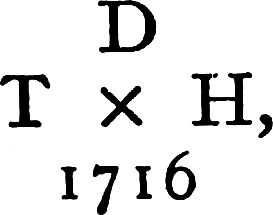
A plate bearing the words “Nugent only 1754,” was in all probability made by Richard Frank, who was a supporter of Nugent at the general election of that year. Another plate, commemorating the same year’s election for Tewkesbury, is supposed to be from the same works; it bears the words “Calvert and Martin For Tukesbury 1754 Sold by Webb.” Among other dated examples of Bristol Delft are the following, which may be from Frank’s pottery. A piece bearing the words “Ye 1st Septr 1761 Bowen · fecit;” a pair of plates made for a member of the family of Davis, with the letters , and others with the following

“Hannah Hopkins Born Sep 17 New Style 1752,” occurs on a christening bowl in the Edkins collection.
A fine plate, painted by Bowen, engraved on Fig. 738, is in possession of Mr. Willet, of Brighton, who also possesses a grand tile picture, consisting of seventy-two tiles, painted with Hogarth’s “March to Finchley.” Mr. Fry has two clever tile pictures of nine tiles each, one representing a cat and the other a dog. On the collar of the latter are the words “Bristol, 1752.”
Later on Richard Frank took his son Thomas into partnership, and in 1777 the works were removed to Water Lane, to the manufactory which, in 1775, had been carried on by James Alsop, a brown stoneware potter. The following advertisement, of the year 1777, refers to this change: “Richard Frank & Son, Earthen and Stone Pot Works, are removed from Redcliffe Backs to Water Lane, where they continue the same business in all its branches.”
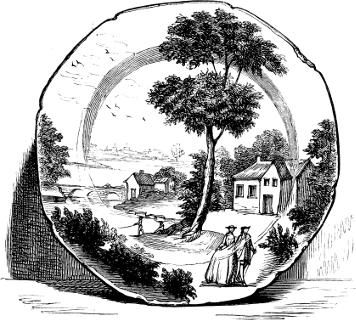
Fig. 738.
In 1784, Joseph Ring, rectifier and vinegar maker, who had married Elizabeth, daughter of Richard Frank (and was father of Sarah, the wife of Frederick Cookworthy,[ ] nephew of William Cookworthy), purchased the business of Frank and Son for £669 1s. 3½d. Mr. Owen prints the following extracts from the valuation for this sale. It shows that Richard Frank and Son were general dealers in all kinds of ware, as well as Delft and stone ware makers. The inventory is headed, “The Stock & Utensils in Trade At the Pot House in Water Lane, Bristol, as Appraised as following.” The following are some of the items; the whole of the plant being valued at only ten pounds:—
£ s. d.
“Black Ware 27 6 2½
Red China Ware 3 16 2
Tortoishell Ware 0 18 0
Blue and White Sprig’d Ware 14 15 6
Blue and White Stone Staffordshire Ware 2 18 9½
Dutch Ware, 18 Jugs, one to ye Warp 0 18 0
Delph Ware 7 5 0
21 Doz. and ½ Copperplate tiles 4 4 0
Best Nottingham Ware 25 16 8½
Blue China Glaz’d Ware 11 3 2½
Enamelled China Glaze Ware 14 8 11½
Common Enamelled Ware 3 13 3
Copperplate Ware 2 0 0
Cream Colour Ware 90 13 4½
White Stone Ware 52 0 9
Brown Stone Ware 159 16 11½
Materials, 27 tons Clay, 2/6 29 0 6
80 bags Sand, 1/2 4 13 4
11 Cut Salt, 5/6 3 0 6
Tools, 324 Pot Boards, 3 Benches, 1 Pounding Trough, 1 Mixing Trough, 1 Clay Chest, 3 Compleat Wheel and Wheel Frames, with Working Benches, &c., Moulds and Drums for making Slugs, Kiln Ladder, Salting Boxes, Lignum Vitæ blocks and Hand Mill 10 0 0
Old Iron Pot, in the Yard 0 4 6
Richard Frank died in 1785, aged about 73, and was buried in the Quaker’s ground at Redcliffe Pit. “Joseph Ring, successor to Richard Frank in the Pottery Business,” in his address stated that he “continues the manufactory of the Bristol Stone Ware, and sells all other sorts of Queen’s and other Ware wholesale and retail.” This last branch of his business he cultivated considerably, and appears to have traded with most of the manufacturers of the day. In 1786 Mr. Ring determined upon manufacturing Queen’s ware, and to that end engaged Anthony Hassel (or Hassells), a potter of Shelton, in Staffordshire, buying from him his stock and moulds, and removing them to Bristol.
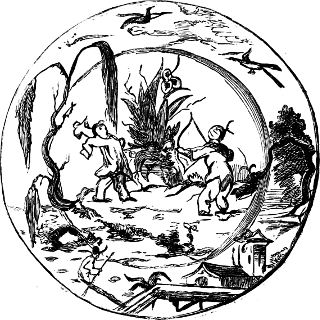
Fig. 739.
In 1788 Mr. Ring took two partners, Mr. Taylor and Mr. Carter, he bringing in a capital of £3,000, and Messrs. Taylor and Carter £1,500 jointly. “The Stock and Utensils in Trade at the Pot House in Water Lane, as per Inventory taken this day,” January 9th, 1788, were sold by Mr. Ring to himself and partners, “under the firm of Ring and Taylor,” for £2038 1s. 10d. The manufacture of Delft ware then came to a close.
Another Delft ware potter was Joseph Flower, who, in 1775 lived at No. 2 on the Quay, and in 1777 removed to 3 Corn Street, where he put a sign-board, painted black, with “Flower, Potter,” in gold letters, for the painting of which he paid Michael Edkins 10s. 6d. Flower’s ware, says Mr. Owen, is thinner and neater in make than most British Delft; the glaze good, and the colour clear and brilliant in tone—indeed, in no respect inferior to Dutch. Fig. 739 is a plate belonging to a dinner service made by Joseph Flower, and now in the possession of his descendant Mr. J. Flower Fussel. It is painted with a Chinese pattern, and bears initial and dates varying from 1742 to 1750. The plate here engraved bears the initials (Fig. 740). In the same hands is a plate dated 1741–2, painted with a view of the river Avon and the old Hotwells House; and two dishes bearing the plan of a battle, and the words “The taking of Chagre in the West Indies by Admiral Vernon.”
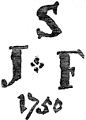
Fig 740.
Bristol China.
The first mention of the making of china in Bristol occurs in a letter of Richard Champion, dated February 26, 1766. In July, 1765, a box of “porcelain earth” “from the internal part of the Cherokee nations, 400 miles from hence (Charles Town), on mountains scarcely accessible,” was consigned to him, by his brother-in-law, to be forwarded to the Worcester china works to be used there in experiments. The letter of advice was dated Charles Town, 1765. At the same time another box of this earth was sent to Champion for the Earl of Hyndford, who desired Champion to open it and try experiments, or give it to Thomas Goldney “who is a very curious gentleman.” In the letter of February 28th Champion, writing to Lloyd, by whom it was consigned, says Mr. Goldney has declined the clay. “I therefore,” he adds, “had it tried at a manufactory set up here some time ago on the principle of the Chinese porcelain; but not being successful is given up.” “The proprietors of the work in Bristol imagined they had discovered in Cornwall all the materials similar to the Chinese; but though they burnt the body part tolerably well, yet there were impurities in the glaze or stone, which were insurmountable even in the greatest fire they could give it, and which was equal to a glass-house heat.” These works he had personally, in November, 1765, spoken of as “a new work just established,” and says, “this new work is from a clay and stone discovered in Cornwall, which answers the description of the Chinese; but in burning there is a deficiency, though the body is perfectly white within but not without, which is always smoaky. This clay is very much like, but not quite so fine as the Cherokee; however there can be no chance of introducing the latter as a manufacture when it can be so easily procured from Cornwall.”[91] This “new work” which had been tried and failed was doubtless connected with Cookworthy of Plymouth. In 1764 he is spoken of as “the first inventor of the Bristol china works.” Champion, at all events, it is clear from the letters, had nothing to do with it, and probably his first idea of making china was got from the fact of the box of porcelain earth being consigned to him for the Worcester works. In March, 1768, Cookworthy, the discoverer of the material, the mainspring in all those matters, and the first to try experiments and bring to a successful issue the manufacture of porcelain from the Cornish materials he had found, took out his patent.[92] Soon after this the manufacture of china was again commenced in Bristol by Richard Champion. In 1771 a china manufactory, carried on by “William Cookworthy & Co.,” appears to have been in operation in Castle Green—the “Co.,” there can be no reasonable doubt, being Richard Champion and others. In May, 1774, William Cookworthy assigned his patent right, &c., to Champion, and the Plymouth manufactory, which had probably been previously removed to Bristol, was finally closed; in the rate-books the firm being, from 1773 to 1780, “Richard Champion & Co.,” in 1781 “Richard Champion” only; and in the following year the premises are stated to have been occupied by a pipe-maker named J. Carey.
“Every circumstance investigated,” says Mr. Owen, in his valuable work “Ceramic Art in Bristol,” “proves that Champion first commenced china-making under licence from the patentee (Cookworthy). Mr. Edward Brice advanced £1,000 in aid of the work in February, 1768; the partnership in 1768 consisted of Richard Champion, Joseph Harford, and Thomas Winwood”—Harford contributing £3,000 to the capital. On the 1st February, 1769, the partnership was dissolved. Mr. Joseph Fry, without being a partner, is also stated to have contributed £1,500 to the scheme. In 1771 an advertisement of “Some beautiful dessert services, ornamental figures, candlesticks, and many other valuable articles of the Bristol manufactory,” were advertised to be on sale “on retail at Taylor’s Hall” in that city.
In 1772, as Mr. Owen incontestably shows, the china works were in full operation in Bristol. On August 15th of that year the following advertisement appeared:—
“China. For Sale by Auction at the Taylors-Hall in Broad Street, on Tuesday the 1st of September and the following days, Useful and Ornamental China, The produce of the Bristol Manufactory, consisting of very elegant Figures, beautiful Vases, Jars, and beakers, with all kinds of useful China, blue and white and enamel’d. To be sold without Reserve. J. Stephens, auctioneer. The whole to be Viewed the Saturday and Monday preceding the Sale, from Ten in the morning till Two, and from Three till Six in the Afternoon. The Manufactory is still carried on in Castle Green, where all persons may be supplied with useful or ornamental China, Wholesale or Retail.”
In November, 1772, the following still more illustrative advertisement appeared:—
“China. At the Manufactory in Castle Green, Bristol, are sold various kinds of The True Porcelain, Both Useful and Ornamental, consisting of a new assortment. The Figures, Vases, Jars, and Beakers are very elegant, and the useful ware exceedingly good. As this Manufactory is not at present sufficiently known, it may not be improper to remark that this Porcelain is wholly free from the Imperfections in Wearing which the English China usually has, and that its Composition is equal in fineness to the East Indian, and will wear as well. The enamell’d Ware, which is rendered nearly as cheap as the English blue and white, comes very near and in some Pieces equal to Dresden, which this work more Particularly imitates. N.B. There is some of the old Stock, which will be sold very cheap.—Two or three careful Boys wanted. ☞ Also at Cadell’s Tea and China Shop, No. 20, in Wine Street, is to be sold Retail, on the same Terms as at the Manufactory, a new and elegant Assortment of the above Porcelain.”
In January, 1773, as again shown by Mr. Owen, to whom the world is much indebted for many years’ laborious searchings into every available source of knowledge, and whom I have to thank for much information, another advertisement appeared as follows:—
“The True Porcelain, both useful and ornamental, Consisting of a large and elegant assortment (Particularly some beautiful Imitations of the Dresden) on any low Terms, to induce the Public to encourage a Manufactory the first of the kind introduced into England, and now brought to Great Perfection. Its texture not to be distinguished from East India China, and will wear equally well. Some of the old Stock selling remarkably cheap.”
From these it is evident the Bristol works were carried on simultaneously with those of Plymouth in the last few years of those later works, and that, like Plymouth, “vases, jars, and beakers, very elegant,” were produced, as well as the ordinary classes of useful goods. In June, 1773, his prices are advertised as “Complete Tea Sets in the Dresden taste highly ornamented £7 0s. 0d. to £12 12s. 0d. and upwards. Tea Sets, 43 pieces, of various prices as low as £2 2s. 0d. Cups and Saucers from 3s. 6d. to 5s. 6d. per half-dozen, and all other sorts of useful Ware proportionately cheap.”
Whatever may have been the position of the manufactory at Bristol, and by whomever—whether “W. Cookworthy & Co.,” “R. Champion & Co.,” or “R. Champion” alone—it was carried on previous to that date, certain it is that (as I have stated) in 1774 Cookworthy sold his patent right, &c., to Champion, closed his Plymouth works, and from that time forth ceased to have any connection with china making.
In 1774, then, “Richard Champion, of Bristol, merchant,” became possessed of Cookworthy’s patent. The deed of assignment of the patent rights, &c., from Cookworthy to Champion, is dated May 6th, 1774, and among other “considerations” it was covenanted that whatever the amount of value of the raw material (the Cornish clay and stone which Cookworthy had discovered and brought into use) Champion used in the course of a year, an equal amount of money should be paid to Cookworthy. For example, if, in the course of a year, Champion paid £1000 for material in Cornwall, he would also have to pay another £1000 to Cookworthy for the privilege of using it, thus doubling the price of the material from that at which Cookworthy had himself worked it. Of this, however, more presently.
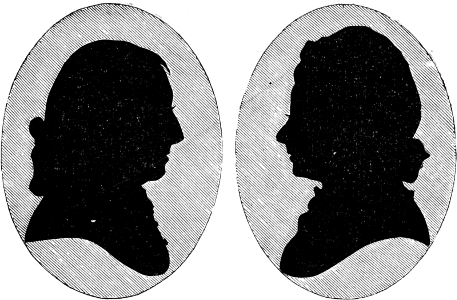
Figs. 741 and 742.—Portraits of Richard Champion and Judith his wife.
Champion was, evidently, a man before his time in Bristol, enthusiastic in everything which could tend to improve that city commercially or otherwise, and ever ready to expend his energies and his money in furtherance of useful schemes and beneficial manufactures. He was, it will have been seen, just the kind of man to enter earnestly, and even enthusiastically, into the scheme of making porcelain on a principle that should employ native materials only, and which bid fair to be a great and lasting benefit, not only to his city, but to the community at large.
I have shown, then, that Richard Champion, in 1774, by deed of assignment from Cookworthy, dated May 6th in that year, became the sole proprietor of the patent right, and everything connected with the china works, for which he covenanted, among other things, to pay to Cookworthy, his heirs, executors, &c., a profit equal to the first cost of the raw material used in his manufactory. The first arrangement was that this royalty was to be perpetual, but it was afterwards restricted to ninety-nine years—the time of the lease for the raw materials. Having thus become proprietor of the concern which had at one time been carried on jointly by Cookworthy, Lord Camelford, and himself (and probably others), he, on the 22nd of the following February, 1775, presented a petition to the House of Commons, praying for the term of patent right to be enlarged for a further period of fourteen years to himself. His petition was referred to a committee, which began its sittings on the 28th of April. The following is the report of the committee of the House of Commons upon the petition:—
“To prove the Allegations of the said petition, His present Majesty’s Letters Patent, dated 17th March, 1768, granted to William Cookworthy, of Plymouth, Chymist, for the sole use and Exercise of a Discovery of Materials, of the same Nature as those of which the Asiatic and Dresden Porcelain are made, were produced to your Committee and read.
“That an Assignment of the said Letters Patent from the said William Cookworthy to the petitioner, dated 6th May, 1774, were also Produced and read; and
“Mr. John Britain being examined, said That he has great Experience in several China Manufactures, and has made several Trials upon all those which had been manufactured in England, and finds that all of them, except that of Bristol, were destroyed in the same fire which brings the same Bristol to Perfection.
“And he produced to your committee several samples of the said kinds of China, which shewd the effect upon china severally, and said that they had not been able to bring the Bristol China to a marketable commodity so as to furnish an order until within the last Six Months, but that sometimes they succeeded and at other times not; but that now they can execute any order.
“That they have lately made considerable Improvements in the said manufacture, and particularly are endeavouring to perfect the Blue, in which as yet they have not entirely succeeded, though they have now a Gentleman who has succeeded in a small way, in which they have been at a considerable expence; that the witness thinks the manufacture is capable of further improvements; that they can afford it at a price equal to Foreign China of equal goodness; and that they have made some Specimens equal to good Dresden; that he had not seen any Dresden ornamental China equal to the Vases produced to your committee, nor anything equal to the Biscuit in those Vases and other Ornaments; that the Gilding stands well; that Seve China differs from this—the Ornamental is more of a cream colour, but the glaze is so soft that it will not bear using; that he believes the Enamell of the Bristol China is as hard as the Dresden and harder than the Chinese; that they can make it of any degree of thickness required; that there is the difference between the Bristol China and the Seve and several other kinds, that when they are broke they seem as dry as a Tobacco Pipe; that this is the case of all the English China; but the Dresden, the Bristol, and the Asiatic China have when broke a moist and Lucid appearance, in proof of which he produced Fragments of the several kinds. That the Bristol China will stand hot water without splitting; that he has never known an instance of it splitting, though he has known several pieces of the Asiatic split; that the gold does not come off the Bristol; that there are some china which frequent use turns brown and cracks, which the Witness thinks arises from there not being a proper Union between the Body and the glaze; that the Manufacturers have their Glaze made into a glass previous to its being applied to the Body, but that that is not the case with the Bristol. That they can make plates, but have had great Difficulties. That they have not hitherto much attended to that object, but have applied themselves to perfecting the body as a Body and the Glaze as a glaze; that they can render this China in most Articles as cheap as the Asiatic, and much cheaper than the Dresden.
“Then the Witness produced to your committee Specimens of the Asiatic and Chinese materials, and said he found no difference except that the materials of the Asiatic shrunk in the Burning One 42d Part more than those of Bristol, and judges the Bristol materials to be better. Then,
“Mr. Samuel Hardensydes Produced to your committee several pieces of China which he had lately tried Experiments on in London; and being examined, said that he had put India, Dresden, Bristol, and other English China into the fire in the same Crucible; that the India, Dresden, and Bristol came out in the same state they were put in; the Bristol was tried three times and stood it; the Fire moved the Gilding into Grains, but had no other Effect upon it; in other respects it was rather better for the Fire.
“Ordered, That leave be given to bring in a Bill for enlarging the Letters patent.
“And that Mr. Frederick Montagu, Mr. Cruger, Mr. Harris, Mr. Cooper, the Lord Clare, and Mr. Eden, do appear and bring in the same.”
By this time he had prepared and produced some remarkably fine specimens of china made at his works, for examination by the committee, and it is not too much to say that at this period his productions were of the highest rank. The result of his application was the ultimate passing of an Act of Parliament, by which the patent was accordingly enlarged. This Act, which contains a vast deal of valuable and interesting information, I give in extenso, for the benefit of my readers.[93] It was passed in 1775 (15 Geo. III., cap. 52), and is entitled, “An Act for enlarging the term of Letters Patent granted by his present Majesty to William Cookworthy, of Plymouth, Chymist, for the sole use and exercise of a discovery of certain materials for making Porcelain, in order to enable Richard Champion, of Bristol, merchant (to whom the said Letters Patent have been assigned), to carry the said discovery into effectual execution for the benefit of the public.” It is as follows:—
“Whereas his present Majesty King George the Third has been graciously pleased to grant his Royal Letters Patent under the Great Seal of Great Britain unto William Cookworthy, Chymist, in the words, or to the effect, following; that is to say: George the Third by the grace of God of Great Britain, France, and Ireland, King, Defender of the Faith, and so forth, to all to whom these presents shall come, greeting: Whereas, William Cookworthy, of Plymouth, in the County of Devon, Chymist, has by his petition humbly represented unto us that he hath by a series of experiments discovered that materials of the same nature as those of which the Asiatic porcelain is made are to be found in immense quantities in our island of Great Britain, which ingredients are distinguished in our two counties of Devon and Cornwall by the names of moor stone, and growan, and growan clay; that the ware which he hath prepared from these materials hath all the character of the true porcelain in regard to grain, transparency, colour, and infusibility, in a degree equal to the Chinese or Dresden ware: whereas, all the manufactures of porcelain hitherto carried on in Great Britain have been only imitations of the genuine kind, wanting the beauty of colour, and the smoothness and lustre of grain, and the great characteristic of genuine porcelain sustaining the most extreme degree of fire without melting; that this discovery hath been attended with great labour and expense, and, to the best of his knowledge and belief in regard to this kingdom, is new and his own, the materials being, even at this time, applied to none of the uses of pottery but by him and those under his direction; and that he verily believes this invention will be of great advantage to the public. He, therefore, most humbly prayed us that we should be pleased to grant him our Royal Letters Patent for the sole making and vending of this new invented porcelain, composed of moor stone or growan, and growan clay, within that part of our kingdom of Great Britain called England, our dominion of Wales, and the town of Berwick-upon-Tweed, for the space of fourteen years, according to the statute in that case made and provided: we, being willing to give encouragement to all arts and inventions which may be for the public good, are graciously pleased to condescend to the petitioner’s request. Know ye, therefore, that we, of our especial grace, certain knowledge, and meet motion, have given and granted, and for these presents our heirs and successors do give and grant unto the said William Cookworthy, his executors, administrators, and assigns, our special licence, full power, sole privilege and authority, that he, the said William Cookworthy, his executors, administrators, and assigns, and every of them, by himself and themselves, or by his or their deputy or deputies, servants, or agents, or such others as the said William Cookworthy, his executors, administrators, and assigns shall at any time agree with, and no others, from time to time, and at all times hereafter during the term of years herein expressed, shall, and lawfully may make, use, exercise, and vend his said invention within that part of Great Britain called England, our dominion of Wales, and the town of Berwick-upon-Tweed, and in such a manner as he, the said William Cookworthy, his executors, administrators, and assigns, or any of them, in their discretions seem meet; and that the said William Cookworthy, his executors, administrators, and assigns shall, and lawfully may, enjoy the whole profit, benefit, commodity, and advantage from time to time coming, growing, accruing, and arising by reason of the said invention for and during the term of years herein mentioned, to have, hold, exercise, and enjoy the said licence, privileges, and advantages hereinbefore granted, or mentioned to be granted, to the said William Cookworthy, his executors, administrators, and assigns, for and during and to the full end of the term of fourteen years from the date of these presents next and immediately ensuing, and fully to be completed and ended according to the statute in such case made and provided, and to the end that he, the said William Cookworthy, his executors, administrators, and assigns, and every of them, may have and enjoy the full benefit and the sole use and exercise of the said invention, according to our gracious intention hereinbefore declared; we do by these presents, for us, our heirs and successors, require and strictly command all and every person and persons, bodies politic and corporate, and all other our subjects whatsoever, of what estate, quality, degree, name, or condition soever they be, within that said part of Great Britain called England, our dominion of Wales, and our town of Berwick-upon-Tweed aforesaid, that neither they nor any of them, at any time during the continuance of the said term of fourteen years hereby granted, either directly or indirectly, do make, use, or practise the said invention or any part of the same so attained unto by the said William Cookworthy as aforesaid, nor in anywise counterfeit, imitate, or resemble the same, nor shall make, or cause to be made, any addition thereunto, or substraction from the same, whereby to pretend himself or themselves to be the inventor or inventors, deviser or devisers thereof, without the licence, consent, or agreement of the said William Cookworthy, his executors, administrators, or assigns, in writing under his or their hands and seals, first had and obtained in that behalf, upon such pains and penalties as can or may be justly inflicted on such offenders for their contempt of this our Royal command; and further, to be answerable to the said William Cookworthy, his executors, administrators, and assigns according to law for his and their damages thereby occasioned; and moreover, we do by these presents, for us, our heirs, and successors, will and command all and singular the justices of the peace, mayors, sheriffs, bailiffs, constables, head boroughs, and all other officers and ministers whatsoever, of us, our heirs, and successors for the time being, that they, or any of them, do not, nor shall at any time hereafter during the said term hereby granted the said William Cookworthy, his executors, administrators, or assigns, or any of them, or his or their deputies, servants, or agents, in anywise molest, trouble, or hinder the said William Cookworthy, his executors, administrators, and assigns, or any of them, or his or their deputies, servants, or agents, in or about the due and lawful use or exercise of the aforesaid invention or anything relating thereto: Provided always, and these our Letters Patent are and shall be upon this condition, that if at any time during the said term here granted, it shall be made to appear to us, our heirs, or successors, or any six or more of our or their Privy Council, that this our grant is contrary to law, or prejudicial or inconvenient to our subjects in general, or that if the said invention is not a new invention as to the public use and exercise thereof, in that part of our kingdom of Great Britain called England, our dominion of Wales, and town of Berwick-upon-Tweed aforesaid, or not invented or found out by the said William Cookworthy as aforesaid, then, upon signification or declaration thereof, to be made by us, our heirs and successors, under our or their signet or Privy Seal, or by the lords of our or their Privy Council, or any six or more of them under their hand, these our Letters Patent shall forthwith cease, determine, and be utterly void to all intents and purposes, anything hereinbefore contained in anywise notwithstanding. Provided also, that these our Letters Patent, or anything herein contained, shall not extend to or be construed to extend to the privileges of the said William Cookworthy, his executors, administrators, or assigns, or any of them, to use or imitate any invention or work whatsoever which has heretofore been found out or invented by any other of our subjects whatsoever, or publicly used or exercised in that part of our kingdom of Great Britain called England, our dominion of Wales, and town of Berwick-upon-Tweed aforesaid, unto whom, the like Letters Patent or privileges have already been granted for the sole use, exercise, and benefit thereof, it being our will and pleasure that the said William Cookworthy, his executors, administrators, and assigns, and all and every person or persons to whom the like Letters Patent or privileges have already been granted as aforesaid, shall distinctly use and practice their several inventions by them invented and found out, according to the true intent and meaning of the said Letters Patent and of these presents. Provided, likewise, nevertheless, and these our Letters Patent are upon this express condition, that the said William Cookworthy, his executors, administrators, or assigns, or any person or persons which shall or may be at any time or times hereafter, during the continuance of this grant, have or claim any right, title, or intent, in law or equity, or of, in, or to the power, privilege, and authority of the sole use of the said benefit hereby granted, shall make any transfer or assignment, or pretended transfer or assignment, of the said liberty and privilege, or any share or shares for the benefit or profit thereof, or shall declare any trust thereof to or for any number of persons exceeding the number of five, or shall open, or cause to be opened, any book or books for public subscriptions to be made by any number of persons exceeding the number of five for such or the like intents or purposes, or shall presume to act as a corporate body, or shall divide the benefit of these our Letters Patent, or the liberty and privileges hereby by us granted, into any number of shares exceeding the number of five, or shall commit or do, or shall procure to be committed or done, any act, matter, or thing whatsoever, during the time such person or persons shall have any right or title, either in law or equity, in or to the said premises which shall be contrary to the true intent and meaning of a certain Act of Parliament, made in the sixth year of the reign of our late royal greatgrandfather King George the First, entituled, ‘An Act for the better securing certain powers and privileges, intended to be granted by his Majesty by two charters, for the Insurance of Ships and Merchandize by Sea, and for laying money out upon bottoming, and for restraining several extravagant and unwarrantable practices therein mentioned,’ or in case the said privilege or authority shall at any time hereafter become vested in, or in trust for, any number of more than five persons or their representatives (reckoning executors or administrators as for the single person whom they represent, as to such interest as they are or shall be entitled to in right of such testator or intestate), that then, and in any of the said cases, these our Letters Patent, and all liberties and advantages whatsoever hereby granted, shall utterly cease and become void, anything hereinbefore contained to the contrary thereof, anywise, notwithstanding. Provided also, if the said William Cookworthy shall not particularly describe and ascertain the nature of his invention, and in what manner the same is to be performed, by an instrument in writing, under his hand and seal, and cause the same to be enrolled in our High Court of Chancery within four calendar months next and immediately after the date of these our Letters Patent, that then these our Letters Patent, and all liberties and advantages whatsoever hereby granted, shall utterly cease, determine, and become void, anything hereinbefore contained to the contrary thereof in anywise notwithstanding. And, lastly we do by these presents, for us, our heirs and successors, grant unto the said William Cookworthy, his executors, administrators, and assigns, that these, our Letters Patent, or the enrollment of the exemplification thereof, shall be in and by all things good, firm, valid, sufficient, and effectual in the law, according to the true intent and meaning thereof, and shall be taken, construed, and adjudged in the most favourable and beneficial sense for the best advantage of the said William Cookworthy, his executors, administrators, and assigns, as well in all our Courts of Record as elsewhere, and by all and singular the officers and ministers whatsoever of us, our heirs, and successors in that part of the said kingdom of Great Britain called England, our dominion of Wales, and town of Berwick-upon-Tweed aforesaid, and amongst all and every the subjects of us, our heirs, and successors whatsoever and wheresoever, notwithstanding the not full and certain describing the nature or quality of the said invention, or of the materials thereto conducing and belonging, in witness whereof we have caused these our Letters to be made patent: witness ourself, at Westminster, the seventeenth day of March, in the eighth year of our reign.
“And whereas the said William Cookworthy hath by an instrument in writing, under his hand and seal, described and ascertained the nature of the said invention,[94] and the manner in which the same is to be performed, and hath caused the same to be enrolled in His Majesty’s High Court of Chancery within the time and in the manner directed by the said Letters Patent; and whereas by a deed of assignment, bearing date the sixth day of May, One Thousand Seven Hundred and Seventy-four, the said William Cookworthy (for the consideration therein mentioned) hath assigned all his interest, benefit, and property, in the said Letters Patent and invention, unto Richard Champion, of Bristol, merchant, his executors, administrators, and assigns; and whereas the said Richard Champion hath been at very considerable expense and great pains and labour in prosecuting the said invention, and by reason of the great difficulty attending the manufacture upon a new principle, hath not been able to bring the same to perfection until within the last year, and it will require further pains, labour, and expense, to render the said invention of public utility, for all which trouble and expense the said Richard Champion will not be able to receive an adequate compensation unless the term granted by the said royal Letters Patent be prolonged. To the end therefore that the said Richard Champion may be encouraged to prosecute and complete the said invention, may it please your Majesty (at the humble petition of the said Richard Champion) that it may be enacted, and be it enacted by the King’s most excellent Majesty, by and with the consent of the Lords Spiritual and Temporal, and Commons, in this present Parliament assembled, and by the authority of the same, that all and every the powers, liberties, privileges, authorities, rights, benefits, and advantages, which in and by the said Letters Patent were originally given and granted to him the said William Cookworthy, his executors, administrators, and assigns, and no further or greater than he or the said Richard Champion would have been entitled to if this Act had not been made, shall be, and the same are hereby given and granted, to the said Richard Champion, his executors, administrators, and assigns, and shall be held, exercised, and enjoyed by him the said Richard Champion, his executors, administrators, and assigns, for and during the present term of fourteen years granted by the said Letters Patent; and from and after the end and expiration of the said term of fourteen years thereby granted, for and during the further or additional term of fourteen years, in as full, ample, and beneficial manner, in all respects, and to all intents and purposes whatsoever, as he the said Richard Champion, his executors, administrators, and assigns, could have held and enjoyed the same under and by virtue of the said Letters Patent for the term thereby granted, in case the said Letters Patent had been originally granted by his Majesty to him the said Richard Champion, his executors, administrators, and assigns.
“Provided always, and be it further granted and declared by the authority aforesaid, that if the said Richard Champion shall not cause to be enrolled in the High Court of Chancery, within four months after passing this Act, a specification of the mixture and proportions of the raw materials of which his porcelain is composed, and likewise of the mixture and proportions of the raw materials which compose the glaze of the same (which specification is now in the hands of the Lord High Chancellor of Great Britain); or if the same shall not be a true and just specification of the mixture and proportions of the said materials, then this Act shall cease, determine, and be absolutely void, anything hereinbefore contained to the contrary notwithstanding.
“Provided also that nothing in this Act contained shall be construed to hinder or prevent any Potter or Potters, or any other person or persons, from making use of any such raw materials, or any mixture or mixtures thereof (except such mixture of raw materials, and in such proportions, as are described in the specification hereinbefore directed to be enrolled), anything in this Act to the contrary notwithstanding.
“And be it further enacted by the authority aforesaid, that this Act shall be adjudged, deemed, and taken to be a public Act, and shall be judicially taken notice of as such by all judges, justices, and other persons whomsoever, without specially pleading the same.”
Between the time, however, of the committee’s sitting and the passing of the Act, Josiah Wedgwood, whose name is always received with reverence by all who study the history of Ceramic Art, ostensibly as the spokesman of the Staffordshire potters, but really at first alone, opposed the grant, on the ground, among others, that the use of the natural productions of the soil ought to be the right of all, and that the restrictions would be detrimental to trade and injurious to the public. In Wedgwood’s “memorial” against the petition of Champion, which he presented to parliament, “Josiah Wedgwood on behalf of himself and the manufacturers of earthenware in Staffordshire,” urges “that the manufacture of earthenware in that county has of late received many essential improvements, and is continually advancing to higher degrees of perfection; that the further improvement of the manufactory must depend upon the application and the free use of the various raw materials that are the natural products of this country; that the raw materials, now secured for a limited time to the petitioner (Champion) may, at the expiration of the patent assigned to him, be of great use to enable the potters throughout Great Britain to improve their manufactures into the finest porcelain, and thereby produce a branch of commerce of more national importance than any of this kind hitherto established;” that Mr. Champion “was not the inventor, but the purchaser only of the unexpired patent granted to another man, who does not appear to have any interest in this application; that the petitioner, therefore, not being the original discoverer, and having purchased the remaining term of the patent at a proportionate price, can have no right to expect a further extension of a monopoly injurious to the community at large, which neither the ingenious discoverer nor the purchaser, for want perhaps of skill and experience in this particular business, have been able, during the space of seven years already elapsed, to bring to any useful degree of perfection;” and that, if he has brought his discovery to perfection, as alleged, the unexpired term of seven years ought to be enough to enable him to reimburse himself. To this memorial of Josiah Wedgwood’s, Champion presented the following honourable reply:—
“When Mr. Champion presented a petition to the Honourable House of Commons, praying the aid of parliament for a prolongation of the term granted by the Patent for making porcelain, he built his hopes of success on two circumstances: the first, the apparent utility resulting from such a manufacture carried to a perfection equal to that of the Dresden and Asiatic. The second circumstance on which he grounded his expectation was the sense which he hoped the House would entertain of the justice of compensating, by some reasonable privilege, the great labour, expense, and risque which had been incurred, not only in the invention of the material and composition, but in the improvement of this important manufacture. He was also almost certain that no person whatsoever in this kingdom could, on a supposition of their being prejudiced in their rights in a similar property, have had any cause of complaint, or pretence to interfere with him, or to oppose the prayer of his petition.
“Mr. Champion however finds, with some surprise, that Mr. Wedgwood, who has never hitherto undertaken any similar manufacture, conceives himself likely to be injured by the indulgence which Mr. Champion has solicited. He has accordingly printed a memorial containing his reasons against the granting the prayer of Mr. Champion’s petition, and is now actually gone in person into Staffordshire in order to solicit others to prefer a petition to Parliament against Mr. Champion’s bill.
“Before Mr. Champion replies to Mr. Wedgwood’s observations or complaints, he begs leave to remark on the time when Mr. Wedgwood introduces them. Mr. Champion presented his petition to the Honourable House of Commons on the twenty-second day of February. The committee to which that petition was referred did not sit until the twenty-eighth day of April, during which time Mr. Wedgwood neither made any public application against Mr. Champion, or gave him any sort of private information of intended opposition. Neither did any manufacturers in Staffordshire or elsewhere express any uneasiness or make any complaint of Mr. Champion’s application, though it is not improbable that Mr. Wedgwood’s journey thither may be productive of both.
“Mr. Champion forbore to bring forward his petition before the committee until he had prepared such specimens of his manufacture as might give the committee the most striking proofs of the truths of his allegations, and this could not be done sooner in a manufacture so very lately, and with such incredible difficulty, brought to its present perfection. He trusts that the specimens which he has produced in various kinds will show that he has been usefully employed, and merits the public protection.
“Mr. Wedgwood is pleased to represent his memorial on behalf of himself and the manufacturers of earthenware in Staffordshire. Mr. Champion says, as has been already hinted, that Mr. Wedgwood had not any authority from such manufacturers, or any others, to make any representations in their behalf.
“Mr. Champion most cheerfully joins in the general praise which is given to Mr. Wedgwood for the many improvements which he has made in the Staffordshire earthenware, and the great pains and assiduity with which he has pursued them. He richly deserves the large fortune he has made from these improvements. But should he not be content with the rewards he has met with, and not have the avidity to grasp at a manufacture which another has been at as great pains as Mr. Wedgwood has employed in his own to establish?—a manufacture entirely original in this kingdom, and which all nations in Europe have been desirous to obtain?
“Mr. Wedgwood says the application and free use of the various raw materials of this country will make a great improvement in the manufacture of Staffordshire earthenware. Mr. Champion has no objection to the use which the potters of Staffordshire may make of his or any other raw materials, provided earthenware only, as distinguished by that title, is made from it. He wants to interfere with no manufacture whatever, and is content to insert any clause to confine him to the invention which he possesses, and which he has improved. He is contented that Mr. Wedgwood, and every manufacturer, should reap the fruit of their labour; all he asks is, such a protection for his own as the legislature in its wisdom shall think merits.
“Mr. Wedgwood’s remark on the difference of merit betwixt Mr. Watt and Mr. Champion is ungenerous and unjust: ungenerous, as Mr. Champion has not, or does not, compare himself to Mr. Watt; he has not even mentioned his name in any of his applications. His business is not with comparative or similar merits; it is his duty to prove the merit of his own manufacture, for which he solicits the encouragement of the legislature. He hopes that the specimens which he has produced before the committee are incontrovertible evidences of it. The remark is unjust, because he has been many years concerned in this undertaking; nearly from the time the patent was granted to Mr. Cookworthy, in whose name it continued till assigned over to Mr. Champion. To deny the advantage of any part of Mr. Cookworthy’s merits to his assignee is to deny that advantage to Mr. Cookworthy himself. One part of the benefit of every work, from whence profit may be derived, is the power of assignment; and if, in fact, the manufacture could not be completed, nor the inventor, of course, derive any profit from it, without the expense, care, and perseverance of the assignee and once partner, the merit of that assignee, who both completes the manufacture and rewards the discoverer, is equal in equity to that of the discoverer himself—equal in every respect, except the honour that attends original genius and power of invention.
“Mr. Champion can assert with truth that his hazard and expense was many times greater than those of the original inventor. Mr. Champion mentions this without the least disparagement to the worthy gentleman, who is his particular friend; he gives him all the merit which was due to so great a discovery; he deserved it for finding out the means of a manufacture which will, in all probability, be a very great advantage to this country; but yet Mr. Champion claims the merit of supporting the work, and, when the inventor declined the undertaking himself, with his time, his labour, and his fortune, improved it from a very imperfect to an almost perfect manufacture; and he hopes soon, with proper encouragement, to one altogether perfect.
“What regards the original discoverer is, in some measure, answered in the foregoing paragraph, but the original discoverer is not without a reward. Mr. Champion at this moment allows him, and is bound to his heirs, &c., in a profit equal to the first cost of the raw material, and, as Mr. Champion’s manufactory is encouraged, must increase to a very great degree.
“Nor is Mr. Wedgwood more excusable for his implication that a want of skill prevented the work being brought earlier to perfection; undoubtedly the difficulty arose from a want of skill in working these new materials. This is a profound as well as civil remark of Mr. Wedgwood’s; but that skill was to be acquired only by care and expense, and that care and expense are Mr. Champion’s merits. Mr. Champion pretends to no other knowledge as a potter than what he has acquired in the progress of this manufacture, his profession of a merchant not putting more in his power; but he had the experience of Mr. Cookworthy, the inventor, one of the most able chemists in this kingdom, to whom the public is indebted for many useful discoveries; he had the experience of the manager of his works, a person bred in the potteries, and thoroughly conversant in manufactures of this kind; the workmen he employed were brought up to the branch, and he has spared no expense in encouraging foreign artificers.
“But Mr. Champion, as a further answer to Mr. Wedgwood’s implication of want of skill, begs leave to observe that the Dresden manufacture (like this, a native clay), which has been established so great a number of years, was long before it attained perfection, and even now it has not that exact proportion of shape which the Chinese manufacture possesses. The Austrian manufacture (also a native clay) was twenty-five years before it attained any degree of perfection, and then only by accidental aid of the Dresden workmen who were dispersed during the late war. The work in Brandenburgh is nothing more than the Dresden materials, wrought by workmen removed hither from that city, the Brandenburgh work having no clay of its own territory. Mr. Champion is surprised that Mr. Wedgwood can find no cause but one, which he chooses to blame, why a new manufacture, upon a principle never before tried in England, should not have attained perfection in a shorter space than the very short space of seven years.
“As to Mr. Wedgwood’s calculation of the profits sufficient to recompense the ingenuity, and repay the trouble and expense of others, Mr. Champion submits it to a discerning and encouraging legislature, whether a seven years’ sale is likely to repay a seven years’ unproductive, experimental, and chargeable labour, as well as the future improvement to grow from new endeavours? Until Mr. Champion was able to make this porcelain in quantities to supply a market, it was rather an object of curiosity than a manufacture for national benefit.
“There is one branch of the manufacture, the blue and white, upon which he has just entered—this branch is likely to be the most generally useful of any: but the giving a blue colour under the glaze, on so hard a material as he uses, has been found full of difficulty. This object he has pursued at a great expense by means of a foreign artificer; and he can now venture to assert that he shall bring that to perfection which has been found so difficult in Europe in native clay.
“If the various difficulties which have attended his work from its beginning could have been foreseen, this patent ought not to have been applied for at so early a period. The time in which profit was to be expected has necessarily been laid out in experiment. It was thought that when the principle was found, the work was done; but the perfecting a chemical discovery into a merchantable commodity has been found a troublesome and a tedious work. It is therefore presumed that the legislature will distinguish between the over-sanguine hopes, in point of time, of an invention which, however, has at length succeeded, and those visionary projects which deceive for ever. Upon the whole, Mr. Champion humbly rests his pretensions to the protection of the legislature upon three grounds—that he has been almost from the beginning concerned in the work which has cost so much labour and expense; that he now allows the inventor a certain and increasing recompense, though the carrying that invention to an actual merchantable manufacture was entirely his own work; that the potteries of chinaware in most other countries in Europe have been at the charge of sovereign princes. It has been immediately so in France, Austria, Dresden, and Brandenburgh; in Italy they have been under the care of great noblemen. In this original work Mr. Champion claims the principal share of supporting, improving, and carrying into execution a manufacture so much admired in China and Japan, and now first attempted in Britain, in capacity of resisting the greatest heat, equal to the Asiatic and Dresden.”
Wedgwood answered this “Reply” of Champion’s by some “Remarks,” which he issued to the members of the legislature, wherein he reminds them that he “has all his life been concerned in the manufacture and improvement of various branches of pottery and porcelain; that he has long had an ambition to carry these manufactures to the highest pitch of perfection they will admit of; and that so far from having any personal interest in opposing Mr. Champion, it would evidently have been his interest to have accepted of some of the obliging proposals that have been made to him by Mr. Champion and his friends, and to have said nothing more upon the subject; but Mr. Wedgwood is so fully convinced of the great injury that would be done to the landed, manufacturing, and commercial interests of this nation, by extending the term of Mr. Champion’s monopoly of raw materials, of which there are immense quantities in the kingdom, and confining the use of them to one or a few hands, that he thought it a duty of moral obligation to take the sense of his neighbours upon this subject, and to give up to the manufactory at large all advantages he might have secured to himself. It is upon these principles, and these alone, that he has acted in this business, and therefore he humbly presumes he does not merit the censure of avidity in grasping at other men’s manufactures, though he thinks that himself and all manufacturers should be protected in the free use of all raw materials that are not invented by men, but are the natural productions of the earth. When Mr. Wedgwood discovered the art of making Queen’s Ware, which employs ten times more people than all the china works in the kingdom, he did not ask for a patent for this important discovery. A patent would greatly have limited its public utility. Instead of one hundred manufactories of Queen’s Ware, there would have been one; and instead of an exportation to all quarters of the world, a few pretty things would have been made for the amusement of the people of fashion in England. It would be the same with the use of the materials in question: if they are not only confined to the use of one person or manufactory, by patent, for fourteen years, but that patent be extended for twenty or thirty years longer, so long they may be the means of supporting one trifling manufactory; but if the materials are left free for general use, and Mr. Champion is in possession of the result of all his experiments and real discoveries with respect to the art of manufacturing these raw materials into porcelain, no essential part of which has been revealed by him to the public, either in his specifications or otherwise, then there is reason to expect a very large and extensive manufactory of porcelain will be established in various parts of this kingdom, to the great benefit of the public, without any injury to Mr. Champion.”
Wedgwood continued his “remarks” by replying that Mr. Champion’s offer of inserting a clause to allow the potters the free use of the raw material in all kinds of earthenware, restricting its use in porcelain only to himself, was a useless concession, because Champion had failed to define the difference between earthenware and porcelain, and had failed to impart the secret of his manufacture to the public, either by his specifications or otherwise. “How then,” he asked, “are the Staffordshire potters to use the growan stone and growan clay for the improvement of their finer stone and earthenwares, without producing such a manufacture as may in Westminster Hall be deemed porcelain?” He also said that, judging from Mr. Champion’s own words, Cookworthy’s patent “ought not to have been applied for at so early a period,” it was evident that the “patent was taken out for a discovery of the art of making true porcelain before it was made; and if the discovery has been since made, there can have been no specification of it; it has not been revealed to the public, it is in Mr. Champion’s own possession, and being unknown, it is presumed the right to practise it cannot be confirmed or extended by Act of Parliament, which ought to have some clear ground to go upon.” The patent, he says, has evidently been considered as a privilege to the patentee, “for the sole right of making experiments upon materials which many persons have thought would make good porcelain, and on which experiments have been prosecuted by several successive sets of operators many years before the date of the patent.” He contended that it would have been an “egregious injury to the public” to continue the patent to one person who was no original discoverer, who was only just commencing the commonest and most useful part of his business with the aid of a foreign artificer, in the hope that a discovery might at some future time be made. He considered that if the raw materials were thrown open to all, “a variety of experienced hands would probably produce more advantage to the nation in a few years than they would ever do when confined to one manufactory, however skilful the director might be,” and that the extension of the patent securing the monopoly “would be a precedent of the most dangerous nature, contrary to policy, and of general inconvenience,” and therefore he “humbly hopes the legislature will not grant the prayer of Mr. Champion’s petition,”—a hope which, however earnestly expressed, and however tenaciously followed, was eventually of no avail. To this opposition, however, is doubtless to be traced the ultimate abandonment of the patent, and the manufacture of the less difficult soft paste to so great an extent in Staffordshire.
The term of the original patent, it will be remembered, was for fourteen years, of which nearly eight years remained unexpired at the time when it was assigned over by Cookworthy to Champion. The extension petitioned for would thus have given Champion nearly twenty-two years’ exclusive right to the raw materials, and it was this extended monopoly which aroused the watchfulness of Wedgwood, and made him determined to use his utmost efforts to prevent its being enacted. In this opposition—which was determined and energetic, though only partially successful—Wedgwood, besides memorialising the legislature against granting the prayer of the petition, issued a number of “Reasons why the extension of the term of Mr. Cookworthy’s patent, by authority of parliament, would be injurious to many landowners, to the manufacturers of earthenware, and to the public.” In addition to this, he made out and presented a “Case of the manufacturers of earthenware in Staffordshire,” setting forth the advantages that would be derived from throwing open the use of the raw materials, and the disadvantages which an extension of the monopoly would entail, not only on the manufacturers, but on the public at large.
These “reasons” why the extension of the term of Mr. Cookworthy’s patent, by authority of parliament, would be injurious to landowners, to the manufacturers of earthenware, and to the public are so ingenious, and the “case” so carefully made out, that I here give them entire.[95]
“It would be injurious to the landowners, because by means of this monopoly materials of great value would be locked up within the bowels of the earth, and the owners be deprived of the power of disposing of them; for the present patentee and his assigns have contracted with one gentleman that he shall sell these materials only to them, and that they shall purchase such materials only from him, during the term of ninety-nine years.
“It would be injurious to the manufacturers of earthenware; because, notwithstanding the mechanical part of their manufactory, their execution, their forms, their painting, &c., are equal, if not superior, to those of any other country, yet the body of their ware stands in great need of improvement, both in colour and texture; because the public begin to require and expect such improvement; because without such improvement the sale of their manufactures will probably decline in favour of foreign manufacturers, who may not be deprived of the use of the materials that their countries produce. For the consideration in this case is not whether one manufacturer or manufactory shall be supported against another, but whether the earthenware manufactories of Great Britain shall be supported in their improvements against those of every other country in the world; because the materials in question are the most proper of any that have been found in this island for the improvement of the manufactures of earthenware; and because no line has been drawn, or can be drawn, with sufficient distinctness, between earthenware and porcelain, and especially between earthenware and the various kinds of this patent porcelain, to render it safe for any potter to make use of these materials in his works.
“The extension of this monopoly would be injurious to the public, by preventing the employment of a great number of vessels in the coasting trade in bringing the raw materials from the places where they would be dug out of the earth to the different parts of this island where they would be manufactured.
“This extension would also be injurious to the public because it would prevent our manufacturers of earthenware from being improved in their quality and increased in their quantity and value to the amount of many hundred thousand pounds per annum.
“And lastly, it would be injurious to the public by preventing a very great increase of our exports, which must infallibly take place when the body of our earthenwares shall come to be improved so as to bear a proportion to the beauty of their forms and the excellence of their workmanship.
“Upon the whole, would it not be unreasonable to extend the term of a monopoly in favour of an individual to the prejudice of ten thousand industrious manufacturers, when the individual can have no merit with the public, as he has made no discovery to them?”
The following is the “case” of the manufacturers of earthenware in Staffordshire, as drawn up by Wedgwood:—
“The potters, and other persons depending upon the pottery in Staffordshire, beg leave humbly to represent that Nature has provided this island with immense quantities of materials proper for the improvement of their manufactures; that such materials have been known and used twenty or thirty years ago, and that many experiments were made upon them by various operators with various degrees of success.
“That porcelain was made of these materials, and publicly sold before the year 1768.
“That in March, 1768, Mr. Cookworthy, of Plymouth, took out a patent for the sole use of the materials in question, called in the patent moor-stone or growan, and growan clay, for the making of porcelain, which is defined to have a fine colour and a lucid grain, and likewise to be as infusible as the Asiatic.
“That Mr. Cookworthy contracted, as the condition upon which he held the privilege of his monopoly, that he would make a full and true specification of the art by which he converted these materials into porcelain, and that he entirely failed in fulfilling this obligation.
“For in the pretended specification which he made, he omitted to describe the principal operations in which his art or discovery consisted, having neither exhibited the proportions in which the materials were to be mixed to produce the body or the glaze, nor the art of burning the ware, which he knew to be the most difficult and important part of the discovery.
“That the company concerned in the porcelain manufactory at Plymouth, established under the authority of this patent, contracted with one gentleman, in whose lands these materials are found, that he should sell the materials only to them, and that they should purchase materials from no other person, during the term of ninety-nine years.
“That nevertheless there are great quantities of such materials in other estates in Cornwall and Devonshire, and probably in many other parts of this island.
“That in the year 1774 Mr. Cookworthy assigned over his patent right to Mr. Champion, of Bristol, who now applies to parliament for an extension of this monopoly, seven years before the expiration of the patent; which assignment was made upon condition that Mr. Cookworthy should receive for ninety-nine years from Mr. Champion as large a sum every year as should be paid to the proprietor for the raw materials, hereby laying a tax of 100 per cent. upon them.
“That Mr. Champion in his petition sets forth that he has brought this discovery to perfection; and that in a paper he has published, entitled A Reply, &c., he says that if the various difficulties which have attended this work from the beginning could have been foreseen, this patent ought not to have been applied for at so early a period; that is, in plain English, the patent was taken out for the discovery of an art before the discovery was made by the patentee. And if the discovery has been made since, there has been no specification of it; it has not been recorded for the public benefit; it is in Mr. Champion’s own possession; it is kept from the public for his own private emolument: and the nature of it being unknown, it is humbly presumed such a pretended discovery can neither entitle the patentee nor the petitioner to the extension of a monopoly injurious to many thousands of industrious manufacturers in various parts of the kingdom.
“And in the same paper in which we find the above curious confession, Mr. Champion acknowledges that even at this time he has just entered upon the commonest and most useful branch of his manufactory, which he has pursued at a great expense, by means of a foreign artificer, and can now venture to assert that he shall bring it to perfection. And in the space of seven years yet to come of his patent, and fourteen years’ further indulgence which he expects from parliament, one would hope some discovery might be made; but would it not be an egregious injury to the public, an unheard of and unprecedented discouragement to many manufacturers who have great and acknowledged merit with the public, to continue to one person who, in this instance, has no public merit, the monopoly of earth and stones that nature has furnished this country with in immense quantities, which are necessary to the support and improvement of one of the most valuable manufactures in the kingdom?
“Mr. Champion says, in the Reply referred to above, he ‘has no objection to the use which the potters of Staffordshire may make of his or any other raw materials, provided earthenware only, as distinguished by that title, is made from them. He wants to interfere with no manufactory whatsoever, and is content to insert any clause to confine him to the invention which he possesses, and which he has improved,’ &c.
“If Mr. Champion had accurately defined the nature of his own invention; if he had described the proportions of his materials necessary to make the body of his ware; if he had also specified the proportions of his materials necessary to produce his glaze, as every mechanical inventor who takes out a patent is obliged to specify the nature of the machine by which he produces his effect; if Mr. Champion could have drawn a distinct line between the various kinds of earthenware and porcelain that have been made, and are now made in this kingdom, and his porcelain, a clause might have been formed to have confined him to the invention which he says he possesses, and to have prevented him from interrupting the progress of other men’s improvements, which he may think proper to call imitations of his porcelain; but as he has not chosen to do the former, nor been able to do the latter, no manufacturer of stoneware, Queen’s ware, or porcelain, can with safety improve the present state of his manufacture.
“It is well known that manufactures of this kind can only support their credit by continual improvements. It is also well known that there is a competition in these improvements through all parts of Europe. In the last century Burslem, and some other villages in Staffordshire, were famous for making milk pans and butter pots, and by a succession of improvements, the manufactory in that neighbourhood has gradually increased in the variety, the quality, and the quantity of its productions, so as to furnish, besides the home consumption, an annual export of useful and ornamental wares, nearly to the amount of two hundred thousand pounds; but during all this progress it has had the free range of the country for materials to work upon, to the great advantage of many landowners and of navigation.
“Queen’s ware has already several of the properties of porcelain, but is yet capable of receiving many essential improvements. The public have for some time required and expected them. Innumerable experiments have been made for this purpose. There are immense quantities of materials in the kingdom that would answer this end; but they are locked up by a monopoly in the bowels of the earth, useless to the landowners, useless to the manufacturers, useless to the public; and one person is petitioning the legislature, in effect, to stop all the improvements in earthenware and porcelain in this kingdom but his own.
“For the next step, and the only step the manufacturers can take to improve their wares, will be deemed an invasion of this vague and incomprehensible patent.
“The manufacturers of earthenware are justly alarmed at the prospect of extending the term of the patent, because, without improvements, the sale of their manufactures must certainly decline in favour of foreign manufacturers, who may not be deprived of the free use of the materials their countries produce; for the consideration in this case is not whether one manufacturer or manufactory shall be supported against another, but whether the earthenware and porcelain manufactories of Great Britain shall be supported in their improvements against those of every other country in the world. Upon the whole, the petitioners against the bill humbly presume this monopoly will appear to be contrary to good policy, highly injurious to the public, and generally inconvenient; that the extension of the monopoly, supposing any patent to be valid, would be greater increasing the injury; that the bill now depending is not only calculated to extend, but to confirm it, and therefore they humbly hope it will not be suffered to pass into a law.”
Despite all this factious opposition—for it was factious in the extreme—to his petition by Wedgwood, as the representative of the potters, and by the members of parliament for the county of Stafford, and others who had been moved by the exertions of Wedgwood and his friends, the bill passed the House of Commons, and was sent up to the lords without amendment. The “case” just given, along with extracts from the bill, with comments, showing, among other things, that the passing of the Act, as originally framed, conferred the full benefits of Cookworthy’s patent on Champion, without compelling him to enrol anew any specification of his process of manufacture, was printed for circulation among the members of the Upper House. With reference to this important point, it was shown that Cookworthy, having enrolled his specification, and having afterwards assigned the patent right to Champion, the bill enacted that all and every the powers, liberties, privileges, authorities, and advantages which in and by the said letters patent were originally granted to the said William Cookworthy, shall be held, exercised, and enjoyed by the said Richard Champion for the present term of fourteen years, granted by the said letters patent, and after the expiration thereof, for the further term of fourteen years, in as full, ample, and beneficial a manner as the said Richard Champion could have held the same in case the said letters patent had originally been granted to him. The view of the bill is manifestly to confirm to Mr. Champion the letters patent for the present term of fourteen years, as well as to grant him fourteen years more. Had it been intended only to enlarge the term, and that the letters patent should have stood upon their own ground, such words of confirmation would not have been necessary; or if they had been thought so, they should have been succeeded by words to the effect following:—“Subject, nevertheless, to the same provisoes, conditions, limitations, and agreements, as the said William Cookworthy held and enjoyed the same before the date of the said assignment.” But these being omitted, and the bill having stated that the “said William Cookworthy had described the nature of his said invention and the manner in which the same is to be performed,” it is evident that the design of the bill is not only to confirm absolutely the letters patent, and consequently the monopoly of these materials for the present term of fourteen years, but also to grant it to him for fourteen years more; and the Act is to have this operation, even though the letters patent may be void by the discovery not being a new invention, according to the statute of James I., or by Mr. Cookworthy’s not having conformed to the terms and conditions of the letters patent, by having described and ascertained the nature of the said invention, and the manner in which the same is to be performed. That the making of porcelain is not a new invention is too evident to need any proof; that the letters patent are not within the intent of the statute is manifest by a cursory perusal of it. That Mr. Cookworthy has not described and ascertained the nature of this invention and the manner in which the same is to be performed (unless the discovery of the materials can alone be deemed so), will appear by what he has been pleased to call his specification. But it will appear in evidence that even the discovery of the materials was not, at the time of granting the letters patent to Mr. Cookworthy, “new and his own,” but that they were at that time, and had been long before, applied to the uses of pottery.
“Is it therefore reasonable that Parliament should confirm to Mr. Champion the present term of fourteen years, and also grant him fourteen years more, in the monopoly of an immense quantity of materials, the natural products of the earth, for the making of porcelain, which no person is to imitate or resemble; but also virtually the sole privilege of vending and disposing of these materials at what price and in what manner he thinks proper? For no person can use them in any respect but they will produce (if not the same effect) an effect that will resemble what he may call his patent porcelain; and it is not to conceive how he can be deprived of the exclusive right of selling as well as using these materials if the bill now depending should pass into a law.”
The presenting these papers to the Lords produced more effect, it would seem, than the efforts in a similar direction had apparently done in the Commons. The consequence was, that “Lord Gower and some other noble lords, having fully informed themselves of the facts upon which the merits of the case depended, and having considered the subject with a degree of attention proportioned to its importance, saw clearly the injurious nature of the bill, and were determined to oppose it.” This determination brought on a conference between the two noble lords who took the most active part for and against the bill, and the result was the introduction of two clauses, the first making it imperative on Champion to enrol anew his specification of both body and glaze within the usual period of four months; the second throwing open the use of the raw materials to potters for any purpose except the manufacture of porcelain, was as follows:—
“Provided, also, that nothing in this Act contained shall be construed to hinder or prevent any potter or potters, or any other person or persons, from making use of any such raw materials, or any mixture or mixtures thereof (except such mixture of raw materials, and in such proportions, as are described in the specification hereinbefore directed to be enrolled), anything in this Act to the contrary notwithstanding.”
The Act being obtained (specimens of his skill in making porcelain having been submitted to the Committee by Champion), the specification was duly prepared and enrolled according to the provisions of the Act. It is dated the 12th of September, 1775, and was duly enrolled on the 15th of the same month. The following is the specification, which will be found to contain much matter of interest; and, taken in conjunction with that of Cookworthy, given in my account of the Plymouth works, completes the important series of papers in connection with this manufactory:—
“To all to whom these presents shall come, I, Richard Champion, of Bristol, Merchant, send greeting, and so forth.
“Whereas his present Majesty, King George the Third, in the eighth year of his reign, did grant his Royal Letters Patent to William Cookworthy, of Plymouth, chymist, for the sole use and exercise of ‘A Discovery of Certain Materials for Making of Porcelain,’ which Letters Patent have been duly assigned to me the said Richard Champion; and whereas by a certain Act of Parliament (intitled an Act for enlarging the Term of Letters Patent granted by his present Majesty to William Cookworthy, of Plymouth, chymist, for the sole Use and Exercise of a Discovery of certain Materials for making Porcelain, in order to enable Richard Champion, of Bristol, Merchant—to whom the said Letters Patent have been assigned—to carry the said Discovery into execution for the Benefit of the Public), all and every the powers, liberties, rights, and advantages by the said Letters Patent granted to the said William Cookworthy are granted to me, the said Richard Champion, my executors, administrators, and assigns, during the remainder of the term of the said Letters Patent, and from the expiration thereof for a further term therein mentioned, provided I, the said Richard Champion, should cause to be inrolled in the High Court of Chancery, within four months after passing the said Act, a specification of the mixture of the raw materials of which my porcelain is composed, and likewise of the mixture and proportions of the raw materials which compose the glaze of the same, which specification was in the hands of the Lord High Chancellor of Great Britain:
“Now know ye therefore, that I, the said Richard Champion, do hereby testify and declare that the specification hereinafter contained is the true and just specification of the mixture and proportions of the raw materials of which my porcelain is composed, and likewise of the mixture and proportions of the raw materials which compose the glaze of the same, and which, at the time of passing the before-mentioned Act, was in the hands of the Lord High Chancellor of Great Britain (that is to say):—
“The raw materials of the above porcelain are plastic clay, generally found mixed with mica and a coarse gravelly matter. It is known in the counties of Devon and Cornwall by the name of growan clay. The other raw material is a mixed micarious earth or stone called in the aforesaid countries moor-stone and growan. The gravel found in the growan clay is of the same nature, and is used for the same purpose in making the body of my porcelain as the moor-stone and growan. The mixture of these materials to make the body of the porcelain is according to the common potter’s method, and has no peculiar art in it. The proportions are as follow:—The largest proportion of the stone or gravel aforesaid to the clay aforesaid is four parts of stone to one of clay. The largest proportion of clay to stone is sixteen parts of clay to one part of stone mixed together. I use these and every proportion intermediate, between the foregoing proportions of the stone to the clay and the clay to the stone, and all this variation I make without taking away from the ware the distinguishing appearance and properties of Dresden and Oriental porcelains, which is the appearance and are the properties of mine. The raw materials of which the glaze is composed are, the stone or gravel aforesaid, and the clay aforesaid, magnesia, nitre, lime, gypsum, fusible spar, arsenic, lead, and tin ashes.
“The proportions of our common glaze are as follows, together with every intermediate proportion, videlicet:—
Growan gravel 128 parts The materials ground and mixed together with water.
Growan or moor-stone 112 „
and I vary it from 96 to 144 „
Magnesia 16 „
and I vary it from 14 to 18 „
Gypsum 3 „
Lime 8 „
“But I also use the following materials for glaze:—
Growan clay 128 parts The materials ground and mixed together with water.
Growan or moor-stone 112 „
and I vary it from 84 to 140 „
Magnesia 20 „
and I vary it from 16 to 24 „
Lime 8 „
and I vary it from 6 to 10 „
Nitre 1 „
and I vary it to 2 „
Fusible spar 20 „
Arsenic 20 „
Lead and tin ashes 20 „
and I vary it from 16 to 24 „
“I have described truly and justly the raw materials, the mixture and proportions of them which are used in making my porcelain, which has the appearance and properties of Dresden or Oriental porcelain, and which porcelain may be distinguished from the frit or false porcelain, and from the pottery, or earthen or stone wares, as follows:—
“The frit or false porcelain will all melt into a vitreous substance, and lose their form and original appearance in a degree of heat which my porcelain, agreeing in all properties with Asiatic and Dresden, will not only bear, but which is necessary for its perfection. My porcelain may be distinguished from all other wares which are vulgarly called earthen or stone wares, which can sustain an equal degree of heat, by the grain, the colour of the grain, and by its semi-transparency; whereas the earthenwares, such as Staffordshire white and yellow earthenwares and all other earthenwares which sustain a strong heat without being fused, are found, when subjected to the most intense heat, to appear cellular or otherwise, easily by the eye to be distinguished from the true porcelain.
“In witness whereof, I, the said Richard Champion, have hereunto set my hand and seal this twelfth day of September, in the year of our Lord one thousand seven hundred and seventy-five, and in the fifteenth year of the reign of our Sovereign Lord, George the Third, by the grace of God, of Great Britain, France, and Ireland, King, Defender of the Faith, and so forth.
“Rich. (S. S.) Champion.
“Sealed and delivered in the presence of us,
“Henry Sherwood,
“Of Wood Street, London.
“Robert Reynolds,
“Of Coventry.
“And be it remembered, that the twelfth day of September, in the year above written, the said Richard Champion came before our said Lord the King in his Chancery, and acknowledged the writing aforesaid, and all and everything therein contained and specified, as form above written. And also the writing aforesaid was stampt according to the tenor of the statute made in the sixth year of the reign of the King and Queen William and Mary of England, and so forth.
“Enrolled the fifteenth day of September, in the year above written.”
The works of Richard Champion were in Castle Green, Bristol, and I was enabled, in 1863, assisted by the researches of Mr. Edkins, kindly undertaken at my request, to fix the exact locality both of the works and of Champion’s residence. This he determined by the singularly fortuitous circumstance of a Directory for the city of Bristol having been published—and for that one year only—in the year in which Champion obtained his Act of Parliament, 1775. In this Directory, which is of extreme rarity, occurs the following entry:—
“Champion, Richard, China Manufactory, 15, and his house, 17, Castle Green.”
This occurs in the alphabetical list of “Merchants, Tradesmen, &c.,” and in another list of the “Merchants and Bankers and their residences,” is the following:—
“Champion, Richard, 17, Castle Green.”
It is perhaps worth just mentioning that this Directory, so opportunely made, is an admirable illustration of the difficulties under which compilers of those useful publications had to labour in the olden times. It was compiled by a person of the name of Sketchley, and, most of the houses not being in those days numbered, he carried with him a lot of metal figures, and nailed them on to the doors as he went on, charging a shilling at each house for doing so; and it is related of him that, with a strict eye to business, he excluded the names of some persons from his list who refused to pay the impost! Fortunately for my purpose, Richard Champion had evidently paid a couple of shillings, and so ensured not only his residence at No. 17, but his works at No. 15 being duly entered. The site of the china works is now covered with small houses.
Armed with his new Act of Parliament, by which he was empowered to enjoy nearly twenty-two years’ patent right, Champion spared no pains and no expense to make the productions of his works as good as possible; and that he continued to produce a magnificent body and a remarkably fine glaze, and turned out some truly exquisite specimens of fictile art, both in design, in potting, in modelling, and in painting, is fully evident by examples still remaining in the hands of collectors.
The commoner description of goods, the blue and white ware, seems to have been, very naturally, considered by Champion to be the branch most likely to pay him, commercially, and this he at one time cultivated to a greater extent than any other branch. His acknowledged and advertised model was the Dresden, and his best efforts were turned in this direction. The patterns which he adopted, being, naturally, in many cases almost identical with those produced at Worcester and other places—which, of course, arose from the fact of the different works copying from the same models—the ware made by Champion is sometimes apt to be appropriated by collectors to that manufactory. It may, however, easily be distinguished by those who are conversant with the peculiarities of its make.
In blue and white, Champion produced dinner, tea, and coffee services, toilet pieces, jugs, mugs, and all the varieties of goods usually made at that period. The blue is usually of good colour, and the painting quite equal to that of other manufactories. Some of these pieces are embossed, and of really excellent workmanship. A good deal of the blue and white ware was marked with the usual cross, but it appears more than probable that the greatest part of this kind of goods passed out of the works unmarked.
Another characteristic class of goods made by Champion was the imitation of the most common Chinese patterns, examples of which are shown in the next engraving of a saucer and a teapot.
There is a thorough Chinese style in the decoration of these pieces, and the colouring is also remarkably well reproduced. The saucer bears the usual mark of the cross, but very many examples of this class which have come under my notice are not marked at all, and pass as foreign pieces. In the same group I have given a cup of elegant form, but of different style, to show the beauty of its outline. Transfer printing was not, it would appear, practised by Champion, but some examples, Mr. Owen informs me, are known, which, although made at Bristol, were evidently printed at Worcester.
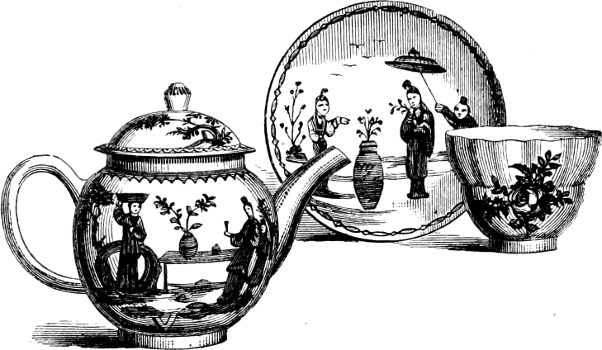
Figs. 743 to 745.
The expenses attendant on this unwarrantable opposition in Parliament drained Champion’s exchequer, and despite the energy of himself, the skill of his workmen, and the beauty of the ware produced at his manufactory, Richard Champion’s hopes of permanently establishing an art in Bristol, which should not only be an honourable and useful, but a remunerative one, proved fallacious, and in little more than five years from his obtaining of the Act of Parliament, the works which he had laboured so hard to establish, and on which he had expended so much time, money, and skill, were lost to the city of Bristol, and removed for ever from its walls, but not, fortunately, until he had proved incontestably his ability to produce a genuine porcelain of the finest texture, and of the most artistic and finished style.