Volume 1 — CHAPTER IX.
Reading edition
Salopian Wares—Uriconium—Caughley Works—Thomas Turner—Introduction of “Willow Pattern”—Worcester Works—Close of Caughley Works—Marks—Transfer Printing—Hancock and Holdship—Coalport Works—Jackfield—John Rose—Swansea and Nantgarw—Productions of the Coalport Works—Marks—“Willow Pattern” and “Broseley Blue Dragon,” &c.—Broseley Pipes—Coalbrookdale Iron Works—Terra Cotta—Madeley—Martin Randall’s China—Jackfield Pottery—Maurice Thursfield—“Black Decanters”—China—Craven Dunnill & Co.’s Tile Works—Broseley—Benthall—Maw’s Tile Works—Broseley Tileries—Benthall Potteries—Coalmoor.
In the midst of one of the most historically interesting districts of the kingdom—a district abounding in spots rendered famous in various ages by the events which have occurred within its boundaries, and full of associations as varied as they are interesting—within a few miles of Boscobel, and Tong, and numberless other places possessing a sad interest as connected with the wanderings and the painful vicissitudes of King Charles II.,—within a short distance of those two glorious monastic ruins, Buildwas Abbey and Wenlock Priory—not far from the “English Nineveh,” Uriconium, and within easy distance of Shrewsbury and Ludlow,—is a group of manufactories whose simple history is as interesting as that of many of these places.
Broseley, whose pipe manufactories two hundred and fifty years ago were as famed as they are now, and whose makers then got rid of their goods without advertising the emphatic words, “When you ask for a Broseley pipe, see that you get it!”—Jackfield, famed of old for its earthenware, and where it is still to some little extent made;—Caughley, formerly a successful rival of Worcester in the excellence of its porcelains;—Coalport, a rival of all other works at the present day;—Horsehay, with its discontinued pot works;—Benthall, where “yellow ware” works are in constant operation, and where the magnificent encaustic and enamelled tile and mosaic works of Messrs. Maw are situated;—Ironbridge, with its famous one-arch bridge, the first iron bridge erected in England, from which it takes its name, spanning the Severn:—Madeley, with its extensive iron furnaces;—Benthall Edge, with its limestone works;—Coalbrookdale, whose iron works are known throughout the world, and where terra cotta is manufactured,—and a score of other busy hives of industry, are here gathered together, and demand careful attention. To the history of some of these I therefore devote this chapter.
Like those of Worcester and Derby, the Salopian manufactory of porcelain dates from the middle of last century; and, like them, has continued from its first introduction to the present time without interruption. Indeed, it may be said of the district that an almost—if not an entirely—unbroken historical chain may be traced from the Romano-British period down to the present day; for, as I have already shown, the same beds of clay which, fifteen hundred years ago, produced some of the fictile ware of the Roman occupiers of the soil, have been worked in the intermediate ages, and still produce, more largely than ever, articles of daily use for every class of the people of England. The same beds which supplied the magnificent city of Uriconium with jugs, mortaria, bowls, and colanders of white ware, still supply the neighbourhood with innumerable articles of daily use.
Caughley.
The Worcester porcelain works, as I have shown, were established in the year 1751; and the commencement of those in Shropshire must have been, if not coeval, at all events closely subsequent to that event. Indeed, the two works may be almost said to have sprung into existence at the same time. The site of the first Salopian china works was at Caughley, about a mile from the present manufactory, and on the opposite or south side of the river Severn. The works were situated on the hill overlooking the valley of the Severn, as it flowed on to Bridgnorth, and commanding a magnificent view of the surrounding country. On this spot, it is said, a small pottery was begun by a Mr. Browne, of Caughley Hall, and after his death managed by a gentleman named Gallimore, who was a relative, to whom, in 1754, a lease of the place was granted for the term of sixty-two years. This Mr. Gallimore does not appear to have been long connected with the works; for the only name, as proprietor, which I have at present been able to establish, is that of Mr. Thomas Turner, who married Dorothy, daughter of Mr. Gallimore and niece to Mr. Browne, and carried on the manufactory.
Mr. Thomas Turner was the son of Dr. Richard Turner, of Magdalene Hall, Oxford, rector of Cumberton, vicar of Elmly Castle and Norton, all in Worcestershire, in 1754, and who was also chaplain to the Countess of Wigtoun. This Dr. Turner, who took his degree at Magdalene Hall, Oxford, was the author of several works on astronomy, gauging, trigonometry, education, history, &c., and, in 1765, was a “teacher of geometry, astronomy, and philosophy” at Worcester. He died in 1791, and was buried at Norton-juxta-Kempsey, near Worcester. Besides his son Thomas, he had two other sons, Richard, LL.D., and Edward, the first of whom also published some works on geography, &c., and the latter was a general in the army in India, where he died; and two daughters, Elizabeth, married to Abraham Wyke, of Broseley, surgeon, and Sarah, married to Dr. William Hancock Roberts, rector of Broadwas and minor canon of Worcester Cathedral. Mr. Thomas Turner, by his first wife, Dorothy Gallimore, who died in 1793, had issue two children who died in infancy; and by his second wife, Mary, daughter of Thomas Milner, of Dothill, and widow of Henry Alsop, had issue one son, George Thomas Turner, of High Broughton, near Manchester, who died at Scarborough March 17, 1869, without issue, and one daughter, Catherine Georgiana Cecilia, who married John Jacob Smith, of St. James’s Priory, Bridgnorth, for more than half a century town clerk of that borough, by whom he had issue the present Hubert Smith, Esq., of St. Leonards, Bridgnorth, the gifted author of “Tent Life with English Gipsies in Norway,” who is the lineal and only representative of the main line of the Turner family. Mr. Turner was born in 1749, and is said to have been brought up as a silversmith at Worcester; but this is an error, as, for the purpose of obtaining the freedom of the city, he was, as a matter of legal form only, apprenticed to his father. It seems pretty certain that he was, at an early period, connected with the Worcester china works, and it is an established fact that he was an excellent chemist, and had thoroughly studied the various processes relating to porcelain manufacture. He was also a skilful draftsman and designer, and occasionally engraved: he was also a clever musician. He became a county magistrate for Shropshire, and was a freeman of the city of Worcester and the boroughs of Wenlock and Bridgnorth. He was also chairman of the Court of Equity for the three counties, which he had been mainly instrumental in establishing. In 1772, he succeeded his father-in-law, Mr. Gallimore, at the Caughley works (Mr. Gallimore having leased them from Mr. Browne in 1754), and carried them on until 1799, when he sold out all interest in the works and retired from business. He died at his residence at Caughley in 1809, aged sixty, and was buried in the family vault at Barrow, where, later, his daughter, Mrs. Smith, was also buried. After his death the commissioners of Oldbury Court presented his widow with a memorial silver cup of large size, bearing on one side the arms of Turner, and on the other an appropriate inscription. This is in possession of his representative, Mr. Hubert Smith.
Mr. Turner had a partner named Shaw. They had a warehouse in London, and, as was usual in those days with other works, had periodical sales by auction of their goods. In my own possession is a bill of this firm, dated January 24th, 1794, and headed “Salopian China Warehouse. Bought of Turner and Shaw.” The lots in this bill were bought “at public sale,” and consisted of “jugs,” “bakings,” “china dishes,” and other “sundry pieces;” the lots were “put up at half price” at the sale. In 1795, Mr. Turner’s manager at Caughley was one Thomas Blase; and I have a letter of his, dated 20th February in that year, concerning a painter, named Withers, at that time employed there, but who had wrongfully left his employment at the Derby china works, where he was “Mr. Deusbury’s articled servant.”
No doubt the incentive to the establishment of the Caughley works were the experiments long carried on at Worcester by Dr. Wall, and the knowledge that at this spot the two principal materials wanting in a pottery of this kind could be had at a trifling cost. With abundance of coal within twenty feet of the surface, with clunch of the best quality for the making of seggars overlying the coal, and with the navigable river at hand for bringing the materials and for carrying away the finished goods, the inducements were strong for the fixing on this spot the manufactory which was destined ultimately to grow into such enviable importance. To Worcester, of course, coal and clunch and other materials had to be conveyed at great cost; but here they were ready to hand, and indeed were cropping out in every direction, inviting to be used. In 1756 the works had attained a considerable degree of excellence; and an example is in existence, bearing that date, which gives most satisfactory evidence of the excellence of the body at that time—a body, however, which speedily became greatly improved. In the early years of the Caughley manufactory, the ware was not many degrees removed from earthenware; but it gradually assumed a finer and more transparent character. Like the early Worcester examples, the patterns were principally confined to blue flowers, &c., on a white ground; and in this style and colour the Caughley works excelled, in many respects, their competitors. An excellent example of the body, as made in 1776, is exhibited in a mug, bearing that date, now in the possession of a family at Coalport. This interesting mug, here engraved, is white, with blue and gold flowers, and bears the words “Francis Benbow, 1776,” surmounted by an anchor; the Francis Benbow, for whom it was made, being a barge-owner.
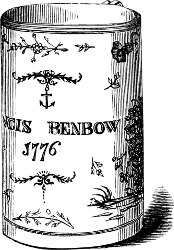
Fig. 584.
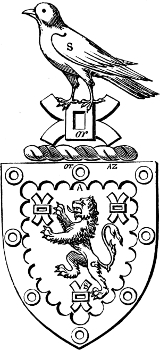
Fig. 585.—Arms of Turner.
In 1772, as I have shown, Mr. Turner succeeded Mr. Gallimore in these works, and set about enlarging them. In 1775 we read, “The porcelain manufactory erected near Bridgnorth, in this county, is now quite completed, and the proprietors have received and completed orders to a very large amount. Lately we saw some of their productions, which in colour and fineness are truly elegant and beautiful, and have the bright and lively white of the so much extolled oriental.” In 1780 he visited France, for the purpose of “picking up knowledge” on the porcelain manufactures of Paris and other places. He is said to have been an excellent draughtsman, and this added to his chemical knowledge—for he had a regular laboratory fitted up at the top of his house—must have been a great advantage to him while in that country of beautiful and chaste designs. On his return from France he brought with him some skilled workmen, and at once entered with increased spirit into the manufacture of porcelain in his own works at Caughley. One of the men whom he had brought over appears to have been a clever architect; and from his design a very tasty and elegant château, which he called “Caughley Place,” and where he resided, was built for Mr. Turner, near the works. This building being of a novel design in England—more especially in the sequestered neighbourhood of Caughley—attracted much attention; and its peculiarities of construction and arrangement are still often talked about by the old inhabitants of the place. This house and Caughley Hall, after Mr. Turner’s death, came into the hands of Lord Forester, and were pulled down in 1820 or 1821; part of the materials being used for making additions to the present works at Coalport. At the present time no vestiges of the house or works remain at Caughley, with the exception of traces of foundations, and here and there a spring flower or two which still make their appearance where once the elegantly laid out gardens existed.
In 1780 Mr. Turner introduced the making of the famous “Willow Pattern”—the first made in England—at Caughley, and about the same time the “Broseley Blue Dragon” pattern. The willow pattern is still commonly known in the trade as “Broseley pattern.”
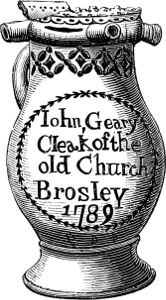
Fig. 586.
An excellent example of dated Caughley ware is the puzzle-jug in the possession of Mr. Edmund Thursfield, here engraved. It is eight inches in length, and is formed of the usual body of these works. It is decorated with blue sprigs, and bears on its front the name, in an oval border, of “John Geary Cleak of the old Church Brosley 1789.” On the bottom is written in blue, “Mathew the v & 16,” though one would fail to see any allusion in the text here referred to either to the vessel or to its purpose. In Mr. Smith’s possession is a fine Caughley mug; white, with blue flowers of bold character: it bears the words, “Wm. Haslewood, 1791,” and has the mark S on the bottom. This William Haslewood was the representative of an old family of that name in this neighbourhood, and his property passed to the Mr. J. J. Smith already spoken of.
In 1788 Mr. Robert Chamberlain commenced his china works at Worcester, and for some time bought his ware at Caughley, had it sent down by barge to Worcester, and there painted and finished it. The same thing was also done when Grainger’s works were first started at Worcester. The number of hands employed at Caughley must have been somewhat large, as the premises were extensive, and the quantity of goods required by Mr. Turner, for his own trade and for Worcester, was considerable. In 1798 or 1799, in consequence of the increase of the trade of Mr. Rose, who had been apprenticed to Mr. Turner, and afterwards commenced on his own account, by which the Caughley business was much injured, the works were disposed of to Mr. Rose and his partner; Mr. Turner entirely retiring from the concern. The Caughley works were then carried on by Messrs. Rose and Co., in conjunction with their own. The coal at Caughley beginning to work out, and the cost of carrying the unfinished ware from thence down the hill and across the water to Coalport was so great,—the unfinished ware being carried on women’s heads the whole distance,—that Mr. Rose determined to remove the works to Coalport, which he did at different times, gradually drafting off the workmen, until about 1814 or 1815, when they were finally removed, the kilns and rooms taken down, and the materials used for the enlargement of the works at Coalport. The last of the buildings, with the house, were not, however, destroyed until 1821, when the materials were brought to Coalport to build the present burnishing-shops and some workmen’s cottages.
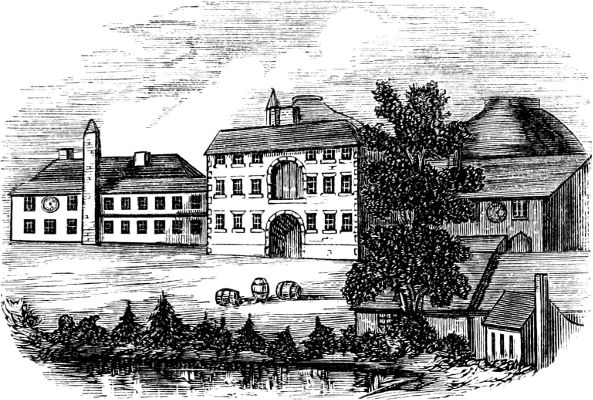
Fig. 587.—The Caughley China Works, taken down in 1815.
The works were built in form of a quadrangle, with an entrance gateway surmounted by an inscribed stone. Of these historical works I am enabled, through the courtesy of my friend Mr. Hubert Smith, to give an engraving from an original drawing in his possession. The entrance building, it will be seen, was three stories in height, the remainder two stories, and the kilns were of large size.
The marks used at Caughley and Coalport have been very few, but they are very important, and require careful attention at the hands of the collector. In my account of the Worcester works I have given several varieties of the crescent as a mark of that establishment, and have also stated that it was used at Caughley. I believe the first mark used at Caughley to have been the crescent alone, and that it was, as I have before stated, intended to have the signification of a C for Caughley, and that its connection with the Worcester works may, in a great measure, be traced to the fact of the goods on which it appears being printed, not at that city, but at Caughley. I have seen examples of this mark on undoubted Worcester body, and also on equally undoubted Caughley make, bearing precisely the same printed patterns. The following are some of the varieties of the crescent occurring on Caughley specimens, and show pretty clearly its transition from a common “half-moon” (I have often heard it called “half-moon china”) to the finished and engraved C.
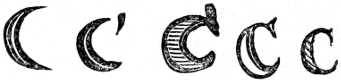
C C’ C C c
Figs. 588 to 592.
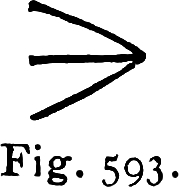
Another mark said to have been used at Caughley, but of which at present I have met with no example, is the accompanying, which is very similar to the mark ascribed to the Leeds manufactory.
Another distinctive mark of the Salopian works was the capital letter S, of which the following are varieties:—
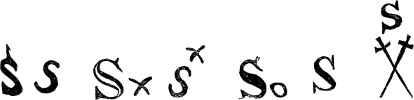
S S Sx Sx So S S
Figs. 594 to 600.
When the S was introduced it is difficult to say; but, at all events, it appears on the dated example alluded to above in 1776, and it was used at the same time as the C for a considerable period. On many of the engraved plates still in existence, indeed, both the C and the S occur, and this leads me to suspect that the one was used to mark the goods sent to Caughley to be printed, and the other those made and printed for their own market. I have seen precisely similar articles in pattern, bearing each of these letters. Occasionally the S and crossed daggers occur.
Vol. I.
Plate III.
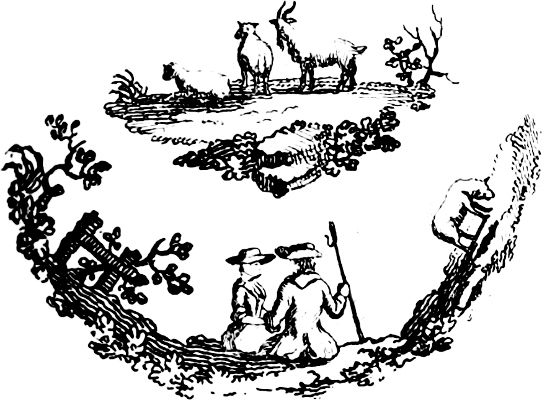
ORIGINAL COPPER-PLATES—CAUGHLEY AND COALPORT.
(The letters C and S are the marks alluded to on page 270; they here occur side by side on the original copper-plate.)
Another circumstance is also worthy of note. On two mugs printed from the same engraved plate, which I have seen, the one bears the S, and the other the accompanying curious mark (Fig. 598), which is evidently of the same character as the examples of assimilated Chinese ones, which are occasionally ascribed to Worcester, but which are in reality, I believe, those of Caughley. Of these I give the following as examples; many of these are disguised figures.

Figs. 601 to 606.
Following the C and S, two impressed marks, bearing the word “Salopian,” were used. These are as follows:—

Figs. 607 and 608.
and it is worthy of remark that, on some examples of plates bearing this impressed mark, the blue printed S also appears; as, on others, does also the crescent. Others, probably merely workmen’s marks, are
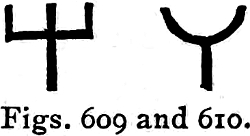
The subject of printing upon porcelain, to which I have already alluded under “Worcester,” is one so intimately and intricately connected with the Caughley and Coalport works, that it will be necessary to consider the period of its introduction at some length. I have already shown that transfer-printing was used as early as 1757 on Worcester porcelain (p. 229, ante); and I have little doubt that quite as early, if not a few years before that period, it was practised at Caughley. Indeed, in the early years of the manufactory, the two works, Caughley and Worcester, seem to have been closely connected, and to have worked “in and in,” if I may be allowed the use of so unscientific an expression, and I believe, with ample reason, that a great proportion of the printed goods bearing the Worcester mark were printed at Caughley. Indeed, it is known that the ware was sent up from Worcester by barge to be printed at Caughley, and returned, when finished, by the same mode of conveyance. I have closely examined the style of engraving and the patterns of a large number of examples, and I am clearly of opinion that they are the work of the same hands.
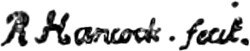
I do not, by this, claim for Caughley the honour of inventing the art of transfer-printing on to porcelain; but I feel assured that that art must have been there practised at quite as early a period as the dated example of Worcester make; and I am led to this belief partly from the fact that the Robert Hancock whose beautiful productions I have before spoken of, and to whom the engraving of the dated example is ascribed, also engraved for the Caughley works. And I have an impression of a plate, of an identical pattern with the famous tea group, which bears his monogram on the Worcester specimens, on which his name, R. Hancock fecit, occurs in full at Caughley. Collectors, therefore, in a case of this kind, must not be too hasty in ascribing, from appearance alone, examples to either one or the other make, but must be guided, in a great measure, by the body on which the engraving occurs.
It cannot be wondered that an art, then such an important secret, should have been followed at Caughley,—a place so perfectly retired from the world, situated in the midst of woods and wilds, almost unapproachable to strangers, and with every facility for keeping the workmen away from all chance of imparting the secret to others,—in place of in Worcester, where secrecy would be almost impossible, and where the information would ooze out from the workmen, at the ale-house or elsewhere, and be greedily caught up by those interested in the process. At Caughley every possible precaution seems to have been taken to secure secrecy; and the workmen—the engravers and printers—were locked up and kept apart from every one else. Who the engravers were I cannot satisfactorily say. It is, however, certain, that Hancock engraved for the works; and it is said that Holdship, of whom I have before spoken, was also employed. Among the other engravers was a man named Dyas, who was apprenticed as an engraver at Caughley about the year 1768, and who continued at the works until his death, at the ripe age of eighty-two. It is also worthy of note that Mr. Minton, the father of Mr. Herbert Minton, was in his early days employed as an engraver at these works. It is not too much to say, that the style of engraving adopted at so early a period was remarkably good, and of really high character. Indeed, some specimens which I have seen of the plates used at Caughley are far superior to most of the productions of the period.
Vol. I
Plate IV.
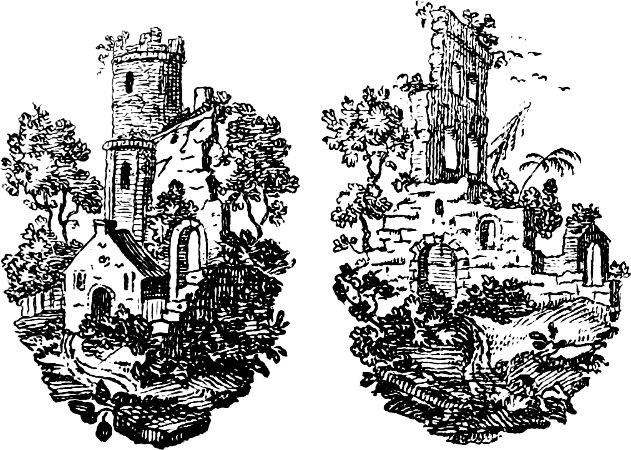
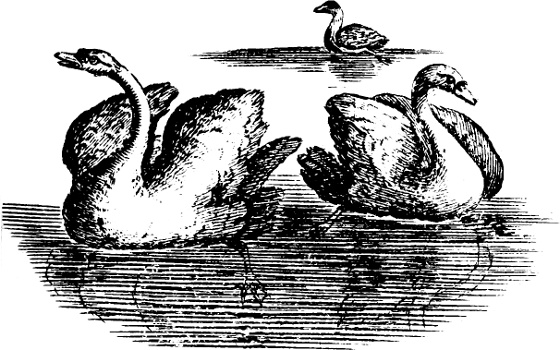
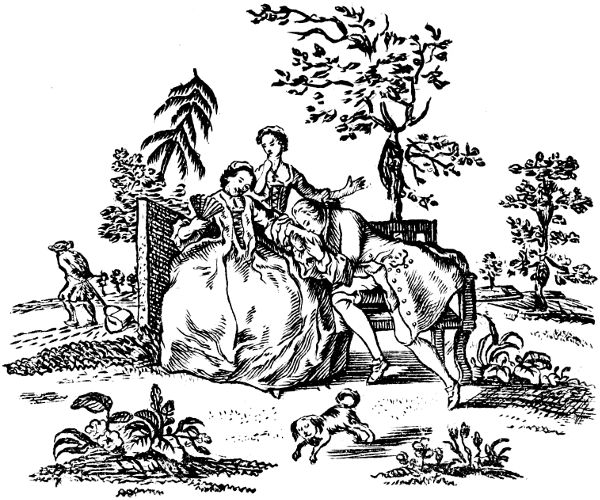
ORIGINAL COPPER-PLATES—CAUGHLEY AND COALPORT.
Of the painters employed at Caughley, it will be sufficient to say that amongst those apprenticed there were John Parker, Thomas Fennell, and Henry Boden, famous for their skill in flowers; and that Muss, Silk, and others, excelled in landscapes and figures—some sepia landscapes being remarkable for their pure artistic treatment; while among the gilders, a most important art, and one to which special attention has always been directed at these works, were men of the names of Rutland, Marsh, and Randall who were considered proficients. Of the latter, a nephew, who is the author of pleasant little volumes on the “Severn Valley” and “The Willey Country,” is still employed at the Coalport works, principally on birds.
I have named above that Robert Hancock engraved for Caughley as well as for Worcester, or at all events that plates of his were printed from at the former place possibly for the latter. His name appears on one of the plates as follows:— and other plates are evidently the work of his hand, though without name. I engraved a curious mark, the monogram RH, anchor, and name of Worcester, in the account of those works. This I reproduce on Fig. 611, and give another which occurs on a plate from Caughley, with the anchor and the word Derby, which I introduce for the purpose of comparison, and to suggest the probability that the place which produced the one with the word Derby (for whatever reason that may have been done), which was undoubtedly Caughley, also produced the one with the word Worcester. The engraved plate, with the anchor and Derby, is a curious one (for a mug), and represents a landscape—a river, with trees on either side, swans sailing in the foreground, behind them two fishermen in a boat drawing a net, beyond them a boat with sails, and in the background a bridge, and church with ruins to the left, and a tall gabled building on the right, over which are the words “Sutton Hall,” whilst above the whole picture is “English Hospitality.”

Figs. 611 and 612.
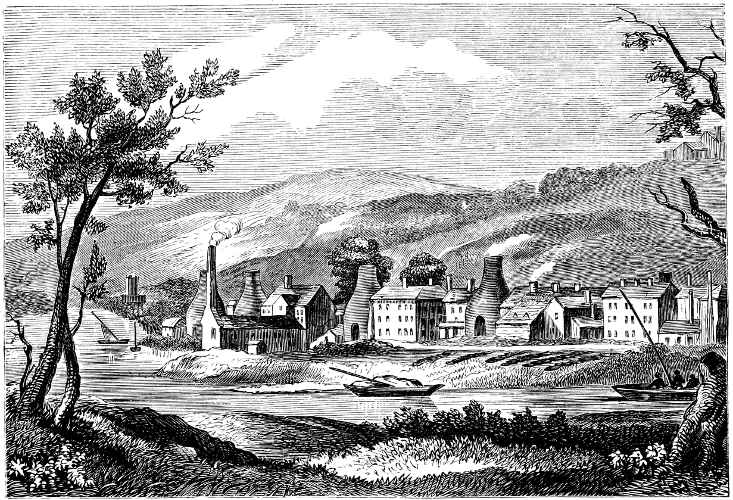
Fig. 613.—Coalport China Works, from a painting by Muss.
Coalport.
One of the most flourishing, most important, and most successful in art-productions of any in the kingdom are the Coalport works, at one time also known as “Coalbrook Dale,” to whose history I now devote a few pages. The founder of these works was Mr. John Rose, a man of wondrous skill and enterprise, to whom the ceramic art is indebted for many important improvements. Mr. Rose, who was the son of a farmer in the neighbourhood of Caughley, was apprenticed to Mr. Thomas Turner, of the Caughley China Works, by whom he was taken into the house, and taught the art of china making in all its branches. Here he remained for several years; but ultimately, from causes which it is not necessary to enter upon, a difference arose between them, and Mr. Rose left Mr. Turner, and commenced a small business on his own account at Jackfield, in the immediate neighbourhood. Here he did not remain long, but removed his works to Coalport, on the opposite bank of the Severn, where he fixed himself in some buildings which had previously been a small pottery belonging to a Mr. Young, a mercer of Shrewsbury, and in these buildings in part they have continued to the present day. Mr. John Rose had not long established himself at Coalport, it appears, before he met with opposition; for other works were started on the opposite side of the canal, and only a few yards distant, by his brother, Mr. Thomas Rose, and partners, who commenced business under the style of “Anstice, Horton, and Rose.” These works, however, did not continue long, but passed into the hands of Mr. John Rose and his partners, who, with other additions, formed them into one establishment. In the space of three or four years from the establishment of the Coalport works by Mr. Rose, he had so successfully carried on his business that the Caughley works of Mr. Turner had become greatly reduced, and were gradually beaten out of the market. In 1799 Mr. Turner, of the Caughley works, gave up the business and sold the concern to Messrs. Rose & Co., who thus became proprietors of both works, as well as of those commenced by the brother of Mr. Rose. Both manufactories were then continued by them, thus giving a great increase to the establishment, and rendering it one of the most extensive in the kingdom.
In 1803 Messrs. Blakeway, Rose, and Horton having become bankrupt, a question as to the ownership of the remainder of the Caughley manufactory arose and was submitted to arbitration. The following is the award, for which I am indebted to my friend Mr. Hubert Smith:—
“To all to whom these presents shall come we Ralph Wedgwood of Bransford in the county of Worcester Gentleman and William Horton of Coalport in the county of Salop Gentleman send greeting Whereas by articles of agreement in writing bearing date the Thirteenth day of December last past and made between Thomas Turner of Caughley in the county of Salop Esquire of the one part and Timothy Yate of Madeley in the county of Salop Charles Guest and Elias Prestwich of Broseley in the county of Salop Gentlemen of the other part Reciting that by a Memorandum of an Agreement bearing date the Twelfth day of October One thousand seven hundred and ninety nine and made between the said Thomas Turner of the one part and Edward Blakeway John Rose and Richard Rose of Coalport in the said county of Salop porcelain manufacturers of the other part The said Thomas Turner did agree to assign amongst other things all his interest in a Lease from Mr. Browne to him of the several works buildings and erections called Caughley China Works and also the colliery then held under lease by him from Mr. Browne to the said Edward Blakeway John Rose and Richard Rose The said Thomas Turner also agreed to assign to the said Edward Blakeway and Co. the unglazed stock of goods then in and about the said manufactory and all the materials implements fixtures moulds copper plates and machinery belonging to the said manufactory and colliery And it was agreed that the said Edward Blakeway and Company should have and be entitled to the same liberties and privileges so far as respected the said manufactory and colliery as the said Thomas Turner was entitled to and that the said colliery should be worked in a fair and workmanlike manner and that the clod and middle coals so far as they were getable together or separate to be got so that the best coals should not be got without the clod and middle coals The said Edward Blakeway and Company to pay Mr. Turner Five hundred pounds per annum for the residue of the term and interest in his lease by half-yearly payments as herein mentioned provided the said coals so to be got should not be sufficient for the use of the said manufactory and the best coals should be exhausted the said Edward Blakeway and Company should be at liberty to give up the said works and premises to the said Thomas Turner at the end of any half year during the remainder of the term by which the same premises were held upon giving him six months notice in writing for that purpose and leaving the materials implements fixtures moulds copper plates and machinery then employed thereat not diminishing the same in the mean time But if the said Edward Blakeway and Company should be desirous of continuing the said works and premises till the expiration of the said term the said Thomas Turner agreed to make an allowance of Two hundred pounds per annum out of the said sum of Five hundred pounds per annum from the time the said best coals should be exhausted if the quantity of best coals used had not exceeded upon the average eighteen tons per week, each ton containing forty eight hundred and it was thereby further agreed that in case any dispute or question should arise between the said parties touching any clause article matter or thing therein contained the same was to be referred to and settled by two indifferent persons one to be chosen by each party and in case they should not agree as to the same then by an umpire to be named by the said two persons whose determination should be final And further reciting that the said Edward Blakeway and John Rose together with Robert Winter their partner who then lately held the said works and premises had lately been declared Bankrupt and the said Timothy Yate Charles Guest and Elias Prestwich chosen assignees of their estate and effects and that they the same assignees had lately contracted to sell all their right title and interest to and in the said Caughley China Works Colliery and Premises unto Cuthbert Johnson and William Clarke Esquires And further reciting that a doubt or question had arisen whether the said materials implements fixtures moulds copper plates and machinery were to be the property of the said Thomas Turner at the end of the said term or whether they were to become his property in the event only of the said Agreement being determined before the expiration of the said term And that the same parties had therefore mutually agreed to refer the said doubt or question to the decision of the said Ralph Wedgwood and William Horton and in case they could not agree then to such person as they should name umpire in the premises And that the said Thomas Turner had agreed to sell and the said Timothy Yate Charles Guest and Elias Prestwich had agreed to purchase all the right and interest of the said Thomas Turner of and in the said materials implements fixtures moulds copper plates and machinery at such a price or sum of money as should be fixed thereon by the said Ralph Wedgwood and William Horton or their umpire to be named as aforesaid And further reciting that a dispute had arisen between the said Thomas Turner and the said Timothy Yate Charles Guest and Elias Prestwich respecting the manner in which the said colliery or coalwork had been managed and carried on which dispute or any other difference which might arise pending that reference as a consequence of the investigation of the claims of the respective parties the said parties had agreed should be adjusted and settled by the said Ralph Wedgwood and William Horton or their said umpire to be appointed by them in manner aforesaid It is by the Articles of Agreement now in recital witnessed that as well the said Thomas Turner as also the said Timothy Yate Charles Guest and Elias Prestwich did thereby for themselves severally and respectively and for their several and respective Heirs Executors and Administrators covenant promise and agree to and with each other and to and with his and their Executors and Administrators that they the said parties respectively their respective Executors and Administrators should and would well and truly stand to abide by perform fulfil and keep this award order or determination which the said Ralph Wedgwood and William Horton or their said umpire should make between them as well concerning the said doubt or question concerning the right and interest of the said Thomas Turner of and in the said materials implements fixtures moulds copper plates and machinery and the price or sum of money to be paid him for the same as also concerning the dispute which had arisen or which pending the said reference might arise between the said parties respecting the manner in which the said colliery or coalwork had been managed and carried on so as the award or umpirage be made in writing under the hands of the said Ralph Wedgwood and William Horton or their said umpire within twelve weeks from the date thereof But it was thereby agreed that that Agreement or any clause therein contained or the said award or umpirage to be made in pursuance thereof should not alter or extend to alter the rent and royalty reserved and made payable by the therein recited Agreement but that the same should remain payable upon the terms and conditions therein mentioned And for the true performance of that Agreement each of the said parties bound himself and themselves his and their Executors and Administrators to the other of them his Executors and Administrators mutually and reciprocally in the penalty of One thousand pounds As by the said recited Agreement reference being thereunto had will appear Now know ye that we the said Ralph Wedgwood and William Horton having duly examined and considered the said Agreement and the proofs and allegations of the said parties to the said reference and all such accounts documents and evidence as have been produced to us relating to the said materials implements fixtures moulds copper plates and machinery and also the said colliery coal-mines and premises do hereby award order decide and determine that the said materials implements fixtures copper plates moulds and machinery were by the said Agreement to be the property of the said Blakeway Rose and Rose at the end of the term mentioned in the said agreement and not the property of the said Thomas Turner but in the event only of the said Agreement being determined before the expiration thereof by six months notice being given in the manner in the said Agreement specified And we do further award order decide and determine that the said Timothy Yate Charles Guest and Elias Prestwich as such assignees as aforesaid shall pay unto the said Thomas Turner his Executors Administrators or Assigns for all his contingent or present right and interest of and in the said materials implements fixtures moulds copper plates and machinery the sum of One hundred pounds on or before the Twenty first day of May next And we do further award order decide and determine that the said colliery or coalwork hath been worked and carried on in a fair and workmanlike manner and according to the spirit of the said Agreement of the Twelfth day of October One thousand seven hundred and ninety nine and that therefore the said Thomas Turner not having been injured is not entitled to any compensation or damage from the said Blakeway Rose and Co. or their said Assignees in respect thereof Given under our hands this Sixth day of March One thousand eight hundred and four.
“Witness
Jn. Pritchard
Ra Wedgwood
Willm Horton
On the 23rd October, 1799, an event occurred in connection with the works at Coalport which was most sad in its results. At that time a considerable number of the work-people and painters employed at the works resided at Broseley, and were in the habit of passing backwards and forwards across a ferry near the works. On this night, thirty-two persons, including the best artists, went on board the ferry-boat, which, about midwater, owing to the intoxicated state of the ferryman, was capsized, and twenty-nine were drowned. The principal painter at this time was an artist named Walker, and an unfinished piece of work of his—the piece he left in progress only a few minutes before he lost his life—is still preserved, with almost religious care, in the factory.
Soon after this time considerable additions were made at Coalport, and since then the manufactory has been constantly and considerably enlarged, and now occupies, I am told, considerably more ground than any other porcelain works in the kingdom.
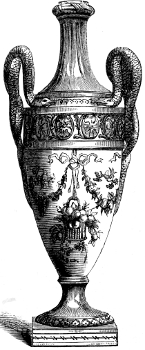
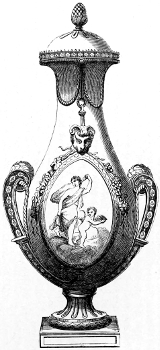
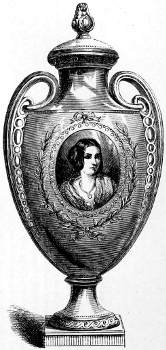
Figs. 614 to 617.—Coalport Vases.
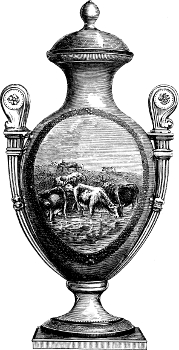
Painted by Hartshorne.
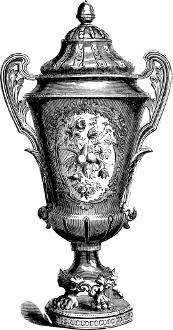
Painted by Cook.
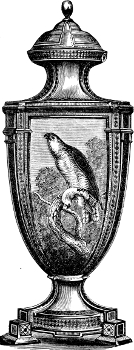
Painted by Randall.
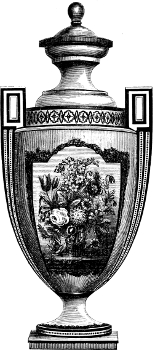
Painted by Cook.
Figs. 618 to 621.—Coalport Vases.
The view of the Coalport China Works given on page 274 will show its extensive character in the early part of the present century, and its pleasant situation on the banks of the Severn. The view is copied from an interesting painting by Muss, who, before his successful artistic career in London, was employed as one of the painters at this establishment. Since the period when Muss made this painting, the works have been constantly increased, and at the present time are about doubled in extent.
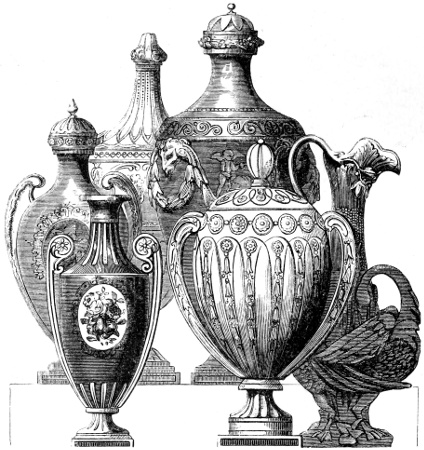
Fig. 622.
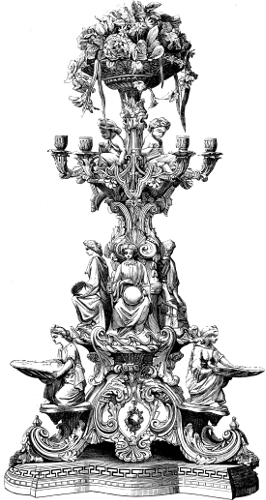
Fig. 623.
The commercial style of the firm has been, ever since its establishment at Coalport, and still is, “Messrs. John Rose and Company,” although many changes in the proprietary have taken place. These changes have been as follows:—“Rose and Blakeway;” “Rose, Blakeway, and Rose;” “Rose, Johnson, and Winter;” “Rose, Johnson, Clarke, and Winter;” “Rose, Winter, and Clarke;” “Rose, Clarke, and Maddison;” “Maddison, Pugh, Rose, and Rose;” “W. Pugh and W. F. Rose;” and the present sole proprietor is “William Pugh;” but the firm is still known by its old style of “John Rose and Co.” Mr. John Rose died in 1841, and was buried at Barrow. He was succeeded by his nephew, Mr. W. F. Rose, of Rock House, Coalport, who retired from the firm in the autumn of 1862, and died in London in 1864, having in the meantime started some small works at Hanley, where he shortly afterwards failed, and unsuccessfully attempted to commence others in Derbyshire. He was a man of the most generous disposition and kindly nature, and his losses were a subject of deep sorrow to myself and his other many friends.
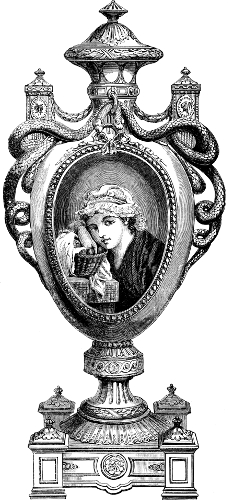
Fig. 624.
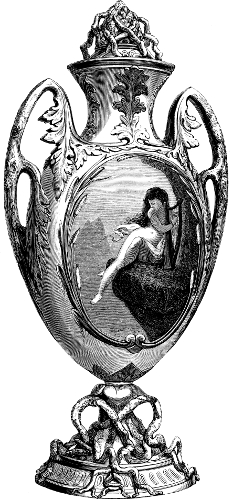
Fig. 625.
It will be seen from what I have said, that the Coalport works had already, before the commencement of the present century, absorbed those of Caughley, of Jackfield, and of the opposition establishment of Messrs. Anstice, Horton, and Rose. Some years later, the Swansea Porcelain Works, which had risen somewhat into repute, were discontinued, and the moulds, &c, bought by Mr. Rose, who removed them, along with the workmen, to Coalport, about the year 1820. Another famed manufactory, though small, that of Nantgarw, established by Billingsley, the famous flower painter, of Derby, and his son-in-law, Walker, also of Derby, in 1816 (under the assumed name of Beeley and Walker), and which produced, perhaps, the finest examples of porcelain with granulated fracture ever made, also soon afterwards was merged into the Coalport establishment. Billingsley and Walker, on discontinuing the works at Nantgarw, removed to Coalport, with all their moulds and processes, and continued employed there until Billingsley’s death, which took place in 1828. Walker was a remarkably clever workman, and did much during the time of his continuance at Coalport to improve the art of china-making. He removed thence to America, where he established a pottery, which, I believe, he still continues to work. The Nantgarw porcelain was very expensive to make, but was remarkably fine in its body and texture. The original recipes for this peculiar body are in the possession of Messrs. Rose & Co.; and it can be made at Coalport of as fine a quality as ever. I have carefully examined specimens made at Nantgarw with others made by Billingsley and Walker when they first came to Coalport, and these again with examples made by Messrs. Rose in 1860, and they appear all to be of equal excellence of body. It is, however, too expensive a process to be followed to any extent, and is never manufactured there now.
In 1820 Mr. John Rose received the gold medal of the Society of Arts for his improvements in the manufacture of china. The prize, which was offered for the best porcelain glaze produced without lead, was competed for by Copelands, Davenports, and all the principal manufacturers, as well as by Mr. Rose, but was honourably gained by him. It bears the inscription—“To Mr. John Rose, MDCCCXX., for his improved glaze for porcelain.”
The history of the works has been one of complete success from their first establishment to the present day; and this success has been attained by untiring and unflagging energy on the part of the proprietary, and by a determination to make their manufactory second to none in existence in extent and in beauty and purity of work. The porcelain trade owes much to the ability and energy of Mr. John Rose; and this skill, ability, and energy is equally the characteristic of the present proprietor, Mr. Pugh.
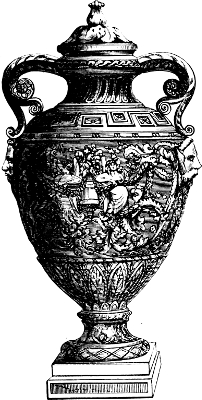
Both at the Great Exhibition in 1851 and that of 1862, as well as at the French Exhibition in 1855, Messrs. Rose & Co. carried off medals for their productions; and these recognitions of excellence have been continued at the later International Exhibitions. At the first a magnificent dessert service in the difficult but truly beautiful Rose du Barry colour, which the firm had succeeded in restoring in all its beauty to the ceramic art, was exhibited, and excited considerable interest. This service, considered by competent judges to equal the original Sèvres in evenness of colour, was purchased by Lord Ashburton. At the second, Messrs. Rose exhibited a large number of exquisite examples of their make; and services were purchased by the Emperor of the French, by M. Fould, and by the principal savans of Paris. At the third, the selection of vases and other decorative pieces was of the finest possible character.
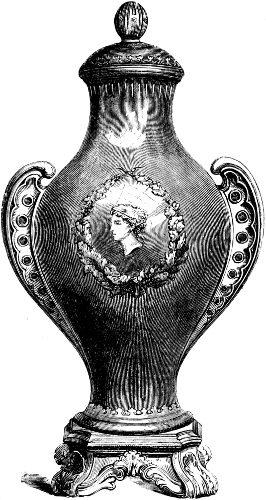
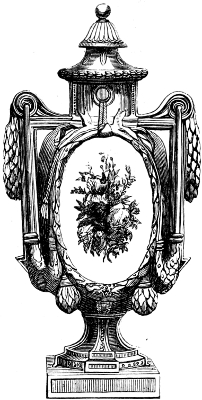
Figs. 626 to 628.
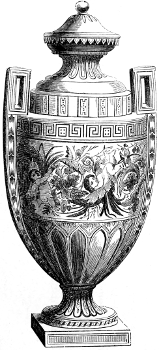
At the present hour the productions of the Coalport works take a foremost rank among the best porcelain of the kingdom; many of the specialities of this firm being marvels of beauty; the colours pure and full, and of extreme richness. Sardinian green—a colour for the extreme depth and richness of which these works are celebrated—is introduced with remarkable effect both in services and otherwise. One of the finest pieces of this colour is a tripod wine goblet, with flowers in tablets, and raised and jewelled gold borders. A lighter shade of this fine green is introduced, with tablets of flowers and Westbourne birds, with great effect on two-handled goblets, &c. Rose du Barry has always been a speciality of the Coalport works, and a colour on the excellence of which its proprietors, especially the late clever and enlightened Mr. W. F. Rose, have always prided themselves. This is used as a ground in every conceivable variety of decoration, and when enriched with raised dead and burnished gold, and with the exquisite painting by which it is usually accompanied, has a remarkably rich and chaste effect. A new jardinière, with pierced key top and Sèvres fruit and flowers, is one of the prettiest examples of this colour, combined with raised gold and flowers, which has been produced. One of the finest and most massive pieces in this colour is a claret jug, with raised gold vine-leaves and grapes and other decorations, and splendidly painted on one side with the head of a bacchante and on the other a bunch of grapes. A pink, or light Rose du Barry, is also much used as a ground for pilgrims’ bottles, vases, services, &c., where, for some kinds of decoration, it harmonizes better than the full colour would. A blue with a slightly purplish cast, which gives it an additional richness and fulness, has been introduced, and forms a splendid ground for Japanese decoration in vases, pilgrims’ bottles, &c., in which style of now very fashionable decoration the Coalport artists excel. In these Japanese patterns some of the designs are unusually elaborate and intricate, and the workmanship is characterized by extreme precision and regularity, while the gilding and colour, especially the deep reds and blues, are rich and full in the extreme. Some of the vases in this style vie with those of the native art of the Japanese, and are not excelled by any other house. The principal artists employed at the present time at the works are Mr. Charles Palmere, Mr. Cooke, Mr. John Randall, Mr. Birbeck, Mr. A. Bowdler, Mr. J. Hartshorne, and Mr. Jabez Aston; and among those formerly engaged here was Mr. R. F. Abraham, a student of Antwerp and Paris and a successful follower of the school of Etty. Modellers of a very high class in their respective branches are also employed, and the excellence of their work is apparent in all the higher class productions of this establishment.

C C’ C C C S S Sx Sx So S S
Figs. 629 to 640.
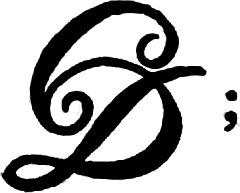
The marks used by the Caughley works have already been fully described.[84] After the removal of these works to Coalport, the same letters, both C and S, for many years were used. At Coalport, however, marks have been adopted, perhaps, more sparingly than at any other works; and the great bulk of the goods have been manufactured, from the first down to the present time, without any mark at all. On some examples of the early part of the present century, the written name of “Coalport,” thus—Coalport —appears; but these are of very rare occurrence. Another mark, adopted somewhat later, though only used very sparingly, was simply the letters for Coalbrookdale, or the same two letters conjoined thus— sometimes also Coalbrookdale appears in full, and at others the contraction “C Dale,” in similar writing letters.


Another mark, adopted in 1820, was of large size, and will, perhaps, be as well understood by description as engraving. It is a circle of nearly two inches diameter, in which is a wreath of laurel encircling the words, “Coalport Improved Felt Spar Porcelain,” in four lines across. Surrounding the wreath are the words, “Patronised by the Society of Arts. The Gold Medal awarded May 30, 1820;” while beneath, and outside the circle, is the name “I. Rose and Co.” This mark was adopted consequent on Mr. John Rose obtaining the Society of Arts’ gold medal for “his improved glaze for porcelain” to which I have before alluded, and the articles on which it appears are of extremely good material and very perfect glaze.
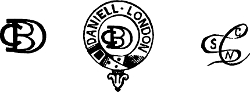
Other marks adopted by this firm, although but seldom used (the great bulk of the goods, as I have said before, being sent out without any mark at all), are the following:— The first of these is a monogram of the letters C B D, for Coalbrookdale, so joined together as to produce a very characteristic and distinctive mark. The second, the same monogram, surrounded by a garter bearing the name of “Daniell, London”—a firm for many years, like Mortlocks and other leading houses, connected with Coalport or Coalbrookdale, who have had that mark used for some especial orders. The third and last is the most recent mark, and is almost the only one now used by the Coalport works: it embraces the initials of the various manufactories which have from time to time been incorporated with, or merged into, the Coalport establishment. Thus the scroll—which at first sight may, to the uninitiated, look like a short “and” (&)—will, on examination, be seen to be a combination of the writing letters, C and S, for Coalport and Salopian, enclosing within its bows the three letters, C, S, and N, denoting respectively Caughley, Swansea, and Nantgarw.
Having now passed through the history of these famed works, and shown their connection with others, both in manufacture and in printing, it only remains to say a few words on the varieties of goods for which the Salopian works have been famed, both in times past and at present. First and foremost, then, of course, come the blue painted and printed wares copied from Chinese patterns, for which both it and the early Worcester works were remarkable. The first painted, as well as printed, wares were close imitations of the foreign; but groups of flowers of original design, &c., were also introduced, and designs based, perhaps, on foreign models were adopted. Groups of figures, in the characteristic costume of the period, were also executed with great taste and ability. Of the Chinese patterns, the two most famous—the well-known “willow pattern” (known generally among the trade as the “Broseley pattern”) and the “blue dragon” (also known as the “Broseley blue dragon”)—owe their first introduction to the Caughley works; and this fact alone is sufficient to entitle them to more than ordinary notice. The willow pattern has undoubtedly been the most popular, and had the most extensive sale of any pattern ever introduced. It has, of course, been made by most houses, but the credit of its first introduction belongs to Caughley; and early examples, bearing the Caughley mark—the cups without handles, and ribbed and finished precisely like the foreign—are rare. The dragon, known still as “the Broseley blue dragon” or “Broseley blue Canton,” was also a most successful imitation of the Chinese, and almost rivalled the “willow” in popularity. A special form of jug, considered in those days to be very far advanced in art, known technically as the “cabbage-leaf jug,” was also first made at the Caughley works.
Later on, the “worm sprig” pattern, the “tournay sprig,” and other equally successful patterns were here introduced from the Dresden, as were also the celebrated Dresden raised flowers and the “Berlin chain edge” pattern. About 1821 a peculiar marone-coloured ground, which is much sought after, was introduced at Coalport, by Walker, of Nantgarw, of whom I have before spoken; and at this time many marked improvements were made in the different processes of manufacture.
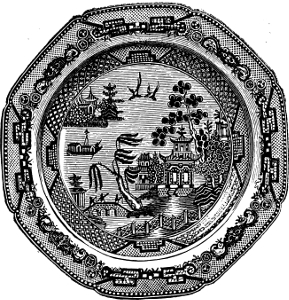
Fig. 641.—Willow Pattern.
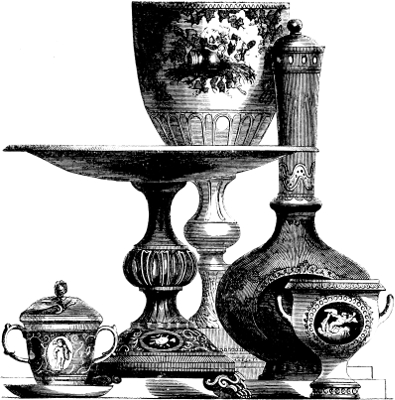
Fig. 642.
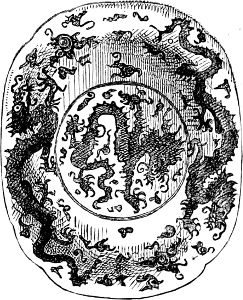
Fig. 643.—Broseley Blue Dragon.
The copies, both in embossing, in body, in colour, and oiliness of the glaze, and in style of painting of birds and flowers, of the Dresden at this period were perfect, and, as the Dresden mark was (perhaps injudiciously) introduced as well, were capable of deceiving even the most knowing connoisseur. It may be well to note that at this period an impressed anchor was sometimes used. This must not be taken to be anything more than a workman’s mark. Very successful copies of the Sèvres and Chelsea have also been at one time or other produced, and on these the marks of those makers have been also copied. Collectors of “old Chelsea,” especially of the famous green examples, must be careful, therefore, not to take everything for granted as belonging to that place on which the gold anchor is found.
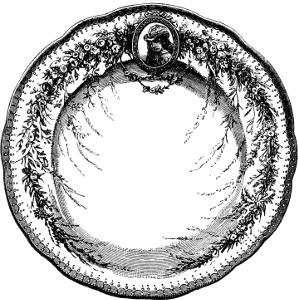
Fig. 644.
The egg-shell china produced at Coalport is much finer than any other which has come under my notice, from the fact that the body is pure porcelain, being composed of one stone and one clay alone, unmixed with bone or any other material whatever.
Broseley.
Broseley Pipe Works.—Broseley is perhaps more universally known as a seat of the manufacture of tobacco-pipes than in any other way; for in this particular it has “held its own” against other localities for about three centuries, and seems still likely to do so for three centuries more, should the habit of smoking continue so long. As a few words must in the course of this work be said upon this branch of ceramic art, it may be well here to introduce it; and I cannot do better than give, in an abridged and altered form, what, some years ago, I drew up for the pages of the Reliquary.[85]
The period at which the introduction of tobacco into England took place is a vexed question, which it is not necessary here to attempt to solve. To Sir Walter Raleigh, Mr. Ralph Lane (his governor of Virginia, who returned to England in 1586), Sir John Hawkins (1565), Captain Price, Captain Keat, and others, have respectively been assigned the honour of its introduction and of its first use in this country. But, at whatever period tobacco was introduced, it must not, I think, be taken for granted that to that period the commencement of the habit of smoking must be ascribed. It may reasonably be inferred, from various circumstances, that herbs and leaves of one kind or other were smoked medicinally, in this country, long before the period at which tobacco is generally believed to have been first brought to England. Coltsfoot, yarrow, mouse-ear, and other plants are still smoked by the people, for various ailments, in rural districts, and are considered highly efficacious, as well as pleasant; and I have known them smoked through a stick from which the pith had been removed, the bowl being formed of a lump of clay rudely fashioned at the time, and baked at the fireside. I have no doubt that pipes were in use before “the weed” was known in our country, and that it took the place of other plants, but did not give rise to the custom of smoking.
It is difficult to assign dates to these early pipes, but the one represented in Fig. 645 is probably Elizabethan. It bears on its spur a rose. Mr. Crofton Croker considered that the smaller the pipe, the more distant its date, and therefore he assigned the diminutive example shown on Fig. 648, of its full size, to an early period. This idea, which originated in the knowledge that tobacco was an extremely expensive luxury when first imported, and as it gradually decreased in value allowed a larger indulgence to the smoker, will not, I think, hold good, for dated examples show that some of the later specimens are far less capacious than others which are of an undoubtedly earlier period. The form of the pipe is generally a better criterion of age than its size, though even this cannot always be depended upon. Adopting Mr. Croker’s arrangement as to periods, the following series of examples, partly selected from pipes in my own possession, will be useful to the collector, and enable him pretty accurately to appropriate any specimens which may come under his notice. The engravings are, of course, of a reduced size. Fig. 649 is of similar form to the one above; it is probably Elizabethan.
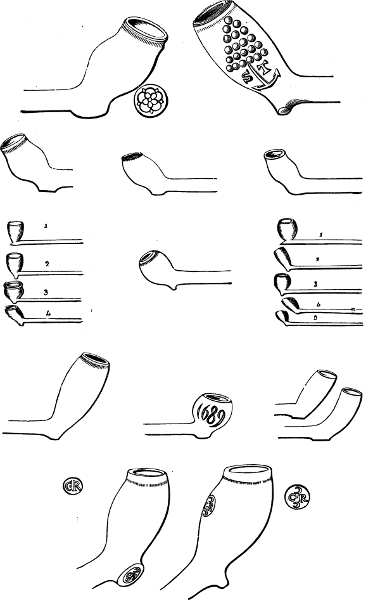
Figs. 645 to 665.—Old English Clay Pipes.
The next example Mr. Croker assigned to the period of James I. or Charles I. It does not differ very materially in shape from the preceding specimens. Of pipes of this period, a large variety of shapes might be adduced. These forms may be understood from the figures in the accompanying group, copied from engravings of the period. The dates are, No. 1, 1630; 2, 1632; 3, 1640; 4, 1641. The latter example is of the same shape as those known to have been in use in the reign of Elizabeth, and is pretty nearly similar to Mr. Croker’s example. The same form is found in use through several reigns. The usual shape of the period, however, will be seen on Figs. 1, 2, and 3.
The barrel-shaped pipe, engraved as an example of the period comprising the Commonwealth and the reign of Charles II., is from Devonshire, and may be taken as the usual type of that era. Of this period, the examples given are chosen principally from Traders’ tokens. One (2) will be seen to be of the form usually ascribed to William III.’s reign. The dates of these specimens are 1, 1650; 2, 1666 (Dunstable); 3, 1688 (Chipping Norton); 4, probably same year (Southwark); 5, 1669 (Leeds). Pipes were made at Leeds from a peculiar vein of clay found there.
Mr. Croker considered the pipes of the reign of William III. to have had bowls of the elongated form (Figs. 662 and 663), and it would appear probable that this is correct, for at the places where his Dutch troops were stationed, the pipes of this and the accompanying form are most abundant. Barrel-shaped bowls were, however, still in use, and I have copied one from Mr. Fairholt’s book, on which the date 1689 is incised. That these long pipes were not imported in very large quantities, may be gleaned from the following highly interesting notice, which I quote from Houghton:—
“The next are tobacco-pipes, of which came from Holland, gross one hundred and ten, chests four. I have seen some very long ones and also small from thence, that truly are very fine. If there comes no more, they’ll do us no great hurt. I think they must be permitted to be patterns to set our people on work, and if our smoakers would use none but fine ones, I question not but we should make as fine as anybody.”[86]
From this it appears that, in 1694, only 110 gross, or four chests, of Dutch pipes were imported, and this included both sorts—the “very long ones and also small.” It is worthy of note, for comparison’s sake, that in the same year from Holland 12,000, and from Germany 23 tons, of “marbles for boys to play with,” were imported.
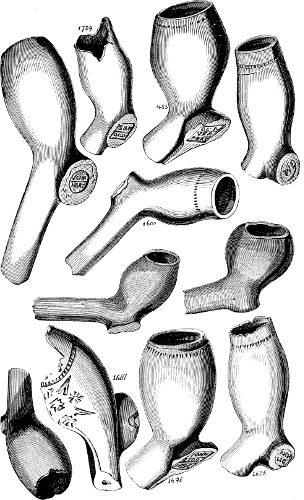
Figs. 666 to 676.—Old Broseley Clay Pipes.
The long-bowled pipes continued in use to the middle of last century, and representations of them may be found on engravings of the period, thus showing that they gradually merged from the bulbous into the elongated form of the time of William III., and so passed on to the wide-mouthed shape of the present day. The heel or spur also changed from the flat form—made to rest the pipe upon during or after use—to the long pointed one now so common, and which took its rise probably from the Dutch. It must be remembered, however, that the Dutch were originally indebted to England for the introduction of pipe-making into that country.
Usually the old pipes were perfectly plain, with the general exception of a milled border, impressed by hand, not in the mould, running round the mouth. It is also worthy of remark, that the bowls of many of the older pipes are scraped into form after having been moulded. Sometimes ornamented examples are met with, but they are of extremely rare occurrence. Mr. Croker had one which he considered to have been of foreign make, but which I think there is little doubt is of English manufacture: and the one in my own possession (Fig. 646) presents some very interesting features; in form it closely resembles one of the examples of James I. and Charles I., and I have no doubt, from the form of the letters, that I am right in appropriating it to that period.
It is not very easy to localise pipes, for but little is known of places where they were made, and the manufacture was of course of so small an extent that it is difficult to trace it. In November, 1601, Mr. Secretary Cecil alludes, in a speech, to a then existing patent of monopoly enjoyed by tobacco-pipe makers; and in 1619 the craft of pipemakers were incorporated, their privileges, according to Stowe, extending through the cities of London and Westminster, the kingdom of England, and dominion of Wales. They were governed by a master, four wardens, and about twenty-four assistants. These privileges were confirmed by subsequent monarchs. At Derby several generations of pipemakers have uninterruptedly carried on business, and it was in one of these ovens that the first pieces of Derby china were fired. The pipes made at Winchester were, in Ben Jonson’s time, great favourites; they were said to be the best then made, and far superior to those of Vauxhall and other places. In the neighbourhood of Bath, pipes were apparently made in the beginning of the seventeenth century, the makers’ names being Thomas Hunt, Henry Putley, Rich. Greenland, Rich. Tyler, and Jeffry Hunt; and some of the examples bear a shield with a branch of the tobacco-plant. At Lichfield they were made to a large extent, as also at Newcastle-under-Lyme, and indeed they were produced in most parts of the country.
From the smallness of size of these early pipes has, I presume, arisen their common name of “Fairy Pipes,” varied sometimes into “Elfin Pipes,” “Mab Pipes,” “Danes Pipes,” etc. They are also sometimes called “Celtic” and “Old Man’s Pipes,” and I have heard them designated by the characteristic name of “Carls Pipes,” a name indicative of a belief in their ancient origin.[87] In Ireland, they are believed to have belonged to the Cluricanes, a kind of wild, mischievous fairy-demon, and when found are at once broken up by the superstitious “pisantry.” In England, they are said to have belonged to the fairies or “old men,” but, unlike their Irish brethren, our peasantry usually preserve them, and in some districts believe that a certain amount of good luck attends their possession. I have known one of these pipes carried about the person for years, and have heard its owner—a Peak-man—declare in his native dialect, on being asked to part with it, “Nay, a’d part wi’ a towth sowner!” A quantity of these “fairy pipes” were found in the parish of Old Swinford, Worcestershire, some few years ago, “and the country folks there had a tradition that it was a favourite spot for the resort of Queen Mab and her court, and that among other appendages of royalty was a fairy-pipe manufactory, of which these were the remains.”
Broseley has been so long famous for its tobacco-pipes, that a “Broseley” is a term familiar to smokers all over the world. That this locality should have been chosen as the place par excellence for their manufacture, is to be accounted for by the excellent clay of the district.
The white pottery found at Wroxeter is made of clay from the Severn Valley, and this shows that the Broseley or other clays were worked at a very early period of our history. The Shirlot clay, of which a few pipes were made at Shirlot and Much-Wenlock, is of a coarse texture, and very inferior to the Devon pipeclay, of which most are now made. This might lead us to suppose that the earliest manufacturers of pipes at first used the clay found in the neighbourhood, but discarded it for the purer clays which they obtained from Devonshire; but I feel assured the Shirlot and Wenlock pipes are not of very ancient date. In the late Mr. Thursfield’s collection were many with marks on the spur. Some of these marks exhibit the maker’s name in full, some abbreviated, others initials only, and one has a gauntlet on the bowl, with S. D. (probably the initials of Samuel Decon, who was alive in 1729) on the spur; three bowls alone only bear dates, viz., Richard Legg, 1687; John Legg, 1687; and John Legg, 1696. These three are engraved on page 293. “I have carefully examined the Broseley parish register,” Mr. Thursfield informed me, “which dates back as early as 1572, and find in 1575, 17th Elizabeth (ten years before Sir Walter Raleigh introduced tobacco), that Richard Legg had a daughter baptized. I therefore consider him to be the father of Broseley pipemakers, for even at the present day some of his descendants follow the trade in this place—from various causes no longer as masters—and still bear the family names of Richard and John Legg. A stone slab let into the front of a substantial cottage, with the words ‘Richard Legg built this, 1716,’ testifies to the well-to-do position held by the family in the early part of the eighteenth century.” The name of Ben Legg also occurs on a pipe found in Worcestershire. The names of the pipemakers at Broseley, judging from the examples I have seen, appear to commence first as follows:—Clarke in 1647, Roden in 1681, Legg 1575, Darbey 1700, Decon 1608, Evans 1615, Hughes 1641, Hartshorne 1620, James 1600, Jones 1590, Price 1608, Partridge 1718, Overton 1700, Smith 1709, Shaw 1630, Wilksone 1733, and Ward 1700. Other names (Brown, Bradley, Dry, Hart, Harper, Overley, and Roberts, for instance) occur as pipemakers here in the olden time.
More than a hundred years ago, the pipemakers began to stamp their names and residences on the stems of the pipes instead of the spurs, the stems being, in many instances, 16 or 18 inches or more in length. They likewise made a small twist or bead mid stem, at such a length from the bowl, that when held between the fingers at that spot, the pipe was balanced.
A pipe-maker, named Noah Roden, brought the long pipes to great perfection, and supplied most of the London clubs and coffee-houses of that day; he died about 1829, and his business was carried on by the late William Southorn, who made great strides in improving the manufacture, and whose eldest son is now carrying on the famed business of maker of the patent and genuine “Real Broseleys.”
About the middle of last century, and since, the Rodens were famous makers of pipes at Broseley, and to them is due the introduction of “churchwardens” and “London straws,” and they were succeeded in the early part of this century by Mr. Southorn, father of the present well-known maker, Mr. Edwin Southorn. The works at present carried on by Mr. Edwin Southorn were established about 1830 by Noah Roden. In 1856 they passed into the hands of Mr. Southorn, and from that time forward their progress has been of marked improvement in every branch of the manufacture. In 1860 Mr. Southorn introduced the process of transfer printing upon pipes, the same as practised in other branches of ceramics. By this means the crests or armorial bearings, names, mottoes, or monograms of his patrons, trade marks or initials of firms, and signs and names of hotels and inns are produced, as are also other devices in colours. In 1868 Mr. Southorn introduced steam-power into his manufactory, and has rendered it available to all parts of his works; he is thus enabled to produce an enormous quantity, counting at the present time about 10,500 gross or 1,500,000 pipes in the course of a year. The “Broseleys” thus, not only in quantity but in quality—for they are the finest produced both in form, in quality of clay, in beauty of surface, and in manipulation of any made—surpass all others. In 1851, Mr. Southorn received honourable mention as “superior tobacco-pipes” at the Exhibition in that year. Mr. Southorn has also introduced the plan of dipping, or “tipping,” his pipes at the mouth-piece with green or any other coloured glaze, which is one of the most marked improvements of modern days.
The variety of pipes produced at these works is somewhat remarkable. Among these are “large bowls,” 21 inches long; “long plain,” 22 inches long; “long Broseley straws,” or “aldermen,” 27 inches long, “fit for an alderman or a king;” “long straws,” or “churchwardens,” 25 inches long, which Dr. Richardson, at the Bath meeting of the British Association, says are unquestionably the best of pipes; “London straws,” 16 inches; “Raleigh straws,” “Lord Crewes,” 27 inches long; “long Dutch straws,” 28 inches long; “short Broseley straws,” “short tips,” “plain tips,” “S. D. straws,” “dhudeens,” “peg-top straws,” “ovarium straws,” “billiard,” “cutty,” “yachting,” “Broseley meerschaums,” and a score of other kinds. One of the specialities, however, of Mr. Southorn’s productions is his “patent Broseley Narghilé.” In this “the pipe, which is formed of clay noted for its fineness and remarkably porous qualities, is enclosed for a portion of its length in a glass tube, which is filled with water; and the action of the water is to draw away the colouring matter and narcotic poison from the smoke before reaching the smoker’s mouth. The proof of this is in the gradual colouring of the water; which may be readily discharged and the tube refilled. A further effect is coolness of the extremity. The glass tubes are supplied from the Broseley pipe works in every variety of style, and we have never seen so much fine art taste combined with utility as in these, some of them vieing with the ancient Venetian glass in the combination of opaque and clear, &c. It is to be understood that by the ‘Narghilé’ is meant the attachment, or tube containing water, which is removable at the pleasure of the holder; a title that serves to recall the luxurious and costly water-pipes of Turkey, to which, in all their best qualities, this patent completely answers. The ‘patent’ Broseley pipe is manufactured specially for the Narghilé, and is the only clay pipe for which it is adapted. It is evident that a clay, either more or less porous than are these tobacco-pipes, would be equally unsuitable; and what is very remarkable, and shows the perfection to which the manufacture has been carried, these pipes are uniform in porousness, in part due to their being manufactured of the very finest and purest clay.”
Many of the forms adopted by Mr. Southorn are adaptations of mediæval examples, and others are of the most artistic and elegant outline. The mark used by him is usually the name “E. SOUTHORN, BROSELEY,” impressed on the stem. Sometimes his name with the royal arms appears printed on the bowl.
The other pipemakers at Broseley at the present day are Mr. William Southorn, of the late firm of William Southorn and Co.; and Richard Tomkis; but of these it is not necessary to speak.
Coalbrookdale.
The terra cotta works belonging to the world-famed “Coalbrookdale Iron Company” were established in 1861. The beds of clay belonging to this company being peculiarly adapted for the finest and best kinds of terra cotta, they, in conjunction with others in the neighbourhood, undertook to prepare and send, for the Exhibition of 1862, examples of goods made from the various clays of the Shropshire coal fields. The result of this determination was the establishment of this branch of the company’s manufacture, and, so far as it has been carried out, it has proved eminently successful. The colour of the terra cotta is a peculiarly light buff of a pleasing and soft tint; and the quality is of the highest order both for firmness, fineness, hardness, and durability. In it the company produce vases, tazzas, pedestals, brackets, pendants, flower-pots and boxes, chimney-pots, and every variety of architectural decoration. With their well-known skill in design, and with the talented artists they employ for their metal work, it may well be supposed that this company would produce striking and beautiful patterns in their vases and other ornamental goods; and such is the case. There is a peculiar sharpness and beauty in the details of many that is far superior to that produced by some other firms. Some of the designs will be seen in the accompanying engravings.
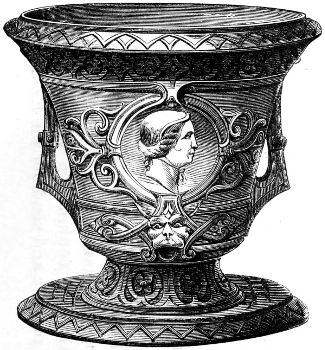
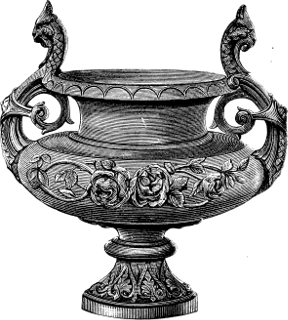
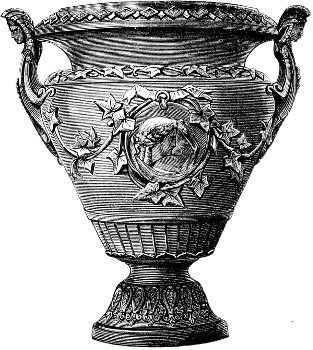
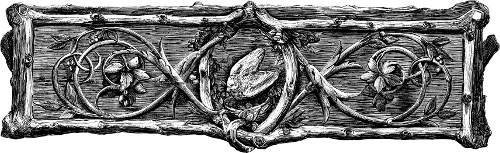
Figs. 677 to 680.—Coalbrookdale Terra Cotta.
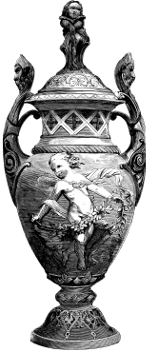
Fig. 681.—Coalbrookdale Terra Cotta.
At Lightmoor, in the same neighbourhood, the Coalbrookdale Company have extensive works for the manufacture of moulded and other bricks in white, blue, and red clays; ornamental and plain roofing tiles, many of which are of very effective shapes; garden edgings and ridge tiles of every style of design, from a simple bead to an elaborate Tudor ornament; paving tiles, &c. Nothing could better show the variety, the importance, and the high quality of the clays of this locality than do these varieties. The colour of the red quarries is rich, and improves with washing and wear, while their hardness is beyond any others. The roof tiles of this company are very extensively used (for instance, the Charterhouse Schools, near Godalming, are covered with them), and they have the reputation of being among the hardest and best produced.
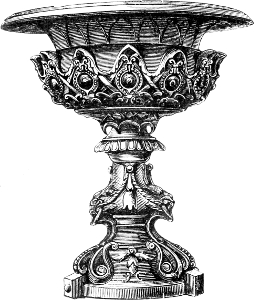
Fig. 682.—Coalbrookdale Terra Cotta.
Madeley.
A small manufactory of china was established and carried on for about a quarter of a century at Madeley, by Mr. Martin Randall, who served his apprenticeship at the Coalport works; his elder brothers, Edward and William Randall, having been apprenticed at Caughley. From Coalport Martin Randall went to the Derby China Works, where he remained for some time, and became the friend of two of their famed painters, Phillip Cleve and William Pegg. From Derby he removed to London, and entered into business with a Mr. Robins, at Islington. Upon a dissolution of partnership he came down to Madeley, and fixed himself in Park Place, where for a few years he confined himself to re-decorating Sèvres china, which was procured by agents; chiefly of Baldock and Garman, in Paris. White china was obtained where feasible; but when that could not be had, dessert, tea, and breakfast services, vases, wine coolers, jardinières, and other articles, ornamented simply with blue and gold lines, dots, or sprigs of flowers, were purchased; the latter of which were removed by fluoric acid, the glaze being so blended with the body that it gave back a new surface on being passed through the enamelling kiln. The gold was so thick on the pieces that it was usually peeled off with a knife, and was then sent to London to be again reduced by acid. At first Randall used a box kiln, with charcoal; but afterwards erected an enamelling kiln, which he heated with billets of wood.
Mr. Randall soon afterwards removed from Park Lane to a larger house at the bottom of Madeley, where he erected enamelling kilns, and also a kiln which served for biscuit and glaze. His potters were Thomas Wheeler, who was thrower and turner; Francis Brewer, modeller; William Roberts, presser; and David Morris, fire-man. Mr. John Randall, nephew of Mr. T. M. Randall, was an apprentice to the painting, and Mr. Francis Brewer, now of the Tamworth Potteries, was an apprentice to the modelling. Mr. Randall took the decorating department, but he also employed as figure painter Mr. Philip Ballard, a son of Mr. S. Ballard, solicitor, Worcester, and brother to Mr. T. Ballard, R.A. Mr. R. B. Gray, artist, now of Dorking, and father of Mr. George Gray, A.R.A., and his son Robert were flower painters; and the late Mr. Enos Raby was ground-layer, colour-maker, and gilder. Mr. Randall’s want of experience in the processes of making led to frequent errors and losses, the latter being the greater from his constant desire to produce a body which should equal Nantgarrw and Sèvres. “Too much beer” on the part of a fire-man sometimes brought down the entire kiln of ware, so that the saggers disappeared below the trial-hole, and the pieces bulged like wax, till they became fast to each other, and assumed the most fantastic forms. Too much flint in the clay, at another time, produced a chalky absorbent body, that drank up so much glaze that when fired it would fly off in the form of small daggers whilst cooling, and continue to do so for weeks. Mr. Randall, however, kept his temper like a philosopher; and at length succeeded in producing the nearest approach to the old Sèvres of any at that time made in this kingdom. It had all the mellow transparency and richness, and the same capability of receiving the colours into the glaze, of that famous ware, and had this to such an extent that the most experienced connoisseurs found it impossible to distinguish between them, excepting by the mark, which no bribe would induce him to imitate; being a strict quaker, he had a conscientious objection to doing so. From Madeley, Mr. Randall removed his business to Shelton; and here it was that the late Mr. Herbert Minton was so struck with the beauty of his productions that he made overtures to him to join his firm, which, however, he did not do; and he soon afterwards retired from business, and went to live at Barlaston, near Trentham, where he died, and was buried in a spot he had chosen for himself. Mr. Randall, who was uncle to Mr. John Randall, F.G.S., one of the celebrated painters of the Coalport works, used no mark.
Jackfield.
The Jackfield Pottery was one of the oldest in Shropshire, and is believed to have been worked for centuries. The potters had, at different times, probably from being expert hands, migrated into Staffordshire; and I am informed that, as early as 1560, several entries occur in the parish registers of Stoke-upon-Trent of people (potters, of course) as “from Jackfield.” A few years ago a coal-pit at Jackfield, which was known not to have been entered for nearly two centuries, was opened, and in it was found a small mug of brown earthenware, bearing the date 1634. The works were, probably not long after this period, carried on by a person of the name of Glover, who used the old salt glaze for his ware. He was succeeded by Mr. John Thursfield, son of Mr. John Thursfield of Stoke-upon-Trent, about the year 1713. This John Thursfield had married a daughter of Captain Webb, who had been in the wars under Marlborough and Prince Eugene, and had, while in the Low Countries, married a Dutch lady. In 1729 John Thursfield married a lady named Eleanor Morris, of Ferney Bank, who is curiously described in the Broseley register as a “sojoinner.” He died in 1751, leaving two sons—John, who built the works at Benthall; and Morris, who succeeded his father at Jackfield. The kind of ware made at Jackfield was a white stoneware, very similar to the Staffordshire make, and on some examples flowers and other ornaments were incised and coloured, that is, the outlines were cut in while the clay was soft, and the flowers and other ornaments touched afterwards with colour. Tiles of the kind usually known as “Dutch tiles” were also made. In 1763 Mr. Simpson carried on the pottery at Jackfield, and made yellow ware, and a ware the body of which was pipeclay and glazed with salt. This he sent down the Severn to the Bristol Channel for export to America—a trade which the American war of independence put an end to. Maurice Thursfield made at Jackfield a very superior black ware, highly vitrified and glazed; indeed, so highly glazed was it that it had all the outward appearance of glass. The forms, and the potting of these articles, locally known as “black decanters,” were remarkably good, and on some specimens which I have seen ornaments have been judiciously introduced. On one, in the possession of the late Richard Thursfield, Esq., of Broseley, a head and wreath are executed in gold and colour; and on others, paintings in oils, both portraits and views, and raised ornaments, are introduced. Some good examples are preserved in the Museum of Practical Geology. Maurice Thursfield died in America, where he had, it appears, considerable business connections.
In these works Mr. Rose, in conjunction with a Mr. Blakeway, soon after the death of Maurice Thursfield, began making china. The works were not, however, carried on long, but were removed to Coalport, on the opposite side of the Severn, where they were begun in some buildings which had formerly been a pottery (I believe belonging to a Mr. Young, a mercer of Shrewsbury), and where they have continued uninterruptedly to the present day.
In the early part of this century a pottery—spoken of in 1836 as the “new pottery”—was established here by Mr. John Myatt, for brown and yellow stone-wares. Here, too, at the same time, near the Calcuts, extensive brick and tile-works were then and still are carried on.
Jackfield Encaustic Tiles.—Many years ago Mr. Peter Stephan (still at this date a modeller at Coalport), son of Stephan the potter, who was a Frenchman, and at one time at Derby and afterwards of Jackfield, where he had a small pottery, produced some strikingly good arabesque patterns in blue printing. His mark was an anchor with cable, impressed in the body of the ware; and also the crest of an anchor on an heraldic roll, with his name above (see Figs. 683 and 684), and printed in blue on the bottom of the ware. His pieces are of rare occurrence. He also made encaustic tiles. These were the first made in this district.
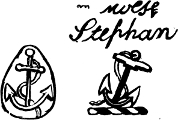
Figs. 683 and 684.
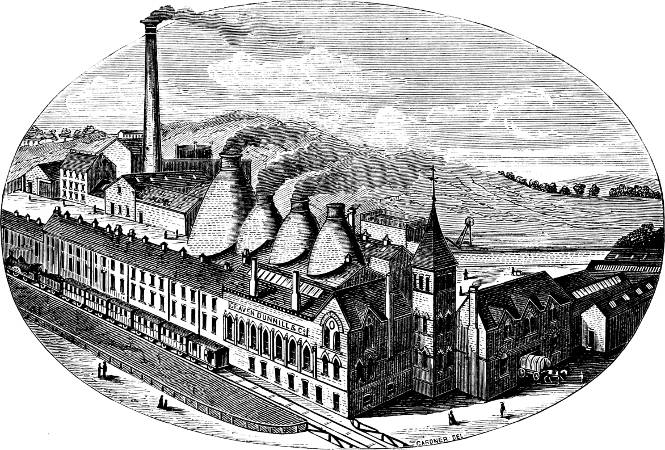
Fig. 685.—The Jackfield Works.
The Jackfield Works.—The site of the present works carried on by Craven, Dunnill, & Co., for the manufacture of Encaustic and Geometrical tiles, is that of the above old pottery in Jackfield, in which Hargreaves and Craven for several years made geometrical tiles by the clay-dust process, and encaustic tiles from plastic clay; but the buildings being old and dilapidated, Mr. H. P. Dunnill formed a limited liability company, consisting of seven shareholders, for rebuilding and carrying on the concern. The old buildings were taken down, a considerable extent of land added to the premises, and on this land the present handsome new works were erected. They now cover an extent of nearly two acres of ground, and are fitted with machinery and arrangements specially adapted to the requirements of the trade, each department succeeding the other in perfect rotation; so that the clay goes into the blunging-house at one point, from thence into the slip-kilns, mill-room, damping-houses, press-shops, encaustic rooms, drying-stove, seggar-house, firing and glaze-kilns, sorting-house, warehouses, packing-room, and finally, having in the various processes gone the circuit of the manufactory, passes into the railway lurries to be conveyed to various parts of the kingdom and abroad. The fine clays of Jackfield and Broseley are largely used in the manufacture, and within the grounds of the works there is a pit in which, from a depth of thirty-five yards, is brought up by steam-power a beautiful red clay, of very fine tone of colour. The firm justly pride themselves on the colour and quality of their plain tiles; and the hardness of their buff tiles—a point much desired by the trade—is very noticeable. The colour and hardness of body of their dove tiles are also very apparent. In encaustic tiles many beautiful designs by Waterhouse, Goldie, Gibbs, Bentley, and other architects are produced. At the instance of one of the firm, Mr. A. H. Brown, M.P. for Wenlock, a noticeable arrangement has been made in the interest of the work-people. Any profit made after ten per cent. paid to the proprietors is equally divided between them and the work-people, and the latter have thus a direct interest to do their work in the best manner, so as to add to the reputation of the firm. Glazed tiles for hearths, of great variety and beauty of pattern, are made here, and also glazed wall tiles in white, cream, celadon, and other tones. The company also produce majolica tiles of the richest class, with an endless variety of printed, painted, and art tiles for decorative purposes. The quality of the tiles is remarkably good; the colours are pure and clear, the body hard and durable, and the glaze firm. Many of the patterns are of extreme beauty and excellence. The marks adopted, impressed on the back of the tiles, are—
HARGREAVES & CRAVEN
HARGREAVES CRAVEN DUNNILL & CO JACKFIELD NR IRONBRIDGE SALOP
CRAVEN DUNNILL & CO LIMITED JACKFIELD NR IRONBRIDGE SALOP
HARGREAVES CRAVEN DUNNILL & CO JACKFIELD
CRAVEN DUNNILL & CO JACKFIELD SALOP
CRAVEN & CO
Benthall Works.—The manufactory of encaustic tiles, mosaics, and majolica, which has for the last twenty-two years been carried on by Messrs. Maw, at the Benthall works, near Broseley, was initiated at Worcester (as named in my account of the works of Mr. St. John in that city) in the year 1850, where Messrs. Maw commenced experimenting on the processes of manufacture on the premises formerly occupied by the Worcester Porcelain Manufactory, when under the hands of Messrs. Flight and Barr, and afterwards used for the production of encaustic tiles by my late friend Mr. Fleming St. John and his partners, by whom the moulds, &c., which had been used by them in the manufacture of encaustic tiles were sold to Messrs. Maw. These gentlemen at once saw that a much wider field was open to them in the production of tiles than had previously been attempted at Worcester. In 1852, Messrs. Maw, feeling the necessity for carrying on the manufacture in a neighbourhood which would produce both the coal and the clay, abandoned the works at Worcester, and removed their moulds, plant, &c., to the Benthall works, near Broseley, where another seven years was spent by them in a series of costly experiments with no immediate profit except the experience gained by which they have subsequently built up the business. Their first effort was to thoroughly investigate and experiment upon the clays of the Shropshire coal-field, as well as the plastic materials found throughout the kingdom, many of which no one had before attempted to turn to economic account.
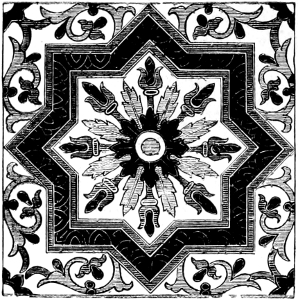
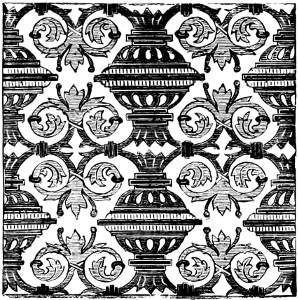
Figs. 686 to 693.—Examples of Messrs. Maw’s Tiles.
The results of these experiments have been illustrated in an extensive series of specimens of the clays or plastic slates of Great Britain presented by Mr. Geo. Maw, F.S.A., to the Government Museum of Practical Geology, in Jermyn Street, and printed in the supplement to the catalogue by Sir H. De La Beche and Mr. Trenham Reeks. In 1857, after all these years of patient labours, the manufacture was commenced on a commercial scale, which for several years barely paid its expenses; but from that time to the present continual additions have been made to the works to meet the increasing demand for their productions. In 1871 supplementary works were commenced at the Tuckies, about two miles from the Benthall works, celebrated as the spot where the late Lord Dundonald carried on his experiments in the manufacture of coal-gas.
Fig. 694.
Messrs. Maw have from the first laid themselves out for applying the very highest art and architectural talents to their manufactures, and, in 1856, commissioned Mr. M. D. Wyatt to design a series of patterns of geometrical mosaic, which were issued as a small lithographed volume of fourteen pages. This little book, which first established their reputation as art manufacturers, was subsequently superseded by a much larger volume, published in 1867, including the designs of Digby Wyatt, George Goldie, J. P. Seddon, George E. Street, J. Burgess, and others, as well as the reproduction of all the best obtainable examples of ancient tiles, geometrical, and Roman mosaic, majolica, &c.
Fig. 695.
In 1851 Messrs. Maw began the manufacture of plain tiles, geometrical mosaic, and the ordinary encaustic tiles of two colours, to which their productions were for several years limited: but since 1857 their progress has been marked by the continual grafting on of specialities, the yearly production of new colours, and new phases of ceramic art applied to tiles. In 1861 they commenced the manufacture of very small tesseræ for the formation of pictorial mosaics, and produced for the Exhibition of 1862 their well-known mosaic of “The Seasons,” here engraved (Fig. 695), and which is now in the South Kensington Museum, from a design expressly made for them by Digby Wyatt. The result was so successful that Mr. Wyatt commissioned Messrs. Maw to execute a mosaic frieze for the inner quadrangle of the New India Office.
The production of coloured enamels for the surface decoration of majolica tiles next occupied their attention, and after years of experimenting, all the colours employed in the ancient tiles of Spain or Italy were successfully reproduced, as well as others which were unknown to the mediæval and Moorish manufacturers.
A stone chimney-piece, enriched with tiles executed for the International Exhibition of 1862, was their first attempt in the application of enamels and majolica in architectural work. Shortly afterwards the successful decoration of ceilings was carried out in the corridors of the India Office. And now the production of majolica tiles and enamelled terra cotta for all kinds of internal and external decoration forms an important branch of Messrs. Maw’s manufacture. Among the more important of their works in enamelled terra cotta may be mentioned the beautiful staircase executed for Sir D. Majoribanks, a portion of which was exhibited in the International Exhibition of 1871, and the chimney-pieces manufactured for the board-room of the South Kensington Museum, and the Museum of Science and Art, at Edinburgh. Messrs. Maw were the first in this country to produce the transparent celeste, or turquoise blue, employed in ancient Chinese enamels, specimens of which were exhibited in the Paris Exhibition of 1867.
Among their more recent productions may be mentioned tesseræ for mosaic work, decorated with rich enamels; embossed tiles; “sgrafito,” a ware the decoration of which is produced by the cutting away of superimposed layers of different coloured clays, after the fashion of cameo carving; “slip painting,” the production of a pattern by the painting of liquid clay on a ground of another colour, and the whole glazed over, after the first burning, with transparent coloured enamels; “pâte sur pâte,” tiles in which the design in high relief is superimposed on a ground of a different colour; mixed coloured glasses and enamels for the decoration of pottery, by which the most subtle and brilliant effects are produced; terra cotta and Parian plant-markers, forming an economical and indestructible substitute for the old wooden and iron name tallies. On these the names of trees and shrubs are written in a permanent black enamel and burnt in.
The special processes employed by Messrs. Maw have been made the subject of a number of patents, among which may be mentioned their mill machinery, used in the preparation of clay for the manufacture of tiles by Prosser’s process; the steam blunger, by which the rough clay is levigated, sifted, and refined ready for drying on the slip-kilns, without the intervention of manual labour; the manufacture of encaustic tiles out of pulverised nearly dry clay, and their patent press worked by steam power for the pressing of tiles, which is the only successful application of steam power to screw presses which has yet been attained.
The geometric and tesselated pavements produced by Messrs. Maw are of the most elegant, elaborate, and beautiful character, and the tesseræ and tiles of which they are composed are made with the utmost mechanical accuracy, and of the finest quality both in body, in colours, and in glaze. The patterns they have prepared are of exquisite beauty and of endless variety, and suitable for every possible purpose both for public and private buildings.
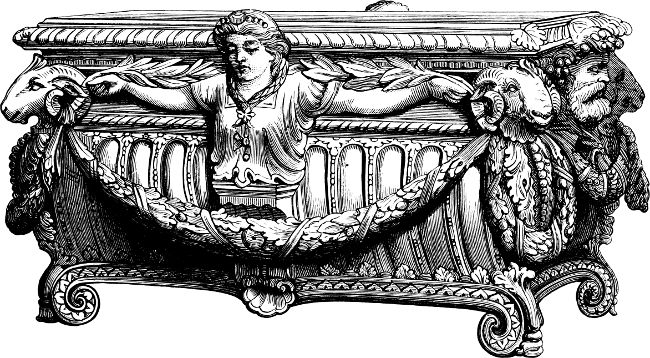
Fig. 696 to 699.
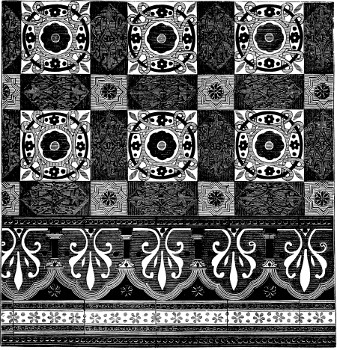
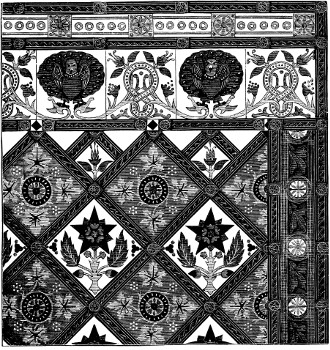
Figs. 700 to 701.
The encaustic, or figured tiles, for pavements, are also a great speciality of Messrs. Maw’s works, and are, like those of other makers, produced in immense variety and in large quantities. They are made in two, three, four, or more colours combined, the colours used being buff or yellow, red, black, blue, chocolate, white, cream, fawn, green, &c., and of various sizes, the usual dimensions being 6 and 4¼ inches square. The patterns are, in many instances, taken from the best remaining ancient examples, and in others have been specially designed for Messrs. Maw by Sir Digby Wyatt, Owen Jones, and the best authorities of the day; and many of the pavements thus produced are matchless both in design, in general effect, and in beauty and brilliancy of colour. Messrs. Maw are not content with producing simple quarries, to be arranged in the usual varieties of ways, but they have introduced entire pavements, over which is spread one grand design covering its entire surface; many entire patterns occupying not the usual old numbers of 4, 9, 12, 16, or 24 tiles, but 144 and other numbers. These are peculiarly rich and effective, and particularly well adapted for halls, vestibules, corridors, &c.
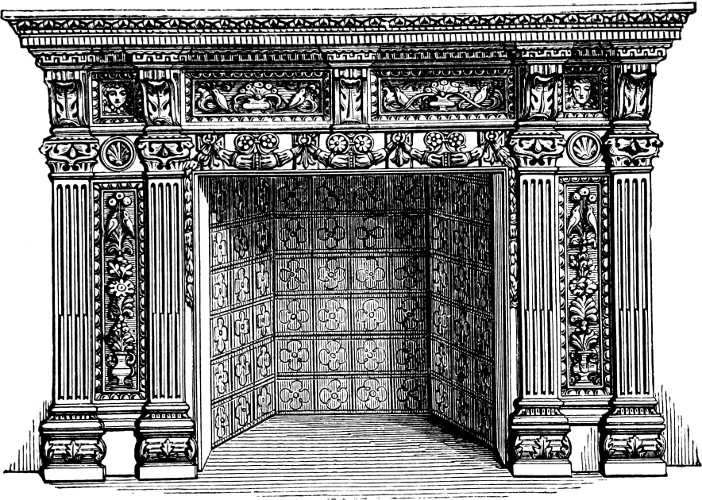
Fig. 702.
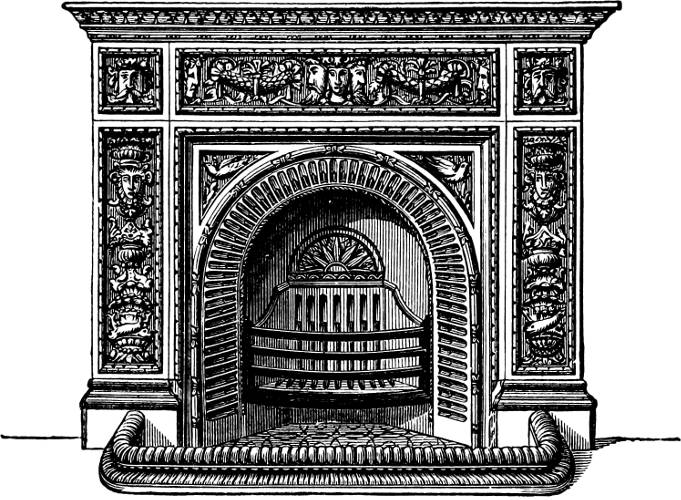
Fig. 703.
The marks used by Messrs. Maw are—
MAW & CO BENTHALL WORKS BROSELEY SALOP
MAW & CO BROSELEY
MAW & CO BENTHALL BROSELEY
MAW & CO BROSELEY SALOP
MAW & CO
The enamelled hearth-pavements and wall-tiles are another great speciality of these works, and are of unsurpassable richness and beauty, as are also their majolica tiles and fire-place linings. These are produced in every possible variety, and are remarkable not only for the richness and delicacy of the colours which are used, and for their purely artistic and masterly combination, but for the excellence of both body and glaze, and the scrupulous accuracy of forms for fitting together. The same remark applies to the embossed and indented tiles, and also to those which are partially pierced for open work. They are all equally good, and bear evidence of that thorough appreciation of art which pervades all the productions of the Benthall works. The engravings (Figs. 702 and 703) show two of their majolica chimney-pieces. The first is of the finest majolica, with a fire-place lining of encaustic, or enamel, tiles, which would also be used for the hearth. The decorations are in high and bold relief, and being coloured with pure artistic taste, have a charming and very striking effect. It is 4 feet 8 inches in height, and 7 feet in width, and is, of course, furnished with a marble shelf at the top—which, however, is not shown in the illustration.
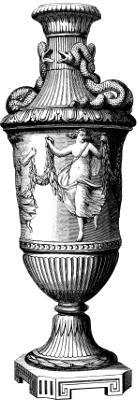
Fig. 704.
The next shows another of these chimney-pieces entirely complete; it is, like the other, of majolica. The ornaments are in bold relief, set off with an excellent arrangement of groundwork and colour; the hearth is formed of encaustic, or enamelled, or mosaic tiles; and the fender is of majolica.
Another branch of ceramics—that of “Art Pottery”—has recently been added to Messrs. Maw’s manufactory. This is the production of vases, &c., in majolica, a branch which they are eminently qualified to bring to perfection. In this branch vases, tazzas, and other articles, more or less decorated with raised or surface ornamentation, are produced. They are of excellent design, the body light but compact, and the decorations of remarkably good and artistic character.
Broseley.
The Broseley Tileries, at Broseley, are said to be the oldest brick and tile works in the district, and they have for more than a century been in the hands of the family of the present proprietor, Mrs. Penelope Jane Thorn. They are now under the management of Mr. H. M. Bathurst. The goods produced are encaustic and geometrical glazed and unglazed tiles, ornamental ridge tiles, roofing and pavement tiles of various kinds, sanitary pipes, &c.