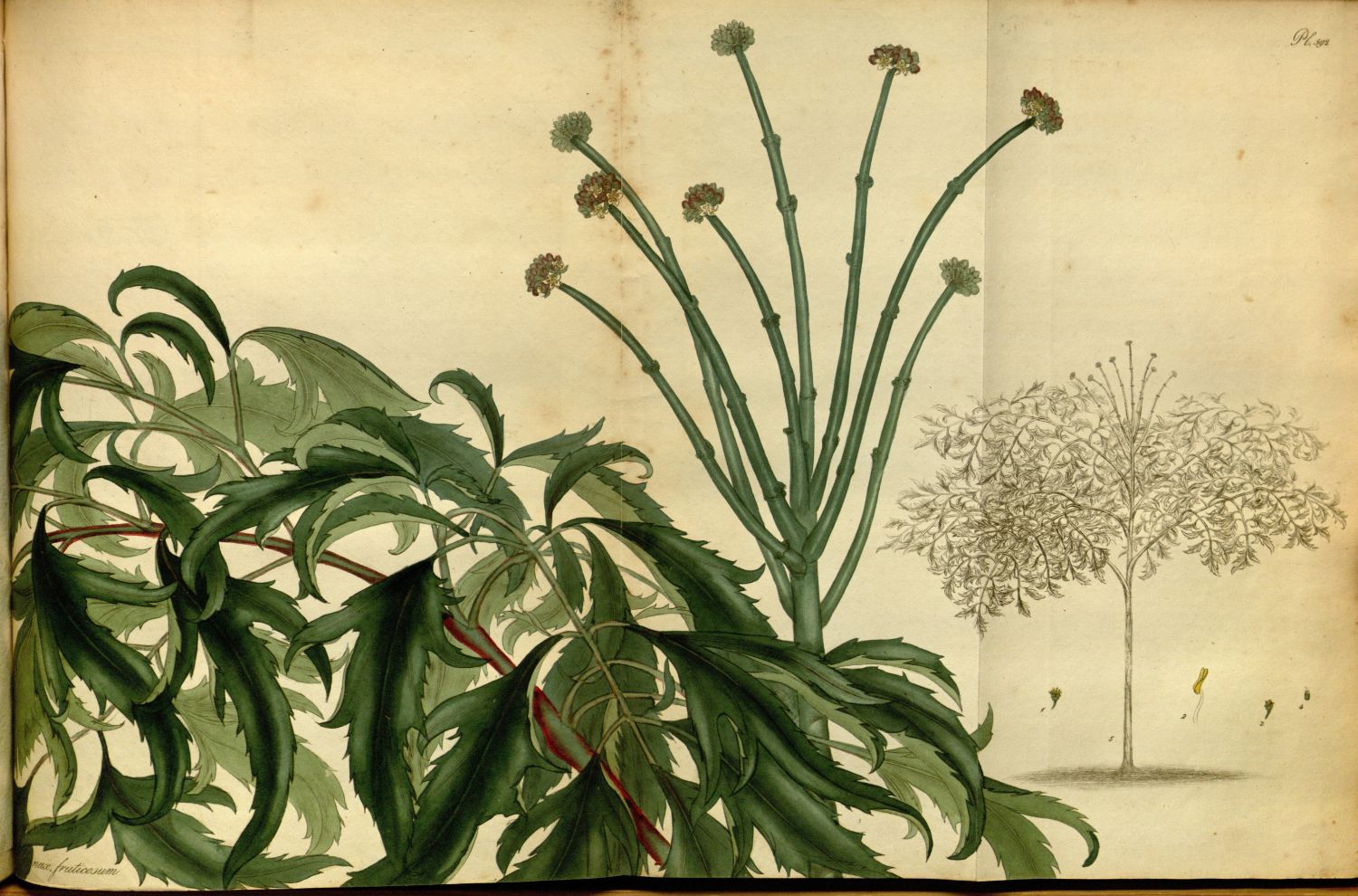
Volume 9 — PLATE DXCV. PANAX FRUTICOSUM. Shrubby Panax.
Reading edition
CLASS XXIII. ORDER II.
POLYGAMIA DIŒCIA. Flowers Male, Female, and Hermaphrodite on different Plants.
ESSENTIAL GENERIC CHARACTER.
Hermaphroditus. Umbella. Calyx 5-dentatus, superus. Corolla 5-petala. Stamina 5. Styli 2 vel 3, sæpe cohærentes. Bacca 2-vel 3-sperma, infera.
Hermaphrodite. An umbel. Cup 5-toothed, above. Blossom 5-petalled. Stamens 5. Shafts 2 or 3, sometimes cohering. Berry 2-or 3-seeded, below.
The male or female flowers we have never seen.
SPECIFIC CHARACTER.
Panax foliis supradecompositis, dentato-ciliatis; caule fruticoso. Willd. Sp. Pl.
Panax with leaves more than doubly compound, ciliated with little teeth; the stem shrubby.
REFERENCE TO THE PLATE.
1. Empalement, chives, and pointals. 2. The pointals. 3. The plant in miniature.
On examining the flowers of this curious and rare species of Panax, we were a little startled to find how widely they differed from the character of the genus; being trigynous, and the berry three-seeded. Professor Jacquin has also observed the same variation in the flowers of P. aculeatum (see his Icones, tab. 634); and fifty years ago Trew observed and delineated the same number of styles in Panax trifolium, one of the original species upon which the genus was established. Nor had this escaped the scrutinizing eye of that profound observer of nature Bernard Jussieu. From these authorities, therefore, in consonance with our own observations, we have enlarged the character of the genus to include the species. Panax fruticosum, as we learn from Rumphius’s Herbarium Amboinense, vol. iv. p. 78 and 79, rises to between five and six feet in height, with a stem as thick as a man’s arm, and grows naturally in the Island of Ternate, where it is also much cultivated by the natives for food, medicine, and œconomy; being planted to separate the areas of their gardens and mark the boundaries of their fields. The boiled leaves are eaten as greens, and a decoction both of the leaves and root is used successfully in nephritic diseases, for which they also sometimes prescribe the roots to be eaten raw. The fame of the plant as a powerful diuretic is also great in Amboyna; where, as well as in Ternate, it is commonly planted both for ornament and use. Labillardiere, the French botanist, who accompanied the expedition that sailed in quest of the unfortunate Lapeyrouse, informs us (in his account of the voyage) that when at Amboyna he found this plant encircling the tomb of the venerable Rumphius, its first described.
Nature he loved; with her he spent his hours: The grateful goddess wreathes his tomb with flowers!
The famous Gin-seng, to which the Chinese attribute such extraordinary virtues, and which, as Osbeck informs us, was commonly sold in their shops in 1751 (see his Travels, English edit. p. 222) for from 30 to 40 times its weight in silver, and which one of their Emperors, 40 years before that, sent 10,000 Tartars in quest of at once, is said by that author to be a species of Panax; but the plant is yet unknown in Europe. Panax fruticosum, we are informed, was introduced to this country about the year 1800, and requires to be kept in the hot-house. The specimen was communicated from Boyton by A. B. Lambert, esq.