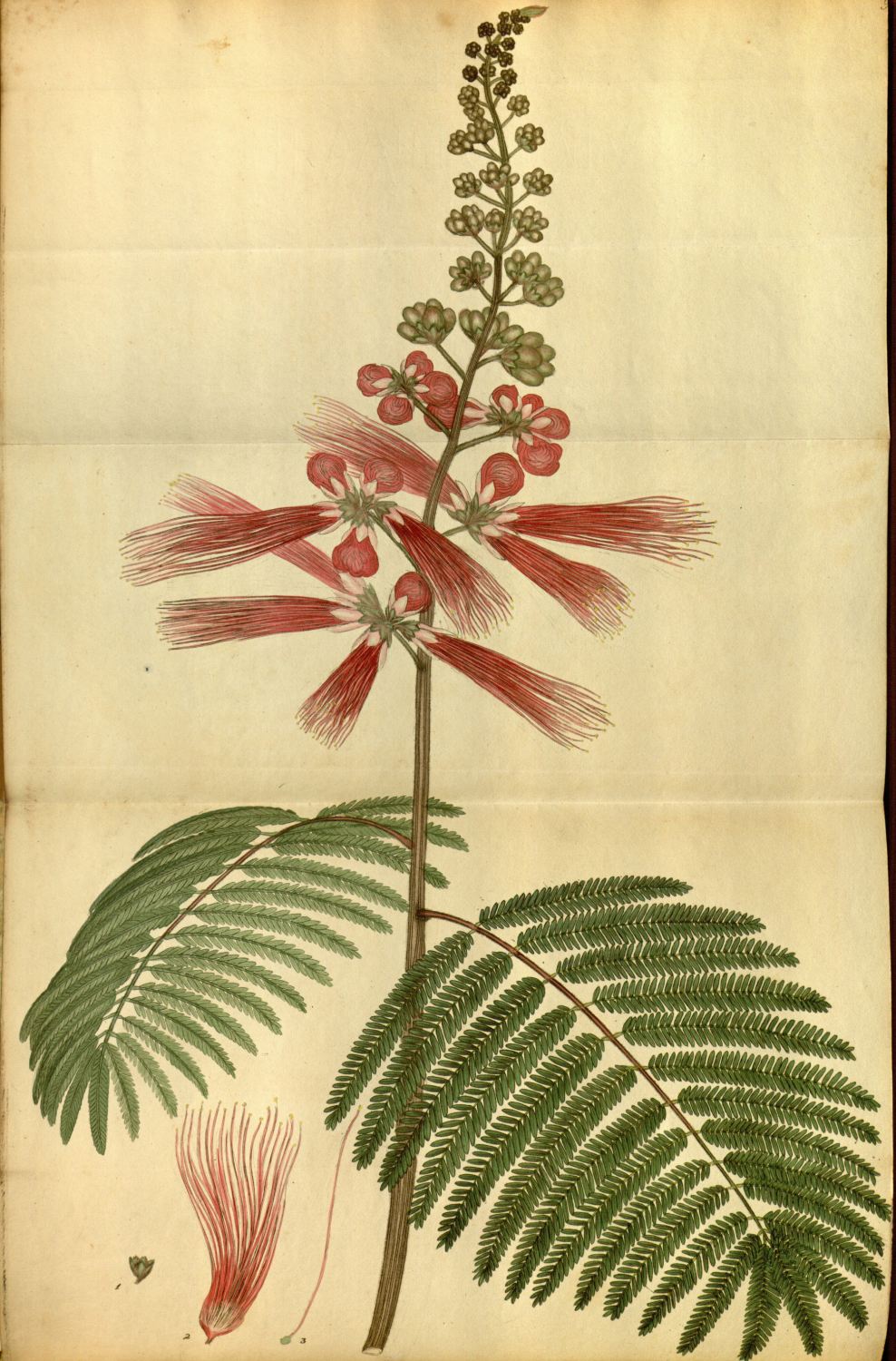
Volume 9 — PLATE DXCII. MIMOSA GRANDIFLORA. Great-flowered Mimosa.
Reading edition
CLASS XXIII. ORDER I.
POLYGAMIA MONOECIA. Flowers Male, Female, and Hermaphrodite, on the same Plant.
ESSENTIAL GENERIC CHARACTER.
Hermaphroditi. Calyx 5-dentatus. Corolla 5-fida vel 5-petala. Stamina 4-200. Pistillum 1. Legumen bivalve.
Masculi. Calyx 5-dentatus. Corolla 5-fida sen 5-petala. Stamina 4-200.
Hermaphrodites. Cup 5-toothed. Blossom 5-cleft or 5-petalled. Chives 4 to 200. Shaft 1. Pod two-valved.
Male Flowers. Cup 5-toothed. Blossom 5-cleft, or of 5 petals. Chives 4 to 200.
SPECIFIC CHARACTER.
Mimosa inermis, foliis bipinnatis, multijugis, ciliatis; racemo composito terminali.
Acacia grandiflora. Willd. Sp. Pl. 4. p. 1074.
Mimosa unarmed, with doubly-winged leaves in many pairs and ciliated, and flowers in a compound terminating bunch.
REFERENCE TO THE PLATE.
1. The empalement. 2. The chives spread open. 3. The pointal.
This species, conspicuous by its tall woody stems, large purple blossoms, and delicate foliage, was brought to the Royal Gardens at Kew from India by Mrs. Norman, about the year 1769. It is a plant of quick growth, and blossoms freely, but has never produced any pods in this country. The only figure of it we have seen is that by Reinagle in Dr. Thornton’s Illustration of the System of Linnæus. A plate however was finished for L’Heritier, who first described it; but his death prevented its publication. The stamens (as in many other Mimosas) are united near the base. The blossoms open in succession from the bottom of the bunch upwards, and continue great part of the summer. The leaves are deciduous. The specimen was communicated from Boyton by A. B. Lambert, esq. in August.