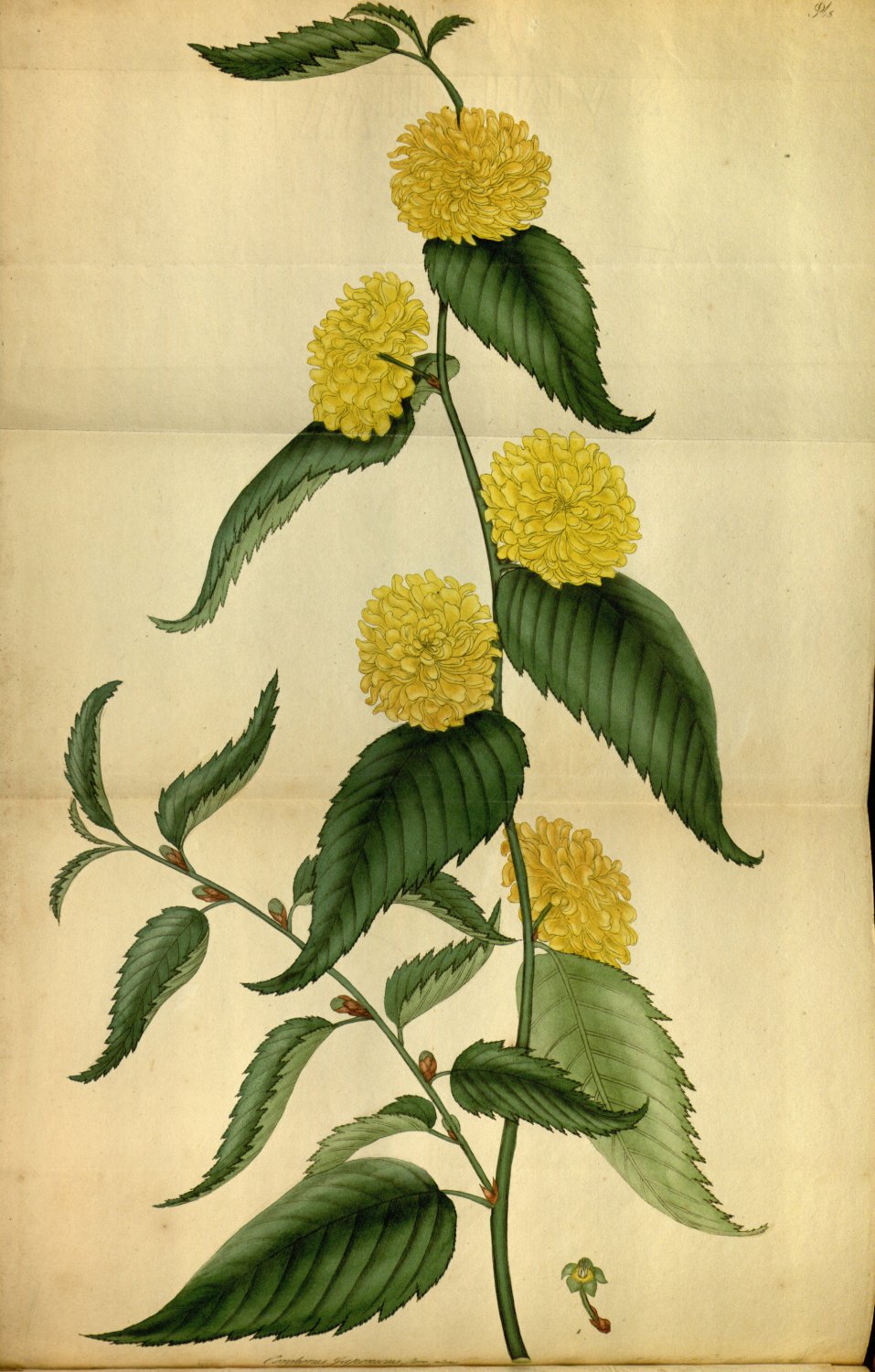
Volume 9 — PLATE DLXXXVII. CORCHORUS? JAPONICUS flore pleno. Japanese Corchorus with double flowers.
Reading edition
CLASS XIII. ORDER I.
POLYANDRIA MONOGYNIA. Many Chives. One Pointal.
ESSENTIAL GENERIC CHARACTER.
Corolla 5-petala. Calyx 5-phyllus, deciduus. Capsula plurivalvis, loculamentosa.
Blossom of 5 petals. Cup 5-leaved, falling off, Fruit with many valves, subdivided.
SPECIFIC CHARACTER.
Corchorus capsulis rotundis glabris, foliis duplicato-serratis.—Flora Japonica, p. 227.
Corchorus with round smooth capsules, and the leaves doubly sawed.
REFERENCE TO THE PLATE.
1. The pointals.
This elegant shrub is amply described in the Flora Japonica of Professor Thunberg, who found it growing naturally about Nagasaki, Miaco, and various parts of the Japanese empire; where it is also commonly cultivated for ornament. The double variety here figured he particularly specifies as naturally adorning the country about Miaco. In Houttuyn’s Pflanrensystem, vol. vii. plate 54, there is also an engraving of it. The single-flowered has not yet been introduced to this country. The time of blossoming is in early spring: but it does not appear to confine itself to that season, as we have been favoured with fresh specimens at various seasons from April to October; and we may therefore safely predict its being long a favourite with cultivators. The flexile twigs starred with blossoms look at a little distance like garlands, and extend when supported to a great length. All the flowers that we have seen are from 5-to 8-gynous; which, with the singular form of the capsule, makes us consider it as a very doubtful species of Corchorus. The Japanese name is Jamma Buki.
Our figure is taken from specimens communicated by Mr. Milne of Fonthill, who informs us that his plant now growing in the conservatory is ten feet high. We first observed it in bloom early last spring at Messrs. Colville’s, and in several other collections during the summer, but smaller both in flowers and leaves.