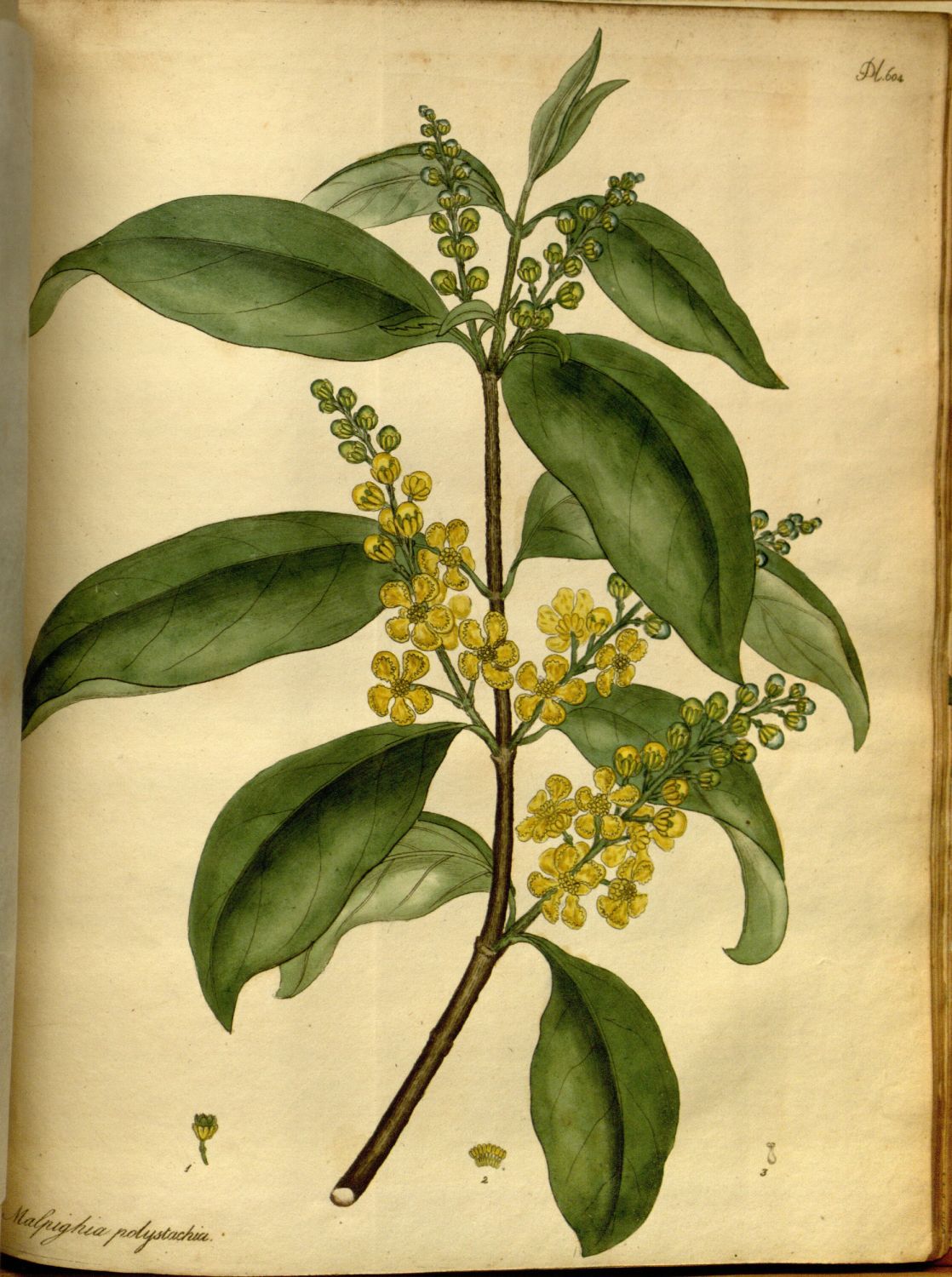
Volume 9 — PLATE DCIV. MALPIGHIA POLYSTACHIA. Branching Malpighia.
Reading edition
CLASS X. ORDER I. TO III.
DECANDRIA MONO-DI-TRIGYNIA. Ten Chives. One to Three Pointals.
GENERIC CHARACTER.
Calyx 5-phyllus basi extus poris binis melliferis. Petala 5 subrotunda, unguiculata. Filamenta basi cohærentia. Drupa 1-locularis tripyrena, nucibus monospermis.
Cup 5-leaved with two honey-bearing pores on the outside at the base. Petals five, nearly round with claws. Threads cohering at the base. Berry fleshy of one cell with three large bony seeds.
SPECIFIC CHARACTER.
Malpighia foliis lanceolato-ovatis integerrimis glabris nitidis, subtus prope basin biglandulosis; racemis axillaribus et terminalibus; pedicellis uniglandulosis; floribus monogynis; stigmate capitato.
Malpighia with lance-ovate, entire smooth shining leaves, with two glands on their underside near the base; bunches both from the sides and tops of the branches; flowerstalks with one gland; style one; stigma headed.
REFERENCE TO THE PLATE.
1. The empalement. 3. The chives spread open. 3. Seed-bud and pointals.
This splendid Malpighia is one of that fine collection of West Indian and American plants (we have before mentioned) made by Lord Seaforth when Governor of Barbadoes, and brought home with him on his return to England. From the catalogue of the collection we learn that the plant is a native of Trinidad, and his Lordship informs us that it was sent to him from that island by Mr. Thompson.
The species ought to be arranged between the M. nitida of Linnæus and M. glandulosa of Cavanilles, from both of which the glands on the leaf and solitary gland on the pedicel easily distinguish it. In the last circumstance, however, it agrees with the M. glandulosa of Jacquin, (see his Icones, tab. 469.) but is totally different both in the flowers and foliage. A. B. Lambert, esq., from whose stove at Boyton we were favoured with the specimen, informs us that it is a shrub of very free growth, throwing out long slender twigs on all sides, and requiring the frequent use of the knife to keep it in due bounds. The bunches of flowers first appeared in November, but did not open until the beginning of April. The leaf-stalks are thinly covered with silky bristles, some of which also appear towards the base of the younger leaves.