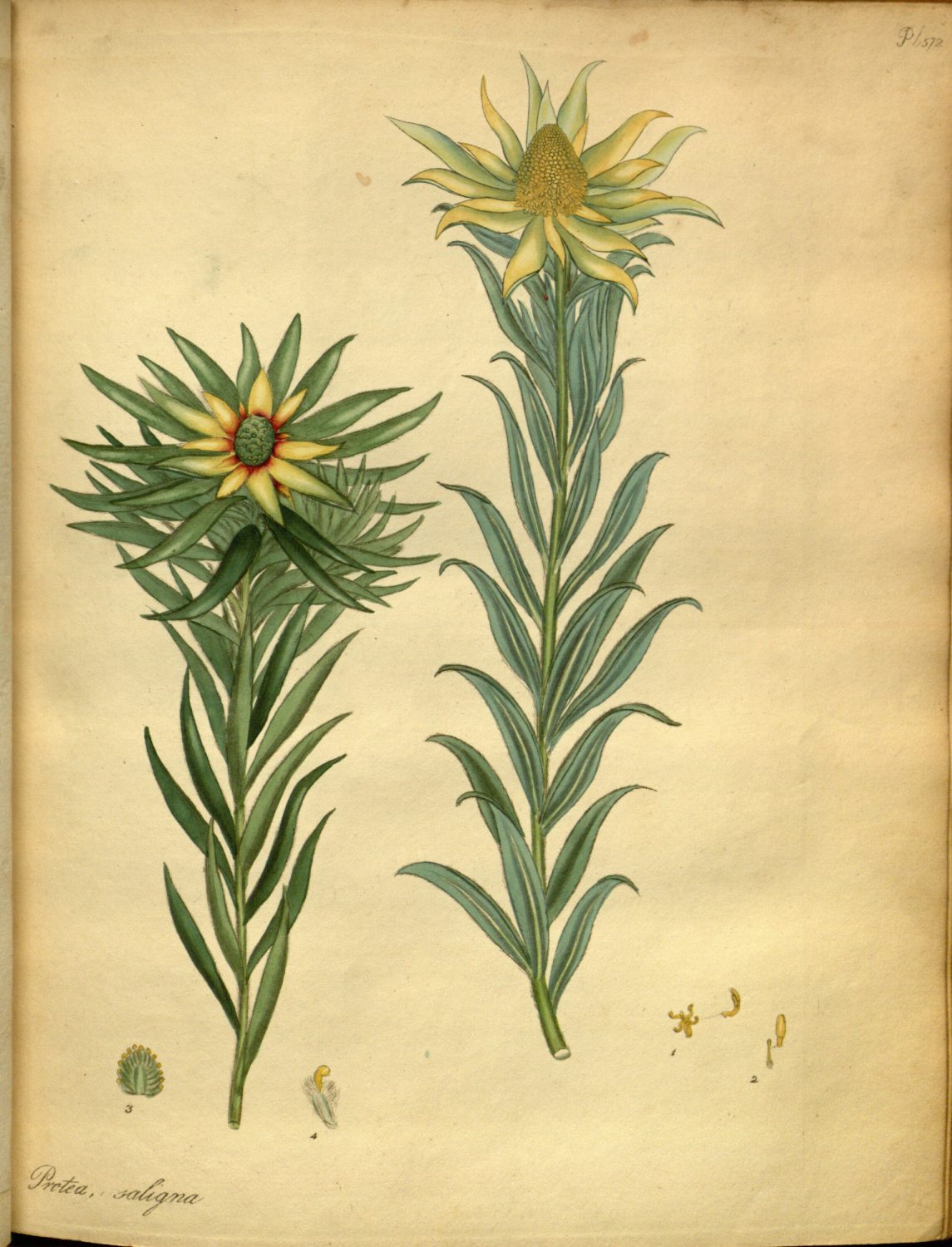
Volume 9 — PLATE DLXXII. PROTEA SALIGNA. Willow-leaved Protea.
Reading edition
CLASS IV. ORDER I.
TETRANDRIA MONOGYNIA. Four Chives. One Pointal.
ESSENTIAL GENERIC CHARACTER.
Corolla 4-fida, seu 4-petala. Antheræ lineares, petalis infra apices insertæ. Calyx proprius, nullus. Semina solitaria.
Blossom four-cleft, or of four petals. Tips linear, inserted into the petals below the points. Cup proper, none. Seeds solitary.
SPECIFIC CHARACTER.
Protea foliis obliquis, lanceolatis, pubescentibus: capitulis oblongis, involucratis, terminalibus.
Feminei flores ramos terminant cum cono ovato magnitudine pisi, involucro bicolori circumdato.
Habitat ad Caput Bonæ Spei.
Protea with oblique, lance-shaped, hairy leaves: heads of flowers oblong, involucrated, and terminal.
Female flowers terminate the branches with an ovate cone about the size of a pea, surrounded by a two-coloured involucrum.
Native of the Cape of Good Hope.
REFERENCE TO THE PLATE.
1. A flower, one tip magnified. 2. Seed-bud and pointal, summit magnified. 3. Section of a head of flowers from the female plant. 4. Seed-bud and pointal, magnified.
Protea saligna, in the Species Plantarum of Linnæus, is considered as only a variety of P. conifera, but is certainly specifically distinct in its foliage, however resembling in other particulars. Finding, soon after we had made our drawing, a female plant in fine bloom, we have annexed a branch of it on the same plate, to elucidate as much as possible the apparent confusion that at present seems to pervade this section of the Genus Protea. The P. saligna of Thunberg, enumerated by Willdenow, we have no doubt, describes the female specimen we have represented, the cone being there mentioned as about the size of a pea, and which exactly accords with our figure. The drawings were made from plants introduced to this country from the Cape of Good Hope, in the year 1806, by G. Hibbert, esq.