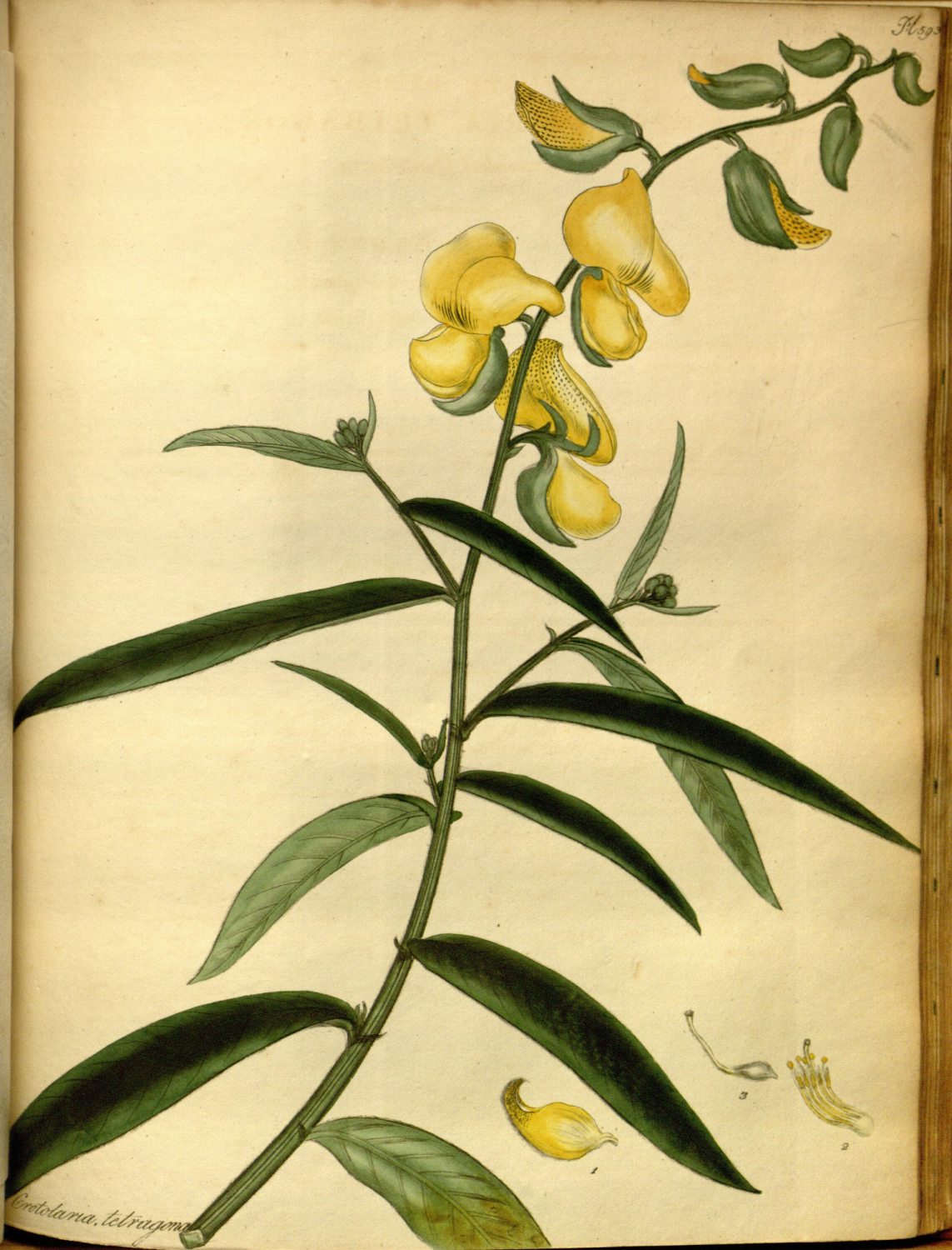
Volume 9 — PLATE DXCIII. CROTALARIA TETRAGONA. Four-sided Crotalaria.
Reading edition
CLASS XVII. ORDER IV.
DIADELPHIA DECANDRIA. Two Brotherhoods. Ten Stamens.
ESSENTIAL GENERIC CHARACTER.
Legumen pedicellatum, turgidum. Stamina omnia connexa.
Pod on a stalk, swollen. Stamens all connected.
SPECIFIC CHARACTER.
Crotalaria caule tetragono, strigoso; petiolis brevibus, foliis oblongo-lanceolatis, acuminatis; stipulis caulem amplexantibus.
Crotalaria with the stem 4-sided, with flat pressed hairs: short footstalks: leaves oblong-lanced, and pointed: stipules embracing the stem.
REFERENCE TO THE PLATE.
1. The keel. 2. The chives and pointal. 3. Seed-bud and pointal.
This new and very ornamental species is remarkable for having the under lip of the calyx often undivided, and every part of the plant up to the blossom covered with shining close-pressed hairs: nor are they entirely wanting on the blossom; on the lower part of the keel they are very conspicuous, hanging downwards like a little beard. A groove with a fringe on each side runs also along the upper side of the style towards the summit. Two thread-shaped silky stipules rise at the base of every leaf-stalk, and, being reflected backwards, closely embrace the stem. A solitary stipule also rises at the base of each flower-stalk, and two where it unites with the calyx: but these, from their singular situation, must perhaps be considered as bracteæ.
We were favoured with the specimens in November from Lord Valentia’s gardens at Arley, along with the Plectranthus barbata. His Lordship received the seeds last year from Dr. Roxburgh in India, by the name of Crotalaria tetragona. The plant appears to be shrubby. No account of the species has before been published. Its place in the genus is near to the Crotalaria juncea figured in our sixth volume.