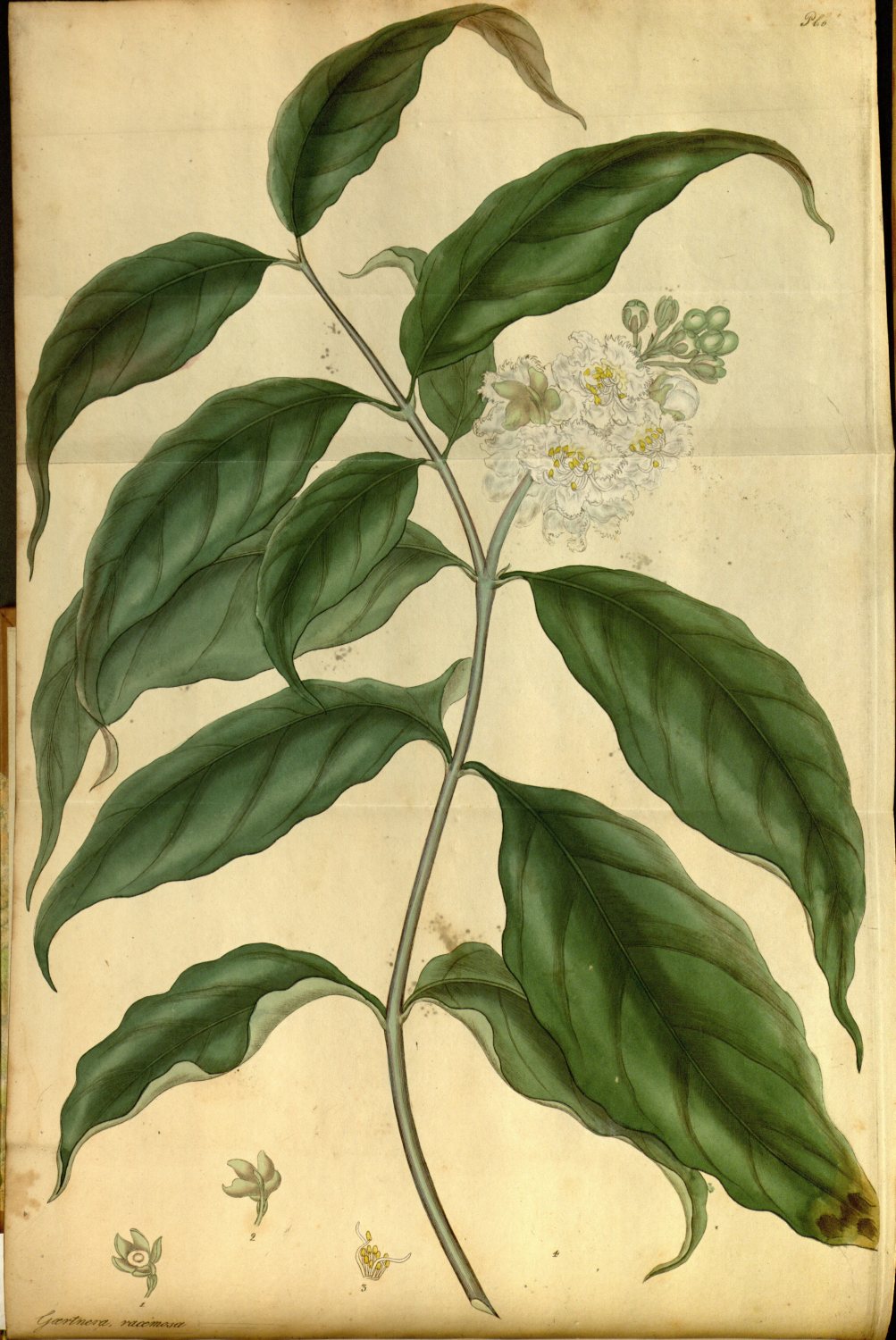
Volume 9 — PLATE DC. GÆRTNERA RACEMOSA. Racemed Gærtnera.
Reading edition
CLASS X. ORDER I.
DECANDRIA MONO-DI-TRIGYNIA. Ten Chives. One to Three Pointals.
GENERIC CHARACTER.
Calyx 5-partitus. Petala 5 lacero-ciliata, inæqualia. Stamina decem, unicum reliquis longius. Stylus incurvus. Stigma simplex. Germen triloculare, 3-spermum. Samara inæqualiter quadrialata, monosperma.
Cup five-parted. Petals five, cut-fringed, unequal. Stamens ten, one longer than the rest. Style incurved. Summit simple. Seed-bud of three cells with three seeds. Fruit with four unequal wings, one-seeded.
REFERENCE TO THE PLATE.
1. The empalement. 2. The same shown from the outer side. 3. The chives and pointals. 4. The seed-bud and pointals. 5. The capsule.
This curious and interesting plant, originally considered as a species of Banisteria by Linnæus, was very properly separated and named in honour of the celebrated Gærtner by Schreber in his Genera Plantarum; and Cavanilles nearly about the same time published it in his Ninth Dissertation, under the name of Molina, in honour of the author of the Natural History of Chili. Gærtnera however has the right of priority, and has been continued by Dr. Roxburgh in his Plants of the Coast of Coromandel, where he has given a figure and description of the plant, (vol. i. p. 19. tab. 18.) and by Willdenow in his edition of the Species Plantarum.
On examining the fructification, we have found the plant more closely allied to Banisteria than has hitherto been suspected, the styles being commonly two with a rudiment of a third, and the germen three-locular with a young seed in each cell; but the inequality of the petals and stamens, the solitary gland on the calyx, and the abortion of the lateral seeds, furnish abundant distinctions.
From the Coromandel plants above quoted we learn that it is a large climbing shrub, growing naturally on the Circar mountains in India, and is commonly cultivated all over that coast on account of the beauty and fragrance of its flowers, which open there during the rainy season. According to Linnæus it is also a native of the Island of Ceylon. No other species of the genus has yet been described. The plant is certainly a great acquisition to our collections, and was introduced from India by the late Lady Amelia Hume about the year 1805. Our specimen was communicated from the collection at Wormley Bury the end of last March.