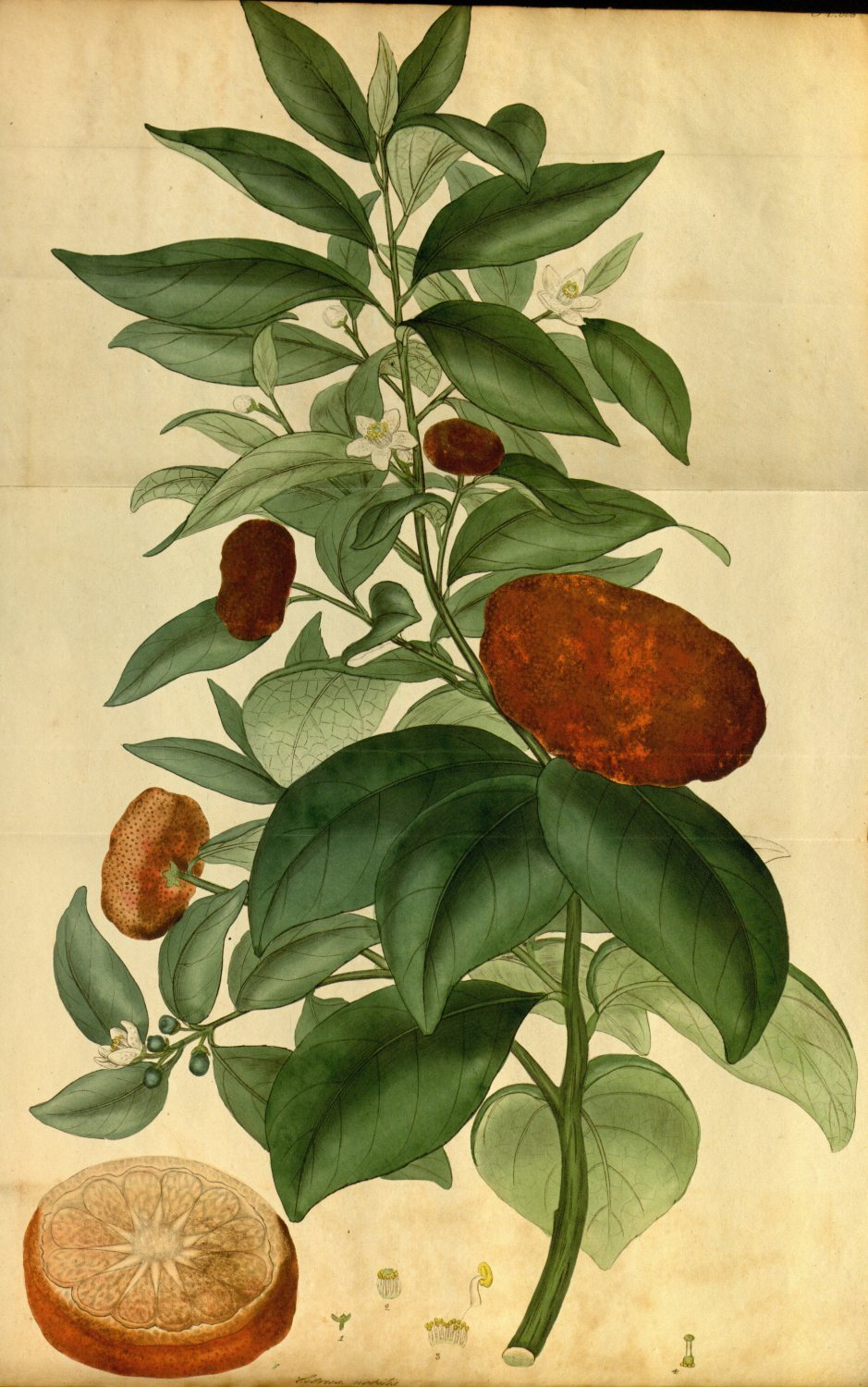
Volume 9 — PLATE DCVIII. CITRUS NOBILIS. Mandarin Orange.
Reading edition
CLASS XVIII. ORDER III.
POLYADELPHIA ICOSANDRIA. Many Sets of Chives. Threads from the Calyx or Receptacle.
GENERIC CHARACTER.
Calyx 5-dendatus. Corolla 5-petala. Stamina 20 in cylindrum passim connata. Stylus 1. Bacca 9-12-locularis, pulpâ vesiculari.
Cup five-toothed. Petals five. Stamens about twenty, generally united at the base. Shaft 1. Fruit 9-to 12-celled, the pulp variously divided.
SPECIFIC CHARACTER.
Citrus petiolis sublinearibus, fructu latescente depresso.
Citrus with nearly linear leafstalks; the fruit broad depressed.
Citrus nobilis, inermis, ramis adscendentibus: petiolis strictis, fructu tuberculoso subcompresso.—Lour. Flor. Cochinchin. 2. p. 569?
REFERENCE TO THE PLATE.
1. The empalement. 2. Chives and pointal. 3. The chives spread open, a tip magnified. 4. Seed-bud and pointal. 5. A horizontal section of the fruit.
The drawing of this remarkable Orange, which has so long been a desideratum in this country, was taken at Wormley-bury in the beginning of last May. The plant is a native of China, and Mr. Barrow informs us, that he found the fruit very common when on his travels in that country, and in much higher estimation than the common Orange by the Chinese, who call it Mandarin Orange (answering nearly to the English epithet of noble) by way of pre-eminence. The same gentleman also informs us, that he found some fine trees of it in the gardens at the Cape of Good Hope; it is therefore the more singular that it has been so long in reaching this country. From Loureiro’s description of his Citrus nobilis, there can be little doubt of its being intended for the Mandarin Orange; which, he informs us, grows to a moderately sized tree, and particularly notices the superior excellence and the depression of the fruit, whose common size is about five inches across. The plant at Sir Abraham Hume’s is as yet only about five feet in height, and was imported from Canton in 1805.
It is easily distinguished from the common Orange, both by its curious form and internal structure, the pulp adhering so loosely to the rind as to be separable from it by the slightest effort, and leaving in many places a considerable opening between them.