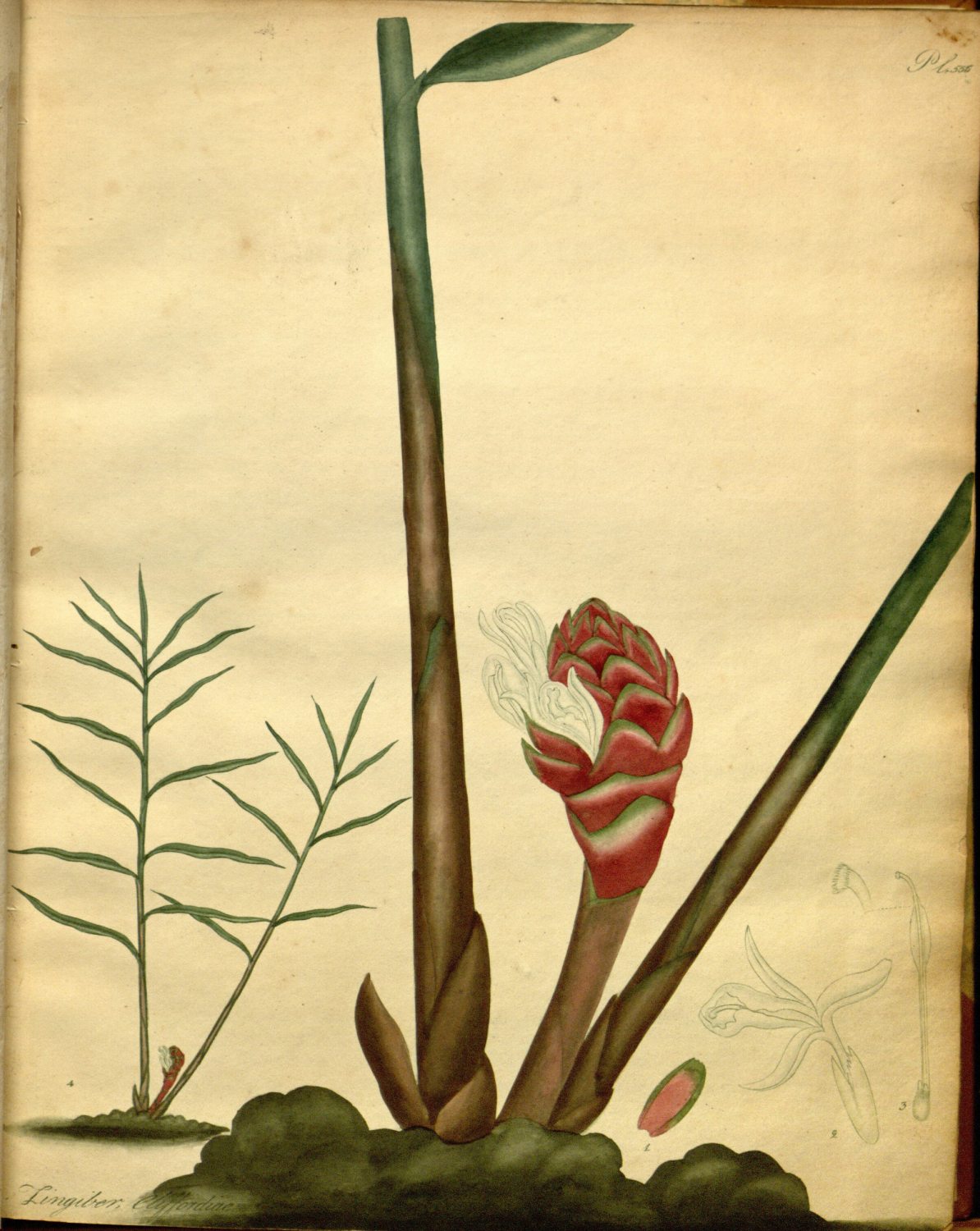
Volume 9 — PLATE DLV. ZINGIBER CLIFFORDIÆ. Cliffordian Zingiber.
Reading edition
CLASS I. ORDER I.
MONANDRIA MONOGYNIA. One Chive. One Pointal.
GENERIC CHARACTER.
Calyx monophyllus. Corolla 4-5-fida. Antheræ 2. Filamentum simplex ultra antheras productum.
Empalement of one leaf. Blossom either 4-or 5-cleft. Anthers two. Filament simple, extended beyond the anthers.
SPECIFIC CHARACTER.
Zingiber scapo simplicissimo, crasso, brevi, capitulo subovato, bracteis inferioribus lato-ovatis obtusis; corollâ 4-fidâ, laciniis tribus exterioribus oblongis marginibus involutis; alteris sub-cordatis duplo majoribus, mox convolutis.
Ginger with an unbranched, thick, short flower-stalk, the lower flower-scales broadly-oval and blunt: the blossom 4-cleft, the three outer divisions oblong with their margins turned inwards, the inner inversely nearly heart-shaped and doubly larger, soon folding together.
REFERENCE TO THE PLATE.
1. Sheath at the base of the calyx. 2. A detached flower. 3. Seed-bud, anthers, and pointal, summit magnified. 4. The plant in miniature.
This fine species of Ginger, we are informed, is a native of Guinea, and in the gardens has long been supposed to be the plant which produced the Grains of Paradise, Amomum Granum Paradisi of Linnæus; but it certainly by no means accords with the character of that plant, either as given in the Hortus Kewensis or by Linnæus himself. From the other species of Zingiber enumerated in the eighth volume of the Linnæan Society’s Transactions it is easily distinguished. Having as yet only blossomed in England in the collection of Lady de Clifford at Paddington, in honour of that patroness and lover of botany we have given its specific designation. The culture is the same as for other plants of the family. Our drawing was taken in 1804.