Volume 8 — PLATE DXXXVIII.
Reading edition
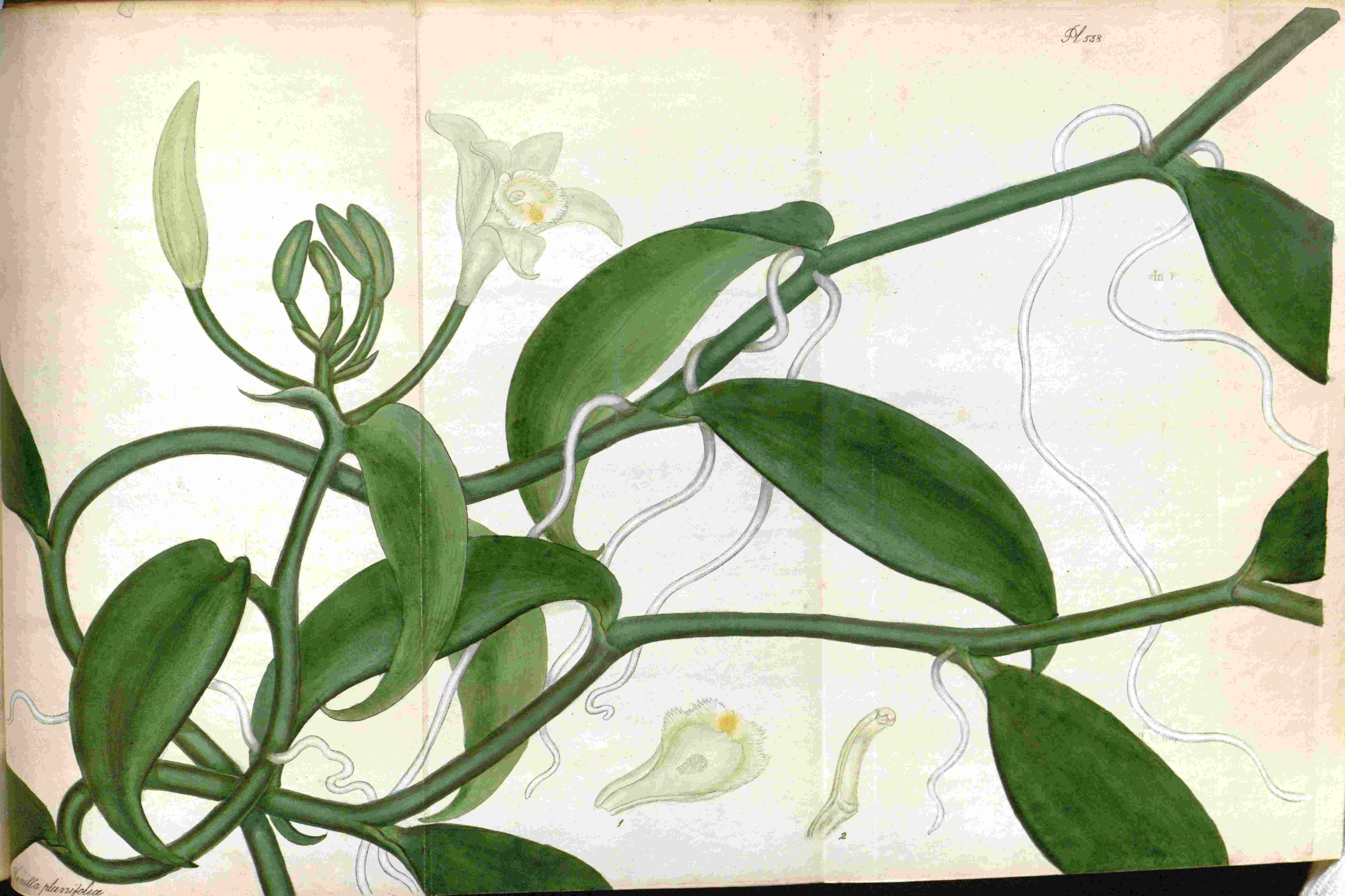
VANILLA PLANIFOLIA.
Flat-leaved Vanilla.
CLASS XX. ORDER I.
GYNANDRIA DIANDRIA. Chives on the Pointals. Two Chives.
GENERIC CHARACTER.
Corolla pentapetala. Labellum basi sub-cucullatum, ecalcaratum. Anthera opercularis, decidua. Capsula siliquæformis, carnosa.
Blossom of five petals. Lip of the nectary nearly cowl-shaped, and without any spur. Anthers covered, at last falling off. Fruit a long fleshy pod.
SPECIFIC CHARACTER.
Vanilla foliis ovato-lanceolatis acuminatis obliquis, obsolete striatis, nitidis: petalis sublanceolatis, incurvis, obtusis.
Vanilla with oval-lanced, oblique pointed leaves, which are faintly streaked, and shining; and the petals of the blossom somewhat lance-shaped, blunt, and curved inwards.
REFERENCE TO THE PLATE.
1. The nectarium spread open. 2. The chives and pointal.
Vanilla flore albo, fructu breviori corallino, of Plumier’s unpublished drawings. The botanical history of this plant is curious. It was published by Plumier in the year 1703, as a third species of Vanilla, as we have ascertained by a copy of his original drawing in the collection of A. B. Lambert, esq. but unnoticed by Linnæus or any of his editors. In the Paradisus Londinensis it has been mistaken for Plumier’s first species, the Epidendrum Vanilla of Linnæus, (Vanilla aromatica of Swartz and Willdenow,) of which we have three original figures: Catesby’s, in his History of Carolina, vol. iii. tab. 7.; Madam Merian’s, and Plumier’s own drawing published by Burman; all of them totally unlike it. No two plants can be more specifically distinct, and we have seldom seen two species of one genus so different in the blossoms.
Vanilla planifolia is an exceedingly ornamental and as yet a scarce species, and runs to many feet in length, throwing out simple tendrils from the axils of the leaves. The finest specimen in England, and the only one that has blossomed, is in the choice collection of the Right Hon. Charles Greville, at Paddington, from which our drawing was taken. We are informed that it is a native of the West Indies, and was introduced to this country by the Marquis of Blandford.