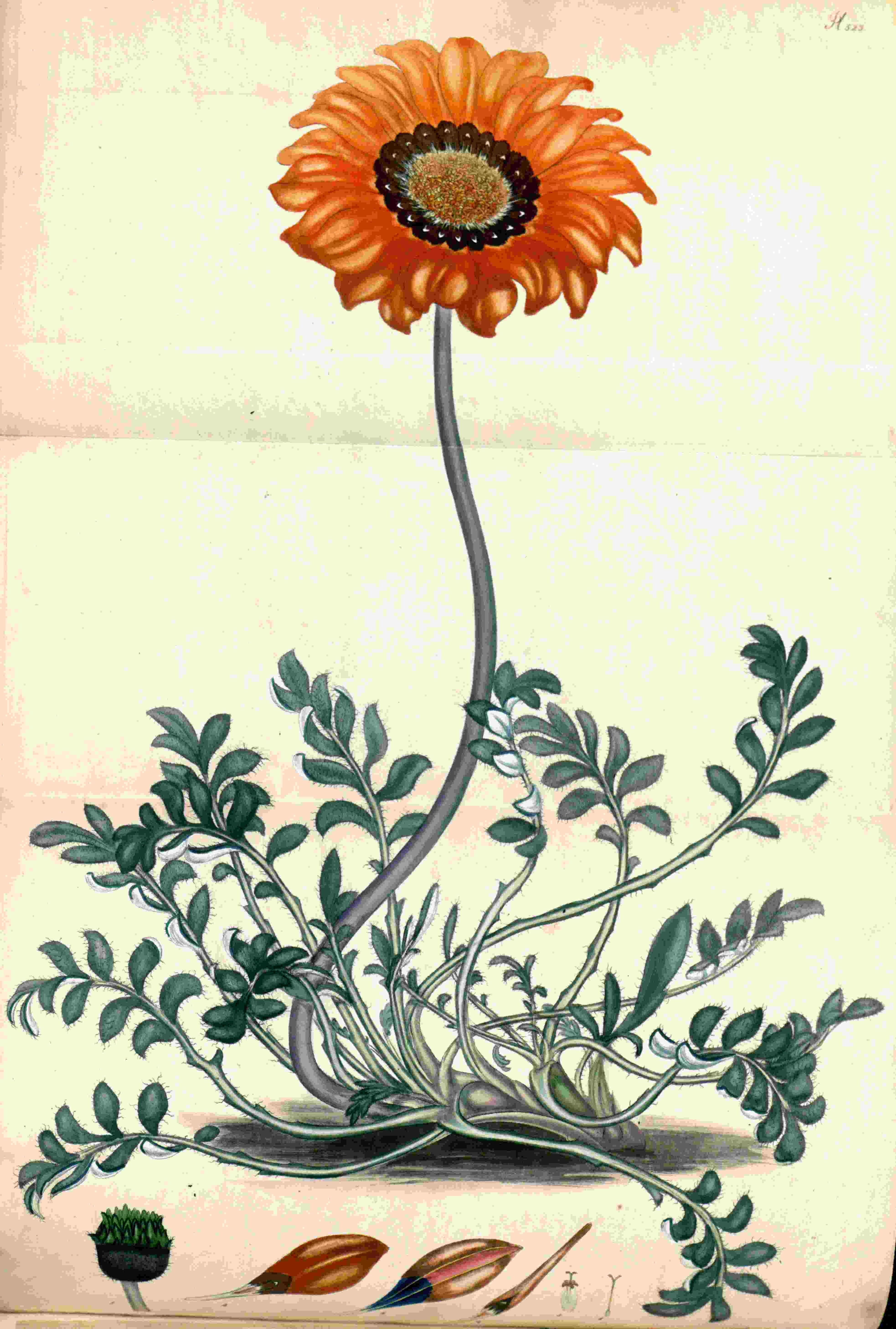
Volume 8 — PLATE DXXIII.
Reading edition
GORTERIA PAVONIA.
Peacock Gorteria.
CLASS XIX. ORDER IV.
SYNGENESIA POLYGAMIA NECESSARIA. Tips united. Necessary Pointals.
ESSENTIAL GENERIC CHARACTER.
Receptaculum nudum. Pappus lanatus. Corolla radiata, lingulata. Calyx monophyllus, squamis imbricatis tectus.
Receptacle naked. Down woolly. Blossom rayed, tongue-shaped. Empalement one-leafed, covered with imbricated scales.
SPECIFIC CHARACTER.
Gorteria foliis pinnatis: foliolis æqualibus, ovatis, marginibus revolutis, pilosis, subtus albis: petalis radii magnis, aurantiis, ad basin eleganter notatis. Caulis herbaceus.
Gorteria with winged leaves. The leaflets are equal, ovate, rolled back at the edges, hairy, and white beneath: petals of the ray large, of a gold-colour, and elegantly marked at the base. Stem herbaceous.
REFERENCE TO THE PLATE.
1. The empalement. 2. One of the radiating petals. 3. The same shown from the under side. 4. A petal as it appears when rolled up. 5. A floret of the disk. 6. The seed-bud and pointal.
This new species of Gorteria stands foremost in the ranks of beauty whilst expanded by the solar ray, whose absence is soon visible in the plant by the rolling up of the petals; but on the following morn, when the sun’s beams begin to warm the vegetable world, they again unfold themselves with undiminished lustre, and so continue successively for near a fortnight.
Our drawing was made from a fine plant in the nursery of Mr. Harrison at Brompton. We also observed it in bloom at Messrs. Colville’s; from whom, to complete the dissections, we received a flower, which, although it had been a week in bloom, continued to perform its diurnal evolutions (in a glass of water) of rolling up and expanding for nearly a week longer—but only from eleven till one in the day:—a shorter time, most probably owing to its being kept in a room whose northern aspect prevented the exhilarating rays of Phœbus from approaching. It was introduced from the Cape of Good Hope by G. Hibbert, esq. about the year 1804, and considered as biennial.