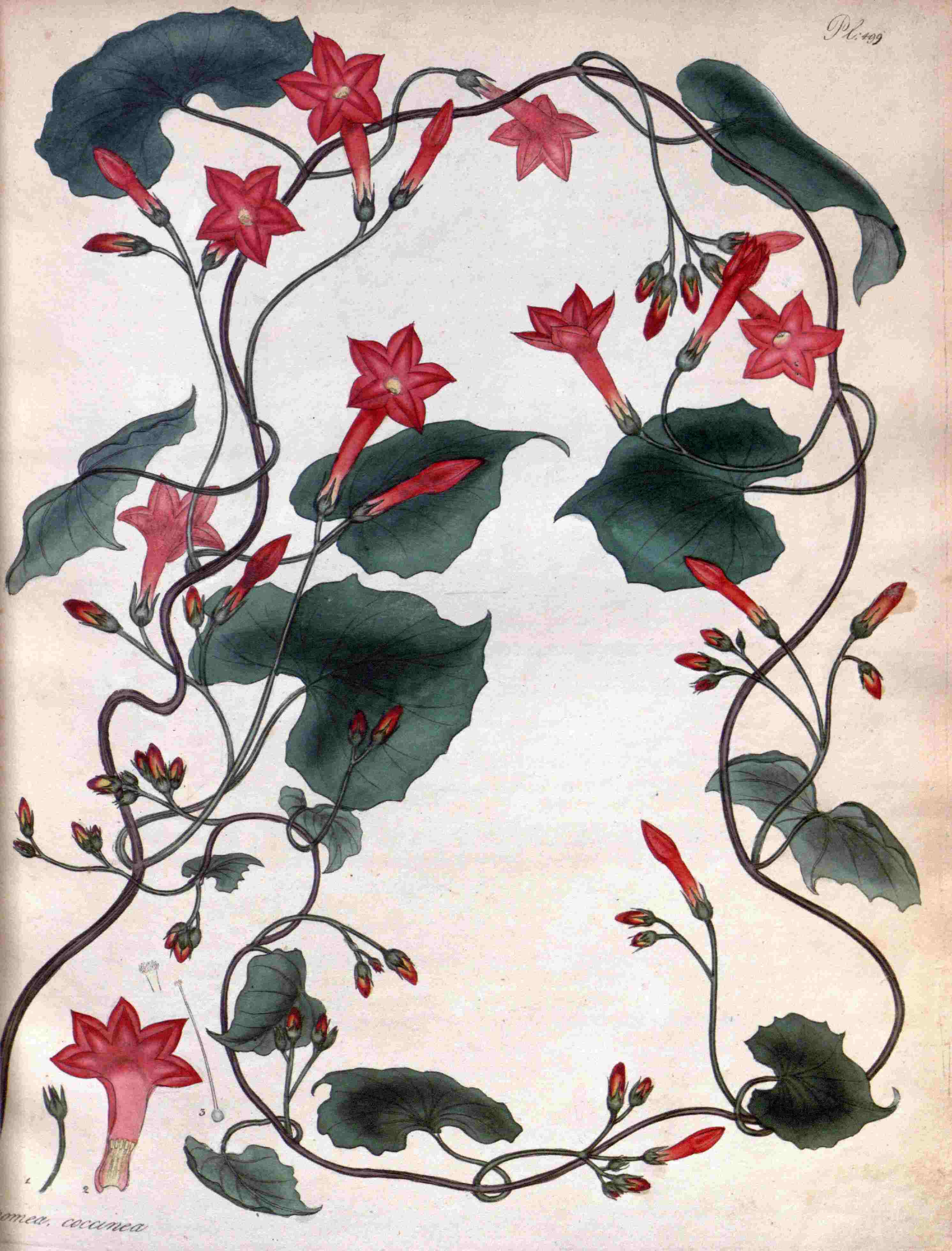
Volume 8 — PLATE CCCCXCIX.
Reading edition
IPOMÆA COCCINEA.
Scarlet Ipomæa.
CLASS V. ORDER I.
PENTANDRIA MONOGYNIA. Five Chives. One Pointal.
ESSENTIAL GENERIC CHARACTER.
Corolla infundibuliformis. Stigma capitato-globosum. Capsula 3-locularis.
Blossom funnel-shaped. Summit headed, of a globular form. Capsule of 3 loculaments.
SPECIFIC CHARACTER.
Ipomæa foliis hederinis: pedunculis multifloris: corollis saturate coccineis: caule purpureo, torto et involuto.
Ipomæa with ivy-shaped leaves: footstalks with many flowers: blossoms of a deep scarlet: stem purple, twisted, and twining.
REFERENCE TO THE PLATE.
1. The empalement. 2. A blossom spread open. 3. Seed-bud and pointal, summit magnified.
Of this species of Ipomæa there are two good uncoloured figures: one in Commelin’s Rariorum, tab. 21, under the title of Quamoclit Americana; the other in the Americana of Plumier, 89, tab. 103, under the appellation of Convolvulus coccineus; but not to be confounded with the Ipomæa coccinea (erroneously so called) of the Botanical Magazine, which is the I. luteola of Jacquin’s Icones, and a very different plant: although Willdenow in his Species Plantarum has made a mere variety of it; observing that it differs in no other particular except in colour. But comparison, either with the living plants or the figures above alluded to, will prove them to be distinct in their foliage as well as the colour of their flowers. Neither of them is well discriminated by its specific title; as the I. luteola is more of a scarlet than of a yellow colour, and the coccinea is of too deep a red to be with accuracy denominated scarlet. But references to colour are mostly too equivocal to be very characteristic.
From Mr. J. Milne, botanic gardener at Fonthill, we received this specimen, whose luxuriant growth in the hot-stove may probably have occasioned the abbreviation in the filaments, which are generally extended a little beyond the mouth of the flower, instead of being confined to the base of the tube, as our figure represents; but in which we follow nature: and although it is not an unprecedented circumstance to find the threads shortened or lengthened by culture, yet when that difference is so very powerful as in the present instance, it is well deserving notice.