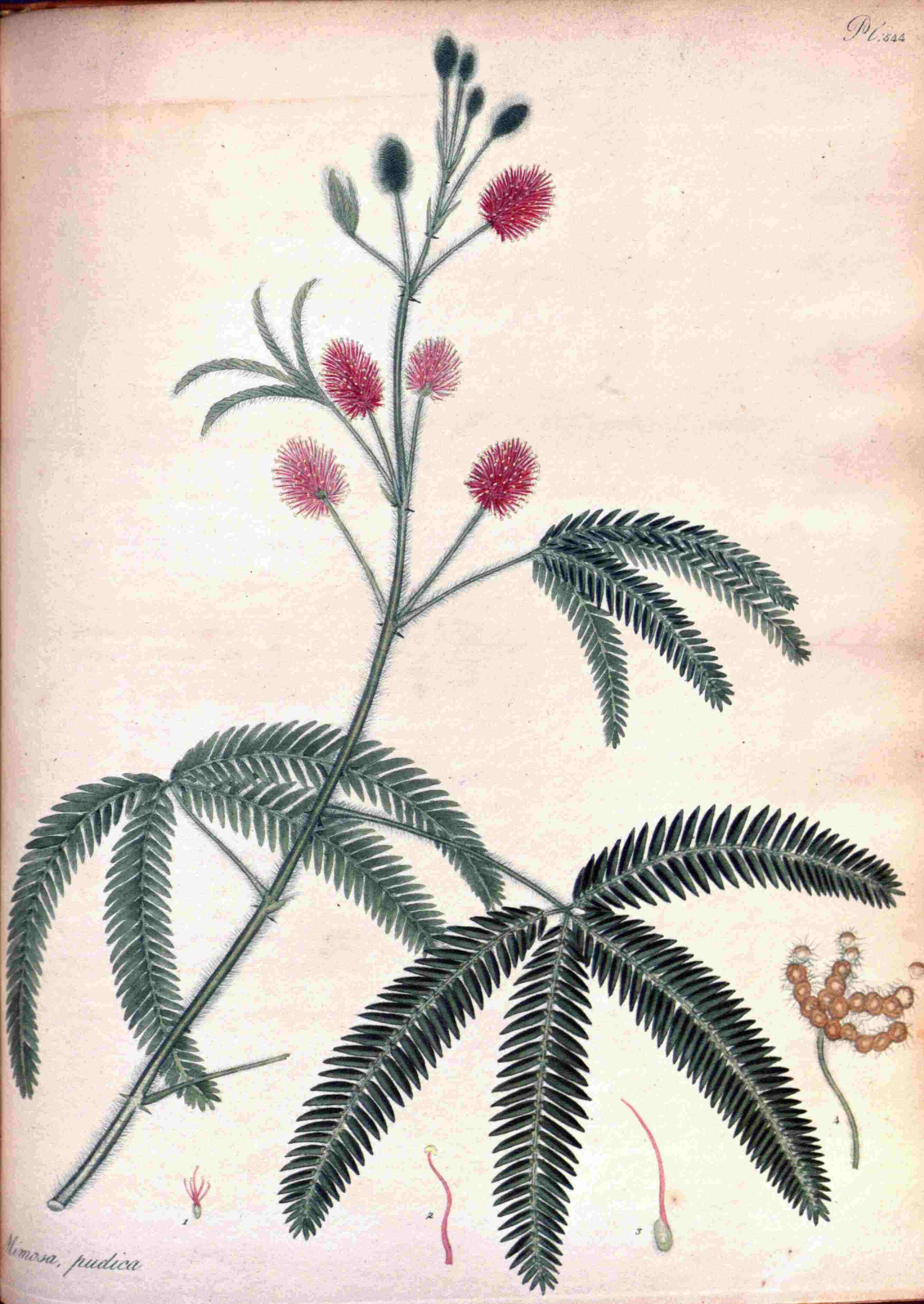
Volume 8 — PLATE DXLIV.
Reading edition
MIMOSA PUDICA.
Bashful Mimosa.
CLASS XXIII. ORDER I.
POLYGAMIA MONŒCIA. Various Dispositions upon one Plant.
ESSENTIAL GENERIC CHARACTER.
Hermaph. Calyx 5-dentatus. Corolla 5-fida. Stamina 5, sive plura. Pistillum 1. Legumen.
Mascul. Calyx 5-dentatus. Corolla 5-fida. Stamina 4, 5, 10, sive plura.
Hermaph. Empalement 5-toothed. Blossom five-cleft. Chives 5, or more. Pointal 1. A pod.
Male. Empalement 5-toothed. Blossom 5-cleft. Chives 4, 5, 10, or more.
SPECIFIC CHARACTER.
Mimosa foliis sensitivis palmato-pinnatis, pinnulis, multijugis. Caulis pilosus, aculeis paucis instructus. Petioli et pedunculi pilosi. Fructus echinatus.
Habitat in Brasiliâ.
Mimosa with sensitive leaves palmately winged, the pinnulæ many-paired. Stem hairy, and furnished with a few prickles. Petioles and peduncles hairy. Fruit prickly.
Native of the Brazils.
REFERENCE TO THE PLATE.
1. A flower. 2. A chive magnified. 3. Seed-bud and pointal magnified. 4. The ripe capsule, with a seed detached.
Five distinct genera were once included under the generic title of Mimosa, but separated by Willdenow into 102 Acacias, 58 Ingas, 9 Desmanthuses, 3 Shrankias, and 32 Mimosas. This susceptible species of Mimosa is an old inhabitant of the stove, and well known to cultivators by the appellation of the Sensitive Plant (but not to be confounded with the M. sensitiva, a very different species). Although this Mimosa is neither new nor rare, it is nevertheless very interesting, and has not hitherto made its appearance in any modern publication; nor is there any coloured figure of it extant. Our representation of it, therefore, is in part a novelty, however old and familiar the plant itself may be. According to the observations of Linnæus, it opens or expands its foliage at three in the morning, and closes it about six in the evening. Its singular quality of shrinking from the touch is supposed to be owing to its being strongly saturated with oxygen gas, which it disengages upon the slightest provocation, and its place for a short time is supplied by the atmospheric air; which retiring, the leaves again resume their former appearance, and so remain expanded till the evening, unless disturbed by design or accident; for the rude approach of the common air disorganises its foliage.
The leaf is mostly composed of four divisions, but sometimes five and six may be found in plants of a luxuriant growth. Each division is supplied with numerous little leaflets, in pairs of an oblong form, with a small yellow gland at their base, which when carefully touched will close up separately, and leave the surrounding leaflets undisturbed. It may be considered either as an annual or a biennial, dying after ripening its seeds. Our drawing was made from fine plants in the collection of J. Vere, esq.