Volume 8 — PLATE DXXI.
Reading edition
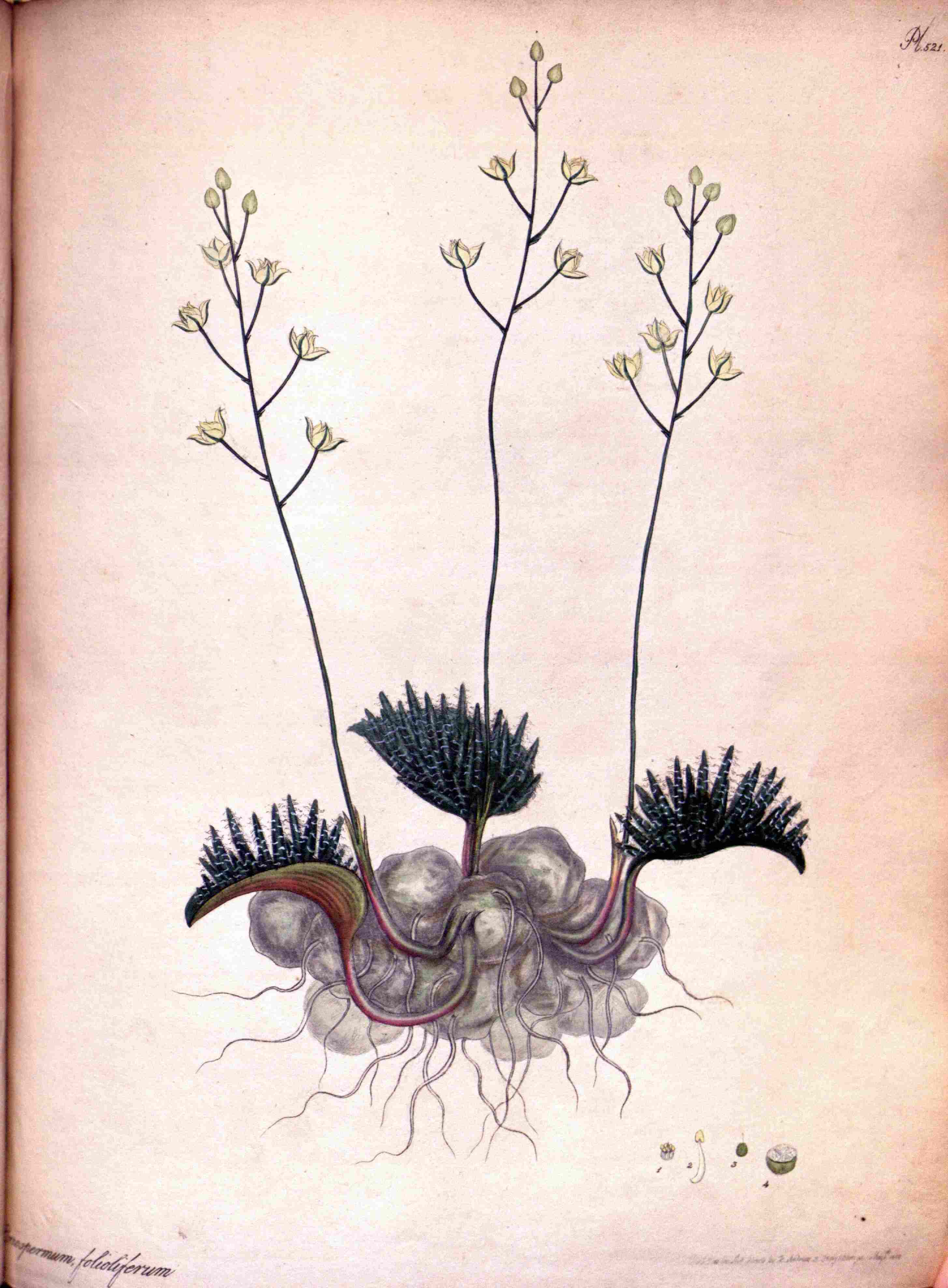
ERIOSPERMUM FOLIOLIFERUM.
Leaflet-bearing Eriospermum.
CLASS VI. ORDER I.
HEXANDRIA MONOGYNIA. Six Chives. One Pointal.
GENERIC CHARACTER.
Calyx nullus.
Corolla. Petala sex basi connata, subtus lanceolata, acuta: tria exteriora patula: tria interiora erecta, cum limbo acuto patulo connivente. Omnia post impregnationem erecta, in modum coni.
Stamina. Filamenta sex, late lanceolata, acuta, plana, apicibus introrsum volutis. Antheræ oblongæ, incumbentes.
Pistillum. Germen superum, subrotundum, trisulcatum. Stylus filiformis, erectus. Stigma obtusum.
Pericarpium. Capsula triloba, trilocularis, trivalvis.
Semina pauca, lanceolata, acuta, pilis tomentosis obsessa.
Empalement none.
Blossom. Six petals approaching together at the base, beneath lance-shaped and pointed, the three outer ones spreading: the three inner ones upright, with a pointed wide approaching border. All after impregnation stand upright, like a cone.
Chives. Six threads broadly lance-shaped, pointed, and flat, with the points turned inward. Tips oblong, and lying on them.
Pointal. Seed-bud above, nearly round, three-furrowed. Shaft thread-shaped, upright. Summit blunt.
Seed-vessel. Capsule 3-lobed, 3-locular, 3-valved.
Seeds few, lance-shaped, pointed, and covered with downy hairs.
SPECIFIC CHARACTER.
Eriospermum foliis sub-cordatis, superne folia parva erecta linguæformia, filamentis albis parvis obsessa, ferentibus. Flores spicati, laxi. Corolla lutea, viride striata.
Habitat in Caput Bonæ Spei.
Eriospermum with nearly heart-shaped leaves, bearing on their upper surface little upright tongue-shaped leaflets beset with small white threads. Flowers grow in a loose spike. Blossom yellow, striped with green.
Native of the Cape of Good Hope.
REFERENCE TO THE PLATE.
1. Chives and pointal. 2. A chive magnified. 3. Seed-bud and pointal. 4. Seed-bud cut transversely, magnified.
This curious Cape plant is not at present, we believe, in any other collection in this kingdom than that of G. Hibbert, esq. where we first observed it in the autumn of 1806. It was not then in bloom, but flowered the following summer. It is by no means specious in its flowers, but very interesting in the singularity of its foliage, whose uncommon structure is very distinct from any plant we have ever seen. Mr. Knight, the botanic gardener, informs me that it increases from the root, but not abundantly, and, like most Cape bulbs, is in a dormant state during the latter part of autumn, at which time it should be watered very sparingly. It appears rather impatient of having its roots often disturbed: once in two or three years is necessary, not only to renew the earth, but to take off any small bulbs it may have produced. It delights to grow in a light loamy or peaty soil, and should stand in an elevated part of the green-house, to enjoy a full circulation of air.