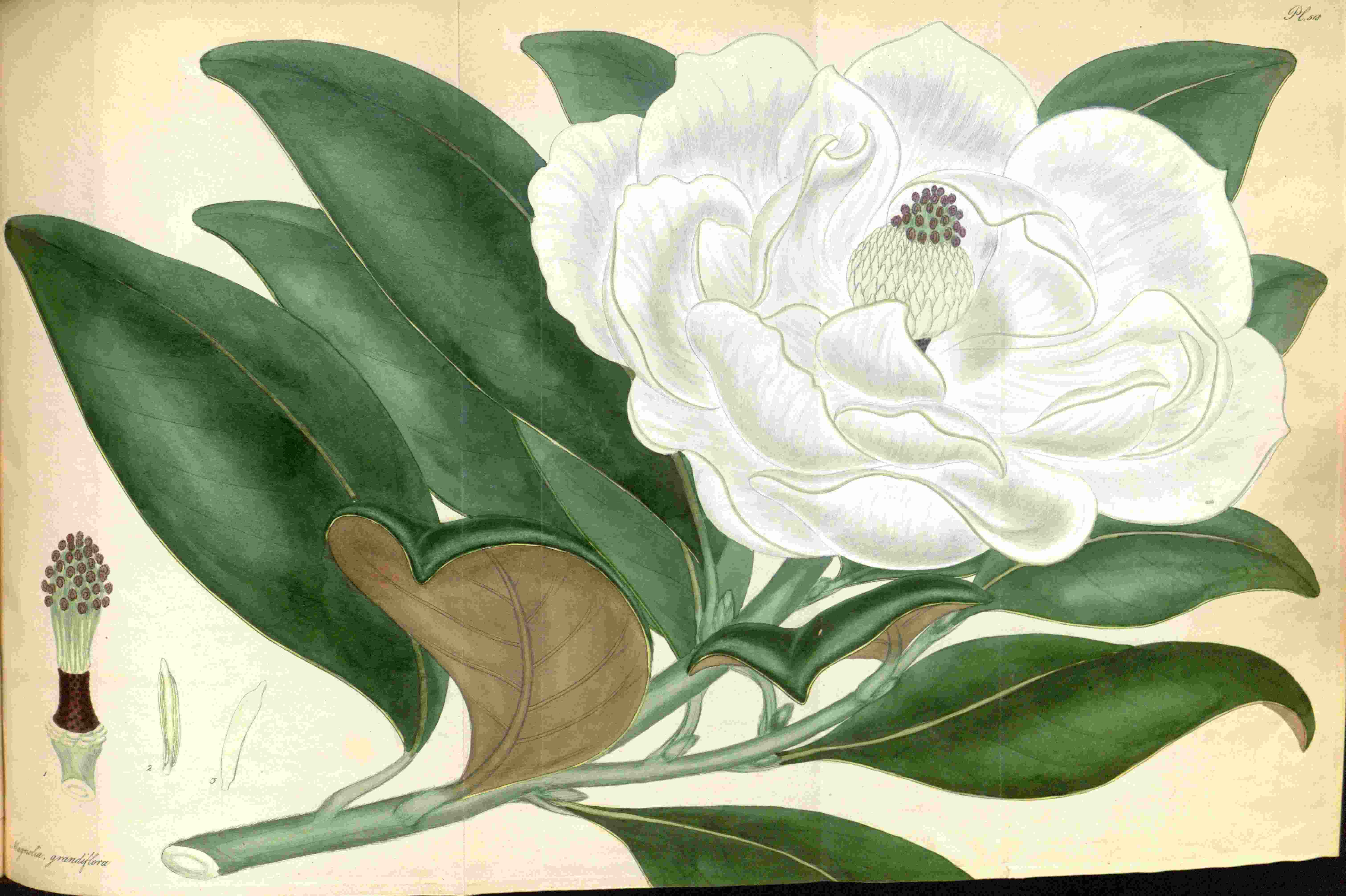
Volume 8 — PLATE DXVIII.
Reading edition
MAGNOLIA GRANDIFLORA.
Larger-flowered Magnolia.
CLASS XIII. ORDER VII.
POLYANDRIA POLYGYNIA. Many Chives. Many Pointals.
ESSENTIAL GENERIC CHARACTER.
Calyx 3-phyllus. Petala 6-12. Capsulæ 2-valves, imbricatæ. Semina baccata, pendula.
Cup 3-leaved. Petals 6-12. Capsules 2-valved, tiled. Seeds berried, pendulous.
SPECIFIC CHARACTER.
Magnolia foliis persistentibus, lanceolatis, obtusis, marginibus cartilagineis, supra viridi-lucidis, subtus ferrugineis: corollis magnis, crassis, albis, odoratissimis.
Habitat in Florida et Carolina meridionali.
Magnolia with leaves persistent, lance-shaped, and blunt, with cartilaginous margins of a shining green on the upper surface, and rusty-coloured beneath. Blossoms large, thick, white, and very sweet-scented.
Native of Florida and South Carolina.
REFERENCE TO THE PLATE.
1. The chives and pointals. 2. A chive. 3. The same shown from the outer side.
This odoriferous plant is figured by Catesby in his Caroliniensis, who describes it as a stately tree eighty feet high; that it perfumes the woods with its fragrance; that its fruit is of a glittering red, not falling immediately to the ground, but hanging pendulous by small white threads about two inches long, in which state it must still be a beautiful object. It very rarely, if ever, perfects its seed in this country. Independent of its fine large sweet-scented flowers, it is a handsome evergreen. There are several variations of it in foliage. It succeeds well, trained up against a south wall. From a plant so situated, on the premises of Messrs. Whitley and Brames, our figure was delineated.