Volume 8 — PLATE DXLIX.
Reading edition
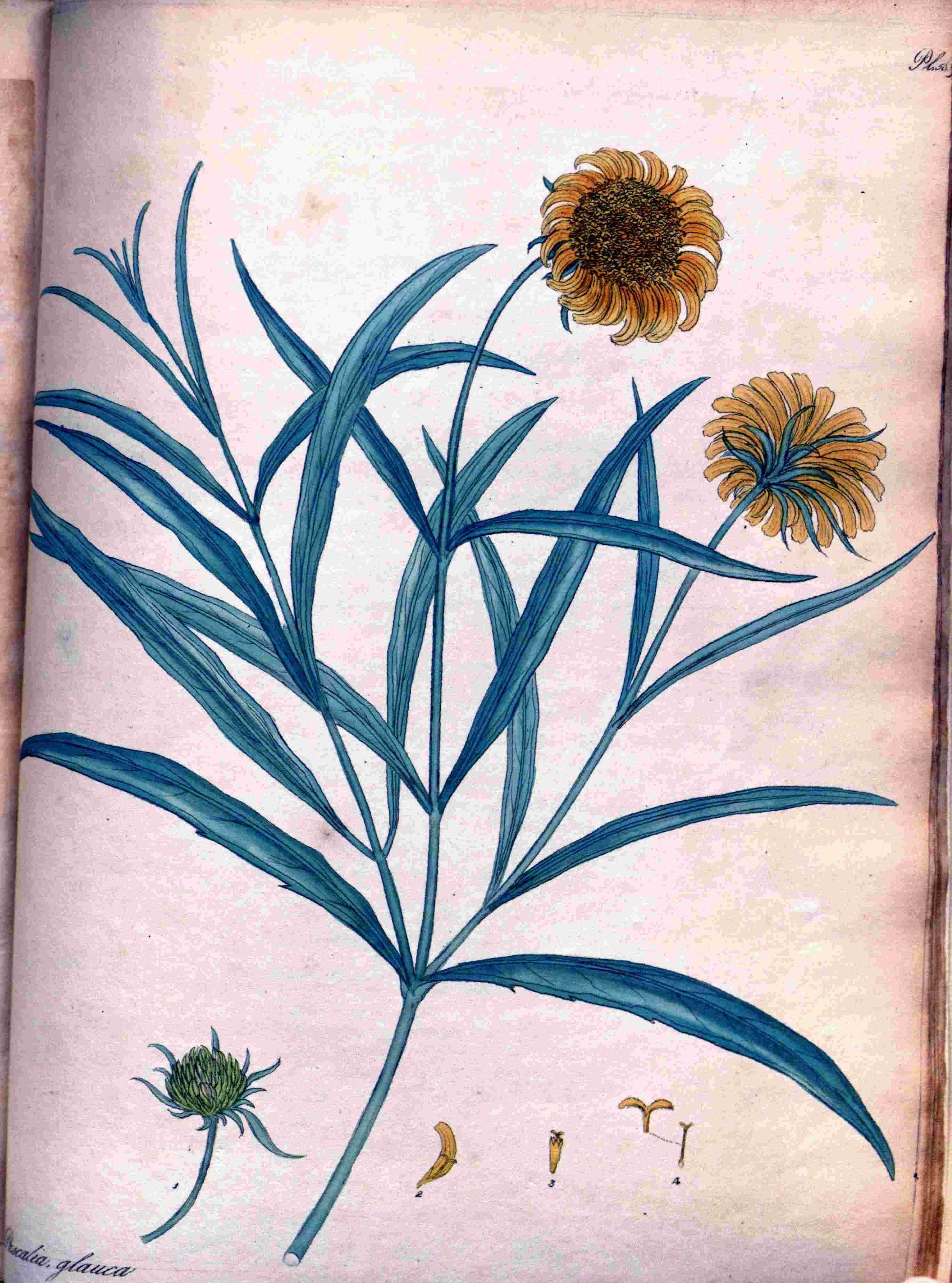
PASCALIA GLAUCA.
Glaucous-leaved Pascalia.
CLASS XIX. ORDER II.
SYNGENESIA POLYGAMIA SUPERFLUA. Tips united. Superfluous Pointals.
ESSENTIAL GENERIC CHARACTER.
Receptaculum paleaceum.
Semina drupacea. Pappus margine dentatus. Calyx imbricatus.
Receptacle chaffy.
Seeds a ripe berry. Down toothed at the edge. Empalement tiled.
SPECIFIC CHARACTER.
Pascalia foliis oppositis, tri-nervibus, glaucis patentibusque; inferiora lato-lanceolatis, denticulatis, acutis, sæpius integerrimis: floribus terminalibus, solitariis: corolla flava.
Habitat in regno Chilensi.
Pascalia glauca Ortegæ Nov. rar. plant, tab. 4.
Pascalia with opposite leaves, three-nerved, glaucous and spreading; the lower ones are broadly lance-shaped, toothed, and pointed, but often entire: flowers terminal and solitary: blossom yellow.
Native of the Kingdom of Chili.
REFERENCE TO THE PLATE.
1. The empalement and receptacle. 2. A floret of the ray. 3. A floret of the disk, summit magnified. 4. Seed-bud and pointal.
The only figure of this syngenesious plant is in the new and rare plants of Ortega, who named it after D. Didaco Pascal, a Spanish physician. It is the only species of the genus yet known, and a fine living specimen of it was communicated to us by Mr. Lambert, who raised it from seed sent to him from Madrid by the late Cavanilles. It is perfectly hardy, and the roots so durable and spreading that they are not easily eradicated. It does not however bloom with equal facility, but seems to want a warmer sun to aid its flowers in their expansion.